National Conference Workshops Series
- Public-Private Partnerships in the School System
By Tengku Azian Shahriman
Director, NKEA Education of PEMANDU
(30 May 2011)
�
1
�
Under NKRA/NKEA the Government has partnered the Private Sector
in several Initiatives
Launching Grant of RM10,000 for private pre-school operators
Fee Assistance to pre-school children from low income families,
enrolling in pre-schools with fees/month of RM150 and below.
24,179 children benefited from fee assistance in 2010
Training of up to 21,000 private pre-school teachers from 20102011, to ensure quality pre-school teachers
6,500 private pre-school teachers were trained by 11 IPTS,
which were selected through a competitive e-bidding process.
Similar off take arrangement will be entered with IPTS in 2011
and 2012
2
�
Other initiative Involving the Private Sector in 2010
In 2010, MoE together with Yayasan Amir launched
10 Trust Schools, 5 each in Johor and Sarawak
The Teach for Malaysia Initiative was also kick start
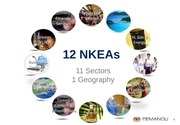
In Oct 2011, the
with 12 NKEAs identified.
was launched
3
�
Wholesale
& Retail
Financial
Services
Tourism
Oil, Gas &
Energy
Greater
KL/KV
12 NKEAs
Business
Services
Education
11 Sectors
1 Geography
Agriculture
Comms
Content &
Infrastructure
Electrical
& Electronics
Healthcare
Palm Oil
4
�
5
�
6
�
7
�
WHY EDUCATION AS A NKEA
Education is one of 12 National Key Economic Areas (NKEAs) and is a critical
driver of Malaysia’s transformation into a high-income nation
Why education?
High Economic Impact
▪ Education is a key enabler for all other NKEAs, which will collectively
generate 3.2 million jobs over the next ten years leading up to 2020
▪ It will drive the shift in our human capital towards a high income nation
and a first-world talent base
Strong Direct Engine of Growth
▪ Education as an economic sector boasts one of the fastest growth rates
over the past decade (6.8%)
▪ It also has one of the highest output multipliers in the country (2.19x) –
even higher than sectors that have benefited from stimulus packages
Higher Lifetime Earnings for the Rakyat
▪ For individuals, higher educational achievement is correlated with higher
lifetime earnings. Education as an economic sector has tremendous
scale and scope for direct touch-points with the rakyat
8
�
Entry Point Projects will expand education touchpoints by 2020
Education NKEA Entry Point Projects
Education Touchpoints (Thousands)
Demand
Generation
Concentration
Rapid Scale-Up
2010
Target 2015
Target 2020
1.
Scaling up early child care and education centres
321
553
857
2.
Improving early child care and education training
1
13
25
3.
Scaling up international schools
19
37
75
4.
Expanding private teacher training
0
3
10
5.
Scaling up private skills training provision
55
96
110
6.
Expanding international distance learning
7
46
161
7.
Building a Islamic finance and business education DC
2
12
54
8.
Building a health services discipline cluster
55
90
150
9.
Building a advanced engineering discipline cluster
0
12
34
10.
Building a hospitality and tourism discipline cluster
17
35
43
11.
Launching EduCity @ Iskandar
3
16
16
12.
Championing Malaysia’s international education brand
77
124
200
13.
Introducing public private partnerships in basic education
0
8
13
9
�
NEW BUILD PPP
EPP 13: Public-private partnerships (PPP) in the School System
Concept overview
# of students
System
Requirements
Concept
Introducing PPP model in
basic education sector
– Selected primary and
secondary schools to be
built by public sector, and
operated by private sector
or
– Under enrolled schools can
be leased to private sector
– A certain proportion of seats
will be secured by the
government to offer free/
low cost universal
education for lower
income families, either as
off-take arrangement or
vouchers, while fees will
be charged for the rest of
the seats
Private Sector Delivery
▪ Quality teaching
▪ Teachers
▪ Opex
SOURCE: NKRA Teacher Quality Lab Report
2009
0
2020
13,000
1
MoE
3
2
Private
school
operators
5
Parents/
Children
# of schools
4
1 Capex saving
4 Voucher
2 Opex saving
5 Tuition fee
3 Off-take
1
2
2009
0
2020
26
Could be started immediately if government schools in pipeline are switched to
PPP (70 schools in pipeline for 2011)
Use under enrolled schools
GNI (USD)
2009
0
2020
0.1 bn
Public Sector Delivery
▪ Curriculum
▪ Capex (land and building, setup and
▪
maintenance)
Off-take seats/ voucher scheme
| 10
�
NEW BUILD PPP
New build PPP should provide greater choice to parents, leverage
and unleash private sector
Guiding principles
1 Provide greater
choice to parents,
and enhance equitable
access to high quality
schools across
Malaysia
2 Leverage and
unleash private
sector potential to
support government
in raising standards
and closing
achievement gap
3 Make entry barrier
lower for private
operators and lower
entry fees for high
quality private school
education
Why is it necessary?
How PPP should support
▪ Fee gap in public (free of charge)
▪ PPP schools will reserve certain
and private (~RM10,000) schools
are high; private education is not an
option for lower income families
today, though it provides wider
variety of education
▪ Public schools cannot cover the
niche demand, as classes offered
is standardized
▪ New government schools will be
built as proposed in 10th Malaysia
Plan (70 planned in 2011), which
would increase management
burden for MoE
▪ Private education offering for
primary and secondary in Malaysia
is one of the lowest in the world at
~2%, which is partially due to high
land and building acquisition cost
proportion of seats (up to ~50%)
for low income families, where
quality education is offered either
free of charge or at very low fee
▪ Private schools can potentially
cover niche segment, while
following the national curriculum
▪ At PPP schools, private
operators manage entire school
operation including hiring and
training of teachers, and
controlling P&L
▪ As government covers upfront
capex, private operators can
start its operation with lower risk,
without having invested to land
and building acquisition cost
| 11
�
NEW BUILD PPP
In comparison to other countries, private schooling enrolment in Malaysia
remains low
2006-08, Percent
Private schooling enrolment in primary & secondary is low
And government spending on education
is currently relatively high
Primary
Spend on education as percentage of
GDP
Secondary
Argentina
22
Australia
29
13
4.6
13
N/A
16
1
43
3.5
3
4.6
18
24
8
Philippines
20
N/A
2.5
N/A
2.9
N/A
7
11
17
Thailand
United States
3.4
7
Peru
United Kingdom
54
1
Indonesia
Sweden
5.1
53
Hong Kong
Singapore
5.2
13
Chile
Malaysia
4.5
27
10
Brazil
Czech Republic
28
7.0
18
5
3.9
25
10
N/A
8
5.7
1 Defined as ratio of the income or expenditure share of the 10% richest group to that of the poorest 10% within the country
SOURCE: UNDP Human Development Report 2009; UNESCO UIS statistics
| 12
�
NEW BUILD PPP
Options for PPP model for new build government schools in Malaysia
Focus of discussion
Starting point
School type
Operating model
A
Existing public
school
Private operator
takes over (the
management of)
existing
public school
Trust School
framework
Implications
▪
School remains as public school but with
significantly enhanced autonomies
▪
Teachers remain civil servants – subject to
performance management (can redeploy but
no firing)
▪
School becomes a PPP school, where
Government owns land and school
buildings, but private operator manages and
operates the school under private school
license and enjoys full private school
autonomies and freedoms
▪
School employs private teachers – can hire or
fire based on performance
▪
School charge lower fees compared to other
private schools due to upfront capex spending
by government
▪
Government puts a capping on tuition fees for
PPP schools
B
Off-take
arrangement
(Government buy
seats from operator)
C
New school
built by
Government
Private operator
manages new
public school
under private
school license
Voucher system
(Government provides
voucher to parents for
choosing PPP school)
D
Hybrid
(Government buy
seats from operator +
provides voucher to
parents)
| 13
�
NEW BUILD PPP
New build PPP – Benefits to stakeholders
Stakeholders
Benefits
▪ Increased access to quality education for all – improve equity for children
Parents
MoE
▪
in all areas of Malaysia
More choices for education – public schools, private schools, PPP schools,
etc.
▪ Reducing the operational burden
– expense of administrating and managing schools
– expense of supplying teachers to the schools which includes training
the teachers, salary, professional development programs, etc.
Providing more choices for education
Increases collaboration between the public & private sector
EPU
▪
▪
▪ Maintains or decreases the current spending on education per student
capita
▪ Able to leverage on private sector to improve overall quality of education
Operator
▪ Spared the upfront (and maintenance) capex cost for school construction
▪ Able to tap latent demand and expand into semi-urban areas (i.e. improve
economic feasibility)
| 14
�
NEW BUILD PPP
New build PPP – Key requirements to deliver this new PPP concept
for new private schools
Requirement
1
PPP
framework
Description
▪ Create an open framework to enable government to
– ‘Purchase’ seats from PPP operators (off-take arrangement)
– Issue vouchers based on a sliding scale (voucher scheme), which they
can develop appropriate pricing mechanism based on actual
household income
– Develop process to allow selected private operators to co-design and
provide input during school construction phase
2
Monitoring
unit
▪ Set-up PPP unit at MOE in order to:
– Evaluate and select private entities to operate PPP schools
– Manage new school development process
– Monitor performance of operators and school outcomes
| 15
�
NEW BUILD PPP
New build PPP – Operating options
Operating model
How it works
▪ Government buys seats for under privileged students1, and the remaining of
Off-Take
▪
Voucher
System
▪
Hybrid
seats will be filled by other (private) students
– Government selects under privileged students (most financially deserving)
from the local community (certain radius of school) to occupy certain amount
of the seats depending on distribution of the targeted income group, and fully
funds up to current government spending
– Private students pay full tuition fee as set by school
Government issue vouchers to parents who choose PPP school
– The value of PPP vouchers issued depends on a household income sliding
scale
(e.g.) Household income below RM 2,000: full tuition fee
Household income below RM 4,000: half tuition fee
– For household groups that do not get full voucher value will have to top-up the
balance as set by school
Government issue vouchers to all or part of parents of PPP school at the
value of current spending on education per capita
– Government either choose to only subsidize under-privileged students or all
students, with the limit of current spending on education per capita
(i.e., if government current spending per capita is RM4,000 at schools where
1000 students are attending, the limit for voucher is RM4mn per school)
– For household groups that do not get full voucher value will have to top-up the
balance as set by school
1 As reference, Malaysia Plan has identified lower 40% category be the target for elevating the quality of life
| 16
�
Thank You
www.pemandu.gov.my
| 17
�
 Historical archive . public document