A LINGUISTIC CONUNDRUM
India’s lack of a central language has historically proven
to be a political, economic and social problem
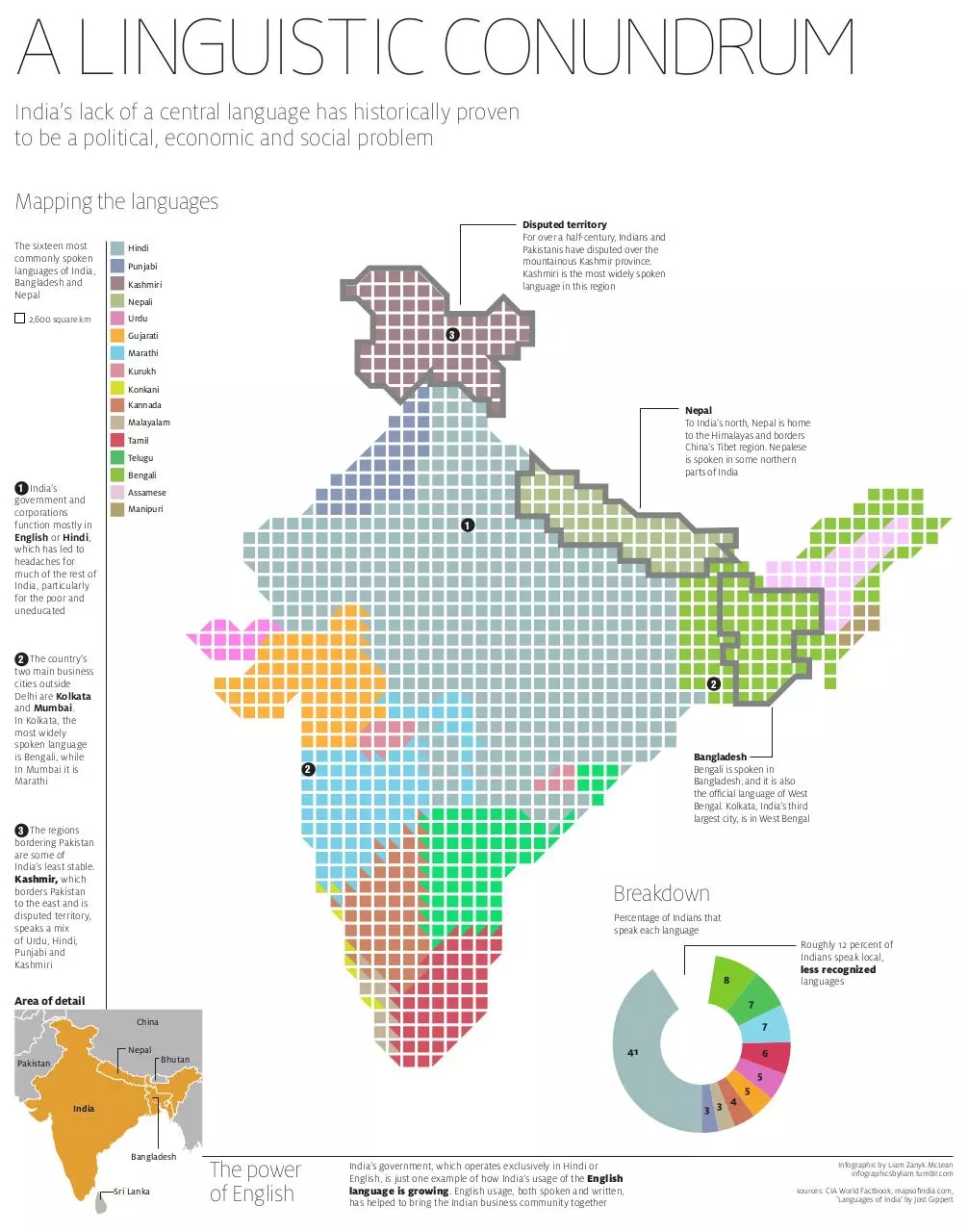
Mapping the languages
The sixteen most
commonly spoken
languages of India,
Bangladesh and
Nepal
2,600 square km
Disputed territory
For over a half-century, Indians and
Pakistanis have disputed over the
mountainous Kashmir province.
Kashmiri is the most widely spoken
language in this region
Hindi
Punjabi
Kashmiri
Nepali
Urdu
3
Gujarati
Marathi
Kurukh
Konkani
Kannada
Nepal
To India’s north, Nepal is home
to the Himalayas and borders
China’s Tibet region. Nepalese
is spoken in some northern
parts of India
Malayalam
Tamil
Telugu
Bengali
1 India’s
government and
corporations
function mostly in
English or Hindi,
which has led to
headaches for
much of the rest of
India, particularly
for the poor and
uneducated
Assamese
Manipuri
1
2 The country’s
two main business
cities outside
Delhi are Kolkata
and Mumbai.
In Kolkata, the
most widely
spoken language
is Bengali, while
In Mumbai it is
Marathi
2
Bangladesh
Bengali is spoken in
Bangladesh, and it is also
the official language of West
Bengal. Kolkata, India’s third
largest city, is in West Bengal
2
3 The regions
bordering Pakistan
are some of
India’s least stable.
Kashmir, which
borders Pakistan
to the east and is
disputed territory,
speaks a mix
of Urdu, Hindi,
Punjabi and
Kashmiri
Breakdown
Percentage of Indians that
speak each language
Roughly 12 percent of
Indians speak local,
less recognized
languages
8
Area of detail
7
China
Nepal
Pakistan
7
41
Bhutan
6
5
3 3
India
Bangladesh
Sri Lanka
The power
of English
India’s government, which operates exclusively in Hindi or
English, is just one example of how India’s usage of the English
language is growing. English usage, both spoken and written,
has helped to bring the Indian business community together
4
5
Infographic by Liam Zanyk McLean
infographicsbyliam.tumblr.com
sources: CIA World Factbook, mapsofindia.com,
‘Languages of India’ by Jost Gippert
�
 Historical archive . public document