THE GRAVEST CRIME
By Paolo Barnard*
August 2011
* Paolo Barnard is a senior foreign correspondent and author from Italy. He has worked for a number
of national newspapers in Italy (Corriere della Sera, La Stampa, Il Mattino…) and was the co-founder
of Italy’s most controversial investigative TV programme, Report (RAI Television, third channel). He
has published four books and a long series of political essays both in national monthly publications
and on the web. He has been a radio broadcaster and frequently gives public talks on the subject of his
investigations. He has also lived in the UK and in the US. He can be reached at dpbarnard@libero.it.
1
�
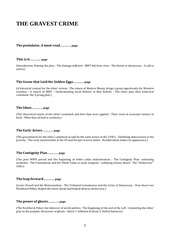
THE GRAVEST CRIME
The postulates. A must read…………… page
This is it…………… page
(Introduction. Naming the ploy - The damage inflicted - MMT hid from view - The threat to democracy - A call to
action.)
The Goose that Laid the Golden Eggs…………… page
(A historical context for the elites’ retreat - The return of Modern Money brings a great opportunity for Western
societies - A sketch of MMT - Understanding Good Deficits vs Bad Deficits - The elites plan their historical
comeback: the 4 prong plan.)
The Ideas…………… page
(The theoretical tenets of the elites’ comeback and how they were applied - Their roots in economic history in
brief - What they all had in common.)
The Early Actors…………… page
(The groundwork for the elites’ comeback as laid by the early actors in the 1930’s - Sidelining democracies is the
priority - The early masterminds in the US and Europe in more detail - Neoliberalism makes its appearance.)
The Contiguity Plan…………… page
(The post WWII period and the beginning of white collar indoctrination - The Contiguity Plan: colonizing
academia - The Foundations and the Think Tanks as main weapons - Lobbying steams ahead - The “Globocrats’”
clubs.)
The leap forward…………… page
(Lewis Powell and his Memorandum - The Trilateral Commission and the Crisis of Democracy - How these two
Neoliberal Bibles shaped the times ahead and helped destroy democracy.)
The power of ghosts…………… page
(The Neoliberal Poker: the takeover of world politics - The beginning of the end of the Left - Cementing the elites’
grip on the peoples: the power of ghosts - Ghost 1: Inflation & Ghost 2: Deficit Hysteria.)
2
�
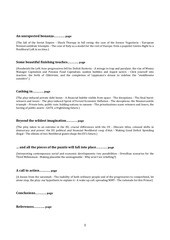
An unexpected bonanza…………… page
(The fall of the Soviet Empire - Shock Therapy in full swing: the case of the former Yugoslavia - European
Neomercantilism triumphs - The case of Italy as a model for the rest of Europe: from a populist Centre-Right to a
Neoliberal Left in no time.)
Some beautiful finishing touches…………… page
(Hoodwink the Left: how progressives fell for Deficit Hysteria - A mirage to trap and paralyze: the rise of Money
Manager Capitalism and Pension Fund Capitalism; sudden bubbles and duped savers - Click yourself into
inaction: the birth of Cliktivism, and the completion of Lippmann’s dream to sideline the “meddlesome
outsiders”.)
Cashing in…………… page
(The ploy-induced private debt boom - A financial bubble visible from space - The deceptions - The final burst:
winners and losers - The ploy induced Spiral of Forced Economic Deflation - The deceptions: the Neomercantile
triumph - Private bets, public ruin: holding nations to ransom - The privatizations scam: winners and losers, the
looting of public assets - GATS: a frightening future.)
Beyond the wildest imagination…………… page
(The ploy taken to an extreme in the EU, crucial differences with the US - Obscure titles, colossal shifts in
democracy and power: the EU political and financial Neoliberal coup d’état - Making Good Deficit Spending
illegal - The diktats of two Neoliberal giants shape the EU’s future.)
… and all the pieces of the puzzle will fall into place…………… page
(Interpreting contemporary social and economic developments: two possibilities - Orwellian scenarios for the
Third Millennium - Making plausible the unimaginable - Why aren’t we rebelling?)
A call to action…………… page
(A lesson from the savannah - The inability of both ordinary people and of the progressives to comprehend, let
alone stop, the ploy: our hypothesis to explain it - A wake up call: spreading MMT - The rationale for this Primer)
Conclusions…………… page
References…………… page
3
�
The postulates. A must read.
History has seen a reversal of two and a half centuries of progressive advancements.
The elites, that since the European Enlightenment had been gradually deprived of the
absolute powers they had in favour of democracy, have staged a successful claw back
to almost total control of the vast majority of our common wealth. They can blackmail
entire nations, preventing them from exercising their sovereign prerogatives in
monetary policy and even in the legislative sphere. They can inflict havoc on millions of
families and firms through their profit seeking schemes, globally. Citizens are today in
a position to vote empty political structures controlled by these financial and
corporate elites. Democracy is rendered virtually meaningless.
Modern Money Theory (MMT) has presented itself as the only powerful, coherent and
scientifically sound alternative to this dramatic state of affairs. It embraces such an
ample range of human functions in the economic, political, and social spheres that no
other theoretical approach seems at present preferable. MMT is a life saving, nation
saving tool for both Western and Developing countries. MMT is Sane Economics for a
Just and Safe Coexistence in Democracy.
MMT faces one major hurdle: people. The overwhelming majority, from academics to
policymakers to ordinary folks, don’t understand it or judge it structurally wrong.
Why? Because what they consider sound economics are in reality the very tools that
the elites used in order to appropriate the larger slice of our common good. In fact
most people, including the progressive forces, literally fell for the ideological deceit
that the elites enacted in the last 75 years through a structural and coordinated effort
within Western countries. This deceit was able to fashion as intuitive, as common
sense and even as socially beneficial most of the elites’ greed-inspired economics.
Citizens and progressives naturally bought into them, wholly unaware of what lay
behind them. It is as shocking a realization as that, no less. As a logical consequence,
since MMT runs contrary to most of the elites-inspired economic dogmas, it will clash
with most people’s and progressives’ core economic convictions. We must help them
see this, with the utmost urgency.
This primer explains the deceit, and shows how MMT can emasculate it. It is a must for
anyone who wishes to bring people and progressives on board along our struggle to
see MMT become government policy. It is a must for a mass communication effort to
ORGANIZE for MMT. Absent the awareness of the elites’ 75 year scheme, no effective
reaction can be organized, and of course MMT will remain for most an apparently
absurd, counterintuitive and even flawed approach.
4
�
This is it.
We are talking about possibly the gravest social crime perpetrated within the Western world
since the end of the Second World War. In Developing Countries it has been raging unchecked
since modern times began, but roughly half a century ago it landed here among us, and
millions of people, their families and their children, were made to suffer needlessly. They still
suffer today, and will almost certainly do so in the future to an even greater extent. Again:
needlessly. Their personal plight cannot be described here, too painful and deep are the
ramifications of what they have had to endure and are enduring. However, the odious nature
of this crime lies precisely in the fact that it was inflicted on them by an elite of powerful
individuals for the sole purpose of snatching the greater slice of the world’s wealth away from
its rightful owners: us, the people, and the States that we democratically legitimize.
These individuals are at work right now, relentlessly and remorselessly. We have termed
their worldwide operation the Neoclassical, Neomercantile and Neoliberal ploy, a ruthless
machination that is also the root cause of the present slide into chaos of the US and EU
economies. Their make up can be defined as follows: they are the top echelon of the world’s
larger financial institutions and corporations, together with their economic thinkers and
technocrats. Obliging policymakers often follow. They are sometimes dubbed “the
international investors”, and they gather at a few exclusive clubs like the Trilateral
Commission, the Bilderberg Group, the World Economic Forum at Davos, the Aspen Institute
and so on. In other words, they are what the respected weekly The Economist has recently
termed “the Globocrats” (1).
Before we reveal their identities, their organizations, their sponsors and the details and aims
of their decades long plan, we would like to give the reader a better idea of the damage they
have inflicted (and are right now inflicting) on millions in the Western world. Let us simply
tell you that for at least 40 years this ploy has been at the root of, to name just a few:
-
a huge chunk of the unemployment and underemployment we have known –
needlessly maintained, with the destructive social ills they bring with them;
-
the perennial dearth of funds for Welfare projects ranging from social programmes to
universal healthcare – with the enormous expansion of the urban poor we have seen
and the many thousands of premature deaths that have been caused;
-
discrimination in schooling and higher education where only the privileged have had
access to the best opportunities – with millions of our young consigned to a lesser life
and a blighted future;
-
the erosion of workers’ rights and bargaining power to an extent unimaginable only a
couple of generations back – which has lead to the present race to the bottom, to ever
decreasing salaries for ever increasing exploitation in the workplace, reinforced by
delocalization of jobs and outsourcing to other countries;
-
the problems of the older generations, whom the masterminds of this ploy the have
made scapegoats for the Deficit Hysteria that has gripped our nations – making
millions of decent seniors feel responsible for the lack of financial means available to
the younger generations;
-
the de facto emasculation of the sovereign States, of their monetary sovereignty, of
their legislative sovereignty, and the sidelining of what was left of the active citizenry,
all aimed at preventing the majority from benefiting from the States’ legitimate wealth
5
�
creating powers – the hard consequences and the amazing success of this part of the
ploy will become clearer as the story develops.
-
the privatization spree, turned unassailable economic religion, that has delivered large
chunks of public assets at a discount into the hands of the international investors –
delivering also entire peoples into the hands of profit seeking providers of essential
services, often with unsettling repercussions on the national social fabric.
-
the huge expansion of a dangerously under regulated private financial sector that is
today in a position to wreak havoc on any State, defrauding millions and speculating on
artificially created economic crises.
-
the present world wide economic downturn that is inflicting massive financial damage
on a host of small and medium businesses, and therefore on entire national economies
and millions of wage earners.
At a personal level this means millions of human lives, personal dreams and hopes either
thwarted or destroyed forever, here in the Western world. On top of that, whole sovereign
States have been rendered meaningless. Let’s repeat: this was done for the exclusive
advantage of an elite of power seeking privileged individuals and their institutions. But we
want to make clear to the readers from the very beginning that this is no conspiracy theory.
On the contrary, the general traits of this crime have been known to prominent intellectuals,
economists and activists for a long time, and have featured in hundreds of books, essays, and
debates. What has not been made public about it, and what must be made public with the
utmost urgency, however, is this:
A) THAT THE PRESENT, SEEMINGLY UNSTOPPABLE POWER OF THE “GLOBOCRATS”
AND THE IMMENSE HUMAN PLIGHT IT HAS CAUSED ARE THE RESULT OF A
STRUCTURAL, COORDINATED 75 YEAR EFFORT SUPPORTED BY A WELL DEFINED
ECONOMIC IDEOLOGY, AND ARE NOT, AS FREQUENTLY STATED, AN ABERRATION OF
CAPITALISM.
B) THAT THERE IS AN ECONOMIC DOCTRINE AND PHILOSOPHY THAT COULD HAVE
AVOIDED, AND COULD STILL AVOID, THIS HUMAN PLIGHT, WHICH WAS INSTEAD
REPRESENTED BY MAINSTREAM PROPAGANDA AS UNFORTUNATE ECONOMIC
NECESSITIES AND ACCIDENTS. THEY HAVE NEVER BEEN, AT LEAST FOR THE PAST
FOUR DECADES.
C) THAT IT WAS PRECISELY TO EMASCULATE THIS ECONOMIC DOCTRINE AND
PHILOSOPHY THAT THE NEOCLASSICAL NEOMERCANTILE AND NEOLIBERAL ELITES
STRIVED TO INFILTRATE POLITICS, ACADEMIA AND THE MEDIA.
D) THAT WHAT HAS BEEN ATTACKED, AND PERHAPS FATALLY WOUNDED, IS THE
VERY EXISTENCE OF DEMOCRACY, DEFINED AS SOVEREIGN STATES USING THEIR
WEALTH CREATING POWERS FOR THE BENEFIT OF THE MAJORITY.
E) THAT THE CONTEMPORARY MASTERMINDS OF THIS PLOY ARE RIGHT NOW DRIVING
OUR SOCIETIES AND ECONOMIES OVER THE CLIFF FOR PURELY FINANCIAL GAINS,
WITH CONSEQUENCES THAT CANNOT BE OVERSTATED. THEY MUST BE STOPPED
WITH NOTHING LESS THAN A CONCERTED EFFORT TO ALERT THE PUBLIC AND TO
DEMAND URGENT ACTION FROM POLICYMAKERS.
6
�
What follows is a Primer on a scheme that has successfully halted more than two Centuries of
the progressive evolution of Western societies. It has opened the way for the return to almost
absolute power of a restricted elite of financial and corporate powerbrokers. We think that
ignorance of the realities of the Neoclassical, Neomercantile, and Neoliberal ploy fatally
impairs any effort to form and to divulge a strategy to halt it. In fact, if one does not
understand the full extent of that scheme, one often gives little credibility to the remedies
proposed by the most advanced progressive economic schools. Above all one cannot grasp
what is really happening to our world, and can all too easily fall prey to the counter
propaganda of those elites. This latter scenario is the exact reason why the Left in the Western
World has been so hopelessly unable to halt their advance.
The Goose that Laid the Golden Eggs.
It is simple to understand, just look at History from a broad perspective. The world had been
run for thousands of years with exactly the same social structures everywhere: a tiny elite at
the top, ruling huge masses of powerless citizens. The rationale for this was just as plain: the
elites claimed unimpeded access to privilege and wealth at the expenses of everybody else.
The horrors of this system need not to be illustrated here. Then things changed when a group
of intellectuals had the courage to imagine an entirely different structure of human existence,
one where it’s the majority of human beings that will determine the appropriation of the
common wealth, the nature of rights and the system of government. These intellectuals were
the European Enlightenment thinkers, and they were proposing democracy.
Since then, and in the 250 years that bring us to contemporary times, our world has
undergone a long series of revolutions, bloody upheavals, wars, mass movements. These
achieved chiefly only one thing: they pushed those elites back and brought us, the majority, to
the fore. They lost in fact almost all of the staggering power they used to have – just think of
the difference between XIX Century Queen Victoria and the present British Queen; or what
King Luis XIV, Richelieu, or the Metternich could do at their whim, something not even
remotely comparable to the constraints that define our governments today. We gained
unprecedented influence on our rulers and a better standard of living for all to see – today no
Western dissident or citizen can be brutally shipped to the penal colonies at the Cayenna to
die there; no child of 8 years of age is to be found toiling in the coal mines of Europe; none of
our farmers is to be seen nowadays being savagely beaten for having dared to eat one apple
out of the Landlord’s yield, and so on. These were sadly common occurrences just 150 years
ago, even less. Wealth distribution, although getting more and more unfair by the day in our
times, is incomparably better than what used to be. Therefore the elites had to retreat
considerably, but did not wither away. Then came a time when some of them started thinking
that they could bounce back and reclaim some of the absolute power they had lost, although
having to adjust their ways to the radically mutated times that shaped Western societies in
the XX Century.
The principal tool they chose for their come back (as the Enlightenment thinkers had done
albeit with opposite aims) was the power of ideas. Their principal target was one: to kill, or
rather hide from us, the ‘Goose that Laid the Golden Eggs’ that we gradually came to possess
during the 250 years of social improvements that peaked in the 1970’s.
Again, it’s simple to understand. Think: is there anything in the world that can stop or
constrain the rulings of a sovereign democratic State legitimized by its own citizens? No,
7
�
nothing can, not even the most powerful private elite. And what if this State acquires the
economic means to enrich and look after the majority of its citizens with, again, no real
constraints? It would simply mean that the larger slice of that State’s wealth would fall into
the hands of the majority of its vote wielding people, and would never be owned or grabbed
by the private elites that live within that State. They would lose any possible claims on an
immense amount of riches, for good.
Was there ever a time in our recent history when States and people possessed such
extraordinary economic means? Yes, there was, ever since the unilateral US ruling of 1971
that changed the international monetary system and de facto introduced Modern Money into
a host of Western countries. Modern Money is FIAT currencies, defined as sovereign*,
floating and non convertible units of account that the State simply crates out of thin air at the
Treasury and at the Central Bank. As the Modern Money Theory (MMT) school of economics
lead by Prof. L. Randall Wray explains (2), these currencies gave the States an unprecedented
ability to use their fiscal policies to inject net financial assets into the non government sector
almost with no limits (the few constraints on this fiscal policy have been fully dealt with by
MMT economists). It is as simple as saying that the government could Deficit Spend inventing
its money out of thin air, and, by so doing, it would make any recipient of that money richer
(crediting checking accounts of citizens and businesses that sold it services and goods). But
really richer, net richer that is, meaning that this would be new money being created by the
government and earned by those recipients. Not like in society where any financial wealth
that anyone gets is money someone else has lost, spent, or that is offset by someone’s IOU. So
it’s not net money being earned, just money shifting from one place to another all the time. So
governments could Deficit spend in this virtuous way, also called Good Deficit Spending**,
and it potentially included financing full employment, full Welfare, full education, better
infrastructure, growing productivity for its citizens. Again: this would have created social
structures where the State apportioned large amounts of financial wealth to the majority, and
where workers and citizens would have become strong entities with equally strong
bargaining powers, because, as the Lebanese economist Joseph Halevi once remarked “real
full employment empowers; deflation, unemployment and small jobs disempower” (3). It would
have been the ‘Goose that Laid the Golden Eggs’ for us people, since, let us repeat, there is
nothing in the world that can stop or constrain the rulings of a sovereign democratic State
legitimized by its own citizens.
The elites could not allow this to happen, and so they acted.
* We remind the reader that whenever the definition “sovereign currency” appears in this
Primer it will refer exclusively to currencies that are
a) issued by a State’s central fiscal authority. Hence they are SOVEREIGN.
b) non-redeemable for gold or for anything else upon citizens’ request (it means that
citizens cannot take their money to a bank and demand to be given instead a fixed amount of
gold or any other valuable thing). Hence they are NON CONVERTIBLE.
c) Exchangeable for foreign money at an exchange rate decided by the markets and by
other factors (it means that the government does not promise to exchange each unit of its
sovereign currency for a fixed amount of any other foreign currency). Hence they are
FLOATING.
8
�
Examples of sovereign currencies: Dollar, Yen, UK Pound, Turkish Lira… Formerly the German
Mark, the French Franc, the Italian Lira and other EU currencies were all sovereign; they were
supplanted by the Euro that is not a sovereign currency, as we will explain later on.
** Before continuing, it is essential for the reader to understand the difference between Good
Deficits and Bad Deficits. In fact, what the elites’ ploy was and still is targeting are the Good
Deficits, for the reasons just explained. When it comes to Bad Deficits, well, their attitude is
profoundly hypocritical, as you will understand later on. But first let’s fully clarify the
difference between the two sets of deficits. MMT will call a Good Deficit the type of
government expenditure that is targeted at creating full employment, full Welfare, full
education, better infrastructure and growing productivity. This engenders a virtuous circle
that will not only make the non government sector better off (us people + firms), but would
end up largely paying for itself. Yes, because it would trigger a decrease of States’ social
expenditures for unemployment benefits, for the underemployed, for the social ills of
unemployment (crime, alcoholism…). Less expenditures also for medical assistance to those
left with no coverage, for the bailing out of foreclosed families or of failing banks, plus many
other savings - all of this going towards reducing the deficit. On the other hand, a Good Deficit
it would trigger an increase in government income through higher tax revenues, even
without increasing the tax rate. In fact a wealthier non government sector will earn more
income and thus pay more money into the States’ coffers – and again, this will reduce the
deficit. But not just. Good Deficits will also result in more things being produced at home and
so less need to import them, improving the current account deficit of the State; they will also
make the country more efficient and more attractive for investors, so there will be foreign
money getting into the country. Finally, Good Deficits will also keep inflation in check because
of all the extra production that will match the increase in the monetary mass going around.
On the contrary, Bad Deficits are disastrous: they are very often the paradoxical result of
the Neoclassical, Neomercatile and Neoliberal hysteria to reduce deficits. In fact, when
the State is forced by that hysteria to slash Good Deficits, it will immediately make all the non
government sector poorer. This will make it fall into a vicious circle of economic deflation,
meaning less consumption, so less sales for firms, and so workers will be fired. There will be
an increase in the social expenditures described above, and a decrease of States’ incomes
through falling tax revenues and falling foreign investments. Many other economic perils like
the loss of marked confidence in that State will ensue. All of this will obviously make the
deficit worse, and wreck the country in the long run.
Mind you: even though, on the face of it, the Neoclassical, Neomercatile and Neoliberal elites
will revile all government deficits, they hypocritically ignore and hide from us the glaring fact
that the only pernicious deficit is the one which directly derives from their sacred economic
prescriptions.
As we were saying, social structures and nations that benefited from some form of Good
Deficit Spending briefly (albeit incompletely) came into existence in some Western nations in
the 1970’s, to the horror of the elites. In fact, the decade that followed the ’68 progressive
mass movements in the US and in Europe saw the ideals born of the Enlightenment era reach
their apex. They looked unstoppable in the midst of an ever growing political consensus. It
became apparent to the elites (in reality this awareness can be traced in them as early as in
the 1930's) that democratic States were approaching the day when they could have gained
the upper hand in the control of the world’s wealth. This could not be allowed to happen.
9
�
Hence the massive planning I mentioned above. Their decision was drastic, their four goals
crystal clear:
1) The sovereign monetary power of the States had to be destroyed together with their
possibility to use it in large part for socially oriented, citizens’ empowering
expenditures. Destroy Good Deficit Spending.
2) The States’ legislative sovereignty had to be equally curtailed lest they legislate to
cement that enlightened possibility into unassailable laws.
3) Citizens had to be sidelined and made useless so they never truly realized the
potentials of their sovereign States.
4) Finally, from the ashes of entire nations wrecked by the success of their ploy, the
elites wished to extol not just the control of the largest slice of the world’s wealth, but
super profits in finance and exports.
In other words: our ‘Goose that Laid the Golden Eggs’ had to be all but destroyed. So it was.
The Ideas.
As we said, it’s ideas that enable power. The elites armed themselves with a set of
sophisticated ideas. The most central of which were these:
MONEY SHOULD NOT FEATURE AS A CENTRAL TOOL IN THE RUNNING OF THE ECONOMIES.
They borrowed this dogma from the work of Neoclassical economists, those who believed that
the Market would always provide the perfect balance of demand and offer of commodities,
and therefore set the fairer prices for all things. Money did not feature in their model. Note
that something else does not feature in this model: the State and its ability to run fiscal policy.
No wonder. It was the elites’ perfect dream: the State out of the way, and their Market as the
supreme ruler of all economic life. They pumped this idea to the point of creating a stereotype
that defined States, or more precisely governments, as something cumbersome stuck in the
middle of an otherwise functional machine that would benefit all: the Market. It’s from here
that the mantra of the necessity of ‘small governments’ took shape, which was then picked up
by others along the way. The scholars most prominent in lending these ideas to the elites
were Dennis H. Robertson, Gerard Debreu, Kenneth Arrow, Frank Hahn and the Neoliberal
political thinkers in general.
Another idea they were happy to adopt was that
SAVINGS MUST ALWAYS COME BEFORE INVESTMENTS, NEVER VICE VERSA.
The father of this rule was British economist David Ricardo (1772-1823). Translated into
modern thinking it provided the rationale for the elites’ attack on States’ spending for the
benefit of citizens. In fact they convincingly argued that
10
�
STATES’ BUDGETS ARE JUST LIKE FAMILIES’, AND, JUST LIKE FAMILIES, STATES MUST EARN
FIRST (SAVING) AND INVEST LATER (SPENDING), BUT ALWAYS MAKING SURE THAT THEY
EARN MORE THAN THEY SPEND, JUST AS A VIRTUOUS FAMILY DOES.
This simple economic theorem is gifted with extraordinary efficacy because of its intuitive
logic that convinced everyone, from policymakers to the public. It was all wrong, especially
from an accounting viewpoint: a family must save more than they spend simply because they
cannot create their own money; they must earn it or borrow it, so they’d better stash some
away for emergencies and not get too much into debt. A sovereign currency State has none of
those constraints, it creates its currency out of thin air and actually must spend more that it
saves in order to enrich citizens and firms, as explained earlier. Despite this truism, the “States
are like families” myth spread like a virus. This is how the whole mantra of balancing the
budgets, of never deficit spending, of cutting State expenditure was born. This is how the
present day Deficit Hysteria was born. Of course it played in the hands of the elites because it
intellectually paralyzed governments from actually deficit spending as much as would have
been necessary to enrich and look after the public. And if we add to this paradigm the
common misrepresentation of tax revenues, things get even worse. In fact, as an addendum to
the “States are like families” fallacy, came the other idea that taxes is money the State collects
from citizens and firms on order to be able to spend. This, with sovereign currencies, is yet
another canard. The reasons are complex (4), but it will suffice to reiterate that a sovereign
currency government creates money by putting its signatures to pieces of paper
(notes/bonds) or to electronic money transfers. Can it ever run out of its own signatures?
Does it need to tax people to get back those signatures that it can just create? Of course not. It
must be careful not to issue too much currency, because it may cause inflation, but it certainly
doesn’t need to come and collect it at your door. However, one thing taxes certainly do: they
will shrink taxpayers’ checking accounts. So now let’s put those two falsehoods together:
States must earn more than they spend (so they must tax our checking accounts more than
they credit them) and States must tax citizens and firms to get money to spend (so again they
must tax our checking accounts). It doesn’t take a genius to understand that this is the
quickest way to impoverish millions of ordinary citizens and firms, and the surest way to
strangle Good Deficit Spending that relies precisely on a State spending more that it taxes.
Pity for millions of families and workers – but also for small and medium businesses – and for
their social rights that directly depended on Good Deficits to be aided and protected. In fact
this ideology that made a sin of any deficits for welfare and full employment is the
fundamental tool of the ploy we are describing here. The wage and rights deflation, the
spreading unemployment and underemployment that we all see today, are the result of this
set of principles. The main modern preachers of “States must spend like families” and of Deficit
Hysteria have been economists : Robert Lucas, Tom Sargent, Neil Wallace (New Classical
school), Jude Wanniski, George Gilder (Supply Siders), Greg Mankiw (conservative New
Keynesian), Carmen Reinhart and Kenneth Rogoff, but of course it’s become a common credo
for all mainstream economist and policymakers.
Next came another fundamental idea:
INFLATION, THE NIGHTMARE SCENARIO OF ALL ECONOMIES, CAN BE CONTAINED BY
CONTROLLING THE MONEY SUPPLY AND BY AVOIDING FULL EMPLOYMENT.
The first may sound like a flawless theorem in abstract, the second a little less. But Milton
Friedman, together with his influential Chicago School and the likes of Carl Brunner and Alan
11
�
Greenspan, spread these ideas aiming at one and only one thing again: to constrain
governments from freely using their sovereign money supply to Good Deficit spend for us
citizens, creating full employment. They ignored, conveniently, the proven benefits of Good
Deficits and full employment, that can control inflation in many ways (5), and thus they made
sure that workers would never be placed in a comfortable bargaining position as fully
employed at a living salary.
Consequently, because one of the main targets of the elites’ comeback were modern workers
and their advanced rights, they had to fish out from the past another sacred dogma:
LOWERING WAGES WILL LEAD TO FULL EMPLOYMENT.
This is one of the most devastating economic theories that the elites pushed through the
layers of governments the world over. It was advanced by the early XX Century economist A.
Cecil Pigou, and carried into contemporary times by other economists like Gerard Debreu,
Kenneth Arrow, Frank Hahn of the Neoclassical school, by the Austrian school of Von Mises
and Hayek, and the New Keynesians like Greg Mankiw, plus the Neoliberal political movement
as a whole. They all argued that a firm is more likely to hire workers if it can significantly
reduce the cost per labour unit, in other words wages. Of course, this very conveniently
ignores the basic truism that lowering wages will reduce aggregate demand and this will drive
sales down which will lower small and medium firms’ profits, leading then to redundancies
and unemployment. The exact opposite to what they claimed would be achieved. So, were
they so thick not to understand this? Of course not. Let’s remember that the elites we are
talking about in this Primer belong mostly to the mega corporate industrial sector and to the
giant financial institutions. They care very little for the destiny of the above mentioned small
and medium firms, and are very happy to be able to fish from a large pool of unemployed
desperate workers prepared to accept any wage in order to work at all. This new “reserve
army of the unemployed” (Marx) allows them to produce at lower costs even within rich
nations and thus to compete on the international export markets. This is the Neomercantile
element of the ploy, this is what is meant by Neomercantilism. Lastly and intuitively, it is clear
that the dogma of lowering wages constitutes yet another impediment for governments that
wish to to Good Deficit spend achieving full employment and setting a higher standard for
living wages.
As we already said, one of the most difficult targets that had to be brought under the elites’
control was the sovereign legislative power of the States (Western ones, since ownership of
Third World countries was never a problem). Here the differences between Europe and the
United States were crucial. The US was a single government with a central fiscal authority,
while the EU was a conglomerate of very different peoples, cultures, and litigious
governments. A lot more difficult to control and to exploit. The colonization process of
American policymakers with the above mentioned ideas could be achieved, as it was, through
a concerted lobbying and financial effort; but it was deemed too complex and time consuming
to attempt the same strategy in Europe. So this is the idea they came up with:
THERE WILL HAVE TO BE A UNITED EUROPE RULED BY UNELECTED OFFICIALS CONTROLLED
BY A WEB OF FINANCIAL AND INDUSTRIAL LOBBIES. THESE UNELECTED OFFICIALS COULD
ISSUE SUPRANATIONAL LEGISLATION SO TO DISEMPOWER NATIONAL PARLIAMENTS. THIS
NEW EU WOULD BE GIFTED WITH A MONETARY UNION ENTIRELY OUT OF SOVEREIGN
GOVERNMENTS’ CONTROL AND WITH NO CENTRAL FISCAL AUTHORITY.
12
�
This whole scam was sold to European voters as a step towards a brighter economic future
and a more civilized Europe. In the EU the creation of the Maastricht and Lisbon Treaties –
ratified into national law by all EU States – has de facto abolished the legislative sovereignty
of the States. Europe lives today the absurd paradox of having an all powerful EU Commission
that rules all with its supranational laws but that is unelected by citizens, and a EU parliament
that is directly elected but cannot propose legislation (sic). National parliaments are de facto
emasculated since the Treaties specifically establish the supremacy of EU law on both
national legislation and Constitutions (6). An analysis of those Treaties shows unambiguously
that the whole edifice has been created for the benefit of the financial and corporate elites,
with no social chapter or fiscal redistribution mechanisms anywhere to be seen. Fiscal
sovereignty is also destroyed by the Treaties according to the original intention of the elites to
prevent States from Good Deficit Spending for the citizens. In the EU this aim was achieved by
introducing the Euro (EMU). In fact the Euro is a non sovereign currency that is issued by 17
Central Banks and has to be borrowed by all 17 Eurozone States. Borrowed from whom?
From the capital markets that directly acquire Euros at their emission. This limits States’ fiscal
sovereignty almost entirely, with the catastrophic results we are now witnessing (more on
this later on). It was here that the all powerful technocrats of the Old Continent played a
pivotal role in delivering the elites’ goals. The most prominent were: the Frenchmen Jean
Monnet, Robert Schuman, Francois Perroux, Jaques Attali, Jaques Delors, Francois Mitterrand,
Valery Giscard D’Estaing, Jean Claude Trichet; Italy’s Giuliano Amato, Romano Prodi, Mario
Draghi, Carlo A. Ciampi, Carlo Scognamiglio, Mario Monti, Tommaso Padoa-Schioppa, Marco
Buti; in Germany Helmut Schmidt, Otmar Issing, Theo Weigel, Helmut Kohl; the Dutchman
Wim Duisenberg; and Luxembourg’s Jean Claude Juncker.
In conclusion, we can clearly see that there is one single element that is common to all these
ideas and economic dogmas: restraining States’ fiscal policy in order to prevent them
from Good Deficit Spending in favour of the non government sector of labour, small and
medium firms and citizens generally. In other words: kill the ‘Goose that Laid the
Golden Eggs’ for society as a whole.
The importance of these ideas cannot be overstated. They shaped the economic functioning
and the political landscape of almost all the civilized world in the later part of the XX Century
and well into the third millennium, with immensely controversial consequences. Last, but not
least, they even penetrated the mindset of ordinary citizens and progressive forces, despite
their socially pernicious aims.
The Early Actors.
As we argued earlier, the elites’ comeback to almost absolute power was perfected in its
theoretical and operational formats from the 1970’s onwards. Their supreme aim was to drive
a wedge between the sovereign functions of citizens centred democracies and the wealth
creating potentials of Modern Money that these democracies could have used in the public
interest. However, the groundwork for the elites’ modern assault on the common good was
13
�
firmly laid in the preceding four decades and must be explored if one wishes to understand all
subsequent developments.
The early actors can be traced in the interval between the two major World Wars of the XX
Century. In those days the elites immediate concerns were not of a purely economic nature, or
at least not entirely. Rather, the phenomenon that they viewed as the most unsettling for their
plans was… us, the citizens, followed of course by the rise of democracy and of the sovereign
States, as already explained. They rightly sensed that the least controllable single element in
history’s momentous changes were the masses, growing enormously in size and taking a
dangerous liking for the power that democracy and socialism was rapidly affording them.
States, they reasoned, could be tackled: after all in those days politicians were almost
exclusively drawn from the top echelon of elitist groups. But people no, they had to be
thoroughly brought under control. It was no easy task in an era that could no longer tolerate
massacres, torture and unchecked brutality as a means for population control.
In the US of the 1930’s a couple of prominent intellectuals come up with a far reaching masscontrol plan. Walter Lippmann and Edward Bernays, belonging to the progressive camp of
those days and destined to be influential up until the presidency of J.F. Kennedy, professed a
simple doctrine: people were “ignorant and meddlesome outsiders” (7) and had to be sidelined
in order to allow the free reign of the enlightened elites. Lippmann had already expressed
such views earlier on in his 1914 work Drift and Mastery, where he claimed that the masses
were threatening the capitalist order. These ideas lent considerable weight to the embryonic
reaction of the elites to the growing influence of socialist ideals in the West. It’s no
coincidence that some years later, in 1938, Lippmann attended a European conference where
it is thought that the term Neoliberalism was coined (8).
The two intellectuals launched what we have come to know as The Industry for Manufacturing
Consent, with its huge mass media operations and its drive to swerve millions away from
social activism through a mix of consumerism and political propaganda. In simple words,
doping people out of their real rights and needs, making them a useless passive mass unable
any longer to hinder the elites’ operations. Later in this Primer we will see how precisely the
same concept would be borrowed in the 1970’s by another set of powerful intellectuals with
equally pernicious aims.
In Europe, in the same decades between WWI and II, similar ideas were also being
contemplated by two French politicians and intellectuals, Robert Schuman and Jean Monnet.
It goes without saying that they too considered citizens as an ignorant mass only to be ruled
by a superior hierarchy. But the two Frenchmen went a lot further than their American
counterparts. They imagined a draconian solution both to the growing influence of the masses
and to the dangers that democratic States could pose to the elites. It must be specified that
Schuman and Monnet viewed with favour the powerful industrial sectors of France and
Germany, whose needs even then were virtually identical to the present day’s: they dreamt of
a Europe split between their ‘fast lane’ economies and ‘slow lane’ ones in Italy, Portugal,
Spain, the Benelux and in the Scandinavian countries. Poorly paid workers from the lesser
States would migrate in desperate search of jobs, guaranteeing super profits to French and
German industries that could compete on the international markets. Governments were to be
kept to the sidelines and should not interfere. Pure and simple Neomercantilism. Of course, in
order to achieve this state of affairs they had to impose to the Old Continent a series of
policies such as: low inflation (the prime excuse to prevent States from Good Deficit Spending
for workers and wages); restraining consumption so as to create economic deflation in the
targeted nations (same trick to prevent expenditure all around and to maintain a high level of
unemployment); and some sort of a higher authority that could keep rebellious States in
check via a supranational legislative capacity. Schuman and Monnet concocted such an
14
�
authority, that they imagined as a future European Union ruled by technocrats in the interests
of the elites. In fact, it was from the 1950 ‘Schuman Plan’ that the earliest embryo of the EU
was born: the European Coal and Steel Community. But not just. As we already explained the
crucial element of this plan was to deprive States of their monetary sovereignty, of the ‘Goose
that Laid the Golden Eggs’, and so here came the fifth actor of this early start of the
Neoclassical, Neoliberal, Neomercantile ploy: the French economist Francois Perroux.
Few can imagine when exactly the present European Monetary Union, with its disastrous
Euro currency, was conceived. The most popular guess is around the 1980’s when European
technocrats were labouring to create the new Treaties for the EU. In reality it was Francois
Perroux that thought of it around 1943, and with the precise intention to “deprive States of
their reason to be” (9). The European Monetary Union stands for a single European currency,
not sovereign for any of the EU States, with no central fiscal authority but with an all powerful
Central Bank, and which Eurozone Treasuries cannot issue and have to borrow from private
capital markets. And there we have it: States’ monetary sovereignty is destroyed. From 1943
to 2011 the plan succeeded with the dire social consequences in Europe for all to see (more
details later on).
It’s worth refreshing our memory to underline how, as early as in the 1930’s and 40’s, already
three of the four goals of the elites’ ploy – the destruction of the monetary and legislative
sovereignty of democratic States, and the sidelining of the active citizenry – had been
thoroughly identified and ideas put forward.
This period saw the rise of another prominent set of high priests of the elites’ comeback that
we cannot leave out of this brief sketch. Let’s name Ludwig von Mises and Friedrich von
Hayek (celebrated author of The Road to Serfdom), Jacques Rueff, Raymond Aaron among the
many, and let’s mention their first European ‘church’ that goes by the name of the Mont
Pèlerin Society of 1947. What they all had in common was an inborn aversion for anything
that smacked of State intervention in economics and for anything even remotely associated
with the work of British economist John Maynard Keynes, bordering in the latter case on
hatred. Having said this, what is interesting to note is that their approach to the general
functions of the State was already soaked in what nowadays some call ‘Lemon Socialism’
(Krugman 2009): it reserves a central role for governments only when it comes to keeping a
social order for the benefit of the Free Market, and particularly when it comes to bailing the
elites out of their unconscionable risk taking with massive infusions of public money (defined
not as tax money, but money that Treasuries could have destined instead to socially oriented
expenditures).
The Contiguity Plan.
Ideas do certainly enable power, but, paraphrasing Oscar Wilde, “with a little help from
others”. The help came in the most obvious fashion for ideas that served the interests of the
super rich: money. Not bucket loads of cash poured into those thinkers’ coffers. The financing
operation was orchestrated in an extremely sophisticated manner so as to achieve two very
pivotal goals: first, to raise funds of course; second to become influential with policymakers
and to infiltrate the world of academia and consequently the ‘real’ command structure of
governments. In this respect, the underlying principles of the elites’ strategy must be
understood because it explains the reason why contemporary societies the world over are
now governed with a Neoliberal single economic dogma that looks unassailable, verging on
15
�
faith. They can be summarised as follows: it became clear to them that the real power
wielding elements of any government were not the front men of politics, but rather the rear
guard composed of technocrats and advisers. Politicians, they reasoned, had to deal with
voters and suffered, at least on the face of it, a number of social constraints before
unashamedly ripping the public off of their rights and resources. The rear guard had none of
these problems and could fashion a set of economic principles to do the dirty job, but
carefully disguised as economic necessities or even virtuous measures. Politicians would
present unpopular choices as sadly inevitable sacrifices, dictated by the right science of
economics that technocrats and advisers presented as authoritative and even vital. So, the
immediate thing to do for the elites was to infiltrate academia where the rear guard of power
were being raised. Later on we will see how this plan was precisely articulated in writing and
by whom.
Of course, two major developments must be remembered at this point, as we are still
considering the decades from the 1940’s and the 1970’s. The outbreak of the Second World
War obviously put a stop to everything, although it is interesting to note that in those terrible
years both the European dictatorships and the resisting democracies embraced economic
policies that paid little attention to the ideology of the Neoclassical and Neoliberal
masterminds. Second, although the elites’ operation was growing in strength and numbers,
the general economic trend in Western societies was running in the opposite direction. As we
already said, progressive and State centred economic and social policies seemed destined to
triumph up until their collapse in the mid 70’s. They were massively influenced by the work of
the British economist John Maynard Keynes, but also by that of a host of other Left Wing
philosophers, economists and political parties, both in the US and in Europe. Nevertheless, the
ploy marched on, full steam and fully funded.
And so it was academia that had to be conquered and controlled by the elites through their
economic dogmas. To this end, they employed what could be called a ‘Contiguity Plan’. In
order to spill more easily their ideology into faculties and onto the top echelon of students in
political science and economics, they set up a ‘contiguous’ structure involved in financing
higher education, training, research and grants, but also capable of mass public opinion
campaigns. It was made up of two fundamental components: the Foundations and the Think
Tanks. The former were a mixture of fund raising entities and cultural centres, the latter were
usually of a purely research and educational nature. Some names for the US, from the early
days on: the Rockefeller Foundation, the William Volker Fund, the Olin Foundation, the
Freedom Network and the Atlas Research Foundation, the American Enterprise Institute, the
Cato Institute; and then the Coors, John M. Ohlin, Sarah Scaife, Smith Richardson, Henry
Salvatori, Carthage, Heritage and Earhart Foundations; the Acton Institute, the Washington
Policy Center, the Manhattan Institute for Policy Research.
In Europe: for the UK, the Institute of Economic Affairs, the Centre for Policy Studies, the
Adam Smith Institute, the Stockholm Network, the Bruges Group, the International Policy
Network. The powerful Mont Pèlerin Society in Switzerland; the CUOA, Acer, CMSS, Bruno
Leoni, Prometeia and Nomisma Institutes in Italy; in France, the Association pour la Liberté
Economique, Eurolibnetwork, the Institut de Formation Politique; in Germany: the Institut
fuer Wirtschaftsforschung Halle, the Institut fuer Weltwirtschaft, and the Institut der
Deutschen Wirtschaft Köln among the most influential.
And so they did spill the Neoliberal and Neoclassical dogmas where it mattered. One name to
be remembered in this context is that of the Swiss Neoliberal monetarist Karl Brunner, a
highly influential thinker in economics who belonged also to the Mont Pèlerin Society, and
16
�
who was active in the US where he held several top teaching positions. His prestigious and
densely attended 1970 Konstanz Seminar on Monetary Theory was a glaring example of how
the architects of this ploy worked in order to convert those that mattered: the politicians, the
top technocrats and academia. As for the latter, Brunner lamented “a gap in the quality of
research and teaching in Europe compared with the United States”, that he sought to fill by
“improving economics departments in European universities, especially in Germany and his
native Switzerland” (10). All this was done, with considerable if not total success. In the words
of John F. Henry: “In addition to funding the development of specific programs and curricula
and supporting research promoting laissez faire, free-market oriented foundations have
sponsored fellowships, mainly in law, economics, political science, and public policy… They
endowed academic chairs, and sponsored book projects. Once articulated, policy prescriptions
and the free-market argument behind these are communicated to not only government officials,
but the public at large via only the usual media outlets but also through the work of foundation
sponsored journalists” (11).
One of these Foundations deserves a little extra attention. The Heritage Foundation was the
brainchild of Ed Feulner, a young American conservative barely known at the time. It was
1973, and he was hovering around the political environment in Washington DC displaying
impatience. To him, conservative and Free Market oriented gurus lacked speed, not ideas.
Sacred institutions like the Mont Pèlerin Society of Friedrich von Hayek in Europe were too
slow, they engaged in eternal lofty debates and Feulner wanted jet propelled penetration into
the political arena now. He came up with a single idea that would change the face of modern
politics, as well as refashion one of the most controversial ‘political species’ of our times: the
lobbyists. Politicians, he thought, were a bunch of people drawn from all walks of life but
entrusted with decisions on a vast range of issues they could not all possibly master. They
needed efficient, well crafted and above all ready to use advice on those issues, something like
fast food if one is hungry but has no time to prepare dinner. The Heritage Foundation would
provide such a service, dishing out “… concise and unsophisticated summaries of key issues that
can be digested en route to congressional votes – what Feulner refers to as the organization’s
pioneering use of shorter policy papers for busy policymakers” (12).
Of course, those papers had to be delivered by someone, and here we have the birth of the
modern version of lobbying and lobbyists. One cannot possibly overstate the impact that this
phenomenon has had on politics and particularly on the success of the Neoclassical,
Neomercantile and Neoliberal ploy. Let us give you some data that speak for themselves:
Washington DC is infested by lobbyists at the tune of 16 to 40 thousand each year, depending
on the political agenda. They can rely on a budget of 3 to 4 billion dollars annually. In the EU,
and specifically at its power centre in Brussels, between 15 to 20 thousand of these men and
women scurry the corridors of the EU Commission and other institutions, with roughly 1
billion Euros as pocket money to spend. In the United States lobbying is so much a part of the
way things are that listing specific groups of lobbyists is a futile exercise. Anyone who is
anyone in America does lobbying, from the American Banking Association, to the Housing
Finance Alliance or the Private Investor Coalition and the US Chamber of Commerce. The
whole of Wall Street from top to bottom engages in furious lobbying at the highest levels, and
again lobbyists are employed by such diverse organizations as the National Rifle Association,
the Christian Coalition, the American Israel Public Affairs Committee, and by big Unions,
gender groups, all industry groups and so on. In Europe, on the contrary, lobbyists became
organized in formal groups, and by far the most influential are the financial and business
lobbies. Names like the Trans Atlantic Business Dialogue, the European Roundtable of
Industrialists, the Liberalization of Trade in Services Group, the European Banking
Federation, the European Employers Association, or Business Europe are much listened to in
17
�
Brussels. Just to give you a significant example, every year the Trans Atlantic Business
Dialogue submits to the EU’s top technocrats a list of its own desiderata and expects an
obliging EU Commission to report back on progress made in meeting those requests (13).
Not to be omitted here, as we deal with these arrangements for highly influential Neoclassical,
Neomecantile and Neoliberal spin masters, are the ‘clubs’ where their cream of the crop have
gathered and still gather annually to discuss the major policy and economic trends of each
given era. Unfortunately, due to the current Internet explosion of wild conspiracy theories, the
mention of these exclusive ‘clubs’ is often met with scorn or even ridicule. To extricate oneself
from the mess of web unchecked factoids is not easy, but in this case the membership of the
‘clubs’, officially published on their websites, dissipates all doubts. They are not many, actually
only four of them are worth remembering: the ultra secretive Bilderberg Group founded in
1954, the Trilateral Commission of 1973, the Aspen Institute of 1950 and the World Economic
Forum that sprang to life in 1971. For more than sixty years all the most powerful men and
women of the planet (too many to mention) gravitated around these organizations, as they
consistently contributed to the historical events detailed in this Primer. But to give the reader
an authoritative measure of their significance, here is a list of just a few of the current
international powerbrokers that belong to one or more of these ‘clubs’:
Peter Sutherland (ex WTO chief, Goldman Sachs exec., ex EU Commissioner, Bilderberg), David
Rockefeller (Trilateral Commission, Bilder.), Paul Volcker (ex FED chief, Aspen Institute, Trilat.,
Bilder.), Leon Brittan (ex EU Commission, Trilat.), Henry Kissinger (ex US govt., Aspen, Trilat.,
Bilder., World Economic Forum), John Micklethwait (Editor of The Economist, Bilder.),
Zbigniev Brzezinski (ex US govt., ex Trilat.), Condoleezza Rice (ex US govt., Aspen, Trilat.,
Bilder.), Henry Paulson (ex US govt., Bilder.), Edmond de Rothschild (Bilder.), Ben Bernanke
(FED chief, Bilder.), Mario Draghi (Bank of Italy chief, Bilder.), Bill Clinton (WEF), Etienne
Davignon (ex EU Commission, Bilder.), Larry Summers (ex US govt., Bilder.), John Negroponte
(ex US diplomat, Trilat.), Paolo Scaroni (ENI CEO, Bilder.), Karel de Gucht (EU Commission,
Bilder.), Jean Claude Trichet (ECB chief, Bilder.), Timothy Geithner (US Treasury Sec., ex Trilat.,
Bilder.), Carl Bildt (Swedish Foreign Min., Trilat., Bilder.), George Soros (WEF), Joaquin
Almunia (EU Commission, Bilder.), Mario Monti (Bocconi Univ., ex EU Commission, Aspen,
Trilat., Bilder.), Carlos Ghosn (CEO Renault, WEF), George Papaconstantinou (ex Greek Finance
Min., Bilder.), Peter Brabeck Letmathe (Nestlè chairman, WEF), José Zapatero (Spain PM,
Bilder.), Cynthia Carroll (Anglo American CEO, WEF), Josef Ackermann (Deutsche Bank CEO,
Bilder.), Neelie Kroes (EU Commission, Bilder.), Christine Lagarde (IMF Chief., Bilder.), Bill
Gates (Bilder.), Donald Graham (Washington Post publisher, Bilder), Robert Zoellick (Pres.
World Bank, Bilder.), John Elkann (Fiat chairman, Aspen, Trilat., Bilder.). No need to comment
further.
European and American Neoliberal foundations, the Think Tanks, the lobbies and the
exclusive “Globocrats’” clubs, certainly deserve a lot of credit for the success of the elites’
‘Contiguity Plan’. But in the same years, the early 70’s, four intellectuals and their respective
mentor organizations were at work to propel the whole Neoclassical, Neomercantile and
Neoliberal ploy into its inexorable final rush to victory.
The leap forward.
No doubt the elites were, by now, doing very well in their inexorable come back to power, but
they also had the good fortune to cross paths with four individuals gifted with a sophisticated
18
�
analytical ability. Let’s rewind a little: it was the month of August of 1971, Lewis Powell was
putting his final touches to what could be considered one of the most efficient blue prints of
the corporate elites’ comeback ever written. He had been
...
 Historical archive . public document