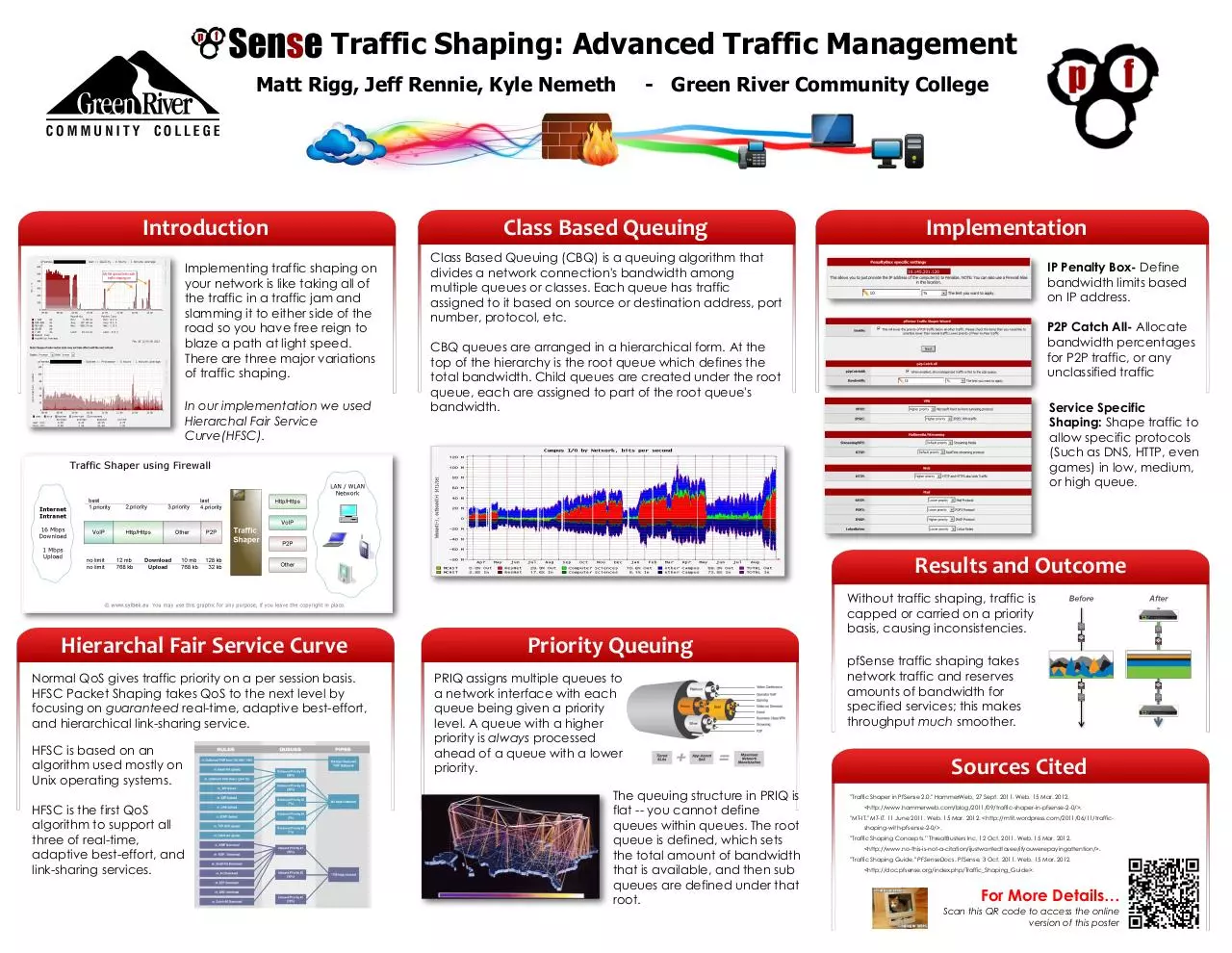
Traffic Shaping: Advanced Traffic Management
Matt Rigg, Jeff Rennie, Kyle Nemeth
Introduction
Implementing traffic shaping on
your network is like taking all of
the traffic in a traffic jam and
slamming it to either side of the
road so you have free reign to
blaze a path at light speed.
There are three major variations
of traffic shaping.
In our implementation we used
Hierarchal Fair Service
Curve(HFSC).
- Green River Community College
Class Based Queuing
Implementation
Class Based Queuing (CBQ) is a queuing algorithm that
divides a network connection's bandwidth among
multiple queues or classes. Each queue has traffic
assigned to it based on source or destination address, port
number, protocol, etc.
IP Penalty Box- Define
bandwidth limits based
on IP address.
P2P Catch All- Allocate
bandwidth percentages
for P2P traffic, or any
unclassified traffic
CBQ queues are arranged in a hierarchical form. At the
top of the hierarchy is the root queue which defines the
total bandwidth. Child queues are created under the root
queue, each are assigned to part of the root queue's
bandwidth.
Service Specific
Shaping: Shape traffic to
allow specific protocols
(Such as DNS, HTTP, even
games) in low, medium,
or high queue.
IMPLEMENTATION
Results and Outcome
Without traffic shaping, traffic is
capped or carried on a priority
basis, causing inconsistencies.
Hierarchal Fair Service Curve
Normal QoS gives traffic priority on a per session basis.
HFSC Packet Shaping takes QoS to the next level by
focusing on guaranteed real-time, adaptive best-effort,
and hierarchical link-sharing service.
HFSC is based on an
algorithm used mostly on
Unix operating systems.
HFSC is the first QoS
algorithm to support all
three of real-time,
adaptive best-effort, and
link-sharing services.
Priority Queuing
PRIQ assigns multiple queues to
a network interface with each
queue being given a priority
level. A queue with a higher
priority is always processed
ahead of a queue with a lower
priority.
The queuing structure in PRIQ is
flat -- you cannot define
queues within queues. The root
queue is defined, which sets
the total amount of bandwidth
that is available, and then sub
queues are defined under that
root.
pfSense traffic shaping takes
network traffic and reserves
amounts of bandwidth for
specified services; this makes
throughput much smoother.
Sources Cited
"Traffic Shaper in PfSense 2.0." HammerWeb, 27 Sept. 2011. Web. 15 Mar. 2012.
<http://www.hammerweb.com/blog/2011/09/traffic-shaper-in-pfsense-2-0/>.
"MT-IT." MT-IT. 11 June 2011. Web. 15 Mar. 2012. <http://mtit.wordpress.com/2011/06/11/trafficshaping-with-pfsense-2-0/>.
"Traffic Shaping Concepts.” ThreatBusters Inc, 12 Oct. 2011. Web. 15 Mar. 2012.
<http://www.no-this-is-not-a-citation/ijustwantedtosee/ifyouwerepayingattention/>.
"Traffic Shaping Guide." PFSenseDocs. PfSense, 3 Oct. 2011. Web. 15 Mar. 2012.
<http://doc.pfsense.org/index.php/Traffic_Shaping_Guide>.
For More Details…
Scan this QR code to access the online
version of this poster
�
 Historical archive . public document