Adventures in Math & Science
AIMS Times
V O LUME 11, I SSUE 9
D ECEMB ER 2 011
Inside this issue:
Director’s Chair
Merry Christmas
AIMS Family!!!!
I absolutely love this
time of year! Celebrating with family and
loved ones, reflecting on
the things that God has
done for me in my life
and helping others are
things I love!
I hope that each of you
have a very Merry
Christmas and Happy
New Year! In the
meantime, do not forget
to send or have your
counselor send us your
final grade reports!
Also, if you have not
turned in your
summer confirmation form, do
so ASAP! We
need to know how
many slots are
open to fill with
new students for
our summer
Dr. Sarr & Family @ Mae Mae’s for the
component!
Holidays!
CongratulaEnjoy your vacation!
tions to the students who
We look forward to
made the A and B
working with you in the
Honor Roll this last
New Year (2012)!
term! We are proud of
Love,
you! Keep up the good
work! Maybe next time
Doris
more of you will be on
the AIMS Honor Roll!
Keep working hard!
Director’s Chair
1
Administrative Assistant
1
Coordinators’ Corners
2
Career Profile: Ecologist
3
Financial Literacy
4
Parents’ Corner
5
The Real Story of Christmas
7
AIMS Honor Roll
9
Schedule At-A-Glance
Special points of interest:
• Career Profile—Ecologist pg. 3
• Financial Literacy—Managing
Money pg. 4
• Parents’ Corner—Are parents
relevant to students’ learning?
• Santa’s Nice List pg. 9
Season’s Greeting from the Administrative Assistant
Hi Everyone,
I'm so happy that the Holiday
Season is here….
The days leading up to
Christmas are so refreshing;
with the everyone coming
and going and doing things
to make the next person
happy, that's the way we
should be on a daily bases.
We are all so blessed and we
should be thankful for all
that we have. No matter
where you find yourself, we
are in the middle. no matter
what the situation. There will
always be someone that is
better off or worse off than
you so you see "We Are In
The Middle."
Do your best and strive to
make your life happy and the
people around you happy.
Love as many people as you
can in life because you can
never get enough love.
Study hard, have fun, relax
your mind, and be safe this
Holiday Season!
Looking forward to seeing
you all in the New Year!
Gail
P.S. Merry Christmas and
May your wishes comes true!
• Schedule At-A-Glance pg. 10
10
�
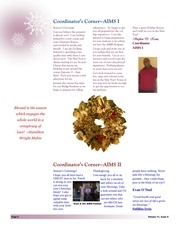
Coordinator’s Corner—AIMS I
Season’s Greetings!
Can you believe this semester
is almost over? I am looking
forward to a very comfy and
cozy Christmas Season
surrounded by family and
friends. I am also looking
forward to spending some
quality time with those I care
about most. The New Year is
always exciting for me because
I know that means my
birthday is just around the
corner (January 11 –hint
hint). Each year means a new
adventure for me.
January also means big steps
for our Bridge Students as we
begin to prepare for college
admittance. So happy to get
you all prepared for the college experience. I am also
pleased to begin preparation
for new students to be admitted into the AIMS Program.
I hope each and every one of
you realizes that we are here
for your benefit. Use us as a
resource and a tool to get the
most out of your educational
experience. Nothing pleases
us more than your success!
Have a great Holiday Season
and I will see you in the New
Year!
Stephen D. Keene,
Coordinator
AIMS I
Let’s look forward to some
fun trips and cultural activities in the New Year! Some of
you may even be lucky enough
to get the opportunity to see
me perform.
Blessed is the season
which engages the
whole world in a
conspiracy of
love! ~Hamilton
Wright Mabie
Coordinator’s Corner—AIMS II
Season’s Greetings!
Thanksgiving.
I hope you all have had a
I encourage you all to sit
GREAT year so far. Finish
back for a moment
it strong so you
and reflect on all of
can rest easy
your blessings. Take
over Christmas
a look around and I’ll
break! I also
guarantee you that
hope you got to
can see others who
spend some
valuable time
are MUCH less
Evan & His AIMS Family!
with your famifortunate. Some
lies over
Page 2
people have nothing. Never
take life’s blessings for
granted…they could disappear at the blink of an eye!!
Evan O'Neal
“Good health and good
sense are two of life's greatest blessings.”
Publilius Syrus
Volume 11, Issue 9
�
Career Profile: Ecologist
WHAT DO ECOLOGISTS
DO?
The work of ecologists is
extremely important. Anything that involves whole
organisms and the living and
non-living things around
them involves ecology.
Whether they investigate
urban, suburban, rural, forest, desert, farm, fresh water,
estuarine, or marine environments, ecologists help us
understand the connections
between organisms and their
environment.
Ecologists are employed in
many different places - universities, government agencies, consulting firms, research laboratories, museums, field stations, parks
and recreation areas, and
industry - and their salaries
are similar to other employees with the same amount of
experience and academic
training.
There is something for everyone in the field of ecology - jobs exist for all experience
levels and abilities. Despite
the differences in their chosen specialties, all ecologists
are scientists who share an
intense curiosity about how
life works on this planet.
•
•
•
•
Ecologists...
•
•
•
•
•
•
teach and advise students;
give advice to local,
state and federal policy
makers;
communicate with coworkers, students, and
the public;
solve environmental
problems;
conduct research outdoors and in laboratories; and
help manage natural
resources.
•
WHAT KINDS OF JOBS
ARE THERE?
AIMS Times
•
•
•
•
Environmental Consultants - assess the ecological impacts of conservation, development,
and industry projects
and recommend solutions to environmental
problems
Natural Resource Managers - manage ecological resources for public
and private organizations
Park Naturalists- develop and deliver education programs to students of all ages
Research Assistants collect and analyze data
in the field and lab
Research Scientists investigate and evaluate
new ideas and problems
through field or lab
work, leading teams of
scientists
Restoration Ecologists plan, organize, and carry
out programs to reestablish natural ecosystems
University/College
Professors - conduct
research and teach at
the undergraduate and
graduate levels
Program Managers develop ways to disseminate and use ecological
knowledge for policy
makers and the general
public
WHAT KIND OF BACKGROUND DO I NEED?
Ecologists specialize in the
links between living things
and their environment so
you will need to have a
strong background in the life
sciences, such as zoology,
microbiology, and botany, as
well as a good understanding
of physical, chemical, and
earth sciences. Computers
are essential tools, and the
more experience you have
with spreadsheets, word
processing, graphics, and use
of the web, the better. All
ecologists rely upon mathematics to measure, describe,
and make predictions about
the natural world.
Ecologists need to communicate ideas with those around
them, so it is extremely important to get a lot of experience writing and making
oral presentations. Because
environmental challenges
require working with people
and ideas from disciplines
beyond the natural and
physical sciences, it also is
useful for ecologists to know
something about economics
and other social sciences and
engineering.
Remember
This December,
That love weighs
more than gold!
~Josephine Dodge
Daskam Bacon
Page 3
�
FINANCIAL LITERACY—Managing money: Students a
bust / High school seniors fail miserably on finance test
Christmas is for
children. But it is for
grown-ups too. Even if
it is a headache, a chore,
and nightmare, it is a
period of necessary
defrosting of chill and
hide-bound
High school seniors don't
make the grade when it
comes to financial literacy,
according to a national survey released today that says
knowledge about managing
money, investing and saving
has gone from bad to worse.
Students answered only 50
percent of questions correctly on a survey, down
from about 52 percent in
2000 and 57 percent in
1997, said Dara Duguay,
executive director of the
Jump$tart Coalition for Personal Financial Literacy in
Washington, D.C.
"Our hope is that the latest
survey results will compel
superintendents to place a
high priority on funding
innovative personal finance
education programs when
applying for the money,"
Duguay said today.
The survey, conducted in
December, January and
February, consisted of a
written 45-minute examination administered to 4,024
12th graders in 183 schools
across the country. On average, participants answered
50.2 percent of the questions -- a failing grade.
Finance experts cited the
findings today as reasons
why schools should ensure
that they teach students the
basic skills to be financially
competent.
"Modern life is such that
almost from the get-go, as
people enter into the job
market, they have to make
economic decisions and
financial decisions," Dwight
Jaffee, a professor of banking, finance and real state at
the Haas School of Business
at the University of California at Berkeley, said today.
"You really have to understand the 'rules of the road'
in order to make decisions
in a good way."
Lewis Mandell, professor of
finance and managerial economics at the University at
Buffalo School of Management, who researched the
students' responses, agreed.
"In spite of the fact that
pretty much everybody is
alerted to the need for better
financial education, we are
not doing much of it, and
where we are doing it, we're
just not doing a good
enough job," he said.
Mandell said any claims
that high school seniors are
too young to be knowledgeable of basic finances are
misguided. Many students
will become adults in high
school and will be solicited
by credit card companies, he
said.
Mandell said whether you
go to Stanford or San Francisco State is "not all that
important" as compared to
"whether you know what a
401(k) is and how to invest
in it."
Among the findings from
the study, which comes as
the coalition recognizes
April as Financial Literacy
for Youth Month:
Henry K. Lee, Chronicle
Staff Writer
hearts. ~Lenora
Mattingly Weber
Page 4
DECEMBER BIRTHDAYS!
JENIFER AXTELL
TIERA MACKINS
RAFIEL BANKS
SASHA MONTGOMERY
MACIE BRITT
EVAN O’NEAL
ADAM ELLIS
TRISHA STINSON
Volume 11, Issue 9
�
PARENTS’ CORNER—Adolescence: Are Parents Relevant to
Students' High School Achievement and Post-Secondary Attainment?
About Family Involvement
Research Digests
Harvard Family Research
Project's (HFRP) Family
Involvement Research Digests summarize research
written and published by
non-HFRP authors and/or
written by HFRP authors
but published by organizations other than HFRP. For
more information on the
research summarized in this
digest, please contact the
author at the address below.
For help citing this article,
click here.
Research Background
Adolescence is an intriguing
stage of development filled
with many physical, cognitive, social, and emotional
changes. At the same time,
the increase in academic
demands and the complexity
of the school structure make
the task of academic success
for adolescents even more
difficult. Because parent
involvement has been
shown to be a very important positive force in a
child's life (Patrikakou,
Weissberg, Redding & Walberg, in press), one would
expect that during such a
critical and demanding
phase the two most important environments in child
development, home and
school, would increase their
collaboration. The opposite
though is true: As children
progress through school,
parent involvement declines
dramatically (Zill & Nord,
1994). Several factors contribute to this paradoxical
decline: the more complex
structure of middle and high
schools, the demanding curricula that can be intimidatAIMS Times
ing to parents, and the fewer
school outreach efforts to
involve parents. Or, is this
decline of parent involvement just an indication of an
underlying decline of parent
influence over adolescents?
This digest will explore
paths by which parental
involvement impacts
achievement in high school
and beyond.
Research Methods
Data for this investigation
were drawn from the National Educational Longitudinal Study (NELS), an
extensive longitudinal
study, which has been constructed to follow a cohort
of students from the eighth
grade through high school,
college, and into the workforce. The first wave of data
were collected in 1988
when participants were in
eighth grade and they have
been resurveyed four times
(in 1990, 1992, 1994, and
2000).
The model used to explore
parent involvement influences was constructed using
theoretical and empirical
elements in the broader area
of parent influences and
academic success. The
model consists of three
blocks of influence: first,
background factors such as
gender and prior achievement, and parent involvement factors such as parent
expectations and parentchild communication; second, the adolescent's perceptions of the parent involvement factors; and
third, student characteristics
such as time spent on homework and the student's own
academic expectations.
The model was tested using
structural modeling, a statistical procedure which estimates both direct and indirect effects that different
factors have on the outcome
under investigation. The
two primary outcomes
tested were academic
achievement in high school
(measured by standardized
scores) and post-secondary
attainment (measured by a 6
-point scale ranging from
some post-secondary education but no degree attained
to Ph.D. or a professional
degree attained).
Research Findings
Several of the parent involvement factors measured
when the adolescents were
in eighth grade had significant and lasting effects on
the academic achievement
in later grades in high
school, as well as on postsecondary attainment. Some
of the paths influencing
both academic achievement
in high school and postsecondary attainment involve parent expectations
and include the following:
I love the Christmastide, and yet,
I notice this, each
year I live;
I always like the gifts
I get,
But how I love the
gifts I give!
~Carolyn Wells
Parent Expectations
Achievement
The further in school parents believed their adolescents would go, the higher
the adolescents' academic
achievement.
Parent Expectations
Perception of Parent Expectations
Student
Expectations
Achievement
The further in school
Page 5
�
Adolescence: Are Parents Relevant to Students' High School
Achievement and Post-Secondary Attainment? (Continued)
parents believed their adolescents would go, the
clearer the adolescents' perception of such expectations, the higher their own
academic expectations, the
higher their academic
achievement.
Parent Expectations
Perception of Parent Expectations
Time
Spent on Homework
Achievement
‘Tis blessed to bestow,
and yet,
Could we bestow the
gifts we get,
And keep the ones we
give away,
How happy were our
Christmas day!
~Carolyn Wells
The further in school parents believed their adolescents would go, the clearer
the adolescents' perception
of such expectations, the
more time they spent on
homework, the higher their
academic achievement. In
agreement with findings
from other studies
(Catsambis, 2001), high
educational expectations
constitute a powerful way
through which parents can
encourage continuously the
educational attainments of
their adolescents in high
school and beyond.
Implications for Teacher
Preparation and School
Practice
The long-lasting effects that
parent involvement variables have on the academic
achievement of adolescents
and young adults indicate
that parent involvement
during high school and beyond still remains an important source of guidance and
support for the developing
individual.
Often, both parents and
school personnel misinterpret the adolescents' desire
for autonomy as a develop-
Page 6
mental barrier to family
involvement. However,
studies have indicated that
such a desire for autonomy
serves as a moderator of
preferences for certain types
of involvement over others,
rather than as a barrier to
any type of parent involvement (Xu, 2002). Secondary
education students believe
that they can do better at
school if they know that
their families are interested
in their schoolwork and
expect them to succeed, thus
challenging the prevalent
view that adolescents do not
want their parents involved
at all.
Also, parent involvement
should not be viewed and
defined in too narrow terms,
such as direct involvement
in homework completion,
because the increasingly
complex demands of the
high school curriculum
would prohibit many parents from being involved in
that way. However, findings
reported in this digest indicate a strong form of parent
involvement is expectations.
Parents who hold high expectations for their teens,
communicate them clearly
and encourage their adolescents to work hard in order
to attain them, can make a
difference in students' success.
Teacher Preparation in
Family Involvement
Robust teacher preparation
for the schools of the 21st
century should reflect the
multitude of research findings pointing to the importance that parent involvement has in all stages of the
educational process. However, only a few teacher
preparation institutions have
reported offering a course
on family involvement, and
even then as an elective.
Several institutions report
having some topic—usually
parent-teacher conferences—relevant to parent
involvement integrated into
another course (Chavkin, in
press).
Infused in some other
course, or taught separately,
preservice teachers should
have a comprehensive picture of the many benefits of
a broadly defined parent
involvement, as well as be
aware of key areas that can
make them more effective
when working with students
and their families (Epstein,
2001; Shartrand, Weiss,
Kreider & Lopez, 1997).
Especially making teachers
who will teach in middle
and high schools—where
parent involvement is not an
expected part of the educational process—aware of the
influential effects of parent
involvement is essential.
For example, required
courses about adolescent
development should debunk
long-standing myths and
inform prospective middle
and high school teachers of
the power that parent involvement has to positively
affect achievement. Empowered teachers will empower parents to be involved and expect more
from their adolescents. Empowered parents can inspire
their teens to do better at
school and in life.
Volume 11, Issue 9
�
The Real Story of Christmas
I. When was Jesus
born?
A. Popular myth puts his
birth on December 25th in
the year 1 C.E.
B. The New Testament
gives no date or year for
Jesus’ birth. The earliest
gospel – St. Mark’s, written about 65 CE – begins
with the baptism of an
adult Jesus. This suggests that the earliest
Christians lacked interest
in or knowledge of Jesus’
birth date.
C. The year of Jesus
birth was determined by
Dionysius Exiguus, a
Scythian monk, “abbot of
a Roman monastery. His
calculation went as follows:
a. In the Roman, pre
-Christian era, years were
counted from ab urbe
condita (“the founding of
the City” [Rome]). Thus 1
AUC signifies the year
Rome was founded, 5
AUC signifies the 5th year
of Rome’s reign, etc.
b. Dionysius received
a tradition that the Roman emperor Augustus
reigned 43 years, and
was followed by the emperor Tiberius.
c. Luke 3:1,23 indicates that when Jesus
turned 30 years old, it
was the 15th year of Tiberius reign.
d. If Jesus was 30
years old in Tiberius’
reign, then he lived 15
years under Augustus
(placing Jesus birth in
Augustus’ 28th year of
reign).
e. Augustus took
power in 727
AIMS Times
AUC. Therefore, Dionysius put Jesus birth in
754 AUC.
f. However, Luke
1:5 places Jesus’ birth in
the days of Herod, and
Herod died in 750 AUC –
four years before the year
in which Dionysius places
Jesus birth.
D. Joseph A. Fitzmyer –
Professor Emeritus of
Biblical Studies at the
Catholic University of
America, member of the
Pontifical Biblical Commission, and former
president of the Catholic
Biblical Association –
writing in the Catholic
Church’s official commentary on the New Testament[1], writes about
the date of Jesus’ birth,
“Though the year [of Jesus birth is not reckoned
with certainty, the birth
did not occur in AD
1. The Christian era,
supposed to have its
starting point in the year
of Jesus birth, is based
on a miscalculation introduced ca. 533 by Dionysius Exiguus.”
E. The DePascha Computus, an anonymous
document believed to
have been written in
North Africa around 243
CE, placed Jesus birth on
March 28. Clement, a
bishop of Alexandria (d.
ca. 215 CE), thought Jesus was born on November 18. Based on historical records, Fitzmyer
guesses that Jesus birth
occurred on September
11, 3 BCE.
on December 25?
A. Roman pagans first
introduced the holiday of
Saturnalia, a week long
period of lawlessness
celebrated between December 17-25. During
this period, Roman courts
were closed, and Roman
law dictated that no one
could be punished for
damaging property or
injuring people during the
weeklong celebration. The festival began
when Roman authorities
chose “an enemy of the
Roman people” to represent the “Lord of Misrule.” Each Roman community selected a victim
whom they forced to indulge in food and other
physical pleasures
throughout the week. At
the festival’s conclusion,
December 25th, Roman
authorities believed they
were destroying the
forces of darkness by
brutally murdering this
innocent man or woman.
B. The ancient Greek
writer poet and historian
Lucian (in his dialogue
entitled Saturnalia) describes the festival’s observance in his time. In
addition to human sacrifice, he mentions these
customs: widespread intoxication; going from
house to house while
singing naked; rape and
other sexual license; and
consuming humanshaped biscuits (still produced in some English
and most German bakeries during the Christmas
season).
Like snowflakes, my
Christmas memories
gather and dance each beautiful,
unique and too soon
gone. ~Deborah
Whipp
II. How Did Christmas
Come to Be Celebrated
Page 7
�
The Real Story of Christmas
It is the most human and
kindly of seasons, as fully
penetrated and irradiated
with the feeling of human
brotherhood, which is the
essential spirit of
Christianity, as the month
of June with sunshine and
the balmy breath of
roses. ~George William
Curtis
Page 8
C. In the 4th century CE,
Christianity imported the
Saturnalia festival hoping
to take the pagan masses
in with it. Christian leaders succeeded in converting to Christianity large
numbers of pagans by
promising them that they
could continue to celebrate the Saturnalia as
Christians.[2]
D. The problem was that
there was nothing intrinsically Christian about Saturnalia. To remedy this,
these Christian leaders
named Saturnalia’s concluding day, December
25th, to be Jesus’ birthday.
E. Christians had little
success, however, refining the practices of Saturnalia. As Stephen Nissenbaum, professor history at the University of
Massachussetts, Amherst, writes, “In return for
ensuring massive observance of the anniversary
of the Savior’s birth by
assigning it to this resonant date, the Church for
its part tacitly agreed to
allow the holiday to be
celebrated more or less
the way it had always
been.” The earliest
Christmas holidays were
celebrated by drinking,
sexual indulgence, singing naked in the streets
(a precursor of modern
caroling), etc.
F. The Reverend Increase Mather of Boston
observed in 1687 that
“the early Christians
who first observed the
Nativity on December 25
did not do so thinking that
Christ was born in that
Month, but because the
Heathens’ Saturnalia was
at that time kept in Rome,
and they were willing to
have those Pagan Holidays metamorphosed
into Christian
ones.”[3] Because of its
known pagan origin,
Christmas was banned
by the Puritans and its
observance was illegal in
Massachusetts between
1659 and 1681.[4] However, Christmas was and
still is celebrated by most
Christians.
G. Some of the most
depraved customs of the
Saturnalia carnival were
intentionally revived by
the Catholic Church in
1466 when Pope Paul II,
for the amusement of his
Roman citizens, forced
Jews to race naked
through the streets of the
city. An eyewitness account reports, “Before
they were to run, the
Jews were richly fed, so
as to make the race more
difficult for them and at
the same time more
amusing for spectators. They ran… amid
Rome’s taunting shrieks
and peals of laughter,
while the Holy Father
stood upon a richly ornamented balcony and
laughed heartily.”[5]
H. As part of the Saturnalia carnival throughout
the 18th and 19th centuries CE, rabbis of the
ghetto in Rome were
forced to wear clownish
outfits and march through
the city streets to the
jeers of the crowd, pelted
by a variety of missiles.
When the Jewish community of Rome sent a
petition in1836 to Pope
Gregory XVI begging him
to stop the annual Saturnalia abuse of the Jewish
community, he responded, “It is not opportune to make any innovation.”[6] On December
25, 1881, Christian leaders whipped the Polish
masses into Antisemitic
frenzies that led to riots
across the country. In
Warsaw 12 Jews were
brutally murdered, huge
numbers maimed, and
many Jewish women
were raped. Two million
rubles worth of property
was destroyed.
Volume 11, Issue 9
�
Santa’s Nice List—AIMS Honor Roll Fall 2011!
AIMS I
Briana Benford
Mary Cooperman
Tim Grove
Sarah McDowell
Sasha Montgomery
Emily Mulcahy
Quayvon Sanders
Cisilie Taft
Zach Warbritton
Passion Wilson
Austin Wisniewsk
Wisniewski
AIMS II
Alexandria Burns
Rafiel Banks
Gianna Douglas
Douglas--Shaw
Martine Lopez
Vivian Parham
Azia Rouse
Alexandria Taylor
Alexis Taylor
Ken'yelle Thomas
Dakota Tucker
Megan Warren
Erica Youngblood
May the spirit of
Christmas bring you
peace,
The gladness of
Christmas give you hope,
The warmth of
Christmas grant you
love.
~Author Unknown
AIMS Times
Page 9
�
A D V EN TU R ES IN M A TH
& S C I EN C E
240 Blackburn Science Building
Murray, KY 42071
AIMS STAFF
Dr. Doris Sarr,
Director AIMS I & II—dclarksarr@murraystate.edu
Phone: 1-877-424-6777
Fax: 270-809-4351
E-mail: www.murraystate.edu/aims
Stephen D. Keene,
Coordinator—AIMS I—skeene@murraystate.edu
AIMS
Evan O’Neal,
Coordinator— AIMS II—eoneal@murraystate.edu
Gail Woolridge,
Administrative Assistant—gwoolridge@murraystate.edu
SCHEDULE AT-A-GLANCE
December
February
May
TBA Dinner @ Patti’s Restaurant and
Variery, Music, Memorie & More
Show! Honor Roll Students—Invitation
Only!
18th KY TRiO Day at Berea College
25th –29th 40th Annual SAEOPP
Conference
28th
10th
March
10:00am
MSU Fall Commencement
19 University Closed through
January 2, 2012
16th Martin Luther King Jr. Day
21st
10:00am—1:00pm
Mandatory Bridge Workshop II/AIMS
Spring Workshop
31st
AIMS Cultural Event
Spamalot –Luther F. Carson Center
5:00pm Dinner—TBA
Bridge 2012 Move-In Day
29th
Summer Classes Begin
16th AIMS Application Deadline
June
1st – 3rd
April
TBA
January
2:00pm – 4:00pm
10
AIMS Spring College Tour
st
21
9:00am – 12:00pm
AIMS Summer Orientation
251 Blackburn Science Building
27th
AIMS Cultural Event
Boyz II Men—Luther F. Carson Center
5:00 Dinner—TBA
th
27th
28
th
29th
Bridge Weekend
Undergraduate Move-In Day
Bridge Graduation
Cultural Extravaganza
Closing Symposium
th
29 – July 3rd End of Summer Trip TBA
�
 Historical archive . public document