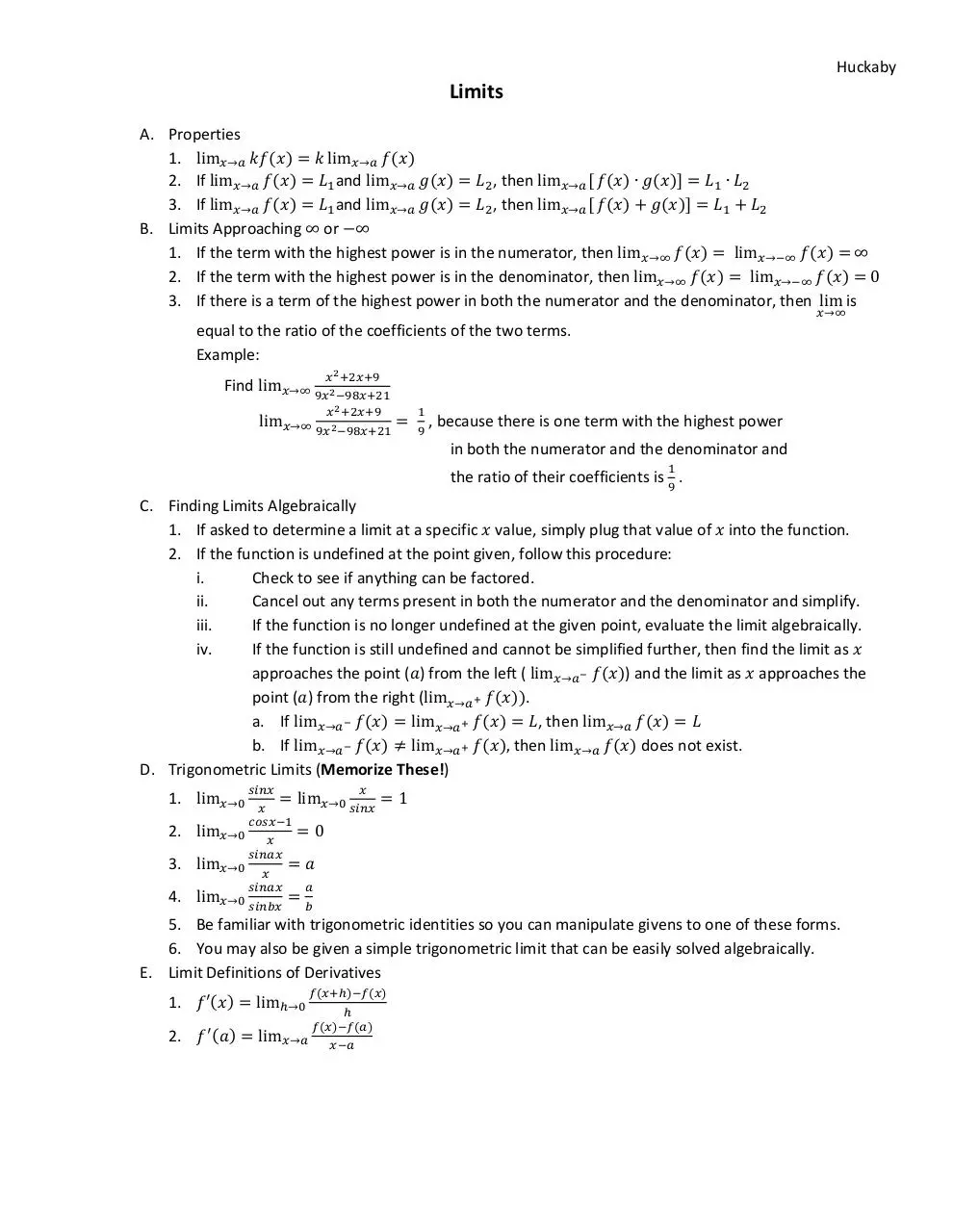
Huckaby
Limits
A. Properties
1.
2. If
and
, then
3. If
and
, then
B. Limits Approaching or
1. If the term with the highest power is in the numerator, then
2. If the term with the highest power is in the denominator, then
3. If there is a term of the highest power in both the numerator and the denominator, then
is
equal to the ratio of the coefficients of the two terms.
Example:
Find
, because there is one term with the highest power
in both the numerator and the denominator and
the ratio of their coefficients is .
C. Finding Limits Algebraically
1. If asked to determine a limit at a specific value, simply plug that value of into the function.
2. If the function is undefined at the point given, follow this procedure:
i.
Check to see if anything can be factored.
ii.
Cancel out any terms present in both the numerator and the denominator and simplify.
iii.
If the function is no longer undefined at the given point, evaluate the limit algebraically.
iv.
If the function is still undefined and cannot be simplified further, then find the limit as
approaches the point ( ) from the left (
) and the limit as approaches the
point ( ) from the right (
.
a. If
, then
b. If
then
does not exist.
D. Trigonometric Limits (Memorize These!)
1.
2.
3.
4.
5. Be familiar with trigonometric identities so you can manipulate givens to one of these forms.
6. You may also be given a simple trigonometric limit that can be easily solved algebraically.
E. Limit Definitions of Derivatives
1.
2.
�
 Historical archive . public document