NUCLEAR MATTERS
A Practical Guide
�
Form Approved
OMB No. 0704-0188
Report Documentation Page
Public reporting burden for the collection of information is estimated to average 1 hour per response, including the time for reviewing instructions, searching existing data sources, gathering and
maintaining the data needed, and completing and reviewing the collection of information. Send comments regarding this burden estimate or any other aspect of this collection of information,
including suggestions for reducing this burden, to Washington Headquarters Services, Directorate for Information Operations and Reports, 1215 Jefferson Davis Highway, Suite 1204, Arlington
VA 22202-4302. Respondents should be aware that notwithstanding any other provision of law, no person shall be subject to a penalty for failing to comply with a collection of information if it
does not display a currently valid OMB control number.
1. REPORT DATE
3. DATES COVERED
2. REPORT TYPE
2008
00-00-2008 to 00-00-2008
4. TITLE AND SUBTITLE
5a. CONTRACT NUMBER
Nuclear Matters. A Practical Guide
5b. GRANT NUMBER
5c. PROGRAM ELEMENT NUMBER
6. AUTHOR(S)
5d. PROJECT NUMBER
5e. TASK NUMBER
5f. WORK UNIT NUMBER
7. PERFORMING ORGANIZATION NAME(S) AND ADDRESS(ES)
Office of the Deputy Assistant to the Secretary of Defense (Nuclear
Matters),The Pentagon Room 3B884,Washington,DC,20301-3050
9. SPONSORING/MONITORING AGENCY NAME(S) AND ADDRESS(ES)
8. PERFORMING ORGANIZATION
REPORT NUMBER
10. SPONSOR/MONITOR’S ACRONYM(S)
11. SPONSOR/MONITOR’S REPORT
NUMBER(S)
12. DISTRIBUTION/AVAILABILITY STATEMENT
Approved for public release; distribution unlimited
13. SUPPLEMENTARY NOTES
14. ABSTRACT
15. SUBJECT TERMS
16. SECURITY CLASSIFICATION OF:
a. REPORT
b. ABSTRACT
c. THIS PAGE
unclassified
unclassified
unclassified
17. LIMITATION OF
ABSTRACT
18. NUMBER
OF PAGES
Same as
Report (SAR)
270
19a. NAME OF
RESPONSIBLE PERSON
Standard Form 298 (Rev. 8-98)
Prescribed by ANSI Std Z39-18
�
Foreword
This practical guide to Nuclear Matters is an expanded and revised version of
the earlier Nuclear Weapons Stockpile Management Handbook and the Nuclear
Weapons Council Handbook. Originally published in 1991 for the use of
Action Officers associated with the Nuclear Weapons Council, previous
editions have been modified over time to meet the needs of the larger nuclear
weapons community as well as those outside the community who seek a better
understanding of the subject. Since the early 1990s, the U.S. Nuclear Weapons
Program has evolved significantly as a result of unilateral and bilateral arms
reductions and the end of underground nuclear testing in the United States;
successive editions of these books have been revised and restructured to reflect
these changes.
This book is intended to be an unofficial reference that explains the history
and development of the U.S. Nuclear Weapons Program as well as the current
activities associated with sustaining the U.S. nuclear deterrent. It is designed
to be useful, but it is neither authoritative nor directive. Please refer to the
applicable statute, regulation, Department of Defense Direction/Instruction, or
Department of Energy Order for definitive guidance in all areas related to the
U.S. Nuclear Weapons Program.
The content of Nuclear Matters: A Practical Guide is the sole responsibility of the
Office of the Deputy Assistant to the Secretary of Defense for Nuclear Matters.
Please forward substantive comments and revisions to:
Office of the Deputy Assistant to the Secretary of Defense
(Nuclear Matters)
The Pentagon
Room 3B884
Washington, DC 20301-3050
www.acq.osd.mil/ncbdp/nm
�
�
�
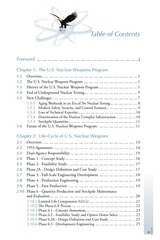
Table of Contents
Foreword .. ... . ... . ... . ... . ... . ... . ... . ... . ... . ... . ... . ... . ... . ... . ... . ... . ... . ... . i
Chapter 1: The U.S. Nuclear Weapons Program
Overview.. . ... . ... . ... . ... . ... . ... . ... . ... . ... . ... . ... . ... . ... . ... . ... . ... . ... . ... . ... 1
The U.S. Nuclear Weapons Program .. .. .. .. .. .. .. .. .. .. .. .. .. .. .. .. .. .. .. .. .. 1
History of the U.S. Nuclear Weapons Program .. .. .. .. .. .. .. .. .. .. .. .. .. .. .. 1
End of Underground Nuclear Testing.. .. .. .. .. .. .. .. .. .. .. .. .. .. .. .. .. .. .. .. .. 5
New Challenges .. .... .... .... .... .... .... .... .... .... .... .... .... .... .... .... .... .. 7
1.5.1 Aging Warheads in an Era of No Nuclear Testing .. . ... . ... . ... . ... . ... 8
1.5.2 Modern Safety, Security, and Control Features.. . ... . ... . ... . ... . ... . ... 9
1.5.3 Loss of Technical Expertise.. . ... . ... . ... . ... . ... . ... . ... . ... . ... . ... . ... . .. 10
1.5.4 Deterioration of the Nuclear Complex Infrastructure.. . ... . ... . ... . .. 10
1.5.5 Stockpile Quantities.. . ... . ... . ... . ... . ... . ... . ... . ... . ... . ... . ... . ... . ... . .. 11
1.6 Future of the U.S. Nuclear Weapons Program.. .... .... .... .... .... .... .... 11
1.1
1.2
1.3
1.4
1.5
Chapter 2: Life-Cycle of U.S. Nuclear Weapons
2.1
2.2
2.3
2.4
2.5
2.6
2.7
2.8
2.9
2.10
Overview.. . ... . ... . ... . ... . ... . ... . ... . ... . ... . ... . ... . ... . ... . ... . ... . ... . ... . ... . . 13
1953 Agreement.. .... .... .... .... .... .... .... .... .... .... .... .... .... .... .... .... 14
Dual-Agency Responsibility .. . ... . ... . ... . ... . ... . ... . ... . ... . ... . ... . ... . ... . . 15
Phase 1 - Concept Study .. . ... . ... . ... . ... . ... . ... . ... . ... . ... . ... . ... . ... . ... . . 16
Phase 2 - Feasibility Study .. .... .... .... .... .... .... .... .... .... .... .... .... .... 17
Phase 2A - Design Definition and Cost Study .. .... .... .... .... .... .... .... 17
Phase 3 - Full-Scale Engineering Development.. ... . ... . ... . ... . ... . ... . ... . 18
Phase 4 - Production Engineering .. .. .. .. .. .. .. .. .. .. .. .. .. .. .. .. .. .. .. .. .. .. . 19
Phase 5 - First Production .. .... .... .... .... .... .... .... .... .... .... .... .... .... 19
Phase 6 - Quantity Production and Stockpile Maintenance
and Evaluation .. . ... . ... . ... . ... . ... . ... . ... . ... . ... . ... . ... . ... . ... . ... . ... . ... . . 20
2.10.1 Limited-Life Components (LLCs).. .... .... .... .... .... .... .... .... .... . 21
2.10.2 The Phase 6.X Process .. .. .. .. .. .. .. .. .. .. .. .. .. .. .. .. .. .. .. .. .. .. .. .. .. .. .. 22
2.10.3 Phase 6.1 - Concept Assessment .. .. .. .. .. .. .. .. .. .. .. .. .. .. .. .. .. .. .. .. .. 23
2.10.4 Phase 6.2 - Feasibility Study and Option Down-Select .. .. .. .. .. .. .. 23
2.10.5 Phase 6.2A - Design Definition and Cost Study .. ... . ... . ... . ... . ... . 25
2.10.6 Phase 6.3 - Development Engineering.. ... . ... . ... . ... . ... . ... . ... . ... . 25
iii
�
2008
Nuclear Matters: A Practical Guide
2.10.7 Phase 6.4 - Production Engineering .. . ... . ... . ... . ... . ... . ... . ... . ... . .. 26
2.10.8 Phase 6.5 - First Production .. ... . ... . ... . ... . ... . ... . ... . ... . ... . ... . ... . 27
2.10.9 Phase 6.6 - Full-Scale Production.. . ... . ... . ... . ... . ... . ... . ... . ... . ... . .. 28
2.11 Phase 7 - Retirement and Dismantlement.. . ... . ... . ... . ... . ... . ... . ... . ... . . 28
Chapter 3: Nuclear Weapons Program Force Structure
3.1
3.2
3.3
3.4
3.5
3.6
3.7
Overview.. . ... . ... . ... . ... . ... . ... . ... . ... . ... . ... . ... . ... . ... . ... . ... . ... . ... . ... . . 29
U.S. Defense Objectives .. .. .. .. .. .. .. .. .. .. .. .. .. .. .. .. .. .. .. .. .. .. .. .. .. .. .. .. . 29
Employment of Nuclear Weapons .. .. .. .. .. .. .. .. .. .. .. .. .. .. .. .. .. .. .. .. .. .. . 31
U.S. Nuclear Stockpile Composition.. ... . ... . ... . ... . ... . ... . ... . ... . ... . ... . 33
Nuclear Stockpile Quantities.. . ... . ... . ... . ... . ... . ... . ... . ... . ... . ... . ... . ... . . 34
U.S. Nuclear Weapons Delivery Systems .. .. .. .. .. .. .. .. .. .. .. .. .. .. .. .. .. .. . 34
3.6.1 Bombers.. ... . ... . ... . ... . ... . ... . ... . ... . ... . ... . ... . ... . ... . ... . ... . ... . ... . 38
3.6.2 Submarines.. .... .... .... .... .... .... .... .... .... .... .... .... .... .... .... .... . 39
3.6.3 ICBMs .. .... .... .... .... .... .... .... .... .... .... .... .... .... .... .... .... .... . 41
3.6.4 Dual Capable Aircraft (DCA).. . ... . ... . ... . ... . ... . ... . ... . ... . ... . ... . .. 41
DoD Strategic and Non-Strategic Operational Bases .. .... .... .... .... .... 42
Chapter 4: Nuclear Weapons Program Infrastructure
4.1 Overview.. . ... . ... . ... . ... . ... . ... . ... . ... . ... . ... . ... . ... . ... . ... . ... . ... . ... . ... . . 45
4.1.1 Complex Transformation.. ... . ... . ... . ... . ... . ... . ... . ... . ... . ... . ... . ... . 46
4.1.2 The U.S. Nuclear Weapons Complex .. .... .... .... .... .... .... .... .... . 46
4.2 Stockpile Stewardship Program .. . ... . ... . ... . ... . ... . ... . ... . ... . ... . ... . ... . . 51
4.2.1 The Transition to a Science-Based Substitute .. ... . ... . ... . ... . ... . ... . 52
4.2.2 Stockpile Stewardship Program Elements .. ... . ... . ... . ... . ... . ... . ... . 53
Chapter 5: Nuclear Weapons Surety
5.1 Overview.. . ... . ... . ... . ... . ... . ... . ... . ... . ... . ... . ... . ... . ... . ... . ... . ... . ... . ... . . 65
5.2 Dual Agency Surety Responsibilities.. .... .... .... .... .... .... .... .... .... .... 65
5.3 Nuclear Weapons System Safety.. . ... . ... . ... . ... . ... . ... . ... . ... . ... . ... . ... . . 65
5.3.1 The DoD and DOE Safety Programs .. ... . ... . ... . ... . ... . ... . ... . ... . 66
5.3.2 Nuclear Weapon Design Safety .. ... . ... . ... . ... . ... . ... . ... . ... . ... . ... . 66
5.4 Nuclear Weapons Security.. .... .... .... .... .... .... .... .... .... .... .... .... .... 72
5.4.1 DoD Nuclear Weapons Security Standard.. .. .. .. .. .. .. .. .. .. .. .. .. .. .. 72
5.4.2 DOE Safeguards and Security.. . ... . ... . ... . ... . ... . ... . ... . ... . ... . ... . .. 73
5.4.3 DoD and DOE Personnel Security.. ... . ... . ... . ... . ... . ... . ... . ... . ... . 74
5.4.4 Procedural Security.. .. .. .. .. .. .. .. .. .. .. .. .. .. .. .. .. .. .. .. .. .. .. .. .. .. .. .. .. 75
5.4.5 DoD and DOE Security Program Authorities .. . ... . ... . ... . ... . ... . .. 75
5.4.6 Programs of Cooperation .. . ... . ... . ... . ... . ... . ... . ... . ... . ... . ... . ... . .. 76
iv
�
Table of Contents
5.5 Nuclear Command and Control (NC2) and Use Control .. .. .. .. .. .. .. .. . 76
5.5.1 Nuclear Command and Control (NC2).. . ... . ... . ... . ... . ... . ... . ... . .. 77
5.5.2 Use Control Features.. .... .... .... .... .... .... .... .... .... .... .... .... .... . 77
5.5.3 The DoD Control Program .. ... . ... . ... . ... . ... . ... . ... . ... . ... . ... . ... . 79
5.5.4 The NNSA Control Program .. . ... . ... . ... . ... . ... . ... . ... . ... . ... . ... . .. 79
Chapter 6: Quality Assurance and Non-Nuclear Testing
6.1
6.2
6.3
6.4
6.5
6.6
Overview.. . ... . ... . ... . ... . ... . ... . ... . ... . ... . ... . ... . ... . ... . ... . ... . ... . ... . ... . . 81
The Evolution of Quality Assurance and Sampling.. .. .. .. .. .. .. .. .. .. .. .. . 82
Surveillance Transformation Project (STP) .. .... .... .... .... .... .... .... .... 84
Stockpile Laboratory Testing (SLT).. . ... . ... . ... . ... . ... . ... . ... . ... . ... . ... . . 84
Stockpile Flight Testing (SFT).. ... . ... . ... . ... . ... . ... . ... . ... . ... . ... . ... . ... . 85
Safety Validation and Reliability Estimates .. .... .... .... .... .... .... .... .... 86
Chapter 7: The Nuclear Weapons Council and Annual Reports
7.1 Overview.. . ... . ... . ... . ... . ... . ... . ... . ... . ... . ... . ... . ... . ... . ... . ... . ... . ... . ... . . 87
7.2 NWC History .. .. .. .. .. .. .. .. .. .. .. .. .. .. .. .. .. .. .. .. .. .. .. .. .. .. .. .. .. .. .. .. .. .. . 87
7.2.1 The Military Liaison Committee (MLC) .. .... .... .... .... .... .... .... . 88
7.2.2 The Blue Ribbon Task Group on Nuclear Weapons
Program Management .. .. .. .. .. .. .. .. .. .. .. .. .. .. .. .. .. .. .. .. .. .. .. .. .. .. .. 89
7.3 The NWC Today.. ... . ... . ... . ... . ... . ... . ... . ... . ... . ... . ... . ... . ... . ... . ... . ... . 90
7.4 NWC Organization and Members .. . ... . ... . ... . ... . ... . ... . ... . ... . ... . ... . . 91
7.5 NWC Responsibilities and Activities.. ... . ... . ... . ... . ... . ... . ... . ... . ... . ... . 92
7.6 NWC Procedures & Processes.. ... . ... . ... . ... . ... . ... . ... . ... . ... . ... . ... . ... . 93
7.7 NWC Subordinate Organizations .. .. .. .. .. .. .. .. .. .. .. .. .. .. .. .. .. .. .. .. .. .. . 94
7.7.1 The Nuclear Weapons Council Standing and
Safety Committee.. .... .... .... .... .... .... .... .... .... .... .... .... .... .... . 96
7.7.2 The Compartmented Advisory Committee.. . ... . ... . ... . ... . ... . ... . 100
7.7.3 The Transformation Coordinating Committee.. . ... . ... . ... . ... . ... . 102
7.7.4 The NWC Action Officers Group .. .... .... .... .... .... .... .... .... .... 103
7.7.5 The Nuclear Weapons Council Staff .. . ... . ... . ... . ... . ... . ... . ... . ... . 104
7.8 NWC Annual Reports .. .... .... .... .... .... .... .... .... .... .... .... .... .... ... 106
7.8.1 Nuclear Weapons Stockpile Memorandum and
Requirements Planning Document (NWSM/RPD) .. .. .. .. .. .. .. .. 106
7.8.2 NWC Report on Stockpile Assessments (ROSA).. .. .. .. .. .. .. .. .. .. 108
7.8.3 NWC Chairman’s Annual Report to Congress (CARC) .. . ... . ... . 110
7.8.4 Joint Surety Report (JSR).. .. .. .. .. .. .. .. .. .. .. .. .. .. .. .. .. .. .. .. .. .. .. .. 111
�
�
2008
Nuclear Matters: A Practical Guide
Chapter 8: The NCCS Committee of Principals
Overview.. . ... . ... . ... . ... . ... . ... . ... . ... . ... . ... . ... . ... . ... . ... . ... . ... . ... . ... 113
National Security Presidential Directive 28 (NSPD-28) .. .... .... .... ... 113
Nuclear Command and Control System (NCCS) .. ... . ... . ... . ... . ... . .. 114
The NCCS CoP .. .... .... .... .... .... .... .... .... .... .... .... .... .... .... .... ... 114
8.4.1 NCCS CoP History.. . ... . ... . ... . ... . ... . ... . ... . ... . ... . ... . ... . ... . ... . 115
8.4.2 NCCS CoP Responsibilities .. ... . ... . ... . ... . ... . ... . ... . ... . ... . ... . ... 115
8.4.3 The NCCS CoP Deputies Committee.. ... . ... . ... . ... . ... . ... . ... . ... 116
8.4.4 Nuclear Weapons Accident Response Subcommittee
(NWARS).. . ... . ... . ... . ... . ... . ... . ... . ... . ... . ... . ... . ... . ... . ... . ... . ... . 116
8.4.5 NCCS CoP Action Officers Group .. .. .. .. .. .. .. .. .. .. .. .. .. .. .. .. .. .. 116
8.5 DoD-Specific NSPD-28 Compliance Actions .. .... .... .... .... .... .... ... 117
8.6 DoD NSPD-28 Implementation Senior Management Oversight.. . ... 117
8.1
8.2
8.3
8.4
Appendix A: Basic Nuclear Physics
A.1 Overview.. . ... . ... . ... . ... . ... . ... . ... . ... . ... . ... . ... . ... . ... . ... . ... . ... . ... . ... 121
A.2 Atomic Structure.. ... . ... . ... . ... . ... . ... . ... . ... . ... . ... . ... . ... . ... . ... . ... . .. 121
A.3 Radioactive Decay.. . ... . ... . ... . ... . ... . ... . ... . ... . ... . ... . ... . ... . ... . ... . ... 124
A.4 Nuclear Reactions .. . ... . ... . ... . ... . ... . ... . ... . ... . ... . ... . ... . ... . ... . ... . ... 125
A.4.1 Fission.. . ... . ... . ... . ... . ... . ... . ... . ... . ... . ... . ... . ... . ... . ... . ... . ... . ... . 125
A.4.2 Fusion .. . ... . ... . ... . ... . ... . ... . ... . ... . ... . ... . ... . ... . ... . ... . ... . ... . ... . 129
A.5 Basic Weapon Designs.. . ... . ... . ... . ... . ... . ... . ... . ... . ... . ... . ... . ... . ... . ... 129
A.5.1 Achieving Supercritical Mass .. .. .. .. .. .. .. .. .. .. .. .. .. .. .. .. .. .. .. .. .. .. 130
A.5.2 Gun Assembly Weapons.. .... .... .... .... .... .... .... .... .... .... .... .... 131
A.5.3 Implosion Assembly Weapons.. . ... . ... . ... . ... . ... . ... . ... . ... . ... . ... . 131
A.5.4 Boosted Weapons .. .... .... .... .... .... .... .... .... .... .... .... .... .... .... 132
A.5.5 Staged Weapons .. . ... . ... . ... . ... . ... . ... . ... . ... . ... . ... . ... . ... . ... . ... . 133
A.5.6 Proliferation Considerations.. ... . ... . ... . ... . ... . ... . ... . ... . ... . ... . ... 133
Appendix B: The Effects of Nuclear Weapons
Overview.. . ... . ... . ... . ... . ... . ... . ... . ... . ... . ... . ... . ... . ... . ... . ... . ... . ... . ... 135
General Concepts and Terms.. . ... . ... . ... . ... . ... . ... . ... . ... . ... . ... . ... . ... 137
The Nuclear Fireball .. ... . ... . ... . ... . ... . ... . ... . ... . ... . ... . ... . ... . ... . ... . .. 138
Thermal Radiation.. . ... . ... . ... . ... . ... . ... . ... . ... . ... . ... . ... . ... . ... . ... . ... 139
B.4.1 Thermal Radiation Damage & Injury.. .... .... .... .... .... .... .... .... 139
B.4.2 Thermal Radiation Employment Factors .. .... .... .... .... .... .... .... 140
B.4.3 Thermal Radiation Protection.. . ... . ... . ... . ... . ... . ... . ... . ... . ... . ... . 141
B.5 Air Blast .. . ... . ... . ... . ... . ... . ... . ... . ... . ... . ... . ... . ... . ... . ... . ... . ... . ... . ... 141
B.5.1 Air Blast Damage & Injury .. .... .... .... .... .... .... .... .... .... .... .... 142
B.1
B.2
B.3
B.4
vi
�
Table of Contents
B.5.2 Air Blast Employment Factors.. . ... . ... . ... . ... . ... . ... . ... . ... . ... . ... . 143
B.5.3 Air Blast Protection .. . ... . ... . ... . ... . ... . ... . ... . ... . ... . ... . ... . ... . ... . 143
B.6 Ground Shock.. .. .. .. .. .. .. .. .. .. .. .. .. .. .. .. .. .. .. .. .. .. .. .. .. .. .. .. .. .. .. .. .. . 144
B.6.1 Ground Shock Damage & Injury.. . ... . ... . ... . ... . ... . ... . ... . ... . ... . 144
B.6.2 Ground Shock Employment Factors.. . ... . ... . ... . ... . ... . ... . ... . ... . 144
B.6.3 Ground Shock Protection.. .. .. .. .. .. .. .. .. .. .. .. .. .. .. .. .. .. .. .. .. .. .. .. 145
B.7 Surface Crater .. .. .. .. .. .. .. .. .. .. .. .. .. .. .. .. .. .. .. .. .. .. .. .. .. .. .. .. .. .. .. .. .. . 145
B.7.1 Surface Crater Damage & Injury.. . ... . ... . ... . ... . ... . ... . ... . ... . ... . 146
B.7.2 Surface Crater Employment Factors .. . ... . ... . ... . ... . ... . ... . ... . ... . 146
B.7.3 Surface Crater Protection .. .. .. .. .. .. .. .. .. .. .. .. .. .. .. .. .. .. .. .. .. .. .. .. 146
B.8 Underwater Shock.. . ... . ... . ... . ... . ... . ... . ... . ... . ... . ... . ... . ... . ... . ... . ... 146
B.8.1 Underwater Shock Damage & Injury .. .... .... .... .... .... .... .... .... 147
B.8.2 Underwater Shock Employment Factors.. . ... . ... . ... . ... . ... . ... . ... . 147
B.8.3 Underwater Shock Protection.. . ... . ... . ... . ... . ... . ... . ... . ... . ... . ... . 147
B.9 Initial Nuclear Radiation.. . ... . ... . ... . ... . ... . ... . ... . ... . ... . ... . ... . ... . ... 147
B.9.1 Initial Nuclear Radiation Damage & Injury .. .... .... .... .... .... .... 148
B.9.2 Initial Nuclear Radiation Employment Factors.. . ... . ... . ... . ... . ... . 149
B.9.3 Initial Nuclear Radiation Protection.. . ... . ... . ... . ... . ... . ... . ... . ... . 150
B.10 Residual Nuclear Radiation .. .. .. .. .. .. .. .. .. .. .. .. .. .. .. .. .. .. .. .. .. .. .. .. .. . 150
B.10.1 Residual Nuclear Radiation Damage & Injury.. . ... . ... . ... . ... . ... . 151
B.10.2 Residual Nuclear Radiation Employment Factors.. . ... . ... . ... . ... . 152
B.10.3 Residual Nuclear Radiation Protection .. .. .. .. .. .. .. .. .. .. .. .. .. .. .. .. 152
B.11 Biological Effects of Ionizing Radiation.. .... .... .... .... .... .... .... .... ... 153
B.11.1 Ionizing Radiation Damage & Injury.. .... .... .... .... .... .... .... .... 153
B.11.2 Ionizing Radiation Protection.. . ... . ... . ... . ... . ... . ... . ... . ... . ... . ... . 154
B.12 ElectroMagnetic Pulse (EMP) .. ... . ... . ... . ... . ... . ... . ... . ... . ... . ... . ... . .. 154
B.12.1 EMP Damage & Injury.. . ... . ... . ... . ... . ... . ... . ... . ... . ... . ... . ... . ... . 155
B.12.2 EMP Employment Factors.. . ... . ... . ... . ... . ... . ... . ... . ... . ... . ... . ... . 155
B.12.3 EMP Protection .. . ... . ... . ... . ... . ... . ... . ... . ... . ... . ... . ... . ... . ... . ... . 156
B.13 Transient Radiation Effects on Electronics (TREE) .. . ... . ... . ... . ... . ... 156
B.13.1 TREE Damage & Injury.. ... . ... . ... . ... . ... . ... . ... . ... . ... . ... . ... . ... 156
B.13.2 TREE Employment Factors .. ... . ... . ... . ... . ... . ... . ... . ... . ... . ... . ... 157
B.13.3 TREE Protection .. .... .... .... .... .... .... .... .... .... .... .... .... .... .... 157
B.14 Black-Out .. ... . ... . ... . ... . ... . ... . ... . ... . ... . ... . ... . ... . ... . ... . ... . ... . ... . .. 157
B.14.1 Black-Out Damage & Injury.. .. .. .. .. .. .. .. .. .. .. .. .. .. .. .. .. .. .. .. .. .. 157
B.14.2 Black-Out Employment Factors .. .. .. .. .. .. .. .. .. .. .. .. .. .. .. .. .. .. .. .. 158
B.14.3 Black-Out Protection .. ... . ... . ... . ... . ... . ... . ... . ... . ... . ... . ... . ... . ... 158
Appendix C: Nuclear Weapons Effects Survivability and Testing
C.1 Overview .. ... . ... . ... . ... . ... . ... . ... . ... . ... . ... . ... . ... . ... . ... . ... . ... . ... . ... . ... 159
C.2 Nuclear Weapons Effects Survivability.. . ... . ... . ... . ... . ... . ... . ... . ... . ... 161
vii
�
2008
Nuclear Matters: A Practical Guide
C.2.1 Nuclear Weapons Effects on Military Systems .. . ... . ... . ... . ... . ... . 161
C.2.2 Nuclear Weapons Effects on Personnel .. .. .. .. .. .. .. .. .. .. .. .. .. .. .. .. 164
C.2.3 Nuclear Weapons Effects Survivability Measures .. .. .. .. .. .. .. .. .. .. 164
C.3 Nuclear Weapons System Survivability.. . ... . ... . ... . ... . ... . ... . ... . ... . ... 166
C.3.1 Nuclear Force Survivability .. .... .... .... .... .... .... .... .... .... .... .... 167
C.3.2 Nuclear Command and Control Survivability .. . ... . ... . ... . ... . ... . 167
C.3.3 Missile Silos.. ... . ... . ... . ... . ... . ... . ... . ... . ... . ... . ... . ... . ... . ... . ... . ... 167
C.3.4 Containers.. .... .... .... .... .... .... .... .... .... .... .... .... .... .... .... .... 167
C.3.5 Weapons Storage Vault . . ... . ... . ... . ... . ... . ... . ... . ... . ... . ... . ... . ... . 168
C.4 Tests and Evaluation.. ... . ... . ... . ... . ... . ... . ... . ... . ... . ... . ... . ... . ... . ... . .. 168
C.4.1 Testing.. . ... . ... . ... . ... . ... . ... . ... . ... . ... . ... . ... . ... . ... . ... . ... . ... . ... . 168
C.4.2 X-ray Effects Testing.. . ... . ... . ... . ... . ... . ... . ... . ... . ... . ... . ... . ... . ... . 169
C.4.3 Gamma Dose-Rate Effects Testing.. .... .... .... .... .... .... .... .... .... 171
C.4.4 Total-Dose Effects Testing .. . ... . ... . ... . ... . ... . ... . ... . ... . ... . ... . ... . 172
C.4.5 Neutron Effects Testing.. . ... . ... . ... . ... . ... . ... . ... . ... . ... . ... . ... . ... . 172
C.4.6 EMP Effects Testing.. . ... . ... . ... . ... . ... . ... . ... . ... . ... . ... . ... . ... . ... . 172
C.4.7 Air-Blast Effects Testing.. . ... . ... . ... . ... . ... . ... . ... . ... . ... . ... . ... . ... . 173
C.4.8 Thermal Radiation Effects Testing .. .... .... .... .... .... .... .... .... .... 173
C.4.9 Shock Testing.. . ... . ... . ... . ... . ... . ... . ... . ... . ... . ... . ... . ... . ... . ... . ... . 174
Appendix D: Underground Nuclear Testing
D.1
D.2
D.3
D.4
Overview.. . ... . ... . ... . ... . ... . ... . ... . ... . ... . ... . ... . ... . ... . ... . ... . ... . ... . ... 175
The Early Years of the U.S. Nuclear Testing Program.. .... .... .... .... ... 175
The Transition to Underground Nuclear Testing (UGT) .. ... . ... . ... . .. 177
The Transition to 3-D Codes.. . ... . ... . ... . ... . ... . ... . ... . ... . ... . ... . ... . ... 181
Appendix E: Nuclear Weapons Accident Response
E.1 Overview.. . ... . ... . ... . ... . ... . ... . ... . ... . ... . ... . ... . ... . ... . ... . ... . ... . ... . ... 183
E.2 National Level Response Entities and Responsibilities .. .. .. .. .. .. .. .. .. . 184
E.2.1 Interagency – The NCCS Committee of Principals (CoP).. ... . ... 185
E.2.2 Department of Homeland Security .. .. .. .. .. .. .. .. .. .. .. .. .. .. .. .. .. .. 185
E.2.3 Department of State.. . ... . ... . ... . ... . ... . ... . ... . ... . ... . ... . ... . ... . ... . 187
E.2.4 Department of Defense.. . ... . ... . ... . ... . ... . ... . ... . ... . ... . ... . ... . ... . 188
E.3 DoD Response .. . ... . ... . ... . ... . ... . ... . ... . ... . ... . ... . ... . ... . ... . ... . ... . ... 188
E.3.1 DoD Nuclear Weapons Accident Guidance.. . ... . ... . ... . ... . ... . ... . 188
E.3.2 Accident Notification .. ... . ... . ... . ... . ... . ... . ... . ... . ... . ... . ... . ... . ... 189
E.3.3 DoD Response Forces .. .. .. .. .. .. .. .. .. .. .. .. .. .. .. .. .. .. .. .. .. .. .. .. .. .. 190
E.4 Interagency Response .. . ... . ... . ... . ... . ... . ... . ... . ... . ... . ... . ... . ... . ... . ... 193
E.4.1 Department of Energy.. .. .. .. .. .. .. .. .. .. .. .. .. .. .. .. .. .. .. .. .. .. .. .. .. .. 193
E.4.2 Department of Homeland Security .. .. .. .. .. .. .. .. .. .. .. .. .. .. .. .. .. .. 195
E.4.3 Department of State.. . ... . ... . ... . ... . ... . ... . ... . ... . ... . ... . ... . ... . ... . 195
viii
�
Table of Contents
E.4.4 Department of Justice .. .. .. .. .. .. .. .. .. .. .. .. .. .. .. .. .. .. .. .. .. .. .. .. .. .. 196
E.4.5 Other Cooperating Agencies .. .. .. .. .. .. .. .. .. .. .. .. .. .. .. .. .. .. .. .. .. .. 196
E.5
Training and Exercise Program .. .. .. .. .. .. .. .. .. .. .. .. .. .. .. .. .. .. .. .. .. .. .. . 197
E.5.1 Management .. . ... . ... . ... . ... . ... . ... . ... . ... . ... . ... . ... . ... . ... . ... . ... . 197
E.5.2 Exercises.. ... . ... . ... . ... . ... . ... . ... . ... . ... . ... . ... . ... . ... . ... . ... . ... . ... 197
E.5.3 Exercise Schedule .. .... .... .... .... .... .... .... .... .... .... .... .... .... .... 198
Appendix F: Classification
F.1 Overview.. . ... . ... . ... . ... . ... . ... . ... . ... . ... . ... . ... . ... . ... . ... . ... . ... . ... . ... 199
F.2 Information Classification .. .... .... .... .... .... .... .... .... .... .... .... .... ... 199
F.2.1 National Security Information.. . ... . ... . ... . ... . ... . ... . ... . ... . ... . ... . 199
F.2.2 Atomic Energy (Nuclear) Information.. ... . ... . ... . ... . ... . ... . ... . ... 200
F.3 Classifying Documents.. .... .... .... .... .... .... .... .... .... .... .... .... .... ... 203
F.3.1 Original Classification Authority.. . ... . ... . ... . ... . ... . ... . ... . ... . ... . 204
F.3.2 Derivative Classification Authority .. ... . ... . ... . ... . ... . ... . ... . ... . ... 204
F.4 Security Clearances.. .... .... .... .... .... .... .... .... .... .... .... .... .... .... .... 204
F.4.1 Department of Defense Security Clearance Levels.. . ... . ... . ... . ... . 205
F.4.2 Department of Energy Security Clearance Levels.. .. .. .. .. .. .. .. .. .. 205
F.4.3 Equating the Two Classification Systems .. .... .... .... .... .... .... .... 205
F.5 Accessing Classified Information .. .... .... .... .... .... .... .... .... .... .... ... 205
F.6 Marking Classified Documents .. . ... . ... . ... . ... . ... . ... . ... . ... . ... . ... . ... 206
F.6.1 Originally Classified Documents .. . ... . ... . ... . ... . ... . ... . ... . ... . ... . 207
F.6.2 Derivatively Classified Documents .. ... . ... . ... . ... . ... . ... . ... . ... . ... 208
F.6.3 Marking Restricted Data and Formerly Restricted
Data Documents.. . ... . ... . ... . ... . ... . ... . ... . ... . ... . ... . ... . ... . ... . ... . 210
F.7 For Official Use Only and Unclassified Controlled
Nuclear Information .. .. .. .. .. .. .. .. .. .. .. .. .. .. .. .. .. .. .. .. .. .. .. .. .. .. .. .. .. . 210
Appendix G: Programming, Planning, and Budgeting Overview
G.1 Overview.. . ... . ... . ... . ... . ... . ... . ... . ... . ... . ... . ... . ... . ... . ... . ... . ... . ... . ... 213
G.2 The Role of the NWC in the Budget Process.. . ... . ... . ... . ... . ... . ... . ... 213
G.3 The Federal Budget .. .... .... .... .... .... .... .... .... .... .... .... .... .... .... ... 213
G.3.1 The President’s Budget.. .. .. .. .. .. .. .. .. .. .. .. .. .. .. .. .. .. .. .. .. .. .. .. .. .. 215
G.3.2 Congressional Budget Resolution.. . ... . ... . ... . ... . ... . ... . ... . ... . ... . 216
G.3.3 Authorization.. . ... . ... . ... . ... . ... . ... . ... . ... . ... . ... . ... . ... . ... . ... . ... . 217
G.3.4 Appropriations .. ... . ... . ... . ... . ... . ... . ... . ... . ... . ... . ... . ... . ... . ... . ... 218
G.3.5 Continuing Resolution.. . ... . ... . ... . ... . ... . ... . ... . ... . ... . ... . ... . ... . 218
G.4 The DoD and the NNSA Role in the Budget Process .. ... . ... . ... . ... . .. 220
G.4.1 Department of Defense PPBS.. . ... . ... . ... . ... . ... . ... . ... . ... . ... . ... . 220
G.4.2 National Nuclear Security Administration PPBE.. .. .. .. .. .. .. .. .. .. 223
ix
�
2008
Nuclear Matters: A Practical Guide
Appendix H: Glossary.. ... . ... . ... . ... . ... . ... . ... . ... . ... . ... . ... . ... . ... . ... . ... . ..225
Appendix I: Acronym List .. . ... . ... . ... . ... . ... . ... . ... . ... . ... . ... . ... . ... . ... . ... 237
Appendix J: Reference List .. .... .... .... .... .... .... .... .... .... .... .... .... .... ...249
Appendix K: Index. . ... . ... . ... . ... . ... . ... . ... . ... . ... . ... . ... . ... . ... . ... . ... . ... . ... 255
�
�
Chapter 1
The U.S. Nuclear
Weapons Program
1.1
Overview
Nuclear Matters: A Practical Guide provides an introduction to the U.S. Nuclear
Weapons Program. It is designed for individuals who have a need to understand
these matters and is intended to explain the various elements that constitute the
Nuclear Weapons Program.
This reference book is unofficial. It was designed to be useful, but is neither
authoritative or directive. The purpose of this book is to familiarize readers with
concepts and terms associated with the U.S. Nuclear Weapons Program�.
1.2
The U.S. Nuclear Weapons Program
The U.S. Nuclear Weapons Program is, first and foremost, a deterrent that
minimizes the possibility that the U.S. will be attacked by nuclear weapons or
other WMD.
The U.S. Nuclear Weapons Program represents the totality of all activities,
processes, and procedures associated with the design, development, production,
fielding, maintenance, repair, storage, transportation, physical security,
employment, and, finally, dismantlement, disposal, and replacement of the
nuclear weapons in the U.S. stockpile. The U.S. Nuclear Weapons Program also
includes the various organizations and key offices within the Administration and
the Congress that are a part of the approval and funding process. Finally, the
U.S. Nuclear Weapons Program encompasses the infrastructure and resources—
human and material—necessary to support the U.S. policy of deterrence.
1.3
History of the U.S. Nuclear Weapons Program
The nuclear weapons of the United States have constituted an essential element
of the U.S. military capability since their initial development. The potential to
harness nuclear energy for military use was first described in a letter signed by
Albert Einstein (Figure 1.1) to President Franklin D. Roosevelt in August 1939.
The letter described the possibility of setting up a nuclear chain reaction in a
large mass of uranium—a phenomenon that would lead to the construction of
bombs—and concluded with the ominous statement that experimental work
�
The information in this book is current as of October 2007.
�
�
2008
Nuclear Matters: A Practical Guide
was being carried out in Berlin. Einstein’s
assertion that a device employing this
principle would be too heavy to be carried by
an aircraft gave some comfort, but this was
short lived. In early 1940, Otto Frisch and
Rudolph Peierls, working at Birmingham
University in England, concluded that, if
the fissile isotope U-235 could be separated
from natural uranium, only about one
pound would be needed for a bomb of huge
destructive capacity. This proposition was
endorsed by the government-appointed
MAUD Committee in 1941, and shortly
Figure 1.1 Albert Einstein
after, Prime Minister Winston Churchill
authorized work to begin on Britain’s atomic bomb project, codenamed Tube
Alloys.
The first MAUD Report was sent from Britain to the U.S. in March 1941, but
no comment was received from the U.S. A member of the MAUD Committee
flew to the U.S. in August 1941 in a bomber to discuss the findings and
to convince the U.S. that it should take the work of Frisch and Peierls very
seriously. The National Academy of Sciences then proposed an all-out effort to
build nuclear weapons. In a meeting on October 9, 1941, President Roosevelt
was impressed with the need for an accelerated program, and by November
had authorized the recommended “all-out” effort. A new policy committee, the
Top Policy Group, was created to inform the President of developments in the
program. The first meeting of the group took place on December 6, 1941, one
day before the Japanese attack on Pearl Harbor and the entrance of the United
States into World War II.
Eventually, the U.S. established the “Manhattan Project,” whose goal was to
produce nuclear bombs in time to affect the outcome of WWII. In 1943, as
outlined in the Quebec Agreement between the United States and the United
Kingdom, the team of scientists working on the British project was transferred
to the Manhattan Project to work collaboratively with their U.S. counterparts.
On July 16, 1945, the United States detonated its first nuclear explosive device
called “the gadget” at the Trinity Site, which is located within the current White
Sands Missile Range, near the town of Alamagordo, New Mexico. Twentyone days later, on August 6, with President Harry S. Truman’s authorization, a
specially-equipped B-29 bomber named the Enola Gay (Figure 1.2) dropped a
nuclear bomb, Little Boy, on Hiroshima, Japan.
�
�
chapter
1
The U.S. Nuclear Weapons Program
Soon after Hiroshima was attacked,
President Truman called for Japan’s
surrender. With no response from the
Japanese after three days, on
August 9, another B-29 bomber (named
Bockscar, Figure 1.3) dropped a second
U.S. atomic weapon, Fat Man (Figure 1.4)
on Nagasaki.
On August 14, 1945, Japan surrendered.
The use of nuclear weapons had shortened
the war and reduced the number of
potential casualties on both sides by
precluding a U.S. land invasion of Japan.
The atomic bombs dropped on Hiroshima
and Nagasaki remain the only nuclear
weapons ever used in combat. Their use
permanently altered the global balance of
power.
The U.S. enjoyed a nuclear monopoly
until August 29, 1949 when the Soviet Union
conducted its first nuclear test. Within a relatively
short time after the end of World War II, the Soviet
Union was recognized as a potential adversary. This
geostrategic consideration, and the Soviet Union’s
development of a nuclear weapons capability, caused
the U.S. to give a high priority to the quantity
production of nuclear weapons.� By the early
1950s, the United States and the Soviet Union
had both developed the more powerful hydrogen,
�
Figure 1.2 Enola Gay
Figure 1.3 Bockscar
Figure 1.4 Fat Man
All nuclear weapons in the current U.S. stockpile are designated either as a warhead,
delivered by a missile (e.g., the W87 and the W76), or a gravity bomb, dropped from an
aircraft (e.g., the B83 and the B61). The distinction between a warhead and a bomb is an
important one at the engineering level because the design, engineering, and component
production responsibilities between the military service and the DOE design laboratories
may be different for a “W” versus a “B” weapon. However, at the national level, the stockpile
plan and other programmatic actions must comply with approved treaties, current legislation,
and national policy directives, most of which use the term warhead to mean all nuclear
weapons, including Ws and Bs. In this book the term warhead is used to denote individual
weapons without distinguishing between “W” or “B” designators, and the term warhead-type
denotes a population of weapons with the same design. The terms weapon and warhead are
used interchangeably in this book.
�
�
2008
Nuclear Matters: A Practical Guide
or thermonuclear, bomb. The United Kingdom, having resumed its nuclear
weapons program in 1947, successfully tested an atomic bomb in 1952. Both
the U.S. and the Soviet Union increased their stockpile quantities until each
possessed nuclear weapons in sufficient quantities to achieve a “secure, secondstrike capability,” so that both sides would be capable of massive retaliation even
after absorbing an all-out first strike. In this way, the United States and the
Soviet Union were “certain” of Mutually Assured Destruction (MAD), which
provided deterrence for both nations.
For the first decade or so of the nuclear era, the U.S. Nuclear Weapons Program
was focused on producing sufficient nuclear material to build enough weapons
to support a nuclear capability for almost every type of available military
delivery system. This was considered essential because of the possibility of Cold
War escalation. Throughout the late 1950s, the United States was committed
to increasing nuclear weapons quantities to enhance flexibility in the types of
nuclear-capable military delivery vehicles.
By 1961, the U.S. nuclear weapons stockpile had grown to more than 20,000
warheads. Most of these warheads had relatively low yields and were for shortrange, non-strategic (then called “tactical”) systems. At the time, many weapons
were forward deployed within the territory of U.S. allies in the North Atlantic
Treaty Organization (NATO).
Beginning in the early 1960s, the U.S. shifted its priority from quantity to
quality. From about 1960 until 1992, the U.S. Nuclear Weapons Program was
characterized by a continuous cycle of “modernization” programs that included
building and subsequently replacing the weapons in the U.S. nuclear stockpile
with newer, more modern designs. In addition to warheads that were simpler�
for the military operator, modern characteristics included greater yield, smaller
size�, better employment characteristics�, and more modern safety, security,
and control features. A key part of this process was the use of nuclear testing
to refine new designs in the development process, to test the yield of weapons
�
4
As a function of simplicity, the United States moved away from warheads requiring in-flightinsertion (IFI) of the nuclear component, to warheads that were self-contained “sealed-pit”
devices, (“wooden rounds”), without requiring the military operator to insert components, or
“build” the warhead. While these warheads may have been more complex internally, this was
transparent to the operator, and the pre-fire procedures were much simpler.
Smaller warhead size allowed strategic missiles to carry a larger number of re-entry bodies/
vehicles, and made nuclear capability possible for a greater number of delivery methods,
including nuclear weapons being fired by cannon artillery or being human-portable.
�
Some of the features that provided increased operational capability included selectable
yields, better fuzing (for a more accurate height of burst), increased range (for cannon-fired
warheads), and shorter response times.
�
�
chapter
1
The U.S. Nuclear Weapons Program
within a year after fielding, and to define or repair certain types of technical
problems related to nuclear components in weapons that were already fielded.
These modernization programs were achieved through continuous research and
development efforts as well as the production of new warheads to replace aging
and less sophisticated weapons, usually after the older warheads had been fielded
for a period of 15-20 years. In addition, the U.S. utilized a complementary
combination of non-nuclear and nuclear testing to refine designs in the
development stage, certify weapon designs and production processes, validate
safety, estimate reliability, detect defects, and confirm effective repairs.
1.4
End of Underground Nuclear Testing
In 1992, in anticipation of a potential comprehensive test ban treaty, the U.S.
voluntarily suspended its program of Underground Nuclear Testing (UGT).
The 1992 legislation that ended U.S. nuclear testing had several key elements,
including a provision for 15 additional nuclear tests to be conducted by the end
of September 1996 for the primary purpose of applying three modern safety
features to those warheads planned for retention in the reduced stockpile under
the proposed Strategic Arms Reduction Treaty (START) II.� With a limit of 15
tests within less than four years, there was no technically credible way (at the
time) to certify design modifications that would incorporate any of the desired
safety features into existing warhead-types. Therefore, the legislation was
deemed too restrictive to achieve the objective of improving the safety of those
warhead-types lacking all of the available safety enhancement elements.� The
moratorium on UGT also resulted in suspending production of weapons with
new, untested designs including those with newer safety improvements beyond
those specified in the legislation. This created a shift toward a second paradigm,
away from modernization and production (a cycle of newer-design warheads
replacing older warheads) to a new strategy of retaining previously produced
warheads indefinitely, without nuclear testing, and with no plans to replace the
weapons.
In response to these new circumstances, the FY 1994 National Defense
Authorization Act (P.L. 103-160), called on the Secretary of Energy to “establish
a stewardship program to ensure the preservation of the core intellectual
�
Public Law 102-377, the FY93 Energy and Water Development Appropriations Act,
specified three features as the desired safety features for all U.S. weapons: Enhanced Nuclear
Detonation Safety (ENDS), Insensitive High Explosive (IHE), and Fire-Resistant Pit (FRP).
�
The 1992 legislation also stated that if, after September 30, 1996, any other nation
conducted a nuclear test, the restriction would be eliminated. Since October 1992, several
nations have conducted nuclear tests. The current restriction is one of policy, not of law.
�
�
2008
Nuclear Matters: A Practical Guide
and technical competencies of the United States in nuclear weapons.” In the
absence of nuclear testing, the Stockpile Stewardship Program was directed
to: 1) support a focused, multifaceted program to increase the understanding
of the enduring stockpile; 2) predict, detect, and evaluate potential problems
due to the aging of the stockpile; 3) refurbish and remanufacture weapons
and components, as required; and 4) maintain the science and engineering
institutions needed to support the nation’s nuclear deterrent, now and in the
future. This “science-based” approach, which has served as a substitute for
nuclear testing since 1992, has developed and matured and now includes
computer simulations, experiments, and previous nuclear test data (combined
with the judgment of experienced scientists and engineers). See Chapter 4,
Nuclear Weapons Program Infrastructure, for a more complete description of this
science-based approach.
Since early 1993 the U.S. Nuclear Weapons Program has been essentially
“stuck” in a continuous loop that represented only a small segment of what was
previously a full cycle of perpetual production and replacement. During this
time, the truncated process consisted primarily of activities associated with the
continuous assessment, maintenance/repair, and refurbishment of the weapons.
See Chapter 2, Life-Cycle of U.S. Nuclear Weapons, for a detailed discussion of the
nuclear weapons life-cycle process.
As a “technological hedge” against the catastrophic failure of a warhead-type for
which there would no longer be a planned replacement weapon, the stockpile
plan (the annually-updated document signed by the President that authorizes
modifications in stockpile quantities and composition) was modified to include
a new category of inactive warheads for reliability replacement. Prior to the
UGT moratorium and the suspension of new production, these weapons would
have been retired from the stockpile, dismantled, and disposed of. Under the
new plan, if one warhead-type developed a catastrophic problem that affected
all warheads of that type (and could not be corrected because of the inability to
conduct UGT), another warhead-type could be re-activated as a replacement.
Because the U.S. suspended both production of new weapons as well as
underground nuclear testing by 1992, confidence in the effectiveness of all U.S.
nuclear weapons could no longer be founded on the perpetual modernization
and upgrade of the warhead-types in the stockpile. Instead, the U.S. nuclear
program relied on a non-nuclear Quality Assurance and Reliability Testing
(QART) program to validate safety, estimate reliability, and detect component
problems for each warhead-type. See Chapter 6, Quality Assurance and NonNuclear Testing, for details of the QART program.
Most of the warheads in the current U.S. nuclear weapons stockpile were
designed and fielded to meet Cold War requirements and have been retained
�
�
chapter
1
The U.S. Nuclear Weapons Program
well beyond their original programmed life-span. U.S. leaders are reassessing
the size and structure of the stockpile as a part of a transition to the potential
development and production of a new warhead design. However, unlike
previous development programs, this will be accomplished without nuclear
testing.
It is the policy of the United States to achieve an effective strategic deterrent
at the lowest level of nuclear weapons consistent with national security and
commitments and obligations to U.S. allies. In 2001, the President directed
that the United States reduce the number of operationally deployed strategic
nuclear weapons from about 6,000 to 1,700-2,200 by 2012—a two-thirds
reduction. Corresponding reductions in the nuclear stockpile will result in the
lowest stockpile quantities since the Eisenhower Administration.
Several factors have permitted these dramatic reductions from the Cold
War nuclear arsenal built and maintained from the 1950s to the 1990s. For
several decades, the Soviet Union represented a large, intractable, ideologically
motivated adversary; its fall has allowed the U.S. to reassess its nuclear force
requirements. In 2001, the President also directed the transition to a new
set of military capabilities more appropriate for credible deterrence in the
21st Century. This “New Triad” of strategic capabilities, composed of nonnuclear and nuclear offensive strike forces, missile defenses, and a responsive
national security infrastructure, reduces U.S. reliance on nuclear weapons while
mitigating the risks associated with drawing down U.S. nuclear forces. Figure 1.5
illustrates the transition from the traditional U.S. Nuclear Triad to this New Triad.
Nuclear weapons, however, will continue as a lynchpin of U.S. national security
for the foreseeable future. All of the activities associated with U.S. nuclear
weapons contribute to the continued safety, security, and reliability of the
U.S. nuclear deterrent. Perhaps most importantly, the U.S. Nuclear Weapons
Program enhances the perceived credibility of U.S. nuclear forces. These tasks
have always been challenging. Today there are a number of new challenges.
1.5
New Challenges
Senior government leaders, and many of the managers at the National Weapons
Laboratories�, have concerns about the state of the nation’s nuclear stockpile.
Several of these concerns have overlapping considerations. Some of the more
significant concerns include:
Aging warheads in an era of no nuclear testing;
�
U.S. national weapons laboratories include Los Alamos National Laboratory, Lawrence
Livermore National Laboratory, and Sandia National Laboratories.
�
�
2008
Nuclear Matters: A Practical Guide
TRADITIONAL
NUCLEAR TRIAD
NEW TRIAD
Nuclear & Non-Nuclear
Strike Capabilities
ICBMs
ICBMs
Transition
Bombers
Bombers
SLBMs
SLBMs
Command &
Control [C2],
Intelligence & Planning
Active & Passive
Defenses
Responsive
Defense
Infrastructure
Figure 1.5 The New Triad
Lack of modern safety, security, and control features in some
warheads;
Loss of technical expertise;
Deteriorating nuclear complex infrastructure; and
Quantity of warheads in the total stockpile.
1.5.1
Aging Warheads in an Era of No Nuclear Testing
Prior to 1992, when certain types of nuclear component problems were
suspected, nuclear testing could be used to define, and if necessary, repair
these problems. Currently, the U.S. Nuclear Weapons Program is focused on
retaining and maintaining aging warheads without nuclear testing. This has
caused increasing risks that should any warhead-type develop a catastrophic
problem, without nuclear testing, it would be impractical, if not impossible,
to resolve. See Appendix D, Underground Nuclear Testing, for a more detailed
discussion of how nuclear testing contributed to solving certain types of
suspected warhead problems, and how the nuclear testing program ended in
1992.
Jointly, the Department of Defense (DoD) and the Department of Energy
(DOE) developed several strategies for mitigating these risks. These included:
�
�
chapter
1
The U.S. Nuclear Weapons Program
A program to develop a computer substitute for nuclear testing;
The retention of inactive warheads to serve as possible replacements
for other types of warheads in the event of a catastrophic failure;
The possible production of new pits� for the production of new
warheads of a previously tested design; and
The retention of a nuclear testing capability at the Nevada Test Site in
the event of a decision to resume nuclear testing in the future.
These mitigation strategies have been a part of stockpile planning for more
than a decade, and new strategies are continually being developed. However,
all of these initiatives combined will not preclude the possibility of one or more
warhead-types from becoming non-operational because of a nuclear component
aging issue.
1.5.2
Modern Safety, Security, and Control Features
The 1992 legislation that ended U.S. nuclear testing specified three modern
safety features that should be incorporated into all U.S. nuclear warheads:
Enhanced Nuclear Detonation Safety (ENDS); Insensitive High Explosive
(IHE); and Fire-Resistant Pit (FRP). At that time, more than 90 percent of the
total number of warheads in the stockpile had ENDS, approximately 50 percent
had IHE, and less than 20 percent had FRP. Because the 1992 legislation
allowed for only a limited number of tests to be conducted over a limited period
of time, there was no credible way to modify any of the warheads that lacked
these specific features; the tests required to certify the modification would have
exceeded the number and timeframe permitted by the legislation.
In early 1993, the stockpile plan included the retirement of all warheads that
lacked ENDS. In the mid-1990s, when Russia failed to accept the START II
Treaty, the U.S. modified its planned drawdown, and some warheads without
ENDS had their scheduled retirement dates extended. With the ratification of
the Moscow Treaty (2003), the U.S. resumed more rapid stockpile reductions,
and there will no longer be an issue of warheads lacking ENDS in the future.
As the stockpile draws down to the Moscow Treaty limits, some non-IHE
warheads are being retired. Additionally, some IHE warheads are being retired
because they are not required. The current stockpile still has a significant
percentage of warheads without IHE, however, and the DoD and the DOE
take extraordinary measures to ensure that the warheads are not subjected to
accidents or damage from abnormal environments. Even so, the increased risk
associated with the transportation of non-IHE warheads remains a concern.
�
A pit is the primary fissile component in U.S. warheads.
�
�
2008
Nuclear Matters: A Practical Guide
The FRP feature is included in only a relatively small percentage of U.S.
warheads. This also remains a concern.
The current stockpile has modern security and control features built into
all warhead-types that would be forward deployed outside the U.S. Other
warheads operate within the U.S. as a part of a complete weapon system.
Security and control features are either integrated into the warhead or included
as part of the delivery system, using features such as a coded-control device
(CCD). The fact that some warheads do not have these features imbedded in
the warhead is a potential cause of concern.
For a more detailed description of safety, security, and control features, see
Chapter 5, Nuclear Weapons Surety.
1.5.3
Loss of Technical Expertise
Another challenge is the competition for “talent,” which is characterized by
the increasing difficulty in attracting, training, and retaining the best and the
brightest Americans to work in both civilian and military positions associated
with nuclear weapons. A 2006 Defense Science Board Report on Future
Strategic Strike Skills concluded that it appears that a serious loss of certain
critical strategic skills may occur over the next decade.
The new generation of personnel within the U.S. nuclear community will face
uniquely difficult challenges, especially in the pursuit of maintaining a safe and
reliable stockpile without nuclear testing. If the leadership of the U.S. decides
that it is necessary to return to nuclear testing, the new generation will do so
with far fewer individuals who possess nuclear testing experience than those
who were working in the 1960s, 1970s, and 1980s.
1.5.4
Deterioration of the Nuclear Complex
Infrastructure
The U.S. nuclear weapons complex is aging. As the current practice of
retaining warheads indefinitely with periodic refurbishment has evolved, the
average age of the legacy warheads continues to increase along with the number
of components required for refurbishment. Most U.S. nuclear weapons
production facilities have been decommissioned. Others are well past their
originally planned life, and are in need of repair and facility refurbishment.
In addition, the increased demand for the production of refurbishment
components may require significant expansion at some facilities. The lack of
availability of some essential materials, coupled with changes in environmental
10
�
chapter
1
The U.S. Nuclear Weapons Program
and occupational safety standards, has resulted in facility closures10 and has
created sunset technologies for which certified substitutes must be found
without the benefit of nuclear testing. All of these factors affect the capacity
of the nuclear weapons complex. See Chapter 4, Nuclear Weapons Program
Infrastructure, for a description of the current nuclear weapons complex.
1.5.5
Stockpile Quantities
As a part of its cooperation within the international community to achieve
nonproliferation goals, the U.S. is committed to reducing its nuclear weapons
stockpile and continuing its current policy of no nuclear testing. Nuclear
weapons stockpile reductions are commensurate with the sustainment of
an effective nuclear force that provides continued deterrence and remains
responsive to new uncertainties in the international security arena.
As the stockpile draws down to a smaller quantity with fewer types of weapons,
the potential consequences of a catastrophic failure of any one warhead-type
could be significantly magnified; the loss of one warhead-type would affect
a larger percentage of the total stockpile. One strategy to mitigate this risk
has been to retain inactive warheads to serve as replacements for another
warhead-type that might develop such a catastrophic problem. Retaining
these additional warheads has attracted criticism because stockpile quantities
are higher than they otherwise might be if this “hedge” were not necessary. It
also places an additional burden on the DoD to store and secure the inactive
weapons. If these warheads were to be reactivated, it would require the DOE to
expand (“surge”) the work at key facilities to produce the components necessary
for reactivation.
1.6
Future of the U.S. Nuclear Weapons Program
The United States is engaged in a fundamental rethinking of its strategic
nuclear arsenal. The international security environment has changed. The
current stockpile was developed for very different threats than those that exist
10
There are many facilities that were once part of the DOE nuclear weapons complex that are
now in the process of transition either to environmental clean up, materials storage, or return
to civilian use. These facilities include: the Idaho Chemical Processing Plant at the Idaho
National Engineering Laboratory, a reprocessing plant for spent reactor fuels; the Rocky
Flats Environmental Testing Site, a nuclear component assembly and disassembly plant;
the Mound Plant, a location that produced explosive and inert components, conducted
diagnostic surveillance testing of nuclear and explosive components, and recovered tritium
from retiring tritium components; the Pinellas Plant, a manufacturer of electrical and
electronic components for nuclear weapons; and the Hanford Site, a former producer of
weapons-grade plutonium.
11
�
2008
Nuclear Matters: A Practical Guide
today and are expected to emerge in the future. The Cold War is over; regional
threats have risen; terrorism has assumed global and destructive proportions;
technology has changed; and a significant number of adversaries have acquired
WMD. These new threats require weapons that can hold at risk different targets
than those for which the current stockpile was designed.
In addition to enhanced deterrence and military performance, stockpile
transformation would also achieve enhanced safety and security of the
U.S. nuclear arsenal. As discussed above, while all weapons in the current
U.S. nuclear stockpile are safe and secure, not all weapons in the stockpile
incorporate every available modern safety and security features. Moreover,
additional features have been developed in the last decade that could be added
to new
...
 Historical archive . public document