Advanced Comprehension Test 1 (PDF)
File information
This PDF 1.5 document has been generated by convertonlinefree.com, and has been sent on pdf-archive.com on 03/03/2014 at 19:27, from IP address 79.173.x.x.
The current document download page has been viewed 736 times.
File size: 155.82 KB (5 pages).
Privacy: public file

File preview
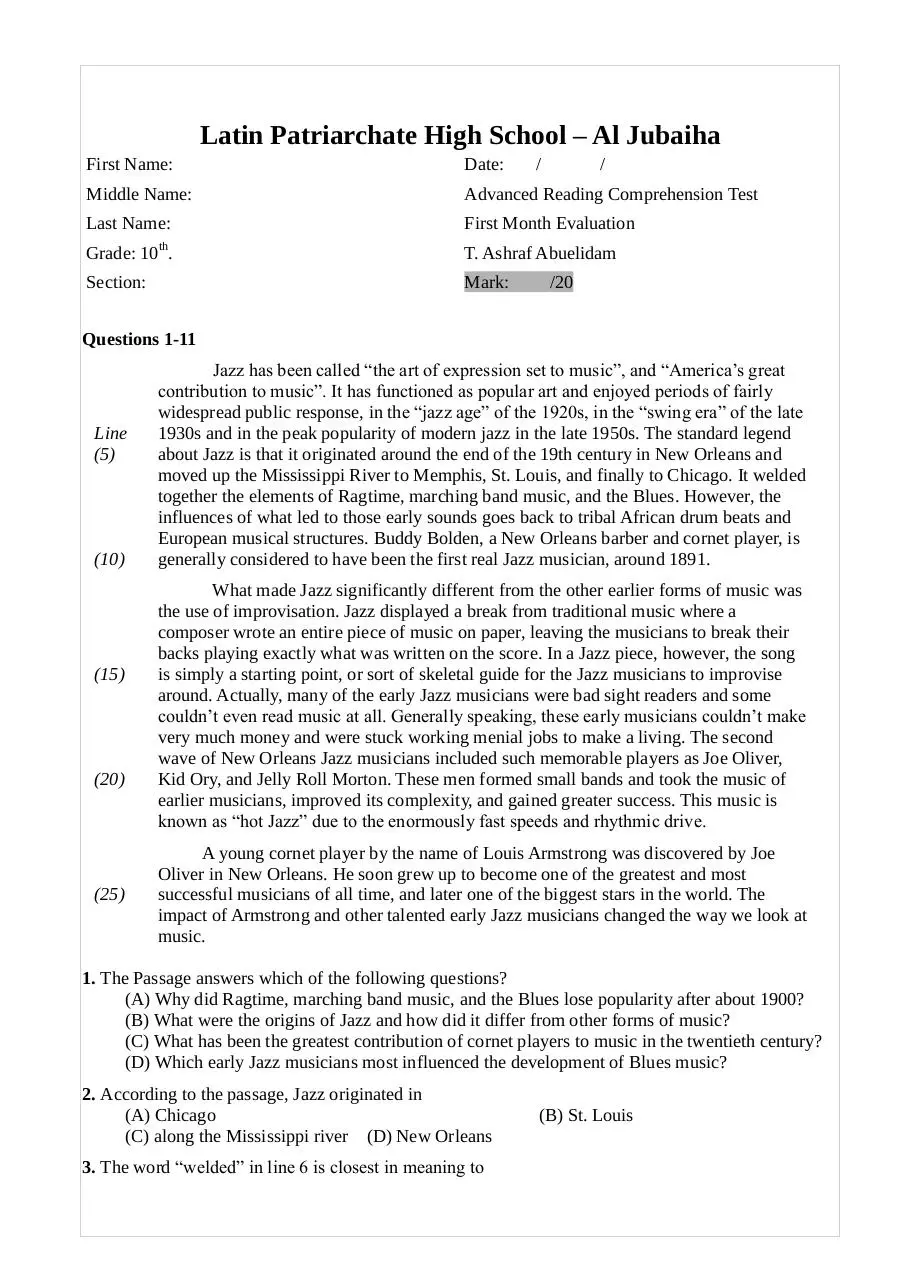
Latin Patriarchate High School – Al Jubaiha
First Name:
Date:
/
/
Middle Name:
Advanced Reading Comprehension Test
Last Name:
First Month Evaluation
Grade: 10th.
T. Ashraf Abuelidam
Section:
Mark:
/20
Questions 1-11
Line
(5)
(10)
(15)
(20)
(25)
Jazz has been called “the art of expression set to music”, and “America’s great
contribution to music”. It has functioned as popular art and enjoyed periods of fairly
widespread public response, in the “jazz age” of the 1920s, in the “swing era” of the late
1930s and in the peak popularity of modern jazz in the late 1950s. The standard legend
about Jazz is that it originated around the end of the 19th century in New Orleans and
moved up the Mississippi River to Memphis, St. Louis, and finally to Chicago. It welded
together the elements of Ragtime, marching band music, and the Blues. However, the
influences of what led to those early sounds goes back to tribal African drum beats and
European musical structures. Buddy Bolden, a New Orleans barber and cornet player, is
generally considered to have been the first real Jazz musician, around 1891.
What made Jazz significantly different from the other earlier forms of music was
the use of improvisation. Jazz displayed a break from traditional music where a
composer wrote an entire piece of music on paper, leaving the musicians to break their
backs playing exactly what was written on the score. In a Jazz piece, however, the song
is simply a starting point, or sort of skeletal guide for the Jazz musicians to improvise
around. Actually, many of the early Jazz musicians were bad sight readers and some
couldn’t even read music at all. Generally speaking, these early musicians couldn’t make
very much money and were stuck working menial jobs to make a living. The second
wave of New Orleans Jazz musicians included such memorable players as Joe Oliver,
Kid Ory, and Jelly Roll Morton. These men formed small bands and took the music of
earlier musicians, improved its complexity, and gained greater success. This music is
known as “hot Jazz” due to the enormously fast speeds and rhythmic drive.
A young cornet player by the name of Louis Armstrong was discovered by Joe
Oliver in New Orleans. He soon grew up to become one of the greatest and most
successful musicians of all time, and later one of the biggest stars in the world. The
impact of Armstrong and other talented early Jazz musicians changed the way we look at
music.
1. The Passage answers which of the following questions?
(A) Why did Ragtime, marching band music, and the Blues lose popularity after about 1900?
(B) What were the origins of Jazz and how did it differ from other forms of music?
(C) What has been the greatest contribution of cornet players to music in the twentieth century?
(D) Which early Jazz musicians most influenced the development of Blues music?
2. According to the passage, Jazz originated in
(A) Chicago
(C) along the Mississippi river (D) New Orleans
3. The word “welded” in line 6 is closest in meaning to
(B) St. Louis
(A) squeezed
(B) bound
(C) added
(D) stirred
TOEFL Reading Comprehension
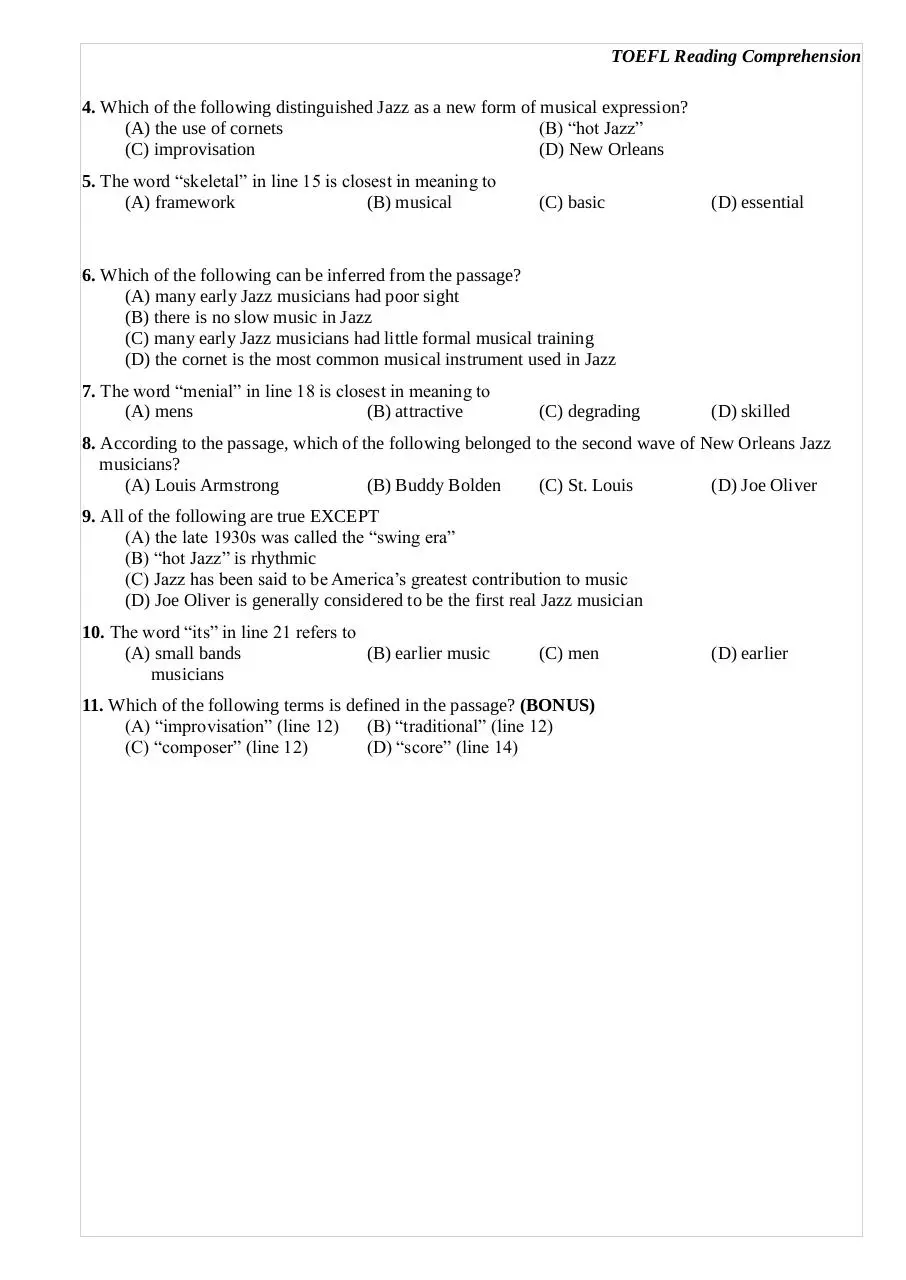
4. Which of the following distinguished Jazz as a new form of musical expression?
(A) the use of cornets
(B) “hot Jazz”
(C) improvisation
(D) New Orleans
5. The word “skeletal” in line 15 is closest in meaning to
(A) framework
(B) musical
(C) basic
(D) essential
6. Which of the following can be inferred from the passage?
(A) many early Jazz musicians had poor sight
(B) there is no slow music in Jazz
(C) many early Jazz musicians had little formal musical training
(D) the cornet is the most common musical instrument used in Jazz
7. The word “menial” in line 18 is closest in meaning to
(A) mens
(B) attractive
(C) degrading
(D) skilled
8. According to the passage, which of the following belonged to the second wave of New Orleans Jazz
musicians?
(A) Louis Armstrong
(B) Buddy Bolden
(C) St. Louis
(D) Joe Oliver
9. All of the following are true EXCEPT
(A) the late 1930s was called the “swing era”
(B) “hot Jazz” is rhythmic
(C) Jazz has been said to be America’s greatest contribution to music
(D) Joe Oliver is generally considered to be the first real Jazz musician
10. The word “its” in line 21 refers to
(A) small bands
(B) earlier music
musicians
(C) men
11. Which of the following terms is defined in the passage? (BONUS)
(A) “improvisation” (line 12) (B) “traditional” (line 12)
(C) “composer” (line 12)
(D) “score” (line 14)
(D) earlier
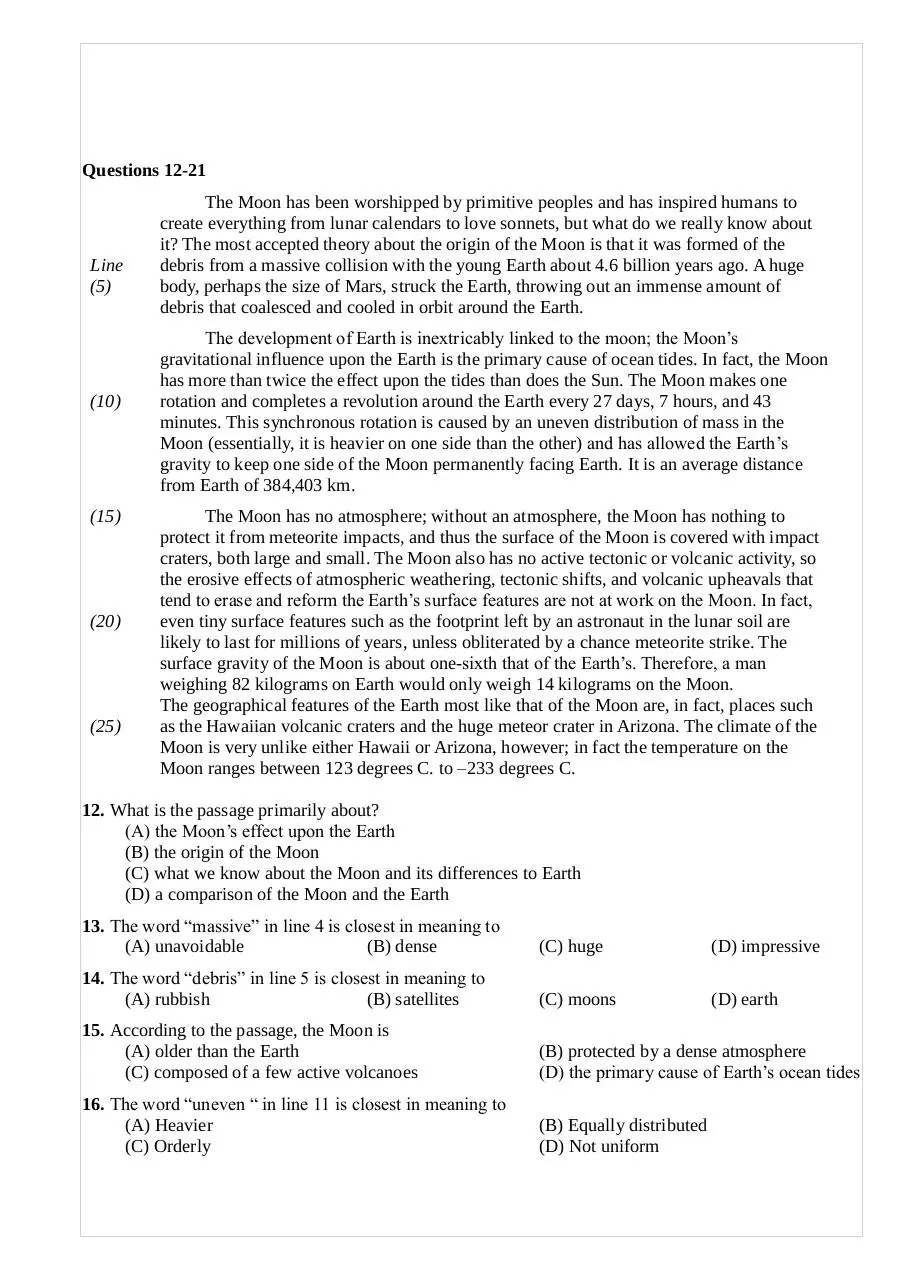
Questions 12-21
Line
(5)
(10)
(15)
(20)
(25)
The Moon has been worshipped by primitive peoples and has inspired humans to
create everything from lunar calendars to love sonnets, but what do we really know about
it? The most accepted theory about the origin of the Moon is that it was formed of the
debris from a massive collision with the young Earth about 4.6 billion years ago. A huge
body, perhaps the size of Mars, struck the Earth, throwing out an immense amount of
debris that coalesced and cooled in orbit around the Earth.
The development of Earth is inextricably linked to the moon; the Moon’s
gravitational influence upon the Earth is the primary cause of ocean tides. In fact, the Moon
has more than twice the effect upon the tides than does the Sun. The Moon makes one
rotation and completes a revolution around the Earth every 27 days, 7 hours, and 43
minutes. This synchronous rotation is caused by an uneven distribution of mass in the
Moon (essentially, it is heavier on one side than the other) and has allowed the Earth’s
gravity to keep one side of the Moon permanently facing Earth. It is an average distance
from Earth of 384,403 km.
The Moon has no atmosphere; without an atmosphere, the Moon has nothing to
protect it from meteorite impacts, and thus the surface of the Moon is covered with impact
craters, both large and small. The Moon also has no active tectonic or volcanic activity, so
the erosive effects of atmospheric weathering, tectonic shifts, and volcanic upheavals that
tend to erase and reform the Earth’s surface features are not at work on the Moon. In fact,
even tiny surface features such as the footprint left by an astronaut in the lunar soil are
likely to last for millions of years, unless obliterated by a chance meteorite strike. The
surface gravity of the Moon is about one-sixth that of the Earth’s. Therefore, a man
weighing 82 kilograms on Earth would only weigh 14 kilograms on the Moon.
The geographical features of the Earth most like that of the Moon are, in fact, places such
as the Hawaiian volcanic craters and the huge meteor crater in Arizona. The climate of the
Moon is very unlike either Hawaii or Arizona, however; in fact the temperature on the
Moon ranges between 123 degrees C. to –233 degrees C.
12. What is the passage primarily about?
(A) the Moon’s effect upon the Earth
(B) the origin of the Moon
(C) what we know about the Moon and its differences to Earth
(D) a comparison of the Moon and the Earth
13. The word “massive” in line 4 is closest in meaning to
(A) unavoidable
(B) dense
(C) huge
(D) impressive
14. The word “debris” in line 5 is closest in meaning to
(A) rubbish
(B) satellites
(C) moons
(D) earth
15. According to the passage, the Moon is
(A) older than the Earth
(C) composed of a few active volcanoes
(B) protected by a dense atmosphere
(D) the primary cause of Earth’s ocean tides
16. The word “uneven “ in line 11 is closest in meaning to
(A) Heavier
(C) Orderly
(B) Equally distributed
(D) Not uniform
TOEFL Reading Comprehension
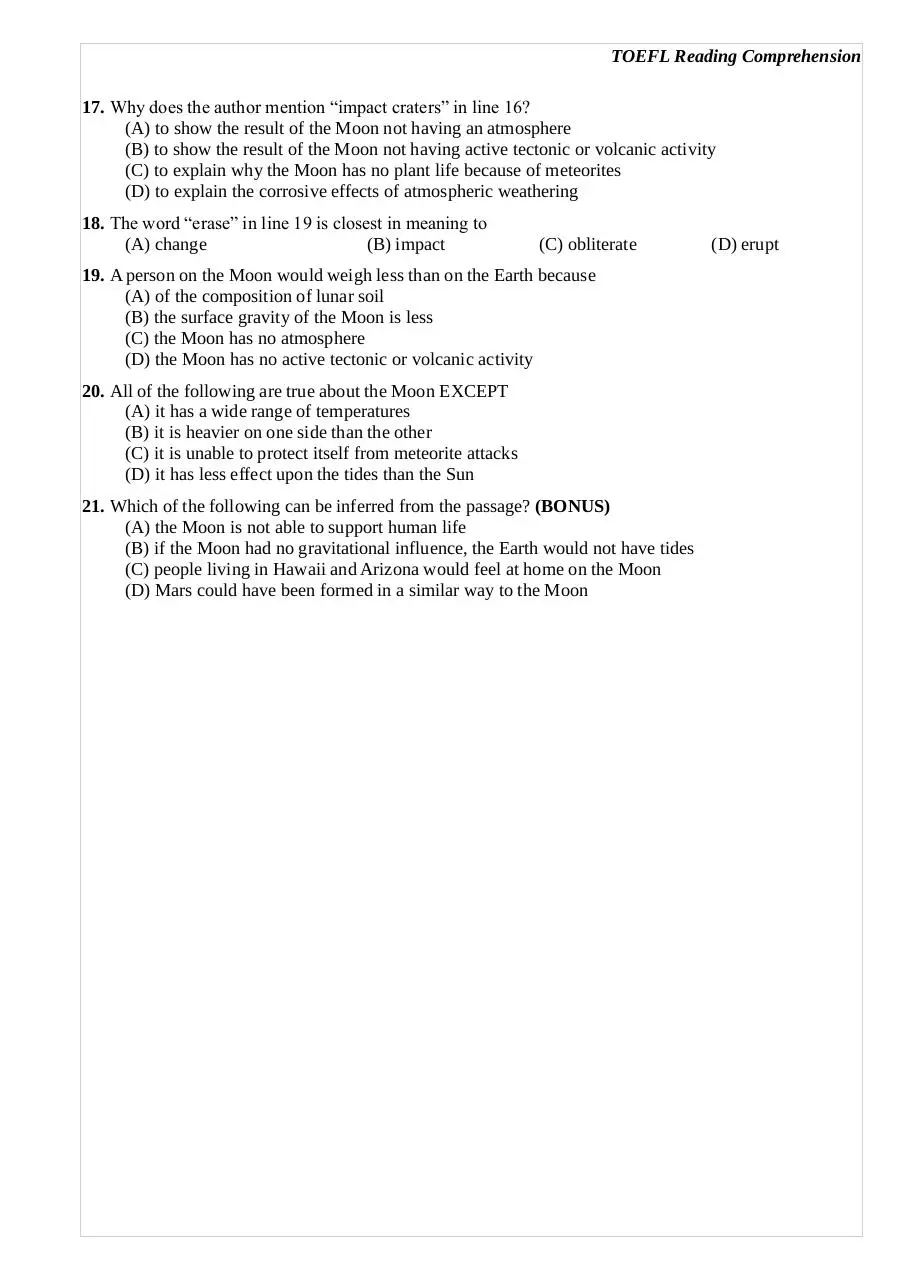
17. Why does the author mention “impact craters” in line 16?
(A) to show the result of the Moon not having an atmosphere
(B) to show the result of the Moon not having active tectonic or volcanic activity
(C) to explain why the Moon has no plant life because of meteorites
(D) to explain the corrosive effects of atmospheric weathering
18. The word “erase” in line 19 is closest in meaning to
(A) change
(B) impact
(C) obliterate
19. A person on the Moon would weigh less than on the Earth because
(A) of the composition of lunar soil
(B) the surface gravity of the Moon is less
(C) the Moon has no atmosphere
(D) the Moon has no active tectonic or volcanic activity
20. All of the following are true about the Moon EXCEPT
(A) it has a wide range of temperatures
(B) it is heavier on one side than the other
(C) it is unable to protect itself from meteorite attacks
(D) it has less effect upon the tides than the Sun
21. Which of the following can be inferred from the passage? (BONUS)
(A) the Moon is not able to support human life
(B) if the Moon had no gravitational influence, the Earth would not have tides
(C) people living in Hawaii and Arizona would feel at home on the Moon
(D) Mars could have been formed in a similar way to the Moon
(D) erupt
Download Advanced Comprehension Test 1
Advanced_Comprehension_Test_1.pdf (PDF, 155.82 KB)
Download PDF
Share this file on social networks
Link to this page
Permanent link
Use the permanent link to the download page to share your document on Facebook, Twitter, LinkedIn, or directly with a contact by e-Mail, Messenger, Whatsapp, Line..
Short link
Use the short link to share your document on Twitter or by text message (SMS)
HTML Code
Copy the following HTML code to share your document on a Website or Blog
QR Code to this page

This file has been shared publicly by a user of PDF Archive.
Document ID: 0000149708.