THE EDGE OF DARKNESS STORYTELLER TEAM PRESENTS
Inferno
All Hell Breaks
Loose
“Death and sorrow will be the companions of our journey;
hardship our garment; constancy and valour our only
shield.”
(Winston Churchill, 1940)
The World of Darkness: 1939 – 1945
�
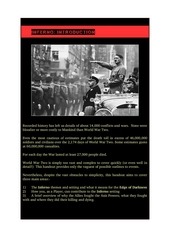
INFERNO: INTRODUCTION
Recorded history has left us details of about 14,000 conflicts and wars. None were
bloodier or more costly to Mankind than World War Two.
Even the most cautious of estimates put the death toll in excess of 46,000,000
soldiers and civilians over the 2,174 days of World War Two. Some estimates guess
at 60,000,000 casualties.
For each day the War lasted at least 27,000 people died.
World War Two is simply too vast and complex to cover quickly (or even well in
detail!) This handout provides only the vaguest of possible outlines to events.
Nevertheless, despite the vast obstacles to simplicity, this handout aims to cover
three main areas:
1)
The Inferno themes and setting and what it means for the Edge of Darkness
2)
How you, as a Player, can contribute to the Inferno setting
3)
A brief overview of why the Allies fought the Axis Powers; what they fought
with and where they did their killing and dying.
�
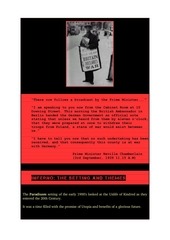
“There now follows a broadcast by the Prime Minister...”
“I am speaking to you now from the Cabinet Room at 10
Downing Street. This morning the British Ambassador in
Berlin handed the German Government an official note
stating that unless we heard from them by eleven o'clock,
that they were prepared at once to withdraw their
troops from Poland, a state of war would exist between
us.”
“I have to tell you now that no such undertaking has been
received, and that consequently this county is at war
with Germany.”
Prime Minister Neville Chamberlain
(3rd September, 1939 11.15 A.M)
Inferno: The Setting and Themes
The Paradiusm setting of the early 1900's looked at the Unlife of Kindred as they
entered the 20th Century.
It was a time filled with the promise of Utopia and benefits of a glorious future.
�
The setting for Inferno concerns itself with the lives of Mages as they struggle to
face the outcome of all the failed plans and projects; all the broken promises and
lies that were told by 1939.
War...avarice...treachery...hatred...fear...deception: these all led to the invasion of
Poland in 1939.
With Inferno ~ the world reaps a bitter whirlwind.
So, what does this mean for me as a Player?
Well, you get to join the good fight!
Battle against the brutal Nazi enemy and their sinister Japanese allies.
As a player you can join one of the secret Allied Units.
The intention is for the setting to look at the work of both Mages and their Mortal
allies and look at their role in World War Two.
The Setting ~ Recruitment
MILITARY CARTOGRAPHIC RESEARCH – A QUICK HISTORY
Working under the motto: Quaerendo Invenietis (seek and you shall find) the
Military Cartographic Research Unit (MCR) was founded during the Peninsular
Campaign (1808 1814) by a farsighted Major of the Royal Engineers.
The original intention of the unit was to survey areas under enemy control, gather
geographic intelligence on French supply routes, the strength of garrison and
fortresses, etc. But over time the role of this small unit grew in importance and its
skillset came to be seen as most useful in gathering a wider range of intelligence
and, borrowing the lessons from the Spanish guerilla, the general conduct of
clandestine and harassing activities.
The role may have changed over time, but the primary mission of MCR has
remained to tackle jobs more conservative and orthodox elements of British
Imperial military structure and law enforcement finds difficult to deal with ~ or
even sometimes acknowledge.
Defence of the Realm is MCR's primary objective: though MCR has tackled spies,
saboteurs...and all manner of dangerous cranks, deviant crackpots and nefarious
criminals!
�
YOUR CHARACTER'S ROLE AND PROBABLE BACKGROUND
Military personnel are likely to be posted to MCR as a deflection from their existing
careers with the Royal Navy, the Army or the Royal Marines – though, by tradition,
MCR is led by an Officer of Engineers. The character maybe from anywhere in the
UK or wider Empire.
Those posted to MCR usually have demonstrated accomplishment in at least one
of several primary characteristics:
●
●
●
●
●
To be a known man of courage, patriotism and loyalty
To be known to exhibit grace under pressure
To have seen at least one military action
To possess 'skill at arms'
To have had an encounter with...well...with something your Commanding
Officer probably found difficult to explain...which is code for: this chap is
probably a Mage.
It is worth noting that if a civilian exhibits skills or knowledge vital to the
accomplishment of a mission for MCR, then he or she could very easily find
themselves assigned 'temporary officer, temporary gentleman/gentlewoman'
status for the duration of their time with MCR by commission and warrant of the
Crown.
MCR enjoys a perverse reputation for radical activity and forward thinking. The
Unit will improvise to get the job done.
As a result, MCR welcomes females to its strength.
When the storm arrives
Would you be seen with me
By the merciless eyes I've deceived?
I've seen angels fall from blinding heights.
But you yourself are nothing so divine:
Just next in line.
Arm yourself: because no one else here will save you.
The odds will betray you.
And they will replace you...
Are you willing to die?
The coldest blood runs through my veins ...
...If you come inside things will not be the same...
(Chris Cornell – You Know My Name)
�
THE MCR CHAIN OF COMMAND
MCR overtly operates under the Order of Battle of the Officer Commanding the
Corps of Royal Engineers alongside the Telegraph Battalion.
However, in practice, this relationship with the Telegraph Battalion is mostly an
illusion designed as a 'cover' and MCR receives its instructions from the highest
levels of High Command and government.
This essential independence of operation is jealously guarded, but is never taken
for granted. MCR relies heavily upon practical support from all areas of
government to function, receive pay, etc. – the unit cannot afford to think itself so
elite that it is indispensable!
Nevertheless, those who survive a posting to MCR attain a mystique and glory
amongst their peers.
Each of the existing 16 MCR units led by a captain.
At anyone time about at third of the 16 units will be 'in the field'. The others will
be on leave; catching up on Rest and Recuperation or training with the latest
doctrine and equipment at any of the specialist training establishments, depots or
garrisons across the Empire.
MCR RESOURCES
MCR has its headquarters in a discrete building...
To protect the secrecy, a brass name plaque is affixed outside announces that the
building is used by the “Imperial Maritime Shipping Company” as a result the
building is known to all in MCR as “Maritime House.” The Colonel Commanding
has an office of his own, as do many of the Lt Colonels.
MCR is lavishly equipped with a large map room and an extensive library which
contains HM Admiralty charts and copies of admiralty charts from several other
nations too. The library has several smaller briefing rooms adjacent to it for more
private and confidential briefings or work.
The library is well equipped with most standard reference works, academic
journals and daily newspapers.
�
HISTORICAL BACKGROUND
A TIMELINE TO WAR
1933 – Waffen SS founded – Himmler founds this elite paramilitary force
1934 – Night of the Long Knives
“They held up a stone.
I said, 'Stone.'
Smiling they said, 'stone.'
They showed me a tree.
I said, 'Tree.'
Smiling, they said, 'Tree.'
They shed a man's blood.
I said, 'Blood.'
Smiling, they said, 'paint.'
They shed a man's blood.
I said, 'Blood.'
Smiling, they said, 'paint.'”
(Amir Gilboa)
1936 – Spanish Civil War
1936 – Bombing of the Spanish town Guernica by the German 'Kondor Legion' of
fearsome Stuka divebombers
Picasso’s depiction of Franco’s relentless bombing of Guernica
1937
�
1938
1939 – Spanish Civil War ends
Why do we fight?
Junker 87 – STUKA's Sturzkampfflugzeug (Dive bomber) – in formation over Europe
Leaving aside such questions as 'was war inevitable?' and 'was Chamberlain
wrong?' we must assume that we are now at war! But why?
The German Army was limited, by terms of the 1919 Treaty of Versailles (that
ended World War One in 1918) to 100,000 men. The Germans were denied an
air force – though the Luftwaffe was secretly built up. The German navy
(Kriegsmarine) was also limited in size and quality of warships. Though the
German naval might was also successfully circumvented.
Well – as shown in Chamberlain's speak at Annex A – Hitler invaded Poland in
contravention of treaties.
Who was the first to die – and why?
They called them the “Tin Cans.”
On August 3, 1939 the first victim was a prisoner. His name isn't known. He was
from a concentration camp.
He died as part of a dastardly scheme hatched by HIMMLER the dreaded Chief of
the SS. The prisoner was dressed in the uniform of a Polish soldier. With several
others, this prisoner was marched out to a radio station on the GermanPolish
�
border at the frontier town of Gleiwitz and then they were all shot dead by an
elite team of SS Stormtroopers under Himmler's direct orders.
The current strategic background
September, 1939
The European theatre of operations is in chaos.
“Half a century has passed, and the time has come to sweep away the myths and
reveal the no less inspiring gleam of that complex and frightening time in which
evil was ascendant,
goodness diffident and the British
− impetuous, foolish and brave beyond measure
the worlds only hope.”
(Len Deighton – Blood, Tears and Folly.)
MISSION No. 1 : Operation NIMBUS
MOST SECRET
To: Capt. ALLEN MC, MCR 12 Det
From: Colonel Commanding, MCR
Date: August, 2 1939
Copied to: WHIRLPOOL, CIGS, HMS KING ALFRED, Station Y
PRIORITY
SUBJECT: TEMPORARY DUTY ORDERS OPERATION NIBUS
�
 Historical archive . public document