building a
HealtHy S a c r a m e n t o
the tools to Fight
Racial Inequality
by N ata s h a vo N K a e N e l
T
his last year has seen a reawakening in
the national conversation about race. And
while this renewed attention is positive,
there has been little change in the rampant racism
that permeates both our institutions and culture.
Julie Nelson, the Director of the Government
Alliance on Race and Equity, might have the
reason why.
“The vast majority of people, when you ask them,
‘Do you support equality?’ They will say, ‘Yes,’” she
says. “But what we need to work on is the institutions
and structures that create racial inequity.”
In Seattle, Nelson worked to develop a tool to
bring conversations about race into government.
The Race Equity Toolkit “bakes equity into the
decision-making process” by forcing policy
makers to answer questions about race equity
and the impacts of their policy on communities
of color. When using the toolkit, policy makers
involve members and stakeholders from impacted
communities directly in the development of policy
and legislation, and work to identify and fix
problems before they even start.
The Race Equity Toolkit may soon be implemented
right here in Sacramento. A few weeks ago, Nelson
met with Sacramento city council members and
community leaders to educate them about the
toolkit and its impacts across the country. The
event was put on with the help of The California
Endowment’s Building Healthy Communities
initiative, which aims to create change in the
laws, policies and systems that impact health
for residents in communities facing inequities,
including South Sacramento.
Currently only a handful of cities use the Race
Equity Toolkit, but Nelson believes the best way to
create race equity in this country is for that number
to keep growing.
these very same communities, and were upset
when presented with this disparity. But with
small tweaks to route planning and practices, the
problem was fixed.
“When looking at the history of government in the
United States, government has played a key role in
creating and maintaining racial inequities,” she says.
“So for us to get to different outcomes, we have to
work across the breadth and depth of government.”
“Every single job has a relationship to racial
equity,” Nelson explains. “So this toolkit sort of
calls out what that relationship is, and makes sure
that instead of perpetuating inequities, we are
advancing racial equity.”
“What We need to Work
on is the institutions
and structures that
create racial inequity.”
BuIldIng HEalTHy
COmmunITIES
In 2010, The California Endowment
launched a 10-year, $1 billion plan to
improve the health of 14 challenged
communities across the state. Over the
10 years, residents, community-based
organizations and public institutions
will work together to address the
socioeconomic and environmental
challenges contributing to the poor
health of their communities.
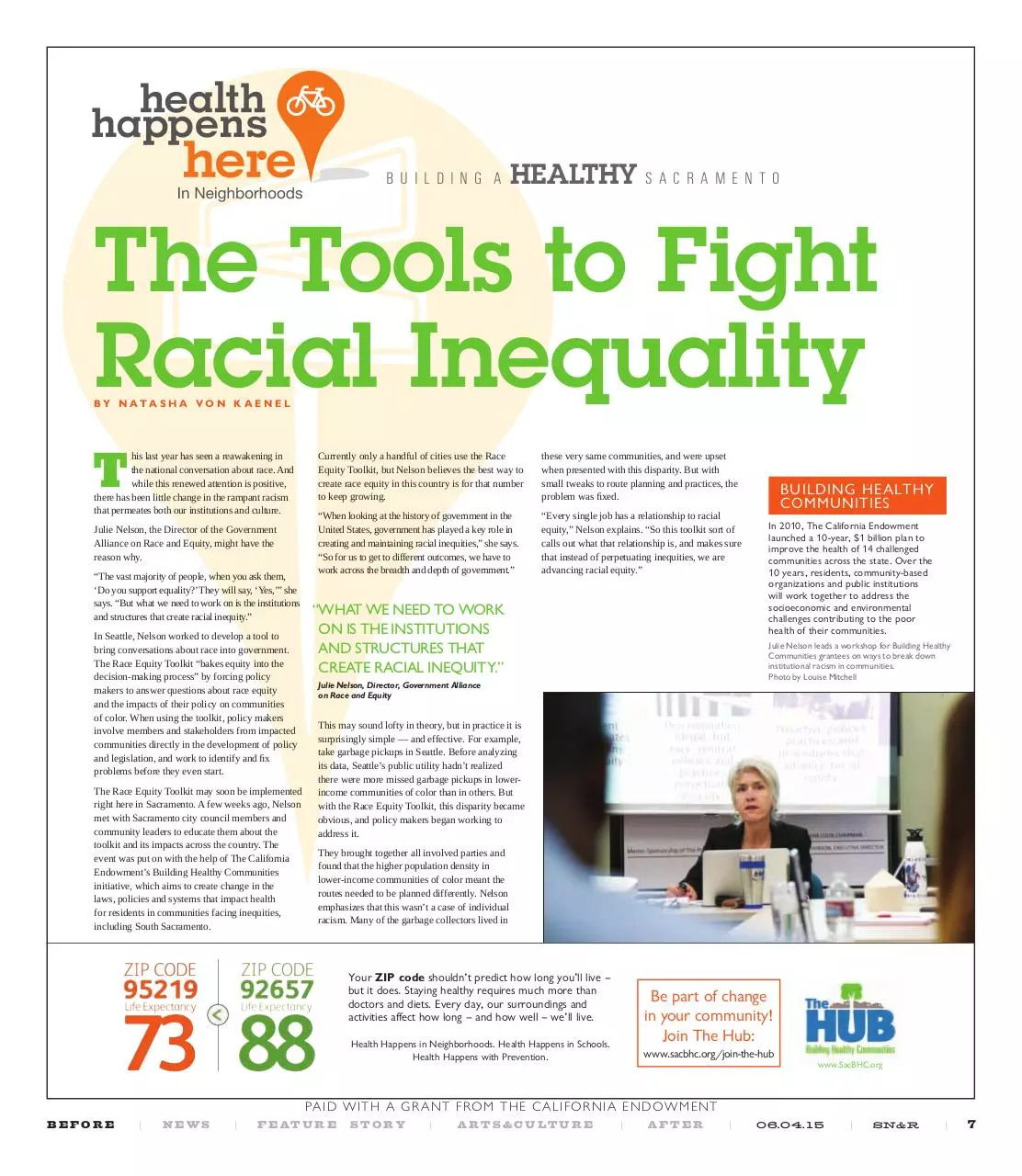
Julie nelson leads a workshop for Building Healthy
Communities grantees on ways to break down
institutional racism in communities.
Photo by louise mitchell
Julie Nelson, Director, Government Alliance
on Race and Equity
This may sound lofty in theory, but in practice it is
surprisingly simple — and effective. For example,
take garbage pickups in Seattle. Before analyzing
its data, Seattle’s public utility hadn’t realized
there were more missed garbage pickups in lowerincome communities of color than in others. But
with the Race Equity Toolkit, this disparity became
obvious, and policy makers began working to
address it.
They brought together all involved parties and
found that the higher population density in
lower-income communities of color meant the
routes needed to be planned differently. Nelson
emphasizes that this wasn’t a case of individual
racism. Many of the garbage collectors lived in
your ZIP code shouldn’t predict how long you’ll live –
but it does. Staying healthy requires much more than
doctors and diets. Every day, our surroundings and
activities affect how long – and how well – we’ll live.
Be part of change
in your community!
Join The Hub:
Health Happens in neighborhoods. Health Happens in Schools.
Health Happens with Prevention.
www.sacbhc.org/join-the-hub
www.SacBHC.org
paid with a grant from the california endowment
BEFORE
|
NEWS
|
F E AT U R E
STORY
|
A RT S & C U LT U R E
|
AFTER
|
06.04.15
|
SN&R
|
7
�
 Historical archive . public document