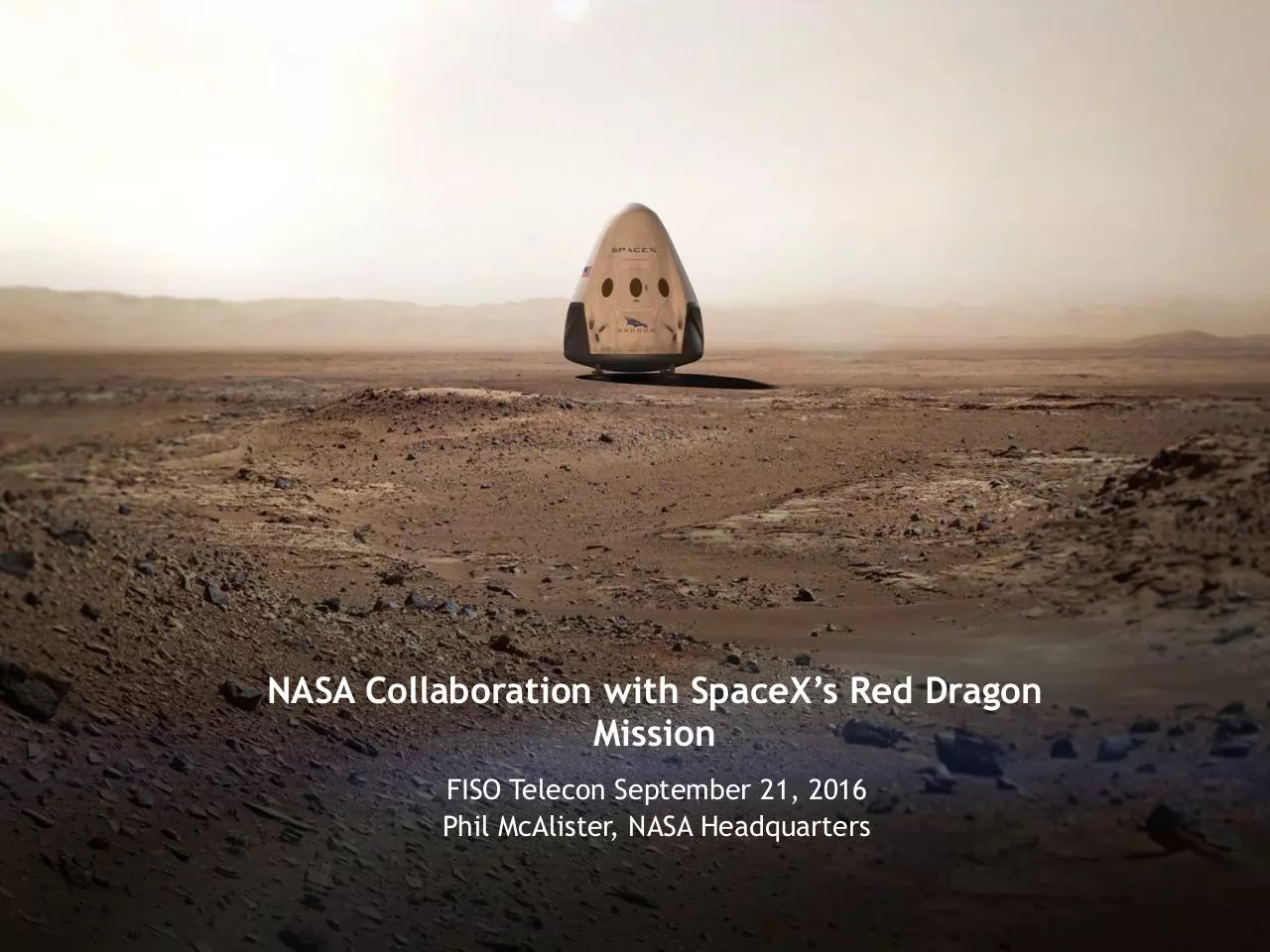
NASA Collaboration with SpaceX’s Red Dragon
Mission
FISO Telecon September 21, 2016
Phil McAlister, NASA Headquarters
�
Background
• December 2014: NASA’s HEOMD competitively awarded Collaborations for Commercial Space
Capabilities (CCSC) Space Act Agreements to four firms, agreeing to provide them with NASA’s
technical insight and assistance on a no-exchange-of-funds basis:
– SpaceX – develop Mars cargo transportation system
– ATK Space Systems - develop space logistics, hosted payload and other space transportation
capabilities
– Final Frontier Design - develop intra-vehicular activity space suits
– United Launch Alliance - develop new launch vehicle capabilities to reduce cost and
enhance performance
• Late 2015: SpaceX requested an expanded level of assistance from NASA under this existing
agreement to support a planned uncrewed technology demonstration mission to Mars with its
Dragon spacecraft
• October 7, 2015: NASA Agency leadership briefed on this concept
– Directed STMD Associate Administrator to form a small team, led by senior leaders
throughout the Agency, to conduct a preliminary concept feasibility study.
– Feasibility study analyzed the technical areas of expanded assistance, identified benefits to
NASA, and developed initial cost estimates for NASA’s expanded level of assistance.
• January 26, 2016: NASA Agency leadership approved additional areas of assistance to the
existing collaboration and directed the CCSC agreement be modified to accommodate
• April 26, 2016: NASA and SpaceX finalized modification to the CCSC agreement (SAAQA-14-18883)
2
�
Agreement and Approach
• SpaceX is responsible for and will maintain control over Red Dragon design, hardware, and
operations. NASA is only providing specific technical support in several technical areas.
• The modification to the CCSC SAA with SpaceX establishes NASA support as defined in six Technical
Exchange Documents (TEDs):
TED 1. Deep space communications, data relay, and tracking
TED 2. Deep space trajectory design and navigation support
TED 3. Entry, descent, and landing (EDL) system engineering and analysis
TED 4. Aerosciences activities
TED 5. Flight system technical review and advice
TED 6. Planetary protection consultation and advice
• In return, NASA obtains EDL flight data for a critical technology in the Mars environment
• NASA’s support is coordinated across three Mission Directorates:
– Human Exploration and Operations Mission Directorate (HEOMD): (a) manage the overall
SpaceX CCSC agreement, and (b) provide communications and tracking support to the
mission (TED 1)
– Space Technology Mission Directorate (STMD): lead the Red Dragon technology
demonstrator mission design and EDL (entry, descent, and landing) support (TEDs 2-5)
– Science Mission Directorate (SMD): provide planetary protection support (TED 6)
– An Executive Committee has been established to ensure cross-directorate coordination
• This will be a SpaceX-funded mission:
– NASA’s support is primarily from existing Civil Service and JPL workforce, employed as
needed depending on the requested support.
– Generally will not be full-time activities.
3
�
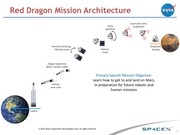
Red Dragon Mission Architecture
© 2016 Space Exploration Technologies Corp. All rights reserved.
4
�
5
�
Human Exploration of Mars is Hard
20-30 tons
Ability to land large
payloads needed
130 tons
Heavy-lift mass
means multiple
launches per
mission
13.5 km/s Earth
re-entry speed
800-1100 days away from
Earth in micro gravity and
high levels of radiation
Reliable in-space
transportation:
Total continuous
transportation power
Thin atmosphere and
dusty conditions for
surface operations.
44 minute max two-way
communication delay
2-week blackout every 26
months when Earth and
Mars are on opposite sides
of the sun
20 tons of oxygen needed for
ascent to orbit: In-Situ Resource
Utilization (ISRU)
6
�
Red Dragon Participation - Benefits to NASA
•
Supports NASA’s authorization to help enable the commercial space
industry
•
Offers flight technology demonstration of critical EDL technologies needed
for human exploration (particularly supersonic retro-propulsion) in the
Mars atmosphere about a decade sooner and at a fraction of the cost to
NASA for a future technology demonstrator mission
– All candidate EDL architectures for Mars human exploration rely on supersonic
retro-propulsion
•
Provides EDL flight data for supersonic retro-propulsion in Mars
atmosphere to improve models
•
Enhances NASA’s EDL capability development/sustainment – preparing the
workforce for challenges of landing greater mass on Mars
– Aero/aeroheating/trajectory performance data on the largest mass and largest
ballistic coefficient ever flown at Mars
– Entry surface heating and pressures
– Entry guidance performance
– Supersonic retro-propulsion performance and guidance during power-on flight
– Ground surface interaction insight for large rocket plumes
•
Industry is focusing effort that will aid the long term challenge of heavy
mass Mars landings
7
�
Summary of NASA Technical Support
• TED 1. Deep-Space Communications, Data Relay and Tracking
•
•
•
Support the SpaceX mission operations team to develop and execute a concept of operations for
deep-space communications, data relay and tracking. Includes providing support and advice on
developing deep-space communications and tracking approach, frequency channel assignment and
spectrum coordination, and provision of Deep Space Network use.
Provide proximity link Mars Relay Network service, including critical event telecommunications and
tracking during EDL and subsequent forward and return link telecommunications post landing.
Provide ground system interfaces support including accommodation of SpaceX gateway equipment.
• TED 2. Deep-Space Navigation and Trajectory
•
•
Support mission design and navigation including launch/arrival space analysis and trades, cruise
trajectory assessments, mission strategies and navigation design assessments, navigation training
and certification for operations, and participation in operational readiness tests.
Perform in-flight navigation support including operational support for determining spacecraft state
and trajectory correction maneuvers, concept of operations for deep space navigations and
trajectory corrections, and maneuver design assessments using existing software tools.
• TED 3. Entry, Descent, and Landing System Engineering and Analysis
•
•
•
•
Provide Mars EDL lessons learned, review and advice.
Support simulation development and model validation.
Provide landing site selection advice and engineering support.
Implement a post-flight reconstruction integrated simulation capability to enable NASA derived
value in understanding flight performance during the complete EDL sequence.
8
�
Summary of NASA Technical Support
• TED 4. Aerosciences Activities
•
•
•
•
•
•
•
•
Coordinate with SpaceX to develop analysis plans for development of engineering source data.
Coordinate with SpaceX on implementation of an integrated flight aerosciences database including
aerodynamic and aerothermodynamic environment.
Perform non-propulsive aerodynamic analysis during EDL phases and perform review and consultation
services for SpaceX in development of their own analysis.
Perform aerodynamic analysis of the spacecraft during powered engine EDL phases.
Perform power-on wind tunnel testing during EDL phases to validate analytical models.
Perform EDL aerothermodynamic analysis and provide consultation services for SpaceX analyses.
Provide consultation support for SpaceX’s characterization of ground and plume interactions.
Support efforts that would significantly enhance the value of flight measurements.
• TED 5. Flight System Technical Review and Advice
•
•
•
•
•
•
•
Review end-to-end flight system, esp. autonomy, fault tolerance, operability, and qualification
approaches
Support design and development of X-band transponder and UHF radio.
Review, advise, and provide test support to SpaceX DSN Direct-to-Earth (DTE) telecom system
development
Perform communications link and navigation performance analysis for DSN DTE link.
Consult and provide interface support for SpaceX developing and procuring UHF transceiver.
Advise on development of radio interference test systems.
Provide assessment of technical risks associated with overall flight system design, development, and
testing.
• TED 6. Planetary Protection Consultation and Advice
•
•
Advise SpaceX in the development of their Planetary Protection Plan (PPP).
Assist SpaceX with the implementation of their PPP including identifying existing software/tools.
9
�
 Historical archive . public document