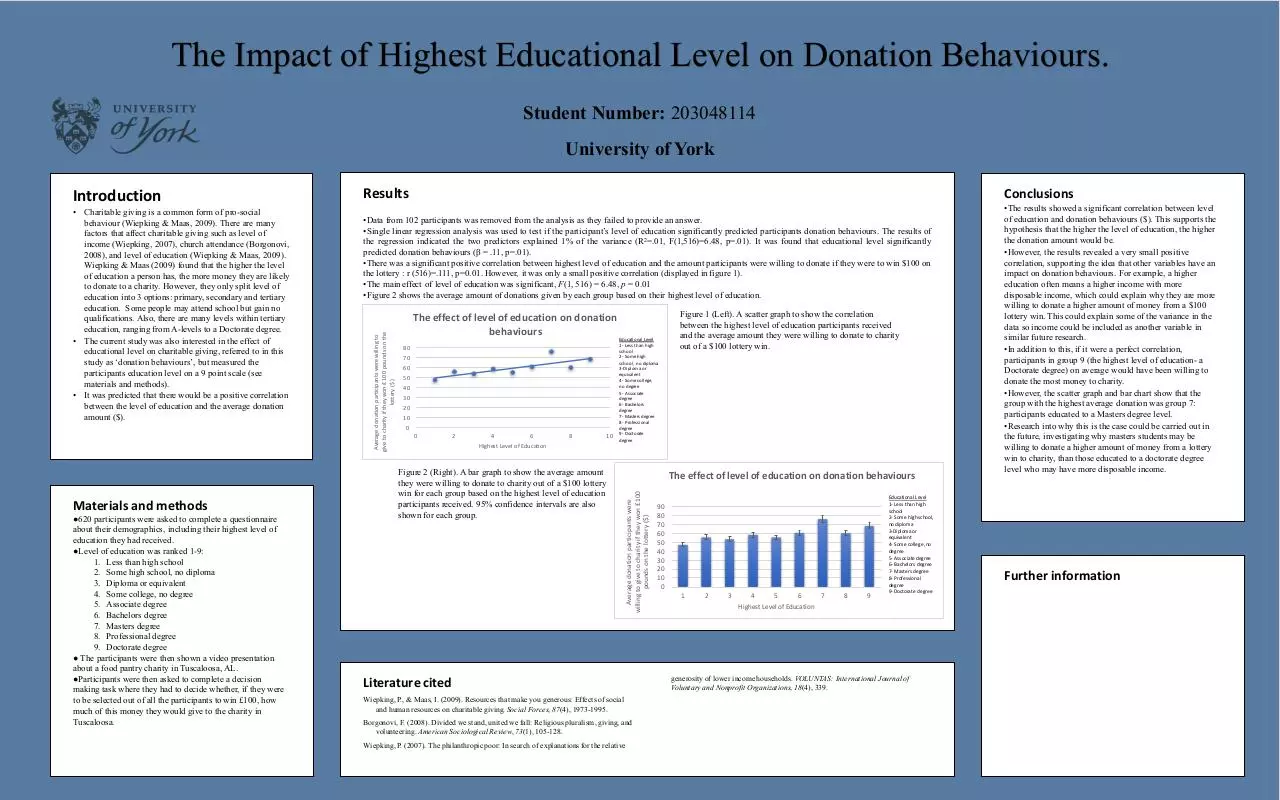
The Impact of Highest Educational Level on Donation Behaviours.
Student Number: 203048114
University of York
Materials and methods
●620 participants were asked to complete a questionnaire
about their demographics, including their highest level of
education they had received.
●Level of education was ranked 1-9:
1. Less than high school
2. Some high school, no diploma
3. Diploma or equivalent
4. Some college, no degree
5. Associate degree
6. Bachelors degree
7. Masters degree
8. Professional degree
9. Doctorate degree
● The participants were then shown a video presentation
about a food pantry charity in Tuscaloosa, AL.
●Participants were then asked to complete a decision
making task where they had to decide whether, if they were
to be selected out of all the participants to win £100, how
much of this money they would give to the charity in
Tuscaloosa.
Conclusions
•Data from 102 participants was removed from the analysis as they failed to provide an answer.
•Single linear regression analysis was used to test if the participant’s level of education significantly predicted participants donation behaviours. The results of
the regression indicated the two predictors explained 1% of the variance (R2=.01, F(1,516)=6.48, p=.01). It was found that educational level significantly
predicted donation behaviours (β = .11, p=.01).
•There was a significant positive correlation between highest level of education and the amount participants were willing to donate if they were to win $100 on
the lottery : r (516)=.111, p=0.01. However, it was only a small positive correlation (displayed in figure 1).
•The main effect of level of education was significant, F(1, 516) = 6.48, p = 0.01
•Figure 2 shows the average amount of donations given by each group based on their highest level of education.
The effect of level of education on donation
behaviours
80
70
60
50
40
30
20
10
0
0
2
4
6
8
Highest Level of Education
10
Educational Level
1- Less than high
school
2- Some high
school, no diploma
3-Diploma or
equivalent
4- Some college,
no degree
5- Associate
degree
6- Bachelors
degree
7- Masters degree
8- Professional
degree
9- Doctorate
degree
Figure 2 (Right). A bar graph to show the average amount
they were willing to donate to charity out of a $100 lottery
win for each group based on the highest level of education
participants received. 95% confidence intervals are also
shown for each group.
Figure 1 (Left). A scatter graph to show the correlation
between the highest level of education participants received
and the average amount they were willing to donate to charity
out of a $100 lottery win.
The effect of level of education on donation behaviours
Average donation participants were
willing to give to charity if they won £100
pounds on the lottery ($)
• Charitable giving is a common form of pro-social
behaviour (Wiepking & Maas, 2009). There are many
factors that affect charitable giving such as level of
income (Wiepking, 2007), church attendance (Borgonovi,
2008), and level of education (Wiepking & Maas, 2009).
Wiepking & Maas (2009) found that the higher the level
of education a person has, the more money they are likely
to donate to a charity. However, they only split level of
education into 3 options: primary, secondary and tertiary
education. Some people may attend school but gain no
qualifications. Also, there are many levels within tertiary
education, ranging from A-levels to a Doctorate degree.
• The current study was also interested in the effect of
educational level on charitable giving, referred to in this
study as ‘donation behaviours’, but measured the
participants education level on a 9 point scale (see
materials and methods).
• It was predicted that there would be a positive correlation
between the level of education and the average donation
amount ($).
Results
Average donation participants were willing to
give to charity if they won £100 pounds on the
lottery ($)
Introduction
Literature cited
Wiepking, P., & Maas, I. (2009). Resources that make you generous: Effects of social
and human resources on charitable giving. Social Forces, 87(4), 1973-1995.
Borgonovi, F. (2008). Divided we stand, united we fall: Religious pluralism, giving, and
volunteering. American Sociological Review, 73(1), 105-128.
Wiepking, P. (2007). The philanthropic poor: In search of explanations for the relative
90
80
70
60
50
40
30
20
10
0
1
2
3
4
5
6
7
Highest Level of Education
8
9
Educational Level
1- Less than high
school
2- Some high school,
no diploma
3-Diploma or
equivalent
4- Some college, no
degree
5- Associate degree
6- Bachelors degree
7- Masters degree
8- Professional
degree
9- Doctorate degree
generosity of lower income households. VOLUNTAS: International Journal of
Voluntary and Nonprofit Organizations, 18(4), 339.
•The results showed a significant correlation between level
of education and donation behaviours ($). This supports the
hypothesis that the higher the level of education, the higher
the donation amount would be.
•However, the results revealed a very small positive
correlation, supporting the idea that other variables have an
impact on donation behaviours. For example, a higher
education often means a higher income with more
disposable income, which could explain why they are more
willing to donate a higher amount of money from a $100
lottery win. This could explain some of the variance in the
data so income could be included as another variable in
similar future research.
•In addition to this, if it were a perfect correlation,
participants in group 9 (the highest level of education- a
Doctorate degree) on average would have been willing to
donate the most money to charity.
•However, the scatter graph and bar chart show that the
group with the highest average donation was group 7:
participants educated to a Masters degree level.
•Research into why this is the case could be carried out in
the future, investigating why masters students may be
willing to donate a higher amount of money from a lottery
win to charity, than those educated to a doctorate degree
level who may have more disposable income.
Further information
�
 Historical archive . public document