Centre Number
For Examiner’s Use
Candidate Number
Surname
Other Names
Examiner’s Initials
Candidate Signature
Question
General Certificate of Education
Advanced Subsidiary Examination
June 2013
Mark
1
2
3
Chemistry
Unit 1
CHEM1
5
Foundation Chemistry
Thursday 23 May 2013
4
6
9.00 am to 10.15 am
7
8
For this paper you must have:
l the Periodic Table/Data Sheet, provided as an insert
(enclosed)
l a calculator.
TOTAL
Time allowed
l 1 hour 15 minutes
Instructions
l Use black ink or black ball-point pen.
l Fill in the boxes at the top of this page.
l Answer all questions.
l You must answer the questions in the spaces provided. Do not write
outside the box around each page or on blank pages.
l All working must be shown.
l Do all rough work in this book. Cross through any work you do not
want to be marked.
Information
l The marks for questions are shown in brackets.
l The maximum mark for this paper is 70.
l You are expected to use a calculator where appropriate.
l The Periodic Table/Data Sheet is provided as an insert.
l Your answers to the questions in Section B should be written in
continuous prose, where appropriate.
l You will be marked on your ability to:
– use good English
– organise information clearly
– use scientific terminology accurately.
Advice
l You are advised to spend about 50 minutes on Section A and about
25 minutes on Section B.
(JUN13CHEM101)
WMP/Jun13/CHEM1
CHEM1
�
Do not write
outside the
box
2
Section A
Answer all questions in the spaces provided.
1
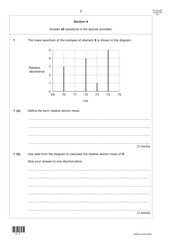
The mass spectrum of the isotopes of element X is shown in the diagram.
5
4
Relative
abundance
3
2
1
0
69
70
71
72
73
74
75
m/z
1 (a)
Define the term relative atomic mass.
............................................................................................................................................
............................................................................................................................................
............................................................................................................................................
............................................................................................................................................
(2 marks)
1 (b)
Use data from the diagram to calculate the relative atomic mass of X.
Give your answer to one decimal place.
............................................................................................................................................
............................................................................................................................................
............................................................................................................................................
............................................................................................................................................
............................................................................................................................................
............................................................................................................................................
(3 marks)
(02)
WMP/Jun13/CHEM1
�
Do not write
outside the
box
3
1 (c)
Identify the ion responsible for the peak at 72
............................................................................................................................................
(1 mark)
1 (d)
Identify which one of the isotopes of X is deflected the most in the magnetic field of a
mass spectrometer. Give a reason for your answer.
Isotope ................................................................................................................................
Reason ...............................................................................................................................
(2 marks)
1 (e)
In a mass spectrometer, the relative abundance of each isotope is proportional to the
current generated by that isotope at the detector.
Explain how this current is generated.
............................................................................................................................................
............................................................................................................................................
............................................................................................................................................
............................................................................................................................................
(2 marks)
1 (f)
X and Zn are different elements.
Explain why the chemical properties of
70X
and
70Zn
are different.
............................................................................................................................................
............................................................................................................................................
(1 mark)
11
Turn over
(03)
䊳
WMP/Jun13/CHEM1
�
Do not write
outside the
box
4
2 (a)
The hydrocarbon but-1-ene (C4H8) is a member of the homologous series of alkenes.
But-1-ene has structural isomers.
2 (a) (i)
State the meaning of the term structural isomers.
............................................................................................................................................
............................................................................................................................................
............................................................................................................................................
............................................................................................................................................
(2 marks)
2 (a) (ii) Give the IUPAC name of the position isomer of but-1-ene.
............................................................................................................................................
(1 mark)
2 (a) (iii) Give the IUPAC name of the chain isomer of but-1-ene.
............................................................................................................................................
(1 mark)
2 (a) (iv) Draw the displayed formula of a functional group isomer of but-1-ene.
(1 mark)
(04)
WMP/Jun13/CHEM1
�
Do not write
outside the
box
5
2 (b)
But-1-ene burns in a limited supply of air to produce a solid and water only.
2 (b) (i)
Write an equation for this reaction.
............................................................................................................................................
(1 mark)
2 (b) (ii) State one hazard associated with the solid product in part (b) (i).
............................................................................................................................................
(1 mark)
2 (c)
One mole of compound Y is cracked to produce two moles of ethene, one mole of
but-1-ene and one mole of octane (C8H18) only.
2 (c) (i)
Deduce the molecular formula of Y.
............................................................................................................................................
(1 mark)
2 (c) (ii) Other than cracking, give one common use of Y.
............................................................................................................................................
(1 mark)
2 (d)
In cars fitted with catalytic converters, unburned octane reacts with nitrogen monoxide
to form carbon dioxide, water and nitrogen only.
2 (d) (i)
Write an equation for this reaction.
............................................................................................................................................
(1 mark)
2 (d) (ii) Identify a catalyst used in a catalytic converter.
............................................................................................................................................
(1 mark)
11
Turn over
(05)
䊳
WMP/Jun13/CHEM1
�
Do not write
outside the
box
6
3
In 2009 a new material called graphane was discovered. The diagram shows part of a
model of the structure of graphane. Each carbon atom is bonded to three other
carbon atoms and to one hydrogen atom.
3 (a)
Deduce the type of crystal structure shown by graphane.
............................................................................................................................................
(1 mark)
3 (b)
State how two carbon atoms form a carbon–carbon bond in graphane.
............................................................................................................................................
............................................................................................................................................
(1 mark)
3 (c)
Suggest why graphane does not conduct electricity.
............................................................................................................................................
............................................................................................................................................
(1 mark)
3 (d)
Deduce the empirical formula of graphane.
............................................................................................................................................
(1 mark)
4
(06)
WMP/Jun13/CHEM1
�
Do not write
outside the
box
7
4
Fritz Haber, a German chemist, first manufactured ammonia in 1909.
Ammonia is very soluble in water.
4 (a)
State the strongest type of intermolecular force between one molecule of ammonia and
one molecule of water.
............................................................................................................................................
(1 mark)
4 (b)
Draw a diagram to show how one molecule of ammonia is attracted to one molecule of
water. Include all partial charges and all lone pairs of electrons in your diagram.
(3 marks)
4 (c)
Phosphine (PH3) has a structure similar to ammonia.
In terms of intermolecular forces, suggest the main reason why phosphine is almost
insoluble in water.
............................................................................................................................................
............................................................................................................................................
(1 mark)
5
Turn over
(07)
䊳
WMP/Jun13/CHEM1
�
Do not write
outside the
box
8
5
Aluminium and thallium are elements in Group 3 of the Periodic Table.
Both elements form compounds and ions containing chlorine and bromine.
5 (a)
Write an equation for the formation of aluminium chloride from its elements.
............................................................................................................................................
(1 mark)
5 (b)
An aluminium chloride molecule reacts with a chloride ion to form the AlCl4− ion.
Name the type of bond formed in this reaction. Explain how this type of bond is
formed in the AlCl4− ion.
Type of bond ......................................................................................................................
Explanation .........................................................................................................................
............................................................................................................................................
............................................................................................................................................
(2 marks)
5 (c)
Aluminium chloride has a relative molecular mass of 267 in the gas phase.
Deduce the formula of the aluminium compound that has a relative molecular mass
of 267
............................................................................................................................................
(1 mark)
5 (d)
Deduce the name or formula of a compound that has the same number of atoms, the
same number of electrons and the same shape as the AlCl4− ion.
............................................................................................................................................
(1 mark)
5 (e)
Draw and name the shape of the TlBr52− ion.
Shape of the TlBr52− ion.
Name of shape ..................................................................................................................
(2 marks)
(08)
WMP/Jun13/CHEM1
�
Do not write
outside the
box
9
5 (f) (i)
Draw the shape of the TlCl2+ ion.
(1 mark)
5 (f) (ii) Explain why the TlCl2+ ion has the shape that you have drawn in part (f) (i).
............................................................................................................................................
............................................................................................................................................
............................................................................................................................................
(1 mark)
5 (g)
Which one of the first, second or third ionisations of thallium produces an ion with the
electron configuration [Xe] 5d106s1?
Tick (✓) one box.
First
Second
Third
(1 mark)
10
Turn over
(09)
䊳
WMP/Jun13/CHEM1
�
 Historical archive . public document