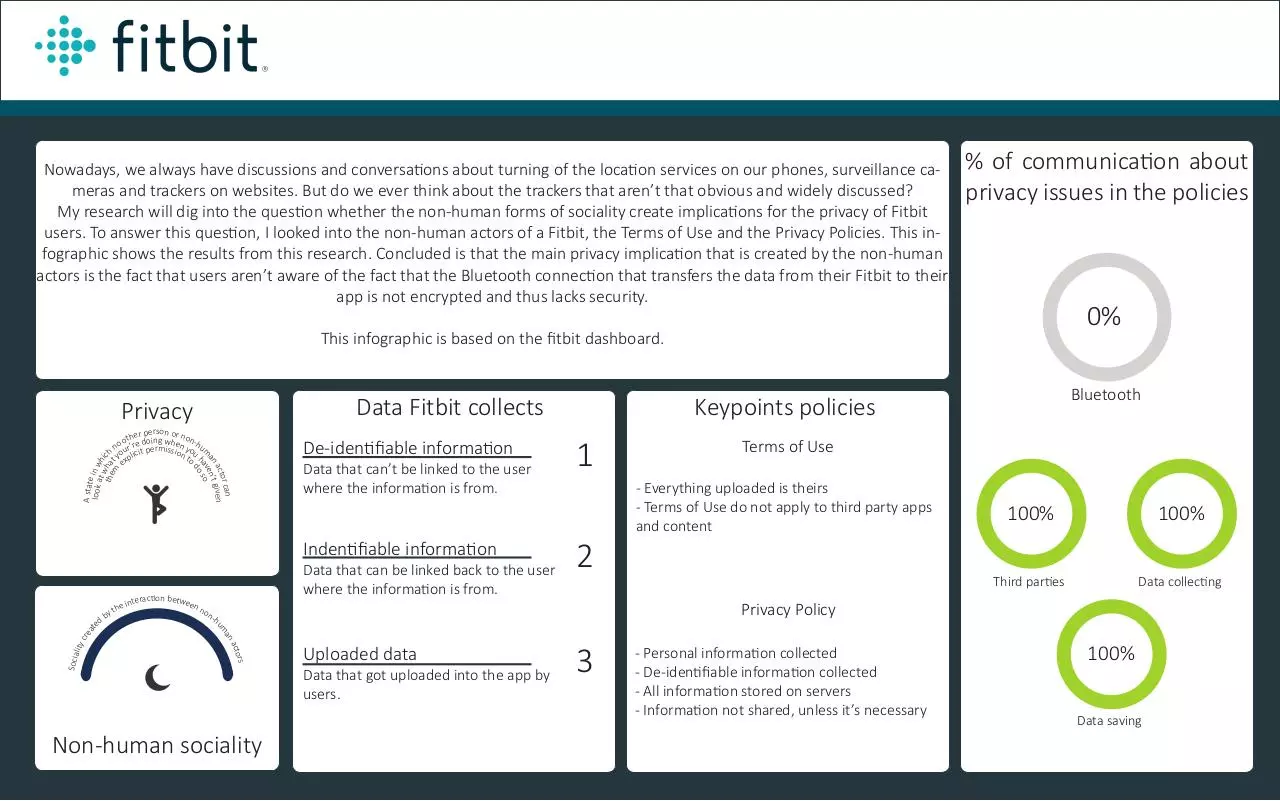
Nowadays, we always have discussions and conversations about turning of the location services on our phones, surveillance cameras and trackers on websites. But do we ever think about the trackers that aren’t that obvious and widely discussed?
My research will dig into the question whether the non-human forms of sociality create implications for the privacy of Fitbit
users. To answer this question, I looked into the non-human actors of a Fitbit, the Terms of Use and the Privacy Policies. This infographic shows the results from this research. Concluded is that the main privacy implication that is created by the non-human
actors is the fact that users aren’t aware of the fact that the Bluetooth connection that transfers the data from their Fitbit to their
app is not encrypted and thus lacks security.
% of communication about
privacy issues in the policies
0%
This infographic is based on the fitbit dashboard.
A state
look a in wh
t w ic
the hat
m
n
or ca
act given
an ven’t
ha o so
d
erson or n
p
r
e
th doing wh on-h
o
no ur ’reit permissieon yo um
h yo lic
u
n
to
p
x
e
De-identifiable information
Data that can’t be linked to the user
where the information is from.
Indentifiable information
cti on betwe
a
r
e
t
in
en
e
no
th
y
nb
h
d
e
ors
act
an
um
Socia
lity
cre
at
Keypoints policies
Data Fitbit collects
Privacy
Non-human sociality
Data that can be linked back to the user
where the information is from.
Bluetooth
1
2
Terms of Use
- Everything uploaded is theirs
- Terms of Use do not apply to third party apps
and content
100%
100%
Third parties
Data collecting
Privacy Policy
Uploaded data
Data that got uploaded into the app by
users.
3
- Personal information collected
- De-identifiable information collected
- All information stored on servers
- Information not shared, unless it’s necessary
100%
Data saving
�
 Historical archive . public document