Individual Differences in Mothers and Children: Effects on Child Autobiographical Outcomes
Y3859664
University of York
Introduction
Results
Discussion
•
•
•
•
•
•
•
•
Highly elaborative mothers have been found to
have children who recall significantly richer and
accurate memories when compared to low
elaborative mothers’ children (Fivush, Habermas,
Waters, & Zaman, 2011).
Maternal depression is likely to be negatively
related to child autobiographical memory
outcomes (Sumner, Griffith, & Mineka, 2010).
Child gender appears to result in memory recall
differences, with girls outperforming boys
(Grysman, & Hudson, 2013).
Child language ability seems to play a role in how
children encode and express memories (Fivush,
2011).
We examined the role of the previously
mentioned variables on child autobiographical
outcomes. The present study used maternal
elaboration during a task, a somewhat
unexplored area of research. Variables predictive
ability on child autobiographical memory
outcomes was also explored.
We expected maternal elaboration, and
language ability to be positively related to child
memory outcomes. Girls were expected to
perform significantly better. Maternal
depression was expected to negatively correlate
with child autobiographical outcomes.
Methods
Data comprised of during-event transcripts of a
mother child interaction, and measures of maternal
depression, child gender and language ability.
Transcripts were coded similarly to criteria by Reese
and Newcombe (2007). Composite scores were
created for maternal elaboration and historic
maternal depression.
•
•
•
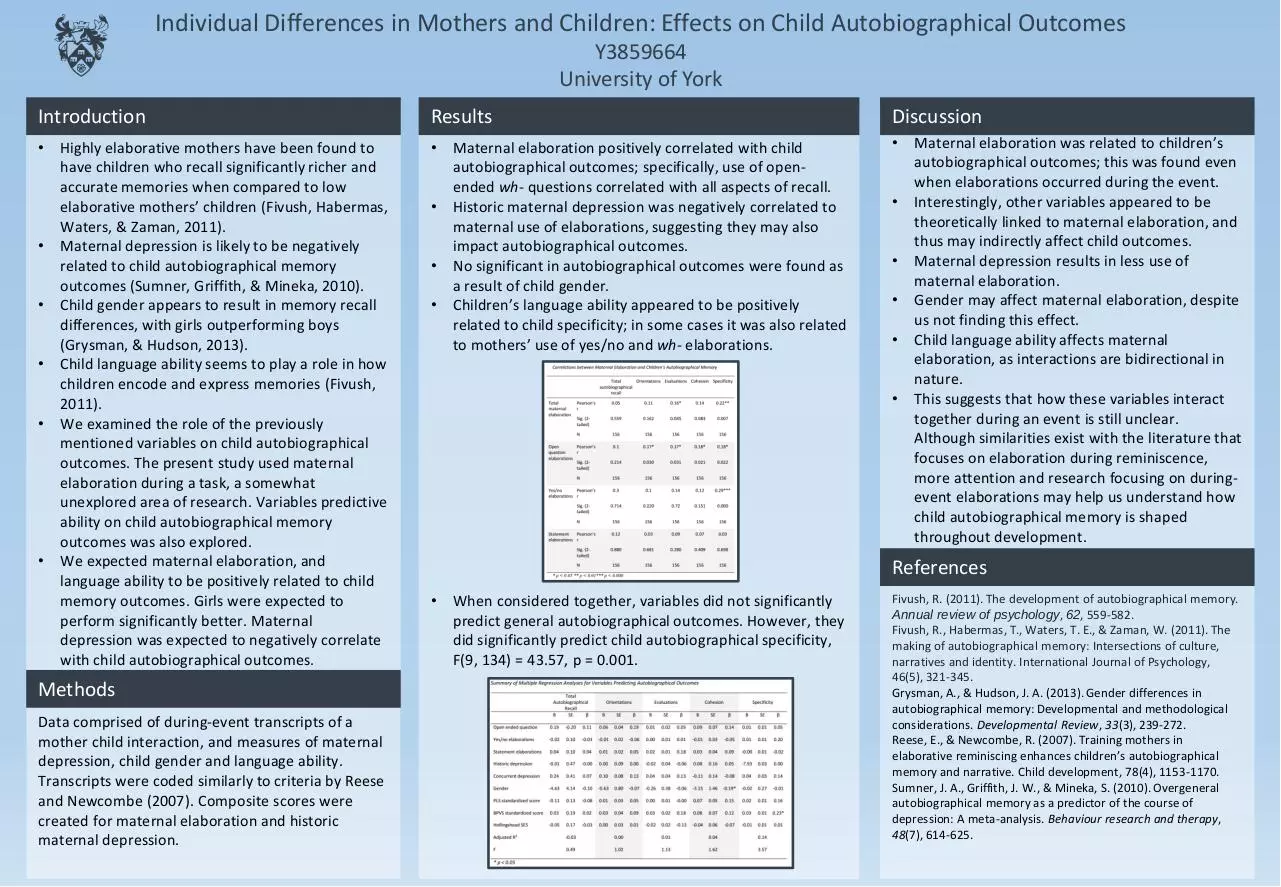
Maternal elaboration positively correlated with child
autobiographical outcomes; specifically, use of openended wh- questions correlated with all aspects of recall.
Historic maternal depression was negatively correlated to
maternal use of elaborations, suggesting they may also
impact autobiographical outcomes.
No significant in autobiographical outcomes were found as
a result of child gender.
Children’s language ability appeared to be positively
related to child specificity; in some cases it was also related
to mothers’ use of yes/no and wh- elaborations.
•
•
•
•
•
Maternal elaboration was related to children’s
autobiographical outcomes; this was found even
when elaborations occurred during the event.
Interestingly, other variables appeared to be
theoretically linked to maternal elaboration, and
thus may indirectly affect child outcomes.
Maternal depression results in less use of
maternal elaboration.
Gender may affect maternal elaboration, despite
us not finding this effect.
Child language ability affects maternal
elaboration, as interactions are bidirectional in
nature.
This suggests that how these variables interact
together during an event is still unclear.
Although similarities exist with the literature that
focuses on elaboration during reminiscence,
more attention and research focusing on duringevent elaborations may help us understand how
child autobiographical memory is shaped
throughout development.
References
•
When considered together, variables did not significantly
predict general autobiographical outcomes. However, they
did significantly predict child autobiographical specificity,
F(9, 134) = 43.57, p = 0.001.
Fivush, R. (2011). The development of autobiographical memory.
Annual review of psychology, 62, 559-582.
Fivush, R., Habermas, T., Waters, T. E., & Zaman, W. (2011). The
making of autobiographical memory: Intersections of culture,
narratives and identity. International Journal of Psychology,
46(5), 321-345.
Grysman, A., & Hudson, J. A. (2013). Gender differences in
autobiographical memory: Developmental and methodological
considerations. Developmental Review, 33(3), 239-272.
Reese, E., & Newcombe, R. (2007). Training mothers in
elaborative reminiscing enhances children’s autobiographical
memory and narrative. Child development, 78(4), 1153-1170.
Sumner, J. A., Griffith, J. W., & Mineka, S. (2010). Overgeneral
autobiographical memory as a predictor of the course of
depression: A meta-analysis. Behaviour research and therapy,
48(7), 614-625.
�
 Historical archive . public document