Tiffan Chilcott Wong
GEOL5333 – Wetlands
Wetlands as Wastewater Treatment Technology
A Review of California Examples
In the grand scheme of pollution control technology and the impacts humans have on the
environment, wetlands have been used and abused for decades by urban development, agriculture, and
indirect poisoning through wastewater systems. This, however, can change when we decide to use them
as a tool, making the best use of nature's mechanisms for our day to day activities. In the natural world,
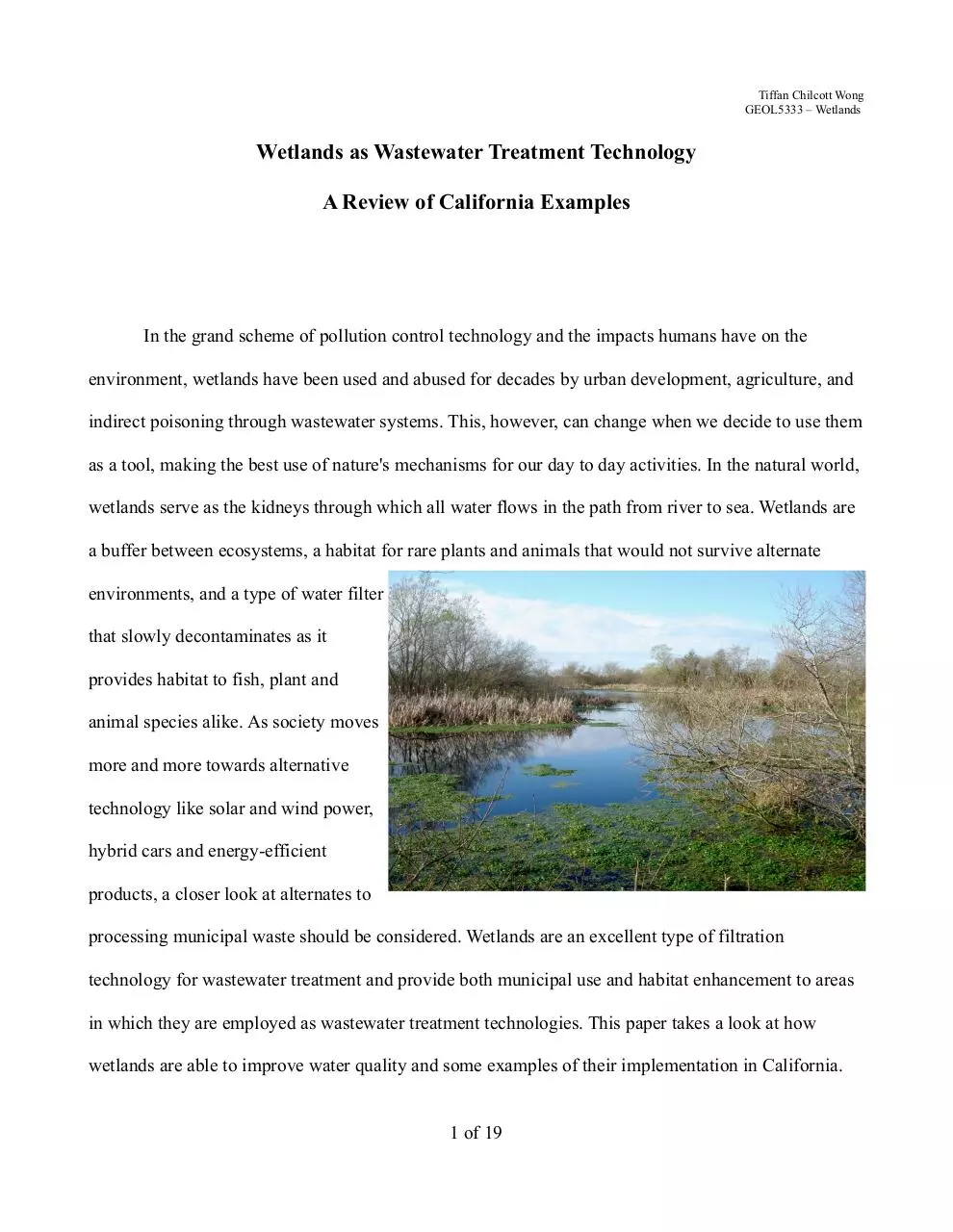
wetlands serve as the kidneys through which all water flows in the path from river to sea. Wetlands are
a buffer between ecosystems, a habitat for rare plants and animals that would not survive alternate
environments, and a type of water filter
that slowly decontaminates as it
provides habitat to fish, plant and
animal species alike. As society moves
more and more towards alternative
technology like solar and wind power,
hybrid cars and energy-efficient
products, a closer look at alternates to
processing municipal waste should be considered. Wetlands are an excellent type of filtration
technology for wastewater treatment and provide both municipal use and habitat enhancement to areas
in which they are employed as wastewater treatment technologies. This paper takes a look at how
wetlands are able to improve water quality and some examples of their implementation in California.
1 of 19
�
Tiffan Chilcott Wong
GEOL5333 – Wetlands
Wetlands have unique capabilities to filter water through the extensive plant and microbiota
ecosystem, taking in pollutants, nutrients, suspended solids, pathogens, and heavy metals into the
intricate web of plant roots. Microorganisms and their decomposition of organic compounds “eat”
away the nutrients like phosphorus and nitrogen, while plant roots and a slow flow rate, leading to a
higher hydraulic retention time, enables sedimentation of pollutants and pathogens. The sorption of te
pollutants onto plant fibers and roots creates bioaccumulation of the pollutant in the plant, removing the
pollutant from the water system and anchoring it in the plant itself.
Water quality has been shown to improve with the implementation of wetlands into the
wastewater system. In one example, it was an accidental discovery when a group of researchers were
studying how to improve the habitat for rearing of juvenile fish species like Pacific Salmon and Brook
Trout. When measured from the inflow point to an outflow point, there is a notable reduction in
pollutants, including total suspended solids, phosphorus, nitrogen, and pathogens as the water trickles
through the wetland system “filter” to discharge into
the final outflow measurement point. In large
systems like major metropolitan river systems, this
can be used as a tool to improve water quality at
different points of the river system to improve the
overall water quality and detoxify water as it flows
downstream and dilutes urban runoff.
Habitat restoration and improvement is a major benefit of wetlands as wastewater treatment
plants, as human activity has destroyed more than 90% of California's original wetlands. Because
2 of 19
�
Tiffan Chilcott Wong
GEOL5333 – Wetlands
wetlands serve as an ecotone between different habitats, like a buffer between saline bay water and
fresh river water, keeping a healthy habitat for species to interact and thrive is essential to maintaining
a vibrant ecology in California. One of the most influential species in the wetlands restoration
movement is waterfowl, as organizations like Ducks Unlimited have taken major steps to ensure the
viability of remaining wetlands systems. However, protecting what we still have is not enough to
ensure future biodiversity; creating wetlands as water treatment systems will only add to the
availability of habitat for wetlands species.
In terms of creating wetlands, there are several types of treatment wetlands to examine. The
most common type is a mono-culture cell-structured wetland, where the area is divided into “cells” and
a specific plant species is planted and allowed to
digest pollutants as they flow through a
wastewater system. Although that is the
rudimentary description of what a treatment
wetlands looks like or how it works, there is
much more to the story than that. They are most
often used as a final “polishing” step in robust
wastewater treatment systems, removing the superfine organic particles and suspended solids that
previous technologies (clarifiers, oxidation pools, digesters) could not remove. Although this tertiary
step of “polishing” the water is not required, many large urban municipalities treat as much of the water
as possible with the most efficient technology. In this case, wetlands are competing against highly
technological systems like reverse osmosis, ion exchange and ultraviolet oxidation. Many of these
systems are high in capital and maintenance costs, but low on space required, whereas wetlands are
3 of 19
�
Tiffan Chilcott Wong
GEOL5333 – Wetlands
much lower in capital and maintenance costs but require much larger portions of land.
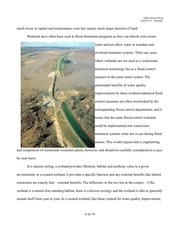
Wetlands have often been used in flood abatement programs as they can absorb extra storm
water and not allow water to inundate and
overload treatment systems. There are cases
where wetlands are not used as a wastewater
treatment technology but as a flood control
measure in the same water system. The
unintended benefits of water quality
improvements by these wetland-enhanced flood
control measures are often overlooked by the
corresponding flood control departments, and it
seems that the same flood-control wetlands
could be implemented into wastewater
treatment systems when not in use during flood
season. This would require heavy engineering
and cooperation of wastewater treatment plants, however, and should be carefully considered on a caseby-case basis.
In a natural setting, a wetland provides filtration, habitat and aesthetic value to a given
environment; in a created wetland, it provides a specific function and any external benefits like habitat
restoration are exactly that – external benefits. The difference in the two lies in the creator – if the
wetland is a natural free-standing habitat, there is a diverse ecology and the wetland is able to generally
sustain itself from year to year. In a created wetland, like those created for water quality improvement,
4 of 19
�
Tiffan Chilcott Wong
GEOL5333 – Wetlands
there is a heavy amount of engineering in common created systems and intentionally-planted species
may not last very long or be overcome by another species that flourishes in the created habitat. Created
wetlands are also subject to failure due to overengineering of the system, whether by maintenance
issues or by a poor selection of wetland placement within the hydrological profile of the area.
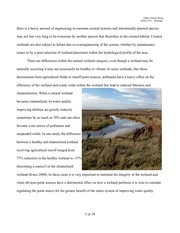
There are differences within the natural wetland category; even though a wetland may be
naturally occurring it may not necessarily be healthy or vibrant. In some wetlands, like those
downstream from agricultural fields or runoff point sources, pollutants have a heavy effect on the
efficiency of the wetland and create voids within the wetland that lead to reduced filtration and
channelization. When a natural wetland
becomes channelized, its water quality
improving abilities are greatly reduced,
sometimes by as much as 70% and can often
become a net source of pollutants and
suspended solids. In one study, the difference
between a healthy and channelized wetland
receiving agricultural runoff ranged from
77% reduction in the healthy wetland to -37%
(becoming a source!) in the channelized
wetland (Knox 2008). In these cases it is very important to maintain the integrity of the wetland and
when obvious point sources have a detrimental effect on how a wetland performs it is wise to consider
regulating the point source for the greater benefit of the entire system of improving water quality.
5 of 19
�
Tiffan Chilcott Wong
GEOL5333 – Wetlands
Created systems function in similar ways but are engineering in very specific ways to create the
most efficient use of resources. There are generally two different types of created systems, a surface or
subsurface flow of water is the main separation parameter.
In the surface-flow system, it looks very much like a naturally occurring wetland, with a pondlike structure and speciation. It is a structured system with detailed elevation profiles of where
sedimentation occurs and how plant roots absorb nutrients and metals. From the surface it often looks
like a giant patch of vegetation, often a monoculture, and often either typha (common cattail), water
hyacinth or a type of bulrush. Because
the created wetland is a contained
system, these aggressive species can be
used with careful monitoring that they
do not spread into nearby waterways. In
the case of water hyacinth, it is often
used in water treatment systems near the
ocean because the risk of it spreading to
the saline water is very low, as it cannot
survive in high salinity. The water is drained near the surface, hence the name, and then discharged to
either open water or led to further water treatment. A sub-surface flow system drains the wastewater
down through the soil and encourages sedimentation and sorption of the pollutants and suspended
solids. The drainage pipe is located beneath the surface, collecting the water as it percolates through the
soil system and is then discharged downstream to either open water or fed to further water treatment
systems.
6 of 19
�
Tiffan Chilcott Wong
GEOL5333 – Wetlands
Wetlands offer very specific tasks in regards to water quality treatment, including the removal
of nutrients, suspended solids, nitrogen, phosphorus and other regulated pollutants. Through various
processes like a reduction in water flow velocity which leads to higher hydraulic retention time, or time
in which the water stays in the wetland, the various plant structures and microorganisms can break
down the nutrients and absorb the pollutants. Specific plant species are planted because of their high
sorption rates and their relevance to the type of wetland created (freshwater marsh floating vs.
emergent, etc.). The plants are responsible for both slowing the water flow through their root structure
and absorbing the suspended solids and nutrients remaining in the water as it flows through the system.
The reduced water flow allows microbiota like algae leftover from previous treatment systems, namely
the oxidation pools, to slow down and settle at the bottom of the wetland floor. This sedimentation
occurs with algae, suspended solids, and pathogens, as well as regulated pollutants like phosphorus.
Regarding habitat, natural and created wetlands are very different in their management of
“visiting” species in the wetland system. Most wastewater treatment plants discourage outside sources
of fauna due to risk of pathogen and other pollutant input. If the oxidation pools of a water treatment
plant is considered a “wetland,” it can be seen as
an extreme, as waterfowl is highly discouraged due
to the risk of increased and untreated transported
pathogens from the birds. In some instances birds
are chased off the ponds and learn to avoid the area
altogether. On the other side of the spectrum is the
wetlands that are designed as tertiary water
treatments, and the effluent from the water will go through a final decontamination before being
7 of 19
�
Tiffan Chilcott Wong
GEOL5333 – Wetlands
discharged to open water and open ecosystems. These processes can include ultraviolet radiation,
chlorine “stripping” of the water, and membrane filtration. In these cases, species variety is encouraged
and will develop a more robust ecosystem for the wetland, creating a stronger system for treatment
faculties. Natural freshwater wetlands and stormwater or flood control wetlands are often seen as the
most friendly habitat while also serving as water quality improvement processes, mostly because the
effluent from these systems is not used as potable water.
There are several examples of wetlands being used as wastewater or stormwater runoff
treatment processes in California. While there are multiple examples of similar processes, there are
three examples in this paper to show the wide spectrum of California's implementation of this advanced
natural filtration process.
Arcata – The original innovator
The city of Arcata was faced with a
financial problem as the potential costs of
building a new wastewater treatment plant in
the late 1970s would create unwanted
development and nullify the existing treatment
plant or create a new solution to make the
discharged water up to Clean Water Act standards. The waterfront treatment site was originally a
condemned landfill and abandoned lumber mill on the shore of Humboldt Bay. Along with these
eyesores included a water treatment plant that was built in 1933, which was essentially a pipe leading
into a ditch. Through the early years of the water treatment plant's discharge into the bay and nearby
8 of 19
�
Tiffan Chilcott Wong
GEOL5333 – Wetlands
oyster beds, the oysters became contaminated from the discharge and epidemics broke out at locations
the oysters were sold; city officials then took a second look at the wastewater system. The city
considered wetlands starting in 1957 with the oxidation ponds in the water treatment system. Then in
1979, in response to the Clean Water Act, a cohort of scientists, academics and politicians collaborated
to create a wetlands system that would benefit the salmon and trout population, treat reclaimed water,
enrich surrounding habitat and transform a dilapidated waterfront. After working through several state
agencies, it was the California Coastal Commission that helped fund the project, which was presented
as a low-cost means to enhance the water entering the bay.
The Arcata Marsh, as it is locally known, has become the standard go-to example of wetlands as
a wastewater treatment solution. It is most
certainly the best use of an existing natural
wetland system and most efficient treatment
process possible for that location and urban
structure. This heavy focus on the treatment
wetlands suits a small community with a
stable influent coming into the water
treatment facility. Arcata is a small town of
17,000 people (as of 2006) with the associated wastewater load from a small town. The wetlands treat
the wastewater and runoff from the city of Arcata and Humboldt State University, which is located in
Arcata and is the primary research engine for the Arcata Marsh. The town site is ideal for a wetland
treatment system, as it is located on a coastal bay with plenty of existing marsh and space available to
create treatment wetlands. Ancillary benefits of the treatment system include a wetland ecosystem vital
9 of 19
�
Tiffan Chilcott Wong
GEOL5333 – Wetlands
for the juvenile rearing of salmon and trout, as well as recreation and aesthetic appeal, including
walking trails and waterfowl observation bridges.
According to the Environmental Protection Agency, “the constructed wetland system is the
cornerstone of Arcata's urban watershed renovation program.” Arcata marsh is certainly one of the most
environmentally advanced, as it uses wetlands in both secondary and tertiary treatment of wastewater,
which is not typical of treatment wetlands systems. This system has a primary treatment system that is
like those used across the country to remove the large particles. Bar separators remove bulk items like
hats, plastic, condoms, leaves, and other large items while the grit separators remove smaller particles
like sand, rocks, and other heavy material from the wastewater. The water is then passed through a
flume for flow regulation to the system.
10 of 19
�
Tiffan Chilcott Wong
GEOL5333 – Wetlands
The clarification step utilizes two clarifiers that separate the solids from the wastewater and
settles out remaining suspended bulk material. The liquid portion from clarifiers is sent to oxidation
ponds, completing the primary treatment. Solids from clarifiers are pumped from the bottom of a
settling tank to the digesters, completing that portion of primary treatment. The next step of the primary
treatment is the digestion of sludge from the primary clarifiers. The sludge goes through two separate
digesters which mix the sludge with methane gas, recovering remaining methane gas in sludge and then
burning off the gas. The methane gas is removed, leaving only sludge in the system. Solid sludge is
then dried and composted, a process lasting over six months, but which produces an exceptional
biosolid fertilizer for use in city parks.
The beginning of the wetlands system starts with the oxidation ponds and the secondary water
treatment. Liquid effluent from the clarification units is sent to the oxidation pond, a large expanse of
water up to 5' deep in the middle. Oxidation occurs and stimulates decomposition of nutrients and
converts soluble organic matter into insoluble microbial cells and stabilizes organic matter, reducing
the mass of microbial solids remaining. This removes an average of 50% of the BOD (biological
oxygen demand), which is a measurement of the dissolved oxygen demand for microorganisms to
biodegrade organic matter. High BOD means there is a higher amount of organic matter in the water,
which increases the demand for oxygen and as the oxygen is consumed, leads to anoxic conditions later
in the stream. Primary stages of solids settlement takes place in the oxidation ponds. Algal suspended
growth causes oxygen boost for aerobic and anaerobic bacteria “buggies” in the oxidation pond. There
is a bacteria separation between the upper aerobic portion of the water and the lower anaerobic portion,
and there are facultative bacteria that switch between aerobic and anaerobic systems. Bacteria, algae
and microorganisms consume and remove nitrogen and phosphorus in the water, and the water is then
11 of 19
�
Tiffan Chilcott Wong
GEOL5333 – Wetlands
sent along to the wetlands portion of secondary treatment.
The treatment marshes are three 2-acre ponds that serve as shallow (2'deep) cells for
sedimentation and plant uptake of nutrients and pollutants through sorption into sediment,
sedimentation and bioconcentration into plant materials. This step removes organic matter and
nutrients, nitrogen, phosphorus, fecal coliform and suspended solids, including the algae suspended
solids and bacteria from the oxidation pond before the water is pumped to the chlorination step. The
majority of the pollutant uptake is performed by a monoculture of either cattails or hardstem bulrush.
This is primarily achievable due to the divided cells within the marsh system so the aggressive species
do not invade other portions of the natural wetlands system. The cattails and bulrush provide little
sunlight for the algae and microorganisms from the oxidation pond, so they expire and settle at the
bottom. A key performance component
here is the hydraulic retention time,
which dictates how long the water stays
in each portion of the treatment marsh
cell. The flow rate is relatively slow,
which allows significant settling of
solids.
What Arcata's water treatment plant calls the “Enhancement Marshes” are what is typically seen
at wastewater treatment plants if wetlands are implemented into the system. This is considered a
tertiary “polishing” treatment. Water is sent from the Treatment marshes to a set of three enhancement
marshes, which continue to reduce BOD, leftover microorganisms from the secondary treatment
systems, nitrogen, phosphorus and heavy metals. This is an extra step not required by the Clean Water
12 of 19
�
Tiffan Chilcott Wong
GEOL5333 – Wetlands
Act, but necessary to promote a healthy ecosystem when the water is released to the open water.
Water from this last portion of the wetlands system, the enhancement marshes, must be
sanitized and send through chlorination and then dechlorination before it is allowed to be discharged
into Humboldt Bay.Pipes transport the water to and from the enhancement marshes under the
recreational footbridge, and control how much is pumped to either side of the processing system.
Chlorine gas is diffused into the water as a stripping process and removes and sanitizes any leftover
bacteria in the treated water. Currently, the Arcata Wastewater Treatment Plant is currently considering
other sanitation systems, including an ultraviolet light filtration system. This is a highly sophisticated
system that must be thoroughly tested due to the sensitive parameters, including water temperature, pH,
oxidants present, and types of oxidants. However, it is a non-invasive and non-chemical approach to
killing pathogens and speeding up the oxidation process.
Arcata's wetland treatment system serves as a model for many west coast wastewater treatment
plant systems considering utilizing wetlands as a wastewater treatment technology. It could even be
said that the Arcata Marsh is the alma-mater of wetlands as treatment systems on the West Coast, and
possibly the country. It is important to note a few key items, though; bioaccumulation of the pollutants
and toxins in the marsh vegetation must occasionally be harvested to protect the fauna utilizing the
marshes as habitat. There is a certain peak capacity of the vegetation to work as a filter, and the
pollutants are essentially transferred from the water to the plant fibers. Also, this system is highly
efficient for the small, rural town of Arcata. At maximum, the wastewater treatment plant processes 5.9
million gallons/day (mgd) on a monthly basis. As a reference, the city of Sacramento requested an
increase from 181mgd to 218mgd on their 2009 water permit renewal.
13 of 19
�
Tiffan Chilcott Wong
GEOL5333 – Wetlands
Bay - Delta
The Sacramento – San Joaquin delta is the nation's most endangered waterway system,
according to the organization American Rivers in 2009. It is the most extensive wetlands in California,
and the state's most valuable water resource, as it charges canals feeding water to Southern California
and provides agricultural water to farms in San Joaquin Valley. A plethora of issues surround the Delta
system. In the nineteenth century, levees were built to drain the delta and create over 450,000 acres of
farmland on what was once a huge tidal marsh. This has created a system of farm “islands” and
generally degraded the natural
wetlands that once proliferated
the area and provided immense
ecotones between upland oak
meadows and estuarine
habitats. These farms have had
a significant impact on water
quality, including pesticide and
herbicides leaching into river waters and affecting organisms, deleterious chemicals and carcinogens
being discharged into the waterways from municipalities, food web bioaccumulation of heavy metals
and pollutants downstream and saltwater creeping into freshwater systems in natural wetlands.
Subsidence issues result from decades, more than a century, of draining and establishing levees on
peat-like marshes in the Sacramento Delta region.
14 of 19
�
Tiffan Chilcott Wong
GEOL5333 – Wetlands
The Sacramento Delta is the confluence of a large watershed, the largest in California, which
means there are many sources for pollutants. The primarily agricultural pollutant loading is from the
San Joaquin Valley feed and Sacramento River inputs. The entire Central Valley is agriculture outside
urban centers like Sacramento, Fresno and Bakersfield; pesticide and herbicide pollutants tend to be
highest from those areas. Effects of a significantly decreased water quality of the Delta include sanitary
issues, which means physical body
contact from recreational use of
delta waterways (swimming, water
skiing and wading) increases risk of
contracting diseases. Reduced water
quality is also from water diversion
to inter-state water canals, which
reduces amount of freshwater in
delta and allows saltwater to migrate up delta waterways. This results in increased salinity and loss of
freshwater wetland species and habitat throughout the delta.
In naturally occurring wetland systems there is a large difference in the ability of the wetland to
reduce contamination and improve water quality between healthy wetlands and degraded, channelized
wetlands. With levee construction and the dredge-and-filling-in of the natural wetland system of the
Delta, the water quality has massively declined, leaving wastewater treatment plants with the brunt of
treating the wastewater that could be mitigated through wetlands filtration.
15 of 19
�
Tiffan Chilcott Wong
GEOL5333 – Wetlands
There was a small study
on
wetlands as a possibility for
wastewater treatment at the Elk
Grove location for the
Sacramento Regional County
Sanitation District in 19941998. Although they did not
implement the wetlands into a
permanent wastewater
treatment process, they absorbed the wetlands into their “Bufferland” system of mitigating the plant's
effect on the local community and now present the wetlands as a “demonstration” of how wetlands
remove trace metals, a significant issue for many of California's rivers that travel through old mining
areas. The wetland used in the study for wastewater treatment still exists today, but only as habitat and
aesthetic value, and not for its water quality treatment ability.
Although the Delta region does not have a treatment wetlands process in place, it is important to
note that the state's most estuarine region has not made the most efficient use of its topography and
continues to make mistakes in land use. Although the Arcata Marsh is used at a small scale, a
consideration of several small treatment wetlands and water treatment stations may be in order. It is
certainly detrimental to the health of the entire central valley's ecosystem that wetlands are not used as
a natural and efficient means of improving water quality and demonstrating how a city or region can
utilize its natural surroundings to incorporate the most sustainable practices possible.
16 of 19
�
Tiffan Chilcott Wong
GEOL5333 – Wetlands
Dominguez Gap, Long Beach
Los Angeles's long-documented abuse of waterways and rivers is being partially mitigated by a
project that implements wetlands as flood abatement. The Los Angeles River is a complex system of
canals, concrete washouts, reservoirs to hold rainwater and dams; most of the river's stormwater runoff
gets washed out to the San Pedro Bay untreated. Dominguez Gap is primarily a flood protection
system, while secondary benefits include improved water quality and groundwater recharge before
water enters San Pedro Bay and the ocean. The issues surrounding groundwater in the greater Los
Angeles basin are superfluous, as the city notoriously exists on borrowed water; since the early 20th
century LA has imported water from the Owens River Valley, the Bay-Delta region, and the Colorado
River through an extensive network of state- and federally-funded aqueducts.
In 2008 the city
installed a set of treatment
wetland cells in a portion
of flood spreading grounds
to allow the water to
percolate back into the
groundwater. There are
two basins with this
groundwater recharge
system, and the wetlands
helps to filter out toxins and treat the water before it goes into the recharge basin. The LA River water
is a major source of groundwater recharge as the treated water moves from the East Basin, which is the
17 of 19
�
Tiffan Chilcott Wong
GEOL5333 – Wetlands
treatment wetlands, to the West basin, which is a spreading ground to allow the water to percolate back
into the greater Los Angeles's groundwater system. Without the water being treated through the
wetlands system, the pollutants and nutrients go directly into the percolating system which could
possibly contaminate the entire water table. The water from the wetlands may also be piped directly
into the water table, depending on the season. In the dry season the water is piped directly, while during
the wet season the wetlands-treated water is sent from the East Basin to the West basin for a slow
percolation and further treatment.
Major sources of pollutants include common urban runoff problems, including bulk trash, used
automobile fluid dumping, rain runoff from streets, and overwatering of lawns. The Los Angeles River
is not a free-flowing river during
the entire year and is subject to
dam water released from reservoirs
upstream. This can mean that
agricultural and urban runoff can
enter a reduced amount of water,
thus highly concentrating the
pollutants and suspended solids in
the water. The wetlands are designed with this in mind. The Dominguez Gap wetlands is designed to
treat 1.3 to 3.2 million gallons per day of stormwater and urban runoff. It “will have a measurable
impact on water quality and return enough water to the groundwater system to meet the supply
demands for 900 families of four for one year,”said Diego Cadena, Deputy Director of the County of
Los Angeles Department of Public Works in 2008.
18 of 19
�
Tiffan Chilcott Wong
GEOL5333 – Wetlands
Additional benefits of the Dominguez Gap wetlands include rare wetlands habitat in the middle
of an urban desert, as well as recreation opportunities for Angelinos. It provides an excellent urban
escape for habitat viewing and environmental education, where children and teenagers can learn about
the importance of preserving habitat and the benefits of natural ecosystems.
California is often seen as one of the most progressive states in the United States, and has made
major strides toward incorporating environmental awareness into the fabric of society. However, there
are hard-lined differences between large urban capacities to incorporate alternative methods and small
community systems that have the space and community support to integrate environmentally
progressive practices. Sacramento is at one end, where they seem to be surrounded by the potential of
incorporating nature' filter system but have yet to actually use it, and Arcata is at the other end, where
the entire community balked at a development-encouraging new water treatment plant and instead
decided to incorporate nature's filter into their city wastewater system. Surprisingly, Los Angeles seems
to be striking a harmonious medium in this respect, as it is using treatment wetlands in appropriate
doses to reduce pollutants and pathogens in water entering their groundwater system. Although it is not
a large-scale in scope, the Dominguez Gap project has inspired several other small treatment wetlands /
park combinations along the Los Angeles river as part of a renewed LA River master plan. In the
United States' second largest city wetlands are being used to successfully improve water quality; large
cities across the country (like Houston) could consider this as inspiration for environmental renewal.
19 of 19
�
 Historical archive . public document