CHARACTERIZATION OF PARAFFINS
Physical Chemistry
Carla Ribeiro
Levan Tsereteli
�
Introduction
Introduction
Devices Used
GC
IR Spectroscopy
DSC
Discussion
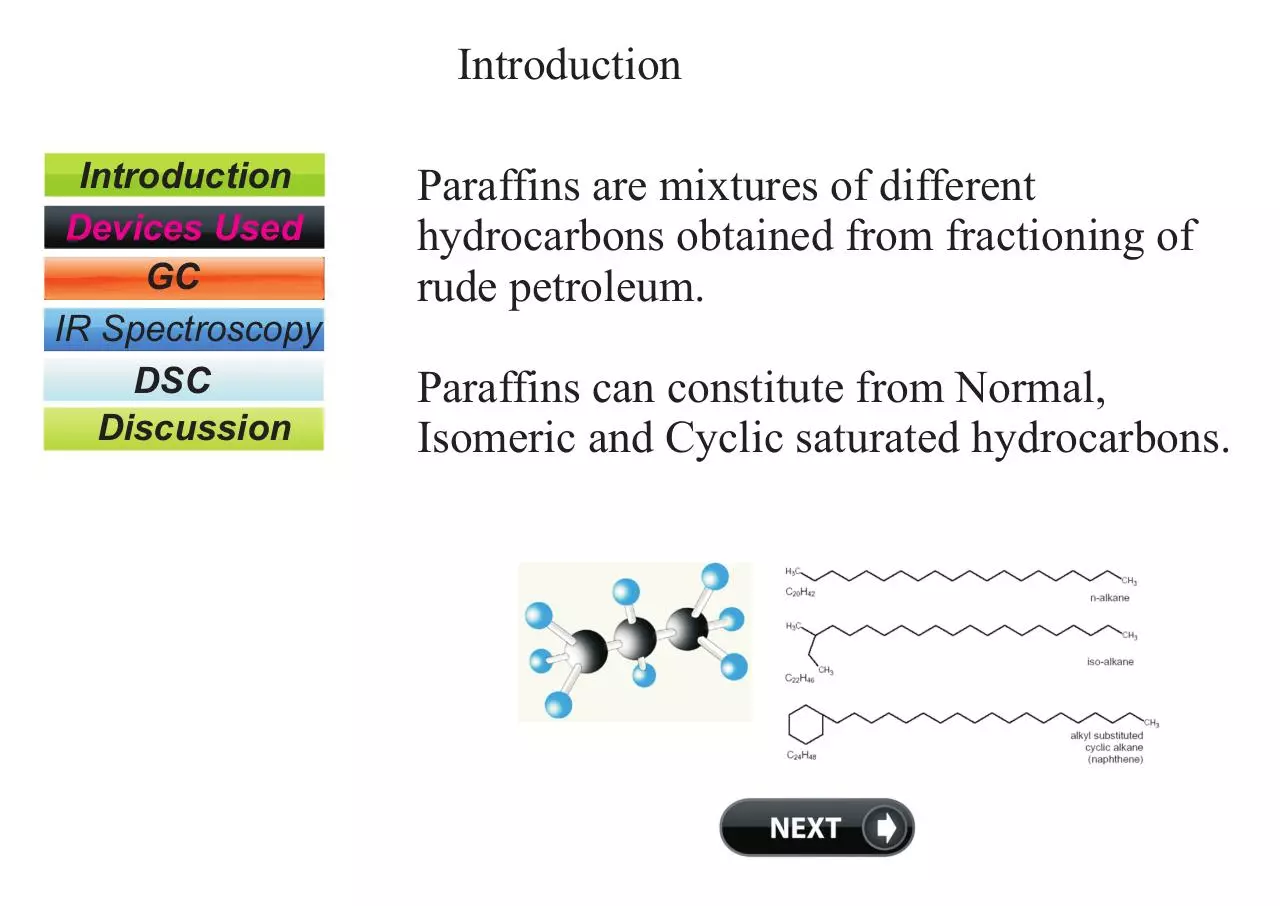
Paraffins are mixtures of different
hydrocarbons obtained from fractioning of
rude petroleum.
Paraffins can constitute from Normal,
Isomeric and Cyclic saturated hydrocarbons.
�
Introduction
Devices Used
GC
IR Spectroscopy
DSC
Discussion
Waxes are composed of hydrocarbons, esters of saturated
fatty acids and alcohols with high molecular weight that
are insoluble in water but soluble in nonpolar organic
solvents. They are fatty or oily substances solid at room
temperature that melt easily when heated.
Could be distinguished natural and artificial waxes
�
Introduction
Devices Used
GC
IR Spectroscopy
DSC
Discussion
These substances are used in the manufacture of candles,
cosmetics, adhesives, pharmaceuticals decorative
candles, paints, waxing paper and other specific uses.
In our experiments we used Wax PARAFFIN 57-59 and
paraffin RUBITHERM® RT 20.
�
Devices used during the experiment
Introduction
Devices Used
GC
IR Spectroscopy
DSC
Discussion
For characterization of paraffins we used, Gas
Chromatography, Infrared Spectrometry and
Differential Scanning Calorimeter.
GS - Hewlett Packard HP 4890 A, Possess 15 meters
long and 0,53mm width colon with siloxane.
�
Introduction
Devices Used
GC
IR Spectroscopy
DSC
Discussion
The gas chromatography (GC) is a technique for separation and analysis of
mixtures of volatile substances.
The sample is vaporized and introduced into an appropriate flow of a gas
called the mobile phase (FM) or carrier gas. This flow of gas with the
vaporized sample passes through a tube containing the stationary phase FE
(column chromatography), where the separation of the mixture occurs.
1- Gas reservoir and
pressure controller.
2 - Injector
3 - Column
chromatography
4 - Column Oven
5 - Detector
6 - Data processing
7 - Registration Signal
�
Infrared, or IR, spectroscopy is one type of vibrational
spectroscopy, which,is a spectroscopic technique
where molecular vibrations are analyzed.
Introduction
Devices Used
GC
IR Spectroscopy
DSC
Discussion
Infrared (ir) spectroscopy is used to identify particular
bond types and functional groups in organic molecules
by measuring a substance's absorption of infrared
radiation at different frequencies.
Obtained peeks are giving us opportunity to analyze
composition of the substance.
�
Introduction
Devices Used
GC
IR Spectroscopy
DSC
Discussion
Differential Scanning Calorimetry - is a thermal analysis
technique that records the flow of heat energy associated
with transitions in materials as a function of temperature.
A method of enthalpy variation, in which the difference in
the supply of heat energy between a substance and a
reference material is measured as a function of temperature.
The substance and reference material are subjected to the
same experimental conditions. The reference crucible
consists of an inert material similar to that used to contain
the sample or simply empty.
�
Introduction
Devices Used
GC
IR Spectroscopy
DSC
Discussion
The sample and reference are heated in the same
oven. The temperature difference is established
between the our sample and the reference sample.
This temperature difference is measured by sensors,
commonly, thermocouples arranged in opposition
�
Results of Gas Chromatography
Introduction
Devices Used
GC
IR Spectroscopy
DSC
Discussion
we conducted analyses of Rubitherm 20 on 150. 160, 170,
180, 190, and 200 C Temperature and obtained following
chromatograms:
140 C
150 C
160 C
170 C
�
Introduction
Devices Used
GC
IR Spectroscopy
DSC
Discussion
180 C
190 C
200 C
From obvious data of the peek retention time
we constructed grafics which charachterizing
properties of constituting hydrocarbons:
�
Rt20
RT20
Temp.
Introduction
Devices Used
GC
IR Spectroscopy
DSC
Discussion
Temp.
140
150
160
170
180
190
200
140
150
160
170
180
190
200
3,508
2,577
1,952
1,529
1,26
1,058
0,93
5,577
3,93
2,858
2,148
1,7
1,371
1,158
Retention time
8,982 14,625 23,897 39,028
6,107 9,604 15,195 24,132
4,282 5,515 10,008 15,439
3,101 4,563 6,797 10,202
2,359 3,348 4,827 7,037
1,83
2,504 3,492 4,936
1,478 1,959
2,64
3,613
�
dead
time/min
Introduction
Devices Used
GC
IR Spectroscopy
DSC
Discussion
0,4
(1/T(K))
F...ln((1/R))
0,002420428 -1,1339794 -1,6442257 -2,149667 -2,655001 -3,1568728 -3,6539774
0,002363228 -0,7779478 -1,2612979 -1,7416935 -2,2196382 -2,6942893 -3,1668243
0,002308669 -0,4395444 -0,899348 -1,3563505 -1,8107448 -2,2625961 -2,7106468
0,002256572 -0,1213323 -0,5584723 -0,9936221 -1,426236 -1,8558291 -2,2825864
0,002206775 0,1508229 -0,2623643 -0,6724341 -1,081127 -1,4877222 -1,8926601
0,002159128 0,4185503 0,0294288 -0,3576744 -0,7438403 -1,1288181 -1,5120456
0,002113495 0,6348783 0,2770719 -0,0751075 -0,4440446 -0,8064759 -1,1672051
slope
Del_Hvap
-5802,654 -6285,3955 -6768,3578 -7214,6755 -7663,7513 -8104,3305
48,24
52,26
56,27
59,98
63,72
67,38
1
y = -3E+ 06x2 + 6026,1x - 0,4373
R² = 0,9999
0,5
0
y = -2E+ 06x2 + 4080,4x + 1,8729
R² = 0,9999
-0,5
-1
y = -2E+ 06x 2 + 1316x + 5,1835
R² = 1
-1,5
-2
y = -2E+ 06x2 + 1597,2x + 4,7946
R² = 1
-2,5
-3
y = -1,815653E +06x 2 + 5,661998E+ 02x + 6,108843E +00
R² = 9,999884E -01
-3,5
-4
0,00205
0, 0021
0, 00215
0,0022
0,00225
0,0023
0,00235
0, 0024
y = -1,731167E +06x 2- 2,573369E +02x + 7, 110533E +00
R² = 9,999906E-01
0,00245
P1
P2
P3
P4
P5
P6
Poly . (P1)
Poly . (P2)
Poly . (P3)
Pol y. (P4)
Pol y. (P5)
Pol y. (P6)
�
0
dead time/min
(1/T(K))
Introduction
Devices Used
GC
IR Spectroscopy
DSC
Discussion
0,002420428
0,002363228
0,002308669
0,002256572
0,002206775
0,002159128
0,002113495
slope
Del_Hvap
-1,2550461
-0,9466259
-0,6688545
-0,4246139
-0,2311117
-0,0563803
0,0725707
F...ln((1/R))
-1,718651 -2,1952226
-1,3686394 -1,8094357
-1,0501221 -1,4544202
-0,7645372 -1,1317246
-0,5306283 -0,8582378
-0,3155404 -0,604316
-0,1466944 -0,3906898
-2,6827324
-2,2621797
-1,8718022
-1,5179803
-1,2083632
-0,9178895
-0,6724341
-3,1737529
-2,7209664
-2,3033848
-1,9164813
-1,5742252
-1,2504746
-0,9707789
-3,6642793
-3,1835388
-2,7368968
-2,3225838
-1,9511819
-1,5965553
-1,2845385
-4350,9398 -5146,9498 -5898,5261 -6570,4053 -7195,1116 -7766,6549
36,17
42,79
49,04
54,63
59,82
64,57
0 ,5
y = -5 E+ 0 6 x 2 + 1 8 0 9 4 x - 1 6 ,0 4 6
R ² = 0 ,9 9 9 9
0
-0 ,5
y = -5 E+ 0 6 x 2 + 1 5 9 5 7 x - 1 3 ,0 7
R ² = 0 ,9 9 9 9
-1
-1 ,5
y = -4 E+ 0 6 x 2 + 1 0 4 0 9 x - 5 ,9 3 5 6
R² = 1
-2
y = -4 E+ 0 6 x 2 + 1 2 4 5 4 x - 8 ,6 2 3 3
R² = 1
-2 ,5
-3
y = -3 ,2 9 1 9 2 5 E+ 0 6 x 2 + 7 ,7 2 6 4 4 7 E+ 0 3 x - 2 ,5 9 2 1 6 6 E+ 0 0
R ² = 9 ,9 9 9 7 6 7 E-0 1
-3 ,5
y = -2 ,8 8 8 0 3 8 E+ 0 6 x 2 + 5 ,3 2 4 1 7 5 E+ 0 3 x + 3 ,6 6 3 1 8 0 E-0 1
R ² = 9 ,9 9 9 8 5 1 E-0 1
-4
0 ,0 0 2 0 5
0 ,0 0 2 1
0 ,0 0 2 1 5
0 ,0 0 2 2
P1
P4
? ? ? ? ? ? ? ? ? ? ? ? ? ? (P 1 )
0 ,0 0 2 2 5
0 ,0 0 2 3
P2
P5
? ? ? ? ? ? ? ? ? ? ? ? ? ? (P 2 )
0 ,0 0 2 3 5
0 ,0 0 2 4
0 ,0 0 2 4 5
P3
P6
? ? ? ? ? ? ? ? ? ? ? ? ? ? (P 3 )
�
Introduction
Devices Used
GC
IR Spectroscopy
DSC
Discussion
We made chromatography of wax paraffine 57-59 on
the 200, 210, 220, 230, 240 and 250 C temperatures.
From the obtained peeks we again constructed
retantion time temperature relation tables.
�
Temp.
Introduction
Devices Used
GC
IR Spectroscopy
DSC
Discussion
200
210
220
230
240
3,607
2,872
2,153
1,774
1,439
5,011
3,875
2,827
2,26
1,786
Retention time
7,007
5,288
3,752
2,919
2,251
9,877
7,258
5,032
3,809
2,873
12,266
8,917
6,057
4,539
3,37
13,934
10,019
6,788
5,012
3,696
17,371
12,297
8,222
5,997
4,361
19,678
13,852
9,192
6,649
4,801
24,576
17,039
11,145
7,966
5,681
27,895
19,206
12,498
8,845
6,256
24,576
15,198
10,607
7,417
30
25
20
15
10
5
0
190
200
210
220
230
240
250
26,6
17,012
11,809
8,196
�
0
0,45
Dead time/min
190
200
210
220
230
240
250
(1/T(K))
F...ln((1/R))
0,002113495 -1,1496222 -1,5175419 -1,8805332 -2,2435779 -2,4694545 -2,6015038 -2,82856 -2,95637 -3,18329 -3,31218
0,002069751 -0,8845936 -1,2311015 -1,5765014 -1,9180984 -2,1361763 -2,2585287 -2,47207
Introduction
Devices Used
GC
IR Spectroscopy
DSC
Discussion
-2,5954 -2,80874 -2,93151 -3,18329 -3,26385
0,002027781 -0,5323914 -0,8658392 -1,1945283 -1,5221356 -1,7240158 -1,8465633 -2,05053 -2,16814 -2,36978 -2,4889 -2,69111 -2,80711
0,001987479 -0,2806575 -0,5933268 -0,9038132 -1,2116433 -1,4083004 -1,5177611 -1,71326 -1,82439 -2,01703 -2,12764 -2,31816 -2,43001
0,001948748 0,0110609 -0,2896801 -0,5883421 -0,8850064 -1,0715836 -1,1774235 -1,36379 -1,47041 -1,6546 -1,75889 -1,94118 -2,04718
slope
Del_Hvap
-7102,4651 -7511,2583 -7908,7636 -8313,6807 -8556,7566 -8715,2216 -8957,01 -9089,48 -9347,74 -9496,47 -9622,54 -10172,3
59,05
62,45
65,75
69,12
71,14
72,46
74,47
75,57
77,72
78,95
80,00
84,57
Parafina GALP 57-59
1,0
0,5
0,0
-0,5
-1,0
-1,5
-2,0
-2,5
-3,0
-3,5
-4,0
0,00193
0,00195
0,00197
0,00199
0,00201
0,00203
0,00205
0,00207
0,00209
0,00211
0,00213
1 / T K-1
? ?? 1
? ?? 2
? ?? 3
? ?? 4
? ?? 5
? ?? 6
? ?? 7
? ?? 8
? ?? 9
? ?? 10
? ?? 11
? ?? 12
? ? ? ? ? ? ?? (? ?? 1)
? ? ? ? ? ? ?? (? ?? 2)
? ? ? ? ? ? ?? (? ?? 3)
? ? ? ? ? ? ?? (? ?? 4)
? ? ? ? ? ? ?? (? ?? 5)
? ? ? ? ? ? ?? (? ?? 6)
? ? ? ? ? ? ?? (? ?? 7)
? ? ? ? ? ? ?? (? ?? 8)
? ? ? ? ? ? ?? (? ?? 9)
? ? ? ? ? ? ?? (? ?? 10)
? ? ? ? ? ? ?? (? ?? 11)
? ? ? ? ? ? ?? (? ?? 12)
�
0
Introduction
Devices Used
GC
IR Spectroscopy
DSC
Discussion
0
220
230
(1/T(K))
F...ln((1/R))
0,002113495 -1,2828764 -1,6116355 -1,9469096 -2,2902088 -2,5068312 -2,6343319
-2,8548
Dead time/min
190
200
210
240
250
-2,9795 -3,20177 -3,32845
0,002069751 -1,0550087 -1,3545457 -1,6654401 -1,9821043 -2,1879596 -2,3044833 -2,50936 -2,62843
-2,8355 -2,95522 -3,20177 -3,28091
0,002027781 -0,7668622 -1,0392161 -1,322289 -1,6158175 -1,8012146 -1,9151563 -2,10681 -2,21833 -2,41099 -2,52557 -2,72116 -2,83392
0,001987479 -0,5732369 -0,8153648 -1,0712411 -1,3373667 -1,5127067 -1,611835 -1,79126 -1,89447 -2,07518 -2,17985 -2,36151 -2,46886
0,001948748 -0,3639484 -0,5799785 -0,8113746 -1,0553568 -1,2149127 -1,3072512 -1,4727 -1,56882 -1,73713 -1,83354 -2,00377 -2,10365
slope
Del_Hvap
-5636,5583 -6323,2803 -6961,0916 -7566,1058 -7917,2043 -8129,9263 -8458,99 -8636,04 -8962,38 -9145,45 -9206,15 -9812,12
46,86
52,57
57,87
62,90
65,82
67,59
70,33
71,80
74,51
76,04
76,54
81,58
Parafina GA LP 57-59
1 ,0
0 ,5
0 ,0
-0 ,5
-1 ,0
-1 ,5
-2 ,0
-2 ,5
-3 ,0
-3 ,5
-4 ,0
0 ,0 0 1 9 3
0 ,0 0 1 9 5
0 ,0 0 1 9 7
0 ,0 0 1 9 9
0 ,0 0 2 0 1
0 ,0 0 2 0 3
0 ,0 0 2 0 5
0 ,0 0 2 0 7
0 ,0 0 2 0 9
0 ,0 0 2 1 1
0 ,0 0 2 1 3
1 / T K-1
? ?? 1
? ?? 2
? ?? 3
? ?? 4
? ?? 5
? ?? 6
? ?? 7
? ?? 8
? ?? 9
? ?? 1 0
? ?? 1 1
? ?? 1 2
? ? ? ? ? ? ?? (? ?? 1 )
? ? ? ? ? ? ?? (? ?? 2 )
? ? ? ? ? ? ?? (? ?? 3 )
? ? ? ? ? ? ?? (? ?? 4 )
? ? ? ? ? ? ?? (? ?? 5 )
? ? ? ? ? ? ?? (? ?? 6 )
? ? ? ? ? ? ?? (? ?? 7 )
? ? ? ? ? ? ?? (? ?? 8 )
? ? ? ? ? ? ?? (? ?? 9 )
? ? ? ? ? ? ?? (? ?? 1 0 )
? ? ? ? ? ? ?? (? ?? 1 1 )
? ? ? ? ? ? ?? (? ?? 1 2 )
�
IR spectroscopy on Rubitherm 20 gave us several peeks very specific for
hydrocarbons:
Introduction
Devices Used
GC
IR Spectroscopy
DSC
Discussion
All hydrocarbons have mainly same skeleton, we can observe
overlaping of the poliethilen (green) and RT 20(black) IR peek
results. so conducting IR spectroscopy on paraffin 57-59 is useless.
�
Introduction
Devices Used
GC
IR Spectroscopy
DSC
Discussion
Graphics obtained from Differential Scanning
Calorimetry Data for Rubiterm 20. Time temperature and
time internal energy dependence (enthalpy) are :
legend:
Tm - Maximum Temperature of fusion
Tc - Maximum Temperature freezing
Äfusion H and Äfreezing H- entalpy of fusion and entalpy of freezing.
�
We can united these graphics to obtain visual representation for
Temperature-Enthalpy change in time, for Paraffine 57-59 it will
be.
Introduction
Devices Used
GC
IR Spectroscopy
DSC
Discussion
C24
slope
Del_Hvap
24 -7102,465106 59,05
C25
C26
C27
C28
C28
25
26
27
28
28
C29
C29
C30
C30
C31
C31
iso
iso
iso
iso
-7511,258265
-7908,763575
-8313,680672
-8556,756562
-8715,221588
62,45
65,75
69,12
71,14
72,46
24
n59,05
25
26
27
62,45
65,75
69,12
28
72,46
-9089,480133
-9347,744012
-9496,467027
-9622,540275
-10172,31431
75,57
77,72
78,95
80,00
84,57
120,861
?vapH°
0,49
125,8155
130,77
135,7245
0,50
0,50
0,51
140,679
0,52
145,6335
0,52
150,588
0,52
155,5425
0,54
71,14
29 -8957,007582 74,47
29
30
30
31
31
Iso
74,47
29
75,57
77,72
30
78,95
80,00
31
84,57
�
Conclusion
Introduction
Devices Used
GC
IR Spectroscopy
DSC
Discussion
Due to this experiment we characterized phycal-chemical properties of
sample paraffins, thier heat capacities, melting point, number of constituent
hudrocarbons, structure of their chains and etc.
RT 20
Paraffin 57-59
The higher the carbon number higher melting point is.
Paraffine 57-59. 200 C
Rubitherm 20, 200 C
�
 Historical archive . public document