Portfolio February 2011
PAOLOKORRE
Experience Research, Design, Strategy.
�
To Teams,
Clients,
Projects
that I Work
with,
I Can
Dealing with Obscurity and
or
Offer:
Uncertainty. Speaking the Language of Business. Cutting Cubes out of Fog. Rapid Prototyp-
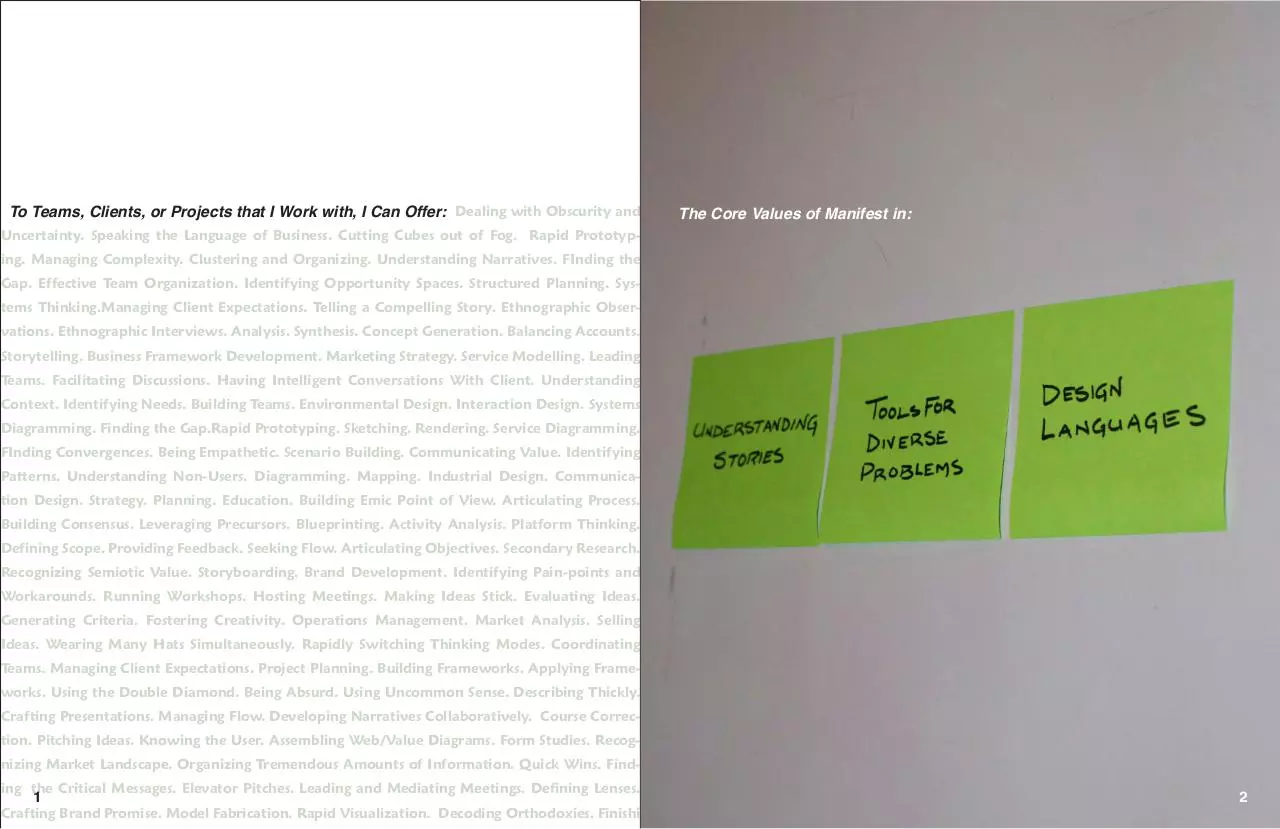
The Core Values of Manifest in:
ing. Managing Complexity. Clustering and Organizing. Understanding Narratives. FInding the
Gap. Effective Team Organization. Identifying Opportunity Spaces. Structured Planning. Systems Thinking.Managing Client Expectations. Telling a Compelling Story. Ethnographic Observations. Ethnographic Interviews. Analysis. Synthesis. Concept Generation. Balancing Accounts.
Storytelling. Business Framework Development. Marketing Strategy. Service Modelling. Leading
Teams. Facilitating Discussions. Having Intelligent Conversations With Client. Understanding
Context. Identifying Needs. Building Teams. Environmental Design. Interaction Design. Systems
Diagramming. Finding the Gap.Rapid Prototyping. Sketching. Rendering. Service Diagramming.
FInding Convergences. Being Empathetic. Scenario Building. Communicating Value. Identifying
Patterns. Understanding Non-Users. Diagramming. Mapping. Industrial Design. Communication Design. Strategy. Planning. Education. Building Emic Point of View. Articulating Process.
Building Consensus. Leveraging Precursors. Blueprinting. Activity Analysis. Platform Thinking.
Defining Scope. Providing Feedback. Seeking Flow. Articulating Objectives. Secondary Research.
Recognizing Semiotic Value. Storyboarding. Brand Development. Identifying Pain-points and
Workarounds. Running Workshops. Hosting Meetings. Making Ideas Stick. Evaluating Ideas.
Generating Criteria. Fostering Creativity. Operations Management. Market Analysis. Selling
Ideas. Wearing Many Hats Simultaneously. Rapidly Switching Thinking Modes. Coordinating
Teams. Managing Client Expectations. Project Planning. Building Frameworks. Applying Frameworks. Using the Double Diamond. Being Absurd. Using Uncommon Sense. Describing Thickly.
Crafting Presentations. Managing Flow. Developing Narratives Collaboratively. Course Correction. Pitching Ideas. Knowing the User. Assembling Web/Value Diagrams. Form Studies. Recognizing Market Landscape. Organizing Tremendous Amounts of Information. Quick Wins. Finding the Critical Messages. Elevator Pitches. Leading and Mediating Meetings. Defining Lenses.
1
Crafting Brand Promise. Model Fabrication. Rapid Visualization. Decoding Orthodoxies. Finishi
2
�
USING STORIES AND STORYTELLING THROUGH
ALL STAGES OF THE DESIGN PROCESS.
A good story is emotive, rich, clear and transformative, helping Witnesses become empathetic to another person in another situation.
Through narratives, the witness is able to understand far more than the information that
may be presented, gaining insight into the
emotions, pains, joys, motivations, spaces,
events taking place and more fundamentally,
the key messages that give meaning to it all.
For this reason, stories and storytelling are ab
invaluable components of my design process.
For many, stories belong at the end of the design process to evoke emotion and communicate the value of a fleshed out idea or concept;
however, they are also powerful tools when
employed in other areas of the design process.
In the beginning I use stories to help me
frame the research areas and methods,
and to point to areas of opportunities;
then to help generate and evaluate concepts; and finally to present the concepts
in ways that are relatable and persuasive.
Everything I do as a designer is steeped in allegory and narratives, and in embracing this,
I have dedicated myself to becoming a more
passionate and skilled storyteller.
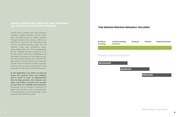
THE DESIGN PROCESS ROUGHLY FOLLOWS:
Problem
Framing
Understanding
Context
Analysis
Sythesis
Implementation
STORIES CAN BE USED TO:
RECOGNIZE
GENERATE
PERSUADE
Based on Diagram by Gravity Tank
3
4
�
FINDING STORIES THAT POINT
TO OPPORTUNITY SPACES
THE BRUSING HELMET
“…Finished getting changed into his
gear, Angelo grabbed his bike and
was about ready to hit the trail. He
reached up to grab the helmet he
perched on top of his van, when a
slip of his hand sent his “bucket” flying. “Bang,” the sound of it hitting
the pavement was loud, but louder
still was Angelo’s angered expression
“%&@*#, my bucket”. This was followed by a tense moment, when he
realized that his $100 piece of equipment was made to sustain only one
blow, and that may have been it. He
looked it over, saw only a scratch on
the surface, and then proceeded to
cycle away without considering that it
may no longer offer him any protection.”
Out in the field, we were able to recognize this compelling story and then
use it to frame our opportunity space.
The adventure of Angelo, though
brief, was the perfect articulation of a
real need within the world of cycling/
mountain biking and because of it we
were able to clearly understand our
challenge: making evident for cyclists
the damage to the padding of their
helmets, hidden by the outer-shell. To
accomplish this, we used biomimicry;
modeling a safety mechanism after
the human body. Just as our internal
muscular injuries are visible as bruises, so to are damages to the helmet’s
internal structure. Upon impact, the
vascular system in the padding ruptures, releasing a gas dye that reacts
with the outer shell, showing as a colourful bruise. Angelo’s, helmet may
or may not have been intact, but with
this system, he would have gained a
critical awareness, crucial to his own
safety as a cyclist.
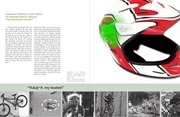
Opposite: The “Brusing
Helmet.” The green stain
indicates this helmet is no
longer safe.
Below: The many stories in
the day of a mountain biker.
“%&@*#, my bucket!”
5
6
�
CRAFTING STORIES TO GENERATE
AND EVALUATE NEW CONCEPTS:
NUDGE - PLATFORM FOR ELDER ENCOURAGEMENT
“…at the end of social gathering, the
hosting officer invited all of the seniors to sign up for the activity bulletin. After doing so Josephine returned
home, and was eager to check her
messages. She sat in her easy chair by
the front window, grabbed the pillow-backed monitor, and placed it on
her lap... (Continues in Video)
Through many iterations of similar
stories, our team was able to identify gaps, inconsistencies, values, reactions, opportunities, having at first
only invested a few sheets of paper
and a couple hours of time. Knowing the real Josephine, we were able
to construct a realistic picture of how
she might respond in a situation, and
then create stories based on this.
Our process took us from sketches,
to rough prototypes, to well crafted
comics, and finally scaled prototypes,
each with the objective of developing
higher fidelity stories that could be
used to test and refine our concept.
7
The Nudge platform, was designed
to use tailored activities and personalized messages to encourage senior
citizens like Josephine with the real
rish of boredom and depression to
be more active. Seniors are “Nudged”
to participate in activities that are of
high interest or value to them, by
friends, family or trusted caregivers,
communicating through peripherals
appropriate for the senior. In the case
of Susan, who lives at a care facility,
the clinical team and her family recognized that she was becoming less and
less active, but also were also aware
that her passions for baking that had
fallen off. She was ‘nudged’ by her
granddaughter, who sent her emails,
asking her to help build a recipe book.
These emails were printed out as letters for Susan to read, and Susan could
then respond with written letters, that
could be scanned into emails for her
granddaughter.
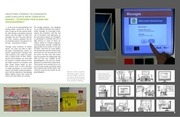
Opposite: Video; Josephine
messaging scenario. Susan’s
story of tangible email system. Below: Scenario generation through quick sketches
and prototype modelling.
This is 83 year old
Susan. She lives in the
Sunnyvale assisted
living community.
8
�
STORYTELLING TO DELIVER A
CONCEPT AND PERSUADE
JUDD GOLDMAND ADAPTIVE
SAILING PROGRAM FOR YOUTH.
Instead of telling our clients at the
Judd Goldman Adaptive Sailing Program and Chicago Parks District about
the concepts ourselves, about their
potential value, how they might
work, we had the users do it for us.
The objective of our project was to
utilize the existing resources and to
build a sailing program for Chicago’s
disabled youth. Through research with
other adaptive sporting associations
and rehabilitation centers throughout
Chicago and parts of Wisconsin, we
designed a program geared towards
fulfilling the needs of both the adaptive athletes and their parents.
The program offers things such as
mentorships, stacked programming,
family lessons, rentals, transportation
coordination and many other features
the improve the entire experience of
all participants. To present the ideas,
parents of the children were “hypothetically interviewed” about their
experiences with the proposed programs. With fair detail they recounted
memorable events as well program
features that were valuable to them.
These stories helped make the concepts feel more understandable, real
and persuasive to our clients.
Don’t say the old lady screamedbring her on and let her scream.
— Mark Twain
Opposite: “future testimony” video from parent
Stefani.
Below: “future testimony”
from parent Bruno.
9
10
�
A ROBUST SET OF TOOLS & METHODS
TO DEAL WITH DIVERSE PROBLEM SETS
Design Thinking, is at root intended to tackle
an enormous array of challenges and problems
of varying degrees of intricacy and complexity. Being a generalist designer requires a set
of tools and methods that can be effectively
adapted to tackling these diverse problem sets.
Methods for problem framing, research, analyzing data, generation, evaluation, presentation, and all steps in between have to be robust
enough to stand up to divergent topic areas,
as well problems with fundamentally different
natures.
Through education and practice I am building up my kit of methods, allowing me
to handle a greater variety of challenges
without pause or intimidation. I carry this
toolkit between different projects and teams; it
helps me to face complex problems with confidence, obscure and undefined problems with
decisiveness, and problems of humane experience with empathy and clarity. Though these
problem characteristics cannot be considered
to be on the same plane, they are three I encounter most often and have learned to approach with poise.
11
REALM OF DESIGN CHALLENGES
HIGHLY COMPLEX
OBSCURE &
UNDEFINED
HUMANE
EXPERIENCE
12
�
PROBLEMS OF GREAT COMPLEXITY
FUTURE LIVING: HOME OF 2050.
Designing a home for the year 2011
is, as any architect or engineer would
testify to, a complex endeavour that
requires the coordination and efforts
of many players. Designing a home
for the year 2050, can only be described as having an exponentially
greater degree of complexity. Taking
on such challenge requires forecasting what living looked like forty years
out; populations and demographics,
life styles, employment values, leisure,
resource availabilities, socio-political
issues, family and social life, weather
and climate, cultural values, and new
technologies. With a membership of
25 and a methodology known as
Structured Planning, our team was up
to the task.
The methodology, which was created
with the expressed intent of dealing
with systems level projects, helped
the members quickly and efficiently
organize and leverage the processing
capacity of what would otherwise be
an unwieldy team. This resulted in
the a home that was designed to have
self-sufficiency of resources, to be
adaptable to all manner of political
and geographic climates, to withstand
any manner of weather event, to suit
an array of cultures, to have a smaller
physical footprint, and do so without
compromis the quality of life for the
inhabitants. The design was awarded
the 2010 IDSA/IDEA Bronze Prize.
Opposite: Structural features of the home.
Inset: Immersion System.
Dynamic room configurations. Simulated Scapes.
Below L to R: All Weather
System. Growth Stadium
mechanics. Resource Network Map. Nanosensor
Integration Diagram.
WA TER
HYGIENE
MAINTENANCE
ENERGY
NUTRIENTS
WA STE
CLIMATE
13
14
�
PROBLEMS THAT ARE OBSCURE
AND UNDFINED
FUTURE LIVING: HOME OF 2050.
When given the opportunity to work
with the V.A. Hospital Network, and
have direct impact on the formation
of the new Women’s Clinic in Milwaukee, our team was brimming with
enthusiasm. We were provided access
to physicians and nurses, secondary
sources, clinical visits, and an open
relationship with the new director
of the clinic. We were not however
provided with any charter, problems,
challenges, goals or constraints; our
task was obscure and undefined. This
project resembled many from the past
in that our team’s starting position
was in the fog, and we had to navigate our way out.
VA MILWAUKEE, NEW WOMEN’S ClINIC
To ensure that our team did not simply stay lost, my responsibility was
to define the objectives and methods
that our team would use. We proceeded through phases of cultural immersion, onsite research, developing
and clustering insights and formulation of these insights into a format
that would be immediately useful to
the clinic. Our goal (and outcome)
was the definition of 12 new Pillars
of Experience that would be used in
the formation of the clinic. These pillars would be used to inform decision
about the physical layout of the clinic,
team dynamics, the flow of patient
visits, information and education and
a host of other fundamental topics.
12 PILLARS OF EXPERIENCE
R
Make Change Comfortable
Support Communication
and Knowledge Sharing
Use Spaces and Relationships
to Motivate and Persuade
X
Build Support For Teams
THIS WAY
Provide Clarity and
Transparency
Opposite: The 12 experience pillars for the new
Women’s Clinic at the
Milwaukee V.A. Hospital.
Below L to R: Insight clustering following site visits.
Value exchange diagram.
Team based user experience journey map.
Unify a Diverse Population
while Respecting Uniqueness
Design for Evolution.
Plan to Learn and Grow
Provide a Pleasing and
Comforting Environment
Nutrition Facts
Serving Size 1 Potato
Focus on the Patient
Point of View
Educate in Tangible,
Personally Relevant Ways
Embody Empathy
Be Familiar. Build Sincere
Connections and Rapport
Patients
G
ac por rea
t t
de cess an er s
cis . G d up
io re inf in n m ate o
g
rig ak r
ht s
Admin..
Nurses
Comforting,
Compassion
Examining,
Analysis
INDIVIDUAL
PLAYERS
Managing,
Administration
Guiding,
Education
Greater satisfaction, greater value
to clinic.
TEAM
CARE
Receptionist
Greater and more
responsibilities.
Pre Check
Call
Wait in
Reception
Area
Have Lab
Taken
Talk with
Nurse
See
Lifestyle
Manager
Follow
Up Call
Learning and
Development
Providers
External to
the Clinic
Active
Participation
Active
Participation
Uncertainty and
Anticipation
Physicians
See
Physician
Healing and
Recovery
R
p ep
te rim ort
a
in m. ary ing
fo S
t
rm ha car o
at rin e
io g
n.
Willingness to
share decision
making rights
and control
Arrive at
Clinic
Suffering, Pain
and Fear
??
15
er
at to n
re s w
G cces ir o s”
a he nt
“t atie
p
tion re.
r c ca istte of ns of
Be ity e co w ut
o p
nu or t fl /in
M en fo
t in
Residents
Better support
from others
on team.
Easier to
concentrate
on necessary
tasks.
Examining,
Analysis
Active
Treatment
??
Accountability from
Clinic managers.
er
at y.
re
G nom ecig
to d in .
au ore ak hts
M n m rig
sio
Less Control Over
Individual Dept’s,
More bottom
up input
Being better
known by
team and
given more
attention.
Willingness to
be cared for
by the team,
not just the
doctor.
rpe e s.
pa r ie
e mo ilit
or , ib am
M ork ons g te
w sp in d.
re eep ate
K pd
u
R
to esp
a re on
te nd po sib
am up rt ilit
. da to y
te
Pharm - D,
Counsellors,
Lifestyle
Managers
16
�
Patient States General Experience
Patient admit ted to ward for
testing from ER
PROBLEMS THAT FOCUS ON
HUMANE EXPERIENCES
PRESENCE: PATIENT NETWORK
“Stephen lay in his bed half asleep, under the heavy influence of the nurse’s
medication. He could not talk or
think clearly, but he could recognize
the faint blue and red stars on his ceiling, and he knew that his friends and
fellow patients were there for him.”
“For Kayla, being stuck in the hospital
means being away from her friends,
who were all in school. Using the remote, she explores the night sky and
found the star of Jessica in room 402.
The star indicates that she was about
the same age, and also interested in
dancing. Kayla thought, maybe she
would be interesting to chat with…”
“Stuck in his meeting for another hour,
Anthony’s mind was on his wife, who
was recovering from an operation. He
was so worried. He discretely glanced
at the app on his phone, and saw that
Karen’s star was bold and bright. He
was comforted knowing that she was
up and awake.
The Presence Network connects patients within a hospital as well as the
loved ones outside, as a means to create a sense of support and stimulate
spiritual and mental healing. It takes
the form of a night sky, either projected on the ceiling or on a monitor; in
which each patient and loved one is
portrayed as a star. It can be used as to
explore, actively meet fellow patients
and chat, or simply as a reminder that
fellow patients and loved ones are
watching over. Developing this concept required a great deal of immersion into the experience of a patient.
A year of visiting with patients at Trillium Hospital generated a wealth of
data. This was translated into profiles,
process diagrams, emotional maps,
storyboards and many other frameworks that helped articulate the insights in a way that helped me to the
transform rich humane experiences
into a focused design concept.
Patient hooked
up to IV with
pain killers and
sedativ e
Patient goes in
and out of
consciousness for
a few days.
Heavily medicated
Patient
returned for
room for night,
still on IV
Patient
wakes
Patient is awake
and aware. Very
bored.
Patient wakes.
Groggy and not
feeling great
Test results
come. Patient
heavily medi cated
Patient is given
medication and
is sedated
Patient goes
for surgery,
unconscious
Patient wakes.
Patient taken to
room for recovery Only slightly
for several hour s conscious, taken
to room s
Patient starts to
feel better.
Light medica tion
Patient packs
up and goes
home.
Has known Fa mily Connections
Has Childre n
Has Grandch ildre n
Ta lks About Fa mily
Fa mily too Busy/ Far to Vi si t
Finds Pu rpose in Fa mily
Enjoys Vi sito rs(strange rs )
Cold to Other Peopl e
Eager to Te ll Life Stor y
Emotional to Vi sito rs
Eager to Know about Othe rs
Window-Light; view outside, reminder of outside world
Activity in chairs
Television
Visitors sit down here
Telephone;
Nothing to doCalls from family/friends
Not much to do
Bedside sickness; unable to go to bathroom
Embarassing and dehumanizing
Activities; books and games
In Bed; boredom, inability to move
Opposite T-B, R-L: Excerpts from research document. Chart of patient
states over duration of
visit. Survey of patient
conversations related to
family. Emotional map of
patient room. Patient Profiles. Rendering of patient
exploring network.
Below L to R: Images of
users in the network.
Meals;
Some look forward to it
Some hate the food/repitition
Bedside sickness; unable to go to bathroom
Medical and sanitary products
Uncomfortable sight
Attachment to blood work
and oxygen
Neighbour’s privacy
Happy/Comforted
Sick/Weakness/
Dehumanization
Bored
Bathroom: sickness and vomiting
Fear of unsanitary conditions from others
Doctor/Nurse walking in
at any moment.
Tests, needles...
Fear
Awkwardness
MS. MARS
MR. SIVARAJAH
MRS. GINNO
75-78 YEARS
40-45 YEARS
35-40 YEARS
Very Hard of Hearing
Indian
Married with Two Kids
May Choose not to Listen
Moved to Canada 16 yrs ago
Married with 12 Yr. old Kid
Very Youthful Looking
Somewhat Senile
Can be very Confused at Times
No Sign of Visitors
Wife Works during the Week and
cannot Visit much
No Indication of Family
Intestinal and Stomach Problems
Can no longer Eat Spicy Food
Transfered to Chronic Care
Indian Food is very Spicy
Always Harassing the Staff
Whole Diet must Change
Paranoid of Everything Staff
Works for a Printing Service
Provides: Water, Food
Wants to Start Acounting
Service
Angry at Cleaners
Afraid of Rising Blood Pressure
Walks back and forth between
17
Patient taken
for testing,
blood samples,
ultrasounds…
Very Healthy Looking
In Very Good Spirit
Room and the Hallway
Always Sitting in Chair Reading
Toronto Star
Has a Walker but doesn’t
Well Read
Use it
Very Fixated on what is
Occuring outside of Her
Interested in Histoy/Politics
Window at anytime
Very Concerned about Violence
back Home.
Enjoys Watching/ Playing Cricket
Very Active Person
Loves Outdoor Activity
Camping, Kayaking, Hiking
Doesn’t have Many Female Friends
who do the Same.
Husband and Kids Busy During the
Day at Work/School.
Can only Visit Nights/Weekends
In A Private Room
Very Isolated Feeling
Dark and Disconnected Room
Had Bad Case of Salmonella
Nearly Fatal, Afraid of Dying
Weak from Recovery
Unable, and Bored
Hates Being Bedridden
Hates Television
New Outlook on Life
Happy to Be Alive
More Cautious Now
18
�
CONNECTING TO DIFFERENT STAKEHOLDER GROUPS THROUGH DISCRETE
DESIGN LANGUAGES.
CONNECTING TO DIFFERENT STAKEHOLDERS
BUSINESS
As designer thinkers, we pride ourselves on
our ability to unite diverse sets of stakeholders
around a project or goal. In the one sense we
do this by bringing these stakeholders together
trying to host intelligent conversations. In another sense we try to gain insight into priorities,
values and constraints of these stakeholders
and then represent them throughout the design
process. In either case, common language and
the ability to relate ideas clearly are vital when
working across discipline lines.
19
IN
DE DUS
SIG TR
N IAL
DESIGN TEAM
ON
/N RS
W NE
NE SIG
DE
I have spent the last several years developing an ability to communicate and act as
a bridge to different key groups of stakeholders. In particular I have developed the
skills to relate to product developers through
industrial design, to business people of different focuses through an understanding of business practices and vocabulary, and to non and
new designers by articulating design thinking in
a simple and digestible form.
20
�
COMMUNICATING IN THE LANGUAGE OF
INDUSTRIAL DESIGN
ARSENAL LIGHT FIXTURES
& THE DRUNKEN MONKEY
I was trained and practiced as an industrial designer for a number of
years, developing a discrete set of
skills around designing products. I am
well versed in ergonomics, material
studies, formal values, sketching, rendering, blue-printing, modeling… all
the domain of the industrial designer.
However, this is not what I am, it is
a language that I understand and can
use to develop and communicate
complex ideas, between design and
product development teams.
The work I’ve done for Eurofase, designing dozens of light fixture families,
is exemplary of this language. From
formal study, through sketching, modeling and up until the tooling is made
to manufacturing, I was in charge of
articulating and communicating the
concepts.
21
The Drunken Monkey Wine Rack is
another example of the product design language. I designed and modeled this product to specs based on
minimization; minimizing material
inputs, one 15”x24” inch piece of plywood and 2 screws; minimizing shipping costs, as it can be flat packed;
and minimizing assembly, putting in
two screws. The Wine Monkey is being published in the Spring of 2011, in
a ‘Plywood, a book about new plywoor designs to commemorate Alvar
Aalto and Charles and Ray Eames.
Opposite: Drunken Monkey Wine Racking System.
Arsenal 6-Light Chandelier for Eurofase; final
product, CAD rendering,
hand-sketch.
Below: Sketches and renderings for the Arsenal
light fixture family.
22
�
WINE INDUSTRY SALES (U.S.)
UNDERSTANDING THE
LANGUAGES OF BUSINESS
MBA, ANALYSIS AND BUSINESS
STRATEGY
I am not a statistician, a securities
trader, or an accountant, nor do I
have the current capacity to be. I do,
however, have the ability to read a
cash flow statement and understand
its implications or to have sensible
conversation with an investor that
who raises concerns about debt leverage ratios of the company.
23
By educating myself in the basics of
business management, I am able to
better relate to and understand the
goals of the firms I work for, be it
ones I am contracted to for projects,
or the company that employs me.
Operations, marketing, accounting,
negotiations, finance, economics, statistics, are skills that not only help enable me to reach out, but also focus
inward, helping me effectively manage projects and lead teams.
Opposite: Sales trends
for wine industry, Robert
Mondavi. Common business vocabulary. Statement of Cash Flows, Microsoft.
24
�
CONNECTING WITH NON/NEW DESIGNERS
CCC/NON PROFIT TOOL KIT.
VA WOMEN’S CLINIC.
INSTITUTE OF DESIGN - SYSTEM’S WORKSHOP.
The “Curse of Knowledge”, affects everyone, even/especially those skilled
in design thinking and its methodologies. The essence of this curse is that
we cannot remember what it was like
to not know something, making it
hard to relate with those that currently do not know. For this reason, the
best designers may struggle to work
with new or non-designers and help
them to understand their thinking,
process and concepts.
Non-Profit Toolkit
Not unlike the Design Thinking process itself.
The toolkit itself is a prototype.
Multimodal
Learning
The Business
303
301
302
Distribution &
Transportation Channels`
201
Storage
202 203
204
205
Harvest
304
Logistics
Planning
Opposite T to B: Excerpts
of presentation to CCC.
Diagram articulating current Dr-Patient relationship shortfalls. Research
Summit of Thought Leaders on Food Industry, I
co-organized for the System’s Workshop.
Below: Semi Lattice; an
important diagram of
Structured Planning
206
208
207
Coop
Development
209 210
IIT Institute of Design | Campus Crusade for Christ
PREGNANCY
DIETARY
ISSUES
SUBSTANCE
ABUSE
LOSS OF
FEMALE
IDENTITY
PTSD
SEXUAL
ASSAULT
211 212
308
307
213
216 217
219
220
314
222
221
Processing 223 224 225
410
Consumer
Nutrition
312 313
311
218
409
Education &
Communication
Nutrition, Appearance, Safety
ratio, balance,
configuration
310
309
214 215
503
408
407
406
405
Sustainability
& Biodiversity
306
305
Workshop
Curriculum
602
404
Water &
Energy
Method
Selection
(B) The Eater
502
402
401
Needs
Diagnostic
SMOKING
701
501
Policy &
Regulation
Extend - the continuation of the experience through reminders and reflections
Things you noticed events, impediments, other people, other thingsÖ
back on the experience... well after it finishes
DEPRESSION
601
403
Exit - finishing and leaving the experience... just as it finishes
Things you felt emotional responses, frustrations, successesÖ
IIT Institute of Design | Campus Crusade for Christ
Information Structure 22 October, 2010
(A) The Practice
Enter - entering into the experience... the moment when it starts
Things you did interactions, activities, actions, processes...
Engage - during the experience
IIT Institute of Design | Campus Crusade for Christ
The Family dinner – Examining Higher Standards of Food Availability, Affordability and Nutrition
(C) The Connection
Entice - the draw to the experience... well before it starts
We have built out some of the phases more than others, but we’ll be providing
definitions for each phase as we see them, and share with you what we did
along the way.
This can be seen through work with
CCC, where our team’s expressed
goals were to develop curriculum to
teach design thinking to non-profit organizations that generally have little
exposure. Similarly, working with the
V.A. Hospital, our goal was not only
to develop concepts and directions
for their new clinic, but also to educate and inform the director of the
clinic in the methods that we were using. The clearest example, is that of
the Teaching Assistant Role I played in
the Systems Workshop; helping new
students of structured planning understand the material, the processes and
underlying reasons, critiquing work
in a way that facilitates learning, and
help them produce good work. Doing
the project myself would have been
relatively easy, helping new students
do it was a valuable struggle.
I have spent considerable amounts of
effort learning methods, not simply
for self-use, but to be able to understand how to clearly relate them to
others. This ability to do so is vital
when I am leading a team, or trying
to articulate concepts that are foreign
to my audience.
5E Definition
Things to Consider
226
Programs 227
228
Access &
Choice
315
316
229 230
231 232 233
(C)
318
317
Decision
Support
234
235 236 237
239
238
Consumer
Waste
Barter Waste
101 102 103 104 105 106 107 108 109 110 111 112 113 114 115 116 117 118 119 120 121 122 123 124 125 126 127 128 129 130 131 132 133 134 135 136 137 138 139 140 141 142 143 144 145 146 147 148 149 150 151 152 153 154 155 156 157 158 159 160 161 162 163 164 165 166 167 168 169 170 171 172
6
76
129
32
33
2
7
151
2
2
4
7
7
77
8
90
127 127
25
3
5
79
90
10
78
90
114 116 87 89 67
115 126 100 102 98
116
103 109 109
117
112 128
67
97
39
92
95
26
28
30
45
60
75
96
60 61 45
82 85 47
113 113 108
113
47
93
41
110
41
64
41
105
46 88
53 99
99 101
107 106
111 107
37
48
49
50
51
52
53
54
55
56
57
36
37
51
58
37
51
52
53
54
55
56
57
59
40
56
57
65
51
56
57
66
102
38
54
56
57
53
54
119
120
44
46
51
53
54
55
86
94
118
55
91
43
56
57
104
106
42
43
86
68
69
51
63
72
73
62
70
72
121 25
122 124
123
124
125
17
18
21
18 18
133 137
18
29
132
15
16
14
15
9
22
24
27
74
23
24
74
18
19
20
74
9
18
74
140
11
74
1
74
74 159 146 31 149 80 153 154 138 130 130
134 160 147 71 152 155 156 156 150 139 135
144 136
157 147
158 161
145 139
148
Note:
130 81 12
131 130 81
144 139 141
164 142
143
144
34
83
34
84
13
35
162
163
Clusters 239, 171 and 172 are disconnected
26
�
Through a disciplined approach to design, I am able to find the critical stories that
drive concepts, understand and communicate with diverse groups of stakeholders,
and apply a robust set of tools and methods to solve an array of challenges.
PAOLOKORRE
Experience Research. Design. Strategy
Korre@id.iit.edu 224.201.0452 /416.305.5445
653 W. Wrightwood, CHICAGO IL. 60614
EXPERIENCE
INSTITUTE OF DESIGN
2010 Teaching Assistant for the Systems Workshop. Primary tasks include instructing students in structured planning methods, organizing
and fostering student-team relationships, providing feedback to help
students progress in the project and
learn the necessary skills, and planning / hosting of a research summit
to assemble best-practice professionals in panel discussions to help expose students to key topics.
EUROFASE GROUP
2007-2009 Industrial Designer
A principle industrial designer for
three separate companies under
one ownership; primarily focused
on design, rendering, blue-printing
and product development for lighting fixtures, home fixtures and sports
equipment. Other responsibilities
included trend forecasting, graphic
design, display design, and advertisement design for internal projects as
well as for clients such as Home Depot and Source for Sports. Notable
work; the design of several lighting
fixtures that are featured in lighting boutiques and the Home Depot
across North America.
AYA KITCHENS
2006-2008 Design/Sales
Primarily charged with the responsibility of design and sales of kitchens
for individual/retail and high-volume/builder clients such as Country
Green Homes and Mattamy Homes.
Tasks included the design of kitchen
layouts, price and sales negotiations,
the development of relationships
new and existing clients, as well as
the development of new sales and
marketing strategies. Notable work;
the design of a new green product
initiative and marketing campaign.
SAWA DYNAMIC BRACES
2005-2009 Designer
Successful design and development
of several new pieces of rehabilitative and orthotic equipment in partnership with Dr. Tom Sawa. Notable
work; designs for a new shoulder
support system in the process of being patent protected.
CANADIAN IMPERIAL BANK
OF COMMERCE
2004-2006 Head Teller, Branch Ambassador, Personal Banker
Responsible, as the head teller, for the
cash and balance the tellers, accessing the safes, problem resolutions, on
top of the duties of customer service.
EDUCATION
ILLINOIS INSTITUTE OF
TECHNOLOGY
2009-2011 Masters of Design/MBA
Candidate. Focus on Strategy, User
Experience and Product Design.
Noteable Projects and Clients:
Future Living, Bronze Prize IDEA/
IDSA Awards, Chicago Parks and
Judd Goldman Adaptive Sailing Program. Veteran’s Administration Hospital. Mt. Sinai Hospital.
ONTARIO COLLEGE OF ART
& DESIGN
2002-2006 Bachelor of Design
Graduate with Distinction
Specialized in Industrial Design
Noteable Projects and Clients:
Trillium Hospital, Patient Network.
MaRS Research, Children’s I,V. System. Drunken Monkey Racking Systems, In Publishing Process. Bleeding
Helmet Safety System.
SKILLS
PLANNING/DESIGN METHODS
Structured Planning, Platform
Development, Analysis and Synthesis
Frameworks, Biomimetic Design.
VISUALIZING/PROTOTYPING
Quick Concept Visualization, Sketching, Technical Drawing, Rendering,
Diagramming, Model Fabrication,
Scenario Building.
BUSINESS
Conversant in Business Language.
Understanding Concepts, Processes,
Values and Terminology.
RESEARCH
Ethnographic Research, Data Organizing Methods and Frameworks,
Storyboarding, Value Mapping, Future-Casting,
COMMUNICATION
Presentation Design/Delivery, Story
Telling, Project Management.
SOFTWARE
Adobe Creative Suite, Solidworks
�
 Historical archive . public document