1
Broad Agency
Announcement
DARPA-BAA-10-36
Cyber Genome Program
2
Prime Organization
HBGary Federal, LLC
3
Proposal Title
DARPA Cyber Genome TA-3
4
5
6
7
8
9
Type of Business (Check
one)
Contractor’s Reference
Number
Contractor and Government
Entity (CAGE) Code
Dun and Bradstreet (DUN)
Number
North American Industrial
Classification System
(NAICS) Number
Taxpayer Identification
Number (TIN)
□ Large Business
□ Small Disadvantaged
Business
■ Other Small Business
□ Government Laboratory or
FFRDC
□ Historically-Black Colleges
□ Minority Institution (MI)
□ Other Educational
□ Other Nonprofit
DARPA-BAA-10-36
5U1U6
832950831
541512
271485507
10
Technical Point of Contact
Mr. Aaron Barr, 3604 Fair Oaks Blvd. Bldg B, STE 250, Sacramento, CA 95864.
Tel: 916-459-4727 ext 117 Fax: 916-481-1460. Email: aaron@hbgary.com
11
Administrative Point of
Contact
12
Security Point of Contact
13
Other Team Members (if
applicable)
Mr. Ted Vera, 3604 Fair Oaks Blvd. Bldg B, STE 250, Sacramento, CA 95864.
Tel: 916-459-4727 ext 118 Fax: 916-481-1460. Email: ted@hbgary.com
Mr. Aaron Barr, 3604 Fair Oaks Blvd. Bldg B, STE 250, Sacramento, CA 95864.
Tel: 916-459-4727 ext 117 Fax: 916-481-1460. Email: aaron@hbgary.com
Dr. Anita D'Amico
6 Bay Ave, Northport, NY 11768
AVI-Secure Decisions
(631) 759-3909 / (631) 754-1721
anitad@securedecisions.avi.com
Cage Code: 07QY2
Mr. Andrew Tappert
2214 Mt. Vernon Ave., Ste 300, Alexandria,
VA 22301
Pikewerks
(256) 325-0010 / (256) 325-1077
andrew.tappert@pikewerks.com
Cage Code: 3XYV3
Mr. Phillip Porras
333 Ravenswood Ave, Menlo Park, CA
84025
SRI International
(650) 859-3232 / (650) 859-2844
phillip.porras@sri.com
Cage Code: 03652
Mr. Russell Wenthold
1100 NW Loop 410, Ste 600, San Antonio, TX
General Dynamics Advanced
78213
Information Systems, Inc.
(210) 442-4207 / (210) 377-0199
russ.wenthold@gd-ais.com
�
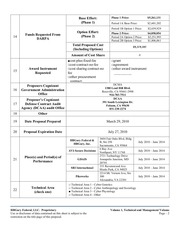
Base Effort:
(Phase 1)
14
Funds Requested From
DARPA
Option Effort:
(Phase 2)
Phase 1 Price:
$5,261,131
Period 1A Base Price:
$2,601,202
Period 1B Option 1 Price:
$2,659,929
Phase 2 Price:
Period 2A Option 2 Price:
Period 2B Option 3 Price:
$4,058,054
$2,251,993
$1,806,061
Total Proposed Cost
(Including Options)
$9,319,185
Amount of Cost Share
0
■cost-plus-fixed-fee
□cost-contract-no-fee
□cost sharing contract-no
fee
□other procurement
contract:______________
□grant
□agreement
□other award instrument:
__________
15
Award Instrument
Requested
16
Proposers Cognizant
Government Administration
Office
17
Proposer’s Cognizant
Defense Contract Audit
Agency (DCAA) audit Office
18
Other
19
Date Proposal Prepared
March 29, 2010
20
Proposal Expiration Date
July 27, 2010
DCMA
1380 Lead Hill Blvd.
Roseville, CA 95661-2998
916-783-7511
DCAA
391 South Lexington Dr.
Folsom, CA 95630
831-238-2274
HBGary Federal &
HBGary, Inc.
AVI-Secure Decisions
21
Place(s) and Period(s) of
Performance
GDAIS
SRI International
Pikewerks
22
Technical Area
(check one)
3604 Fair Oaks Blvd, Bldg
B, Ste 250
Sacramento, CA 95864
6 Bay Ave
Northport, NY 11768
2721 Technology Drive
Annapolis Junction, MD
20701
333 Ravenswood Ave
Menlo Park, CA 94025
2214 Mt. Vernon Ave, Ste
300
Alexandria, VA 22301
July 2010 – June 2014
July 2010 – June 2014
July 2010 – June 2014
July 2010 – June 2014
July 2010 – June 2014
□ Technical Area 1 - Cyber Genetics
□ Technical Area 2 - Cyber Anthropology and Sociology
■ Technical Area 3 - Cyber Physiology
□ Technical Area 4 - Other
HBGary Federal, LLC. Proprietary
Use or disclosure of data contained on this sheet is subject to the
restriction on the title page of this proposal.
Volume 1, Technical and Management Volume
Page – 2
2
�
Table
of
Contents
Section
II.
Summary
of
Proposal................................................................................................................... 4
II.A
Innovative
Claims
for
the
Proposed
Research................................................................................................. 4
II.B
Deliverables,
Plans,
and
Capability
for
technology
transition
and
Commercialization..................................... 5
II.B.1
Deliverables ......................................................................................................................................................5
II.B.2
Plans
and
Capability
to
Achieve
Commercialization
and
Technology
Transition .............................................6
II.B.3
Data
Rights
and
Intellectual
Property...............................................................................................................6
II.C
Cost,
Schedule
and
Measurable
Milestones.................................................................................................... 7
II.D
Technical
Rationale,
Technical
Approach,
and
Constructive
Plan.................................................................... 9
II.D.1
Technical
Rationale...........................................................................................................................................9
II.D.2
Technical
Approach
and
Constructive
Plan ....................................................................................................10
II.E
Detailed
Management,
Staffing,
Organization
Chart,
and
Key
Personnel: ......................................................11
II.E.1
Management ..................................................................................................................................................12
II.E.2
Teaming
and
Staffing ......................................................................................................................................12
II.E.3
Organizational
Chart .......................................................................................................................................12
II.E.4
Key
Personnel .................................................................................................................................................13
II.F
Summary
Slides .............................................................................................................................................14
Section
III.
Detailed
Proposal
Information................................................................................................... 18
III.A
Statement
of
Work
(SOW) ...........................................................................................................................18
III.A.1
Program
Management ..................................................................................................................................18
III.A.2
SOW
Tasks .....................................................................................................................................................18
III.B
Description
of
the
Results ............................................................................................................................25
III.C
Detailed
Technical
Rationale ........................................................................................................................25
III.D
Detailed
Technical
Approach .......................................................................................................................26
III.D.1
Specimen
Collection
and
Pre-‐Processing ......................................................................................................27
III.D.2
Specimen
Repository.....................................................................................................................................28
III.D.3
Specimen
Analysis
and
Visualization
Interface
(SAVI)...................................................................................28
III.D.4
Traits
Library .................................................................................................................................................29
III.D.5
Genomes
Library ...........................................................................................................................................30
III.D.6
Static
Memory
Analysis
and
Runtime
Tracing
(SMART) ................................................................................31
III.D.7
Belief
Reasoning
and
Inference
Network
(BRAIN) ........................................................................................33
III.E
Comparison
with
Other
Research.................................................................................................................34
III.F
Previous
Accomplishments ..........................................................................................................................34
III.G
Place
of
Performance,
Facilities,
and
Locations ............................................................................................38
III.H
Detailed
Support
(Including
Teaming
Agreements) ......................................................................................38
III.I
Cost,
Schedules
and
Measurable
Milestones.................................................................................................39
III.I.1
Task
1
–
Specimen
Collection
and
Pre-‐processing..........................................................................................39
III.I.2
Task
2
–
Specimen
Repository ........................................................................................................................40
III.I.3
Task
3
–
Specimen
Analysis
Visualization
Interface
(SAVI) .............................................................................40
III.I.4
Task
4
–
Genomes
Library...............................................................................................................................41
III.I.5
Task
5
–
Traits
Library .....................................................................................................................................41
III.I.6
Task
6
–
Static
Memory
and
Runtime
Tracing ................................................................................................42
III.I.7
Task
7
–
Belief
Reasoning
and
Intefernce
Network
(BRAIN)...........................................................................42
III.J
Data
Description ...........................................................................................................................................43
Section
IV.
Additional
Information ............................................................................................................. 43
HBGary Federal, LLC. Proprietary
Use or disclosure of data contained on this sheet is subject to the
restriction on the title page of this proposal.
Volume 1, Technical and Management Volume
Page – 3
3
�
Section
II.
Summary
of
Proposal
II.A
Innovative
Claims
for
the
Proposed
Research
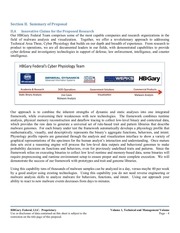
Our HBGary Federal Team comprises some of the most capable companies and research organizations in the
field of malware analysis and visualization. Together, we offer a revolutionary approach to addressing
Technical Area Three, Cyber Physiology that builds on our depth and breadth of experience. From research to
product to operations, we are all documented leaders in our fields, with demonstrated capabilities to provide
cyber defense and investigatory technologies in support of defense, law enforcement, intelligence, and counter
intelligence.
Our approach is to combine the inherent strengths of dynamic and static analyses into one integrated
framework, while overcoming their weaknesses with new technologies. The framework combines runtime
analysis, physical memory reconstruction and dataflow tracing to collect low-level binary and contextual data,
which provides the raw data to generate a universal set of rule-based trait and pattern libraries that describe
malware genomes. For each binary under test the framework automatically develops a physiology profile that
mathematically, visually, and descriptively represents the binary’s aggregate functions, behaviors, and intent.
Physiology profile reports are generated through the analysis and visualization interface to show a variety of
graphical representations of the specimen for the human analyst’s interaction and understanding. Once mature
data sets exist a reasoning engine will process the low-level data outputs and behavioral genomes to make
probability decisions on functions and behaviors, even for previously undefined traits and patterns. Since the
framework relies on executing binaries to collect low level runtime and memory-based data, some binaries will
require preprocessing and runtime environment setup to ensure proper and more complete execution. We will
demonstrate the success of our framework with prototypes and trait and genome libraries.
Using this capability tens of thousands of malware samples can be analyzed in a day, versus maybe 40 per week
by a good analyst using existing technologies. Using this capability you do not need reverse engineering or
malware analysis skills to analyze malware for behaviors, functions, and intent. Using our approach your
ability to react to new malware events decreases from days to minutes.
HBGary Federal, LLC. Proprietary
Use or disclosure of data contained on this sheet is subject to the
restriction on the title page of this proposal.
Volume 1, Technical and Management Volume
Page – 4
4
�
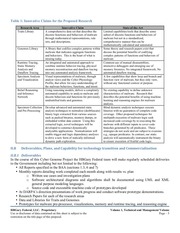
Table 1: Innovative Claims for the Proposed Research
Research Area
Traits Library
Innovative Claim
A comprehensive data set that describes the
discrete functions and behaviors of malware
through mathematical representations, rule
sets, and descriptions.
Genomes Library
A library that codifies complex patterns within
malware that indicates aggregate functions
and behaviors. This is the heart of what is
missing today.
An integrated and automated approach to
combine runtime behavior tracing, physical
memory reconstruction and dataflow tracing
into one automated analysis framework.
Visual representations of malware, through
analyst views and the Cyber Physiology
Profile, that allow for easy understanding of
the malware behaviors, functions, and intent.
Using reasoning models, deliver a completely
automated capability to analyze malware and
discern behaviors and functions for previously
unidentified traits and genomes.
Runtime Tracing,
Static Memory
Analysis and
Dataflow Tracing
Specimen Analysis
and Visualization
Belief Reasoning
and Inference
Network
Specimen Collection
and Pre-Processing
II.B
Develop advanced and automated static
analysis techniques to normalize (deobfuscate)
binary logic extracted from various sources
such as packed binaries, memory dumps, or
embedded within data content. Using this
extracted logic, novel techniques will be
developed to construct dynamically
analyzable applications. Normalization will
enable trigger and logic dependency analyses
to drive a new form of statically-informed
dynamic path exploration.
State-of-the-Art
Limited capabilities/tools that describe some
subset of discrete functions and behaviors of
malware but not in a standardized,
comprehensive manner that can be
mathematically calculated and automated.
Some theory and research papers exist that
discuss the potential benefits of codifying
complex patterns of functions and behaviors of
malware
Common use of manual disassemblers,
interactive debuggers and emerging use of
memory forensics. No integrated framework. No
automated dataflow tracing.
A few capabilities that show loop and branch and
function view of malware, but they only view,
without any functional context or purpose.
No existing capability to define unknown
characteristics of malware. Research that
describes the potential benefits of using machine
learning and reasoning engines for malware
analysis.
Blind dynamic analysis techniques execute
binaries with no guarantees of complete code
coverage. Other proposed techniques for
multipath execution of malware logic seek
increased code coverage by re-executing the
malware with different inputs to cover code
branches generated by all predicates. These
strategies do not scale and are subject to evasions
e.g., opaque predicates. In contrast, our static
analysis will automatically instrument the binary
to ensure execution of fruitful code logic.
Deliverables,
Plans,
and
Capability
for
technology
transition
and
Commercialization
II.B.1
Deliverables
In the course of this Cyber Genome Project the HBGary Federal team will make regularly scheduled deliveries
to the Government including but not limited to the following:
• All Reports specified in the BAA (sections 1.3, 6 and 7)
• Monthly reports detailing work completed each month along with results vs. plan
o Written use cases and investigation plans
o Software architectural diagrams and algorithms shall be documented using UML and XML
general purpose modeling languages.
o Source code and executable machine code of prototypes developed
• At DARPA’s direction presentations of work progress and conduct software prototype demonstrations.
• Research Papers for each of the research areas
• Data and Libraries for Traits and Genomes
• Prototypes for malware pre-processor, visualizations, memory and runtime tracing, and reasoning engine
HBGary Federal, LLC. Proprietary
Use or disclosure of data contained on this sheet is subject to the
restriction on the title page of this proposal.
Volume 1, Technical and Management Volume
Page – 5
5
�
II.B.2
Plans
and
Capability
to
Achieve
Commercialization
and
Technology
Transition
HBGary and Pikewerks have track records of commercialization success. They have successfully transitioned
their cyber security software products to the operational environment, as evidenced by hundreds of active
customers. These were developed in part via the Small Business Innovative Research program. If awarded the
contract, we anticipate that promising technologies will emerge from our research that will be desired by both
Government and private sector organizations. Where appropriate, we will offer the technologies to the
Department of Defense (DoD), the Intelligence Community (IC) and civilian agencies for further development
and transition to operations. But we will not rely on the Government for technology transition. We anticipate
making significant additional IRAD investment to convert the results of this contract into commercial grade
software.
II.B.3
Data
Rights
and
Intellectual
Property
We understand and appreciate DARPA’s needs for rights in data; therefore the data generated under this
contract will be delivered to the Government with Unlimited Rights. HBGary has developed two patented
technologies that it brings to the table for possible use to help satisfy the goals of the project -- Digital DNA
Sequence and Fuzzy Hash Algorithm. We propose these technologies for possible use; although it is possible
these technologies may end up playing no role in developing the methodology that DARPA seeks. At the very
least, the team will leverage the tremendous experience gained in developing these two technologies. If and to
the extent that these two technologies become deliverables in the resulting contract, HBGary will deliver them
with Restricted Rights. (See table below). To the extent that any modifications to these two existing,
proprietary technologies need to be made, HBGary will perform such modifications under pre-existing
administrative codes billed to HBGary indirect accounts, and they will not be charged under the contract.
Table 2: Existing Intellectual Property Table
Assertion of Technical Data Rights in accordance with DFARS 252.227-7018
Technical Data Computer
Asserted Rights
Software To be Furnished With Basis for Assertion
Name of Person Asserting Restrictions
Category
Restrictions
Developed at Private
Bob Slapnik, Vice President HBGary,
Digital DNA Sequence
Restricted Rights
Expense
Inc.
Developed at Private
Bob Slapnik, Vice President HBGary,
Fuzzy Hash Algorithm
Restricted Rights
Expense
Inc.
HBGary Digital DNA™
Developed at Private
Bob Slapnik, Vice President HBGary,
Restricted Rights
commercial software (1)
Expense
Inc.
Developed at Private
HBGary Responder™ Professional
Bob Slapnik, Vice President HBGary,
Expense and SBIR,
Restricted Rights
commercial software (1)
Inc.
non-severable
Developed at Private
HBGary REcon™ commercial
Bob Slapnik, Vice President HBGary,
Expense and SBIR,
Restricted Rights
software (1)
Inc.
non-severable
Developed with mixed Government Purpose
Eureka
SRI
funding
Rights
(1) Data involved in and related to commercial software products will not be delivered nor do they need to be
delivered to fulfill the requirements of this BAA contract, if awarded, but will be discussed in the proposal.
HBGary Federal, LLC. Proprietary
Use or disclosure of data contained on this sheet is subject to the
restriction on the title page of this proposal.
Volume 1, Technical and Management Volume
Page – 6
6
�
Digital DNA Sequence
The digital DNA sequencing engine is a system or method to evaluate any data object received via any device,
network or physical memory based upon a set of rules (“genome”). The invention evaluates the contents of the
digital object and generates a digital DNA sequence, which permits the data object to be classified into an
object type. A trait has a rule, weight, trait-code, and description. A DDNA sequence is formed by at least one
expressed trait with reference to a particular data object that has been evaluated by the DDNA engine.
Typically, a DDNA sequence is formed by a set of expressed traits with reference to a particular data object that
has been evaluated by the DDNA engine. When a rule fires, then that means that the trait code (or trait) for that
rule has been expressed. In an embodiment of the invention, the traits can be concatenated together as a single
digital file (or string) that the user can easily access.
•
•
•
•
•
•
Patent application number: 12/386,970
Inventor name(s): Michael Gregory Hoglund
Assignee names: HBGary, Inc.
Filing date: April 24, 2009
Filing date of any related provisional application: not applicable
Summary of the patent title: Digital DNA Sequence
HBGary's ownership of the invention is indicated in Reel/Frame 023009/0815 in the Assignment Division of
the US Patent and Trademark Office.
Fuzzy Hash Algorithm
An embodiment of the invention provides an algorithm that will generate a fuzzy hash value to identify contents
of a data object and to classify a data object. A digital DNA sequencing engine may be used to execute the
fuzzy hash algorithm. A fuzzy hash value is a calculated sequence of bytes (e.g., hexadecimal bytes). A data
stream is data content of a data object. The algorithm will place meta-tags (i.e., metadata tags) in a buffer,
where a meta-tag corresponds to a value in the data stream. The fuzzy hash value can be calculated against
varied data streams and can then be used to determine the percentage of match between those data streams.
•
•
•
•
•
•
Patent application number: 12/459,203
Inventor name(s): Michael Gregory Hoglund
Assignee names: HBGary, Inc.
Filing date: June 26, 2009
Filing date of any related provisional application: not applicable
Summary of the patent title: Fuzzy Hash Algorithm
HBGary's ownership of the invention is indicated in Reel/Frame 023441/0496 in the Assignment Division of
the US Patent and Trademark Office.
II.C
Cost,
Schedule
and
Measurable
Milestones
HBGary Federal will hold weekly technical interchange meetings to ensure careful management of the technical
risks on such a challenging project, as well as monthly program reviews to ensure cost, schedule, and
milestones are being upheld and to address any challenges early. Milestones and associated success criteria will
be reviewed carefully as good benchmarks of the health of the program. Table 4 provides a breakout of costs
by task and by year with associated task leads and success criteria for evaluation for funding options.
HBGary Federal, LLC. Proprietary
Use or disclosure of data contained on this sheet is subject to the
restriction on the title page of this proposal.
Volume 1, Technical and Management Volume
Page – 7
7
�
Table 3: Task Costs with Success Criteria by Year
Task
Task1
Task Lead
SRI/Pikewerks
Year
1
Cost
$826,808
2
$765,096
3
$642,466
4
$619,962
Task2
Total Task 1
HBGary
Federal
1
$2,854,332
$52,050
Task3
Total Task 2
Secure
Decisions
1
$52,050
$463,261
2
$498,704
2
$961,965
$396,044
3
$287,281
4
236,844
1
$920,69
$843,891
2
$426,384
3
370,901
4
129,263
Total Task 5
HBGary
2
$1,621,391
$219,092
HBGary
3
$320,261
HBGary
4
$230,662
3
$770,014
$213,978
4
$110,199
Task4
Task5
Task6
Task7
Total Task 3
HBGary
Federal
Total Task 4
HBGary
Federal
Total Task 6
HBGary
Federal
HBGary
Federal
Total Task 7
Success Criteria
Proof-of-concept for automating collection, unpacking, de-obfuscating, and
mitigating anti-analysis techniques achieved through research.
Prototypes that successfully collect, unpack/de-obfuscate, and mitigate antianalysis techniques
Enhanced Prototypes for collection, unpacking/de-obfuscating, and mitigating
increasingly complex anti-analysis techniques
Enhanced Prototypes for collection, unpacking/de-obfuscating, and mitigating
increasingly complex anti-analysis techniques
Database architecture with appropriate schema for storing all related malware
specimen data, including; object, traits, genomes, analysis and tracing meta-data,
and physiology profile.
Proof-of-concept visualizations of malware behavior, function, and structure that
enhance understanding and identification of malware characteristics
Prototype visualizations of malware overall behavior and functions as well as more
detailed views of traits and patterns that enhance manual analysis and overall
understanding of malware behavior, function, and intent.
Proof-of-concept foundational genomes library and methodology that can be
applied during malware analysis to identify trait patterns unique to malware
Prototype genomes library that can be applied during malware analysis to identify
trait patterns unique to malware
Enhanced prototype genomes library with more complex patterns for aggregate
behavior and functions.
Proof-of-concept foundational traits library that can be applied during malware
analysis to identify and qualify traits that represent discrete functions and behaviors
in malware
Prototype malware traits library that successfully identifies malware discrete
behaviors and functions based on trait matches.
Mature malware traits library to decrease false positives and increase accuracy of
identification of malware discrete behaviors and functions
Mature malware traits library to decrease false positives and increase accuracy of
identification of malware discrete behaviors and functions
Proof-of-concept for integrating static and dynamic analysis and implementing data
flow tracing to discern variables required for greater and smarter function tree
execution.
Prototype that integrates static and dynamic analysis, conducts data flow tracing,
and identity and exercise relevant code branches.
Integrated prototype that automatically conducts integrated static and dynamic
analysis and data flow tracing, identifying and exercising code branches deemed
relevant for further analysis.
Proof-of-Concept Belief engine that can automatically determine aggregate
behavior, function, and intent of malware with previously unidentified traits
Prototype belief engine that can automatically determine aggregate behavior,
function, and intent of malware with previously unidentified traits.
$324,177
HBGary Federal, LLC. Proprietary
Use or disclosure of data contained on this sheet is subject to the
restriction on the title page of this proposal.
Volume 1, Technical and Management Volume
Page – 8
8
�
II.D
Technical
Rationale,
Technical
Approach,
and
Constructive
Plan
II.D.1
Technical
Rationale
While it is a challenging undertaking, we plan to research and develop a fully automated malware analysis
framework that will produce results comparable with the best reverse engineering experts, and complete the
analysis in a fast, scalable system without human interaction. In the completed mature system, the only human
involvement will be the consumption of reports and visualizations of malware profiles.
Our approach is a major shift from common binary and malware analysis today, requiring manual labor by
highly skilled and well-paid engineers. Results are slow, unpredictable, expensive and don’t scale. Engineers
are required to be proficient with low-level assembly code and operating system internals. Results depend upon
their ability to interpret and model complex program logic and ever-changing computer states. The most
common tools are disassemblers for static analysis and interactive debuggers for dynamic analysis. The best
engineers have an ad-hoc collection of non-standard homegrown or Internet-collected plug-ins. Complex
malware protection mechanisms, such as packing, obfuscation, encryption and anti-debugging techniques,
present further challenges that slow down and thwart traditional reverse engineering technique.
We start with the realization that malware is just software in binary form without source code. Like any
software, malware must execute to do what it does. To execute it must reside in physical memory (RAM) and
be operated on by the CPU. The CPU has two requirements: 1) the operating instructions of the binary must be
in clear text, and 2) the CPU does only one thing at a time. A binary that is packed or encrypted must unpack or
unencrypt itself; otherwise the CPU will not operate on it. A CPU operates only on instructions and data.
A major innovation of this proposal is to combine the inherent strengths of dynamic and static analyses into one
integrated framework, while overcoming their weaknesses with new technologies for dataflow tracing and
increasing code execution paths. The HBGary Federal team’s approach will be to run the binary in a controlled,
instrumented and automated run trace system that will harvest everything the CPU does, one operation at a time
in sequential fashion. All instructions and data will be collected and stored in exactly the same sequence as they
occur. “Replaying” the collected data will reproduce the binary’s behaviors, along with contextual information
about interactions with other digital objects. Physical memory can be imaged and automatically reconstructed,
revealing all digital objects in memory at that point in time. The binary can be extracted from the memory
image – typically unpacked and unencrypted – and will be analyzed statically along with the contextual
information contained within the memory image. The framework will harvest and collect a very complete set of
low level, granular binary behavioral data providing the raw input for observed binary traits and genomes.
We make the assumption that there is a finite set of possible functions and behaviors that software and malware
can have, although it can be a large set as software evolves over time. For example, there are only so many
ways to communicate over the network, to survive reboot or to write to a file. We will create a set of traits and
genomes that predefine observable functions and behaviors of software and malware. Using a set of rules to
operate on the vast low-level data collected from the binary run trace, memory reconstruction and dataflow
tracing, the system will automatically determine which traits and genomes exist in each binary sample. Over
time, this approach will also be able to determine evolutionary changes in the traits and genomes.
Even though the automated analysis has moved from granular technical data to the higher levels of traits and
genomes, this level of information is insufficient to completely describe the functions, behaviors and intent of
the binary sample. The observed traits and genomes will be fed into the Belief Reasoning engine that uses prior
knowledge to make probabilistic decisions about the binary. The user will be presented with visual
representations of malware physiology profiles.
HBGary Federal, LLC. Proprietary
Use or disclosure of data contained on this sheet is subject to the
restriction on the title page of this proposal.
Volume 1, Technical and Management Volume
Page – 9
9
�
II.D.2
Technical
Approach
and
Constructive
Plan
Fig. 1 illustrates our malware analysis framework, which will allow users to quickly comprehend malware
functions, behaviors and intent in a fully automated system. The system will automatically recognize traits
and genomes to classify and categorize binaries and malware. During the initial phase, traits and genomes will
be developed manually. In later phases the mature system will create traits and genomes automatically during
later phases based on prior knowledge of malware. The mature system will rely on manual development of
traits and genomes only as an exception. The low-level data generation will occur using an iterative static
memory and runtime tracing approach. The three data sets – the Malware Specimen Repository, Traits and
Genomes Libraries – will be continually updated with data through the analysis process, to include the resulting
malware physiology profile. The physiology profile will contain mathematical and visual representations of the
malware, as well as a human readable summary of the malware's overall and more detailed behaviors, functions,
and purpose.
Figure 1. Cyber Physiology Framework
Cyber Physiology Analysis Framework:
1. Specimen Collection and Pre-Processing. Subscriptions to malware feeds for updated malware objects. We
will also research methods to identify and collect emergent Windows and Linux malware specimens. This
will include methods we devise for automated static binary preparation, external analysis, and
instrumentation, including; removing anti-analysis mechanisms and discovering environmental triggers. The
goal of this phase is to normalize and prepare malware specimens for automated memory analysis and
runtime tracing.
2. Specimens Repository. This will be a central repository for all digital specimen objects and all data
associated with the Cyber Physiology Analysis Framework including: specimen raw files, hard artifacts,
associated traits and genomes, all low level data collected through static memory reconstruction, runtime
analysis and dataflow tracing, and a full malware physiology profile. HBGary has 500GB of malware
samples to start the effort. The research will focus on data format normalization and standardization.
HBGary Federal, LLC. Proprietary
Use or disclosure of data contained on this sheet is subject to the
restriction on the title page of this proposal.
Volume 1, Technical and Management Volume
Page – 10
10
�
3. Specimen Analysis & Visualization Interface (SAVI). Methodology for streamlined analysis to assist in
identifying new traits and genomes as well as present malware physiology profiles. Research will focus on
visual representations of malware data to aid in analysis and understanding of malware's functions and
behaviors and purpose. When there are function and behavior traits or genome sequences that are not fully
understood by the automated system, those are flagged in the malware physiology profile stored in the
specimen repository and scheduled for manual analysis.
4. Traits (Gene) Library. Developed trait rules that represent discrete functions, behaviors, and intent of
software. We propose the best methodology for understanding the aggregate functions, behaviors, and
purpose of malware is to first identify and understand the discrete expressed parts of malware at their lowest
level and build up, qualifying them in a way that can be classified and mathematically calculated.
5. Genomes Library. Much like biological gene/trait sequences. To understand how a biological system
works, or how genes are expressed within an aggregated system requires an understanding of the importance
of sequences, ordering, and clustering of traits. Our research will focus on identifying trait patterns that
express an aggregated functionality or behavior. These will be the algorithms and patterns used to develop
the visual and mathematical graphs to examine the malware’s overall function, purpose, severity. Develop
behavior and function correlation engines and visual representations based on exhibited traits, external and
environmental artifacts, space and temporal artifact relationships, sequencing, etc.
6. Static Memory Analysis and Runtime Tracer (SMART) - Uses a combination of static memory analysis and
runtime tracing techniques to collect and record as much of the malware internals as possible, including
exercising as much of the full execution tree as possible. Our research will focus on dataflow tracing and
full branch execution. HBGary and Pikewerks have existing semi-automated technologies for memory
analysis and runtime tracing that we can leverage for the research and development in this task.
7. Belief Reasoning Analysis and Inference Network (BRAIN). We should be able to instrument a Belief
Reasoning Engine to automatically identify mutations within the genomes and classify those mutations to
some degree without any manual analysis. Our research will focus on building the malware behavior and
function inference models to do the automated analysis of malware.
II.E
Detailed
Management,
Staffing,
Organization
Chart,
and
Key
Personnel:
As a small business, HBGary Federal has a very simple and streamlined approach to program management,
defining a framework for the research and development with well-defined responsibilities and interfaces for
collaboration, and exchange of information. This includes a detailed research and development schedule. The
program quantitative and qualitative success criteria will be included in the schedule, milestones, and
deliverables, with progress updated regularly in weekly management and technical discussions. The Principle
Investigator is responsible for the overall technical direction of the effort and quality of the technical
deliverables, and as such will lead the technical approach, make decisions on redirection based on research
results measured against the quantitative and qualitative success criteria. The Program Manager is responsible
for the cost and schedule of the effort and works closely with the Principle Investigator to ensure the team is
meeting the technical, quantitative and qualitative goals of the effort within the cost and schedule proposed.
Each of the subcontractor provides an individual responsible for leading their areas of responsibility within the
project (listed below as Key Personnel).
HBGary Federal, LLC. Proprietary
Use or disclosure of data contained on this sheet is subject to the
restriction on the title page of this proposal.
Volume 1, Technical and Management Volume
Page – 11
11
�
II.E.1
Management
HBGary Federal will manage all project deliverables through all execution phases of this contract and will hold
weekly Technical and Management meetings with the research leads (key personnel) or representative of each
the team members to ensure we are managing cost, schedule and milestones in meeting quantitative and
qualitative success criteria.
II.E.2
Teaming
and
Staffing
HBGary Federal’s teaming strategy focuses on addressing the hard problems associated with automated
analysis of malwares behavior, function, and intent. Our team offers the companies with the most significant
capabilities to research, develop, and deliver tangible, quantitative and qualitative solutions. This requires
organizations with extensive experience in malware research, binary instrumentation, cyber security operations
and investigations, computer security productizing, malware analysis products and services, visualization, data
management, and Windows and Linux malware analysis and memory forensics, binary instrumentation, and
cyber security operations and investigations experience. We are very proud of our team and believe we are the
most capable companies in each of these areas.
II.E.3
Organizational
Chart
Figure 2: Organizational Chart
HBGary Federal, LLC. Proprietary
Use or disclosure of data contained on this sheet is subject to the
restriction on the title page of this proposal.
Volume 1, Technical and Management Volume
Page – 12
12
�
II.E.4
Key
Personnel
Key Technical Staff
(% Time on Project)
Proposed Role on Project
Greg Hoglund (15%)
Principal Investigator
Aaron Barr (15%)
Program Manager
Jason Upchurch (25%)
Research Lead
Tom O’Conner (100%)
Research Lead
Kenneth Prole (25%)
Research Lead
Experience
Chief Executive Officer, HBGary Inc. Sacramento, CA
• Chief architect of commercial cyber security software products:
o Digital DNA, Responder and Recon
• Created and documented first Windows kernel rootkit
• Pioneered new technologies to automatically reverse engineer software binaries from within
computer memory
• Developed technologies to automatically harvest malware behaviors during execution.
• Published numerous significant works in cyber security field, including:
o Rootkits: Subverting the Windows Kernel; Exploiting Software: How to Break Code; An
Exercise in Advanced Rootkit Design; Runtime Decompilation; Exploiting Parsing
Vulnerabilities; Kernel Mode Rootkits; A *REAL* NT Rootkit, Patching the NT Kernel.
Founder and CTO of Cenzic
• Developed Hailstorm, a software fault injection test tool
President, HBGary Federal LLC Sacramento, CA
• Developer and integrator of cyber security software products for the Government and IC
CTO, Northrop Grumman, Cyber and SIGINT Systems Business Unit
• Developed and implemented technical strategy and execution across $700M organization
• Managed a $20M R&D program across Cyber, SIGINT, Airborne, and Special Access Programs
Chief Engineer, Northrop Grumman, Cyber Security Integration Group
• Developed and planned corporate cyber security strategy
Senior Technical Lead, GDAIS Cyber Systems, Centennial, CO
• Leads incident response and forensics on computer intrusions for Director of Cyber Systems
• Technical manager and subject matter expert in malware analysis and intrusion forensics
Technical Lead, DoD Computer Forensics Laboratory (DCFL) Intrusion Section
• Led malware analysis development at DoD Cyber Crime Center as Center’s first malware analyst
• Instrumental in guiding the process for malware analysis and cyber intelligence within DoD
Contract Manager, National Cyber Investigative Joint Task Force (NCIJTF)
Contract Manager, DoD Collaborative Investigative Environment (DCISE)
Senior Technical Lead, Pikewerks, Alexandria, VA
• Supports development of government and commercial software security products
• Develops Windows and Linux security products in multiple languages and relational databases:
Research Lead, Cyveillance,
• Internet researcher for compromised data and malware sites and IRC Channels.
• Operated monthly web crawl and index of over 100 million domains,
Research Lead, Cigital,
• Developed source-based software security tools for both C and Java
• Supported Java Security; co-authored appendix on Java code signing in “Security Java” book
Project Engineer, Applied Visions, Inc., Secure Decisions Division, Northport, NY
• Develops visualization solutions for both government and commercial clients
• Leading DARPA funded wireless transmitter visualization SBIR project called MeerCAT
• Leading visualization development for DARPA sponsored National Cyber Range program
• Led security visualization in large scale government research projects for DARPA and DHS
• Patent Pending for Multilayer Wireless Network Flow Graph
Program Director, SRI International, Computer Science Lab, Menlo Park, CA
• Principal Investigator in a multi-organization NSF research project: “Logic and Data Flow
Research Lead
Extraction for Live and Informed Malware Execution.”
• Lead research into malware pandemics on next generation networks for Office of Naval Research
• Principal Investigator of a large ARO-sponsored research program entitled Cyber-TA
HBGary Federal, LLC. Proprietary
Volume
1, Technical
and
Management
Volume
o Developing new techniques to gather and analyze
large-scale
malware
threat
intelligence
Use or disclosure of data contained• on
this sheetprototype
is subjecttechnologies
to the
Page – 13
Developed
including:
13
restriction on the title page of this proposal.
o BotHunter, BLADE, Highly Predictive Blacklists, and Eureka malware unpacking system
o Holds eight US Patents
Program Manager, Aerospace Corp., Trusted Computer Systems Department
• Experienced trusted product evaluator for NSA
o Performed security testing, risk assessment, and penetration testing of systems and networks
Phillip Porras (25%)
�
II.F
Summary
Slides
HBGary Federal, LLC. Proprietary
Use or disclosure of data contained on this sheet is subject to the
restriction on the title page of this proposal.
Volume 1, Technical and Management Volume
Page – 14
14
�
HBGary Federal, LLC. Proprietary
Use or disclosure of data contained on this sheet is subject to the
restriction on the title page of this proposal.
Volume 1, Technical and Management Volume
Page – 15
15
�
HBGary Federal, LLC. Proprietary
Use or disclosure of data contained on this sheet is subject to the
restriction on the title page of this proposal.
Volume 1, Technical and Management Volume
Page – 16
16
�
HBGary Federal, LLC. Proprietary
Use or disclosure of data contained on this sheet is subject to the
restriction on the title page of this proposal.
Volume 1, Technical and Management Volume
Page – 17
17
�
Section
III.
Detailed
Proposal
Information
III.A
Statement
of
Work
(SOW)
The HBGary Federal Team will execute the Statement of Work in accordance with the Work Breakdown
Structure (WBS) developed for the DARPA Cyber Genome (DCG) Program, consisting of the following seven
major Tasks: Task 1 – Specimen Feeds and Pre-processor; Task 2 - Specimen Repository; Task 3 - Specimen
Analysis & Visualization Interface; Task 4 - Genomes Library; Task 5 - Traits Library; Task 6 - Static Memory
Analysis and Runtime Tracing; Task 7 - Belief Reasoning and Inference Network.
III.A.1
Program
Management
The HBGary Federal Team will use suitable program and subcontract management practices to attain the
technical, cost and schedule goals of the DCG program. We conduct internal technical interchange meetings to
facilitate performance on our programs, with quarterly program reviews and a final review with DARPA at the
conclusion of each phase. Quarterly reviews will be held at different contractor locations, or with DARPA’s
concurrence, at other facilities to permit demonstrations of incremental system capabilities. The HBGary
Federal team will divide the work according to our strongest competencies and adjust work share appropriately
as the research progresses.
III.A.2
SOW
Tasks
III.A.2.1
Task
1:
Specimen
Feeds
&
Pre-Processor:
SRI
Lead
Team Member SRI shall provide research and development of techniques for unpacking and de-obfuscating
malware, as well as identification and remediation of malware trigger and anti-analysis techniques. This
includes developing and refining research papers and prototypes for each of these capabilities.
Team Member Pikewerks shall provide research and development of Linux malware capture capabilities
including next generation honeynets, client-side malware, email-borne malware, and malware embedded in p2p
networks. This will include support for the development of novel and scalable automated unpacking/deobfuscation techniques for captured malware.
HBGary Federal, LLC. Proprietary
Use or disclosure of data contained on this sheet is subject to the
restriction on the title page of this proposal.
Volume 1, Technical and Management Volume
Page – 18
18
�
Table 4: Task 1 - Detailed Task Description and Duration
Date
Effort
Performer
Months 1-12
Establish basis of research for automated unpacking/de-obfuscation of malware.
SRI
Months 1-12
Establish basis of research for identifying malicious logic and anti-analysis
techniques in malware
SRI
Months 12-24
Develop a prototype for automated unpacking/de-obfuscation of a subset of
packing/obfuscation techniques.
SRI
Months 12-24
Research methodologies for automated remediation of malicious logic and antianalysis techniques.
SRI
Months 24-36
Refine techniques and prototype for automated unpacking/de-obfuscation.
SRI
Months 24-36
Develop a prototype of automated remediation of malicious logic and anti-analysis
techniques
SRI
Months 36-48
Refine automated remediation of malicious logic and anti-analysis prototype
SRI
Months 1-6
Establish basis of research, proof of concept and methodologies for acquiring Linuxbased malware with an emphasis on current specimens.
Pikewerks
Months 6-12
Develop prototype(s) for acquiring Linux-based malware
Pikewerks
Months 1-12,
Provide support in research and development of automated unpacking/de-obfuscation Pikewerks
techniques for Linux-based malware
Months 12-24
Months 12-24
Develop mature prototype capabilities to acquire Linux-based malware in the wild.
Months 24-36,
Maintain acquisition capability of new Linux-based malware through development of Pikewerks
new techniques (honeypots, clients, etc).
Months 36-48
Pikewerks
Table 5: Task1 - WBS Milestones, Completion Criteria and Deliverables
Planned Date
Milestones, Completion Criteria and Deliverables
Performer
Month 12
Deliver research paper and proof of concept for automated unpacking/de-obfuscation SRI
of binaries and code not mapped to process memory
Month 12
Deliver a research paper on malicious logic and anti-analysis techniques.
SRI
Month 24
Deliver updated research paper on refined unpacking/de-obfuscation techniques and
deliver prototype to cover a subset of high priority/high volume packing/obfuscation
technologies.
SRI
Month 24
Deliver a proof of concept and research paper on removal of malicious logic and anti- SRI
analysis techniques
Month 36
Deliver an enhanced prototype for automated de-obfuscation/unpacking of a larger
subset of malware packing/obfuscation techniques
SRI
Month 36
Deliver a full-features prototype and demonstration on malicious logic and antianalysis techniques with updated research paper.
SRI
HBGary Federal, LLC. Proprietary
Use or disclosure of data contained on this sheet is subject to the
restriction on the title page of this proposal.
Volume 1, Technical and Management Volume
Page – 19
19
�
Month 48
Deliver a fully automated prototype for removal of malicious logic and anti-analysis
techniques with updated research paper.
SRI
Month 2
Deliver Linux-based malware feeds or specimens necessary for the project.
Pikewerks
Month 6
Deliver research paper and proof of concept for methods to acquire current Linuxbased malware specimens (i.e. honeynets, client capture, email, document, or p2p
embedded).
Pikewerks
Month 12
Deliver prototype for acquiring Linux-based malware specimens (i.e. honeynets,
client capture, email, document, p2p embedded).
Pikewerks
Month 24
Deliver enhanced prototype for acquiring Linux-based malware specimens (i.e.
honeynets, client capture, email, document, p2p embedded).
Pikewerks
Task
1
Dependencies
Task 1 activities are not dependant on other DCG Tasks..
III.A.2.2
Task
2:
Specimen
Repository:
HBGary
Federal
Lead
HBGary Federal will develop a specimen repository, which will be used to store live malware samples and their
associated metadata.
Table 6: Task 2 - Detailed Task Description and Duration
Date
Effort
Performer
Months 1-3
Develop database schema for storing malware samples and their associated metadata. HBGary Federal
Design architecture to host the Specimen Repository,
Months 3-4
Implement Specimen Repository Database and configure architecture.
HBGary Federal
Months 5-11
Refine database schema to incorporate new knowledge gained through research on
other DCG tasks.
HBGary Federal
Table 7: Task 2 - Milestones, Completion Criteria and Deliverables
Planned Date
Milestones, Completion Criteria and Deliverables
Performer
Month 3
Deliver database design document for Specimen Repository.
HBGary Federal
Month 4
Deliver Specimen Repository software architecture.
HBGary Federal
Month 12
Deliver refined Specimen Repository software architecture.
HBGary Federal
Task
2
Dependencies
Task 2 activities are dependant upon obtaining sample of malware specimens collected during Task 1.
III.A.2.3
Task
3:
Specimen
Analysis
&
Visualization
Interface:
AVI/Secure
Decisions
Lead
Team Member AVI/Secure Decisions, supported by GDAIS, will develop visual tools to represent malware
traits, sequences, and physiology profiles. These will aid analysts in the identification of new traits, genomes,
and aggregate malware types and unique compositions, and assist in the understanding of malware’s overall
function, behavior and intent through these visual cues.
HBGary Federal, LLC. Proprietary
Use or disclosure of data contained on this sheet is subject to the
restriction on the title page of this proposal.
Volume 1, Technical and Management Volume
Page – 20
20
�
Table 8: Task 3 - Detailed Task Description and Duration
Date
Effort
Performer
Months 1-6
Define visualization requirements for the analysis of malware functionality and
behaviors.
AVI/Secure
Decisions
Months 7-8
Describe and document an architecture that visualizes malware functionality and
behaviors
AVI/Secure
Decisions
Months 9-12
Develop visualization prototypes to assist in the analysis of malware functionality
and behaviors.
AVI/Secure
Decisions
Months 12-24
Integrate and demonstrate progressively more complete visualization prototypes
AVI/Secure
Decisions
Months 19-21
Define requirements for the visualization of aggregate malware functionality and
behaviors (fingerprinting and auto-discovery of characteristics through visual cues.
AVI/Secure
Decisions
Months 22-23
Describe and document an architecture that visualizes aggregate malware
functionality and behaviors (fingerprinting and auto-discovery of characteristics
through visual cues.
Provide malware analysis expertise and operational relevance to the developed
analysis interfaces and products developed in phase 1a
AVI/Secure
Decisions
Months 1-12,
Months 12-24
GD AIS
Table 9: Task 3 - Milestones, Completion Criteria, and Deliverables
Planned Date
Milestones, Completion Criteria and Deliverables
Performer
Month 6
Deliver research paper on visualization for analysis of malware behavior and
functions.
Month 8
Deliver research paper on visualization architecture and proof of concept for malware AVI/Secure
functions and behaviors.
Decisions
Month 12
Deliver prototype capability for the visualization of malware functionality and
behaviors
AVI/Secure
Decisions
Month 24
Deliver enhanced prototype with fully functional capability to visualize malware
functionality and behaviors.
AVI/Secure
Decisions
Month 21
Deliver a research paper on the visualization of aggregate malware functionality and
behaviors, including the ability to identify and classify malware based on its visual
cues.
Deliver research paper on visualization architecture and proof of concept of malware
aggregate functionality and behaviors.
AVI/Secure
Decisions
Month 23
AVI/Secure
Decisions
AVI/Secure
Decisions
Task
3
Dependencies
Task 3 activities are dependant upon the outputs of Tasks 4,5, and 6.
III.A.2.4
Task
4:
Genomes
Library:
HBGary
Federal
Lead
HBGary Federal will provide research and development of complex, clustered, or sequenced functions and
behaviors (genomes) to fully enumerate and qualify overall malware functions, behavior, and intent.
HBGary Federal, LLC. Proprietary
Use or disclosure of data contained on this sheet is subject to the
restriction on the title page of this proposal.
Volume 1, Technical and Management Volume
Page – 21
21
�
Table 10: Task 4 - Detailed Task Description and Duration
Date
Effort
Performer
Months 12-24
Establish basis of research for identification and mathematical representation of
Windows-based malware complex, clustered, or sequenced functions (genomes).
HBGary
Federal
Months 24-36
Research and develop Windows base genome datasets of linear execution space.
HBGary
Federal
Months 36-48
Research and develop more sophisticated Windows genome datasets in linear execution
space.
HBGary
Federal
Months 12-48
Provide support to Windows based Genome datasets.
HBGary
Months 12-24
Establish basis of research for identification and mathematical representation of linuxbased malware complex, clustered, or sequenced functions (genomes).
Pikewerks
Months 24-36
Research and develop base genome datasets of linear execution space.
Pikewerks
Months 36-48
Research and develop more sophisticated genome datasets in linear execution space.
Pikewerks
Table 11: Task 4 - Milestones, Completion Criteria and Deliverables
Planned
Date
Performer
Milestone
Month 24
Deliver research paper and proof of concept for enumerating higher le
...
 Historical archive . public document