Shape Conservation and Remnant Movement
Gereon M¨
uller
Universit¨at T¨
ubingen
1.
Introduction
Remnant movement is movement of an XP β from which extraction of α has taken
place; cf. (1). This phenomenon has been argued to support a derivational approach
to syntax (cf. Chomsky (1998)): Since remnant movement creates an unbound α trace
that is separated from its antecedent by an XP in non-selected position (i.e., a barrier),
the wellformedness of the resulting structure is unexpected under representational
approaches that require proper binding of traces and check locality constraints at Sstructure; but nothing is wrong with (1) under a strictly derivational approach in which
proper binding is replaced by strict cyclicity and locality is checked directly after each
movement operation.
(1) [ β 2 ... t1 ... ] ... [ ... α1 ... [ ... t2 ... ]]
Remnant movement has been suggested for two different kinds of constructions. On
the one hand, Thiersch (1985) and den Besten & Webelhuth (1987; 1990)) have argued
that cases of incomplete category fronting like (2-a) in German should be analyzed as
involving scrambling of NP1 and remnant VP2 topicalization.1 On the other hand, it
has recently been proposed that remnant movement is a much more general phenomenon that also underlies certain other constructions where this may not be immediately
obvious. Most notably, Kayne (1998) analyzes constructions like (2-b) in English as
involving obligatory overt negative NP1 preposing followed by TP-internal remnant
For comments and discussion, I would like to thank Artemis Alexiadou, Darcy Berry, Jane Grimshaw, Fabian Heck, Kyle Johnson, and the audiences of the workshop on Remnant Movement &
Feature Movement (Universit¨
at Potsdam, July 1999) and NELS 30 (Rutgers University, October
1999). The research reported here was supported by DFG grants MU 1444/1-1,2-1.
1
Also see Stechow & Sternefeld (1988), Bayer (1996), M¨
uller (1998), Grewendorf & Sabel (1999),
and references cited in these works.
c 2000 by Gereon M¨
uller
NELS 30
�
2
Gereon M¨
uller
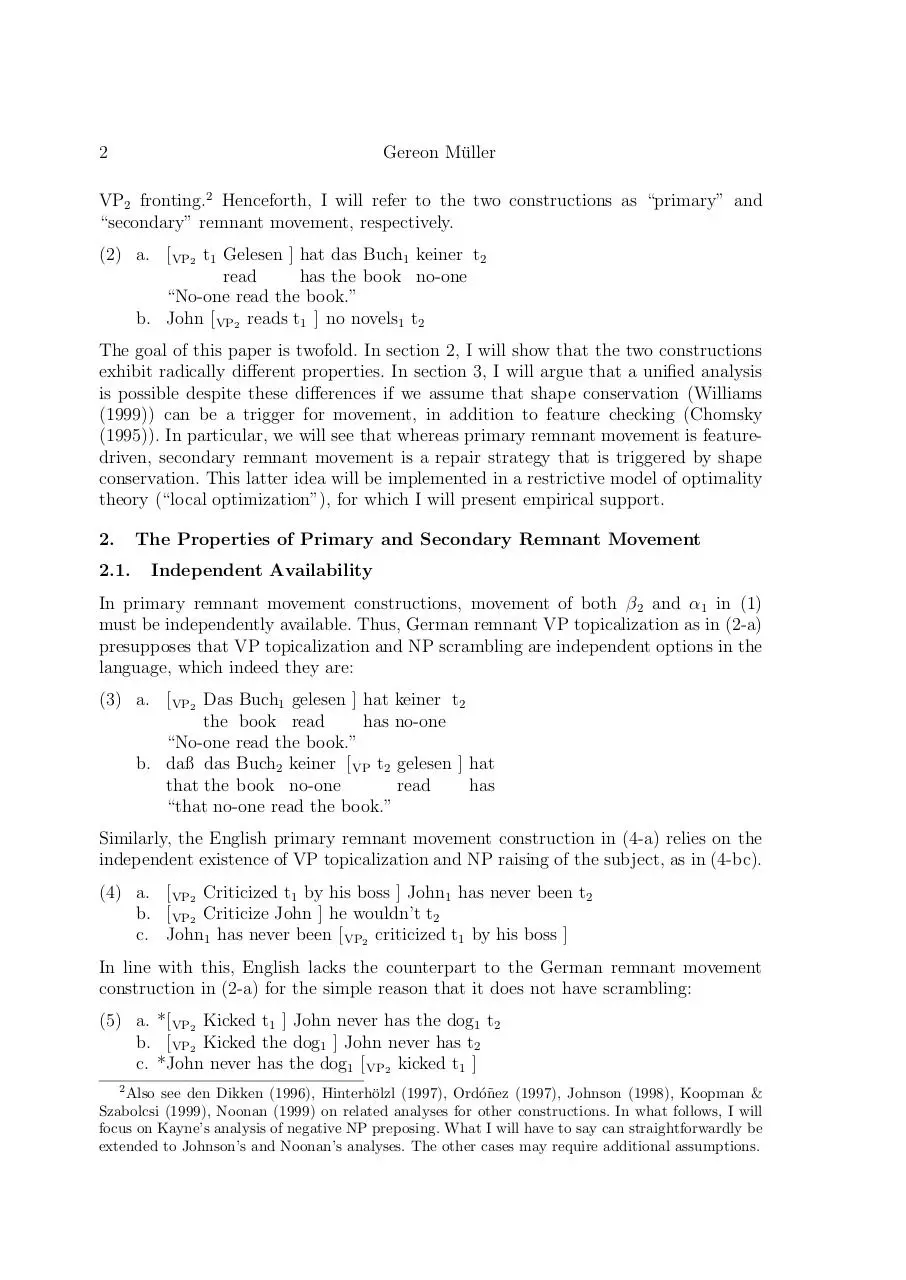
VP2 fronting.2 Henceforth, I will refer to the two constructions as “primary” and
“secondary” remnant movement, respectively.
(2) a. [ VP2 t1 Gelesen ] hat das Buch1 keiner t2
read
has the book no-one
“No-one read the book.”
b. John [ VP2 reads t1 ] no novels1 t2
The goal of this paper is twofold. In section 2, I will show that the two constructions
exhibit radically different properties. In section 3, I will argue that a unified analysis
is possible despite these differences if we assume that shape conservation (Williams
(1999)) can be a trigger for movement, in addition to feature checking (Chomsky
(1995)). In particular, we will see that whereas primary remnant movement is featuredriven, secondary remnant movement is a repair strategy that is triggered by shape
conservation. This latter idea will be implemented in a restrictive model of optimality
theory (“local optimization”), for which I will present empirical support.
2.
The Properties of Primary and Secondary Remnant Movement
2.1.
Independent Availability
In primary remnant movement constructions, movement of both β 2 and α1 in (1)
must be independently available. Thus, German remnant VP topicalization as in (2-a)
presupposes that VP topicalization and NP scrambling are independent options in the
language, which indeed they are:
(3) a. [ VP2 Das Buch1 gelesen ] hat keiner t2
the book read
has no-one
“No-one read the book.”
b. daß das Buch2 keiner [ VP t2 gelesen ] hat
read
has
that the book no-one
“that no-one read the book.”
Similarly, the English primary remnant movement construction in (4-a) relies on the
independent existence of VP topicalization and NP raising of the subject, as in (4-bc).
(4) a. [ VP2 Criticized t1 by his boss ] John1 has never been t2
b. [ VP2 Criticize John ] he wouldn’t t2
c. John1 has never been [ VP2 criticized t1 by his boss ]
In line with this, English lacks the counterpart to the German remnant movement
construction in (2-a) for the simple reason that it does not have scrambling:
(5) a. *[ VP2 Kicked t1 ] John never has the dog1 t2
b. [ VP2 Kicked the dog1 ] John never has t2
c. *John never has the dog1 [ VP2 kicked t1 ]
2
Also see den Dikken (1996), Hinterh¨
olzl (1997), Ord´
on
˜ez (1997), Johnson (1998), Koopman &
Szabolcsi (1999), Noonan (1999) on related analyses for other constructions. In what follows, I will
focus on Kayne’s analysis of negative NP preposing. What I will have to say can straightforwardly be
extended to Johnson’s and Noonan’s analyses. The other cases may require additional assumptions.
�
Shape Conservation and Remnant Movement
3
In contrast, in secondary remnant movement constructions like (6-a) (= (2-b)), movement of neither α1 nor β 2 is independently available. This is clear for negative NP
preposing; cf. (6-c). Given that independent VP2 fronting in (6-b) would be stringvacuous, the question arises of whether this is an option. Since Kayne assumes that
the “more emphatic, less neutral character” of sentences like (6-a) “must be correlated
with VP-movement,” and since it is unclear which feature could trigger TP-internal
VP fronting in (6-b), we may conclude that it is not.3 Consequently, none of the two
movement operations in (6-a) is independently available in secondary remnant movement constructions.
(6) a. John [ VP2 reads t1 ] no novels1 t2
b. *John [ VP2 likes that novel1 ] t2
c. *John no novels1 [ VP2 reads t1 ]
2.2.
Secondary Object Fronting
Double object constructions reveal a second difference. Primary remnant VP topicalization in German may carry along or strand (by scrambling) any of the two objects:
(7) a. [ VP2 t1 Ein Buch zum Geburtstag geschenkt ] hat sie dem Jason1 t2
a bookacc for the birthday given
has she ART Jasondat
“She gave Jason a book as a birthday present.”
b. [ VP2 Dem Jason1 t3 zum Geburtstag geschenkt ] hat sie ein Buch3 t2
ART Jasondat for the birthday given
has she a bookacc
c. [ VP2 t1 t3 Zum Geburtstag geschenkt ] hat sie dem Jason1 ein Buch3 t2
for the birthday given
has she ART Jasondat a bookacc
In contrast to this, whether secondary remnant VP fronting carries along an NP in a
double object construction or strands it prior to VP fronting depends on whether the
pre-movement order is maintained. If the negative NP is the first object, the second
object cannot be fronted together with the verb, but must leave the VP by an earlier
operation that I will call “secondary object fronting” (indicated here by underlining);
this operation targets a position below that of the negative NP, thereby restoring the
pre-movement order:4
(8) a.
b.
c.
d.
*John
John
*John
John
[ VP2
[ VP2
[ VP2
[ VP2
gave
gave
gave
gave
t1
t1
t1
t1
to Mary3 ] no books1 t2
t3 ] no books1 to Mary3 t2
a book3 ] no-one1 t2
t3 ] no-one1 a book3 t2
If, on the other hand, the negative NP is the second object, the first object must be
fronted together with the verb, and cannot undergo secondary object fronting:
(9) a. John [ VP2 gave Mary1 t3 ] no books3 t2
b. *John [ VP2 gave t1 t3 ] no books3 Mary1 t2
3
Kayne states that negative NP preposing will “in turn ... require the ... VP to prepose,” which
suggests that TP-internal VP fronting is not independently available in English.
4
Derivations of the type in (8-a) have sometimes been argued to underlie heavy NP shift; but this
issue is clearly not at play in the case at hand.
�
4
Gereon M¨
uller
2.3.
Extraction
Both the remnant XP β 2 and the antecedent of the unbound trace α1 in (1) are
barriers for further extraction in primary remnant movement constructions. This is
a standard freezing effect that is expected if (a) moved items end up in non-selected
positions, where they are barriers (cf. Cinque (1990) vs. Lasnik & Saito (1992)), and
(b) strict cyclicity ensures that extraction from these items cannot take place before
they undergo movement to a lower position (cf. Chomsky (1995) and references cited
there). This is shown for β in (10-ab), and for α in (10-c) (barriers are underlined).
(10) a. *Wem3 denkst du [ CP [ VP2 t3 t1 gegeben ] hat das Buch1 keiner t2 ] ?
whom think you
given
has the book no-one
“To whom do you think that no-one gave a book?”
b. *Children3 I think that [ CP [ VP2 written t1 for t3 ] those books1 could not
possibly be t2 ]
c. *[ VP2 t1 Gerechnet ] hat da3 gestern [ PP1 t3 mit ] wieder keiner t2
counted
has there yesterday
with again no-one
“Again, no-one reckoned with it yesterday.”
In contrast, neither β 2 nor α1 is a barrier for further extraction in secondary remnant
movement constructions; cf. (11-a) and (11-b), respectively.5 Given the interaction of
barriers theory and strict cyclicity, this anti-freezing effect is a priori unexpected.
(11) a. Which book3 did John [ VP2 give t3 t1 ] [ PP1 to no-one ] t2 ?
b. About Nixon3 John [ VP2 read t1 ] [ NP1 only one book t3 ] t2
2.4.
Movement Types
It has often been noted that not all movement types seem to be able to affect (primary)
remnant XPs equally well, the crucial distinction being that between middle fieldexternal and middle field-internal movement operations. E.g., whereas topicalization
of a remnant infinitival VP is possible in German (cf. (12-a)), scrambling of the same
remnant VP leads to ungrammaticality (cf. (12-b)).6
(12) a. [ VP2 t1 Zu lesen ] hat das Buch1 keiner t2 versucht
to read has the book no-one tried
“No-one tried to read the book.”
b. *daß [ VP2 t1 zu lesen ] das Buch1 keiner t2 versucht hat
that
to read the book no-one tried
has
“that no-one tried to read the book.”
Again, things are different with secondary remnant movement. Indeed, secondary remnant VP2 fronting is not just permitted to target a middle field-internal (post-subject)
landing site (cf. (13-a) = (2-b)); it is required to do so (cf. the failed attempt at
topicalization in this context in (13-b)).
(13) a. John [ VP2 reads t1 ] no novels1 t2
b. *[ VP2 Reads t1 ] (I think that) John t02 no novels1 t2
5
6
Note that Kayne (1998) treats only-phrases on a par with negative NPs.
See Fanselow (1991), Frank, Lee & Rambow (1992), Haider (1993), Grewendorf & Sabel (1999).
�
Shape Conservation and Remnant Movement
5
To sum up, we have seen that primary and secondary remnant movement constructions
differ radically. One might want to take this to indicate that one of the two approaches should be abandoned. Given that both approaches have their virtues, I will not
draw this conclusion here. Rather, I will develop a unified approach that explains the
diverging properties of primary and secondary remnant movement constructions by
distinguishing between feature-driven movement and repair-driven movement.
3.
A Unified Approach
3.1.
Shape Conservation and Local Optimization
All movement operations can plausibly be viewed as being feature-driven in primary
remnant movement constructions. Thus, (14-a) involves a combination of NP raising
(triggered by the EPP feature) and VP topicalization (triggered by a topic feature);
and (14-b) has NP scrambling (which I will here assume to be triggered by a specific
scrambling feature7 ) followed by VP topicalization (again triggered by a topic feature).
In contrast, in secondary remnant movement constructions, it looks as though only
one movement operation is feature-driven; in the construction at hand, this is negative
NP preposing. All other movement operations are parasitic – they depend on the first
operation having taken place. The absence of a feature that triggers secondary remnant
movement and secondary object fronting is illustrated in (14-c).
(14) a. [ VP2 Criticized t1 by his boss ]-[top] John1 [-D] has never been t2
b. [ VP2 t1 t3 Zum Geburtstag geschenkt ]-[top] hat sie dem Jason1 -[scr]
for the birthday given
has she ART Jason
ein Buch3 -[scr] t2
a book
c. John [ VP2 gave t1 t3 ]-Ø no books1 -[neg] to Mary3 -Ø t2
Then, given constraints like the Feature Condition (FC) in (15) and Last Resort
(LR) in (16) (cf. Chomsky (1995)), a problem arises: Some instances of movement in
secondary remnant movement constructions are not triggered by FC, and they thus
violate LR. Consequently, a different trigger must be involved, and respecting this
trigger must permit a violation of LR, which is otherwise impossible. Thus, secondary
remnant movement emerges as a repair strategy: Exceptionally, LR can be violated so
as to prevent even greater damage.
(15) Feature Condition (FC):
Strong features must be checked by overt movement.
(16) Last Resort (LR):
Overt movement must result in checking of a strong feature.
I would like to suggest that the trigger in question is the Shape Conservation (SC)
constraint that is proposed on independent grounds in Williams (1999). For the sake
of concreteness, I will assume that SC basically demands that the shape of predicate
7
See Sauerland (1997) and Grewendorf & Sabel (1999). Arguably, there is more than one possible
trigger for scrambling in German, and this fact might be formally encoded by assigning a complex
internal structure to the scrambling feature. This would not affect the issue at hand, though.
�
6
Gereon M¨
uller
phrases, or vPs, must be preserved in derivations:8
(17) Shape Conservation (SC):
Feature checking in the domain of a head Y must not change the linear order of
lexical items established in vP within YP.
The English vP shape that will be relevant is completely standard, and given in (18).9
(18) [ vP NP1 [ v’ v+V [ VP NP2 [ V’ tV {NP3 /PP3 } ]]]]
The analysis then relies on three assumptions. First, feature-driven movement of the
negative NP1 in (14-c) ends up in the specifier of a functional head Neg that bears
a strong [neg] feature. Given SC, it follows that vP2 -[Ø] (and not VP, as assumed
thus far) must be fronted to an outer specifier of Neg (i.e., to a position that precedes
NP1 -[neg] within the same projection), as an instance of repair-driven movement.10
It also follows that repair-driven movement of PP3 -[Ø] in (14-c) must end up in an
inner specifier of the very same domain, NegP.
The second assumption concerns a qualification. Evidently, whereas negative NP
preposing requires vP shape conservation, other movement operations do not. This is
obvious in the case of wh-movement in English: Checking of [wh] with an object NP in
the C domain does not trigger repair-driven movement of TP4 to an outer specifier of
C; cf. (19-a) vs. (19-b) (the latter would correspond to a wh-in situ language in which
there is evidence that wh-movement is in fact overt).
(19) a. What1 -[wh] did [ TP4 you3 [ vP2 t3 see t1 ]] ?
b. *[ TP4 You [ vP2 t see t1 ]]-Ø what1 -[wh] did t4 ?
This means that SC either does not hold for wh-movement in English (and many
other movement operations), or that it holds, but in a much weaker form. I will
draw the second conclusion here and suggest that SC is to be split up, and made
sensitive to feature classes: Features like [neg] obey a strong SC constraint that
permits a violation of LR (cf. the references in footnote 2 for other possible features
with this property), whereas features like [wh] obey only a weaker SC constraint
that does not permit a violation of LR (other features in this class include [top] and
[scr]). It is tempting to conclude that the relevant distinction is between features
that trigger A-movement and features that trigger A-bar movement. Indeed, most
cases of NP raising to SpecT will automatically satisfy SC. Successive-cyclic NP
raising may initially look problematic; but assuming that the absence of intermediate
vP projections is exactly the property that makes such raising possible, SC is
respected in this case as well. Similarly, Scandinavian object shift is well known
8
For predecessors of this constraint, see Lakoff (1971), Kroch (1974), Huang (1982), Reinhart
(1983), Lasnik & Saito (1992), Watanabe (1992), Haegeman (1995), Meinunger (1995), and M¨
uller
(1997). In general, these constraints are defined in structural rather than linear terms. This would
not be sufficient for the present analysis – SC-driven movement restores linear order, not c-command.
9
Whether NP2 occupies SpecV as a result of movement or base-generation in dative shift constructions is immaterial for present purposes – as long as there is no vP yet, all movement (including
V-to-v raising) satisfies SC vacuously. As for German, I will postulate essentially the same structure,
the only difference being that v+V is right-peripheral in vP.
10
This position follows typical adverb positions; cf. the evidence against V-to-T raising in English.
�
Shape Conservation and Remnant Movement
7
for its rigid order preservation.11 Thus, let us assume that there are only two general SC constraints – SCA (including [D], [Neg]) and SCA (including [wh], [top], [scr]).
Third, since the analysis involves the notion of repair and depends on the violability
and ranking of constraints, it lends itself to an optimality-theoretic implementation.
The implicit ranking just sketched can be made explicit as follows (the ranking of FC
and SCA is not determined by the evidence discussed here):
(20) {FC, SCA } � LR � SCA
Repair phenomena are certainly among those constructions where optimality theory
has proven most successful, and the notion of repair itself can be given a precise
characterization in this approach: A repair is a competition in which the optimal
candidate incurs an (otherwise fatal) violation of a high-ranked constraint Ci in
order to respect an even higher-ranked constraint Cj . However, it is clear that
standard global optimization procedures as laid out in Prince & Smolensky (1993)
induce complexity of a type that more recent versions of the minimalist program
manage to avoid. In view of this, and deviating from the vast majority of work in
optimality-theoretic syntax, I would like to suggest that syntactic optimization is
local, not global, and takes place repeatedly throughout the derivation.12
For the sake of concreteness, suppose that syntactic derivations proceed as in
Chomsky (1995): Merge and Move alternate, with each XP a cyclic node. Crucially,
the subderivation from one cyclic node α to the next cyclic node β (α → β) is subject
to input/output optimization. An XP is optimal if the subderivation that creates it
best satisfies an ordered set of violable constraints and respects inviolable constraints
(like strict cyclicity), which can be conceived of as parts of the definitions of Merge
and Move. Thus, an XP that is the optimal output of a subderivation forms the input
for the next subderivation, together with a new lexical item Y (and possibly another
optimal ZP if SpecY is to be filled by Merge). Optimization determines the new optimal output YP, which in turn shows up in the input of the next subderivation, and
so on, until the optimal root is reached. Based on these assumptions, the differences
between primary and secondary remnant movement can now be explained.
3.2.
Independent Availability and Secondary Object Fronting Revisited
Consider again a typical secondary remnant movement example like (21-c):
(21) a. [ vP2 John3 reads [ V P3 tV no novels1 ]]
+ Neg →
b. [ NegP [ vP2 John3 reads t1 ] [ Neg’ no novels1 [ Neg’ Neg t2 ]]]
+T→
c. [ TP John3 T [ NegP [ vP2 t3 reads t1 ] [ Neg’ no novels1 [ Neg’ Neg t2 ]]]]
11
Multiple object shift strictly preserves vP shape, and it seems possible to reanalyze double object
NP1 -Pronoun2 orders as the result of feature-driven pronominal object shift accompanied by by
SC-driven NP1 fronting. See M¨
uller (1997), Williams (1999), and references cited there.
12
Versions of multiple optimization in phonology are discussed in Prince & Smolensky (1993, ch.2)
and McCarthy (1999). Heck (1999) and Wilson (1999) assume multiple (but non-local) optimization
in syntax – three times per sentence in the former case (to determine D-structure, S-structure, and
LF), and twice in the latter case (to determine interpretation and syntactic expression). Also note
that there is a trade-off: Whereas there is more complexity with global optimization than there is with
local optimization, local optimization in turn requires a large number of optimization procedures.
�
8
Gereon M¨
uller
What we want to derive is that NP1 moves to SpecNeg to check a strong [neg] feature
and thereby respect FC, and that vP2 then raises to an outer SpecNeg position
without feature checking in order to respect SCA , even if this violates LR. The
optimization procedure that ensures this outcome is the one that takes the optimal
vP2 in (21-a) and Neg as inputs and creates a set of NegPs as output candidates. The
optimal NegP is the one in (21-b), which violates LR but respects FC and SCA , and
thus has a better constraint profile than its competitors, which fatally violate either
FC (by not applying negative NP1 preposing) or SCA (by not applying secondary
remnant vP2 movement). The local competition is shown in tableau T1 .
T1 : vP → NegP Optimization: Secondary remnant movement
Input: Neg, [vP2 John3 reads [V P tV no novels1 ]]
⇒O1 : [N egP [vP2 John3 reads [V P tV t1 ]] no novels1 Neg t2 ]
O2 : [N egP no novels1 Neg [vP2 John3 reads [V P tV t1 ]]]
O3 : [N egP – Neg [vP2 John3 reads [V P tV no novels1 ]]]
O4 : [N egP [vP2 John3 reads [V P tV no novels1 ]] Neg t2 ]
O5 : [N egP reads4 no novels1 Neg [vP2 John3 t4 [V P tV t1 ]]]
FC | SCA
|
|
*!
*!
LR
*
SCA
*!
|
|
|
*!
*
*
The optimal NegP O1 is then merged with T, and subsequent NegP → TP optimization produces the expected result: The best subderivation fronts the subject NP3 to
SpecT and has v+V in situ (this output violates none of the constraints at hand).
Note that only O1 can be in the input for the next optimization procedure, not
O2 –O5 or other suboptimal outputs. It is this property that minimizes complexity:
Under standard, global optimization, all these suboptimal outputs would have to be
continued to the end (in representational terms: considered as substructures of the
whole sentence) and would thereby give rise to exponential growth of the candidate set.
In addition to this conceptual difference, local optimization turns out to also yield
a desirable empirical difference. In the present system, it is clear that V raising is not
an alternative to remnant vP movement: Local V raising to SpecNeg as in O5 does not
satisfy SCA , leading to VOS instead of SVO order; and non-local V-to-T raising can
never satisfy SCA within NegP. In contrast, under global optimization there would be
no SCA violation, due to subsequent NP3 raising to SpecT (which ultimately restores
SVO order), and repair-driven V raising might incorrectly (given adverb placement
facts) be permitted along with (or instead of) remnant vP movement.13
Next consider the case where secondary remnant movement is accompanied by
secondary object fronting, as in the double object construction (22-c).
(22) a. [ vP2 John4 gave [ VP no books1 tV to Mary3 ]]
+ Neg →
b. [ NegP [ vP2 John4 gave [ VP t1 tV t3 ]] no books1 to Mary3 Neg t2 ]
+T→
c. [ TP John4 T [ NegP [ vP2 t4 gave [ VP t1 tV t3 ]] no books1 to Mary3 Neg t2 ]]
Again, the important subderivation is the step from vP in (22-a) to NegP in (22-b),
and essentially the same reasoning applies as before. The optimal NegP is one in
13
Of course, V raising could still independently be filtered out by stipulating a higher-ranked
constraint that, e.g., bans movement of a lexical category (cf. Grimshaw (1997), Vikner (1999), and
Kayne (1998, fn. 11), who notes: “The lexical verb in English cannot raise by head movement, yet
it must move, consequently the whole VP moves”). Still, the point remains that local and global
optimization differ empirically, and the former approach offers a simpler account in the case at hand.
�
Shape Conservation and Remnant Movement
9
which NP1 moves to SpecNeg to check the [neg] feature and thereby respect FC,
and PP3 and vP2 undergo repair-driven movement to inner and outer specifiers of
NegP, respectively, to respect SCA . This incurs two violations of LR, but as shown
in tableau T2 , all competing subderivations fatally violate higher-ranked constraints.
Note in particular that O1 blocks O5 as suboptimal; O5 has secondary remnant vP
movement but fails to apply secondary object fronting.
T2 : vP → NegP Optimization: Secondary remnant movement and object fronting
Input: Neg, [vP2 John4 gave [V P no books1 tV to Mary3 ]]
⇒O1 : [N egP [vP2 J4 gave [V P t1 tV t3 ]] no books1 to M3 Neg t2 ]
O2 : [N egP no books1 Neg [vP2 J4 gave [V P t1 tV to M3 ]]]
O3 : [N egP Neg [vP2 J4 gave [V P no books1 tV to M3 ]]]
O4 : [N egP [vP2 J4 gave [V P no books1 tV to M3 ]] Neg t2 ]
O5 : [N egP [vP2 J4 gave [V P t1 tV to M3 ]] no books1 Neg t2 ]
O6 : [N egP no books1 to M3 Neg [vP2 J4 gave [V P t1 tV t3 ]]]
FC | SCA
|
|
*!
*!
LR
**
SCA
*!*
|
|
*!
| *!***
|
*
*
*
As before, the step from (22-b) to (22-c) is straightforward because a constraint
conflict does not arise and FC, SCA,A , and LR can all be satisfied.
Furthermore, a second argument for local optimization can be gained. Suppose
that PP3 in (22) bears a [top] feature. Then, local optimization proceeds exactly as
shown here, creating (22-b) from (22-a) as in T2 , and then (22-c) from (22-b). The only
difference is that later in the derivation, PP3 is moved to the topic position, yielding
(23).14
(23) [ CP To Mary3 [ TP John4 T [ NegP [ vP2 t4 gave [ VP t1 tV t3 ]] no books1 t03 Neg t2 ]]]
Viewed globally, SCA cannot be fulfilled by this sentence. This would threaten to
undermine the motivation for remnant vP movement in this context.15 In contrast,
no problem arises if optimization is local: The subderivation vP → NegP respects FC
and SCA by violating the lower-ranked LR, and the subderivation TP → CP respects
FC and LR by violating the lower-ranked SCA . Instead of giving a tableau that shows
this latter optimization procedure, let me proceed to the case of primary remnant
movement, where exactly the same reasoning applies. A simple example is (24-d) from
German, with its derivation in (24-abc).16
(24) a.
b.
c.
d.
[ vP2 der Fritz3 ein Buch1 gelesen ]
+ [ V hat ] →
[ VP ein Buch1 [ vP2 der Fritz3 t1 gelesen ] [ V hat ]]
+T→
[ TP der Fritz3 [ VP ein Buch1 [ vP2 t3 t1 gelesen ] [ V tV ]] [ T hat]]
+C→
[ CP [ vP2 t3 t1 Gelesen ] hat [ TP der Fritz3 ein Buch1 t2 ] tV ]
read
has
Fritz a book
14
I assume here that English topicalization is movement to SpecC, but the same argument can be
made if topicalization is adjunction to TP, movement to SpecTop, etc.
15
It would not help to assume that SC can be fulfilled by traces like t03 because, if nothing else is
said, this would mean that SC is trivially respected by all sentences, vP order always being recoverable
with the help of vP-internal traces.
16
The derivation given here rests on some decisions that are controversial and, to some extent, arbitrary (concerning the projection of auxiliaries, subject raising to SpecT, V raising to a right-peripheral
T, etc.). The only important assumption is that both NP1 scrambling and vP2 topicalization are triggered by features that obey SCA .
�
10
Gereon M¨
uller
Consider first the subderivation vP2 → VP in (24-ab); cf. tableau T3 . Assuming
that the object NP1 has an optional [scr] feature that is matched by [V hat ] (and
the subject NP3 does not), the optimal VP is O1 . Here, NP1 moves to SpecV
(respecting FC), and NP3 stays in situ (respecting LR and violating SC): Whereas [neg] obeys SCA , [scr] obeys SCA . This precludes repair-driven movement as in O3 .
T3 : vP → VP Optimization: Scrambling
Input: [V hat ], [vP2 der Fritz3 ein Buch1 gelesen ]
⇒O1 : [V P ein Buch1 [vP2 der Fritz3 t1 gelesen ] [V hat ]]
O2 : [V P [vP2 der Fritz3 ein Buch1 gelesen ] [V hat ]]
O3 : [V P der Fritz3 ein Buch1 [vP2 t3 t1 gelesen ] [V hat ]]
O4 : [V P der Fritz3 [vP2 t3 ein Buch1 gelesen ] [V hat ]]
FC
SCA
LR
SCA
*
*!
*!
*
*!
The optimal VP O1 (= (24-b)) is subsequently merged with T. Assuming that the
EPP feature can optionally be strong in German, and is strong in the case at hand,
the optimal output of the subderivation VP → TP is (24-c), in which the subject
NP3 moves to SpecT (in addition, V moves to T). Since this subderivation respects
FC, LR, and SCA,A , it is not necessary to illustrate the competition by a tableau.
Finally, the optimal TP in (24-c) is merged with C. In V/2 languages, an empty
finite declarative C bears a [top] feature (and a feature attracting V). Assuming
that this feature is also instantiated on vP2 , the optimal output of the subderivation TP → CP is (24-d), which involves remnant vP2 movement to SpecC and
respects FC and LR at the cost of violating the lower-ranked SCA (cf. O1 vs. O3 in T4 ).
T4 : TP → CP Optimization: Primary remnant VP movement
Input: C, [T P der Fritz3 ein Buch1 [vP2 t3 t1 gelesen ] hat ]
⇒O1 : [CP [vP2 t3 t1 Gelesen ] hat [T P der Fritz3 ein Buch1 ]]
O2 : [CP Hat [T P der Fritz3 ein Buch1 [vP2 t3 t1 gelesen ]]]
O3 : [CP der Fritz3 ein Buch1 [vP2 t3 t1 gelesen ] hat [T P t03 t01 ]]
O4 : [CP der Fritz3 [vP2 t3 t1 gelesen ] hat [T P t03 ein Buch1 ]]
FC
SCA
LR
SCA
*
*!
*!*
*!
*
SCA has not yet been fatally violated by a candidate; i.e., it has played no role in
the analysis so far. However, there is evidence for a low-ranked SCA : As soon as two
or more subderivations behave identically with respect to higher-ranked constraints,
the decision is passed on to the low-ranked SCA . A particularly obvious case is the
superiority effect in English:17
(25) a. (I wonder) [ CP who1 C [ TP t1 bought what2 ]]
b. *(I wonder) [ CP what2 C [ TP who1 bought t2 ]]
Suppose that C bears a strong [wh] feature here which is matched by weak [wh]
features on both wh-phrases. T5 then shows that the subderivation TP → CP must
involve movement of one wh-phrase to SpecC, so as to fulfill FC (cf. O3 ), and must
leave one wh-phrase in situ, so as to fulfill LR (cf. O4 ). O1 and O2 (= (25-ab)) meet
both requirements, and they vacuously fulfill SCA . However, only O1 respects SCA by
17
Other phenomena that lend themselves to the same kind of analysis are German weak pronoun
fronting and multiple wh-movement in Bulgarian. These phenomena are covered by Par-Move in
M¨
uller (1997); it seems that SCA can do all the work that was attributed to that constraint.
�
Shape Conservation and Remnant Movement
11
maintaining vP order with [wh] feature checking; therefore, it blocks O2 . Thus, the
superiority effect is derived without recourse to constraints like the ECP or the MLC.
T5 : TP → CP Optimization: The superiority effect
I: C-[wh], [T P who1 [vP t1 bought what2 ]]
⇒O1 : [CP who1 C [T P t01 [vP t1 bought what2 ]]]
O2 : [CP what2 C [T P who1 [vP t1 bought t2 ]]]
O3 : [CP – C [T P who1 [vP t1 bought what2 ]]]
O4 : [CP who1 what2 C [T P t01 [vP t1 bought t2 ]]]
3.3.
FC
SCA
LR
SCA
*!
*!
*!
Extraction Revisited
Recall that both the remnant XP β2 in (26-a) and the antecedent of the unbound
trace α1 in (26-b) are barriers for extraction of some element δ 3 in primary remnant
movement constructions (freezing; cf. (10)), and that neither β 2 nor α1 is a barrier for
extraction in secondary remnant movement constructions (anti-freezing; cf. (11)).
(26) a. δ 3 ... [ β 2 ... t3 ... t1 ... ] ... α1 ... [ ... t2 ... ]
b. δ 3 ... [ α1 ... t3 ... ] ... [ ... t2 ... ]
Assuming that XPs in derived positions are barriers, the freezing effect with primary
remnant movement can be accounted for. But how can secondary remnant movement
escape this effect? The key to a solution is that secondary remnant movement is
triggered by SCA rather than by FC. Hence, it always restores local relations that
existed earlier in the derivation. Thus, if α1 , β 2 are not barriers in situ, they will not
be turned into barriers in secondary remnant movement constructions because each
selected XP will still be in the same minimal domain as the head that selects it. To
execute this idea, let us assume the Barriers Condition (BC) in (27-a), and define
barriers as in (27-b); this definition differs from standard approaches (cf. Cinque (1990)
and references cited there) only in replacing the notion of sisterhood in (27-b.(ii)) by
the slightly more liberal notion of same minimal domain.
(27) Barriers Condition (BC):
a. Movement must not cross a barrier.
b. An XP γ is a barrier unless there is a non-derived head σ such that:
(i) σ selects γ.
(ii) σ and γ are in the same minimal domain.
Thus, extraction from α1 , β 2 does not violate BC in secondary remnant movement
constructions. However, given that feature-driven movement in primary remnant
movement constructions typically has the effect that an XP γ and its selecting head σ
are not in the same minimal domain anymore, extraction from α1 , β 2 violates BC in
this case.18 To derive ungrammaticality from this violation, one could postulate that
BC is an inviolable constraint (part of the definition of Move), or that it is ranked
high. Let us assume the latter. The optimal subderivation YP → ZP (where SpecZ is
the landing site of δ 3 in (26)) can then be one that yields an empty output (which
18
The confinement to non-derived heads in (27-b) ensures that γ may not become transparent by
accidentally ending up in the same domain as σ after non-local movement; cf. (10-a).
�
12
Gereon M¨
uller
vacuously respects BC/FC and violates a lower-ranked ban on empty outputs) – the
derivation cannot continue; it crashes.19
We expect that movement in primary remnant movement constructions does not
create barriers if it is extremely local. As noted by den Besten & Webelhuth (1990),
this prediction is borne out. Whereas PP1 is a barrier for extraction in (28-a) (=
(10-c)), it is transparent in (28-b), where it has undergone string-vacuous scrambling.
(28) a. *[ vP2 t1 Gerechnet
counted
b. [ vP2 t1 Gerechnet
counted
3.4.
] hat
has
] hat
has
da3
there
da3
there
gestern [ PP1 t3
yesterday
gestern wieder
yesterday again
mit ] wieder keiner t2
with again no-one
keiner [ PP1 t3 mit ] t2
no-one
with
Movement Types Revisited
Based on examples like those in (12), I have so far assumed that middle field-internal
movement (e.g., scrambling) cannot affect remnant XPs, whereas middle field-external
movement (e.g., topicalization) can. This generalization has proven problematic in the
light of secondary remnant movement, which is obligatorily middle field-internal; cf.
(13-a) vs. (13-b). The illformedness of (13-b) now follows from the fact that SCA -driven
movement is strictly local (accompanied by the standard assumption that finite vPs
cannot bear a [top] feature); but the difference between illegitimate primary remnant
scrambling in (12-b) and legitimate local secondary remnant movement in (13-a) still
calls for an explanation. This turns out to be straightforward. Note that the above
generalization is not quite correct: Remnant scrambling is in fact possible if the antecedent of the unbound trace has not also undergone scrambling, but another type of
movement, e.g., weak pronoun fronting; cf. (29-a) (= (12-b)) vs. (29-b).
(29) a. *daß [ vP2 t1 zu lesen ] das Buch1 keiner t2 versucht hat
that
to read the book no-one tried
has
“that no-one tried to read the book.”
b. daß [ vP2 t1 zu lesen ] es1 keiner t2 versucht hat
that
to read it no-one tried
has
“that no-one tried to read it.”
Similarly, middle field-external remnant wh-movement is impossible if the antecedent
of the unbound trace has also undergone wh-movement, and possible if it has undergone
another type of movement, e.g., scrambling; cf. (30-a) vs. (30-b).
(30) a. *[ NP2 Was f¨
ur ein Buch t1 ] fragst du dich [ CP [ PP1 u
¨ber wen ] du t2
what for a book
ask you REFL
about whom you
lesen sollst ] ?
read should
“*What kind of book do you wonder about whom to read?”
19
Alternatively, the optimal subderivation could remove the feature that triggers δ 3 -movement
and, e.g., change a [+wh] wh-element into a [–wh] indefinite. Then, δ 3 can remain in situ without
violating BC or FC, at the cost of a violation of a lower-ranked faithfulness constraint; this amounts
to neutralization of a [±wh] distinction in the input.
�
Shape Conservation and Remnant Movement
13
b. [ NP2 Was f¨
ur ein Buch t1 ] hast du [ PP1 u
¨ber die Liebe ] t2 gelesen ?
what for a book
have you
about the love
read
“What kind of book did you read about love?”
Thus, the data suggest a constraint like Unambiguous Domination (UD) in (31),
rather than a stipulation as to which movement type may affect remnant XPs.20
(31) Unambiguous Domination (UD):
In ... [ α ... β ... ] ..., α and β cannot check the same kind of feature (outside α).
It can easily be verified that UD is violated in cases like (29-a) and (30-a), but respected
in (29-b), (30-b), and typical primary remnant movement constructions that involve a
combination of scrambling (or NP raising) and topicalization. Furthermore, it is now
clear why secondary remnant movement as in (13-a) can never violate UD: α and β
cannot check the same feature if α does not check a feature at all.
4.
Conclusion and Outlook
I have tried to show that the different properties of primary and secondary remnant
movement follow from the fact that the former operation is feature-driven, whereas
the latter is not: It is a repair strategy forced by Shape Conservation and the
Feature Condition, in violation of Last Resort. As a consequence of this,
secondary object fronting may also be required; Barriers Condition violations
can be avoided; and Unambiguous Domination violations do not show up.
On a more general note, I have argued that since repair-driven secondary remnant movement presupposes constraint violability and ranking, it lends itself to an
optimality-theoretic analysis. What is more, it provides evidence that syntactic optimization is local, not global (as is standarly assumed): On the one hand, there are
ill-formed derivations that are indeed locally suboptimal, but globally optimal (cf. T1 ).
And on the other hand, there are well-formed derivations that are locally optimal, but
globally suboptimal (cf. T2 ). In general, it seems that syntactic repair is typically a
local phenomenon: An “offending” property is removed instantaneously, not at some
earlier or later stage in the derivation. This holds for other cases of repair-driven movement that have been proposed in the literature; cf. Heck & M¨
uller (1999), where arguments are given for local analyses of, e.g., semantically vacuous QR that is forced by
a higher-ranked parallelism constraint (Fox (1995)), and wh-scrambling that is forced
by a higher-ranked Neg-intervention constraint (Beck (1996)). Moreover, many other
cases of syntactic repair that have been approached in terms of global optimization
(cf., e.g., Grimshaw (1997) on do-support, Pesetsky (1998) and Legendre, Smolensky,
& Wilson (1998) on resumptive pronouns, Schmid (1998) on the Westgermanic “Ersatzinfinitiv”) can be treated by local optimization. It remains to be seen, though,
whether local optimization can (or should) do all the work that global optimization
has been held responsible for in syntax.
20
UD is from M¨
uller (1998). To ensure ungrammaticality in cases where UD would have to be
violated by a subderivation, the same reasoning applies as in the case of BC. For more empirical
evidence and attempts to derive (something like) this constraint from even more general assumptions,
see also Takano (1993), Koizumi (1995), and Kitahara (1997).
�
14
Gereon M¨
uller
References
Bayer, Josef. 1996. Directionality and Logical Form. On the Scope of Focussing Particles and Wh-in-situ. Dordrecht: Kluwer.
Beck, Sigrid. 1996. Wh-Constructions and Transparent Logical Form. Doctoral dissertation, Universit¨at T¨
ubingen.
Besten, Hans den, & Gert Webelhuth. 1987. Adjunction and Remnant Topicalization
in the Germanic SOV-Languages. Paper presented at GLOW (Venice).
Besten, Hans den, & Gert Webelhuth. 1990. Stranding. In Scrambling and Barriers,
ed. G¨
unther Grewendorf and Wolfgang Sternefeld, 77-92. Amsterdam: Benjamins.
Chomsky, Noam. 1995. Categories and Transformations. Chapter 4 of The Minimalist
Program. Cambridge, Mass.: The MIT Press.
Chomsky, Noam. 1998. Minimalist Inquiries. Ms., MIT, Cambridge, Mass.
Cinque, Guglielmo. 1990. Types of A’-Dependencies. Cambridge, Mass.: MIT Press.
Dikken, Marcel den. 1996. Extraposition as Intraposition, and the Syntax of English
tag Questions. Ms., Vrije Universiteit Amsterdam.
Fanselow, Gisbert. 1991. Minimale Syntax. Habilitation thesis, Universit¨at Passau.
Fox, Danny. 1995. Economy and Scope. Natural Language Semantics 3:283-341.
Frank, Robert, Young-Suk Lee, & Owen Rambow. 1992. Scrambling as Non-Operator
Movement and the Special Status of Subjects. In Proceedings of the Leiden Conference for Junior Linguists 3:135-154. Leiden: University of Leiden.
Grewendorf, G¨
unther, & Joachim Sabel. 1999. Scrambling in German and Japanese.
Natural Language and Linguistic Theory 17:1-65.
Grimshaw, Jane. 1997. Projection, Heads, and Optimality. Linguistic Inquiry 28:373422.
Haegeman, Liliane. 1995. The Syntax of Negation. Cambridge: CUP.
Heck, Fabian. 1999. Quantifier Scope in German and Cyclic Optimization. Ms., Universit¨at Stuttgart. To appear in Competition in Syntax, eds. Gereon M¨
uller &
Wolfgang Sternefeld. Berlin: Mouton/de Gruyter.
Heck, Fabian, & M¨
uller, Gereon. 1999. Repair-Driven Movement and the Local Optimization of Derivations. Ms., Universit¨at Stuttgart.
Hinterh¨olzl, Roland. 1997. An XP-Movement Account of Restructuring. Ms., USC.
Huang, Cheng-Teh James. 1982. Logical Relations in Chinese and the Theory of Grammar. Doctoral dissertation. MIT, Cambridge, Mass.
Johnson, Kyle. 1998. Ways to Hide Quantifier Raising. Ms., University of Mass., Amherst.
Kayne, Richard. 1998. Overt vs. Covert Movement. Ms., New York University. Also in
Syntax 1.
Kitahara, Hisatsugu. 1997. Elementary Operations and Optimal Derivations. Cambridge, Mass.: MIT Press.
Koizumi, Masatoshi. 1995, Phrase Structure in Minimalist Syntax. Doctoral dissertation, MIT, Cambridge, Mass.
Koopman, Hilda, & Anna Szabolcsi. 1999. Verbal Complexes. To appear: Cambridge,
Mass.: MIT Press.
Kroch, Anthony. 1974. The Semantics of Scope in English. Doctoral dissertation, MIT,
Cambridge, Mass.
Lakoff, George. 1971. On Generative Semantics. In Semantics, ed. Danny Steinberg &
Leon Jakobovits, 232-296. Cambridge: Cambridge University Press.
�
Shape Conservation and Remnant Movement
15
Lasnik, Howard, & Mamoru Saito. 1992. Move α. Cambridge, Mass.: MIT Press.
Legendre, G´eraldine, Paul Smolensky, & Colin Wilson. 1998. When is Less More?
Faithfulness and Minimal Links in Wh-Chains. In Is the Best Good Enough?, eds.
Pilar Barbosa et al., 249-289. Cambridge, Mass.: MIT Press & MITWPL.
McCarthy, John. 1999. Harmonic Serialsm and Parallelism. Ms., University of Massachusetts, Amherst.
Meinunger, Andr´e. 1995. Prominence Hierarchy and Phrase Ordering. FAS Working
Papers, vol. 2. ZAS: Berlin.
M¨
uller, Gereon. 1997. Parallel Movement. In Zur Satzstruktur im Deutschen, ed. Franz
d‘Avis & Uli Lutz, 171-214. T¨
ubingen: SFB 340 Working Papers no. 90. Revised
version to appear in Optimality-Theoretic Syntax, eds. G´eraldine Legendre, Jane
Grimshaw, & Sten Vikner. Cambridge, Mass.: MIT Press.
M¨
uller, Gereon. 1998. Incomplete Category Fronting. Dordrecht: Kluwer.
Noonan, Maire. 1999. CP-Pied Piping and Remnant VP Movement in Long-Distance
Wh-Movement. Ms., York University.
Ord´on
˜ez, Francisco. 1997. Word Order and Clausal Structure in Spanish and Other
Romance Languages. Doctoral dissertation, CUNY.
Pesetsky, David. 1998. Some Optimality Principles of Sentence Pronunciation. In Is
the Best Good Enough?, eds. Pilar Barbosa et al., 337-383. Cambridge, Mass.: MIT
Press & MITWPL.
Prince, Alan & Paul Smolensky. 1993. Optimality Theory. Constraint Interaction in
Generative Grammar. Ms., Rutgers University.
Reinhart, Tanya. 1983. Anaphora and Semantic Interpretation. London: Croom Helm.
Schmid, Tanja. 1998. Optional, Obligatory, and Impossible IPP Constructions in West
Germanic. Ms., Universit¨at Stuttgart. To appear in Proceedings of Console.
Sauerland, Uli. 1997. Scrambling and Interpretability. Ms., MIT, Cambridge, Mass.
Stechow, Arnim von, & Wolfgang Sternefeld. 1988. Bausteine syntaktischen Wissens.
Opladen: Westdeutscher Verlag.
Takano, Yuji. 1993. Minimalism and Proper Binding. Ms., UC Irvine.
Thiersch, Craig. 1985. VP and Scrambling in the German Mittelfeld. Ms., University
of Tilburg.
Vikner, Sten. 1999. V-to-I Movement and ‘Do’-Insertion in Optimality Theory. Ms.,
Universit¨at Stuttgart. To appear in Optimality-Theoretic Syntax, eds. G´eraldine
Legendre, Jane Grimshaw, & Sten Vikner. Cambridge, Mass.: MIT Press.
Watanabe, Akira. 1992. Wh-in-Situ, Subjacency, and Chain Formation. Ms., MIT,
Cambridge, Mass. (MIT Occasional Papers in Linguistics 2.)
Williams, Edwin. 1999. Economy as Shape Conservation. Ms., Princeton University.
Wilson, Colin. 1998. Bidirectional Optimization and the Theory of Anaphora. Ms.,
Johns Hopkins University. To appear in Optimality Theoretic Syntax, eds. Jane
Grimshaw, G´eraldine Legendre, & Sten Vikner. Cambridge, Mass.: MIT Press.
Seminar f¨
ur Sprachwissenschaft
Universit¨at T¨
ubingen, Wilhelmstr. 113
D-72074 T¨
ubingen, Germany
gereon.mueller@uni-tuebingen.de
�
 Historical archive . public document