IDENTIFICATION OF CHEMICAL CONSTITUENTS IN STONE DAMMAR
EXTRACTS AND THEIR POTENCIES AS ANTIBACTERIAL AGENTS
Noryawati Mulyono
School of Biology, Faculty of Biotechnology, Atma Jaya Catholic University,
Jakarta 12930 Indonesia
Email noryawati@atmajaya.ac.id
ABSTRACT
Stone dammar, resin obtained from Shorea eximia, grows well in Kalimantan, Sumatra and Sulawesi. Its
wood has been utilized, but the other parts of the plant have no economical value. The aim of this
fundamental research was to extract the stone dammar using nonpolar and semipolar organic solvents,
and to identify chemical constituents in stone dammar resin using py-GC/MS. Sesquiterpenes and
terpene-O were the main compounds in stone dammar extracts using hexane or ethyl acetate. Some
predominant sesquiterpenes are α-copaene, δ-cadinene, valencene, β-elemene and alloaromadendrene;
and terpene-O were spathulenol and α-cadinol. High content of sesquiterpenes in these extracts indicated
their potencies to be used as antimicrobial agent.
KEYWORDS: dammar; sesquiterpene; antibacterial.
1. Introduction
Stone dammar is resin from the bark of Shorea eximia, included in
Dipterocarpaceae family. There are about 600 species of Dipterocarpaceae in
Indonesia [1]. Research and development of this nontimber forest product is needed to
improve its economical value but this is still rare because only wood that has been
commercialized [2-3]. Since it is secondary metabolite and it is produced as an
immune system, it is potential to be developed as antibacterial agent. It will not only
improve its economical value, but also diminish bacteria resistance due to continuous
exposure of synthetic antibiotics and suitable to be applied as natural antibacterial in
lipophillic products, both food and cosmetics. The aim of this research was to inform
chemical constituents in stone dammar resin.
2. Materials and Methods
2.1. Plant Material
The resin was supplied by Research and Development Agency, Indonesia
Forestry Department (Bogor). Dry resin was ground into fine powder and extracted at
room temperature using hexane and ethyl acetate, separately at 5% (w/v). Each
extract was concentrated by vacuum rotary evaporator and dried by vacuum oven. The
yields of hexane and ethyl acetate extracts were 25.79 and 37.61% (w/w),
respectively.
�
2.2 Chemical Identification Using Py-GC/MS
Chemical compounds from single extraction were identified using py-GC/MS
(QP 2010 Shimadzu). The GC column was a 30 m DB-5 column (J&W Scientific,
Folsom, USA) with 0.25 mm i.d. and 0.25 μm film thickness. The temperature
conditions (oC): pyrolisis 400, column 50, interface 280, ion source 280. Helium was
used as carrier. Mass spectra were automatically compared to database from National
Institute of Standards and Technology, Wiley, Pesticide, Flavor and Fragrance Natural
and Synthetic Compounds, and Drug libraries, and were used to predict the chemical
composition. Percentage composition were calculated based on peak area.
3. Results and Discussion
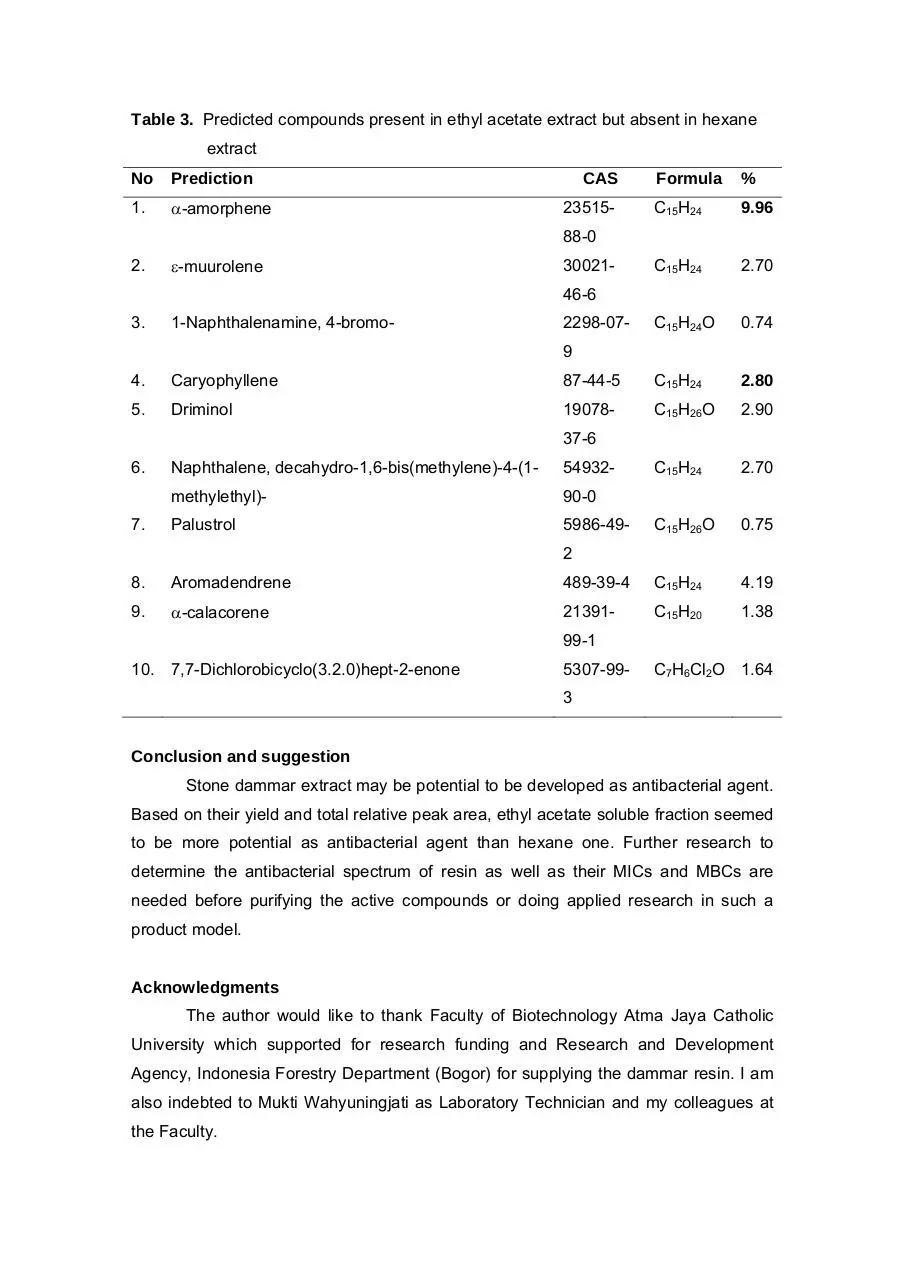
The chromatogram of hexane soluble fraction of stone dammar showed that
there were 45 compounds in that fraction, but only 6 peaks could be predicted with
high similarity index (SI>90%) and 15 peaks with SI 80-90%. Extraction using ethyl
acetate yielded fraction consisted of 31 compounds, 8 and 17 out of them could be
predicted with high and moderate SI, respectively (Figure 1). For all data in table,
number in bold means that SI > 90% and in regular means that SI 80-90%.
Compounds with a SI <80% were not reported here.
Figure 1. Chromatograms of stone dammar extracts.
�
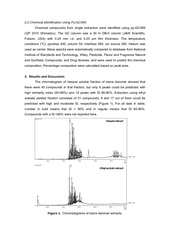
There were 14 compounds present in all extracts (Table 1). All of them were
sesquiterpenes (C15H24), except for (-)-caryophyllene oxide, α-cadinol, platambin and
spathulenol, which could be categorized as terpen-O. It seemed that ethyl acetate was
better solvent because of its high total relative peak area (70-72% vs 53-56%).
Compounds no 1-10 in Table 1 have been reported about their presence in essential
oil from medicinal plants such as Teucrium sp., Hypericum sp, Nepeta sp., Phlomis sp.
and Ottonia martiana Miq. [4-10].
Table 1. Chemical compounds in stone dammar extracted by either hexane or ethyl
acetate
No
Name
CAS
Formula
Hexane
Ethyl acetate
(%)
(%)
1.
α -copaene
3856-25-5
C15H24
4.63
8.86
2.
(-)-caryophyllene
1139-30-6
C15H24O
1.81
2.44
oxide
3.
δ-cadinene
483-76-1
C15H24
5.93
7.45
4.
α-cadinol
481-34-5
C15H26O
5.61
6.74
5.
α-muurolene
31983-22-
C15H24
0.73
8.48
C15H24
3.83
1.75-3.85
9
6.
Germacrene D
23986-745
7.
Valencene
4630-07-3
C15H24
8.19
5.39
8.
β-elemene
515-13-9
C15H24
5.67-8.78
11.24
9.
Alloaromadendrene
25246-27-
C15H24
3.83
5.64
9
10. Spathulenol
6750-60-3
C15H24O
3.52
5.48
11. 1S,cis-calamenene
483-77-2
C15H22
5.05
1.88
12. Longicyclene, (+)-
1137-12-8
C15H24
0.78
1.57
13. Platambin
58556-80-
C15H26O2
1.48
2.52
C15H24
2.04
0.75
2
14. γ-gurjunene
489-40-7
�
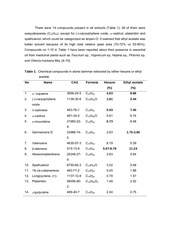
There are 7 compounds could be extracted using hexane, but absent in ethyl
acetate extract (Table 2). Only 2 of them had been reported about their antibacterial
activities, i.e. α-cubebene and α-ylangene in essential oil from Ottonia martinata and
Teucrium montanum [8-9].
Table 2. Chemical compounds present in hexane extract but absent in ethyl acetate
extract
No Name
CAS
Formula %
1.
α-cedrol
77-53-2
C15H26O
3.17
2.
α-cubebene
17699-
C15H24
0.69
C15H24
3.83
C15H24
1.38
C15H26O
1.69
C15H24O
3.52
C15H24O
1.49
14-8
3.
α-ylangene
1491244-8
4.
β-cubebene
1374415-5
5.
6.
1H-Benzocyclohepten-7-ol, 2,3,4,4a,5,6,7,8-
6892-
octahydro-1,1,4a,7-tetramethyl-, cis-
80-4
1,4-Diiodooctahydropentalene
9261751-1
7.
Longifolenaldehyde
1989084-7
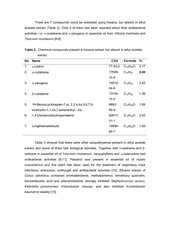
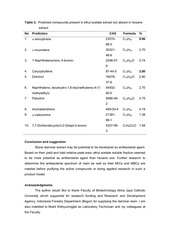
Table 3 showed that there were other sesquiterpenes present in ethyl acetate
extract and some of them had biological activities. Together with δ-cadinene and βselinene in essential oil of Teucrium montanum, caryophyllene and α-calacorene had
antibacterial activities [9,11]. Palustrol was present in essential oil of Hyptis
suaveolensis and this plant has been used for the treatment of respiratory track
infections, anticancer, antifungal and antibacterial activities [12]. Ethanol extract of
Cistus salvifolius contained aromadendrene, methylpentenol, trimethoxy quercetin,
benzeneacetic acid and phenylindolizine strongly inhibited Staphylococcus aureus,
Klebsiella pneumoniae, Enterobacter cloacae, and also inhibited Acinetobacter
baumannii weakly [13].
�
Table 3. Predicted compounds present in ethyl acetate extract but absent in hexane
extract
No
Prediction
1.
α-amorphene
CAS
23515-
Formula
%
C15H24
9.96
C15H24
2.70
C15H24O
0.74
88-0
2.
ε-muurolene
3002146-6
3.
1-Naphthalenamine, 4-bromo-
2298-079
4.
Caryophyllene
87-44-5
C15H24
2.80
5.
Driminol
19078-
C15H26O
2.90
C15H24
2.70
C15H26O
0.75
37-6
6.
7.
Naphthalene, decahydro-1,6-bis(methylene)-4-(1-
54932-
methylethyl)-
90-0
Palustrol
5986-492
8.
Aromadendrene
489-39-4
C15H24
4.19
9.
α-calacorene
21391-
C15H20
1.38
99-1
10. 7,7-Dichlorobicyclo(3.2.0)hept-2-enone
5307-99-
C7H6Cl2O 1.64
3
Conclusion and suggestion
Stone dammar extract may be potential to be developed as antibacterial agent.
Based on their yield and total relative peak area, ethyl acetate soluble fraction seemed
to be more potential as antibacterial agent than hexane one. Further research to
determine the antibacterial spectrum of resin as well as their MICs and MBCs are
needed before purifying the active compounds or doing applied research in such a
product model.
Acknowledgments
The author would like to thank Faculty of Biotechnology Atma Jaya Catholic
University which supported for research funding and Research and Development
Agency, Indonesia Forestry Department (Bogor) for supplying the dammar resin. I am
also indebted to Mukti Wahyuningjati as Laboratory Technician and my colleagues at
the Faculty.
�
References
[1]. E.H. Hakim (2002). Oligostilbenoid from Dipterocarpaceous plants. Bull. Soc. Nat.
Prod. Chem. 2, 1-19.
[2]. I. Hakim and A. Saiban (1994). Potensi, permasalahan dan prospek pengusahaan
hutan damar, di Krui, Lampung Barat. J. Penel. Pengemb. Kehut. 9(2), 45-52.
[3]. E. S. Sumadiwangsa and Gusmailina (2006). Teknologi budidaya, pemanfaatan
dan pengembangan hasil hutan bukan kayu. Forestry Ministry, Bogor.
[4]. M. Pavlovic, O. Tzakou, P. V. Petrakis and M. Couladis (2004). Essential oil
composition of Hypericum perforatum l., Hypericum tetrapterum fries and
Hypericum olympicum l. growing in Greece. In: 3rd Conference on medicinal and
aromatic plants of southeast European Countries. Book of Abstracts, ed: M. Haban
et al., Slovak University of Agriculture, Nitra, Slovak, pp. 89-90.
[5]. G. Gkinis, I. Fitsiou, O. Tzakou (2004). Volatile metabolites of Nepeta nuda ssp.
Nuda from Greece. In: 3rd Conference on medicinal and aromatic plants of
southeast European Countries. Book of Abstracts, ed: M. Haban et al., Slovak
University of Agriculture, Nitra, Slovak, pp. 105.
[6]. M. Kucuk, C. Gulec, A. Yasar, O. Ucuncu, N. Yayli, K. Coskuncelebi, S. Terzioglu
and N. Yayli (2006). Chemical composition and antimicrobial activities of the
essential oils of Teucrium chamaedrys subsp. chamaedrys, T. orientale var.
puberulens, and T. chamaedrys subsp. Lydium. Pharmac. Biol. 44(8), 592-599.
[7]. A. Basta, O. Tzakou, M. Couladis (2004). Essential oil composition of Phlomis
cretica C. Presl. In: 3rd Conference on medicinal and aromatic plants of southeast
European Countries. Book of Abstracts, ed: M. Haban et al., Slovak University of
Agriculture, Nitra, Slovak, pp. 94.
[8]. M. M. Cunico, A. L. Lopes, L. C. Cocco, C. I. Yamamoto, R. C. B. Plocharski, M. D.
Miguel, A. G. Junior, C. G. Auer and O. G. Miguel (2007). Phytochemical and
antibacterial evaluation of essential oils from Ottonia Martiana Miq. (Piperaceae).
J. Braz. Chem. Soc. 18(1), 184-188.
[9]. N. Vukovic, T. Milosevic, S. Sukdolak, S. Solujic (2007). Antimicrobial activities of
essential oil and methanol extract of Teucrium montanum. eCAM 4(S1),17-20.
[10]. N. A. A. Ali, M. Wurster, N. Arnold, U. Lindequist and L. Wessjohan (2008).
Chemical composition of the essential oil of Teucrium yemense Deflers. Rec. Nat.
Prod. 2(2), 25-32.
[11]. N. Vukovic, T. Milosevic, S. Sukdolak and S. Solujic (2008). The chemical
composition of the essential oil and the antibacterial activities of the essential oil
and methanol extract of Teucrium montanum. J. Serb. Chem. Soc. 73(3), 299-305.
�
[12]. Z. F. Tonzibo, A. B. Florence and G. Bedi (2009). Chemical composition of
essential oil of Hyptis Suaveolensis(L) Poit. from Côte d’Ivoire. Eur. J. Sci. Res.
38(4), 565-571.
[13]. K. Bayoub, T. Baibai, D. Mountassif, A. Retmane and A. Soukri (2010).
Antibacterial activities of the crude ethanol extracts of medicinal plants against
Listeria monocytogenes and some other pathogenic strains. Afric. J Biotechnol
9(27), 4251-4258.
KEMBALI KE DAFTAR ISI
�
 Historical archive . public document