Fe
Sh Offi mal
or ce e P
t R r’ il
oa s O ots
dr ath
un
ne
r
Officers
Page 4
and
Bluegrass
�
brass and bluegrass
Page 4
Regulars
Around RC-South
Page 14
Latest LOLs
Page 16
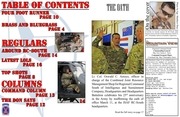
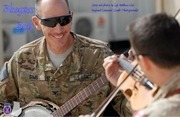
Canadian Air Force Capt. Paul Dacier, officer in charge
of priority air mission requests for RC-South, plays
bluegrass music at the RC-South headquarters, March 18,
2011, at Kandahar Airfield, in Kandahar, Afghanistan.
The
Mountain
View
magazine
4
Top Shots
Page 8
Columns
Command Column
Page 13
The Don says
Page 12
2
On the cover
Four foot runner
Page 10
THE OATH
Photo by Sgt. Matthew Diaz
Table Of Contents
14
Regional Command South
Commanding General
Maj. Gen. James L. Terry
Command Sergeant Major
Command Sgt. Maj. Christopher Greca
Lt. Col. Oswald C. Arroyo, officer in
charge of the Combined Joint Resource
Management Shop for Regional Command
South of Intelligence and Sustainment
Company, Headquarters and Headquarters
Battalion celebrates his 25th anniversary
in the Army by reaffirming the oath of
office March 11, at the ISAF RC-South
headquarters.
Read the full story on page 17
The Mountain View is an authorized
publication for members of coalition
forces. Contents of The Mountain View
are not necessarily official views of,
or endorsed by, coalition governments.
All editorial content of The Mountain
View is prepared, edited, provided and
approved by the Regional Command South
Public Affairs Office.
Editorial Staff
RC-South PAO Lt. Col. Web Wright
RC-South PAO NCOIC
Master Sgt. Tami Hillis
Command Information OIC
Ensign Haraz N. Ghanbari
Managing Editor Sgt. Matthew Diaz
Media queries please contact RC-South
Public Affairs at 10thmtnpao@gmail.com
Contributing Units
TF Destiny
TF Kandahar
TF Lightning
TF Raider
TF Strike
TF Thunder
CT Uruzgan
CT Zabul
NTM-A
16th MPAD
�
Bluegrass
Buds
4
Story and photos by Sgt. Matthew Diaz
Regional Command (South) Photojournalist
�
Afghanistan: combat, progress, bluegrass?
deployment so they could continue to play music together.
Two ISAF Regional Command (South) officers bring They both made good on this arrangement and now regularly
a little twang to Southwest Asia.
enjoy each other’s company and musical style once a week.
U.S. Army Col. John Sims, chief of information
Dacier is no one-trick pony, he plays fiddle, piano
effects for RC-South, and Canadian Air Force Capt. Paul and guitar. He also runs his own business teaching people to
Dacier, officer in charge of priority air mission requests for play the fiddle or piano. He’s been playing instruments since
RC-South, get together every Friday morning to play a little he was 10 years old.
bluegrass.
“I started with the piano at 10, then one night my dad
With Sims on the banjo and Dacier scratching the was practicing the fiddle, and I wanted to learn to play,” said
fiddle, the pair tries to brighten the day of passers-by. They Dacier. “I picked up the fiddle and learned the song on the
set up in an open area usually
spot; I was 17 years old then.”
utilized for ceremonies
Sims too comes from
in front of the RC-South
a musical family, noting that
headquarters and play for
everyone in his family plays
an hour for anyone that will
some sort of instrument. He
listen. Some folks stop and
attributes his start with the
listen for a while, others
banjo to being a bored youth.
pass by with no interest, but
“I stared playing when
a few get comfortable and
-Canadian Air Force Capt. Paul Dacier, officer I was about 14,” recalled Sims.
start their Friday with a little
in charge of priority air mission requests for “I was hanging out at a gas
musical enjoyment.
station with nothing to do and
RC-South
This unlikely pair
a guy on a motorcycle rolled
met at Fort Drum before
up with a banjo on his back, I
their current deployment during an exercise to prepare their asked what it was, he said it was a banjo and I decided I
units for Afghanistan. The visiting Canadians held a barbecue wanted to learn it.”
at the end of the exercise and invited the Americans to join
Sims said he wanted to be a musician for the Army,
them. Some of Dacier’s colleagues asked him to bring his but he decided to swing it in another direction.
fiddle along to provide a little entertainment. When he
“I joined the Army to play the banjo in the Army
arrived he found out that an American brought a banjo with band - that was in 1980. That didn’t quite work out the way
him. They jammed together that night. That is how the pair I wanted it to,” said Sims. “I became a field artilleryman, but
of Sims and Dacier came to be.
if you love music, you don’t just leave it, and it goes with
When Sims and Dacier parted ways, they made you.”
an agreement to bring their instruments with them on the
When playing together, the pair mostly goes off the
“I picked up the fiddle and
learned the song on the
spot.”
6
cuff, playing whatever song comes to mind. Their selection
may range from favorites like “Do Your Ears Hang Low”
and “Pachelbel’s Canon” to gospel classics like “Amazing
Grace.”
Dacier said when you know a lot of well known
songs it’s easier to just sit and jam with someone as opposed
to composing your own tunes.
The duo’s informal approach to bluegrass works well
for them. The performances are generally well received by
passers-by and those who take the time to stop and enjoy the
music.
Playing for their fellow Soldiers does more
than allow them to have a little fun once a week.
It sets a good tone for the day and could have an
effect on someone who just walks by and gets a cheerful
tune stuck in their head.
“This is a very important mission that we’re here
doing, and we’re pretty serious about it, but you have to
sharpen your axe,” said Sims. “We only do it an hour once a
week, but it’s just long enough to get in there and hopefully
bring a bit of peace and stability to Afghanistan.”
The musicians get something personal out of the
weekly jam sessions as well.
“When I play music I think about nothing else,”
said Dacier. “I just play the song the best I can so all my
focus goes into the song and I just forget about the war and
conflict.”
Being from a family of musicians, Sims isn’t content
to let music fade from his life
“Music was always something that held my family
together, and just like that I think I passed that on to my kids
so my kids are musicians or they sing, they dance and my
wife Theresa is our favorite fan,” Sims said.
While playing music helps clear Dacier’s mind, Sims
said it’s good plain fun.
“It’s my favorite day of the week,” remarked Sims.
�
S
T
O
H
P
S
O
T
8
“TOP SHOTS” ENTRIES ARE OPEN TO ALL READERS.
ALL “TOP SHOTS” SUBMISSIONS MUST BE IN BY THE FRIDAY BEFORE PUBLICATION DATE. SEND SUBMISSIONS TO 10THMTNPAO@GMAIL.COM
�
10th Mountain’s shortest officer
takes part in KAF’s biggest runs
Story and photo by Sgt. Matthew Diaz
Regional Command (South) photojournalist
Vo is widely accepted as the fastest person in her
battalion, with many others struggling to keep pace with her
in a race. Her name has become synonymous with speed and
Soldiers aspire to keep up with her. To date she has not been
able to find someone to match her pace. This means she has
to motivate herself to work harder and become faster.
The short statured runner said most of the time it is
just her running against her watch. This does not hinder her
training though; her motivation is such that she is always
pushing herself regardless of the competition, or lack
thereof.
“She gets up pretty early, I don’t know the exact time
but I know I sleep for several more hours after she gets up,”
said Vo’s roommate, Towanda, Pa. native, Capt. Megan Cain
of Headquarters Support Company, HHBN, 10th Mountain
Division (LI). “I call her crazy number one as a result of her
running. There are definitely a lot of comments about her
short legs and how she can run so fast. I know it’s because
she trains. We were making fun of her one day because she
was very muddy after a race; she said she was so close to the
ground, she couldn’t help it.”
Any runner needs to train and Vo is no different.
She spends hours on the treadmill daily just to keep in
The Vietnam-born, Fort Smith, shape. When a big race comes up she begins to increase her
Ark., native has been running in workouts in a manner that will avoid injury.
Vo said ideally she would get to train a few months
races since 2006. Since her arrival to prior to a big race. On KAF, runs are often announced with
Kandahar Airfield, Afghanistan, she has very short notice but she makes do.
While she may be the fastest around, Vo is not alone
participated in more than 15 races and on her runs. Her roommates participate and support her in
has come in first or second place every the races.
Cain said when she and her roommates participate in
time.
a race with Vo, that Vo would finish so fast she has time to
“I started running when I went to Fort go home, grab the other’s jackets and be waiting for them at
Lewis,” said Vo. “I always loved running but the finish line.
Currently, running is just a hobby for Vo. She said
didn’t run that much before. There was a captain she would like to improve, but said she doesn’t see herself
there who asked me to join the (Army) 10-miler running professionally.
“There are certain people around here who will say,
team and that’s how I got started.”
Vo is easy to pick out in a crowded field ‘I kept up with Captain Vo for a whole quarter of a mile!’ I
of runners as she is usually the shortest person like to tell her that when I hear it,” said Cain.
Just as important to preparing for a run, is the
competing. She said her short height does not leave mindset during and after the race. If a runner starts to doubt
her at a disadvantage on the track.
themselves in the middle of a marathon it will affect them
“I do get comments about being short a lot, but I just for the rest of the race. Vo’s first thought after finishing a
run,” she said with a laugh.
long race? “I’m hungry!”
Running. To some it is an
exercise of torture. To others it
is a way of life. More than just
a way to get from point A to
B, running can provide a stress
outlet for deployed Soldiers.
For Capt. Loan Vo, engineer
projects manager for RC-South with
Operations Company, Headquarters
and Headquarters Battalion, running
is part of her daily life.
10
�
K
N
I
R
D
Staying hydrated in this arid environment is a mainstay for a Soldier’s health, survival
and ability to stay in the fight. The temperature is changing as I’m sure everyone has realized.
It is going to get hotter still. It is important for everyone to acknowledge their own limits.
The recommended daily intake of water is about six - eight full glasses of water per day. In
Kandahar, it is my feeling that up to eight - 10 bottles of water should be consumed daily
per person. That rate should be increased with strenuous activities or missions, i.e. going to
the gym or sitting in MRAPS. It is also important to recognize the signs and symptoms of
dehydration not only for yourself but also for your battle. Some signs and symptoms are pale,
flushed, lack of perfusion (sweating), lightheaded or dizziness. It is important to take the proper
measures to combat dehydration. Moving yourself or your battle to a shaded area, drinking
water, loosen clothing, and contacting medical assistance are primary measures for treating a
heat casualty. So make sure you are drinking water 10th MTN! Climb to Glory!
Cultural
Considerations:
Afghanistan films and theater shows had
many viewers in the past, but during the three
decades of war and conflict, Afghanistan
Films/movies have received the most damage
and almost lost its value among Afghan
People. The biggest damage to Afghanistan
movies was during the period of Taliban rule
when they shut down the cinemas, burned
and destroyed the movies and banned all
entertainment in Afghanistan. After the
collapse of Taliban government there was
a reopening of cinemas and re-broadcasting
of television. Due to lack of Afghan movies,
people turned to foreign movies but especially
to Indian movies.
12
Soldier In The Spotlight
Name: Spc. Russel W. Akers
Unit: 552nd MP, Co., 504th MP BN
MOS: Combat Medic
Hometown: Hamlet, N.C.
Quote: “As the Platoon Medic
it is my job to place the needs
of the platoon ahead of myself.”
Spc. Russel W. Akers distinguished himself as the platoon medic
on 27 February 2011 while conducting a dismounted patrol with
his platoon in district 7. While moving back to their dismount point
after completing their sweep of the area Akers’ squad was hit by a
command detonated IED. The blast blew Akers 10 feet up in the air
onto his back. Within seconds Akers went into action disregarding
the safety of his own life knowing there could be secondary
IED’s in the area. Akers jumped into a ditch to retrieve the body
of his fellow comrade and pulled him out. Once he had him out
he determined that he was KIA and he immediately moved on to
another comrade who was wounded in the middle of the road. Akers
assessed his wounds and prepared him for immediate MEDEVAC.
It was not until six hours later once he knew his comrades were safe
that he checked himself into Role 3 with issues breathing.
Recognition
How do you say “thank-you” and recognize
heroes who risk their lives every day in support of you
and their team? I often think about this as I’m circulating
the battlefield and wonder if I am doing enough.
I say thank-you, attempt to smile and laugh,
present a medal or Coins of Excellence when asked, and
just try to listen to their concerns. They love to tell their
stories and I love to listen – where they are from, about
their families, and typically what made them join the
Army. I tell them how proud I am of all of them, how
proud their families must be of them back home in the
States, and how they are making history.
I try to make them feel important and know that
this leadership team cares, about them and their families.
They are all important, heroes, and we could not do this
without them and I am humbled to be part of their team!
Climb to Glory!
Command Sgt. Maj. Christopher Greca
Mountain 7
What is Your Story?
CH (LTC) Kelly Moore
What’s your story? Everyone has one.
It is always fascinating to me when I hear how
people got to where they are today. Some
people had difficult childhoods and had to go
through some rather hard times. Some people
had relatively “normal” lives and things
perhaps stayed normal, or perhaps some event
occurred that changed their course. Some may
have started out normal, but because of some
event life became hard. In every story there
is the intrigue of people and events weaving
together to create a unique personal story.
There’s an old saying that, the events
of life will either make us bitter, or better.
When I hear of what some people have had to
experience I find myself very grateful to have
had a somewhat normal and stable life. But it
is always inspiring to me when I hear of the
hardships, yet the person telling their story
is upbeat and has a bright view of the future.
Obviously, they used those difficult events to
become a better person, not a bitter person.
I am also reminded of an e-mail I
recently received from my daughter, who is a
college student at the University of Oklahoma.
She was on spring break and she had planned
to simply rest and do some things she wanted
to do. She wrote me, “God had other plans.”
And went on to describe how events she had
not anticipated “changed” her week. She was
not bitter, but actually better, because she had
the realization that, “Man plans his ways, but
the LORD directs his steps.” (Proverbs 16:9).
She was not bitter about her change of plans,
she was better. She also understands Jeremiah
29:11, “For I know the plans I have for you,”
declares the LORD, “plans to prosper you and
not to harm you, plans to give you hope and a
future.”
I’ll ask again, “What’s your story?”
More importantly, has it made you
bitter or better?
CORNER
COMMAND COLUMN
Spc. Don W. Ellen
The Don Says ... WATER
CHAPLAIN’S
�
Female aviators defy reported odds
Story and Photos by Sgt. 1st Class Stephanie L. Carl
Task Force Thunder Public Affairs
KANDAHAR AIRFIELD, Afghanistan -- When Chief
Warrant Officer 4 Trudy Truax arrived at her first unit as an
OH-58A pilot in 1996, her commander refused her orders.
“I’ve had my own battalion commanders not speak
to me,” Truax said.
Truax was one of the first females to join the
community of Cobra, Apache and Kiowa pilots after
then-President Bill Clinton lifted the restrictions that
kept women from flying the traditionally combat-focused
rotary-wing birds. She was one of only six women in her
class – three from West Point and three warrant officers.
Today, she’s the only one of the six still serving in the
Army, and she serves as the standardization instructor
pilot for Company C (Dustoff), 1st Battalion, 52nd Aviation
Regiment, which is currently deployed to Afghanistan with
Task Force Thunder, the 159th Combat Aviation Brigade.
According to a study released earlier this month
by the Military Leadership Diversity Commission, women
account for only 16 percent of leadership positions in
the military – a seemingly staggering statistic to release
during National Women’s History Month. But not so
much so when compared to the overall statistic of women
serving in the military, which is 16.4 percent, according
to a September 30 report released by the Department of
Defense.
To Truax and the other women who fill key
positions within the aviation community, the numbers are
just that – numbers. And they don’t take into account the
positions that women are holding within the military or
where they were 20 years ago.
Lt. Col. Neil Reilly, the squadron commander for
th
7 Squadron, 17th Cavalry Regiment, was assigned to 2nd
Sqdn., 17th Cav. Rgt., in 1998. With him was then-Warrant
Officer Anne Wiley, who had recently graduated as an
OH-58 Kiowa pilot. Today, Wiley is a Chief warrant officer
4 and serves as the senior standardization instructor pilot
for Reilly’s unit. She is the first female to hold that position
at a squadron level. But she didn’t get there overnight.
“I went through relentless hazing,” Wiley said of her time
as a new pilot and a female in a man’s world. “But today,
when one of my peers comes up and bumps
me on the shoulder and asks how it’s going, I
know it was worth it, and that I’ve made it.”
The challenges Wiley and her counterparts
faced in the beginning paved the way for
many who’ve come since.
“Flying has been my recurring dream since
14
I was little,” said Capt. Carmel Cammack, an assistant
operations officer in Task Force Palehorse and an OH58D Kiowa Warrior pilot. “I’ve never been treated any
differently, and I appreciate the fact that (other women)
were the ones to pioneer this for me. I know that they went
through a lot of hazing and a rash of other stuff that I have
not had to go through.”
For Reilly, it’s never been about gender, and Wiley
and the female pilots like her have proven that time and
again.
“Miss Wiley maintains a mission focus, but has the
personality, the charisma, and also has the professionalism
and experience that afford her a great deal of credibility,”
Reilly said.
For the women filling the leadership roles, the
professionalism and experience are the important parts.
“As you show your competence and as you show
that you can hang with the boys, you show that you’re
as good as the boys, your acceptance is there,” Truax
explained. “You must always maintain – as with any aviator
– proficiency and excellence, and if you can show that’s
what you have, then you’re fully accepted.”
While Truax and Wiley have been around long
enough to know what it’s like to be evaluated on gender
rather than competency, they’ve witnessed the shift
throughout their careers, and the younger women coming
From left to right: Capt. Carmel Cammack, Capt. Donna
J. Buono, Chief Warrant Officer 4 Anne Wiley, and Chief
Warrant Officer 2 Elizabeth Kimbrough, assigned to Task
Force Palehorse, pose for a group photo outside the task
force’s operation center at Kandahar Airfield.
up behind them have only experienced evaluations based
on capabilities.
Capt. Donna J. Buono, the company commander for
Company B, 3rd Battalion, 101st Aviation Regiment, which
is task-organized under Reilly’s unit for the deployment,
was commissioned in 2004 and joined her first unit as a
platoon leader while the company was deployed to Iraq.
She was the first female to serve with the company in more
than 15 years.
She said she was expecting the fact the she is a
female to cause some push-back, but she got more flak for
being a new platoon leader.
“It’s more about being a good leader and being
competent, and much less these days about male-female,”
she explained.
In fact, the main challenges that limit the number
of females serving in leadership positions are often
brought on by their own accord rather than by restrictions
or gender bias within the Army.
Chief Warrant Officer 2 Elizabeth Kimbrough
is a pilot in command and safety officer with Co. B, 3rd
Bn., 101st Avn. Rgt. She flies the AH-64D Apache, which
often serves to intimidate on the battlefield. At nearly 32,
Kimbrough said she loves what she does, but thinks her
family is afraid she’ll stay in forever.
“My time will be up after June of next year, and
I’m still on the fence,” she said. “I love, love my job, but
I’d still like the opportunity to get married and have kids,
and I don’t know how I’d do it if I’d stay in. So that’s
something I think about nearly every single day.”
Kimbrough isn’t the only one facing that
challenging decision.
“I have kind of fended off most relationships that
have possibly started,” said Cammack. “I personally think
it would be extremely hard to have a family in the military.
Right now I have the opportunity to say that I don’t want
kids in the military – I think that would be hard, and that is
not something that I want to do, how that’s going to play
into future career, I don’t know. I don’t know. It’s tough.”
As pioneers for women in aviation, both Wiley and
Truax stand as an example in this regard too. Wiley started
her aviation career as a single mom. Truax has a different
perspective.
“Women can be in the Army, and we can have
20-plus year careers and we can have 20-plus years
married to the same man, and like I have – I have four
children,” she said. “I want it all. I want the cake and the
ice cream. You can have a solid marriage. You can have
children and still do your time in combat.”
As with anything in life, it’s about balance and
maintaining that delicate harmony between professional
and personal. But for those women who want to fill the
leadership roles, the doors are far from closed.
“I never expected to be where I am today, and I
never expected to be in the positions I’ve been in,” Truax
said. “Standarizations wasn’t a place women went. I
think the new men of the Army - new commanders - they
understand, and if I didn’t cut the mustard I wouldn’t be
in the positions I’ve been in. But they very much have
unlocked the doors to allow us to show that we have the
ability to do what we (Army aviators) do.
“I had to open the doors by proving myself, but they
unlocked them for me.”
Chief Warrant 4 Anne Wiley (left), the senior standardizations
instructor pilot for 7th Squadron, 17th Cavalry Regiment, and
Capt. Carmel Cammack, an assistant operations officer for the
unit, both OH-58D Kiowa pilots, conduct pre-flight inspections
on their aircraft at Kandahar Airfield, Afghanistan.
�
THIS JUST IN!
10th Mountain Division officer marks 25 years of service
FROM THE INTERNET
Soldier’s Board
Heat cramps
Heat exhaustion
Heat stroke
12
16
U T OU
O
T
H
S
S!
Name three categories
of heat injuries
Story and Photo by Sgt. Matthew Diaz
Regional Command South Photojournalist
Here is your chance to say hi to
your friends and family. Contact
the RC-South Public Affairs
Office to put in your shout out
request at
10thmtnpao@gmail.com
Twenty-five years ago the Internet was in its
infancy, the world was mourning the loss of the Challenger
shuttle crew and Eddie Murphy was singing about his girl
who liked to party all the time.
Twenty-five years ago, a 10th Mountain Division
(LI) officer was enlisting in the Army.
Lt. Col. Oswald C. Arroyo, officer in charge of the
Combined Joint Resource Management Shop for Regional
Command South of Intelligence and Sustainment Company,
Headquarters and Headquarters Battalion celebrated his 25th
anniversary in the Army by reaffirming the oath of office
March 11, at the ISAF RC-South headquarters.
The Philippines native joined the Army after his
parents immigrated to America and discovered he could
join the service without being an American citizen.
“I went with them for a few months and then went
back to the Philippines to finish my schooling,” Arroyo
said. “I heard you can join the Army as an immigrant – we
always thought you had to be a citizen – in the Philippines,
being in the service is a big deal.”
With $85, a pair of jeans, running shoes and a
hygiene kit, Arroyo enlisted in the Army on March 11,
1986, as a private first class.
“Not only is Lieutenant Colonel Arroyo a highly
valued member of the 10th Mountain staff, 25 years
of service is a true American success story,” said Maj.
Gen. James L. Terry, Regional Command South and 10th
Mountain Division (LI) commander. “Ozzie is a son of the
Philippines who enlisted in the U.S. Army with the support
of his young family who reunited with him in the United
States after he completed training and was assigned to his
first duty station.”
Saying goodbye to his family, he shipped off to
basic training at Fort Knox, Ky. He went to advanced
individual training at Fort Benjamin Harrison, Ind., to
become an accounting specialist.
“When I became a citizen in 1990, I applied
to (Officer Candidates School), but to go to OCS you
needed to have college credits, I had my schooling in the
Philippines so I had to find a way to transfer my credits,”
recalled Arroyo.
Twenty-five years of service is no small feat, but
Arroyo said he is proud of his service.
“I’ve always wanted to be a Soldier so I just kept
continuing on. If the Army didn’t want me they would have
told me to pack my bags and leave,” he said. “Being in the
Army is a lot like being a marketing major, you have to sell
the Army to your Family.”
At the end of the day, Arroyo doesn’t serve for the
money, he serves for his Family.
“The Army doesn’t make you rich, but at the same
time it makes life comfortable for you. The Family being
supported enough helps; there are a lot of good benefits that
come with it,” said the seasoned finance officer.
Lt. Col. Oswald C. Arroyo, officer in charge of the Combined Joint
Resource Management Shop for Regional Command South smiles as
Maj. Gen. James L. Terry, Regional Command South and 10th Mountain
Division (LI) commander makes remarks about the officer before he
reaffirms his oath of office.
Become a friend and check in often for the latest news, pictures and video from RC-South.
FACEBOOK
www.facebook.com/ISAF.RCSouth
TUMBLR
The Mountain View Magazine wants your input!
www.ISAF-RCSouth.Tumblr.com
We are looking for cartoonists, columnists,
TWITTER
sports fanatics and many more to contribute.
www.twitter.com/ISAF_RCSouth
If interested, contact the RC-South Public AfYOUTUBE
fairs Office at 10thmtnpao@gmail.com.
www.youtube.com/user/ISAFRCSouth
DVIDS
www.dvidshub.net/units/RC-S
RC-South Social Media Director: MC1 Thomas Coffman
�
 Historical archive . public document