Issue 2
Dub8
The latest local news within Dublin 8
Aware Tackle
Depression
Rising numbers seeking help
Persian New Year
Shining a light on the
Romanian community
Local Initiatives • Religion • Culture • Community • Health • Local Business
�
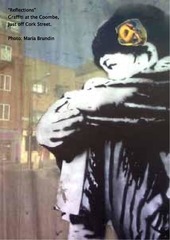
“Reflections”
Graffiti at the Coombe,
just off Cork Street.
Photo: Maria Brundin
�
Dub 8
March 2011
Dub8
Issue 2
Contents
New Inchicore Housing Project 4
D8CEC Education centre 5
Living With Violence 6
Persian New Year 7
Dublin 8’s Romanian Community 8
Aware Continue Support Services 10
The Lesse Known League St. Patrick’s Athletic
11
Dublinia’s Viking Dublinia 12
The Artwork of Francis St. 13
St. James’ HIV treatment 14
Phoenix Park 15
Editors
Jonathan Keane
Stephen Ramsey
Contributors
Richard Bohan
Grainne Byrne
David Goulden
Matthew Jaffray
Donia Jenabzadeh
Jonathan Keane
Daryl McGarrigle
Ciara Mooney
Ornella Pastushok
Stephen Ramsey
Karla Stein
Sub Editors
Richard Bohan
David Goulden
Matthew Jaffray
Daryl McGarrigle
Ciara Mooney
Layout & Design
David Goulden
Matthew Jaffray
Donia Jenabzadeh
Jonathan Keane
Cover Image
Maria Brundin
Photographers
Kieran Broderick
Maria Brundin
Jonathan Keane
Stephen Ramsey
Karla Stein
Photo Editor
Ornella Pastushok
Dub8mag@gmail.com
Dub8 is produced by
journalism students in the Journalism & Media Faculty of Griffith
College Dublin, SCR, Dublin 8.
Tel: 01 4150400
The opinions and views in the
publication are those of the contributors and are not necessarily
shared by Griffith College Dublin
3
�
Dub 8
March 2011
Inchicore in new
housing initiative
by Matthew Jaffray
I
nchicore at centre of new housing scheme
A new housing project spearheaded by Habitat for Humanity
is under way in Emmet road, Inchichore, which aims to renovate
derelict residential buildings with
help from local volunteers.
The scheme, which is being carried out in conjunction with Dublin City Council, is scheduled to
begin by the middle of next month
and aims to give low income families from the Dublin City Council
housing list an opportunity to purchase their own home. The only
cost Habitat asks are a small low interest mortgage and for the future
inhabitants to invest ‘sweat equity’
volunteer hours into the project.
Spokeswoman for Habitat Jannie
McCann said that professionals
are currently on the site drawing
up estimates and that the board of
Habitat Ireland are currently “in
4
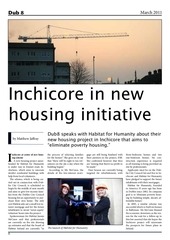
Dub8 speaks with Habitat for Humanity about their
new housing project in Inchicore that aims to
“eliminate poverty housing.”
the process of selecting families
for the houses.” She goes on to say
that “there will be eight to ten volunteers on the site a day when the
building begins.”
According to Ms McCann, the
details of the low-interest mort-
gage are still being finalised with
their partners in the project, ESB.
She confirmed however that they
are “aiming that there’s no profit to
be made.”
Four houses are currently being
targeted for refurbishment, with
The launch of Habitat for Humanity
three-bedroom homes and two
one-bedroom homes. No construction experience is required
as all training is being provided on
site by professionals.
Applicants must be on the Dublin City Council list and live in Inchicore and Habitat for Humanity
have pledged to support the future
inhabitants with their mortgages.
Habitat for Humanity, founded
in America 35 years ago has been
in Dublin since 2002. Its company
goal is to ‘eliminate poverty housing by building simple, decent, affordable homes’.
In 2005, a similar scheme was
successful which re-built six houses
in Ballymun. Ms McCann blamed
the economic downturn as the reason for the wait for a follow-up to
this but asserted that she hopes the
Inchicore project will rejuvenate
the prospects for future plans in
Ireland.
�
Dub 8
March 2011
D8CEC continue their
work on Thomas St
With the economy still in a woeful
state many people are continuing
looking to upskill. The Dublin
8 Community Education Centre
on Thomas Street provides such
a service. D8CEC Director Marie
Mulvihil spoke with Dub 8.
by Ciara Mooney
T
he D8CEC (Dublin 8 Community Education Centre)
was established in 1996.
Since then it has provided over 300
adults a year with a second chance
at education.
According to the 2006 census,
30% of the population in the South
West Inner City has lower second
level education at most. 21% of this
statistic has no formal educational
qualifications at all. “All of our students are from the Dublin 8 communities, our goal is to provide
young adults with second level education and to get people out and
working,” said Marie Mulvihill, Director of the D8CEC.
There is huge demand for basic
qualifications in the Dublin 8 community and the D8CEC provides a
range of FETAC accredited courses
to meet these needs. FETAC courses available include, FETAC level 3
Maths, FETAC level 4 Computer
Applications, FETAC level 3 Communications and FETAC level 5
Personal and Interpersonal Skills.
“Our computer courses would
be the most popular, particularly
amongst unemployed students. It
gives them a better chance at finding work and even just for learning
how to master the internet for personal use,” Marie continued.
The D8CEC also provides or-
dinary level Leaving Certificate
courses in Maths and English, for
those seeking work in a field where
a Leaving Certificate qualification
is required.
age 300 students per year.
According to this report, students
in the D8CEC come from local
community employment schemes
and from the wider community.
“This term we have students
ranging from all ages. The
youngest being nineteen and the
oldest celebrated her 80th
birthday last week.”
The centre moved to Thomas
Street last summer, it currently accommodates lifelong learning for
over 450 adults from the Dublin 8
area. The building that the centre is
located in was originally one of the
first public libraries built in Dublin.
According to the D8CEC annual
report 2009/2010, it was as eventful
year for them due to the downturn
in the economy. This downturn is
all too evident in the Dublin 8 community. The demand for courses
has increased since then, as the
necessity of gaining qualifications’
has become all the more prominent. It was during this year that
the D8CEC’s student numbers rose
to 450 in comparison to their aver-
Last year, the ages ranged from
19 to mid-70s, with a ratio of 53%
women and 46% men. “This term
we have students ranging from all
ages.
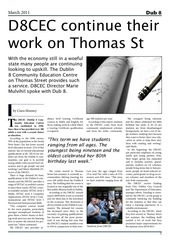
Students from D8CEC
The youngest being nineteen
and the oldest celebrated her 80th
birthday last week. A lot of our
students are from disadvantaged
backgrounds, we have a lot of single mothers studying here because
they want to better their own education in order to help their children with reading and writing,”
said Marie.
In the beginning the D8CEC
put particular emphasis on young
adults and young parents. Now,
their target group has expanded
and it includes parents, grandparents, workers on CE schemes,
people living alone due to bereavement, people on fixed reduced incomes, participants in drug recovery schemes and members of the
new Irish community.
The D8CEC receive funding
from FAS, Dublin City Council
and The Department of Education,
amongst others. Funding is essential for the D8CEC, as the group is
constantly bettering the building
for the students so that they can
enjoy a learning experience in a
suitable environment.
According to the D8CEC, when
they first moved to Thomas Street
last summer, the building itself
needed a lot of work but they
promised major improvements for
the autumn term 2010/2011.
5
�
Dub 8
March 2011
LIVING WITH
VIOLENCE
The city can be a dangerous place at night time, Dub8 investigates
Clanbrassil Street’s darker side
by Ornella Pastushok
L
ars Schweinsberg, (40) a Community Support Worker from
Dublin 8 is frequently experiencing violence from kids aged 7-10
who shot at him and other cyclists
using pellet guns.
The majority of hooligans hang
around on a very small side road
on Clanbrassil Street and New
Street South late in the evening.
“I went up Clanbrassil Terrace,
five or six of those boys were first
shouting at me, then shooting with
a pellet gun at me. It happened a
few times when I go home at 9pm
Friday night or Saturday night,”
said Lars.
“Never mind that, but one incident really made me go mad. Friday night, I went home from work
on at 9:30pm.
I saw a wheelchair user being surrounded by five boys in front of the
Chicken Hut takeaway on Clanbrassil Street. I heard them shouting abuse at him, three of them trying to push over his chair.”
The boys are aged between
seven and ten and they all live in
the same area, according to some
neighbours.
Luckily enough Lars was there at
the time of the violent behaviour to
help the “poor chap”.
He approached one of the boys
who seemed to be the oldest and
6
“I saw a
wheelchair user
being
surrounded by
five boys”
told him they are “cowards attacking a wheelchair user.”
The witness took out his mobile
phone, claiming to call the police.
In the meantime, the male wheelchair user, in his mid 50s, managed
to get away.
As Lars works with people who
have disabilities, they always complain of being verbally abused by
some people. Gerry,
One of the Lars clients, who is
also a wheelchair user, explains that
he never was the subject of physical abuse, however, he was verbally
abused a few times. Gerry said,
“It has stopped recently, maybe
it has something to do with more
Gardaí around.”
Meanwhile, according to the
Central Statistics Office (CSO)
in 2010 there were 3,632 people
reported assaults causing harm.
However, there are many ignored
and unreported.
Lars has tried to approach Gardaí
and complain about the incident,
however because there were no
witnesses or any kind of evidence,
there was nothing they could do
about it.
“Not that satisfying at the moment, but ever since I noticed more
Gardaí presence in the area.”
In order to prevent this kind of
behaviour towards people with
disabilities, Lars believes that they
should be hit by Anti-Social Behaviour Order (ASBOS), a civil act that
provides the Gardaí with a new
means of dealing with anti-social
behaviour.
According to Mr Schweinsberg,
their parents should be cautioned
about their actions, and children
should not be allowed to be out on
the street after a certain time. And
if they are, he believes their parents
should be charged with neglect.
younger generation is more
violent. It lacks of adequate idols.
Those culprits should be punished
harder,” said Mr. Schweinsberg.
�
Dub 8
March 2011
March date confirmed
for Nowruz celebration
Dublin 8’s Persian community set to celebrate the
New Year and the start of spring
by Donia Jenabzadeh
O
n Sunday the 20th of March,
people all over the world
will celebrate International
Nowruz Day, or the Persian New
year, to mark the first day of spring
and the start of the New Year in the
Persian calendar.
Last year on February 24th, the
United Nations General Assembly
recognized March 20th as the International Day of Nowruz, ‘a festival of Persian origin that marks the
beginning of a new year for more
than 300 million people’.
Nowruz, meaning a new day in
Farsi, is celebrated on the vernal
equinox. It is a non-religious festival that has been around for more
than 3,000 years.
Pedram Rad, 22, medical student
from the Dublin 8 area, explains,
“A
typical day would involve a
big family breakfast followed by
opening presents.
Then we would go to visit relatives
starting with the oldest. The night
would end with a family party.
Haftsin, or the seven Ss, is a traditional table setting of Nowruz.
There are a lot of powerful symbols
on the New Year table.It involves
seven items that start on the letter
S in Persian such as the following:
1) Sabzeh: wheat, barley or lentil,
symbolising rebirth
2) Samanu: a sweet pudding
made from wheat germ, symbolis-
“It is a day of
joy for people
all around the
world”
A Nowruz tableset - courtesy of Fatemah
courtesy of San Jose Library
ing affluence
3) Senjed: dried fruit of the oleaster tree – love
4) Sir: garlic – medicine
5) Sib: apples – beauty and health
6) Somaq: sumac berries – the
colour of sunrise
7) Serkeh: vinegar, which symbolises age and patience.
Nowruz is not only celebrated by
Persians but also by people from
the Balkans, the Black Sea Basin,
the Caucuses, Central Asia and the
Middle East. It marks the beginning of a new year and also the start
of spring.
“It is a day of joy for people all
around the world. The best thing
about Nowruz is that you get to see
all relatives that you haven’t seen in
a very long time.
For me, it is a day that we let go
of absolutely everything and just
enjoy the company of our loved
ones,” said Sepideh Shams, 28, from
Dublin.
“Of course it marks the beginning
of a new year so you could say it
marks a new chapter for me,” said
Pedram.
7
�
Dub 8
March 2011
FROM PLESCOI TO
PORTOBELLO
All across the city there are various ethnic communities, Dub 8 looks
at the local Romanian community
by Richard Bohan
R
omania is one of the newest
members of the European
Union and previously one of
the poorest. Despite the country’s
growing tourism industry, promoting the old Transylvanian castles
and thousands of westerners flocking to the beaches of the Black Sea,
many Romanian people live on less
than €40,000 per year.
Background
The EU didn’t feel that Romania
was ready to join in 2004 when
other countries, formerly under
the Iron Curtain, were granted
membership. Romania had to meet
8
certain conditions in order to petition for membership of the European Union, which they finally met
by 2007.
Romanians In Portobello
There are small Romanian communities dotted around Dublin
City, the largest being in the Dorset
Street area. Other areas made home
by Romanians living in Dublin include Firhouse, Donnybrook, Portobello and Lower Drumcondra.
The Portobello community is
close knit and everyone seems to
know everyone else. Many of these
Romanians work in moderate to
low paying jobs, such as secretarial
work, call centres, newsagents and
chip shops, despite the fact that
many of them are college graduates.
“I am still
not given the
chance to work
in a job suited
to my skills.”
One Romanian woman currently
living off Harcourt Street is twenty-eight year old Alina Serban. “I
came to Ireland to look for better
life,” she says, “and although my life
is better in some ways, I am still
not given the chance to work in a
job suited to my skills. I am just a
member of a PR firm but I have a
Masters from Bucharest University
of Economics.”
Alina grew up in the small town
of Plescoi, near Buzau (approximately 100km north-east of Bucharest). “Life is simple in Plescoi,”
she says, “goats and their farmers
walking up the town are very common. There are many goats in rural
Romanian villages.”
Alina attended the local primary, middle and high schools and
graduated with impressive results
�
Dub 8
March 2011
before moving to Bucharest to
study business management and
accounting
“I was always very good with
English and math,” she says. “In
Romania today, English is the best
way to have a good job because you
can live in Bucharest or Black Sea
cities and work in tourism and hotels. Of course, you can leave Romania and go to other countries,
like I did, but many Romanians
wish to stay in Romania because of
how many of us are treated outside
our home country.”
Alina is friendly with many other
Romanians living in Dublin. Her
fiancé lives in Lower Drumcondra
but came here from the central Romanian city of Brasov, one of Romania’s many historical cities.
“Brasov is very beautiful and very
big,” Alina explains, “maybe the
size of Galway or Cork. The old
town is like middle-ages and the
tourists love the old town but the
new city is very modern with many
glass buildings. Brasov is not what
the tourist expects to see when they
come to Romania.”
Miltown before coming here. I like
living beside Harcourt Street because it is close to city centre and I
have many friends here.”
Alina explains that the Romanians living in Dublin don’t only socialise with other Romanians, but
mix with lots of different groups
of foreign-nationals. “Many of my
friends here are from Middle East
and many are Russian and other
Eastern European peoples. I have
some Irish friends but more Russian than anyone else. I am here to
work and make Dublin my home,
not party like many do, so I do not
mix [with] the Romanians who
come to Ireland to party.”
Racism
Romanians living outside of Romania are very often subjected to
racism and prejudice, due to the
negative image of the RomaineGypsies. “The gypsy is not Romanian”, Alina explains. “They come
to Romania, Ukraine, Moldova and
Bulgaria from Pakistan and India
region many years ago and made
their home in our countries.”
“Eastern European people can
tell the difference between the
gypsy and a Romanian but the
Irish people cannot. They think
we are the same, which is not
true at all.”
Many Romanians currently living in Dublin know each other but
there are no set community gatherings or functions. “We just live our
lives like we would in Romania,”
says Alina. “Ireland is not so different and we just want to live and not
make a big deal about being outside of our home country because
Romania is like Ireland fifty years
ago, so it not so different for us.”
Romanian grocery stores can be
found throughout Dublin, many of
which bare the name Alimentara
and have the Romanian flag painted above the doors. Alina says that
only a few Romanians she knows
shop in these stores as many of
them just frequent the likes of
Tesco and Marks & Spencer’s.
Alina and her roommates lived
in various neighbourhoods around
Dublin before moving to the Harcourt Street area. “I lived before
in Drumcondra, Donnybrook and
She continues, “Most gypsies have
no Romanian blood. They marry
into other gypsy families. I think,
only 10% maybe have any Romanian blood. Romanians will not interact with the gypsy and the gypsy
will not interact with us. They are
their own people and many live in
their own villages away from us.”
Gypsies are subject to what many
see as unfair treatment in Romania, as well as here in Ireland.
Their reputations for thievery, telling untruths and con-artistry have
followed them from their original
home in the Indus River valley to
Eastern Europe and are well known
here in Dublin.
“The gypsy is very dark,” Alina
says. “Eastern European peoples
can tell the difference between the
gypsy and a Romanian but the Irish
people cannot. They think we are
the same, which is not true at all.”
The gypsies appear to have a
negative image here in Dublin,
due to begging in the city centre,
which they also do in Eastern Europe. “They cannot blame others
for how they are treated,” Alina
says.
“Maybe some of them are good
people, I am sure. But many, many
of them tell lies and they steal from
people and they are dangerous
people. Today in Romania we are
living with the gypsy better than
twenty years ago but they are still
not seen as Romanian people by us
because they do not wish to be. The
gypsy is very proud of their heritage and insists that they are not
Romanian, Ukrainian, Moldovan
or Bulgarian.”
In Romania today, gypsies are
not granted citizenship. They are
not allowed to have social security
cards or passports. “They are not
Romanian,” Alina says, “so they
do not have passport and come to
Ireland and France on fake visas.
France sends them back to Romania and Bulgaria but the governments don’t know what to do with
them. They will not leave Eastern
Europe.”
Bulgaria houses the majority of
gypsies in Eastern Europe but this
little fact is unknown to most Irish
people. “The Irish think all Romanians are the gypsy but most gypsies in Dublin are Bulgarian gypsies.
They do not speak Romanian or
have ever been in Romania. I do not
think it is fair that we are blamed
for the gypsy in Ireland when most
of them come here from Bulgaria
on a fake visa. But we can do nothing. We just want to live our lives
and make good homes for ourselves here in Dublin. I don’t think
this should be halted by ignorance
of Irish people thinking we are the
gypsy.”
9
�
Dub 8
March 2011
Aware
continue
support
services
by Jonathan Keane
D
epression is, and will always
remain, a very serious and
delicate mental health issue.
Not only that but there has shown to
be a rise in the number of sufferers
in Ireland in recent years. Aware,
who work under the principle:
“Helping to defeat depression”, have
been providing a support service to
sufferers since 1985. Its beginnings
are rooted in what were their first
support group meetings that took
place in St. Patrick’s University Hospital, James St.
Aware support groups are strictly confidential meetings where
anyone is welcome to discuss and
share their experiences with depression and avail of a unique support. There are also support group
meetings for relatives.
“The service has developed and
expanded over the years and in addition to the Aware support groups,
which continue to meet in St Patrick’s Hospital”, comments Aware
PRO Sandra Hogan, “there are also
groups meeting in eight other locations in Dublin and about 40 locations throughout the country.”
“Each support group would have
an average attendance of about 1015 people,” she continues.
Dues to logistical constraints or
various personal reasons some
people may be unable to attend
support group meetings. As a result, Aware also launched an online
support group service, recently.
10
Photo: Jonathan Keane
People availing of mental health support at St.
Patrick’s Hospital increases
In the last few years, with the
economic mire of the country ever
worsening, Aware and other organisations have seen a sharp rise
in the numbers of people suffering
from depression, and that is only
recorded cases. In Ireland there are
over 300,000 sufferers from depression.
“All of Aware’s services have been
busier in the past couple of years,
so the financial climate at this time
would appear to be having an impact on people’s mental health.” In
a recent study, the HSE declared
that people who have found themselves unemployed are more likely
to slip into depression.
This just doesn’t affect the number of people attending the groups
but could potentially affect how
the service is delivered. Aware is
a voluntary organisation and “relies on fundraising and donations
for more than 80% of its annual
budget.”
The woes of the country’s economy have meant that numbers availing of Aware’s service have risen;
the donations they rely on have
gone the opposite direction and
fallen. Regardless, this slip has not
dented the protocol of Aware.
“There has been a decrease in
the income received in the last 18
months or so, of about 12-14%.
This has not impacted on our
frontline services, nor will we allow
it to.”
As well as its support groups St.
Patrick’s Hospital and Aware run
monthly lectures on various mental illnesses in a bid to further educate people on and provide awareness. “The Aware monthly lecture
takes place in the Swift Lecture
Theatre, St Patrick’s Hospital on the
“There has been
a decrease in
the income
received in the
last 18 months
or so, of about
12-14%.
This has not
impacted on our
frontline
services, nor will
we allow it to.”
second Wednesday of each month”,
says Sandra.
“Lectures are free to attend and all
are welcome. They are of interest to
individuals and families affected by
depression, as well as anyone who
has an interest in mental health.”
Aware lectures have included
speakers from different fields of
both medicine and psychiatry
fields. February’s lecture was presented by Marie Sutton, a clinical
nurse from DETECT, an organisation specialising in awareness of
psychosis. Prior to that in January,
the lectures tackled the issue of eating disorders and featured speakers
from the organisation Body Whys.
For March’s lecture we are told
that well-known General Practitioner Dr. Harry Barry will present
his lecture ‘Depression and the
Plastic Brain – A Modern Perspective’. Dr. Barry is a renowned doctor and author with two books,
Flagging The Problem and Flagging The Therapy, as well as several
articles in The Irish Independent,
mostly focusing on mental illness,
care and prevention. More lectures
will continue in the Swift Lecture
Theatre in the coming months.
For more information on Aware’s
services, support groups and lectures, visit aware.ie or their lo-call
helpline:
St. Patrick’s Hospital: 01 249 3200
�
Dub 8
March 2011
The
Lesser
Known
League
by David Goulden
W
hile the majority of Irish
sports fans are drooling
over the last stages of The
Champions League and are eagerly
awaiting the summer months for
The GAA Championship, another,
largely ignored, sporting calendar
is about to begin. To most of this
‘sporting’ nation, the return of the
League Of Ireland season will go
largely unnoticed, only to excite a
few.
Most big League Of Ireland news
stories these days involve clubs’ financial problems and, in some cases, the death of these clubs. Only
recently, Sporting Fingal, a club
that entered the league in 2007,
came to its inevitable end. High
wages, low support and the demise
of their main sponsor and benefactor saw Fingal cease to just weeks
before the 2011 season was due to
start.
But some clubs in the league are
going about their business professionally and prudently. Clubs like
Sligo Rovers, St. Patrick’s Athletic
and Dundalk have all shown the
way in the past few seasons even
though, with the exception of Sligo,
they’ve come away trophy-less. But
if Cork City, Shelbourne, Bohemians and Drogheda United’s stories
have been anything to go by, being
prudent is being progressive.
St. Patrick’s Athletic play at Rich-
A familiar scene from Richmond Park
St Patrick’s Athletic prepare for the League of
Ireland with fans full of hope for the new season
mond Park, Inchicore, Dublin 8,
just a half hour walk from Griffith
College. The club was founded in
1929 and played their home games
at Phoenix Park in Dublin. A year
later they moved to their current
home in Dublin 8 and entered the
League Of Ireland in 1951 after
establishing themselves as the top
intermediate team in the country.
Although the club has been located in Inchicore for the majority
of its past, they have also played
at Milltown, (original ‘home’ of
Shamrock Rovers) Chapelizod,
Harold’s Cross Greyhound Stadium and the original home of Irish
football; Dalymount Park.
The club has won seven League
Of Ireland titles and two FAI Cup’s
since its inception. Their last League
Of Ireland title came in 1999 when
the club finished 3 points ahead of
Cork City. They won eleven other
trophies, the most recent being
their 2003 Eircom League Cup over
Longford Town.
The last few seasons won’t go
down in the history of the club as
the most memorable. Finishing last
season in fifth position, behind the
now defunct Sporting Fingal, saw
Pat’s fail to make it to the qualifying
rounds of the Europa League. But
due to Fingal’s withdrawal from the
league, Pat’s will enter the competition at the first qualifying round in
mid July 2011.
Although, for Pat’s it is the Europa League that gave them their
most memorable nights.
Last
season they went all the way to
the Play-off round of the Europa
League qualification process but
were knocked out by Romanian giants Steaua Bucharest. Along the
way Pat’s defeated Valletta FC of
Malta (2-1 on aggregate) and FC
Krylia of Russia (3-3 on aggregate,
won on away goals). Previous to
this Pat’s also had big wins in the
2008 season beating JFK Olimpus
Riga of Latvia(3-0 on agg.), Elfsborg of Sweden (4-3 on agg.) before being knocked out by Hertha
Berlin of Germany. Pats did manage a 0-0 draw at the RDS, one of
the best results in recent memory
for any Irish team in Europe.
This season sees team manager
The club has won seven League
Of Ireland titles and two FAI
Cup’s since its inception.
Pete Mahon and his squad attempt
to wrestle the Airtricity League
Premier Division title off local
rivals Shamrock Rovers. Mahon
has brought in a mix of experience and skill with signings like
Stephen Bradley from champions
Shamrock Rovers and David and
Evan McMillan from UCD. Daryl
Kavanagh also makes the move to
Inchicore from Waterford United
and is a proven goal scorer in the
Airtricity League First Division.
Mahon also took advantage of
the situation at Sporting Fingal,
signing exciting young midfielder
Shane McFaul from the former
Santry based side.
Some of the regulars from last
year’s squad have gone out the door
at Richmond Park. Players like last
year’s influential midfielder Stuart
Byrne, tricky winger Ryan Guy and
captain Damian Lynch have left
the club along with squad players
like winger Brian Cash and striker
Vinny Faherty, who was on trial
at a Turkish second division side.
Young attacking midfielder Dave
McAllister also left the club, signing for Npower Championship side
Sheffield United.
Pat’s first home game of the season is on Friday 11th April. You
can visit www.stpatsfc.com for
more info on the club and directions to the ground.
11
�
Dub 8
March 2011
Step Back
in Time to
Find Your
Viking Side
Dub 8 takes a tour of Viking
times at Dublinia at Christchurch
A Viking model at the Dublinia Viking Centre Photo: Karla Stein
by Karla Stein
T
ravel back to Medieval Dublin! From Strongbow to the
reformation, Dublinia recreates the sights, sounds and smells
of this busy city. Learn of warfare,
crime and punishment, death and
disease and even tooth ache remedies of 700 years ago. This Viking
centre has a lot to offer, especially
those with an interest in Irish history. It is located at the heart of the
city.
When I visited the centre, two
tour guides greeted me warmly
and were more than willing to
take me on an adventurous tour
of the renowned centre. According to Mary-Therese Byrne, the
company’s tourism and marketing
manager, the centre is “never quiet”. With various schools coming
from across the country every day
to see what life was like 1000 years
ago. Still, “weekends are definitely
our busiest with a huge influx of
tourists”.
The inside was laid out like a
maze. Every corner you turned
were offered you something different. It started by showing the visitor the beds in which the Vikings
slept, which were wooden and
carved delicately.
The walls of most of the houses in
Ireland were built using a double
12
skin of post and wattle with a filling of vegetation for insulation. It
was interesting to see this up close,
I felt as though I was taking a step
back in time.
When Vikings raided a settlement they not only took away as
much treasure as they could lay
their hands on, they also took away
people. There is a wax model of
a Viking holding a little girl by a
chain around her neck, for slavery.
It is quite surreal and fascinating to
think that actually happened.
I noticed while experiencing this
famous centre, I was the only Irish
person touring at that particular
time. Many of the groups passing
through were European, which I
felt showed an ignorance that people living in Dublin have not visited such an exceptional place and
it is in the middle of town.
The Vikings have been a major
source of inspiration for both literature and cinema. This was interesting to know as I have an interest
in both these areas. Tolkien used
his knowledge of Norse mythology when he created his novels The
Lord of the Rings and The Hobbit.
Many elements from Viking myths
and sagas feature prominently in
his stories, including dwarves,
runes, magic, fire demons and even
the rings themselves, which were
an important part of Viking rituals.
Vikings are frequently featured
in cartoons and comics; this was
evident in the centre as there were
cartoon versions of Vikings on
display. Perhaps this was done to
give young children a connection
with the Viking world. For most
adults and children a ‘Viking’ is as
instantly recognisable as Mickey
Mouse despite the fact that they are
depicted in different forms. These
range from amusing and hapless
characters in Martyn Turner’s cartoons for the Irish Times to the
superheroes portrayed in pages of
Marvel Comics.
Vikings have a strong identity in
advertising terms. Their name and
many of the images associated with
them have been applied to a wide
range of products.
According to Mrs. Byrne “Rover
cars and the AIB Bank are just two
of the better known examples in
Northern Europe. The corporate
symbol of the AIB Bank is based
upon a Celtic carving of the Ark
from a stone cross in Co. Meath.
The image of the Ark clearly shows
the influence of the Viking long
ship.”
I thoroughly enjoyed my experience of Dublinia; I would most definitely go again. I think it has a lot
to offer. It is perfect for a family day
out as it has a coffee shop upstairs
with plenty of treats. I would recommend it for those with a huge
interest in Irish history, for tourists visiting Dublin it is a definite
‘must-see’.
“Weekends are
definitely our
busiest with a
huge influx of
tourists”
�
Dub 8
March 2011
The Irish Art
of Francis Street
Cross Art Gallery, Francis Street, Dublin 8
by Stephen Ramsey
I
f you are ever looking for an art
gallery or an antique dealer in
Dublin, Francis Street has long
been established as the city’s art district.
It is filled with galleries for various types of art; the antiques are
amcient and beautiful. You can
browse at your leisure without any
pressure to buy and even the car
park for the Tivoli Theatre (located
at the south end of the street) is
decorated with thought provoking
and artistic graffiti. But has the economic recession damaged Dublin’s
artistic venues?
Walking down Francis St. you
will notice that some of the galleries are rarely or never open for
business. The Bad Art Gallery recently closed and was forced to
relocate, while Portfolio on Francis
Street, situated across the road, is
selling itself as real estate.
Zebrano has boarded up its entrances and the WOI? Gallery has
been painted over and is also ready
to be sold on.
However, when asked whether or
not business was bad in the area,
the owner of Johnston Antiques
Photo: Kieran Broderick
Dub 8 takes a look at the various art galleries that
are scattered across Francis Street and investigates
the rumours of a decline in the industry
shrugged and said, “Places are closing down everywhere.”
Despite what appears to be a trend
of bad business on Francis Street,
the store owners remain positive
and bookings for exhibitions continue. The Cross Art gallery has
been displaying the painted works
of Cara Thorpe since mid February
and has sold almost all of them. Its
next exhibition will be a series of
pencilled pieces called Pencil to the
Plough (no artist attributed) to be
debuted in March.
Vincent Kelly, the owner of Gallery Zozimus, discussed how certain art forms were not well known
yet but are growing. A fan of ceramic art, he emphasised its value and
how it sold for a great deal more
in New York than here. Over there
“they recognise it as art.” But when
asked if Irish art connoisseurs were
starting to realise the value of ceramic art he said, ”There’s no doubt
about it, they are.”
Gallery Zozimus also plays host
to students from the National College of Art and Design [NCAD].
“The students show here nearly
every year,” he said. “The NCAD
“I like working
with the
students and
I like working
with the college
because of its
different ideas”
[students], as part of their third
year, have to set up a gallery and
we’ve been doing that for the last
three or four years.” Mr Kelly facilitates all sorts of student art from
paints to ceramics and sculptures
during the late spring and early
summer months.
He also noted how the influx of
student art helped to keep the industry fresh. “I like working with
the students”, he says, “and I like
working with the college because
of its different ideas.”
When asked how the art business was doing Mr Kelly was quite
enthusiastic. He talked about the
annual Antique and Art fair that
will be held in the RDS on the 24th
and 25th of March. “A lot of shops
will be going,” he said in reference
to the Francis St. businesses. However, he stressed that other dealers
would be there too. “They come
from all over Ireland.”
So it would appear that not only
is the Francis St. art trade safe and
successful but so is the national art
trade. It is important though to
support our local art and antique
dealers where we can.
13
�
Dub 8
March 2011
HIV Drugs
Offers Hope
for Patients
by Grainne Byrne
L
iaison Nurse Gillian Farrell
from St James Hospital has
stated that modern medicines
have allowed HIV patients to live to
a healthy elderly age.
Ms Farrell says “HIV is not the
death sentence it used to be modern drugs are enabling patients to
live a long and healthy life”
HIV first appeared in the 1980s
where it was mostly common in
the Gay community. The condition became known when many
became ill with various s diseases
but were not responding to medical
treatments.
It was evident to doctors that
this was the cause of an immune
decline allowing simple illness to
fatally attack patients.
HIV is a lentivirus, and like all
viruses of this type, it attacks the
immune system. Lentiviruses are
in turn part of a larger group of vi-
14
Nurse from St James Hospital praises modern
drugs that will give HIV patients a longer life. Dub
8 speaks with Gillian Farrell about progressive HIV
treatment
ruses known as retroviruses.
The name ‘lentivirus’ literally
means ‘slow virus’ because they
take such a long time to produce
any adverse effects in the body.
They have been found in a number
of different animals, including cats,
sheep, horses and cattle.
However, the most interesting
lentivirus in terms of the investigation into the origins of HIV is the
Simian Immunodeficiency Virus
(SIV) that affects monkeys, which
is believed to be at least 32,000
years old.
The frightening thing to many
people is that HIV does not produce any symptoms and many can
live with it for years without knowing it exists in their bodies.
It is commonly known that HIV
is not in fact dangerous it is the
progression of HIV into AIDS that
is fatal.
“HIV is not the
death sentence
it used to be
modern drugs
are enabling
patients to
live a long and
healthy life”
Gillian Farrell says, ”Aids is rarely
seen anymore as modern drugs are
able to control the virus during the
HIV stages”
ST James hospital would deal
with four thousand five hundred
patients diagnosed with HIV and
would care for two thousand regular HIV Patients. Gillian Farrell
added that “counseling services are
provided “for those newly diagnosed with the illness.
Today according to ms Farrell
due to modern drugs HIV will not
“disrupt a normal life” patients will
still be able to conceive children.
children of HIV patients will only
have a one per cent chance of contracting the virus compared to a
forty per cent ten years ago.
Gillian myers says”We will help
patients in any way that we can to
live a normal life, it doesn’t have to
be a death sentence.
�
Dub 8
March 2011
Urban
Oasis Offers
Break from
Daily Grind
Couple on rental bikes.
by Daryl McGarrigle
D
ublin 8 is not immediately
known the world over as a
hub of intellectual or creative endeavour.
Ask the locals on Cork Street
and they will probably bemoan its
newly-built apartments and say
the character of the area is losing
ground to commercialisation.
The mosque on the South Circular road has complained that there
is not enough mixing of their congregation with the locality.
There are divisions, then in an
area once called ‘Little Jerusalem’.
The whole Dublin 8 area on the
outset looks as sad and monotonous as a mime’s funeral.
It is densely populated by housing est ates, more so than many
other Dublin post codes and as
such there is little to see or do, one
would think.
The Phoenix Park is situated in
Photo: Maria Brundin
Escape the concrete jungle: Dub 8 magazine
explores the bastion of nature that is Phoenix Park
Dublin 8 and is one of the largest
national parks in the world. Completely free, the place is inundated
with a sense of history and beauty.
It was established in 1662 by James
Butler, Duke of Ormond, on behalf of King Charles II and was
conceived initially as a Royal deer
park.
Áras an Uachtaráin, the residence of the President of Ireland
is located in the centre of the park
and dates from 1750. Many other
historic buildings and monuments
are located in the Park. Dublin Zoo
is also situated there, as are many
other sites such as a two and a half
acre Victorian Kitchen Walled
Garden and Ashtown Castle.
A particular monument to note
is the one paid in tribute to Dubliner Sir Arthur Wellesley, A.K.A
Duke of York, for his defeat of Napoleon at the Battle of Waterloo.
“The Park is
worth a visit
anytime...With
spring already
in full flow,
now is the time
to take full
advantage of
the Park and all
its splendour.”
On-the-site businessman Paul
says the high season is the summer yet “the Park is worth a visit
anytime”.
Paul currently runs Phoenix Park
Bike Hire, a business started three
years ago that supplies bicycle
rental to patrons of the park and
has proved very popular.
When asked why he thinks it
is such a popular venue for tourists and natives alike, he cited “the
open spaces” as the reason.
A perfect place then, to go on a
bicycle jaunt and Paul takes pride
in the value of his:“[It’s] €5 per
hour and €10 for as long as you
want, rendering it most definitely
one of the best value bike hire facilities in Europe”
With spring already in full flow,
now is the time to take full advantage of the Park and all its splendour.
15
�
�
 Historical archive . public document