Let's Talk...
Apr-Jun 2011
Movement Education
Wellness in Motion
L ara Evans Bracciante
Someone may tell you it's all in your
head. Yet you know it's not, because
you're feeling it, in excruciating detail,
in your body. Movement education
pioneers agree that it may have started in
your mind- -way back when your body
and your brain were learning together
how to crawl, stand and walk- -but it
didn't end there. Movement education
theorizes that when the body establishes
responses to its emotional or physical
environment, those responses are
carried forward long after the original
stimulus is gone. In other words, that
pain in the neck, back, or head may just
be the latest chapter in a story that began
long ago.
the mind, anew. This is done through a
series of sessions where practitioners
may use hands-on manipulation to
teach the student different ways to move,
sit, stand, reach, bend, lift, and walk.
This type of bodywork is especially
beneficial for people suffering from
chronic difficulties, but also for anyone
trying to achieve higher levels of physical
and mental wellness. Athletes, dancers,
and musicians have credited movement
therapy for enhanced performance.
There are many variations of movement
modalities, including the ones featured
here. Similar in their goals. they offer
subtle differences in technique and
philosophy.
What happens
in our lives is
not as
important as
how we deal
with it.
-Anonymous
Office Hours and Contact
Body of Peace Massage, LLC
Lisa A. Pizza
609-658-2224
Mon, Tues, Thur, 9am to 7pm
By teaching body awareness, movement education can have profound effects on health.
In this Issue
Learning New Patterns Alexander Technique
Movement Education
Soothe Your Skin’s Winter Ailments
Exercise Myths
Movement education- -an umbrella
term also known as re-education
movement,
somatic
movement
education, repatterning, and movement
therapy- -employs the philosophy that
one's body structure and movements get
stuck in habitual, unhealthy patterns.
Movement approaches unwind the
patterns and teach the body, as well as
The Alexander Technique was created by
F. Matthias Alexander (1869-1955), a
Shakespearean orator who began losing
his voice while on stage. In trying to
alleviate his chronic laryngitis, he
realized that reducing neck tension
Continued on page 2
�
Continued from page 1
eased head compression, which in turn
eased spine compression. By using his
entire body to initiate an action, his
movements became more unified and
efficient.
Today, Alexander Technique therapists
certified by the American Society for the
Alexander Technique (AmSA T), the
major certifying body, must have
completed 1,600 hours of training over
a minimum of three years to be
certified. During a typical session,
lasting 30 to 60 minutes, the client
wears comfortable clothes and receives
instruction on conducting everyday
movements. The instructor may lightly
touch the student while she moves to
determine how much tension the
muscles are involving and redirect the
movement. Through gentle, physical
and verbal guidance, the therapist
teaches the student to release
maladaptive behaviors.
one hour is devoted to bodywork and
thirty minutes to movement therapy.
The therapist also uses verbal dialogue to
explore emotional factors that may be
causing tension. As a preventative
technique, the goal of Hellerwork is to
produce permanent, corrective change
in alignment and movement.
Trager Approach
The T rager Approach originated with
Milton T rager (1908-1997), who was
born with a congenital spinal deformity.
After receiving bodywork, he discovered
he had a knack for healing touch.
Three elements make up T rager,
including tablework, Mentastics - T rager's term for "mental gymnastics"
- - and recall. During tablework, the
client lays on a massage table in a warm
room wearing either loose-fitting
clothes or underwear. The practitioner
uses gentle, rhythmic touches to free the
body from restrictive movement. The
session lasts from 60 to 90 minutes.
After tablework, the student receives
instructions in Mentastics, which teach
how to recreate the freedom and
pleasurable sensory state experienced
during the tablework, encouraging
positive tissue response. Each time
Mentastics are practiced, the changes
become more permanent. The third
component, recall, promotes relaxation
by learning how to remember the feeling
you had during tablework.
Are You Aware?
Movement education is proving to be an
empowering form of healthcare available
to anyone
interested
in selfimprovement. By teaching awareness,
movement education has the potential to
not only make a person's body feel
better, but also raise consciousness
about other aspects of one's life.
Feldenkrais Method
The Feldenkrais Method was developed
by Russian-born Moshe Feldenkrais
(1904-1984). Living primarily in Israel,
Feldenkrais's career in movement
education evolved when an old
soccer-derived knee injury vastly
improved after he injured his other
knee. He began researching and
proposed that nearly our entire
spectrum of movement is learned during
our first few years of life. By
communicating with the central nervous
system via the skeletal system, old
patterns can be replaced with new ones
that lead to improved physical, mental,
and emotional functioning.
Feldenkrais
education
has
two
components: group sessions, in which
the teacher guides students through
movement sequences, and one-on-one
sessions, lasting 45 to 60 minutes, in
which the student is fully clothed. The
teacher uses gentle touch and movement
to help the student become aware of
existing patterns and new, more
functional possibilities.
Hellerwork
Joseph
Heller
determined
that
movement education and deep-tissue
bodywork
emphasizing
vertical
realignment of the body can release
chronic stress and tension. Hellerwork
involves eleven sessions: in each session,
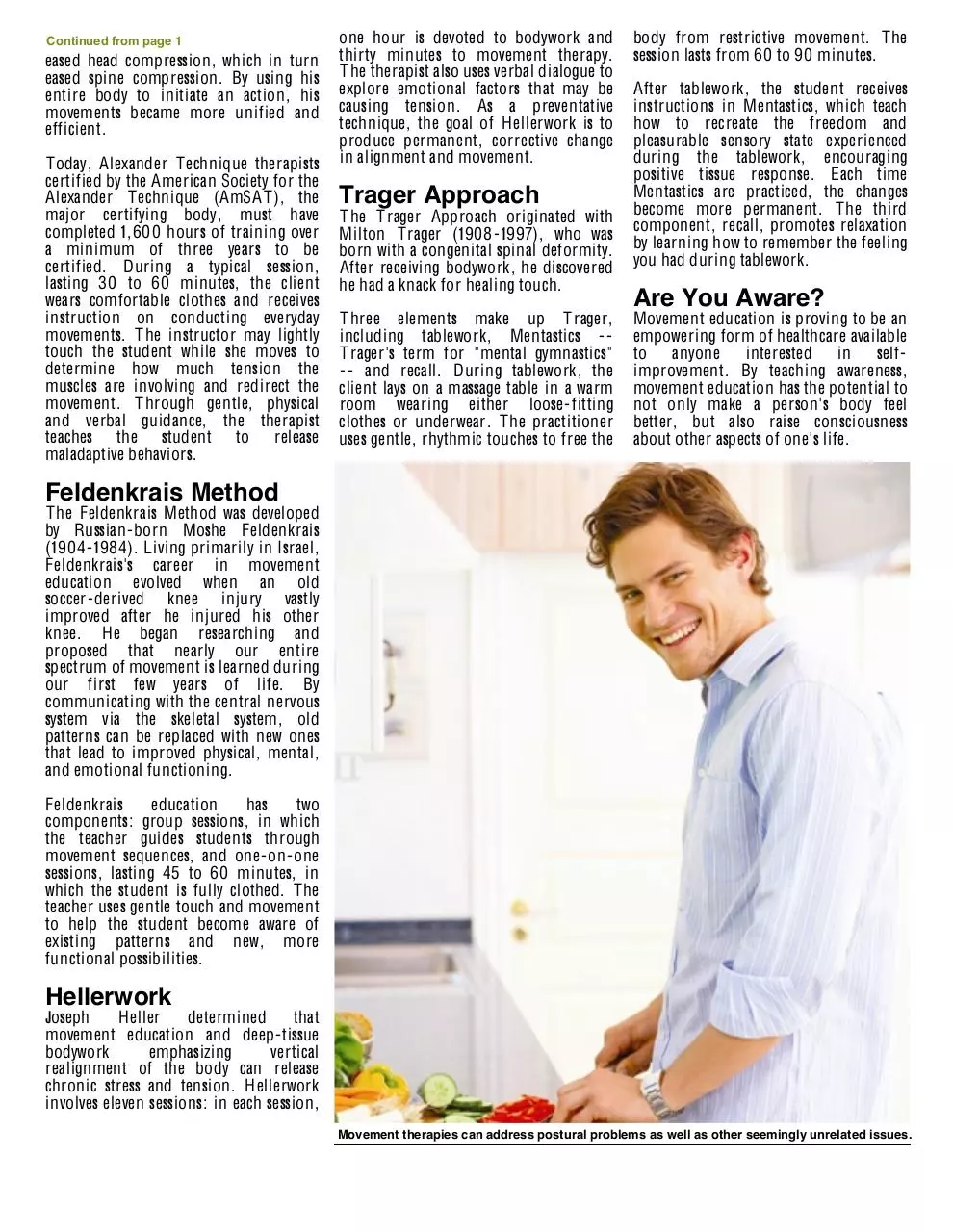
Movement therapies can address postural problems as well as other seemingly unrelated issues.
�
Soothe Your Skin’s Winter Ailments
Kayla Fioravanti
The drying effects of winter are upon
us. Here are some at-home ideas to help
soothe your skin through this
challenging season.
Cleanse
Put away your foaming gels and soaps
and stock up on creamy products.
Cleansing creams, lotions, and milks are
great winter choices, because they don't
contain the harsh, oil-stripping
detergents found in most cleansing gels.
Tone
Shelve your astringents and switch to a
toner. In the cold months, your skin
needs to be soothed and balanced, not
dried out further.
Moisturize
Choose heavier creams than you would
in summer months. You can even use
your heavy eye cream on your lips and
face. If your skin itches, the dry air is
causing the moisture in the top layer of
your skin to evaporate quickly. Slather
those areas with extra moisture until you
feel relief, and never be afraid of using
pure oils on your skin- -a bottle of
jojoba or olive oil is great to have on
hand.
Exfoliate
Exfoliate twice a week to remove dead
skin cells and help your skin absorb the
extra moisture you are using. Because
central heating systems reduce the
amount of sebum our skin secretes,
contributing to dryness, exfoliation will
free this natural regulating agent. Use a
cream-based exfoliant with jojoba beads,
so your body can soak up the rich oils.
Hydrate
For a simple in-home hydrotherapy
treatment, start your day with a steamy
shower. Just as you are finishing, switch
the water to cold for about 15 seconds
and then back to warm for 15 seconds.
Repeat the process for two minutes.
Shower and Bathe with Oils
Did you know you can apply body oil,
lotion, or cream during your shower or
bath? The heat and steam help your skin
to thoroughly absorb the moisture.
Exercise Myths
Fiction Vs. Fact
Although old fitness fictions like " no
pain, no gain " are fading fast, plenty of
misconceptions still exist. Following are
some of the most common myths,
counteracted by the latest research.
FAC T : Any exercise is better than none.
For example, regular walking or
gardening for as little as an hour a week
has been shown to reduce the risk of
heart disease.
for example, has been shown to help
treat low-back pain and fibromyalgia.
Improved flexibility, strength, and stress
management are just some of the
benefits.
FI C T I O N: You wi l l burn more fat if
you exercise longer at a lower
intensity.
FAC T : The most important focus in
exercise and weight control is how many
calories are burned during the activity.
The faster you walk, step or run, the
more calories you use per minute.
However, high-intensity exercise may be
more difficult to sustain.
FI C T I O N: If you exercise long and
hard enough, you wi l l a lways get the
resul ts you want.
FAC T : In reality, genetics plays an
important role in how people respond
to exercise. Your development of
strength, speed, and endurance may be
very different from that of other people
you know.
FI C T I O N: Home workouts are fine,
but going to a gym is the best way to get
fit.
FAC T : Some people find it easier to
stick to a home-based fitness program.
In spite of all the hype on trendy
exercise programs and facilities, the best
program for you is the one you will
participate in consistently.
FI C T I O N: The hea l th and fitness
benefits of mind-body exercise l ike t'ai
chi and yoga are questionable.
FAC T : The benefits abound! T'ai Chi,
This information was provided by
IDEA, www.ideafit.com.
FI C T I O N: If you're not going to work
out hard and of ten, exercise is a waste
of time.
�
The journey of a
thousand miles
begins with the
first step.
- Lao Tzu
Body of Peace Massage
Golden Crest Office Complex
Hamilton, NJ 08690
It's never too late to re-energize your personal care regimen.
Make a list of the things you do each day to maintain your
vitality. If you're already eating healthy, are there any healthy
foods that you can add to your diet to boost the healthful
benefits? Do you have an exercise plan in place? If so, is
there anything you can do to push yourself a little harder or
add an element to keep your program interesting? Are you
making time in your schedule for fun or using meditation to
ease stress? And don't forget the benefits of massage
therapy and reflexology to ease those aches and pains and
rejuvenate yourself. It's always a good time to add or adjust
elements in our personal care tool kit. Remember, it's all
about living our best life.
�
 Historical archive . public document