CQ
Researcher
Published by CQ Press, a division of SAGE Publications
www.cqresearcher.com
Human Rights in China
Are crackdowns on basic freedoms increasing?
W
hen the curtain rises on the Summer
Olympics next month in Beijing, China
will eagerly showcase its hypersonic economic growth and its embrace of what it
calls the “rule of law.” But 19 years after its bloody suppression
of protesters in Tiananmen Square, China will also be displaying
its human-rights record for all to judge. Human-rights advocates
say the sheen of Chinese progress and prosperity hides repression
and brutality by the Chinese Communist Party, including the violent
repression of pro-independence protesters in Tibet, forced abortions
stemming from China’s one-child policy and the trampling of basic
freedoms of speech, religion and assembly. Chinese government
officials say their nation of 1.3 billion people has made huge
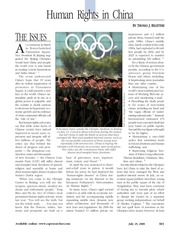
A Tibetan protester in Brussels, Belgium, last April
calls for a boycott of the Summer Olympics in Beijing
following a violent crackdown by Chinese security
forces on pro-independence demonstrators in Tibet.
I
strides on the legal and human-rights fronts and that the West has
N
no business interfering in China’s internal affairs.
S
I
D
E
CQ Researcher • July 25, 2008 • www.cqresearcher.com
Volume 18, Number 26 • Pages 601-624
THIS REPORT
THE ISSUES ......................603
BACKGROUND ..................610
CHRONOLOGY ..................611
CURRENT SITUATION ..........616
AT ISSUE ..........................617
OUTLOOK ........................619
RECIPIENT OF SOCIETY OF PROFESSIONAL JOURNALISTS AWARD FOR
EXCELLENCE ◆ AMERICAN BAR ASSOCIATION SILVER GAVEL AWARD
BIBLIOGRAPHY ..................622
THE NEXT STEP ................623
�
HUMAN RIGHTS IN CHINA
THE ISSUES
603
• Is China’s human-rights
record improving?
• Will China’s exploding
growth lead to Westernstyle democracy?
• Should U.S. companies
in China push harder for
human-rights reforms?
OUTLOOK
619
Mao’s Legacy
Mao Zedong imposed
repressive human-rights
practices.
610
Catalog of Abuses
A new Amnesty International report lists numerous rights violations.
613
616
One-Child Policy
Rights advocates say China’s
family-planning policy
threatens women’s rights.
Great “Walk” Forward
Some experts say progress
is coming to China, but
slowly.
604
China Gets Low HumanRights Rating
China lags far behind the
United States and France.
605
China’s Lackluster HumanRights Record
China performs poorly in all
four human-rights categories.
611
Chronology
Key events since 1893.
612
Intimidation of Press Said
to Be Widespread
But private media continue
to push boundaries.
614
619
Olympic Heat
As the Games approach,
tensions over China’s
human-rights record are
rising.
Internet’s Impact
Bloggers and other Web
users ultimately may bring
about human-rights reforms.
Cover: Credit AFP/Getty Images/John Thys
602
CQ Researcher
Environmental Problems
Spark Unrest, Health Woes
Protests reflect rise of citizen
activism, hope for future.
July 25, 2008
Volume 18, Number 26
MANAGING EDITOR: Thomas J. Colin
tcolin@cqpress.com
ASSISTANT MANAGING EDITOR: Kathy Koch
kkoch@cqpress.com
ASSOCIATE EDITOR: Kenneth Jost
STAFF WRITERS: Thomas J. Billitteri,
Marcia Clemmitt, Peter Katel
CONTRIBUTING WRITERS: Rachel S. Cox,
Sarah Glazer, Alan Greenblatt,
Barbara Mantel, Patrick Marshall,
Tom Price, Jennifer Weeks
DESIGN/PRODUCTION EDITOR: Olu B. Davis
ASSISTANT EDITOR: Darrell Dela Rosa
FACT-CHECKER/PROOFREADER: Eugene J. Gabler
A Division of
SAGE Publications
PRESIDENT AND PUBLISHER:
John A. Jenkins
EXECUTIVE DIRECTOR,
REFERENCE INFORMATION GROUP:
Alix B. Vance
DIRECTOR, ONLINE PRODUCT DEVELOPMENT:
617
CURRENT SITUATION
616
Chinese-style Change
Reforms will reflect
China’s unique culture.
SIDEBARS AND GRAPHICS
BACKGROUND
610
CQ Researcher
At Issue
Should the U.S. use trade
sanctions against China to
promote human rights?
FOR FURTHER RESEARCH
621
For More Information
Organizations to contact.
622
Bibliography
Selected sources used.
623
The Next Step
Additional articles.
623
Citing CQ Researcher
Sample bibliography formats.
Jennifer Q. Ryan
Copyright © 2008 CQ Press, a division of SAGE Publications. SAGE reserves all copyright and other rights
herein, unless previously specified in writing. No part
of this publication may be reproduced electronically or otherwise, without prior written permission. Unauthorized reproduction or transmission of SAGE copyrighted material is a violation of federal law carrying
civil fines of up to $100,000.
CQ Press is a registered trademark of Congressional
Quarterly Inc.
CQ Researcher (ISSN 1056-2036) is printed on acidfree paper. Published weekly, except; (March wk. 4)
(May wk. 3) (July wk. 1) (July wk. 2) (Aug. wk. 2)
(Aug. wk. 3) (Nov. wk. 4) and (Dec. wk. 4), by CQ
Press, a division of SAGE Publications. Annual fullservice subscriptions start at $803. For pricing, call 1800-834-9020, ext. 1906. To purchase a CQ Researcher
report in print or electronic format (PDF), visit www.
cqpress.com or call 866-427-7737. Single reports start
at $15. Bulk purchase discounts and electronic-rights
licensing are also available. Periodicals postage paid
at Washington, D.C., and additional mailing offices.
POSTMASTER: Send address changes to CQ Researcher, 2300 N St., N.W., Suite 800, Washington, DC 20037.
�
Human Rights in China
BY THOMAS J. BILLITTERI
THE ISSUES
trepreneurs and 4.3 million
private firms, banned until the
early 1980s. China’s middle
t a ceremony in March
class, barely evident in the early
in flower-bedecked
1990s, had exploded to 80 milTiananmen Square,
lion people by 2002, and by
Vice President Xi Jinping sug2025 is expected to number
gested the Beijing Olympics
an astonishing 520 million. 4
would lead China and people
Yet a litany of serious abusthe world over to join hands
es by the Chinese government
in creating “a more harmonious
persists, according to the U.S.
and better future.” 1
advocacy group Freedom
The event underscored
House and others, including:
China’s hope that 19 years
• Imprisoning more journalists
after its violent suppression of
than any other country;
protesters in Tiananmen
• Maintaining one of the
Square, it could present a new
world’s most sophisticated sysface to the world. China’s natems of blocking Web-site actionalistic pride in its rise as a
cess and monitoring e-mail;
global power is palpable, and
• Prescribing the death penalthe country is clearly anxious
ty for scores of non-violent
to showcase its hypersonic ecocrimes, including tax fraud and
nomic growth and its embrace
“the vague offense of ‘underof what communist officials call
mining national unity.’ ” Amnesty
the “rule of law.”
International estimated 470
But human-rights advocates
people were executed death last
say that while some facets of
year, based on public reports,
Policemen train outside the Olympic Stadium in Beijing
Chinese society have indeed
but said the true figure is thought
on July 21. Concern about terrorism during the Games
improved in recent years, reto be far higher;
has led China to take the kinds of actions that have
pression and inequity still af• Maintaining a one-child
outraged the West and sparked internal unrest, such as
fect millions of people. The
policy that sometimes leads
the recent public execution of three young men
reportedly with terrorist ties. China is hoping the
critics say that behind the
to forced abortions and human
Olympics will showcase its economic and social gains,
sheen of progress and prostrafficking; and
but critics say the Communist Party still stifles
perity — the ubiquitous con• Repressing religious freedissent and tramples basic freedoms.
struction cranes and thousands
dom of Falun Gong adherents,
of new factories — the Chinese Com- base of grievances, tears, imprisonTibetan Buddhists, Christians, Musmunist Party (CCP) still stifles dissent ment, torture and blood.” 2
lims and others. 5
In April Hu was sentenced to threeand tramples basic freedoms of speech,
Security threats related to the Olympics
religion and assembly at home and and-a-half years in prison. A month have led China to take the kind of acabets human-rights abuses in places like before his arrest, he had deplored the tions that have outraged the West and
“human-rights disaster” in China dur- sparked internal unrest. In July, an exSudan’s Darfur region.
“When you come to the Olympic ing testimony via the Internet to the ecution squad publicly shot three young
Games in Beijing, you will see sky- European Parliament’s Subcommittee men in the public square of the city of
scrapers, spacious streets, modern sta- on Human Rights. 3
Yengishahar. They had been convicted
In many ways, China’s rigid societal of having ties to terrorist plots, which
diums and enthusiastic people,” Teng
Biao and Hu Jia, two of China’s most control is at odds with its economic rev- authorities said were part of an effort
prominent human-rights activists, wrote olution and the accompanying rapidly to disrupt the Games by a separatist
last year. “You will see the truth, but expanding middle class, dynamic new group seeking independence on behalf
not the whole truth. . . . You may not urban architecture and thousands of of Muslim Uyghurs. 6 The executions
know that the flowers, smiles, har- new laws and regulations. By 2006 the did not quell fears of terrorism as the
mony and prosperity are built on a nation boasted 11 million private en- Olympics drew nearer, however. At least
AFP/Getty Images/Mark Ralston
A
Available online: www.cqresearcher.com
July 25, 2008
603
�
HUMAN RIGHTS IN CHINA
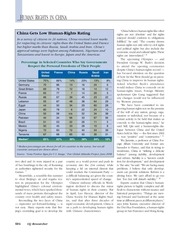
China Gets Low Human-Rights Rating
In a survey of citizens in 24 nations, China received lower marks
for respecting its citizens’ rights than the United States and France
but higher marks than Russia, Saudi Arabia and Iran. China’s
approval ratings were highest among Pakistanis, Nigerians and
Tanzanians and lowest in Europe, Japan and the Americas.
Percentage in Selected Countries Who Say Governments
Respect the Personal Freedoms of Their People
United
States
France
China
Russia
Saudi
Arabia
Iran
United States
75%
66%
14%
23%
13%
8%
Germany
70
86
13
16
24
6
Great Britain
69
78
12
18
14
12
France
65
77
7
14
20
5
Russia
66
67
39
45
23
22
Lebanon
55
87
48
38
64
29
Egypt
44
50
34
29
60
28
Japan
80
78
6
22
24
10
China
50
58
n/a
52
34
38
Pakistan
45
34
66
33
67
56
Brazil
51
53
22
26
11
5
Mexico
50
45
33
28
10
8
Nigeria
72
60
72
40
54
39
Tanzania
67
68
65
50
35
31
Median*
65%
63%
30%
28%
24%
10%
* Median percentages are shown for all 24 countries in the survey, but not all
countries surveyed are shown above.
Source: “Some Positive Signs for U.S. Image,” Pew Global Attitudes Project, June 2008
two died and 14 were injured in a pair
of bus bombings in the city of Kunming
as authorities tightened security for the
Games. 7
Meanwhile, a scramble this summer
to clear Beijing’s air and regatta waters in preparation for the Olympics
highlighted China’s colossal environmental woes, which have sparked thousands of mass protests throughout the
country over health and safety issues.
Reconciling the two faces of China
— repressive yet forward-looking — is
not easy. Many experts note that Beijing’s overriding goal is to develop the
604
CQ Researcher
country as a world power and push its
economy into the 21st century while
keeping a lid on internal dissent that
could weaken the Communist Party —
a difficult balancing act given the country’s unprecedented speed of change.
Chinese embassy officials in Washington declined to discuss the status
of human rights in their country. But
in April, Luo Haocai, director of the
China Society for Human Rights Studies, said that after three decades of
rapid economic development, China is
on a path to developing human rights
with Chinese characteristics.
“China believes human rights like other
rights are not ‘absolute’ and the rights
enjoyed should conform to obligations
fulfilled,” he said. “The country deems
human rights not only refer to civil rights
and political rights but also include the
economic, social and cultural rights. These
rights are inter-related.” 8
The upcoming Olympics — and
President George W. Bush’s decision
to attend the opening ceremonies
despite China’s human-rights record —
has focused attention on the question
of how far the West should go in pressing China to improve its human rights.
Asked whether Bush’s attendance
would induce China to concede on its
human-rights issues, Foreign Ministry
spokesman Qin Gang suggested that
any changes would not be influenced
by Western pressure.
“We have been committed to improving human rights not on the premise
of the will of any nation, group, organization or individual, nor because of a
certain activity to be held that makes us
concede to the human-rights issue,” he
said. Still, Qin said, a human-rights dialogue between China and the United
States held in May — the first since 2002
— was “positive” and “constructive.” 9
Wu Jianmin, a professor at China Foreign Affairs University and former ambassador to France, said that in trying to
modernize, China is “striking a delicate
balance” among stability, development
and reform. Stability is a “known condition for development,” and development
is “the aim,” he said. “We are facing many
problems. I believe that only development can provide solutions. Reform is a
driving force. We can’t afford to go too
fast. Too fast will disturb stability.” 10
Experts caution that China’s humanrights picture is highly complex and difficult to characterize without nuance and
historical perspective. “Things are moving forward and backward at the same
time at different paces at different places,”
says John Kamm, executive director of
the Dui Hua Foundation, a human-rights
group in San Francisco and Hong Kong.
�
China’s human rights present a
“moving target,” adds Margaret Woo, a
professor at Northeastern University
School of Law and co-editor of the
forthcoming book, Chinese Justice: Civil
Dispute Resolution in China. “It really
depends on what time you’re talking
about, what particular topic, whether
you’re looking at it in terms of its progress
vs. where it is today. It’s not an easy,
simple yes-or-no answer.”
The tension in China between progress
and repression emerged in full force
after the massive earthquake in Sichuan
Province in May, killing nearly 70,000
Chinese. Prime Minister Wen Jiabao and
President Hu Jintao both toured the disaster zone, with Wen visiting an aid station and exhorting rescue workers not
to give up on saving lives, and Hu clasping hands with survivors. 11 But behind
the scenes, local Chinese officials have
tried to stifle complaints of parents whose
children died in collapsed schools, reminding them that disturbing the social
order is against the law. 12
Despite concern over China’s humanrights behavior, its rising prominence as
an economic powerhouse and nationalsecurity ally has led U.S. policy makers
to act in ways that satisfy neither Chinese officials nor Western human-rights
advocates. In March, just as a massive
pro-independence protest erupted in
Tibet, leading to violent clashes with
Chinese security forces, the State Department removed China from its list of
the world’s 10 worst human-rights violators. Activists denounced the move,
and The New York Times opined that removing China from the list “looked like
a political payoff to a government whose
help America desperately needs on difficult problems.” 13 Yet the State Department’s annual report on global human
rights called China an “authoritarian state”
whose record remained “poor.” 14 It cited:
• Extrajudicial killings, torture and
coerced confessions of prisoners;
• Coercive birth-limitation policies
sometimes resulting in forced abortions;
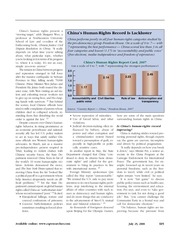
China’s Human-Rights Record Is Lackluster
China performs poorly in all four human-rights categories studied by
the pro-democracy group Freedom House. On a scale of 0 to 7 — with
7 representing the best performance — China scored less than 3 in all
four categories and lowest (1.17) in “accountability and public voice”
(free elections, media independence and freedom of expression).
China’s Human Rights Report Card, 2007
(on a scale of 0 to 7, with 7 representing the strongest performance)
2.5
2.0
2.14
2.49
2.23
1.5
1.0
1.17
0.5
0.0
Accountability and Civil liberties
public voice
Rule of law
Anticorruption and
transparency
Source: “Country Report — China,” Freedom House, 2007
• Severe repression of minorities;
• Use of forced labor, and other
violations;
• Judicial decision-making often influenced by bribery, abuse of
power and other corruption and
a criminal-justice system biased
toward a presumption of guilt, especially in high-profile or politically sensitive cases.
In another report in May, the State
Department charged that China “continued to deny its citizens basic democratic rights” and called for the government to bring its practices in line
with international norms. 15
Foreign Ministry spokesman Qin
called the May report “unreasonable.”
“We remind the U.S. side to pay more
attention to its own human-rights problems, stop interfering in the internal
affairs of other countries with such issues as democracy and human rights,
and do more things that are conducive
to the advancement of Sino-U.S. mutual
trust and bilateral relations.” 16
As thousands of foreigners descend
upon Beijing for the Olympic Games,
Available online: www.cqresearcher.com
here are some of the main questions
surrounding human rights in China:
Is China’s human-rights record
improving?
China is making strides toward protecting personal rights, though experts
say the gains are uneven, incomplete
and driven by political pragmatism.
“It really depends on how you break
it down,” says Minxin Pei, a senior associate in the China Program at the
Carnegie Endowment for International
Peace. The government has, for example, loosened up in recent years on
personal freedoms, such as the freedom to travel, while civil or political
rights remain “very limited,” he says.
It is now “fair game” to discuss
public-policy issues such as health care,
housing, the environment and education, Pei says, and even to “take government to task for not doing a good
job.” But, “you cannot challenge the
Communist Party in a frontal way and
call for democratic elections.”
“On balance, human rights are improving because the pressure from
July 25, 2008
605
�
HUMAN RIGHTS IN CHINA
AFP/Getty Images/Frederic J. Brown
society is so enormous,” Pei said. “Also, overnight but rather through “a grad- in the truest political sense — the right
the legitimacy of repression is de- ual process.”
to oppose the government, the right to
clining. Even the government under“China is a developing country with dissent — then they’ve made remarkstands there are certain things you a population of 1.3 billion, and China’s ably little progress over the last 30 years.
cannot use force to deal with, and human-rights development still faces Each time you think there’s been a step
international pressure is also rising.” many problems and difficulties,” Wang forward, you see retrogression.”
Cheng Li, a senior fellow at the said. “To respect and protect human
Kirk Donahoe, assistant director of
Brookings Institution think tank in rights and promote all-round devel- the Washington-based Laogai Research
Washington who moved from Shang- opment of human rights is a long-term Foundation, which monitors Chinese
hai to the United States in 1985, says arduous task for the Chinese govern- human-rights violations, including in the
compared to decades past, human ment and Chinese people.” 17
prison system, is similarly downbeat. “The
rights in China “are improving, there’s
But many China experts are doubt- political progress has just not kept pace
no question about that.”
ful significant progress will occur in with the economic progress,” he says.
Cheng, also a pro“Sure, people’s living stanfessor of government
dards have improved, and
at Hamilton College,
a lot of times when you
points out that durtalk to the Chinese peoing the Cultural Revple they’ll mention living
olution in the 1960s
standards and health and
and ’70s, China was
medication as being in“like a prison,” and
dicative of a better humanhuman suffering was
rights situation.”
widespread. Even 20
But, Donahoe says,
years ago, around the
“the basic situation has
time of the Tianannot improved” when meamen Square cracksured in traditional Westdown, Cheng says,
ern terms: freedom of
Chinese authorities
speech and religion, the
viewed discussions
right to criticize the govabout human rights as
ernment and dissent
“propaganda or Westfrom official policy, free
ern hypocrisy.”
elections, and so on.
Prominent human-rights activist Hu Jia, right, with his wife Zeng Jinyan
But in recent
While China’s constiin 2007, was sentenced to three-and-a-half years in prison. A month
before his arrest, he had deplored the “human-rights disaster” in China.
years, China gradutution guarantees certain
ally has loosened up
rights, such as freedom
on some fronts, according to Cheng. the immediate future. James Mann, a of speech and religion, Donahue says,
He notes that dissidents have been former diplomatic correspondent for “as long as there’s a one-party system
able to give interviews to foreign media, the Los Angeles Times and now author in place, these reforms don’t carry
some intellectuals have been critical in residence at Johns Hopkins Uni- much weight.”
of the Chinese government and sig- versity’s Paul H. Nitze School of AdHuman-rights advocates have voiced
nificant progress has occurred toward vanced International Studies, says that particular concern over violations in the
instituting legal and economic reforms. despite some gains in recent years, months leading up to the Olympics.
Although “no fundamental break- China still lacks the freedoms that form “Over the past year, we have continthrough” has occurred on such issues the bedrock of civil society in the West. ued to document not only chronic
“If you define human rights to in- human-rights abuses inside China, such
as ethnic freedom, Tibet and treatment
of the outlawed Falun Gong spiritual clude personal freedoms such as what as restrictions on basic freedoms of
movement, “in general terms, China is people can wear and what music they speech, assembly and political particimore open and freer than at anytime can listen to, then human rights have pation, but also abuses that are taking
definitely expanded,” says Mann, au- place specifically as a result of China’s
in recent history,” Cheng says.
Wang Chen, director of the Infor- thor of The China Fantasy: How Our hosting the 2008 Summer Games,” said
mation Office of China’s State Coun- Leaders Explain Away Chinese Repres- Sophie Richardson, advocacy director
cil, said human rights do not advance sion. But, “if you define human rights of Human Rights Watch’s Asia Division.
606
CQ Researcher
�
“Those include an increasing use
of house arrest and charges of ‘inciting subversion’ as [a] means of silencing dissent, ongoing harassment of
foreign journalists despite new regulations protecting them and abuses of
migrant construction workers without
whose labors Beijing’s gleaming new
skyline would not exist.” 18
“People do have more choice in
their daily lives” than in decades past,
says Minky Worden, media director
of Human Rights Watch and editor
of China’s Great Leap: The Beijing
Games and Olympian Human Rights
Challenges. “But if they try to cross
one of the invisible red lines by posting something on the Internet, criticizing the government, if they fall
afoul of a corrupt party official in
their village, the political situation can
still be very harsh.”
During the one-year run-up to the
Olympics, Worden says, Human Rights
Watch has seen “a fairly systematic deterioration of human rights across most
of the measurable areas. After a couple
of decades of progress, we’re seeing a
retrenchment.”
Will China’s exploding growth
lead to Western-style democracy?
Some China experts say the middle
class is the key to China’s future.
“If the middle class believes that its
interests are being adequately tended
to by the state, then there will be less
pressure for democracy,” says Harry
Harding, university professor of international affairs at The George Washington University (GWU). “If they think
the state is violating or ignoring their
interest, then the desire for democracy
can become extremely powerful.”
For now, many analysts argue,
China’s expanding middle class tends
to be highly nationalistic, supportive
of the central government and concerned that if Western-style rights are
given to the country’s massive poor
population, the interests of wealthier
Chinese could suffer.
Johns Hopkins University’s Mann
says “people tend to assume that as
a country becomes more prosperous
it will develop an independent civil
society. . . . But China seems to be
developing a new political model in
which the emerging middle class,
which as a percentage of the overall population is still small, has much
closer ties to the existing regime than
we’ve seen elsewhere. It’s not just
that they may not be independent
enough to push for democracy. They
may be threatened by democracy because in China, where you have 500800 million poor peasants or migrant
workers either in the countryside or
the edges of cities, there is fear
among the emerging middle class that
with democracy they will be outvoted, and that their interests will not
emerge on top.”
Nevertheless, democracy — at least
focused on the local level and in a
form shaped to Chinese political culture
— has been a hot topic within the
administration of President Hu. Writing
before the 17th Congress of China’s
Communist Party last fall, Brookings
scholar David Shambaugh alerted
readers to “expect lots of ‘democracy’
initiatives.”
“While these initiatives do not constitute democratic institutions and procedures as recognized in real democracies, they nonetheless represent serious
efforts to broaden what the Chinese
describe as ‘inner-party democracy,’
‘electoral democracy’ and extra-party
‘consultative democracy,” he wrote.
“All of these forms go under the broad
rubric of ‘socialist democracy’ or ‘democracy with Chinese characteristics.’ ” 19
Scholars say that while China allows — and sometimes even encourages — criticism of corrupt local party
officials, it keeps a tight lid on dissent
aimed at the central government out
of fear that it could lead to chaos and
threaten the party’s control.
“At this point in China’s political
development, there isn’t a lively multi-
Available online: www.cqresearcher.com
party system, and there isn’t an established political institution for political
transition,” says Northeastern University’s
Woo. “So imagine if your sole source
of legitimacy goes out the window.
What’s going to happen to the country?
They’ve never been able to figure that
one out yet.”
Some China scholars argue that
China inevitably will move toward
some kind of democracy that includes a multiparty political system.
“The question for China is not whether,
but when and how,” says Pei, of the
Carnegie Endowment for International
Peace. “You can definitely say 20 years
from now, China probably will be
democratic and will have a multiparty
system.”
But others are doubtful. In The
China Fantasy, Mann critiques scenarios often held by policy elites in
the West — that capitalism will lead
to democracy in China or that social
or economic upheavals will undermine the current regime. He poses a
third scenario: that China will continue to grow stronger economically but
retain its authoritarian ways. The West
should not continue to overlook China’s
human-rights violations at home and
its support for repressive regimes elsewhere, he argues.
“[W]e should not assume China is
headed for democracy or far-reaching
political liberalization,” Mann writes.
“China will probably, instead, retain
a repressive one-party political system for a long time. In fact, such an
outcome may not bother the American or European business and government leaders who deal regularly
with China; it may indeed be just the
China they want.
“But they rarely acknowledge that
they would be content with a permanently repressive and undemocratic China. . . . Instead, they foster an
elaborate set of illusions about China,
centered on the belief that commerce
will lead inevitably to political change
and democracy.” 20
July 25, 2008
607
�
HUMAN RIGHTS IN CHINA
China Holds More Than 700 Political Prisoners
China is detaining or imprisoning 734 political prisoners, according to the Congressional-Executive
Commission on China.* Many were convicted of overstepping government speech or media regulations or
inciting separatism — as occurred recently in Tibet and Xinjiang Province. Prisoners representing a
range of offenses are profiled below.
Selected Political Prisoners in China
Name
Reason for detention
Ethnic group
Date of detention
Length of sentence
Adrug Lupoe
Tibetan
Aug. 21, 2007
10 years
Lupoe and other protesters climbed onto a stage where Chinese officials were speaking and called for the
Dalai Lama’s return to Tibet, freedom of religion and the return of exiled figure Gedun Choekyi Nyima. The
Ganzi Intermediate People’s Court convicted him of espionage and inciting “splittism.”
Abdulghani Memetemin
Uiyghur
July 26, 2002
9 years
Memetemin provided information to the East Turkistan Information Center, a Munich-based organization
advocating independence for Xinjiang Province. The group is designated by China as a terrorist organization.
He was sentenced by the Kashgar Intermediate People’s Court for “supplying state secrets to an organization
outside the country.” On top of his prison sentence, he received three years’ deprivation of political rights.
Chi Jianwei
Han
Oct. 18, 2006
3 years
Chi was detained for participating in a sit-in and distributing materials from the Falun Gong spiritual group,
which were found in his home. Shangcheng District People’s Court charged him with “using a cult to
undermine implementation of the law.”
Shi Tao
Han
Nov. 24, 2004
10 years
Shi was convicted of disclosing state secrets to foreigners after disobeying a government order limiting
journalists’ reports during the 15th anniversary of the Tiananmen democracy protests. Shi e-mailed his notes to
the Democracy Forum, a U.S.-based online newspaper. His conviction was based in part on evidence provided
by the China office of Yahoo!, which agreed to pay his legal expenses.
Tenzin Deleg
Tibetan
April 7, 2002
20 years
Deleg was convicted of exploding bombs and scattering separatist leaflets. Deleg and an accomplice were
sentenced to death, but Deleg’s sentence was commuted to life imprisonment. He is reportedly being treated
for heart disease in Chuandong Prison in Sichuan Province.
* Congress created the commission in 2000 to monitor human rights and the development of the rule of law in China. It consists
of nine senators, nine House members and five senior administration officials.
Source: “Political Prisoner Database,” Congressional-Executive Commission on China, June 26, 2008
Should U.S. companies in China
push for human-rights reforms?
In April, actress Mia Farrow, chairwoman of the humanitarian group
Dream for Darfur, criticized most of the
major corporate sponsors of the Beijing Olympics, including Visa and CocaCola, for their alleged failure to take
meaningful steps to pressure China to
608
CQ Researcher
help end human-rights abuses in warravaged Darfur.
“Because sponsors are desperate to
win the hearts and minds of 1.3 billion potential consumers in China,
they have been frozen into silence on
Darfur,” Farrow said. “If the Summer
Games go down in history as the
Genocide Olympics, it will be because
of the Chinese government’s support
of the regime in Sudan, abetted by
the moral cowardice of the sponsors
who would not speak out publicly
about the genocide in Darfur.” 21
China’s growing thirst for oil has
led it to deal with resource-rich nations that have been ostracized by the
West for human-rights abuses. Sudan,
�
for instance, where more than 200,000
people have died in fighting in the
Darfur region since 2003, is one of
China’s biggest oil suppliers. China repeatedly has blocked efforts by the
West to impose sanctions against
Sudan and until recently was reluctant
even to pressure the Sudanese government to curb the fighting. 22
But some companies returned fire
on Dream for Darfur. Coca-Cola’s chief
executive called its approach “flawed.”
“It judges concern by one narrow
measure — the degree to which one
pushes a sovereign government in public — while ignoring what we and
others are doing every day to help
ease the suffering in Darfur,” wrote
Coke CEO Neville Isdell. He added:
“Our approach encompasses: immediate relief to those on the ground;
investments to address water, one of
the conflict’s underlying causes; and
efforts to bring local and international stakeholders together to develop
long-term solutions.” 23
While many scholars and humanrights activists say corporations have
an important role to play in pushing
China toward human-rights and political reforms, some recommend a more
low-key dialogue with Chinese officials while ensuring that their own corporate operations within China are
clean of any taint of abuse.
“Private discussion and dialogue instead of finger pointing” is the best
approach says the Brookings Institution’s Cheng.
In a commentary in Condé Nast Portfolio, New York University business Professor Tunku Varadarajan explored the
question of whether companies receiving global exposure from sponsoring
the Olympics should press for humanrights improvement in China. 24 “At the
very least,” he wrote, the corporations
“owe it to us to show that they are not
wholly blind to human-rights issues.”
While they “cannot be asked to entirely
subordinate the interest of their stockholders to those of a more amorphous
group of stakeholders,” he wrote, “the
global practice of capitalism is not a
morality-free exercise.”
As a first step, advises Georges Enderle, a professor of international business ethics at the University of Notre
Dame, companies “should keep their
own house in order in China [and]
treat their employees decently and according to American standards.”
U.S. and foreign companies can help
bolster the rule of law in China, he
says, by following a major, new labor
law in China and help explain to Chinese companies why the law is important. The law requires employers
to provide workers with written contracts, restricts the use of temporary
workers and makes it more difficult
to lay off employees. It also strengthens the role of the Communist Party’s
monopoly union and allows collective
bargaining for pay and benefits. 25
The law was developed despite stiff
objections from many multinational
companies, who said it would significantly increase labor costs and reduce
flexibility. As passed, the measure softened some controversial provisions
but kept others. 26
While it has drawn wide international attention, the law nonetheless
“may fall short of improving working
conditions for the tens of millions of
low-wage workers who need the most
help,” said The New York Times —
“unless it is enforced more rigorously
than existing laws, which already offer
protections that on paper are similar
to those in developed economies.” 27
The Times pointed out that “abuses
of migrant laborers have been endemic
in boom-time China” and noted the labor
law was passed shortly after Chinese
officials and state media exposed the
widespread use of slave labor in brick
kilns and coal mines. 28
Michael A. Santoro, a professor of
ethics at the Rutgers University business school and author of Profits and
Principles: Global Capitalism and
Human Rights in China, says preach-
Available online: www.cqresearcher.com
ing to the Chinese about human rights
simply engenders hostility toward Westerners. But foreign companies, he argues, should be far more aggressive in
holding the Chinese government to trade
and business standards that China itself
committed to when it became a member of the World Trade Organization
(WTO) in 2002.
By aggressively enforcing those standards and exercising the rights granted to them under the WTO, he argues, foreign companies could help
promote the rule of law in China and
provide moral support to citizens who
are challenging China’s government
on political and human-rights issues.
“How many cases do you think foreign companies have brought” against
China so far under the WTO rules?
Santoro asks. “Try zero.” Even if China
retaliated, WTO provisions entitle
companies to resolve their disputes
with the Chinese government through
a fair and independent court system
in China, Santoro says. And if that
fails, he adds, a dispute becomes an
international trade case.
“We have this whole legal mechanism in place, and nobody’s using it.”
Instead, business leaders continue “to
work within the old paradigm of power
in China,” using personal connections
rather than international law to resolve
business disputes.
While not suggesting that multinational businesses always deal with
China in the most confrontational way,
Santoro says “they need to start thinking about the fact that they have economic rights — and not economic privileges that the [Chinese] government is
granting to them.”
As flawed as China’s judicial system
is, Santoro says, “we see very brave Chinese citizens pushing the envelope” on
labor, environmental and economic-rights
issues in the Chinese judiciary. But he
says, “the foreign business community
and the foreign legal community are
not doing nearly enough to promote
the rule of law in China.”
July 25, 2008
609
�
HUMAN RIGHTS IN CHINA
BACKGROUND
Mao’s Legacy
C
hina’s human-rights practices have
been under scrutiny for generations. Some scholars have painted Chairman Mao Zedong, who founded the
People’s Republic of China, as one of
history’s worst monsters. A controversial 2005 biography claims he was responsible for more than 70 million
deaths in peacetime, with nearly 38
million dying of starvation and overwork during the Great Leap Forward
and an accompanying famine. 29
Whatever the true death figure, and
notwithstanding that some Chinese continue to revere him, Mao’s legacy is
widely viewed as shameful. During his
disastrous 10-year Cultural Revolution
in the 1960s and ’70s, even top political and military leaders were subject to arbitrary arrest, torture and extrajudicial execution. 30 Young
intellectuals were forced into “reeducation” camps to work alongside
peasants, Red Guards beat citizens for
perceived slights to the authorities and
Western music and other cultural expressions were suppressed.
In February 1972 Mao and President
Richard M. Nixon met in Beijing in a
spectacle that gave American television
viewers a window on a China they had
not seen for more than two decades.
The visit, the first by a U.S. president
to China, marked the first steps toward
normalizing relations between the two
countries and helped lay the groundwork for China’s opening to the West.
Following Mao’s death in 1976, hopes
for democracy grew in China. In 1978
— 30 years ago this year — China
adopted a “Reform and Opening” policy, which, while fostering dramatic
economic and cultural changes also led
to a vast chasm between rich and poor
610
CQ Researcher
and what critics say has been a legacy of human-rights violations, including
relocations of Chinese citizens to make
way for new development, government
corruption and other abuses.
The push for greater freedom suffered its most notorious setback in 1989,
when Chinese tanks crushed a prodemocracy movement in Tiananmen
Square and the nearby Avenue of
Eternal Peace.
Ma Jian, a well-known Chinese
writer, described what happened: “The
protests had been set off by the death
of the reform-minded party leader Hu
Yaobang. College students had camped
out in the square — the symbolic heart
of the nation — to demand freedom,
democracy and an end to government
corruption. There they fell in love, danced
to Bob Dylan tapes and discussed
Thomas Paine’s ‘Rights of Man.’
“The city had come out to support
the protesters: workers, entrepreneurs,
writers, petty thieves. After the tanks
drove the students from the square in
the early hours of June 4, 1989, nearby
shop owners turned up with baskets of
sneakers to hand out to protesters who’d
lost their shoes in the confrontation. As
soldiers opened fire in the streets, civilians rushed to the wounded to carry
them to the hospital.” 31
According to the PBS TV program
“Frontline,” the Chinese Red Cross initially reported 2,600 were killed, then
quickly retracted that figure under intense pressure from the government.
The official Chinese government figure is 241 dead, including soldiers,
and 7,000 wounded. 32
Ma went on to say that the Communist Party in China rewrote history
and “branded the peaceful democracy
movement a ‘counterrevolutionary riot’
and maintained that the brutal crackdown was the only way of restoring
order. . . .
“Realizing that their much vaunted
mandate to rule had been nullified by
the massacre, the party focused on economic growth to quell demands for po-
litical change. Thanks to its cheap, industrious and non-unionized labor force,
China has since become a world economic power, while the Communist
Party has become the world’s best friend.”
About 130 prisoners are still being
held for their role in the Tiananmen
protests, according to Human Rights
Watch. 33
The Tiananmen massacre isolated
China on the global stage for years afterwards and helped defeat its bid to
host the 2000 Olympics. “[W]hen the
application was made in 1993, the sounds
of the gunshots in Beijing were still
ringing in people’s ears,” according to
Chinese journalist Li Datong. 34
In the nearly two decades since Tiananmen, experts say, China has changed in
some significant ways, including the attitude of its youth toward the government. “In 1989,” says Kamm of the Dui
Hua Foundation, “young people were
very critical of the government, and that
was in line with international outrage
over Tiananmen. Today the situation is
radically different. You still have international concern over the bad humanrights record, but in China you have extreme nationalism, which basically says
‘my country right or wrong’ and ‘how
dare you criticize my government because in doing so you criticize China
and by doing that you criticize me.’ ”
A University of Hong Kong survey
this spring found that most Hong
Kong residents continue to believe
that Chinese students were right to
protest at Tiananmen and that the government’s reaction was wrong, but 85
percent said human rights in China
had improved since 1989. 35
Catalog of Abuses
C
hina’s selection to host the 2008
Games was predicated in part on
promises to improve its human rights.
Beijing Mayor Liu Qi told the International Olympic Committee the Games
Continued on p. 612
�
Chronology
1890s-1970s
Mao Zedong founds People’s
Republic of China.
1893
Mao is born in Hunan province.
1949
Mao leads Communists to power.
1958
Mao launches Great Leap Forward
to increase industrial and agricultural
production, causes deadly famine.
1959
Great Leap Forward opponent Liu
Shaoqi replaces Mao as chairman
of the People’s Republic.
1966
To reassert his power, Mao launches
Cultural Revolution; repression of
human rights and religion causes
political and social chaos.
1972
President Nixon visits China.
1987
China sets up China Academic Network, its first computer network.
2003
Hu Jintao becomes China’s president;
Wen Jiabao becomes premier.
1989
Military brutally clears pro-democracy
demonstration in and around Beijing’s Tiananmen Square, resulting in
hundreds of deaths.
2004
Zhao Yan, a Chinese researcher
working for The New York Times in
China, is charged with disclosing
state secrets to the newspaper;
charges are later dismissed.
1991
China’s State Council issues white
paper on human-rights record.
1993
European Parliament denounces
repression in Tibet and opposes
China’s bid to host 2000 Olympics.
1994
Advocacy groups complain about
President Bill Clinton’s decision to
delink human rights and trade in
dealing with China.
1999
Beijing bans Falun Gong spiritual
movement as part of continuing repression of Christian house churches,
Muslim Uyghurs and others.
1976
Mao dies; power fight ensues.
1978
China adopts “reform and opening
up” policy spurring economic growth
and progress on human rights.
•
1980s-1990s
Economic reforms stimulate development, but pro-democracy
efforts meet resistance.
1982
New Chinese constitution promises to
protect freedom of speech, press, assembly, association and other rights,
but crackdowns persist.
•
2000s
Human-rights
abuses continue to mar China’s
international image.
2001
Beijing wins bid to host 2008
Summer Olympics. . . . China receives formal approval to join
World Trade Organization.
2007
President Bush meets with President
Hu in Australia and emphasizes U.S.
concern about human rights. . . .
Yahoo! officials defend company’s
role in jailing of Chinese journalist
Shi Tao, sentenced in 2005 to 10
years. . . . Human-rights activist Hu
Jia arrested. . . . Dozens of women
in southwest China reportedly
forced to have abortions.
March 2008
Foreign journalists restricted from
traveling to Tibet as monks and
other pro-independence demonstrators engage in deadly clashes with
Chinese police. . . . State Department removes China from list of
top 10 human-rights violators but
says its record remains “poor.”
April 2008
Olympic Torch Relay hit by antiChina protesters around the world.
May 2008
Earthquake kills nearly 70,000 in central China, opening country to scrutiny by Western reporters and leading
to charges of poor building standards
and government corruption.
2002
Hu Jintao elected general secretary
of Chinese Communist Party.
July 2008
China scrambles to deal with environmental woes and prepare the
country for start of Olympic Games.
2002-2004
China suppresses media coverage
of SARS outbreak.
Aug. 8-24
Olympics to be held in Beijing.
Available online: www.cqresearcher.com
July 25, 2008
611
�
HUMAN RIGHTS IN CHINA
Intimidation of Press Said to Be Widespread
But private media continue to push boundaries.
W
ith the Olympic Games approaching, media representatives and human-rights advocates have stepped up
their perennial calls for greater press freedom for both
Chinese reporters and foreign correspondents working in China.
Press advocates say China has violated temporary regulations
it established 18 months ago that allow foreign correspondents
more latitude in covering the country before and during the Games.
The rules, which took effect in January 2007, expire in October.
In early July China repeated its pledge to abide by the rules, with
Li Changchun, a high-ranking Chinese official, encouraging foreign journalists to report “extensively” on the games. 1
But free-press advocates say reporting efforts by foreign
and domestic journalists, Chinese cyber-dissidents, bloggers
and others have been anything but unfettered. Shortly before
Li’s statement, Human Rights Watch released a report concluding that China continued to thwart and threaten foreign
journalists.
Drawing on more than 60 interviews with correspondents
in China between December 2007 and this past June, the report said correspondents and their sources continued to experience intimidation and obstruction when pursuing articles that
could embarrass authorities, uncover official wrongdoing or
chronicle social unrest. 2
Chris Buckley, a senior correspondent for Reuters, was beaten and detained by “plainclothes thugs” last September after
interviewing rural citizens seeking redress for abuses by local
authorities, Human Rights Watch said. In October, it said, a EuContinued from p. 610
“will help promote our economic and
social progress and will also benefit
the further development of our
human-rights cause.” 36 Yet, critics
charge that China has not lived up to
its word.
Some of the criticism stems from
its crackdown this spring in Tibet and
widely perceived failure to do more
to stem abuses in places like Darfur.
But rights advocates also express a
more general concern over practices
within China, despite the economic
gains of some citizens in recent years.
“In some limited aspects, there has
been some progress” on human rights,
says Sharon Hom, executive director
of Human Rights in China, an international organization founded in 1989
612
CQ Researcher
ropean TV correspondent experienced similar treatment when
trying to report on provincial unrest.
Other groups also have voiced strong complaints about
China’s disregard for free expression. In a report reissued this
year, the New York-based Committee to Protect Journalists cited
a “yawning gap between China’s poor press-freedom record
and promises made in 2001 when Beijing was awarded the
Olympic Games.” 3 As of early July, more than two dozen Chinese journalists remained in prison, the group said. 4
Reporters Without Borders, a Paris-based press-advocacy
group, said China jails more journalists, cyber-dissidents, Internet users and freedom of expression campaigners than any
other country. 5
But China’s journalistic scene is not uniformly bleak. As the
nation’s economy has boomed, a climate of spirited competitiveness has developed among private Chinese newspapers and
magazines, some with a zest for investigative reporting and the
willingness and ability to push censorship boundaries. Also, the
temporary rules established for the Olympics have helped open
a window on China. The rules coincided with this year’s massive earthquake in Sichuan Province, which was heavily covered by both Western and Chinese media.
Still, journalists have experienced harassment. They were banished from strife-torn Tibet, where riots last March generated some
of the biggest international news of the year. 6 And after the earthquake, the Wall Street Journal reported, officials in Xianger, a coalmining town, “prevented foreign reporters from entering areas
by Chinese students and scholars. For
example, she cites “the 400 million lifted out of absolute poverty.”
“However, for the vast majority —
the migrants, the rural inhabitants, the
urban poor, ethnic-minority groups, Tibetans, Uyghurs, Mongols — which together comprise the vast majority of the
1.3-billion population — the humanrights situation has not only not improved, it has absolutely deteriorated in
the last 20 years with respect to the right
of individuals to have . . . religious [freedom], cultural freedom [and] the freedom of expression and association.”
What’s more, Hom says most Chinese continue to lack decent housing,
jobs, education and health care and
that the problems are so severe the
Communist Party has recognized the
need for improvement because of the
social unrest they have generated.
Hom cautions that it is impossible to
know the full extent of human-rights
abuses in China because of the centralized control exerted under the one-party
system, the state-of-the-art technology to
monitor and filter information and the
pervasive state-secrets system.
A detailed report last year by Human
Rights in China said the state-secrets
system “perpetuates a culture of secrecy that is not only harmful but
deadly to Chinese society.” 37 The system controls the flow of data on
everything from the effects of environmental damage in urban industrial areas to forced abortions and
deaths among political prisoners, Hom
explains. “Anything and everything
�
where schools collapsed, stopped parents from speaking with reporters elsewhere and in some case have threatened parents trying to voice their anger.” 7
Chinese journalists face particular challenges in reporting on
issues that government authorities deem threatening to state security or the Communist Party. The Committee to Protect Journalists noted in its report that censorship of domestic reporters
in China “remains in force across all regions and types of
media,” with “all news outlets . . . subject to orders from the
Central Propaganda Department” and provincial authorities blocking coverage of sensitive local issues.
Journalists must avoid reporting on the military, ethnic conflict, religion issues (especially the outlawed Falun Gong movement) and the internal workings of the government and Communist Party, the committee said. “Coverage directives are issued
regularly on matters large and small. Authorities close publications and reassign personnel as penalties for violating censorship orders.” 8
The committee also noted that even Western Internet service
providers have yielded to government pressure, pointing out that
Yahoo turned over e-mail account information that led to the
imprisonment of a journalist and several dissidents, Microsoft
deleted a reporter’s blog, and Google “launched a self-censoring
Chinese search engine.” 9
In a new book on China, Philip P. Pan, former Beijing bureau chief for The Washington Post, describes how Cheng
Yizhong, editor in chief of The Southern Metropolis Daily, ran
could be deemed a state secret, even
retroactively,” she says.
Despite the lack of reliable data, journalists and Western governments have
nonetheless compiled thousands of
pages of documentation in recent years
on human-rights abuses in China. Amnesty
International, for example, says it believes a “significant drop in executions”
is likely to have occurred since the
Supreme People’s Court review of death
sentences was restored in 2007, but that
China remains the world leader in the
use of the death penalty, with roughly
68 offenses punishable by death, including
non-violent ones such as embezzling and
certain drug-related crimes. 38
In its 2008 report on global human
rights, Amnesty estimates that at least
470 people were executed and 1,860
an exposé on the shourong system, a detention-center network
used to enforce a passport policy designed to keep “undesirables” out of cities. After The Daily reported on a detainee’s
death, it was announced that Premier Wen had done away
with the shourong regulations and was going to shut the detention centers. But The Daily paid a high price for its success: Advertisers were directed away from the paper, its general manager was sentenced to prison and Cheng himself was
arrested and held for five months. 10
1
“China pledges media freedom at Olympic Games,” The Associated Press,
July 11, 2008.
2 See “China’s Forbidden Zones: Shutting the Media out of Tibet and other
‘Sensitive’ Stories,” Human Rights Watch, July 2008, http://hrw.org/reports/2008/china0708/.
3 “Falling Short,” Committee to Protect Journalists, updated and reissued
June 2008, p. 8, http://cpj.org/Briefings/2007/Falling_Short/China/china_updated.pdf.
4 “One month before the Olympics, media face huge hurdles,” Committee
to Protect Journalists, July 8, 2008.
5 “2008 Annual report — Asia-Pacific: China,” Reporters Without Borders,
p. 79, www.rsf.org/IMG/pdf/rapport_en_asie.pdf.
6 For background, see Brian Beary, “Separatist Movements,” CQ Global Researcher, April 2008, pp. 85-114.
7 James T. Areddy, “China Stifles Parents’ Complaints About Collapsed
Schools,” The Wall Street Journal, June 18, 2008, p. 10A.
8 “Falling Short,” op. cit., p. 8.
9 Ibid., p. 9.
10 Michiko Kakutani, “Dispatches From Capitalist China,” The New York
Times, July 15, 2008. See Philip P. Pan, Out of Mao’s Shadow (2008).
sentenced to death in 2007, based
on public reports, “although the true
figures were believed to be much
higher.” 39 Kamm of the Dui Hua
Foundation estimates there were 5,000
executions last year, compared with
perhaps 15,000 in the late 1990s.
“[D]eath penalty trials continued to
be held behind closed doors, police
often resorted to torture to obtain ‘confessions,’ and detainees were denied
prompt and regular access to lawyers,”
the Amnesty report said.
Amnesty’s catalog of abuses is far
broader than the death penalty. For example, it said “torture in detention remained widespread.” Also, “while space
for civil society activities continued to
grow, the targeting of human-rights defenders who raised issues deemed to be
Available online: www.cqresearcher.com
politically sensitive intensified.” China continued to tightly control the flow of news
and information, Amnesty said, noting
that around 30 journalists were known
to be in prison along with at least 50
individuals for posting their views on the
Internet. (See sidebar, p. 612.)
In addition, millions of Chinese were
impeded in their quest for religious freedom, with Falun Gong practitioners,
Uyghur Muslims, Tibetan Buddhists and
underground Christian groups “among
those most harshly persecuted.”
One-Child Policy
A
dvocates also point to threats to
women’s rights in China, including forced abortions, a problem long
July 25, 2008
613
�
HUMAN RIGHTS IN CHINA
Environmental Problems Spark Unrest, Health Woes
Protests reflect rise of citizen activism, hope for future.
I
n 2005, thousands rioted in a village in southeastern China,
breaking windows and overturning police cars to protest
factory pollution.
“The air stinks from the factories,” said villager Wang Yuehe.
“We can’t grow our crops. The factories had promised to do a
good environmental job, but they have done almost nothing.” 1
The episode marked one of numerous pollution-related
protests — many peaceful but some violent — that have occurred in China in recent years as the nation’s exploding economic growth has led to some of the world’s worst environmental damage in history.
Experts say the problem has had massive human-rights consequences, including an alarming rate of cancer deaths, shrinking access to clean water and forced relocations of citizens to
make way for new buildings and infrastructure.
Pollution has haunted the Olympics, too. In the city of Qingdao, for example, thousands of people were mobilized this summer to clean algae from the Yellow Sea, where the Olympic
sailing regatta was planned. Concerns arose that the foul-smelling
algae would impede sailing competitions. And marathoners have
worried
...
 Historical archive . public document