56
sojourn to find Alamut,
the sacred mountain of
Hashem. After years of
training under an Assamite mentor (their Sire),
finding the mountain
temple of Alamut proves
an Assamite devotee’s
self-mastery, and they
can then begin their
training for the great Jyhad. The trials and training an Assamite receives
in Alamut are brutal, and
failure means final death. Disciplines
This tests not only an Assamites mastery over their own Qipoth
nature, but also tests their understanding of the words of The Assamites learn to focus the unclean aura of the ghūl
djinn and their spiritual pull over blood to evoke an unHashem, the way of the Analects of Blood, and most
natural silence, weaken those in their presence, and
importantly, the Assamites Self-Control. After
taint or simply kill with blood.
at least seven years in Alamut, an Assamite
emerges as a refined demon-for-God. The
devout bring a tithing of the Vitae they’ve
Celerity
collected from fallen heathen Kindred to the
The Assamites move like a black wind, with
Heart’s-blood, the well of blood in Alamut,
unnatural an superhuman speed.
where the Vitae of the Kindred is kept in the
hands of the righteous.
Corpus
The
Ghūl
By the end of
Djinn
are
the Dark Ages,
formless
spirits
the Assamite jyof the netherworld,
had was broken
and spend most of
by the defection of
their time Incorpotheir European infilreal, intangible, and
trators to the Cainite cult,
unseen. Over time, the
the Sabbat, and by the terrible
Ghūl are able to manipuBlood Curse laid upon them by the
late the transition between
Tremere. Though their Sabbat defecbeing physical and being
tors, the Angels of Caine, escaped
incorporeal - even what
the fate of the devout, all other Aslikeness they take on when
samites were mystically prohibited
Corporeal. The Ghūl Djinn
from Diablarizing by the Warlocks.
develope several appearancIn the modern nights, the Assaes, from their fierce demonmites go on, assassinating the unform to their deceptively
righteous, though now they often
week succor-form. Many
do so as hired assassins, working
orthodox Assamites wrap
for Vitae promised them by the
themselves from head to
many patrons (often looking to
toe in cloth, believing
eliminate a rival). Though an asthemselves
incorposassin will work force Camarilla
real within their heavy
princes and Sabbat Bishops,
garments.
they are a sect unto themselves.
Assamite Curse
The Tremere cursed
�
57
the Assamite Bloodline in an attempt to prevent the “Clan vision, trekking with spirits, peering into minds and
of Diablarie” from eating their fellow Kindred. Now, sensing mystic forces.
drinking Kindred Vitae poisons an Assamite. Every point
of Kindred Vitae that an Assamite consumes causes 1 lev- Corpus
el of aggravated damage. The Sabbat Angels of Caine do The Ghūl Djinn are formless spirits of the netherworld,
not suffer this prohibition.
and spend most of their time Incorporeal, intangible,
and unseen. Over time, the Ghūl are able to
The Assamites have developed purifying blood-rites to al- manipulate the transition between being physical and
low them to consume Kindred Vitae that has been treated being incorporeal - even what likeness they take on
by the ritual, but the heady days of Jyhad Diablarie are when Corporeal. The Ghūl Djinn develope several
gone, at least for now. Further, Orthodox Assamites still appearances, from their fierce demon-form to their
tithe ten percent of the Vitae they earn to Alamut.
deceptively week succor-form.
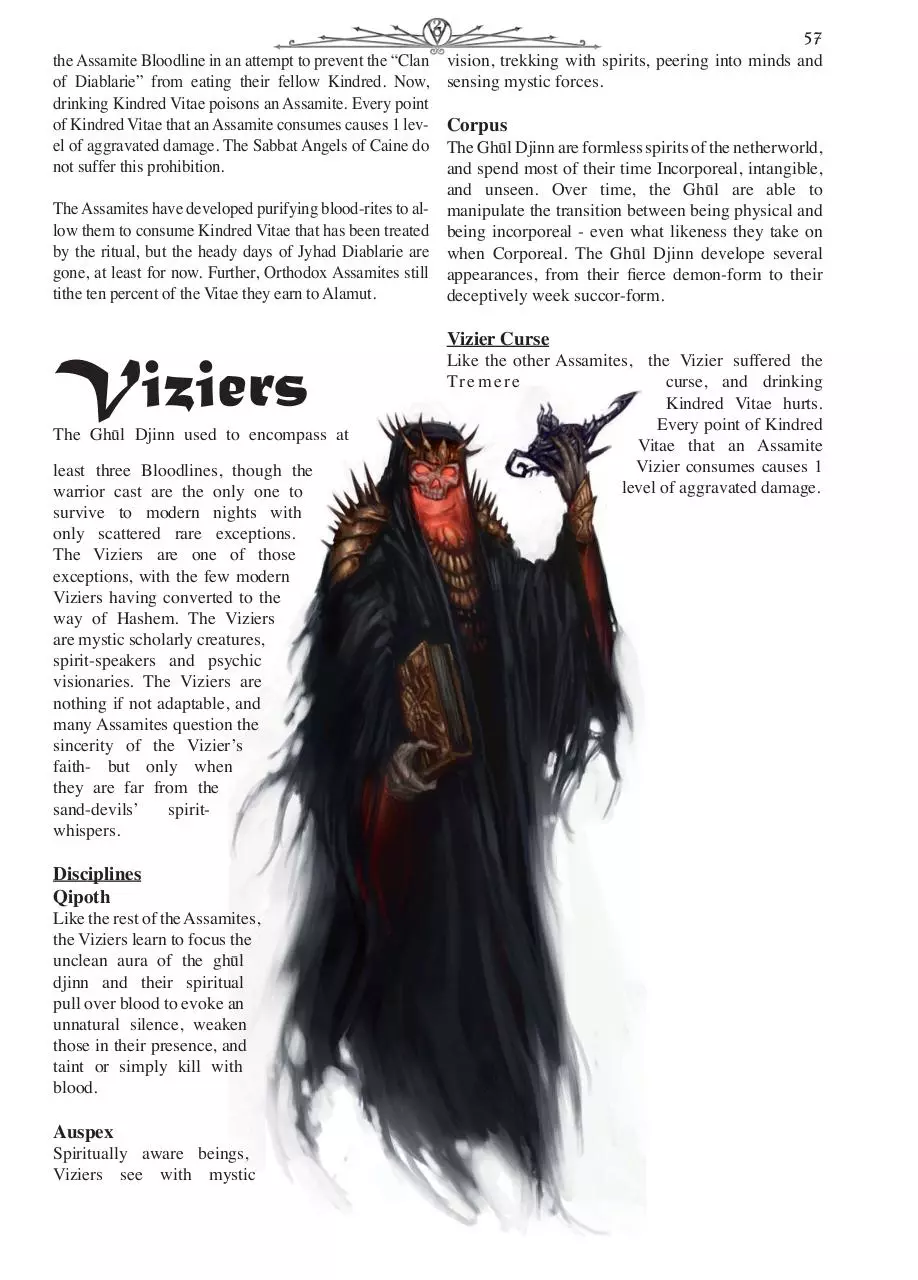
Viziers
The Ghūl Djinn used to encompass at
least three Bloodlines, though the
warrior cast are the only one to
survive to modern nights with
only scattered rare exceptions.
The Viziers are one of those
exceptions, with the few modern
Viziers having converted to the
way of Hashem. The Viziers
are mystic scholarly creatures,
spirit-speakers and psychic
visionaries. The Viziers are
nothing if not adaptable, and
many Assamites question the
sincerity of the Vizier’s
faith- but only when
they are far from the
sand-devils’
spiritwhispers.
Disciplines
Qipoth
Like the rest of the Assamites,
the Viziers learn to focus the
unclean aura of the ghūl
djinn and their spiritual
pull over blood to evoke an
unnatural silence, weaken
those in their presence, and
taint or simply kill with
blood.
Auspex
Spiritually aware beings,
Viziers see with mystic
Vizier Curse
Like the other Assamites, the Vizier suffered the
Tr e m e r e
curse, and drinking
Kindred Vitae hurts.
Every point of Kindred
Vitae that an Assamite
Vizier consumes causes 1
level of aggravated damage.
�
58
Rakshasa
The Undead lords of India, the Rakshasa are demons
of dreams, illusion, and lies. There they stand over
the Salubri, Nagasura (Indian Setites), and Kueijin in the Court of Infinite Thunders. They’re great
eastern empire, the vampire kingdom of Lanka (the
mortal lands once ruled from Lanka, the Hell of
Living Nightmares), spans from the edges of the
Middle East, through the Indus valley, across the
Ganges river and into the far reaches of the orient,
though to most Kindred, it doesn’t even exist. The
Rakshasa spread throughout Europe and Asia in the
guise of other Kindred- appearing as creatures
resembling
Succubae,
Gangrel,
Trashing-Dragons and many others,
and to the eyes of onlookers, they
are simply odd yet familiar Kindred
travelers.
Mystic creatures that know more of
the nature of the world than they
want to, they can choose to believe
the delusions that shroud them
from truth so strongly that the world
appears to bend to their imaginings.
The Rakshasa know that Kindred are
locked perpetually outside the cycle
of the universe. Whereas most beings
are reincarnated through Samsara,
the attachment to the drama of life, the
unfinished business that draws us back to life
and the continual entanglement with the world
that keeps us in the cycle of death and rebirth,
Kindred have eluded that cycle. When a person is so
entangled and stagnantly attached to this petty life,
that attachment can grow so strong that they remove
themselves from the cycle of life, death and rebirththey perpetuate as Undead creatures, to stagnant to live,
to stagnant to die, they can only animate themselves
with the life-force (Sakti) of others. This makes them
destined for the Embrace, the outward manifestation
of this spiritual turning point. While western Kindred
may think that the Embrace is inflicted on or gifted
to a Childer, the Rakshasa know that the destiny
(Karma) of each person is just a reflection of their
inner state. After all, the Embrace doesn’t guarantee
a prospective Childer’s transformation and some
Kindred rise again without need of a Sire. Every
individual has his own purpose in this life, their
Svadharma. Vampires, excluded from the cycle, have
lost theirs. In place of the dharma they once followed,
each Kindred must now try to advance Maya (the
world-illusion, the delusion and un-enlightenment
that gives rise to this world of petty existence in each
of us), hopefully understanding it in the process and
finally penetrating the great illusions that shroud
Ultimate Truth from their eyes. The means by which
the Rakshasa undertake this cyclical advancement,
however, is by selective deception. Other vampires
look upon the Raskshasa as untrustworthy, and can
hardly be expected to take the advice of these illusion
masters. As such, the Raskshasa have had to resort
to elaborate ruses in order to get other vampires - or,
indeed, anyone with whom they come in contact at all
- to undertake a course of action. Raskshasa see their
Undead state as a curse, like many other Kindred.
However, the Raskshasa believe this
shruti (what has been learned from
the gods) to be due to their failure to
understand Maya. Other Kindred, also
removed from the karmic wheel, fail to
realize the necessity of their return to
the cycle. The Raskshasa understand
this - and expedite their return by
destroying them.
The Rakshasa are the children of
Ravana, lord of Maya. Ravana was a
mystic, a priest who, on the precipice
of enlightenment, instead chose eternal
delusion, entanglement and the illusion
of power. The ancient Hindu holy text,
the Ramayana, tells of the savior Rama’s
battle with Ravana the demon lord of Lanka,
and of Rama’s struggles with the delusion
of entanglement with this world on his road
to enlightenment. Ravana’s powers have no end.
Shapechanger, dream weaver, to Ravana even hell is
heaven, and even heaven is the same painful hell as
the rest of this transitory world.
�
59
some odd tell, showing these illusions to be unreal;
hands or feet that appear backwards, phantom water
or flame flowing in reverse, objects that fall too
slowly or writing that reads as gibberish. Further,
manifestations of the Beast haunt their illusions; a
savage starving bloodthirsty tiger stalks the walking
dreams they inflict on others. Truthfully, the tiger is
them.
Beneath their illusions, Rakshasa are Undead, stagnant
and unchanging, their flesh holding the bluish hue of
a drowned corpse. Most, however, appear drastically
different form their stagnant true form. Rakshasa live
in their own illusions and most of the ancients can’t
even remember their own face through the masks of
their magical dreams.
The Rakshasa hail from the most ancient cities in the
world, a pointless trail of endless repetition. They’re
in every corner of life, unnoticed. The Rakshasa have
spread far and wide, insinuating themselves into the
societies of Kindred throughout the world, appearing
strangely like the native vampires of the region.
In India they are princes of unreal worlds. They
bred families of human servitors [yatu-dhana, bred
Ghouls] and spread to the west with Gypsies, and
to the orient as sorcerers. This deception is perhaps
the only thing that keeps the Rakshasa from being
universally hunted, for being in the presence of one of
these dream-weavers is a terrifying experience, where
nothing is real and life is an unending nightmare.
Still, their control is not absolute. There is always
The Rakshasa are creatures of vice, compulsion and
obsession.
- The dreams-made-real by the Rakshasa always
have a disturbing tell, some incongruity that shows
the unreal nature of their illusions. This tell is
compulsive, though usually very discrete. Anyone
observing the illusions cast by a Rakshasa can make
a Wits + Enigma’s roll at a difficulty of the caster’s
Blood Potency to notice a tell (though this will not
dispel the illusions, only hint at their unreal nature).
- A bloodthirsty tiger stalks the dreams given life by the
Rakshasa. Each Illusion cast is marked by the Beast, a
sign of the man-eater, which shows their true nature.
This sign of the tiger often shows on a Rakshasa’s
personage (vertically slit pupils, bright golden hungry
eyes, fiery stripes, a tigers tail, or a low growl that
haunts their voice). Though many Rakshasa embrace
this motif, they often try to repress this sign out of
self-denial or fear that the tiger will expose the nature
�
60
The Lexicon of Lanka
Avidyā: Ignorance; the tradition of deception among the Rakshasa and
the Infininte Thunders Court that has convinced the people of India that there
vampires do not really exist, disguising the Kindred’s continued nocternal
activeties from modern eyes; the Masquerade.
Dharma: Right action, dharma is not a fixed coad of behavior, thought
or action, but rather is a form of situational ethics; dharma is synonimous
with moral or spiritual teachings. Following dharma is generally thought to
be the path to spiritual progression through the Karmic Wheel. The Rakshasa
dharma, called the Mayapisatya, is the persuit of a return to the wheel by
understanding Maya.
Kuei-jin practice a self-refining Discipline called Dharma (with a capital “D,”
as opposed to the general term for moral teachings- dharma), which they
learn in tandem with one of several moral Paths of Identity, elevating and
transforming them from Thin-Blooded Catifs into higher Blooded creatures.
The Infinite Thunders Court: The Kindred poitical bodies
of India.
Lanka: Found in the spirit world along the River of Blood, Lanka is the
realm of Ravana, the Hell of Living Nightmares. All Rakshasa experience
an instant in Lanka at the moment of their transformation, where they are
spiritual reborn as demons. All things pulse with the blood of the river in the
shifting realm of Lanka. In the age of legends, Hanuman burned Lanka to a
sinder, and now the realm is a husk of its former majesty.
Lanka can also reffer to the earthly lands of India and surrounding territories,
which were once concoured by the Demon King.
Karma: Fate, Destiny; The rebounding effects that one’s inner-self, one’s
actions and one’s impact on others has on eachother. The repercusions of
previous phases of one’s existance have on sucessive phazes or incarnations.
It is the beliefe of most Rakshasa that becoming a vampire was their Karma,
and the result of an inner spiritual turning point that they had reached. The
Karmic Wheel, aka the Wheel of Ages, is the track of designy, the natural
cycle of life, death and rebirth.
Maya:A) The transitory, manifold appearance of the material world,
which maskes the undifferentiated spiritual force, the trancendant true
reality, from which maya originates; the illusory appearance of “reality.’ The
great world-illusion, the dream of existance.
B) The power of a god or demon to transform a concept into an element of
physical reality.
The Mayapisatya teaches that the Rakshasa must understand the illusury
nature of Maya to return to the Karmic Wheel.
Pisacha: Devil Rajas; Nightmare obsessed warrior-king Rakshasa.
Ravana: The Rakshasa Demon King of legend. Ravana was a yogi
and mystic who gained immortality from the gods, created the Hell of
Livign Nightmares from his own delutions and concured the heavens, the
underworlds and earth. Progenator of the Rakshasas, counted by the WanKuei as a Yama King and by the Cainites as an Antideluvian.
Sakti: The active creative energy of the universe.
The magic that a Kindred refines from the life-force they feed on;
Blood, Yang Chi, Animae, Vitae.
Vetala: The iconic Rakshasa descever, merchant of false wonders and
pliers of the devil’s-deal, the Vetala have spread to the east and mimic the
Kuei-jin found there.
Yatu-dhana:A
human witch or sorcerous devotee or servitor of
Ravana that derives their power from one or moe Rakshasa, often simply by
drinking Rakshasa blood. A member of a human family that decends from
the worshipers of Ravana and his Rakshasa children; A Ghoul, often a born
ghoul, mortal vampire or dampyre.
of their illusions. Once per scene, a Rakshasa may
spend a Willpower point and roll their Self-Control
at a base difficulty of 6 (though the closer a Rakshasa
is to frenzy the higher this difficulty will rise). If
successful, that Rakshasa can avoid showing the tiger
in their Illusions for the rest of the scene, though it
will always return.
- Each Rakshasa has a specific vice, ranging from
plagiarism to mass-murder. When the opportunity to
indulge that vice is present, Rakshasa must succeed
in a Self-control check to avoid indulging in that vice.
�
 Historical archive . public document