66
Ravnos
In the bygone nights, Rakshasa
took their yatu-dhana, bottomfeeding human worshipers
of Ravana, twisted by the
demon king, and bred them
into debased human lineages
to serve at the Rakshasa’s
command before their soul’s
eventual journey to Lanka. Yatudhana families traveled out of India, feeding,
protecting and bearing their demonic patron to
new lands as magicians and gypsies. There, in
these new lands, the Rakshasa and their Childer,
drawn from their yatu-dhana servitors, took on
the appearance of the native Kindred.
The Ravnos are both a jati
(bloodline) of western
Rakshasa and a tribe
of Romani (Gypsies)
that have traveled the
world as dispossessed
cutthroats, magicians
and thieves. The
Ravnos family are
largely responsible
for the negative
stereotypes of the Gypsy people that have
plagued and hounded them throughout
the ages. The Rom still carry the old lore
of spirits and night-creatures from
the ancient past, not falling into
the ignorance that the age of
“reason” brought. Though
they’ve
adapted
their
spiritual knowledge to the
Islamic and Christian lands
they’ve traveled, they still learn
the wisdom of the Death-Mother
(Kali) as Sarah, practice folk-shamanism and
placate the Mulo (spirits of the dead). Romani
legends warn of revenants, Shilmulo, that
return from death to plague or protect their
living families, and the Ravnos are indeed
protective (and possessive) of their
living descendants. The Gypses do
value the Ravnos family as Dampyres,
the living children of the Mulo, gifted
as mediums with the spirit-sight and
as half-vampires possessing great
longevity. The Ravnos family are the
underworld witches of the Gypsies,
and act as go-betweens for their living
kin and the creatures of the underworld.
The human Ravnos tend to live in
extremes, even for the Rom. Passions
burn brightly, and they hold their livefor-the-moment attitude as dear as the
gaje (non-gypsies) clutch their remote
controls. But the other side of this coin,
and perhaps the driving force behind
their determination to reach new heights
of head-spinning intoxications and
trickery, arises from two sources. The
first of these threats stems from within
the family itself. The Ravnos family is
named for the first Shilmulo, the great
ancestral trickster-god, Ravana. Since
then, the number of Romani vampires
has grown, and all are members of the
Ravnos family. Even if a Gypsy from
another family is taken by a Ravnos in the
tumnimos (the Embrace) she is from that
time forth a member of the Ravnos.
These vampires can seek any of the Ravnos
family for aid whenever necessary. As such,
the Ravnos are careful that their homes,
vans, trailers, and wagons have at least one
�
place where no sunlight can ever reach. Sometimes a
particular Shilmulo will adopt a kumpania (a nomadic
group of young Rom, usually siblings and cousins)
and travel with it, too often feeding on his own kin.
Ravnos vampires who feed on Gypsies have to fight
their own form of addiction, as the Ravnos family were
bred for millennia to possess intoxicatingly potent
blood. In fact, many Ravnos are born
as livingvampires, aging more and more
slowly as the years stretch
into decades, and
eventually
rising
again as revenants,
without need of
the
tumnimos
(the
Embrace).
Similarly, many
young Ravnos get
off on drinking
the blood of the
Shilmulo, becoming
addicted to the power
and highs the Shilmulo blood
grants. Still, most Ravnos fear
the attentions and ministrations
of their vampiric kin. However,
Ravnos are family, whether
mortal, kindred, gypsy or no, the
Ravnos shall always aid their fellow
kin. In the European genocides of the
Holocaust, it’s said that ancient Ravnos
nightmares rose to slake their thirst on Nazi
concentration camps, awakened by the mass
slaughter of their mortal descendants.
Though Undead, the Ravnos dream-form appears
to be an Unliving underworld creature. In the Middle East, they became a demonic prize of Kindred
harems and court performers. In the thirteenth-
67
century, the Kindred scholar Antonio
DeMacci mistakenly
described the Ravnos
as an eastern line of
Umpyre Succubae, feral shape-shifting concubines of the Slavic
black-forests. In fact,
at first glance even
the Voivode had considered them a line of
eastern Gangrel, until
in their dungeons they
found that dreams
don’t bow to the flesh.
Among the Gypsies, Ravnos have passed down the
knowledge of the Rakshasa’s dharma (mayapisatya) as
the Path of Paradox- deceiving to gain understanding,
advancing dilution as a means to return to the natural
cycle of the world and destroying Kindred that cannot
see the need for their return. The vampiric Ravnos have
rejected the laws of Camarilla society and choose to
live in a democracy, though those under Camarilla law
consider them anarchs, though they are a scattered faction unto themselves, independent of the great western Sects.
Disciplines
Chimestry
Rakshasa are phantom-sorcerers and dream-form shapechangers. Profoundly connected to the illusory
nature of the world,
they use that connection to evoke
illusions
and
delusion in all
those in their
presence. Masters of waking
dreams,
they
weave the life-force they’ve
gathered into powerful illusions, some so powerful that
they are real.
Ferality
Ravenous beasts, animals driven by
hunger and want, the Rakshasa have a
spiritual connection to the feral preda-
�
68
tors of the world who share in
their base drives.
Fortitude
Stagnant and unchanging,
the Rakshasa are immune to
harm, resisting even the rays
of the twilight sun and the
burning touch of flame.
Ravnos’s Curse
Though they are attracted
to all forms of vice and debauchery, in addition to their
particular vice all Ravnos are
compulsive liars. While not
every word out of their mouth is untrue, in any given
scene, a Ravnos must tell at least one significant lie,
though a successful Self-Control roll will enable them
to choose when and what untruth they will tell in the
scene- enabling them to disguise their compulsion as a
joking obvious mistruth.
Mephisto
The Devil’s Deal
To the Ravnos, Ravana the Demon King of Lanka
is known as Mephisto, the Devil. Unlike the distant
sleeping lord of illusions known to the Rakshasa
of the east, the Devil walks with the Ravnos, the
shapechanging trickster and caddish dark rough that
tempts humanity and Kindred alike with his doubleeged deals. Far from the incarnation of evil, the Devil is an enlightened grifter, a con-man ensnaring the
wicked by thier own foolish desires through the Devil’s Deal. Though he comes to grant wishes, such bargans always result in the wishers suffering, often by
giving them exactly what they want. Each Ravnos, it
is said, has made the Devil’s Deal to defy death. This
has left them as the Devil’s brood, offering the Devil’s
Deal to others, and through this, teaching them wisdom by the suffering they gain from their own foolish
desires. The Ravnos are themselves trying to get the
better of the Devil and escape the damnation of their
Deal by learning the wisdom of mortality through the
leasons they teach others. Each of the Ravnos can attest that their is only one way to win the game of the
Devil’s Deal - don’t play it. Still, each one of them
still believes they can get the better of their bargan,
thinking they can out-wit the Devil. Mephisto’s illusions are so powerful that they are reality, and he has
the power to edit the world as needed. Wealth, love,
power, revenge, and even resurection of the dead; the
great deciver is always ready to make a Deal.
�
Salubri
(Devasura)
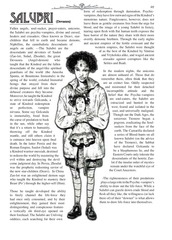
Fallen angels, soul-sucker, prayer-eaters, unicorns,
the Salubri are psychic-vampires, divine and cursed,
healers and crusaders. Once known as Deavi, starchildren that fell to earth and became demons;
Niphillim, the cannibalistic descendants of
angels on earth; ---The Salubri are the
descendants and devotees of Saulot
(Zao-lot, Sulad, Zhoalut), the great
Devasura
(Angel-demon)
who
taught that the Kindred are the fallen
descendants of the angel-like spiritual
guardians of the world (the Amesha
Spenta, or Bounteous Immortals) in the
spring of the world, exhaled Immortal
beings that strayed from their
divine purpose and fell into the
debased creatures they became.
Moreover, he taught the Kindred
to strive towards Golcanda, a
state of Kindred redemption
or
perfection,
vampire
nirvana. Some say Golcanda
is immortality, freed from
the curse of predation to bask
in the sun, while other say
that it’s a return to humanity,
throwing off the Kindred
mantle, and still others claim it
is entrance into heaven upon final
death. In the latter Persia and the
Roman Empire, Saulot (Sulad) was
a Kindred warrior-messiah, destined
to redeem the world by mastering the
evil within and destroying the devil
come judgment day. In Persia, Zhoalut
was the prophetic redeeming savior of
the now star-children (Deavi). In China
Zao-lot was an enlightened demon sage
who taught the Kindred to mastery their
Beast (Po’) through the higher-self (Hun).
Those he taught developed the ability
to freely channel the life-force they
had once only consumed, and by their
enlightenment, they gained their most
distinguishing and conspicuous featurea vertically slit third-eye opened on
their forehead. The Salubri are Unliving
oddities, each searching for their own
69
form of redemption through damnation. Psychicvampires, they have few outward signs of the Kindred’s
monstrous nature. Fanglessness, however, does not
leave them as gentile creatures free from the urge for
blood, and the image of a young Salubri in frenzy,
tearing open flesh with flat human teeth exposes the
base horror of the nature they share with their more
overtly demonic brethren. Through the early nights
and ancient empires of the fertile croissant and the
western empires, the Salubri were thought
of as the best of the Kindred by Ventrue
and Vrykoloka alike, and waged ancient
crusades against corruptors like the
Setites and Baali.
In the modern nights, the unicorns
are almost unheard of. Those that do
remember them, often think that they
are an extinct line. Oddly suspected
and mistrusted for their detached
incorruptible attitude and the
belief that the Psychic-vampires
are soul-eaters, the Salubri are
ostracized and hunted in the
west, feared and isolated in the
east, and universally maligned.
Though out the Dark Ages, the
sorcerous Tremere began a
pogrom, eradicating the Soulsuckers from the face of the
earth. The Camarilla declared
a series of Blood-hunts on all
known Salubri (on the advice
of the Tremere), the Sabbat
have declared Golcanda to
be a blasphemous lie, and the
Eastern Courts only tolerate the
descendants of the heretic Zaolot if the insular order of mystics
remain under the watchful eye of
the Court Ancestors.
-The righteousness of their predations
plays a large role in the Psychic-vampire’s
ability to draw out the life-force. While a
Salubri can guzzle down crude blood and
flesh all they like, the willingness (or lack
there of) of their “downer” is what allows
them to draw life-force into themselves.
�
70
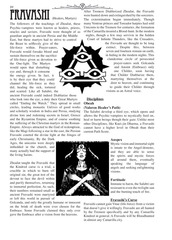
After Tremere Diablerized Zhoalut, the Fravashi
were hunted down and extinguished by the sorcerers.
(Healers, Martyrs)
The extermination began immediately. Though
The followers of the teachings of Zhoalut, these many Ventrue princes and Toreador harpies had sold
Psychic-vampires were known as healers, priests, Unicorns to the Tremere for centuries, the formation
oracles and saviors. Fravashi were thought of as of the Camarilla insured a Blood-hunt. In the modern
nights, though a few may servivie in the hidden
guardian angels in ancient Persia and the Middle
Court of Infinite Thunders, like the Crusaders,
East, but these martyrs had to strive to control
the Frevashi are thought to be long
the Beast to selflessly give of the
ext
extinct. Despite this, between
rs,
life-force within. Prayer-eaters,
sev
seven and fourteen remain on earth,
nd
Fravashi would forsake blood and
in
hhiding in the modern nights. This
sustain themselves on the sacrifice
cl
clandestine circle of persecuted
of life-force given as devotion to
prayer-eaters seek Golcanda
the One-light. The Martyrs
and Anoint (Embrace) only
would open that disturbing
one Childer, soon having
eye and, through it consume
that
Childer Diablarize them,
the energy given. In fact, it
martyring themselves at the
is by their eye that they could
door to heaven, and continuing
y
channel the life-force as they
to
guide their Childer through
d
did, healing the sick, tortured
vis
visions as an Astral voice.
and scarred. Like all Salubri, the
bl i those
h
ancient Fravashi could indeed Di
Diablarize
Disciplines
who look into the eye, a duty their Great Martyrs
called “Ending the Watch.” They spread in small Obeah
circles, leading monastic Unlives of good works (Valeren Healer’s Path)
and scholarly wisdom in India and Persia, studying The Salubri develop a third eye, which opens and
divine lore and redeming secrets in Israel, Greece allows the Psychic-vampires to mystically feed on,
and the Byzantine Empire, and of course soothing heal or harm beings though their gaze. Unlike most
the suffering of the Christian martyrs in the Roman- other Disciplines, like Kuei-jin Dharma, a Fravashi
Empire. Always attracted to the God of redemption, cannot have a higher level in Obeah than their
like the Magi following a star in the east, the Persian current Path Score.
Fravashi courted the divine light at the fringes of
early Christianity. By the Dark
Auspex
Ages, the unicorns were deeply
Mystic vision and immortal sight
imbedded in the church, and
is innate to the Angel-demons,
many actually had the support of
and they are able to sense
the living Saints.
the spirits and mystic forces
all around them, eventually
Zhoalut taught the Fravashi that
speaking the language of
the Kindred curse is a trial, a
angels and seeking enlightening
crucible in which to burn off
visions.
original sin, the great test of the
devout to face the devil within
Fortitude
and purify themselves, returning
Immune to harm, the Salubri are
to immortal perfection. As such,
resistant to even the twilight-sun
their numbers remained small as
and the burning touch of fire.
ancient Fravashi were martyred
or left this world in pursuit of
Fravashi’s Curse
Golcanda, and only the greatly humane or innocent Fravashi cannot gain Vitae (life-force) from a victim
on the brink of death were ever chosen for the that doesn’t give it willingly. Fravashi are all hunted
Embrace. Some Fravashi claimed they only ever by the Tremere specifically and by any Camarilla
gave the Embrace after a vision from the heavens.
Kindred in general. A Fravashi will be Bloodhunted
Fravashi
in almost any Camarilla city.
�
 Historical archive . public document