96
My Drinking Problem
The crux of the matter, really, is that drinking blood
not only allows me to perpetuate my existence, but
also provides a sensation unlike anything else this
world has to offer. What is it like? My dear, words
cannot describe it. Imagine drinking the finest champagne and the sensation of the most sensual lovemaking you’ve ever experienced. Overlay that that with
the rush the opium fiend feels as he takes that first
breath on the pipe, and you begin to have some sense,
some tiny, infinitesimal sense of what it feels like to
drink the blood of a kine - excuse me, a living human
being. Your modern-day addict will lie, steal, cheat
and kill for their little tickets to Heaven. Mine is better, and it makes me immortal besides. Can you imagine the deeds I might commit to feed that hunger?
Don’t bother speaking possibilities; the truth that you
can imagine. And I am considered to be a gentleman
of my kind. Now imagine, if you will, some of my relatives, the ones who aren’t so nice as I. They can - and
do - commit acts that even I don’t wish to consider.
And here you are, poor little
mortal, learning
how fragile your whole existence is.
Are you starting to be afraid
yet? You
should be.
The Blood is the Life
Vampires use their blood (also called
Vitae) for a variety of purposes, the
most fundamental of which is that
vampires must use blood (or the lifeforce contained within it) to get up
and move; every night, vampires expend a certain
amount of their accumulated blood-energy to rise.
Vampires can reconstitute or heal wounds to their
body by using their reserves of blood. In addition,
vampires can use the life-force of blood to enhance
their physical attributes, becoming inhumanly
strong, fast or enduring for a time, and to fuel their
supernatural Disciplines. Vampire blood is used to
perform the Embrace, passing on their vampirism by
replacing a mortal’s blood with the Kindred’s own
Immortal blood. Further, a vampire’s blood can be
given to a mortal creature to ‘enchant’ it, arresting the
aging process in that mortal. Finally, Kindred Blood is
terrifically addictive, and consuming it is like taking a
powerful mind altering drug.
Immortal beings, Kindred cannot generate their own
blood as they are unable to directly tap the well of
life; that is the birthright and nature of mortality.
Thus, blood is generally replaced by sucking it out
of humans. While vampires can feed on animals, they
do not enjoy the taste of it and older vampires will acquire no sustenance from it. The life-draining process
of taking blood is often called ‘the Kiss’ and through
this Kiss, many vampires can hide the puncture marks
of fangs by drawing up the life-force of their victims,
causing them to heal those minor wounds made during feeding. Vampires do not have to completely drain
a victim, although frenzying vampires are likely to do
so.
The feeding process is highly pleasurable (arguably
the only pleasure) for vampires, and can be an extremely pleasurable for victims. The Kiss is the process of drawing out a victims blood, and is more than
simply taking the material liquid from their veins.
Those that experience being fed on through the Kiss
feel as if a current of energy is running through their
body, usually a paralyzing experience; for some,
being fed on causes muscular clenching that runs
through their whole body, while others feel their body
loose all force of motion, releasing themselves into
the grip of the predator. While the Kiss of some Kindred is orgasmically pleasurable, the Kiss of others is
dreadfully painful.
Though Kindred need blood to animate themselves, if deprived of blood, a
vampire will not expire; they
are Immortal. A “starving” vampire grows closer and closer to
a monstrous rage as the Thirst
drives them mad, until the night they
no longer have the blood within htem
to animate htemselves, at which point
they simply remain in slumber, entering
the death-like slumber of the ages, called
Torpor. Kindred can ramain in Torpor for centuries, millinia or indefinatly, awaiting the blood they
need to rise again.
Once taken in, a vampire transforms their victim’s
blood, extracting its life-force and distilling that blood
into the vampires own cold thick essence; Vitae.
Vitae
In its most basic sense, Vitae is a term modern western Kindred might use to refer (wrongly) to blood in
general, but specifically Vitae is Kindred Blood; the
Blood of the Immortals.
A Latin term for “of life,” which first came into vogue
among the Ventrue of the Roman Empire, Vitae is the
primal essence of blood; more than just the physical
substance, Vitae is the concentrated life-force within
it. The “blood” in a vampire’s body is so much more
than the red syrup of plasma, platelets, hemoglobin
and hormones that courses through mortal veins. Kin-
�
97
dred feed on the tepid life-force of mortals, distilling
it into a concentrated serum of Immortallity, a magical fluid of great power.
While the terms Animae (Greek; animating-energy)
and Prana (Sanskrit; breath-energy) may be used to
refer to Kindred Blood, these terms can refer to anyone’s blood and to all life-force in general, even the
subtle energy that courses through even inanimate
objects, as evident in the swirling radiant auras that
permeate the whole world and the flux of forces seen
on the Astral Plane.
Red & Black
The energy of existence springs from creation, emerging from raw infinite potential, giving rise to and
flowing through the patterns of the world, eventually
resolving and ebbing into the Great Unmaking. This
spiritual force is known by many names;
S`a, Ojas, Akasha, Quintessence, Chi. For
Kindred, this energy is known in its form
as the life-force (and death-force) in
people; Prana, Animae, Vitae. Vampires’ bodies act as cauldrons,
collecting and refining Chi into
their various ichors and bodily
humors. Chi absorbed by a vampire permeates the creature’s
corpse. It moves through their
flesh as a thick Red liquid or a
cold Black ichor.
Red
Yang Chi is the “kinetic” energy of life,
known to some as Ka or Sakti; it is the lifeforce energy that all Kindred extract from their living
prey and concentrate within themselves to animate
their body and ‘live’. It constantly seethes, constantly
crackles from point to point, and constantly transforms itself. It flows through raging rivers; it rides on
summer storms. It is present in the kiss of a lover and
the spring of a tiger. Kindred, who are so cut off from
the normal cycles of the world, find Yang Chi to be a
heady, often euphoric, stimulant. Yang Chi undergoes
some changes in the vampiric metabolism. Vampires
may use “positive” Chi, but such Chi is a far cry from
the relatively “pure” Chi found in a newborn baby or
the light of the sun. Yang Chi of the sort used by Kindred is known as “Scarlet” Chi; it is a fierce, roiling
energy, the distilled essence of torment, rage and lust.
This scarlet Chi manifests as a seething, effervescent
liquid that flows freely through the Kindred’s corpse.
The Blood-Points contained within Kindred are always ‘Red’ unless otherwise noted.
Black
Yin Chi, by contrast, is the “potential” energy of Oblivion: energy at rest or in a passive state. Yin Chi
also encompasses the energy of terror, depression and
other “negative” emotions. At its ultimate level of
development, Yin Chi is the energy of death, and it
permeates the various levels of the Underworld. Most
Kindred are unable to tap the decaying energy of Yin,
though the Vrykolaka, and of course, the dreaded Nagaraja are known to be able to yoke this dark force,
alternately known as Tomas, Ghost-Blood or entropy.
The Discipline of self-refinement, Dharma, enables
Eastern Kindred to consume and direct Yin deathenergies as well, but this energy is far from pure, and
the Yin Chi consumed, used and contained within
Kindred is simply the darkest, dead-est flavor of the
life-force. Yin Chi tends to “coagulate,” to mystically
accumulate in sites suited to it, such as graveyards,
abandoned buildings and plague-ridden shantytowns. In contrast to the “kick” of Yang,
vampires find Yin to be a sort of
narcotic: dark, soothing, deceptively intoxicating. Yin Chi, per
its nature, congeals into a viscous, blackish liquid. Kuei-jin
refer to this stuff as “Black”
Chi.
The amout and strength of lifeforce a being contains is usually
measured in “Blood-Points.” An
adult mortal human contains about 10
Blood-Points, though for each Healthlevel they loose to sickness or injury, 1 BloodPoint is lost as well. This is not because the
volum of blood in their body has nessesaraly
gone down, so much as their blood no longer holds
as much life-force within it. As the human heals, they
replenish their Blood-Points. Kindred contain BloodPoints as well; those taken from their victims, now
transformed into Vitae. The amount of Vitae within
a Kindred is likewise measured in Blood-Points of
Vitae, Sakti, or Chi. Most Kindred must spend 1
Blood-Point each night to rise from their slumber, and reemerge into the living world.
Similarly, a Kindred can spend 1
Blood-Point to heal/reconstitute
one of their Healthlevel. Generally, 1 Blood-Point is equal to a pint
of blood, though the Vitae of the
ancients is much thicker and
even a drop can hold many
�
98
Blood-Points.
Thick and Thin
Blood Legacy
available to them in their flickering life-spans to dedicate to developing those Abilities. Thus, mortals are
typically limited to a maximum rating of 5 in any of
their Abilities. While a Kindred can spend litterally
hundreds of years training themselves in sword-play,
most will tragically find that their developement of
their skill hits a glass-ceiling, a point at which, no matter how much more time they dedicate to it, no matter
how diligently they train, and no matter how much
effort they put into developing those skills, they cannot reach any higher heights than they have already
gotten. This is because, sadly, a Kindreds personal
potencial is not their own. The potencial of a vampire
is the strength of their Legacy , their capacity for development is limited to the strength of their vampiric
inheritance, despite the centuries of Immortality they
may dedicate to reaching for greater acheivements.
This becomes all the more dire when you consider
that a Kindred’s Disciplines work much like Skills do,
and thus a Kindred’s level of mastery of their Disciplines is also limited to the maximum ratings of their
Legacy . While Kindred of weaker Blood are often
limited to the heights of mortal achievment of just one
breif life-time, the Thick Blooded Ancients can attain
a level of mastery of even mortal skills that seem
superhuman, and their greater Legacy lets them develope their Disciplines to nearly god-like heights, giving them vast and profound controle over the hords of
their weak blooded descendants.
Not all Kindred are created equal. The Blood of some
Kindred is drop for drop, thicker, stronger and more
potent than other, thinner blooded Kindred. This is because some Kindred have gained a stronger vampiric
inheritance than others. The measure of a Kindred’s
vampiric inheritance is reffered to as their Blood
Legacy, alternatly called a Kindred’s Generation by
Cainites, but is usually simply refferred to as the relative Greatness or Thinness of a vampires Blood.
Kindred of Greater Blood can contain more life-force
within themselves, having more Vitae, though not
possessing a larger volume of blood in their flesh.
But, should they Embrace, the Legacy they pass on
will be deminished by one step. In this fashion, each
Generation thins the Blood, untill all strength of vampiric Inheritance are lost; the truly Thin-Blooded cannot make Blood-Bonds, have none of the destinguishing characteristics of the Bloodlines of the Kindred
kind, and they cannot Embrace another generation.
The Thin-Blooded are genaric creatures with no Disciplines inate to their breed. For this reason, Cainites
reffer to The Legacy of the Blood as Generation, and
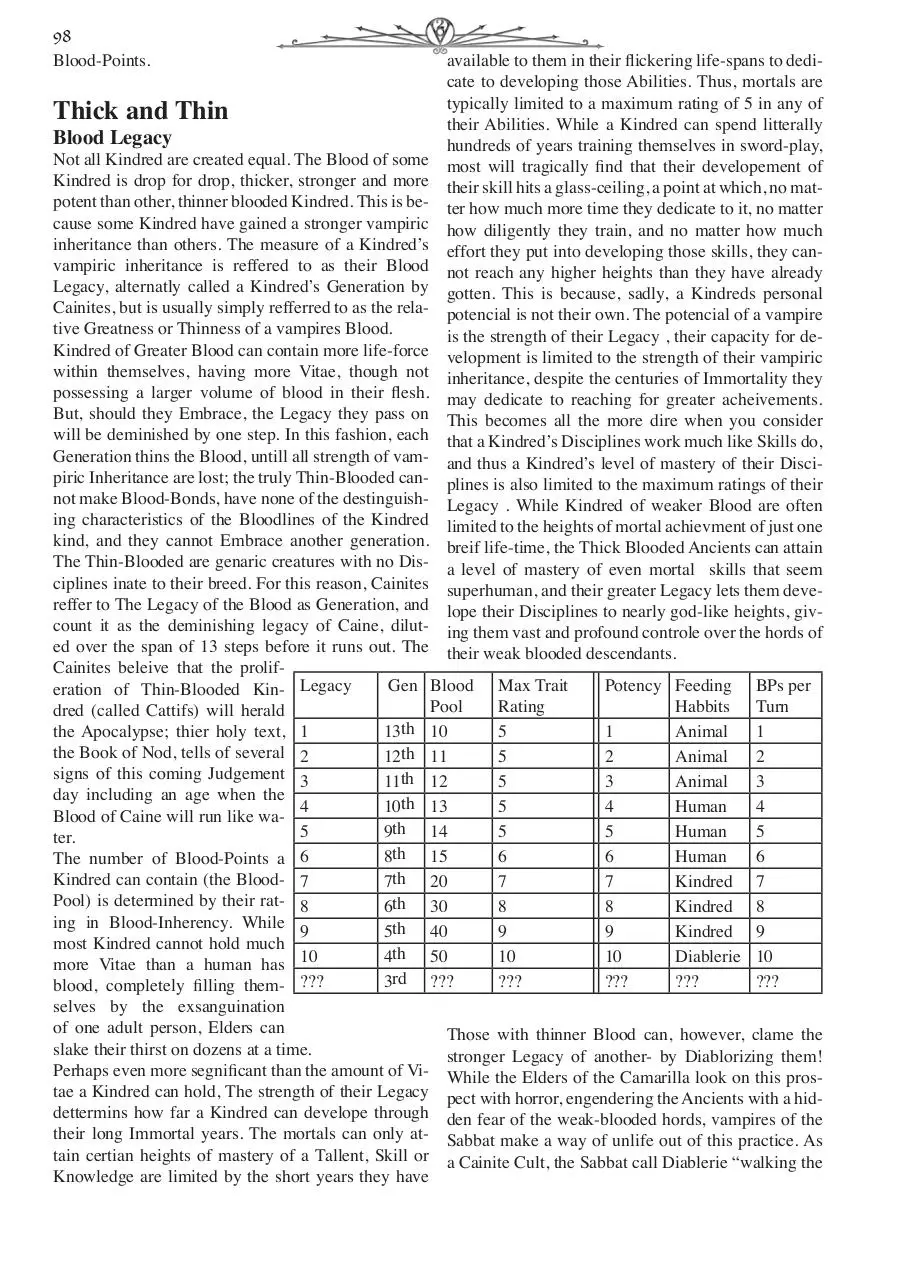
count it as the deminishing legacy of Caine, diluted over the span of 13 steps before it runs out. The
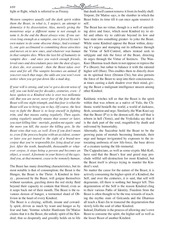
Cainites beleive that the prolifGen Blood Max Trait
Potency Feeding BPs per
eration of Thin-Blooded Kin- Legacy
Pool
Rating
Habbits Turn
dred (called Cattifs) will herald
th
the Apocalypse; thier holy text, 1
13
10
5
1
Animal
1
the Book of Nod, tells of several 2
12th 11
5
2
Animal
2
signs of this coming Judgement 3
11th 12
5
3
Animal
3
day including an age when the
4
10th 13
5
4
Human
4
Blood of Caine will run like wath
5
9
14
5
5
Human
5
ter.
8th 15
6
6
Human
6
The number of Blood-Points a 6
Kindred can contain (the Blood- 7
7th 20
7
7
Kindred 7
Pool) is determined by their rat- 8
6th 30
8
8
Kindred 8
ing in Blood-Inherency. While
th
9
5
40
9
9
Kindred 9
most Kindred cannot hold much
4th 50
10
10
Diablerie 10
more Vitae than a human has 10
3rd ???
???
???
???
???
blood, completely filling them- ???
selves by the exsanguination
of one adult person, Elders can
Those with thinner Blood can, however, clame the
slake their thirst on dozens at a time.
stronger Legacy of another- by Diablorizing them!
Perhaps even more segnificant than the amount of Vi- While the Elders of the Camarilla look on this prostae a Kindred can hold, The strength of their Legacy pect with horror, engendering the Ancients with a hiddettermins how far a Kindred can develope through den fear of the weak-blooded hords, vampires of the
their long Immortal years. The mortals can only at- Sabbat make a way of unlife out of this practice. As
tain certian heights of mastery of a Tallent, Skill or a Cainite Cult, the Sabbat call Diablerie “walking the
Knowledge are limited by the short years they have
�
99
ladder of Caine,” as they believe each Diablerie of
a Greater Blooded Anceint brings them closer to the
mythic forebearer of vampire kind. Besides this monstrous method of soul-consumption, there is seemingly no way for a Kindred to change the Legacy they
were resurected with.
The Kuei-Jin all take the second-breath as
Thin-Blooded Kindred, though their
self-refining Discipline of Dharma
has the exceptional ability to raise a
Kindred’s Legacy by their degree of
advancement in Dharma.
Blood Potency
While Legacy is usually a rigid hierarchy among the Kindred, with
Elders possessed of great power and
a fear of their weaker Blooded progeny, jealous of their master’s strength, there
is another element to the degree of power
a Kindred’s innate vampirism gives them; The
degree to which a Kindred feeds and bolsters their
vampiric nature. While there is certainly more to developing ones vampiric nature than what or who one
eats, what blood a Kindred regularly feeds on certainly impacts their Potency. Kindred that feed on weak
blooded animals will find that they are denying their
vampiric nature, and their Blood will remain fairly
impotent, while those that feed off of humans, or better yet, other Kindred, find their Potency growing
strong. Torpor, the Kindred death-slumber through
which they pass the ages without rising, deminishes
their Potency dramatically. Similarly, using the magic
of their Blood’s inherent power (such as Embracing a
new Childer) drains a Kindred’s Blood Potency until
they can once again build their Potency up. These are
not the only ways in which a Kindred’s Potency increases or diminishes, but exactly what else can affect
a Kindred’s sanguin strength is unclear.
The Wan-Kuei measure their Blood Potency as a
function of the strength of thier Beast, or P`o. In fact,
Kuei-Jin posses a rating in P`o from which they can
syphon the Beast’s primordial force. A Kuei-Jin’s P`o
score can be considerred that Kindred’s Blood Potency.
A character’s Blood-Potency (or P`o) determins how
many Blood-Points that vampire can spend for any
reason per turn (3-10 seconds; enough time to take
one action). Thus, with impotent blood, a Kindred can
only draw on a bit of the power of their Vitae at a
time, while Potent vampires can shunt around large
amounts of Vital Force at a time. Some Kindred are
reputed to be so Potent that they can be sliced in half
and heal that wound before the blade is done cutting,
as if they were immune to injury.
Kindred with higher Lagacies find it easyer to raise
their Blood Potency to a level comparable to their
Inheritence, while thinner Blooded Kindred find
r a i s i n g their Blood Potency to be difficult and
demaning regular and consistant
boosts. Diablarie always raises
a Kindred’s Blood Potency, no
matter how Thin-Blooded their
victim may be. At the begining
of each Story (not each gameseasion), the Story Teller should
assume that their Player’s
Kindred characters have a Blood
Potency equal to their Legacy ,
unless awakening from Torpor
or having feeding practices that
keep that Potency lower.
The Story Teller should allow the Player
of a Kindred character to spend XP to raise their
Blood Potency, so long as they have been feeding
within the quality of prey needed to atain that level of
Potency. A Player who’s character has been fulfilling
their Kindred nature should be allowed to raise
their Blood Potency for a reduced XP cost. Some
actions will automatically raise a character’s Blood
Potency, such as Diablarizing another Kindred, and
such additions should be made immediatly, while
other actions can insure a Kindred character’s Blood
Potency will diminish, such as successfully Siring
a Childer, and such deductions, should likewise be
made immediatly.
P`o assumes that the more powerful a Kindred’s Blood
Potency, the more powerful the Beast within them
is. Thus, the followers of Xue’s Dharmas often roll
their virtues against a difficulty equal to their rating
in Blood Potency/P`o- and it is true that Kindred with
higher Blood Potency seem more harried by their
inner Beast, having to resist or contain their urge to
frenzy much more frequently than the weak blooded.
In the sevetenth century, Kindred philosopher and
scholor Allegra DeMarco said “the more potent
the blood the more it sturs the Beast’s heart in your
Kindred breast.”
The Beast
The Beast refers to the innate demonic predator
that awakens in each and every vampire upon their
Embrace. The Beast stands in direct opposition to a
vampire’s Humanity and is responsible for many of
the debased urges Kindred feel on a nightly basis. In
times of extreme duress the Beast can overwhelm a
vampire and force him into a state of pure animalistic
�
100
fight or flight, which is referred to as Frenzy.
Western vampires usually call the dark spirit within
them the Beast, in what is, I suspect, an attempt to
demonize it by dissociation. Alas, merely giving the
monstrous urge a different name is not enough to
tame it. In the end the Beast always wins. If one survives long enough as a vampire, one is forced by one’s
own nature to do some obscene things. And eventually, one gets acclimated to committing those atrocities
and moves on to new ones, and whatever was human
in that vampire dies. When the last bit of humanity in
vampire dies - and once you watch enough friends,
loved ones and descendants pass into the dust of ages,
it does die, rest assured - then the Beast takes over
once and for all. The vampire becomes an animal. If
you ever reach that stage, the odds are you won’t even
notice when you get put down like a mad dog.
If your will is strong, and you’ve got a decent sense of
self, you can hold out for decades, centuries, even - I
have spoken to a Kindred who is over two millennia
old. But you are never, never free of the fear that the
Beast will one night triumph, and that fear is what the
Beast will use to bring you to bay. Of course, the best
way to fight the Beast is to keep oneself in fighting
trim, and that means eating regularly. Then again,
eating regularly usually means that sooner or later,
you start killing kine - mortals, pardon me again - and
the more you kill, the easier the killing gets. So the
Beast wins that way, as well. Even if you don’t mean
to, even if the process begins with an accident, sooner
or later you get inured to the sight of a brand-new
corpse that you’re responsible for, lying dead at your
feet. After the tenth, hundredth, thousandth or whatever corpse, it stops being a person and becomes an
object, a vessel. A footnote in your history of the ages.
And you, at that moment, cease to be remotely human.
The Beast has many disterbing characteristics, but its
most notable is that of consumption; the Beast is the
Hunger, the Beast is the Thrist. A Kindred in frenzy , possessed by the Beast, will gorgue themselves
without sasiation, guzzling down the red sticky fluid
beyond their capacity to contain that blood, even as
it seeps back out of their mouth. The Beast is the ravanous demon of hunger, a tormented shard of Oblivion in the heart of every Kindred.
The Beast is a cloying, selfisth, insane and cowardly spirit, driven as much by want and hunger as by
fear and hate. Ventrue scholor Hardistate De’Matise
claims that it is the Beast, the unholy spirit of the Kindred, that so desperatly and greedily holds on to life
that death itself cannot remove it from its bodily shell.
Torpore, De’Matise says, is the slumber in which the
Beast bides its time till it can once again resurect itself.
The Beast has no virtue, though is a well of unyeilding drive and force, which most Kindred try to stiful and others try to cultivate beyond its low and
base state into something greater- to yoke the Beast.
While some Kindred oppose the Beast within, denying it’s urges and stamping out its influence through
the Virtue of Self-Control, others instead seek to
subjigate and ride the force of the Beast, directing
its urges through the Virtue of Instincts. The WanKuei Dharmas teach them to not oppose or repress the
P`o (Beast), but rather to balance it with the rational
higher self (Hun). This enables them to directly draw
on its spiritual force (Demon Chi), but also permits
the force of the Beast to seep into their conciousness,
at times casting a dark shadow over their mind, giving the Beast a malignant intelligence unseen among
other Kindred.
Kuldunic witches tell us that the Beast is the spirit
within that was reborn as a native of Vulo, the Chthonic world beniefh the world, a world of darkness,
flesh, sensation and urge. Similarly, the Wan-Kuei say
that the Beast (P`o) is the demon-self, the self that is
reborn in hell (Yomi), and the Vrykolaka say that it
is the dark part of the soul, magnified by death and
enlivened by Immortality.
Alternatly, the Succubae hold the Beast to be the
growing pains of mortals becoming Immotals, their
urge and hunger invigorated by exposure to the intoxiating ambrosia of raw life-force, the base drives
of a creature tasting the life-immortal.
The Cappadocians, as well as some cryptic Mal-Koft,
have said that the Beast’s fear and greed may proclude willful self-destruction for most Kindred, but
the Beast itself is always trying to murder the Kindred’s soul.
No matter the cause for the nature of the Beast, it is
actively consuming the higher-spirit of a Kindred, the
Self, and over the centuries, it is said, that self will
degenerate, till there is nothing but hunger left. This
degeneration of the Self is the reason Kindred cling
to their various Paths of Identity. Freedom from the
Beast is often thought to be the true rewards of reaching the mythic state of Golcanda and the Dharmas
all teach a Kuei-Jin to trancend the degeneration that
slowly kills the soul of other Kindred.
Indead, Diablarie is the process of allowing one’s own
Beast to consume the spirit, the higher-self as well as
the lesser Beast of another Kindred.
�
 Historical archive . public document