MEMOIRS
OF
REV. PROFESSOR HUBERT E WALTERS
MUSIC DIRECTOR
THE VOICES OF IMANI (1982-2010)
BOSTON COLLEGE, CHESTNUT HILL, MASSACHUSETTS 02467
1
�
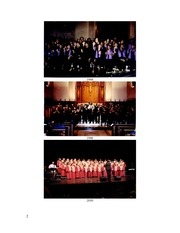
1994
1998
2010
2
�
Table of Contents
•
Table of Contents
p3
•
Voices of Imani Over the Years: 1994, 1998, 2010 p 2
•
Opening and remarks of Prof. Joe Burns
p4
•
Supportive Faculty and Assistant Directors
p6
•
The Repertory of Voices of Imani
p8
•
Dr. MLK,JR and the Kuumba Singers of Harvard p 10
•
Ashley’s Purpose “Crowning Achievement”
•
White House Performance, February 2010 & Music of the Civil Rights
Era
p 13
•
“Lord, I Done Done”
p 14
•
Standard Yearly Activities of Voices of Imani
p 16
•
Annual Christmas Concert and “Amen”
p 17
•
Annual Spring Concert and “This Day”
p 18
•
Work with Music and other Departments
p 19
•
Tours Over the Years
p 20
•
Student Recitalist
p 21
•
Media and Biographical Material
p 22
p 11
I would like to express my sincere thanks and appreciation to Mary
McAteer, Administrative Assistant in the AADS Program, and Nathaniel
Tolbert ’10, Graduate Assistant in the AADS program, for their expert
technical assistance in the preparation of my MEMOIRS.
– Rev. Professor Hubert E. Walters
3
�
Dear Voices of Imani,
As I approach the end of my 28th year as Music Director of the Voices of Imani, I find
myself reflecting on the outstanding and significant contributions this group has made
upon the musical and cultural life at Boston College. No one has expressed this
contribution more eloquently than Professor Joe Burns, the Associate Academic VicePresident for Undergraduate Programs, as he spoke at a retirement reception that was
given for me in the Spring semester of 2008. Below is a summary of his remarks:
“Thank you everyone, and congratulations to you Rev. Prof. Hubert Walters. I don’t
want to take too much time, but I want to take the time to thank Prof. Walters, especially,
for what he has done for B.C. I first met him in 1986, when the Voices of Imani was
performing for the MLK, JR Banquet. (Which is held each year in February at Boston
College-Voices of Imani has provided the music for all 28 years that I have conducted the
group). I should say that I am a 1967 graduate of B.C. I left B.C. for about 20 years, and
when I came back I met Hubert Walters in the spring of 1986, I remember quite clearly
the first performance of the Voices of Imani at the MLK JR. banquet. In my mind, it was
clear that B.C. had changed dramatically in those 20 years. And that the Irish-Catholic
commuter college that I had left, had embraced African American culture, especially the
music that was part of that culture.
It was kind of, beyond the imagination! So things
had changed dramatically! It was clear that the African American students along with
the African American experience had found a warm place here at Boston College, a place
that valued and appreciated their contributions even if they were not “ white, Irish, and
Catholic.” These African American students in the Voices of Imani and some white
students included, had created a place here (at B.C.) where they could be comfortable,
and where their experience and culture could be shared with other students. A place
where they could learn to perform the music of Black America and develop as
individuals. Note the response of THE GIRLS at the concert tonight (laughter) (The
Girls) were a group of former very talented members of the Voices of Imani, who became
life-long friends. They had returned to honor Prof. Walters at his retirement.)
About the greatest honor a teacher can receive is where those who have been under your
tutelage, have come back to appreciate what you have done for them. And (with that)
4
�
they have gone on to bigger and better things. When I was here in the 1960s, not only
could we not have had the concert that you witnessed tonight, but also, you could not
have imagined such a thing! The concept was beyond the imagination that the richness
and diversity of the African American culture had come to Boston College. This was a
huge step for us, and we were challenged as a college to develop the kind of education we
have today.
Let me say, that this was a time (1986) when Hubert was not exactly, “the voice in the
wilderness.” It was not a complete wilderness music or artistic-wise, but some of the
things that the young people take advantage of at B.C. now, simply did not exist. You
have to think back to the time before Professor Sebastian Bonaiuto started B.C Bop and
before Professor John Finney became the conductor of the University Orchestra; before
there was an Arts Festival, before there was an Arts Renaissance under the late Father
Barth who was Dean of the College of Arts and Sciences.( Incidentally, Father Barth was
the first recipient of the Arts Award, now given each year at the Arts Festival in April, to
the faculty member who contributes most to the Arts at Boston College. I received the
award in the spring semester of 2004.) In 1986, there was no Music Department, there
was not the plethora of a cappella groups that we have here today. The Voices of Imani
stuck out as an example of not only a sort of new and vibrant culture that drew in other
people, but they represented the kind of art and musical expression that we did not have
at Boston College at that time. I don’t know why Professor Walters came to Boston
College as a member of the faculty of the Black Studies Program at that time. I am
certain as a member of the faculty that it was not the money (laughter). It must have been
the legendary persuasiveness of Amanda Houston (The first Chair of the Black Studies
Program) it was clear that you (Prof. Walters) had brought not only the experience that
our young people needed, but a passion for the music and the culture of Black America.
It was your desire that the students not only learn to perform and express themselves in
music, but also to learn the culture and historical and social context in which the music
developed; and in so doing, learn the real meaning of that music. You have made Boston
College a richer place. If KUUMBA (the name of the group that performed at the
concert, and for which Prof. Walters was the first Music Director at Harvard
5
�
University in 1970) means leaving a place better than you found it, there is nobody that
can take greater pride in leaving Boston College a better place that it was, than you
Professor Hubert E. Walters.”
I will always cherish these remarks by Professor Joe Burns on your behalf and mine. The
link below will take you to an article that appeared in the Chronicle on April 25, 2008,
titled “Around the Campus.” It is a fitting summary of some of the activities that took
place at this most memorable concert on my behalf:
http://www.bc.edu/bc_org/rvp/pubaf/08/chronicle4252008.pdf
+++++++
I would be remiss if I did not mention at this juncture in my memoirs, other members of
the faculty at Boston College, who over the years assisted me fulfilling my own personal
dream for the music culture of African-Americans and its importance in American
culture as a whole:
First and foremost, I must speak of the late Mrs. Amanda Houston who was the first
chair of the Black Studies Program- as AADS was called a this time. It was she who
hired me immediately at the end of my first interview with her in 1982. It was she who,
along with Dean Carol Hurd Green shared the vision of a singing group at Boston
College who could carry on the great tradition of the Black College Choir. At the outset
they both wanted the group to be connected with the Black Studies Program as well as
the Music Department. The connection was successfully made through the cooperation of
Father Kennedy, Chair of the Music Department and Professor Jeremiah McGran, the
Associate Chair of the Music Department. As the years have gone by, I often reflect on
the evolvement of these women from the faculty and administration at Boston College,
on the success and legacy of the Voices of Imani.
Dr. Robbie Tourse, a professor in the Social Studies Department,(now retired), was the
first faculty advisor for the Voices of Imani. She is a graduate of Spellman College in
Atlanta, Georgia. She spoke often of the possibility of the Voices of Imani participating
in the Annual Christmas Concert at Spellman College in Atlanta, as a means of
6
�
introducing the VOI to the great tradition of choral singing in the Historically Black
Colleges and Universities. We did not get to Atlanta for the Annual Christmas Concert
while she was faculty advisor, but we did manage a tour of Atlanta some years
afterwards. Dr. Tourse was faculty advisorVOI for 15 years.
Dr. Ferna Phillips, Director of Learning Resources for Students, (now retired) was our
Faculty Advisor for the next 13 years. Both of these ladies we extremely helpful in
helping me to manage the tremendous energy of the young men and women who
participated in VOI.(Voices of Imani) They made it possible for me to focus most of my
attention on the musical development of the group.
Dean Paulette Durett, Assistant Dean in the Student Programs Office, has been a
constant source of inspiration for the Voices of Imani. She traveled with us on several of
our tours, and was always available when we needed chaperones.
Sheyron Banks, Senior Human Resources Officer, was our faculty advisor from 2008
through 20010. At the beginning of the 2010-2011 school year, Mrs. Yvonne McBarnett,
from the Office of AHANA Student Programs, became the faculty advisor for the Voice
of Imani.
Dr. Sandra S. Young, Associate Director of AADS. Dr. Young and I are perhaps the
oldest members of both the formerly Black Studies Program and AADS Program as it is
now called. She was always a source of inspiration, as she constantly reminded me to
have the singers pursue “the broadest possible vocal utterance of the Black music
aesthetic.”
Over the years, I was privileged to have students who served as assistants to me. Several
young men and women assisted me over the years, but none was more efficient and
reliable as Mr. Elan Trotman, who was my Assistant Music Director for approximately
ten years. While serving as my assistant, he met and married his wife, Grace, who is a
former President of the Voices of Imani Their first child, Timmie was born a few weeks
7
�
before our Tour to the D.C /Maryland area in 2007, and Timmie and his mother Grace
accompanied us on this tour. Elan also produced the first and only CD of The Voices of
Imani to date. He is a very talented musician and father. Below is a web site which gives
more information about Elan Trotman.
www.elantrotman.com
+++++++
As a college choral group established in the 1970s, on a formerly predominately white
college campus, it is IMPORTANT for you to remember that you stand on the backs of
an earlier group of African-American singers known as the Fisk Jubilee Singers. This
group was the first to introduce the world to Black Music (A reliable source for
information about this group is a book by Andrew Ward titled: Dark Midnight When
I Rise: (The story of the Jubilee singers who introduced the world to the music of
Black America) There is also, a VCR titled “Sacrifice and Glory”, a PBS
documentary on the Fisk Jubilee Singers. In addition there is the Jumpstreet VCR
titled “Gospel and Spirituals,” All are available in the Media Center of the O’Neal
Library. I would hope that these two media items and others like them, will be used
each year to give the singers some background about the music and purpose of groups
like the Voices of Imani. That stand on the tradition that was started by the Original
Fisk Jubilee Singers.
The repertory of the Voices of Imani has always reflected the broad spectrum of African
American Religious music. We have sought to include both spirituals and contemporary
gospel in our programs throughout the year. In addition to the text and media materials
mentioned above, there is a very reliable web site that is devoted to the preservation of
the spirituals and other music of the African American tradition. Two web sites below
are highly recommended. The first site is the home page of The Spirituals Project. The
second is Sweet chariot and audio-visual history of the Spirituals:
http://www.spiritualsproject.org/
http://ctl.du.edu/spirituals/Present/
A third web site is pasted below:
http://www.artofthenegrospiritual.com/research/GospelTruthNegro
Spiritual PDF- The research of Randyne Jones.
8
�
It is therefore, IMPORTANT that you remember The Fisk Jubilee Singers, who in fact did
introduce to the world the Spirituals. To insure that the contributions of the Fisk Jubilee
Singers would not be forgotten, I established a group within the Voice of Imani that I
named THE New FISK JUBILEE SINGERS with the hope that The Voices of Imani
would continue to remember the contributions of the Original Fisk Jubilee singers, by
including in their repertory EACH YEAR a number of the time honored creations of
Black People called SPIRITUALS. The larger group will study and learn a certain
number of these “historical documents” (as the Spirituals are sometimes called) each year
(minimum 4), but on special occasions, (such as the performance given each year
during the Arts Festival at B.C. when the NFJS present an afternoon concert of
Spirituals and Contemporary Gospel Songs in the Gasson Library each year) this
smaller group consisting of no more than eight to sixteen singers-be the primary vehicle
designed to keep the SPIRITUALS fresh in the hearts and minds of every one. It is
absolutely essential that this group be remembered forever. Much of what I have done
with the Voices of Imani is to continue this tradition and at the same time, introduce and
perform a newer version of the Spiritual that has been labeled- Gospel- to the world by
way of the various college campus groups established on the formerly predominantly
white campuses following the assassination of DR. Martin Luther King Jr, on April 4
1968.
Below is a web site, which is devoted entirely to the present-day Fisk Jubilee
Singers:
http://www.fiskjubileesingers.org/
Notice the statement to the left of the web page of the Fisk Jubilee Singers: “We stand on
the shoulders of the original Jubilee Singers, continuing their legacy, we sing Negro
Spirituals.” This statement should be the “watch word” of every college gospel choir,
especially those that were established on formerly “all white colleges and universities”
shortly after the assassination of Dr. Martin Luther King on April 4, 1968.
+++++++
9
�
The assassination of Dr. King was very critical time in my life, personally!
I was shaken beyond words when he was assassinated on April4, 1968. As a result of his
death however, many doors that were formerly closed to African Americans, were
opened, and there was a clamor to enroll Black students and to hire Black Professors at
the predominantly white universities and colleges, and monies were being made available
for Black students to further study in their chosen fields. I was fortunate enough to have
received a Martin Luther King, Jr. fellowship from the Woodrow Wilson Foundation
to continue my Doctoral studies at Boston University. This was also the time period
when singing groups composed mostly of Black students, were being formed at these
colleges and universities. The young people were riding on the popularity of a newer
form of the “spirituals” that had been promoted over the air waves, that they called
“Gospel.”This had been the case since 1957, when an Edwin Hawkins' recording of “O
Happy Day” was heard around the country and indeed the world. Many of these young
people were not aware of the earlier form of the gospel song called Spirituals. This was
also the case with the Voices of Imani when I became Music Director in the Fall of 1982.
I decided at that moment that we should begin making these students aware of the great
heritage they were representing. There was some resistance at the beginning because
many of the students, had never been exposed to these “historical documents.” as one
writer calls them.
You may or may not already know that I was the first Music Director of the Kuumba
Singers at Harvard University. This group was probably the first “Gospel Choir” to be
established on the campus of a predominantly white educational institution in New
England. I have recorded this experience elsewhere. On the web site below you will find
an article written by me under the heading “About Kuumba” titled “Kuumba the Early
Years”:
www.kuumbasingers.org
I would urge you to read this account of the early years of Kuumba. In doing so, you
may realize that that the Voices of Imani originated some what on the same lines as the
10
�
Kuumba Singers. But I can truly say that much more of what I dreamed for the Kuumba
Singers at Harvard was accomplished here at Boston College than at Harvard.
I am also reminded of the award that was given to me, on your behalf, at the 2004 Annual
Arts Festival held at Boston College. This award is presented each year to the faculty
member who has contributed to the artistic life at Boston College. I received it on your
behalf because it was my work with you that made this award possible. The link below
will take you to an article that appeared in the May 13, 2004 edition of the Chronicle
Magazine of Boston College describing the events on the occasion of presenting this
award:
http://www.bc.edu/bc_org/rvp/pubaf/chronicle/v12/my13/walters.html
+++++++
Another outstanding event that I consider the “crowning achievement of my
tenure at Boston College,” was a play written by Professor Scott Cummings, of the
Theater Department, titled “Ashley’s Purpose.” Professor Cummings conceived this
original play, and he chose the Voices of Imani from among many other singing groups at
the college, to provide the music for this production. Below are his comments made to
me as he presented me with a DVD of the play:
1 May 2010
Dear Hubert
Here, at long last, is a DVD of Ashley’s Purpose. I apologize for the long delay in
delivering it to you. Thinking back to this project more than two years ago, I see it as one
of the most challenging and most rewarding experiences I have ever had in making
theater. You and Voices of Imani were a huge part of the reward. I never dared to dream
that the music would be such a crucial and exhilarating part of the production. Our work
was a constant source of inspiration for me. I will cherish memories of it forever.
Love, Scott Cummings
The DVD remains as a part of the archives of the Voices of Imani. On the following
pages you will find photos of the members of the 2008 (New) Fisk Jubilee Singers who
11
�
provided the music for the spectacular play titled “Ashley’s Purpose.” Their names are
as follows: (From left to right) Top of page Sopranos-Meghan Perez ’11, Vanessa
Christopher ’08, Alexis Jones ’08, (bottom row) Stephanie Sanabria ’09, Natasha
Ahsaki-Henry ’08, (Not pictured Derronda Williams’08).Top Second frame (from left
to right) Altos- Rosanne Burns ’10, Ashley Hazelwood ’08, Milisia Douglass ’08,
(bottom row) Charisse Gilmer ’08, Krysten White ’08. Middle Frame (From left to
right) Tenors-Bryan Cardillo ’11, David Reed ’11, David Altenor ’10, Tom Meunier ’08.
Second Frame-Basses-Harry Jean-Conte ’10, Brandon Jackson ’08, Jeremey Yancey
’09, Alex DeKeyserling ’10, (Not pictured Charles Wisniewski ’08). Bottom- Rev.
Prof. Hubert E. Walters.
12
�
I am also attaching to this document, Media and Biographical Materials that the
members of Voices of Imani should engage before they leave the University. Attached
also is a listing of the Standard Activities of the Voices of Imani Over the Years. I
hope that the group will continue to be involved in the activities of Boston College, as the
listing will show. I have often reminded you of how blessed we are as a college
“Gospel:” Choir, to be “fully” involved in the activities of the University; contrary to
groups like ours at other Boston area Universities, that remain somewhat outside the
realm of the University calendars.
+++++++
This past year (2009-2010) was a rather quiet one for us as we were in the in the rebuilding process that occurs ever so often at the university. You have heard me say many
times that we are much like the athletic teams as they go through re-building years
occasionally. But an event occurred at the White House in February of 2010, that in
many ways speaks powerfully to me as a veteran of the Civil Rights Era. I believe it has
great significance for me personally as I prepare to close my tenure at Boston College. I
have pasted two web sites below, which will take you directly to the Performance at the
White House, in February of 2010:
http://video.pbs.org/video/1410865290/
http://video.pbs.org/video/1410665412/
13
�
The first web site is of the performance featuring a long list of performers, some of
which you probably know, others probably not. The second web site did not appear as a
part of the televised portion of the evening, but did occur prior to the entrance of
President and Mrs. Obama and Vice-President Biden and his wife. As I shared with
some of you at a recent retreat of Voices at which we discussed this video; the producers
of the show were probably not aware of the historical significance of this style of Black
Song. Consequently, the televisions audience and television audience was not given the
opportunity to see the historical connections between the opening performance by the
Howard group and the more contemporary performers in the main body of the concert at
the White House. This performance is by the Howard University small group (that may
be compared to our NFJS) is a fitting doxology for me personally. The group sang a
spiritual titled “Lord, I Done Done Whatch Told Me To Do.” This spiritual is a fitting
benediction for me as I leave you, because it expresses ALL that I dreamed and hoped
for when I first came to New England in the fall of 1969. I have transcribed the lyrics
below as some of them are not quite clear in the video:
+++++++
LORD I DONE DONE WHATCH TOLD ME TO DO
Solo: Lord I done done, Lord I done done__________
Lord I done done,
I done done whatch told me to do
Chorus: (Repeat Solo Above) Bass: Talkin’ ‘bout…
Call: Well, You told me to sing and I done dat too_______ Chorus Response
I said, told me to pray and I done dat too_______ “
“
Chorus: Same as above
Call: Well you told me to teach and I done dat too_______Chorus Response
14
�
I said, you told me to preach and I done dat too______Chorus Response
Chorus: Same as above.
Call: Well, you told me to shout and I done dat too_ Response
I said, you told me to clap and I done dat too__Response
Chorus: Same as above (repeat as needed)
As you look at the Howard singers and the way they shape their tones, you will be see a
clear example of the expressive choral singing style, of which I have often spoken, and
how it is accomplished.
I have frequently reminded you that it is important to have a much background as
possible about the repertory of the Voices of Imani.
To that end, I have attached in the Appendix of my Memoirs, a listing of Media and
Biographical Materials that contain a great deal of information about the African
American culture from which the music springs. These items are available in the Media
Center of the O’Neal Library and I hope that you will use them to enlighten future
members of the legacy of the Voices of Imani at Boston College.
In the Appendix also, is a listing of University activities in which the Voices of Imani
have participated over the 28 years of my tenure. I hope that you will continue this type
of involvement as the University has formally recognized the aesthetic and cultural
contributions of this group.
*[N.B.] There are two significant traditions that were established during my tenure at
B.C., that I respectfully ask you to remember and to include in the Christmas and
Spring Concerts respectfully: (1) The singing of Amen by Jester Hairston as former
members join the current members in singing towards the end of the Christmas
Concert, (2) the singing of “Give Us This Day” arranged by me in memory of Mrs.
Amanda Houston, the first Chairwoman of the Black Studies Department.
15
�
(A more detailed description of these two traditions, will appear under-Standard Yearly
Activities of the Voices of Imani-in the attached appendix)
I leave you with THIS Imami, so that whenever you think of me, and I hope that you
will; these MEMOIRS and especially the two previously mentioned videos of
Performances at the White House, will offer a vivid description of the DREAM that we
were able to realize to some extent, during my tenure at Boston College.
May God Bless and Keep You,
As Ever,
Professor
+++++++
APENDIX
STANDARD YEARLY ACTIVITIES OF THE VOICES OF IMANI
AFRICAN AND AFRICAN DIAPORA STUDIES
BOSTON COLLEGE
140 CHESTNUT HILL
CHESTNUT HILL, MASSACHUSETTS 02467
First Semester
•
Fall Concert (during the first semester if repertory is sufficient)
•
Annual Christmas Concert (Usually the first Friday of December) (Each
year at this concert, former members of the Voices of Imani who are
attending the concert, are asked to join the current Voices of Imani in the
singing of “AMEN” (SATB) by Jester Hairston (Bourne Music IM
103946.) This usually occurs just before the Annual Candle Light
Service- The singing of Amen by Jester Harriston with former members
16
�
of Voices of Imani and the audience the Candle Light Service has
BECOME A TRADITION at the Annual Christmas Concert by the
Voices of Imani at Boston College.) N.B. I have often shared with Voices of
Imani, that this arrangement by Jester Hairston is a “condensed”
presentation of “The Messiah” in the African American tradition in that the
text that Hairston employs clearly follows the birth, ministry, ,crucifixion,
and resurrection of Jesus Christ. I’ve called it a Miniature Messiah.
•
“Breaking the Barriers” A University Sponsored event usually the New Fisk
Jubilee Singers provide the music for this event)
•
Campus, and local church performances when possible
•
Religious Services with the Campus Ministry
Second Semester
•
MLK Banquet and Celebration- (usually during the month of February
known as Black History Month)
•
Participates in the Memorial Service for Dr. Martin Luther King, Jr
sponsored by the Campus Ministry.
•
Tour- (WHEN REPERTORY AND NUMBERS ARE SUFFICIENT)during SPRING BREAK.
•
ANNUAL SPRING CONCERT- in conjunction with Black Family
Weekend (usually the first or second week end in April) (Each year at
this concert, former members of the Voices of Imani are asked to join
the current members in the singing of “Give Us This Day” by Edwin
17
�
Hawkins. THE ARRANGEMENT OF THIS SELECTION WAS DONE
BY PROFESSOR WALTERS, AND DEDICATED TO THE MEMORY
OF THE LATE AMANDA HOUSTON, WHO WAS THE FIRST
CHAIRPERSON OF THE BLACK STUDIES DEPARTMENT WHICH
IN NOW THE AFRICAN AND AFRICAN DIASPORA STUDIES
PROGRAM AT BOSTON COLLEGE) N.B.I have left a voice and piano
arrangement of This Day, as well as an SATB arrangement of this piece,
in the Imani Archives in the AADS Program office. (copyright pending)
•
UNIVERSITY ARTS FESTIVAL- (usually the final weekend in the
month of April. Two separate performances usually required (1) 20
minute concert with the larger ensemble –usually on the Friday of
that weekend. (2) A concert by the NFJS in Gasson Hall-usually on
the Saturday of that weekend. At this Festival in 2004, Professor
Hubert E. Walters, Music Director of the Voices of Imani, was awardedthe Boston College Arts Council Award for faculty and staff, in
recognition of outstanding contributions to the arts at Boston College.
Professor accepted the award on behalf of the Voices of Imani.
•
Religious Services with Campus Ministry
•
Participation in Commencement (when possible) with the Liturgical
Singers
•
Annual Imani Banquet.
+++++++
18
�
•
WORK WITH MUSIC AND OTHER DEPARTMENTS AT THE
UNIVERSITY:
a. Civil War Project (with the Music Department-Fall 2009)
b. Spirituals and Art Song of Black Composers-Suzanne Ely, Soprano,
Professor Walters, accompanist. (Fall 2009)
c. Three Generations: Baritones-William Warfield, Benjamin Matthews,
and Robert Simms. (The day after the concert, Robert Simms
conducted a Master Class in Singing in Gasson Hall. Several
singers from the Voices of Imani participated. (February 2001)
d. Dr, Arthur Jones, Spirituals Project Concert, Professor Walters was the
accompanist for Dr. Arthur Jones. Program sponsored in conjunction
with the Music Department.
e. Gospel Mass with the Liturgical Singers, February 13, 2000:
Professor Leticia Blain, who was composer in residence at the
time, invited the Voices of Imani to perform portions of A Gospel
Mass by Raymond Ray at the Sunday evening Mass. The
attendance of students at this Mass was one of the largest in the
University’s history. (A Program of this events is available)
f. Accompanied Jennifer Holiday, (NFJS) New Fisk Jubilee Singerssong “You Are the Wind Beneath my Wings” Coral arrangement by
Prof. Walters. Paid $3000.00
g. With B. C. Dance Ensemble- “Order My Steps” sung to dance
choreography- 3-day event-C. 1999-2000. The singing of the group
19
�
was preceded by a dance choreographed to the “ I Have a Dream”
speech by Dr. Martin Luther King, Jr. A Videotape of this
performance is available.
h. Ashley’s Purpose: (2008) One of the crowning achievements of the
Voice of Imani! The NFJS provided the live music for a play titled
“Ashley’s Purpose,” written by Dr. Scott T. Cummings of the
Theater Department. A DVD of the performance is available.
i. Arts Festival Performance with B.C. Bop- Excerpts from Duke
Ellington Sacred Concerts- 2008 (Flyer Available)
+++++++
TOURS OVER THE YEARS:
• Washington, D.C. & Howard University 1984-We were invited to sing at the
Annual Spring Concert of the Howard University Gospel Choir. Milton Brunson
was the featured guest.
• North Carolina and Tennessee 1995- We performed in several churches here.
• Dallas, Texas and Memphis, Tennessee 2000. We attended morning worship at
the Potters House, Bishop T.D. Jakes, while in Dallas. We visited the Civil
Rights Museum while in Memphis, Tennessee.
• Los Angeles, California 2001. We attended worship services at West Angeles
Church of God in Christ, Bishop Charles E. Blake. Stevie Wonder sang “I
Won’t Complain” during the service. (A power point presentation of scenes
from the California tour, is available in the Imani archives in AADS.
• Richmond and Petersburg, Virginia 2003.
20
�
• Raleigh, Durham, Fayetteville, and Greenville, N.C. 2006. We performed at
churches in each of these cities. Prof. Walters served as organist and choir
director in these churches, while an undergraduate student. We also visited East
Carolina University in Greenville, N.C., Professor Walters’ hometown. He
was the first Black to graduate from East Carolina University in 1965. (A
DVD of this tour is available in the archives in AADS.
• Washington, D.C. 2007. We presented concerts at three churches in the
D.C./Maryland area. (A DVD of this tour is available in the archives)
STUDENT RECITALIST: (Independent Study)
The following students were trained and accompanied by Prof. Walters. Each presented
a full length vocal recital to fulfill the requirements of Independent Study.
•
Candace Ashir, Soprano- 2000
•
John Richardson, Tenor- Class of 2001(VCR Available)
•
Michael Cormack, Bass 2003
The web site below is another article that appeared in the Boston College Heights
magazine:
http://www.bcheights.com/2.6188/hubert-walters-1.906543
+++++++
MEDIA AND BIBLIOGRAPHY RECOMMENDATIONS
MEDIA
N.B. Most of the items listed below are available in the Media Center of the O’Neal
Library.
21
�
•
The Story of Gospel Music (The Power in the Voice) BBC-DVD. One of the
more powerful pieces on the History of the Religious music of Black Americans.
Features: Tramaine Hawkins, Mahalia Jackson, The Fisk Jubilee Singers, Cissy
Houston, Shirley Ceasae, Thomas Dorsey, Vanessa Bell Armstrong and more.
Commentators: Rev. Dr. Wyatt Walker, Leroi Jones (Amiri Braka), the late
Dr. Horace Boyer and others. N.B. One of the most comprehensive media
pieces to date. Should be view several times by members of Voices of Imani.
•
From Jumpstreet Series: “Spirituals and Gospels” with Oscar Brown as
narrator. (Part of a 10 part video presentation of the History of Black MusicEntertaining and informative-Members of Imani should see ALL of the segments
during their time at B.C.)
•
“Say Amen Somebody” (a documentary on the life of Thomas A. Dorsey, the
man who coined the word “gospel” to identify the new style of African American
religious music he was introducing. He is now known as the “Father of Gospel
Music.
•
“This Far by Faith” (A DVD presentation of the origin of the Black Church in
American from its beginning during the era of slavery through the 1900s. The link
below will take you to this most important DVD which should be REQUIRED
VIEWING for every member of the Voices of Imani:
http://www.pbs.org/thisfarbyfaith/about/the_series.html
•
“Eyes on the Prize” Parts I & II
•
“The Bible and the Gun” with Basil Davidson
•
“Rock and Roll the Early Days” (This video should be viewed before or after
seeing part I of Eyes on the Prize titled “The Awakening.” The events in these
videos occur around the same time-period)
•
“Sacrifice and Glory” (The story of the Fisk Jubilee Singers) The link below
will take you to the PBS program: www.pbs.org. &
www.fiskjubileesingers.org
•
“Roland Hayes: A Ministry of Music”: A local television broadcast of the life,
and musical contributions of Roland Hayes, the first American concert artist
to receive world-wide acclaim It is based upon his autobiography titled
22
�
“Angel,Mo and Her Son” (available in the library.) Mr. Hayes was the first
Black artist to present the “Spirituals” in concert version right here in
Boston at Symphony Hall, in 1917. (The video that I will make available for
the media Center, is a my own personal copy of the original television
program.)
23
�
 Historical archive . public document