James Marriott
Investigative Study
Visual Communication Level 6
10th January 2011
Arts University College Bournemouth
Unit Leader: Dr Anna Middleton
Could The Adoption of Flexible Identity Systems by
some Contemporary Designers Have Any Enduring
Influence on the Field of Brand Identity Design?
�
James Marriott
Could The Adoption of Flexible Identity Systems by
some Contemporary Designers Have Any Enduring
Influence on the Field of Brand Identity Design?
Essay
page 3
Conclusion
page 20
Bibliography
page 23
Image Sources
page 30
Figure 1 -MTV Logos
page 3
Figure 2 -Aol Logos
page 8
Figure 3 -Initial London 2012 Logos
page 12
Figure 4 -Variants of London 2012 Logo
page 12
Figure 5 -City of Melbourne Logos
page 13
2
�
James Marriott
Could The Adoption of Flexible Identity Systems by
some Contemporary Designers Have Any Enduring
Influence on the Field of Brand Identity Design?
The first decade of the 21st century has seen the emergence of a new phenomenon
within the field of brand identity design. The flexible brand identity has precedents
in the tyre manufacturer Michelin’s Bibendum or Michelin Man mascot conceived
in 1898 [1] and Wolff Olins’ identity for Hadfields Paint in 1969 (Van Den Bergh,
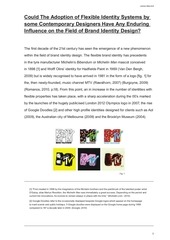
2009) but is widely recognised to have arrived in 1981 in the form of a logo [fig. 1] for
the, then newly-founded, music channel MTV (Rawsthorn, 2007) (Burgoyne, 2009)
(Romanos, 2010, p.18). From this point, an in increase in the number of identities with
flexible properties has taken place, with a sharp acceleration during the 00’s marked
by the launches of the hugely publicised London 2012 Olympics logo in 2007, the rise
of Google Doodles [2] and other high profile identities designed for clients such as Aol
(2009), the Australian city of Melbourne (2009) and the Brooklyn Museum (2004).
Fig. 1
[1] “First created in 1898 by the imagination of the Michelin brothers and the paintbrush of the talented poster artist
D’Galop, alias Marius Rossillon, the Michelin Man was immediately a great success. Depending on the period and
current tire innovations, he evolves to remain always in phase with his time.” (Michelin.com : 2010)
[2] Google Doodles refer to the occasionally displayed bespoke Google logos which appear on the homepage
to mark events and public holidays. 5 Google doodles were displayed on the Google home page during 1999
compared to 197 a decade later in 2009. (Google, 2010)
3
�
James Marriott
The flexible brand identity model is divergent from the traditional or ‘static’ one, in that,
whereas the latter attempts to stimulate recognition through repeated exposure of a
consistent visual element (termed a ‘constant’ [3]) such as a logo (Rawsthorn, 2007),
the flexible identity is a system that uses a consistent visual element that displays, or
is juxtaposed with, a varying visual element (a ‘variable’ [3]). The MTV logo practically
demonstrates the model as the constant of its emblematic ‘M’ is used as a container
to house the variable: an ever-changing plethora of images. This though, is a single,
relatively basic example of a flexible identity and constant-variable interaction in other
flexible branding is effected through a diverse array of techniques. Whilst the MTV
identity essentially revolves around a customisable logo, other flexible identities do
not conform to this relatively simple formula, instead, within the multifarious group of
identities [4] which could fall under the umbrella term of ‘flexible’, a host of methods,
devices, nuances and idiosyncrasies are evident. Flexible identities may: comprise of
sign families [5] linked by rules or premises [6], fluctuate according to a live data feed
[7], use algorithmic computer programmes to make them aleatoric, [8] be transformed
by their context [9] or become an entire visual language in themselves [10] but
intrinsic to all of these examples is a relationship between a constant element and
variable element.
[3] Ulrike Felsing’s division of dynamic identities into the two elements of the constant and the variable helps to
establish a framework for discussion of the flexible identity model (Felsing, 2010).
[4] An established set of terms for different types of flexible identity has yet to be authoritatively consolidated and
defined but some include; ‘moving brands’ (Smith, 2010), ‘dynamic identities’ (Felsing, 2010) and ‘living brands’ (Vit,
2009a).
[5] Sign families are groups of signs which exhibit similarities in both signifier and signified “each member of a sign
family may prepare the interpreter to initiate the same response sequences to denotata, since each sign has the
same signification” (Charles Morris cited in Scott, 2004)
[6] In the case of the identity for the Kigali Conference Centre in Rwanda the ‘”rule” on the basis of which the
variable factors can “come into play”’ (Felsing, 2010, p.26) is the abstraction of a bird’s-eye view of the landscape
surrounding the conference centre.
[7] Neue Design Studio devised a brand identity to promote tourism to Norway’s Nordkyn Peninsula that uses a live
feed of weather statistics to change the colour and shape of its logo. This is updated every 5 minutes on the website
and is captured at a point in time relevant to the application when required for analogue media (Vit, 2010).
4
�
James Marriott
Compared with the traditional static identity, the above examples of flexible identities
seem more avant-garde and sophisticated. However, some may question whether,
within this label of ‘avant-garde’, is manifested a prediction of the longevity of the
flexible branding model as the phrase is synonymous with the fleeting phenomena
of the ‘trend’ (Wordnik, 2010). It may be tempting to view the morphing signifiers that
constitute flexible identity systems as merely an interesting, eye-catching counterpoint
to the more established, static identities that dominate mainstream brand design and
to assume their popularisation will be swiftly followed by a return to static branding
[11]. Such a dismissal may seem too hasty when flexible identities are examined
with reference to contextual factors such as sociological change, technological
development and movements in culture. These can be seen to have influenced the
formulation and increased presence of the flexible identity, thus suggesting that the
development of flexible properties is, perhaps, necessary in order for brand identities
to adapt to, and function in, a much changed world. This essay investigates whether
this observation is indeed correct and we are seeing the movement away from the
monolithic brand model, prevalent for the majority of branding’s inception in 2250BC
[12] or if, instead, it is little more than a short-lived deviation from this.
One initial response to the notion of the flexible brand is to invoke the adage that the
brand identities require consistency and repeated exposure to facilitate the recognition
and memorability that generates its value [13] and that surely, if the identity appears
[8] Saks 5th Avenue is a large New York department store whose identity, created by Pentagram, features the
company logo split into 64 tiles, shuffled and rotated to create a unique pattern in each instance. According to
Pentagram’s Michael Bierut the number of combinations exceeds “the number of electrons in the known universe”
(pentagram.com, 2006).[9] Stefan Sagmeister’s logo for the Casa De Musica in Portugal uses a bespoke piece of
software that analyses the colour values of any image accompanying it. It then generates a colour scheme for the
logo harmonious with the image. (Vit, 2007)
[9] Stefan Sagmeister’s logo for the Casa De Musica in Portugal uses a bespoke piece of software that analyses
the colour values of any image accompanying it. It then generates a colour scheme for the logo harmonious with the
image. (Vit, 2007)
[10] “with a bit of hard work and a good idea an organization stops being about just a logo and gains a complete
visual and verbal language” (Johnson-Banks, 2007).
[11] “if flexibility becomes the new norm then of course inflexibility may become attractive again.”
(Johnson-Banks, 2007).
5
�
James Marriott
to change each time it is seen, repeated exposure cannot be achieved. While there is
validity to this argument, in that, repetition is key to the memorisation and subsequent
recognition of any stimuli (Buzan, 2005, p.57), it is also true that when we perceive
a given stimuli, we do not merely perceive it as an amalgamation of constituent
parts, we perceive an holistic entity defined by the dynamic relationships between
these parts. This is a key principle of Gestalt theory which advocates the idea that
“we always experience perceptual wholes, not isolated parts” (Behrens, 1998).
Extended to the study of brand identity, this theory implies that the alteration of a part
(or even parts) of a brand signifier will not render it unrecognisable, as long as the
whole remains intact [14] This theory is seen in practice in the MTV logo, which is
not degraded in its recognisability by its flexibility due to the remaining relationships
between its constituents such as the proportions of the M, the spray-painted ‘TV’
and 3D perspective. Conversely, when seen enough times for the viewer to surmise
that this logo changes, its variable behaviour becomes an anticipated part of the
brand identity [15]. The application of Gestalt theory vindicates the flexible model as it
explains that it is not inherently flawed in producing brands with that integral attribute
of recognisability as the logic of the static model might suppose.
However, it also provides an important caveat to the use of flexibility, in that, ‘Gestalt’
describes “the essential, the elemental” (Felsing, 2010, p.22), (or overall character of
something) and how it cannot be made indistinguishable simply by altering one (or
more) of its parts. The constant of a distinctive overall character is crucial to any brand
identity to differentiate its company, individual or product from similar ones [16].
[12] Karl Moore and Susan E. Reid present evidence of the practice of ‘branding’ in the Indus Valley in 2250BC in
their paper The Birth Of Brand: “The Harappan cities were home to craftsmen working in stone and bronze, who
created little square seals, which they sold to merchants. There are hundreds of square seals with animal figures,
used as trademarks, found at Mohenjo-daro, Harappa, and Lothal” (Moore and Reid, 2008)
[13] “brands with positive appeal and vast exposure are at the forefront of customer purchasing decisions”
(Hembree, 2006, p.149)
[14] “the whole is greater than the sum of its parts” (Behrens 2002).
6
�
James Marriott
Functional flexible identities withstand variation because this overall character clearly
anchors [17] them within a single, recognisable sign family. If they lack this, individual
differences between members of the sign family are liable to be greater than what
remains constant. Consequently the identity becomes diffuse through variation as the
ability of the audience to group its elements into a single, unified sign family clearly
denoting the brand, is impaired. In the extreme, this will cause complete disintegration
of the flexible identity, in which recognition and memorisation of it are impossible and
it becomes unable serve its purpose as the visual link that associates a company,
individual or product with their goods, services or communications.
A less extreme instance of this process can be observed in Wolff Olins’ flexible logo
for Aol. The logo was devised to be a visual metaphor for Aol’s service: the delivery
of differing content to differing audiences, (Wolff Olins, 2009) and to be “deliberately
disruptive, deliberately unlike what is being done by other media businesses” (ibid).
In this capacity it succeeds through its use of around sixty logos, each comprising of
the Aol logotype reversed out of one of a host of images of everything from a goldfish
to rock music’s symbolic ‘horns’ gesture [fig.2]. However, as a brand identity, at some
point, the key function of communicating a tangible point of difference for this service
must be fulfilled, and in this capacity, the identity does not entirely succeed. Although
the constant of the punctuated Aol logotype is evident throughout the sign family, its
basic, white geometric sans serif (which bears strong resemblance to the widely used
Futura typeface) does not exactly exude distinctive essential character. Furthermore,
the variables dominate it as the element that anchors it as the logo of Aol recedes into
[15] Neuroscientist Jeff Hawkins emphasises that human brains are particularly adept at recognising and
memorising patterns of stimuli in order predict the behaviour of similar stimuli in future encounters. “we experience
the world through a sequence of patterns, and we store them, and we recall them, we match them up against reality,
and we’re making predictions all the time” (Hawkins, 2003).
[16] “it identifies and distinguishes the company or product from its competition, thereby building customer
recognition” (Hembree, pg.149).
[17] ‘Anchorage’ is a term coined by Barthes which denotes the use of a device that attempts to aid the reader in
extracting the intended of meaning from a sign. (Chandler, 2003).
7
�
James Marriott
the background (to which it is matched due to its setting in white) and is also dwarfed
by the larger images that subsume it, which according to the well established visual
convention of the hierarchy [18], will immediately suggest to the audience that it is less
important. The behaviour of the variables cannot even contribute to the establishment
of an ever-present Gestalt as the spatial inter-relation of the two elements and
the signification of the images is unpredictable, not forming any apparent pattern
(other than ‘anything is possible’) or creating between the logos, any strong ‘family
resemblances’ [19]. The indistinct, recessive nature of the company signifier coupled
with the visual emphasis placed on the variable images serves to create a sprawling,
diffuse front for an identity which could, from a traditional standpoint on branding, be
said to have failed as, instead of using a distinctive visual Gestalt to differentiate the
brand, Aol is being visually portrayed through so many signifiers, each with their own
separate, diverging and polysemous [20] significations and connotations, it starts to
become generalised. Though the ‘generic’ or ‘all-encompassing’ are relevant traits to
Fig. 2
[18] “Hierarchy refers to the apparent importance of the design elements, which can be determined by size, spacing
or colour” (Ambrose and Harris, 2007, p.44)
[19] ‘Family Resemblances’ is a phrase originating with Austrian philosopher Ludwig Wittgenstein which denotes
the likening of resemblances in physical attributes between members of the same biological family and the
resemblances between signs in sign families as they are both variable, sometimes rooted in subtlety, sometimes
abundantly obvious. “we see a complicated network of similarities over-lapping and criss-crossing: sometimes
overall similarities, sometimes similarities of detail” (Wittgenstein cited in Felsing, 2010, pg 149)
[20] All signs are ‘polysemous’, meaning that they simultaneously signify different things and are open to audience
interpretation (Baldwin and Roberts, 2006, p.36).
8
�
James Marriott
be associated with a service used in different ways by a large swathe of the world’s
population [21] as identified by the designer (Wolff Olins, 2009), it is questionable as
to how effectively the logos perform in emphasising that Aol is the provider of this allencompassing service.
The flaws inherent in the Aol logo demonstrate that the flexible identity is a complex
mechanism which requires designers to understand its many internal processes
in order to construct it in a manner conducive to its appearance as a unified sign
family. Furthermore, the points at which potential disintegration of this sign family can
occur do not exist only within the preliminary stage (of the configuration of its visual
components) but provide pitfalls throughout its ongoing implementation.
One unique selling point of the flexible identity is its ability to continually adapt to new
contexts [22]. Whereas any new facet of a static identity will have its appearance
governed, sometimes rigidly, by a set of brand guidelines, [23] the individual changes
made to a flexible identity demand the acute observation of the identity’s Gestalt and
pattern of behaviour and an execution that successfully preserves all its intricacies so
as not to destroy its cohesiveness and distinct character. Complicating this process
is the fact that changes may not be implemented by the initial creator of the identity
(potentially an externally-sourced, specialist branding agency such as Wolff Olins,
who will most likely subsequently transfer the management and use of the identity to
an in-house design team and/or freelancers) but by another party, which necessitates
the communication via some means (such as a guidelines manual) of how the identity
should be varied without being excessively rigid (so as to negate the unique aspect
[21] 28.7% of the world population uses the internet (internetworldstats.com, 2010).
[22] Romanos defines the flexible identity system by its “ready capability to adapt to new, different or changing
requirements.” (2009, p.23).
[23] or, as Hembree names it, a “graphic standards manual”. This is serves to “instruct a client on the appropriate
and consistent use of the elements of their corporate identity. Guidelines are created so that anyone designing
materials will know the ‘rules’ of how the company’s logos, colours, layouts etc should appear to maintain
consistency across their program (2006, pg 179).
9
�
James Marriott
of the flexible identity), whilst providing enough guidance to maintain consistency.
To this end, there must be some mechanism for filtering anomalous results within
identities whose variations are either: based on a loose rule, welcoming of individual
designers’ own idiosyncratic interpretations [6] or subject to a generative system
such as an algorithm or a set of data [9]. Similarly, flexible identities that exhibit visual
language-like qualities must also be policed in their continual application to avoid their
dissolution into a group of signs with imperceptible links to one another
(Felsing, 2010, p.218.).
The constant regeneration of flexible identities, whilst allowing them to perform
functions impossible within a static identity system, creates various points at which the
identity can become undone thus necessitating perpetual maintenance and scrutiny
during its use [24]. Alberto Romanos writes In Non Fixed By Rules:
it would be naive to believe that any identity could be accurately
applied without supervision during the implementation process.
(Romanos, 2009, p.60)
This seems to go as far as to suggest that guidance in the form of a manual is not
sufficient and that the continued consultation and oversight of the original creator is
needed, which, especially if this was an externally sourced expert, will exert additional
pressure on the client’s resources [25]
The numerous pitfalls during creation and ongoing management of a flexible identity
[24] This notion is echoed by Identityworks.com writer Roger Van Den Bergh: “Discipline during implementation and
ongoing maintenance is essential.” (Den Bergh, 2009).
[25] “A visual identity that responds flexibly and distinctly to special events is considerably more time-consuming
and expensive” (Felsing, 2010, pg 222).
10
�
James Marriott
in addition to the inevitable extra resources they demand, will potentially discourage
clients and designers alike from incorporating flexibility into brand identities and
precipitate the return to the well-trodden path of the simpler, static identity. Further
support for this assertion can be seen in the other obstacles encountered exclusively
by flexible identities. Critically, their adaptability to litho printing, used to produce a
large proportion of print design due to its ability to produce large runs economically
[26], is problematic as the nature of the process dictates that it can only accommodate
a single, fixed image per print-run. Additionally, a requisite of flexible identities is
relatively higher exposure to both avoid the audience aberrantly reading a single
variant as the identity in its entirety [27] and establish the behaviour of the variable
and character of the sign family (which is important to facilitate future recognition [15]
and, in language-like identities, to create a framework within which specific things can
be communicated).
On the other hand, these obstacles of communication of guidelines, constant
oversight and mechanisms for distribution presented during the ongoing
implementation of a flexible identity, could easily be remedied or become a standard
part of the design process if flexible identities prove their worth and proliferate, as the
processual infrastructure, currently geared towards the conventional static identity
could easily adapt to meet to the unique challenges they create.
Based on vacillating public and critical receptions of different high-profile flexible
identities, it is difficult to gauge whether this proliferation will be realised. Branding
agency Landor’s identity for the Australian city of Melbourne [fig.5] has enjoyed the
[26] “Offset Lithography is the least expensive way to print quantities of 500 to 100,000 pieces.” (Hembree, 2006,
pg 56).
[27] Due to the overriding convention for the identity to behave in a static way, unless we are made aware of an
identity’s variable behaviour through seeing variations and drawing a link between them, we are likely to interpret an
isolated instance of the flexible system as constituting the whole brand. Felsing notes this process in her description
of the illustrated characters that define the flexible identity for SSH Utrecht “repeated in the various media, as a
whole the characters have a stabilising effect” (pg 149, 2010).
11
�
James Marriott
recognition of being featured in the 2010 D&AD annual and has attracted critical
acclaim from prominent branding blog Brand New whose author, Armin Vit, describes
the identity as “very appealing and avant garde” (Vit, 2009b). The extent of the praise
enjoyed by Landor’s identity, however, is exponentially dwarfed by the criticism
endured by another, now infamous, flexible identity. The outpouring of hatred for
Wolff Olins’ identity for the 2012 olympics in London was, at the time unprecedented.
The media and public seemed to be unanimous in their negative reaction upon
its unveiling, as indicated in headlines such as: “The London 2012 Logo- The
Blogosphere is angry” (Metro, 2007), “Please Look Away….It’s The 2012 Logo”
(Glendinning for The Guardian, 2007) and “Olympic Logo Triggers Epilepsy” (White
for The Sun, 2007) and a public petition to change the logo which gathered 50,000
signatures (Go Petition, 2007). The controversy courted by the identity will surely
result in designers and clients both seeking to avoid creating any association with the
London 2012 identity, a factor which would impede the flexible identity model’s ascent
Fig. 3
Fig. 4
12
�
James Marriott
towards becoming an enduring method with which to visualise a brand. Nevertheless,
it is important to note that most of the criticism of the logo pertained to its form [28] as
opposed to its flexibility [fig.4] as only four iterations of the logo were initially presented
with a different fluorescent hue on each constituting the only variable [fig.3].
Furthermore, the Melbourne identity was conceived two years after that of London
2012, providing evidence that the flexible model is durable enough to weather the
storm of criticism. The climate after the logo’s unveiling would have made it more
tempting than ever to revert to the staid, static branding model. After all, a singular
identity which is laconic enough to summarise the brand in a singular colour scheme,
visual style and graphic motif (the traditional fundamental components of an identity
according to Healy [2008, p.4]) can sustain itself for decades [29] and by affecting
Fig. 5
[28] The incongruous form of the logo has drawn an array of unfortunate comparisons ranging from a ‘broken
swastika’ to a certain character from The Simpsons engaging in a sexual act (Glancey, 2007).
[29] Coca-Cola’s identity is the epitome of durability and consistency. Based around their trademark red and
white colour scheme underpinned by an inimitable logo, it has served the company for over a century. “the Coca
Cola logo has been hailed as one of the world’s most successful brands. It is now 120 years old (in 2005), and if
someone was interested in acquiring the rights to it, the brand alone would cost something like over $67 billion”
(LogoOrange, 2005).
13
�
James Marriott
and maintaining such an identity, its timelessness should allow the client and designer
to bypass the problematic rebrand with all its associated pitfalls and negative public
and media clamouring. The fact this reversion did not materialise (various designers
continued to pursue flexible systems in identity design) indicates that there is a clear
scope for the flexible identity to endure.
Supporting this is the fact that a newly devised logo forming the basis of a new static
identity for the clothing retail giant Gap recently fell foul of public and media opinion to
the same degree that the flexible London 2012 identity did and, whereas the London
2012 identity was resolutely defended by client [30] and designer, Gap capitulated
to popular opinion by quickly mothballing their new identity and reinstating its
predecessor (Kuang, 2010). This evidences the recent trend for a public, afforded the
ability to instantly broadcast information to potentially huge audiences (via accessible
social networking websites such as Facebook and Twitter), to increasingly vocalise
opinion about identity design, especially fervently critical opinion [31]. The recent highprofile casualties of this trend mean that brands in the public eye are likely to adopt an
increasingly tentative approach to creating or redesigning their visual identities which
resists bold moves or stark changes to avoid the negative press of another public
outcry over an unfavoured identity [32].
In addition to the increased ability for people to publish their opinions through
the internet, current discourses, related to the ethos of web 2.0 [33] advocating
individual interaction, participation and democratisation of media have fostered a
[30] Lord Coe, head of the London Organising Committee for the Olympic Games rallied against the immediate
negative reactions of public and media saying: “It won’t be to be eveybody’s taste immediately but it’s a brand that
we genuinely believe can be a hard working brand which builds on pretty much everything we said in Singapore
about reaching out and engaging young people, which is where our challenge is over the next five years. If we don’t
do that, then frankly the whole project is unsustainable.” (BBC, 2007)
[31] “Looking back over the past couple of years, we see Tropicana, Pepsi, AOL, and even Apple being raked over
the coals for similar missteps” (MCcallion, 2010).
[32] “You gotta wonder: Are rebrandings -- whether bold and visionary or downright terrible -- impossible in the age
of Twitter and Facebook?” (Kuang, 2010).
14
�
James Marriott
greater proclivity to do so. These discourses are manifested in websites such as
Wikipedia and Youtube which are composed of user-generated articles and videos
respectively. They are also reflected in the cult of the Flash-mob, popularised by
an ongoing T-Mobile television advertising campaign [34] and the phenomenon of
‘crowd-sourcing’ which opens up problems related to design, computing, engineering,
[35] and myriad other fields to the public (in an attempt to harness the ‘wisdom of the
crowd’ to attain solutions which certain professionals may not necessarily arrive at).
At the core of the above examples is the value placed on openness and the input of
the heterogenous individuals that make up the crowd (as opposed to the traditionally
linear arrangement of singular authorship followed by audience consumption) that is
integral to sustaining them. The recent prevalence of participatory media, evidenced
by the popularity of sites like Youtube and Wikipedia (respectively reported as the 4th
and 11th most visited websites in the world [Netcraft.com, 2010]) serves to perpetuate
a general discourse that gives greater currency to crowd input in media and thus
encourages people to impart their art, views or ideas more readily.
The multifarious channels of social media and web 2.0 populated with content
generated by a vocal and heterogenous public serve to present the perfect conditions
for the flexible identity to thrive as the model bestows the attributes of responsiveness,
adaptability and plurality (and potentially participation) that are necessary for the
communication and management of a brand in a media environment deftly portrayed
in the following summary:
[33] Web 2.0 essentially describes the evolution of the internet to allow it to be defined by its users as opposed to
those who build and administer it. This is achieved through what internet publishing expert Tim O’Reilly describes
as an “architecture of participation” (O’Reilly cited in Singel, 2005) whereby web designers create the tools for
ordinary users to easily share and author content.
[34] The flash-mob treads the line between collaborative prank and performance art and involves a group of people
privately organising to perform a pre-determined activity (singing a given song is a popular choice) in a public
place. The T-Mobile flash-mob TV adverts depict several instances of these recorded in different public spaces and
won the British Television Advertising Awards’ TV ad of the year 2010. (Sweeney 2010).
[35] Crowdsourcing is a term coined in 2006 by Jeff Howe, writing in Wired magazine (Howe, 2006). It refers to the
sourcing of ideas, solutions or work from the public instead of a pre-determined individual or group. Crowdsourcing
has been used variously to try and solve the BP Deepwater Horizon mining disaster, to write computer operating
systems like Linux (De Castella, 2010) and to complete graphic design briefs (99designs.com).
15
�
James Marriott
the world is changing: new media: We shrink back from conclusive
judgements. No assertions anymore, only fragments, questions
and experiments. (unattributed, cited in Felsing, 2010).
Though the ramifications of social media and are an important contributing
factor in the creation of a general zeitgeist and context that supports the flexible
identity, movements and changes in other fields can also be identified as influences
on its formation.
Generative art describes any art that is created by a system, devised or designated,
“to which the artist cedes partial or total subsequent control” (Galanter, 2007) and,
according to Galanter, has existed as long as “art itself” (ibid). The label ‘generative
art’ is more recent however. Emerging fully around the latter half of the 20th
century, it is more pointedly applied to works such as Hans Haacke’s Condensation
Cube created in 1963 [36] and the music of Brian Eno [37]. It is also evident in
contemporary art. One example is the work of artist Rafael Lozano-Hemmer whose
recent pieces have included large scale interactive light installation Vectorial Elevation
(displayed in the sky above Vancouver during its hosting of the 2010 Winter Olympics)
and Frequency and Volume, an installation of 48 radios with a frequency and volume
that fluctuated according to the motion of visitors inside London’s Barbican gallery
during its 2008 exhibition (Lozano-Hemmer, 2010). Generative art is part of a broad
contemporary paradigm that also encompasses the flexible identity which has, at
its core, the themes (clearly evident in both generative art and the flexible identity)
of variability, systems, rules and a degree of independence from authorship. The
[36] “A simple acrylic cube with a bit of water at the bottom and sealed shut, “Condensation Cube” becomes a
miniature weather system as an ever changing display of condensation forms on the cube’s walls. This work
anticipated meteorologist Ralph Lorenz’s discovery of chaotic strange attractors, and stands as a wonderful
example of generative art.” (Galanter, 2007)
[37] Brian Eno describes generative music in a talk in San Francisco in 1996: “What I am talking about tonight is
an idea that really began for me about 25 years ago and has pretty much obsessed me ever since. It began as a
musical idea, it began as something I heard in music and gradually I realised that in fact it was an idea that was
occurring in all sorts of areas”.
16
�
James Marriott
implication of this is the suggestion that the flexible identity is not merely a trend
confined to identity design and that it actually possesses a degree of resonance with
contemporary culture.
The flexible identity is also able to better exploit the technology such as the seemingly
ubiquitous, zeitgeist-defining smart-phone and its technical capability to show, in
high-resolution, motion or multiple still images. Furthermore, a new type of display
technology termed ‘electronic-ink’ or ‘electronic-paper’, which allows for the display
of high resolution digital images and video using a relatively low amount of energy
and with a relatively low cost, is beginning to proliferate as a medium of choice for
various applications. Of these, one of the most significant for the flexible identity is
surely the billboard. The first electronic-ink billboard was displayed in Cannes in 2006
(Hanlon, 2006) and, as the technology has subsequently been developed, use of
them has risen worldwide. Ogilvy and Mather advertising agency head of planning
Russell Davies predicts that, within the next twenty years, “Video screens are getting
so cheap and disposable that they’ll be plastered everywhere we go” (Davies, 2011)
which, if accurate, would imply that an infrastructure will exist that will provide an ideal
platform for the flexible identity thus somewhat negating the aforementioned issues
surrounding their physical application through traditional processes like litho printing.
The developments in art, social media and technology outlined above will not
however, guarantee that the flexible identity becomes an enduring feature of brand
identity design. Counter-trends and backlashes will, almost inevitably, occur against
any popular phenomenon. Where radical change has altered our visual landscape in
1. Under influential semiotician Ferdinand De Saussure’s dyadic composition of a sign’s elements (Chandler : 2009)
2. Not all signs are completely meaningless without a meaning previously constructed and conventionalised by
humans. Influential semiotician Charles Peirce developed a ‘fundamental division’ of signs in which exist Iconic
signs, which denote a physical object through its straightforward portrayal, symbolic signs which have come to
signify something solely through convention and indexical signs, which can logically suggest things (smoke=fire) but
the meaning derived from these has no other context if not framed by other signs to convey the significance of the
icon or index and they are therefore very limited in what they can communicate in isolation. Saussure also talks of
the relationship between signifier and signified as sometimes having a motivated logic. (Chandler: 2009)
17
�
James Marriott
the past, this has often been preceded by movements that have sought to reassert
more traditional practices and values. A recent example is the movement which
rallied against the computer generated imagery that had become pervasive with the
advent of the mac as a design tool, in favour of an aesthetic characterised by manual
processes such as drawing, painting and craft. Poynor described this in 1999 as “the
inevitable swing of the pendulum back in the other direction.”, also propounding the
view that “The keyboard-generated look has become predictable and trite” (cited in
Hyland and Bell, 2003, p.8). The flexible identity is similarly susceptible to such a
backlash which could impact on its longevity as a model for creating brand identities.
Intrinsic to the flexible identity though, are certain traits which may enable it to
transcend any backlash or counter-trend. For instance, the flexible identity can more
effectively command the attention of its audience, conducive to the maintenance of a
conspicuous brand presence, through its ability to counter the process of habituation.
Habituation is the psychological process by which “exposure to unchanging stimuli
results in less attention after repeated exposures” (Wogalter and Mayhorn, 2006,
p.788). In the context of brand identity design, the implication is that an identity which
is static, or unchanging, will increasingly lose its ability to command attention and thus
communicate, each time it is seen. Within the flexible identity model is the capacity to
remedy this process as it permits variation which will prevent it from being perceived
as ‘unchanging’ [38].
Another inherent benefit of the flexible identity model is the way it engages the innate
human trait of taking pleasure in recognising patterns. Pattern recognition has proved
[38] Furthermore, the nature of habituation means that the stimuli that we become habituated to is always specific in
nature. This is to say that whilst we may become habituated to one stimuli, this will not habituate us to other stimuli
related to it. This is illustrated in a study by Domjan and Grau who found that participants habituated to the taste of
a lemon showed “invigorated responding when tested with the taste of lime at the end of the experiment (and vice
versa)” (2010, pg. 41) In the context of a flexible identity, this suggests that each new variation will constitute a new
stimuli.
18
�
James Marriott
advantageous to humankind as an evolutionary function as it aids us in making the
predictions which constitute intelligent behaviour (Hawkins, 2003) [39]. As such,
we have developed a mechanism which rewards us when we discern a pattern
among any stimuli. Margulis and Sagan cite the “aha! feeling of discovery” as an
example of this (1995, p.30) whilst evolutionary scientist Alistair Clarke describes how
the experience of humour is a reward for recognising patterns (cited in Melville, 2008)
[40]. Flexible identities engage this process when they present us with a sign family
as they challenge us to recognise the underlying pattern that unites it and
consequently appear to possess a human resonance than the comparably facile
static model lacks [41].
A concept which, in some ways, relates to the pleasure of pattern recognition is
that of the ‘aesthetic experience’. Expounded by design writer Roy Behrens in his
paper (2002), it describes how the term ‘aesthetic’ has undergone a semantic shift
whereby it has become exclusively applicable to visual stimuli, a shift which Behrens
seeks to revise by recontextualising the term using its opposite: ‘anaesthetic’.
Where ‘anaesthetic’ describes stimuli that is either, at one extreme, “benumbing”
(dull, monotonous) or, at the opposite extreme, “stupefying” (confusing, excessively
esoteric), aesthetic qualities are evoked when a balance between these two extremes
is evident in a stimuli, creating an experience that is “striking or stirringly felt” (parallels
can be drawn between this experience and the reward for recognising a pattern). This
balance is termed variously in the paper as “unity in diversity”, “strict wildness” and,
more elegantly, the “harmonious disarray” and is best explained in a quote by the art
[39] Margulis and Sagan also describe how, “Pattern recognition was such a useful trait for our ancestors” as it has
essentially driven developments in science and art (1995, pg 30).
[40] “An ability to recognize patterns instantly and unconsciously has proved a fundamental weapon in the cognitive
arsenal of human beings. The humorous reward has encouraged the development of such faculties, leading to the
unique perceptual and intellectual abilities of our species.” (Clarke cited in Melville, 2008).
19
�
James Marriott
historian Gombrich, who states that “delight lies somewhere between boredom and
confusion” (cited in Behrens, 2002). The flexible identity model is almost tailor-made
for the creation of this as, simply, its constant component provides the unity,
strictness and harmony whilst the variable element constitutes the diversity, wildness
and disarray.
Conclusion
New developments in any sphere of life must convince those affected by them of
their worthiness in order to be sustained. In a recent article by journalist Patrick
Barkham on a campaign to put the UK’s clocks forward by an hour this idea is
cogently described:
When new ideas come up they are scrutinised for perfection. If
that perfection is not found, they are rejected for the status quo,
which if scrutinised in the same way would fare much worse.
(2010)
Though the flexible identity model is not ‘perfect’, it is difficult to see, in the wake of
recent and impending developments in technology, society and culture, it disappearing
in the same way countless other short-lived trends embraced by designers have
done as the model is seemingly so appropriate to the current and foreseeable media
environment in a way which the static identity is not. The flexible identity model
[41] This human resonance is insinuated further in Gotz’s comparison between the serial design model (which has
many parallels with the flexible identity) and the biological process of evolution:
“This brings to light the second power source of the design series : differently than with the industrial production
of identical objects of use, it functions in an evolutionary manner. It takes up the proven and familiar (for instance,
the elegance and prestige embodied by the Mercedes logo and radiator grille), thereby testifying to the product’s
functionality and superiority. At the same time, it introduces targeted changes in order to adapt to new requirements
and challenges. One could almost say that this enforces a process of creative selection, as outdated forms are
discarded, whilst more sustainable, -i.e timeless- forms are retained and developed further.” (2006, pg 8).
20
�
James Marriott
possesses certain attributes and capabilities that give legitimacy to the argument that
a brand identity developed in accordance with its principles may be inherently better
at engaging and retaining the attention of its audience.
In the very recent future, hesitancy in the uptake of flexible identities by designers
is foreseeable as they are likely to be dissuaded by some of the aforementioned
obstacles present in the implementation of a flexible identity such as the relative
complexity, higher cost and incompatibility with litho printing.
Even if these obstacles were to be overcome through changes to the design
process to meet the flexible identity’s requirements, it is unlikely that it will be applied
universally as its appropriateness differs according context. For example, designer
Bruce Mau remarked that a flexible identity is not ideal in the context of the branding
of a bank as a bank, in his view, should appear “radically stable” (cited in Rawsthorn,
2007) which contrasts with the flexible identity’s key principle of variability. Additionally,
the hypothetical proliferation of the flexible identity would eventually result in the model
itself developing into a widely understood code [42], which would give all flexible
identities a common underlying signification (with changeable connotations derived
from the manner in which the model is used) that may render it suitable or unsuitable
in certain contexts [43]. This would suggest that, if the flexible model does endure, it
would need to be used sensitively and pragmatically:
When we develop flexible identity schemes we need to consider
how and why the identity changes, and even if it needs to change
[42] Codes are conventions that are always used in decoding meanings from texts. Gillian Dyer’s description of this
process is that ‘Codes organize our understanding of the world in terms of ‘dominant meaning patterns’ (1982 : p26).
The flexible identity, if we are to accept that it is prevalent enough to already constitute a code, could, presently in its
nascent phase, be read as a code for the concepts such as ‘avant-garde’ and ‘contemporary’.
[43] In the event that it becomes prevalent, the flexible identity will be established as a type of medium. Mcluhan’s
famous phrase “the medium is the message” (Cited in Baldwin and Roberts, 2006, p.24) describes the implications
of this as the message conveyed by the medium of the flexible identity will not be appropriate to all contexts.
21
�
James Marriott
at all. This should be as important as the choice of colour palette
or typeface. It’s a design decision in its own right and, like colour
and typography, its choice is loaded with meaning. (Hewitt, 2008)
There is also the latent possibility that flexible identities may be superseded by
an entirely different method of communicating and delineating a brand, perhaps
born out of necessity following unforeseen developments in media, technology, the
environment or other areas.
However, though possible, this is pure conjecture and thus cannot constitute strong
evidence to argue against the flexible identity’s ability to remain a useful tool for the
identity designer. A somewhat radical development would be required to prevent
the eventual recognition, by designers, of the many positive attributes of flexible
identity systems and impede their subsequent enduring influence on the field of brand
identity design.
22
�
James Marriott
Bibliography
Resources:
99designs. (2010) About Us. [Online]. Available from: http://99designs.com/help/
aboutus [accessed 23rd November 2010].
Ambrose, G and Harris, P. (2007). The Layout Book. Lausanne: AVA.
Baldwin, J and Roberts, L. (2006) Visual Communication: From Theory to Practice.
Lausanne: AVA.
Barkham, P. (2010). Wouldn’t Changing Our Clocks Make Our Lives Better? [online]
Available from: http://www.guardian.co.uk/uk/2010/dec/20/british-summer-timechanging-clocks-accidents-daylight [Accessed 11th December 2010].
BBC. (2007). London Unveils Logo Of 2012 Games. [online]. Available from: http://
news.bbc.co.uk/sport1/hi/other_sports/olympics_2012/6718243.stm [accessed 11th
December 2010].
Behrens, R. (1998). Gestalt in Art and Design. Leonardo Online. [online]. Available
from: http://www.leonardo.info/isast/articles/behrens.html [Accessed 12 November
2010].
Behrens, R. (2002). How Form Functions. Bobolink Books. [online]. Available from:
http://www.bobolinkbooks.com/Gestalt/HowFormFunctions.html [Accessed 8th
December 2010].
Bell, R and Hyland, A. (2003). Hand To Eye Contemporary Illustration. London:
Laurence King Publishing.
23
�
James Marriott
Bierut, M. (2006). Pentagram. New Work: Saks Fifth Avenue. [online]. Available from:
http://pentagram.com/en/new/2006/12/new-work-saks-fifth-avenue.php [Accessed
12th December 2010].
Burgoyne, P. (2010). MTV Logo Changes, Stays Same. 9th February 2010. Creative
Review Blog. [online]. Available from: http://www.creativereview.co.uk/cr-blog/2010/
february/mtv-refreshes-logo [Accessed 17th October 2010].
Buzan, T. (2005). The Ultimate Book Of Mind Maps. Harper Thorsons.
Chandler, D. (2003). Semiotics For Beginners: Intertextuality. [online]. April 10th 2003.
Available from: http://www.aber.ac.uk/media/Documents/S4B/sem09.html [Accessed
27th March 2010].
Davies, R. (2011). 20 Predictions for the Next 25 Years. [online]. Available from: http://
www.guardian.co.uk/society/2011/jan/02/25-predictions-25-years [Accessed 2nd
January 2011].
De Castella, T. (2010). Should We Trust The Wisdom Of Crowds? [online]. Available
from: http://news.bbc.co.uk/1/hi/magazine/8788780.stm [Accessed 21st December
2010].
Domjan, M. (2010). The Principles of Learning and Behaviour. Belmont, CA:
Wadsworth.
Eno, B (1996). Generative Music. [online]. Available from: http://www.
inmotionmagazine.com/eno1.html [Accessed 3rd January 2011].
Felsing, U. (2010). Dynamic Identities In Cultural And Public Contexts. Baden: Lars
Muller.
24
�
James Marriott
Galanter, P (2007) What is Generative Art? Complexity Theory as a Context for Art
Theory. [pdf] Available from: http://philipgalanter.com/downloads/ga2003_paper.pdf
[Accessed 3rd January 2011].
Glancey, J. (2007) How Lisa Simpson got Ahead at the Olympics. [online].
Available from: http://www.guardian.co.uk/artanddesign/artblog/2007/jun/05/
howlisasimpsontooktheolym [Accessed 7th December 2010].
Glendinning, L. (2007). Please Look Away….It’s The 2012 Logo. [online]. Available
from: http://www.guardian.co.uk/media/2007/jun/06/marketingandpr.olympics2012
[Accessed 8th December 2010].
Go Petition. (2007). Change the London 2012 Logo. [online]. Available from: http://
www.gopetition.co.uk/petitions/change-the-london-2012-logo.html [Accessed 8th
December 2010].
Google. (2010). Logos. [online]. Available from: http://www.google.com/logos/logos.
html [Accessed 14th December 2010].
Gotz, R. (2006) Repitition Desired: Value of Design Series with Reference to Porsche
Design In Kotler, R et al. Serialize: Family Faces and Variety in Graphic Design. Die
Gestalten Verlag.
Hanlon, M. (2006). The Digital Ink Billboard. [online]. Available from: http://www.
gizmag.com/go/5655/ [accessed 14th October 2010].
Hawkins, J (2003). How Brain Science Will Change Computing. [online]. Available
from: http://www.ted.com/talks/jeff_hawkins_on_how_brain_science_will_change_
computing.html [Accessed 15th December 2010].
Healy, M. (2008). What is Branding? Mies: Rotovision.
25
�
James Marriott
Hembree, R. (2006). The Complete Graphic Designer. Gloucester, MA: Rockport.
Hewitt, J. (2008). Flexible Consistency, Consistent Flexibility. [online] Available from:
http://www.underconsideration.com/speakup/archives/004431.html [Accessed 30th
December 2010].
Howe, J. (2006). The Rise Of Crowdsourcing. [online]. Available from: http://www.
wired.com/wired/archive/14.06/crowds.html?pg=1&topic=crowds&topic_set=
[Accessed 2nd January 2011].
Internet World Stats. (2010). Internet Usage Statistics. [online]. Available from: http://
www.internetworldstats.com/stats.htm [Accessed 23rd December 2010].
JohnsonBanks. (2007). All Change. 20th June 2007. JohnsonBanks - The Thought
For The Week. [online]. Available from: http://johnsonbanks.co.uk/thoughtfortheweek/
index.php?thoughtid=210 . Accessed 11th December 2010].
Kuang, C. (2010). Gap Bows to Outcry, Nixes New Logo and Crowdsourcing. [online].
Available from: http://www.fastcodesign.com/1662470/gap-bows-to-outcry-nixes-newlogo-and-crowdsourcing [Accessed 14th December 2010].
LogoOrange. (2005). Logo Design History. [online]. Available from: http://www.
logoorange.com/logodesign-C.php [Accessed 18th December 2010].
Lozano-Hemmer, R. (2010). Projects. [online]. Available from: http://www.lozanohemmer.com/projects.php [Accessed 12th December 2010].
Margulis, L and Sagan, D. (1995). What Is Life?. Berkeley: University of California
Press.
Mayhorn, C and Wogalter, M. (2006). Handbook Of Warnings. New Jersey: Laurence
Erlbaum Associates Inc.
26
�
James Marriott
McCallion, S. (2010). The Real Lesson of the Gap Debacle: Logos Aren’t Key
Anymore. [online]. Available from: http://www.fastcodesign.com/1662542/the-reallesson-of-the-gap-debacle-logos-arent-key-anymore [accessed 14th December 2010].
Melville, K. (2008). The Humour Hypothesis. [online]. Available from: http://www.
scienceagogo.com/news/20080527183142data_trunc_sys.shtml [Accessed 4th
January 2011].
(author uncredited) in Metro. (2007). The London 2010 Logo- The Blogosphere is
Angry. [online] Available from: http://www.metro.co.uk/news/51740-the-london-2012logo-the-blogosphere-is-angry [Accessed 8th December 2010]
Moore, K and Reid, S.E. (2008) The Birth Of Brand: 4000 Years Of Branding History.
[pdf] Munich University. Available from: http://mpra.ub.uni-muenchen.de/10169/1/
MPRA_paper_10169.pdf [Accessed 17th December 2010].
Michelin. (2010). The Michelin Man. [online]. Available from: http://www.michelin.
com:80/corporate/EN/group/michelin-man [Accessed 14th December 2010].
Rawsthorn, A. (2007). The New Corporate Logo: Dynamic and Changeable Are All
The Rage.New York Times. [Online]. February 11th 2007. Available from: http://www.
nytimes.com/2007/02/11/style/11iht-design12.html?_r=2 [Accessed 20th November
2010].
Romanos, A. (2009). Non Fixed By Rules. [pdf]. Issuu. Available From: http://issuu.
com/albertoromanos/docs/non-fixed_by_rules [Accessed 11th December 2010].
Scott, A. (2004). William Charles Morris’s Writing On The General Theory Of Signs.
[online]. Available from: http://www.angelfire.com/md2/timewarp/morris.html [Accessed
16th December 2010].
27
�
James Marriott
Singel, R. (2005). Are You Ready For Web 2.0? [online]. Available at: http://www.
wired.com/science/discoveries/news/2005/10/69114 [Accessed 2nd January 2011].
Sweeney, M. (2010). T-Mobile Flashmob Wins TV Ad Of The Year. [online]. Available
at: http://www.guardian.co.uk/media/2010/mar/11/tmobile-flashmob-ad-of-year
[Accessed 2/01/2010].
Toolbar.netcraft.com. (2010). Most Visited Websites. [online]. Available from: http://
toolbar.netcraft.com/stats/topsites [Accessed 2nd January 2011].
Van Den Bergh, R. (2009). Aol. and Dynamic Branding: When is it a Good Idea?.
[online]. Available from: http://www.identityworks.com/forum/logo-design/aol-anddynamic-branding-when-is-it-a-good-idea/ [Accessed 14th December 2010].
Vit, A. (2007). The 17 Sides Of A Cultural Identity. 17th September 2007. Brand New.
[online]. Available from: http://www.underconsideration.com/brandnew/archives/
the_17_sides_of_a_cultural_ide.php [Accessed 18th October 2010]
Vit, A. (2009a). A is for A Lot of Dots. 9th July 2009. Brand New. [online]. Available
from: http://underconsideration.com/brandnew/archives/a_is_for_a_lot_of_dots.php
[Accessed 13th December 2010].
Vit, A. (2009b). Pieces Of Melbourne. 22nd July 2009. Brand New. [online] http://www.
underconsideration.com/brandnew/archives/pieces_of_melbourne.php [Accessed
13th November 2010].
Vit, A. (2010). Where The Cold Wind Blows. 29th September 2010. Brand New.
[online]. Available from: http://www.underconsideration.com/brandnew/archives/
where_the_cold_wind_blows.php. [Accessed 6th December 2010].
White, R. (2007). Olympic Logo Triggers Epilepsy. [online] Available from: http://www.
thesun.co.uk/sol/homepage/news/article232233.ece [Accessed 8th December 2010].
28
�
James Marriott
Wolff Olins. (2009). Aol : Translating Vision into an Innovative New Brand. [online].
Available from: http://www.wolffolins.com/aol.php. [Accessed 21st November 2010].
Wordnik. (2010). Avant-garde - definition and meaning from Wordnik. [online].
Available from: http://www.wordnik.com/thesaurus/avant-garde [Accessed 14th
December 2010].
29
�
James Marriott
Images
Fig.1. Selected Variants of MTV Flexible Identity Logo.
Hewitt, J. (2008). Flexible Consistency, Consistent Flexibility. [online image]. Available
From: http://www.underconsideration.com/speakup/archives/004431.html [Accessed
30th December 2010].
Fig.2. Selected Variants of AOL Flexible Identity Logo.
Fast Company. (2009). Aol. A Shrunken New Logo For a Shrunken Company. [online
image]. Available From: http://www.fastcompany.com/blog/alissa-walker/designerati/
aols-new-logo-youve-got-aol?partner=homepage_newsletter [Accessed 20th
November 2010].
Fig.3. Initial London 2012 Logos.
Electronic News. (n.d.). The Unofficial London 2012 Olympics Forum. [online image].
Available From: http://electronic.districsides.com/the-unofficial-london-2012-olympicsforum [Accessed 6th Decmeber 2010].
Fig.4. Selected Variants of London 2012 Flexible Identity Logo.
Burgoyne, P. (2009). MTV Logo Changes, Stays Same. [online image]. Available
From: http://www.creativereview.co.uk/cr-blog/2010/february/mtv-refreshes-logo
[Accessed 17th December 2010].
Fig.5. Selected Variants of Melbourne Logo.
Vit, A. (2009). Pieces Of Melbourne. [online image]. Available From: http://www.
underconsideration.com/brandnew/archives/pieces_of_melbourne.php [Accessed
13th November 2010].
30
�
 Historical archive . public document