Downingtown
Quadline
“The DQ” Handbook
2011
Compiled by
Aaron Griesser
�
Table of Contents:
General Battery Methods and Techniques…………3
Quad Technique……………………………………………………..6
Playing Zone Chart……………………………………………….9
Exercises………………………………………………………………10
Closing…………………………………………………………………19
2
�
General Battery Methods and
Techniques
•
•
•
•
•
•
•
•
•
•
In order to achieve our goal of excellence as a battery percussion
ensemble, we must achieve uniformity in all areas: technique, touch,
sound quality, rhythmic clarity, and dynamic clarity.
Always strive for a big, strong, uniform quality of sound as you play. Quality
of sound is everything.
Always strive for a relaxed physical sensation.
Allow the stick to vibrate naturally within your hand, don’t choke off the
vibrations by squeezing too tightly.
Use energy and motion efficiently while maintaining rhythmic clarity.
Create presence behind your instrument- think “big upper body” while
maintaining relaxation at all times.
When practicing, encourage absolute consistency by checking yourself in
as many ways as possible- with a met, marking time, in front of a mirror,
or with a friend.
Always warm up before you dive into the hard stuff, like show music.
Although ultimately unattainable, strive for perfection in all areas of your
playing.
PLAY WITH A METRONOME!
Stroke:
• The primary strokes that we use as a battery percussion ensemble are the
Full (Legato) and Down (Marcato) Strokes.
• The hands should move in a hinging motion (rest your arm on a table and
knock on it without picking up your arm; this is the primary motion of
the wrists).
• The main focus is a wrist turn, but allow the wrist, fingers, and arm to
work together to create a full, relaxed sound.
• When playing, the weight of the stick generally sits in the middle of the
hand (between the middle and ring fingers). Having the weight/rotation
points further back in the hand (rather than in the front finger fulcrum
between the index finger and thumb) enables us to achieve a fuller sound
while focusing on the proper wrist rotation.
• While there should never be tension in the front finger fulcrum, there
should also never be a gap between the index finger and the thumb.
• Minimize the amount of human interference in each stroke. Allow each
stroke to be as efficient as possible. Let the drum do the work.
• If the stick is held too tightly, the natural vibrations and resonance of the
stick are choked off, resulting in a very thin quality of sound.
Consequently, the shock of an improper stroke into the drum will be
3
�
transferred directly into the player’s hands and forearms- potentially
resulting in unnecessary injury. Always let the stick “breathe” in your
hands.
Legato/Full Stroke:
• Think “Legatos” exercise.
• Stick starts and stops at the same point. Let the stick bounce back
naturally.
• Goal is to allow the rebound to do the work.
• Rebound should be the same speed as the initial movement (don’t stop
it!)
• Avoid letting the stick hit the back of the hand, which stops the motion.
Marcato/Down Stroke:
• Think “Tap-Accent” exercise.
• Should sound the same as full strokes and feel the same prior to hitting
the drum.
• Once contact is made with the drum, the difference between full and
down strokes is the stopping of the wrist motion, which prevents the stick
from rebounding to the initial height.
• Avoid squeezing the fingers to stop the motion.
• There should be no tension in the marcato stroke. STAY RELAXED!
Dynamics/Stick Heights:
• We use a dynamic system that includes specific heights- this makes it
easier to understand visually and helps to create uniformity.
• We strive to have a consistent approach to the drum regardless of
heights/dynamics.
• In general, consistency of heights dictate volume, however the music is
the ultimate factor in defining volume (there will be situations in which
players are asked to play a phrase stronger or lighter than normal for
musical expression.)
• Additional arm is added above 15”.
• The sticks will never travel past vertical but will be higher in the air
because of the arm extension above 15”.
Approximate Heights:
• p 3” (grace notes and light buzz textures)
• mp 4 ½” (inner beat height/tap height)
• mf 6”
• f 9”
• ff 12”
• fff 15” (sticks vertical)
• ffff 15” + arm (will be specifically defined for visual effect)
4
�
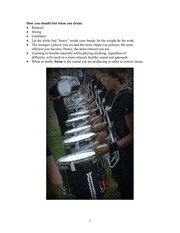
How you should feel when you drum:
• Relaxed
• Strong
• Confident
• Let the sticks feel “heavy” inside your hands- let the weight do the work.
• The stronger a player you are and the more chops you possess, the more
efficient you become. Hence, the more relaxed you are.
• Learning to breathe naturally while playing anything, regardless of
difficulty, will result in a more relaxed, healthy sound and approach.
• When in doubt, listen to the sound you are producing in order to correct issues.
5
�
Quad Technique
Grip:
• The grip for the quads will be the same for both hands.
• Thumb/Index finger connect approximately 1/3 from the bottom of the
stick.
• Thumb is parallel with the stick (runs along the side of the stick).
• Middle, ring, and pinky fingers are all wrapped naturally around the
stick, while never completely leaving the stick when in motion. I like to refer to this
concept as “the cradle”.
•
The butt of the stick should be slightly visible out the back of the hand.
6
�
Playing Position:
• In order to achieve an ideal positioning over the drum, work from the
beads of the stick backwards up to the shoulders.
• Generally, drum height should be slightly lower than the waistline, but will
be adjusted on a case-by-case basis.
• The shoulders should be very relaxed to avoid transferring tension into our playing,
while still maintaining correct posture (“soft shoulders”).
• “Home Position” will be defined as the sticks over drums 1 and 2. The
sticks will start and end in this position before and after all passages and
exercises. We will not shift from drum to drum, unless defined
otherwise.
•
•
•
•
Beads are ½” above the drumheads, and approximately 1½” in from the
rim.
Sticks should be angled slightly inward, almost perpendicular to the
shoulders.
Movement to the outer drums (3 and 4) should come from a horizontal
pivot, starting from the elbow (think windshield wipers). Never move to the outer
drums by turning your wrist over. Never allow the elbows to move behind the plane
of the shoulders, unless playing on the spock drum.
The hands should be rotated slightly outward in relation to the drum. The
hands should not be completely flat to the drum, like German grip, nor rotated
completely vertical, like French grip, as these tend to hinder use of finger
motion and wrist motion respectively. This hybrid between flat and
turned over is known as American grip.
7
�
•
•
•
•
The arms should be naturally draped down, not resting against the body. Avoid
pushing the elbows up or out, creating unnecessary tension in the
upper body.
The tacet position comes into play when one stick is playing and the
other is resting. The resting stick should remain completely motionless
and in its home position, no matter how active the other stick may be. This same
concept applies when both sticks are motionless
The sticks should create a slight downward angle to the drum, but will be closer to
parallel with the surface of the drums.
It is important to keep your fingers, wrists, arms, and entire body relaxed
while you play. If you feel tension at any point during your playing, you
are doing something wrong. Remember to breathe!
8
�
Playing Zone Chart
9
�
Closing
I would like to thank the following people for inspiring the information,
ideas, and techniques found in this packet:
Walter Riesenberg
Jon Merritt
Julian Goldthwaite
Jason Heaton
Darren Hazlett
Nicholas Buddock
The motivation of these individuals has pushed me to achieve more than
I ever thought possible.
Sources:
The Blue Way: Methods, Techniques, and Audition Materials for Battery
Percussion Ensemble by the Bluecoats Drum and Bugle Corps
Images: innovativepercussion.com, The
Cavaliers Drum and Bugle Corps
Contact:
Aaron Griesser
(614) 256-7296
AG667750@wcupa.edu
“Work hard. Good things will happen.”
10
�
 Historical archive . public document