Public‐Private
Partnerships
in
the
Malaysian
School
System
31
May
2011
InterContinental
Hotel
Kuala
Lumpur
The
Malaysian
Education
System:
Past,
Present
and
Future
Tunku
’Abidin
Muhriz
Founding
President,
IDEAS
�
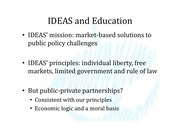
IDEAS
and
Education
• IDEAS’
mission:
market‐based
solutions
to
public
policy
challenges
• IDEAS’
principles:
individual
liberty,
free
markets,
limited
government
and
rule
of
law
• But
public‐private
partnerships?
• Consistent
with
our
principles
• Economic
logic
and
a
moral
basis
�
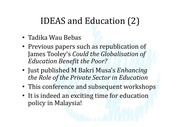
IDEAS
and
Education
(2)
• Tadika
Wau
Bebas
• Previous
papers
such
as
republication
of
James
Tooley’s
Could
the
Globalisation
of
Education
Bene4it
the
Poor?
• Just
published
M
Bakri
Musa’s
Enhancing
the
Role
of
the
Private
Sector
in
Education
• This
conference
and
subsequent
workshops
• It
is
indeed
an
exciting
time
for
education
policy
in
Malaysia!
�
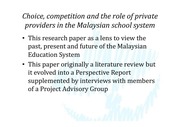
Choice,
competition
and
the
role
of
private
providers
in
the
Malaysian
school
system
• This
research
paper
as
a
lens
to
view
the
past,
present
and
future
of
the
Malaysian
Education
System
• This
paper
originally
a
literature
review
but
it
evolved
into
a
Perspective
Report
supplemented
by
interviews
with
members
of
a
Project
Advisory
Group
�
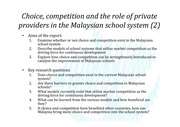
Choice,
competition
and
the
role
of
private
providers
in
the
Malaysian
school
system
(2)
• Aims
of
the
report:
1.
2.
3.
Examine
whether
or
not
choice
and
competition
exist
in
the
Malaysian
school
system
Describe
models
of
school
systems
that
utilise
market
competition
as
the
driving
force
for
continuous
development
Explore
how
choice
and
competition
can
be
strengthened/introduced
to
catalyse
the
improvement
of
Malaysian
schools
• Key
research
questions
1.
2.
3.
4.
5.
Does
choice
and
competition
exist
in
the
current
Malaysian
school
system?
Are
there
barriers
to
greater
choice
and
competition
in
Malaysian
schools?
What
models
currently
exist
that
utilise
market
competition
as
the
driving
force
for
continuous
development?
What
can
be
learned
from
the
various
models
and
how
bene[icial
are
they?
If
choice
and
competition
have
bene[ited
other
countries,
how
can
Malaysia
bring
more
choice
and
competition
into
the
school
system?
�
Important
de[initions
• ‘Choice’:
– Ability
of
parents
to
choose
how
the
education
of
their
child
is
structured,
managed
and
ultimately
executed
– Ability
of
schools
to
select
teaching
staff,
widen
admissions
policies,
administer
[inances
and
control
discipline,
uniforms,
meals,
etc.
– Ability
of
teachers
to
choose
schools
in
which
they
would
like
to
teach
�
Important
de[initions
(2)
• ‘Competition’:
– The
condition
in
which
the
choices
stated
create
incentives
for
schools,
parents,
pupils
and
teachers
to
behave
in
such
a
manner
as
to
be
selected
by
the
other
parties
• ‘Private
providers’:
– Schools
or
other
organisations
that
provide
educational
services
run
in
a
private
manner,
including
conventional
‘private
sector’,
community
groups,
trade
unions,
social
enterprises
�
Choice
and
competition
in
the
past
• The
origins
of
schooling
in
Malaysia
• Many
schools
private
at
[irst,
but
appropriated
by
interest
groups
and
political
parties
that
competed
for
recognition
and
power,
leading
to
subsidy,
perpetuation
and
expansion
of
certain
types
of
school
�
Choice
and
competition
in
the
past
(2)
• National
schools
were
built
and
operated
by
British
colonial
government
and
subsequently
the
Malaysian
government,
in
addition
to
missionary
schools
today
fully
assimilated
into
the
national
education
system
• For
a
time
many
were
English
national
schools
until
their
medium
of
instruction
was
changed
to
Malay
• Sekolah
pondok
grew
from
Muslim
families
seeking
a
religious
instruction,
but
madrasah
were
more
systematic;
today
they
cover
the
full
spectrum
of
being
fully
private,
government‐aided
or
fully
public
–
nonetheless
they
were
originally
built
in
response
to
demand
�
Choice
and
competition
in
the
past
(3)
• What
are
now
known
as
vernacular
schools
were
established
to
cater
for
the
education
of
immigrants
from
China
and
India;
typically
built
by
philanthropists
or
mining
companies;
a
majority
now
known
as
national
type
schools,
but
still
some
that
are
run
autonomously
�
Choice
and
competition
the
past
(4)
• The
Barnes
Committee
(1950)
that
wanted
to
minimise
dangers
of
ethnic
cleavages
would
have
reduced
choices
by
replacing
myriad
of
school
types
with
just
one
• Fenn‐Wu
Report
(1951)
opposed
Barnes
–
not
to
defend
freedom
of
choice,
but
to
defend
Chinese
education
• Razak
Report
(1956)
retained
the
‘national
unity’
agenda
of
Barnes
but
allowed
vernacular
schools
to
operate;
after
the
Rahman
Talib
Report
(1960),
Education
Act
1961
was
passed
�
Choice
and
competition
in
the
past
(5)
• Education
Act
1996:
‘Nothing
in
this
Act
can
be
interpreted
as
prohibiting
the
institution
of
new
private
schools’
• National
Education
Philosophy
1988
did
not
place
restriction
on
private
providers
either
�
Choice
and
competition
in
the
present
• There
is
indeed
room
for
choice
in
present
day
Malaysia
• Don’t
forget
tuition!
• In
some
cases
that
choice
is
restricted
by
academic
performance,
geography
or
other
criteria
determined
by
the
Ministry
of
Education
• But
some
parents
work
outside
the
system
to
circumvent
these
restrictions
• Private,
and
within
public
there
are
different
possibilities
�
Choice
and
competition
in
the
future
• Developments
with
PEMANDU,
Khazanah
Nasional
• Trust
Schools
and
Yayasan
Amir;
The
Pintar
Foundation
and
Teach
for
Malaysia
• Not
forgetting
of
course
the
great
schools
that
have
endured
the
past
few
decades
• And
the
great
schools
that
have
sprung
up
in
more
recent
time
without
–
perhaps
they
will
say
despite
–
government
intervention
• Religious
communities
e.g.
Khalifah
Model
School,
the
Methodist
Church
• International
schools
�
Conclusion
• The
past
as
a
series
of
experiments?
• Let
us
end
that
experiment
and
use
the
evidence
we
have
from
our
own
history
and
the
experiences
of
other
countries
• The
present
is
a
time
of
uncertainty;
government
is
seen
to
be
[lip‐[lopping
on
an
issue
which
is
seen
by
many
to
be
only
the
tip
of
a
much
bigger
and
deadly
iceberg
• But
there
is
huge
potential
for
the
future!
�
Thank
you!
�
 Historical archive . public document