MALAYSIAN EDUCATION SYSTEM:
PAST, PRESENT AND FUTURE
Producing Tangible Results:
Key Issues Around Implementation
Dr. Zahri Aziz
Deputy Director General (Operations)
Ministry of Education Malaysia
Public-Private Partnerships in the School System. What has worked? What hasn’t worked?
Organised by Razak School of Government and IDEAS, Intercontinental KL, 31 Mei 2011
�
Malaysian Education System: Past, Present, Future
Period/ Policy
1957
1961
Education Development
Preindependence
Diverse system
Postindependence
Consolidation
Establish a national education system
1961 Education Act & democratisation of ed
Expansion &
equity
Malay as the main medium of instruction
Emphasis on infrastructure, civics, science
Introduce support programs
KBSR, KBSM, National Education Philosophy
1971
NEP
1981
1991
New Economic Policy
NDP
National Dev Policy
Reform for
excellence
2001
NVP
National Vision Policy
National Mission
2011
2020
Main features
NEM
GTP
ETP
“First class
mentality”
1Malaysia
Raise student
outcomes
Study the schooling system
Strengthen acts and policies
Expand ICT in education
Upgrade teacher qualification
Introduce compulsory primary ed, PPSMI, MPV, j-QAF
Strengthen support programs & teacher
professionalism - pensiswazahan guru,
Pengetua JUSA C & Guru Gred Khas C, upgrade TTC to TEI (IPG)
Register SAR & SAN and widen access to international schools
Education NKRA – Preschool, LINUS, HPS, New Deal plus
School Improvement Program & Teacher Quality
MKRA – Transformation of vocational education
Introduce PPP - Trust School
Education NKEA – ECCE, ECCE Training, International Schools,
Teacher Training, PPP Schools & e-learning
�
Producing Tangible Results: Education for All (EFA)
Education Indicators
• Enrolment rates:
96% primary, 88% secondary
• Survival rate to grade 5: 94%
• Dropout rate: 0.0066% primary
• Adult literacy 15 yrs & above: 92%
• Gender specific EFA Index: 96%
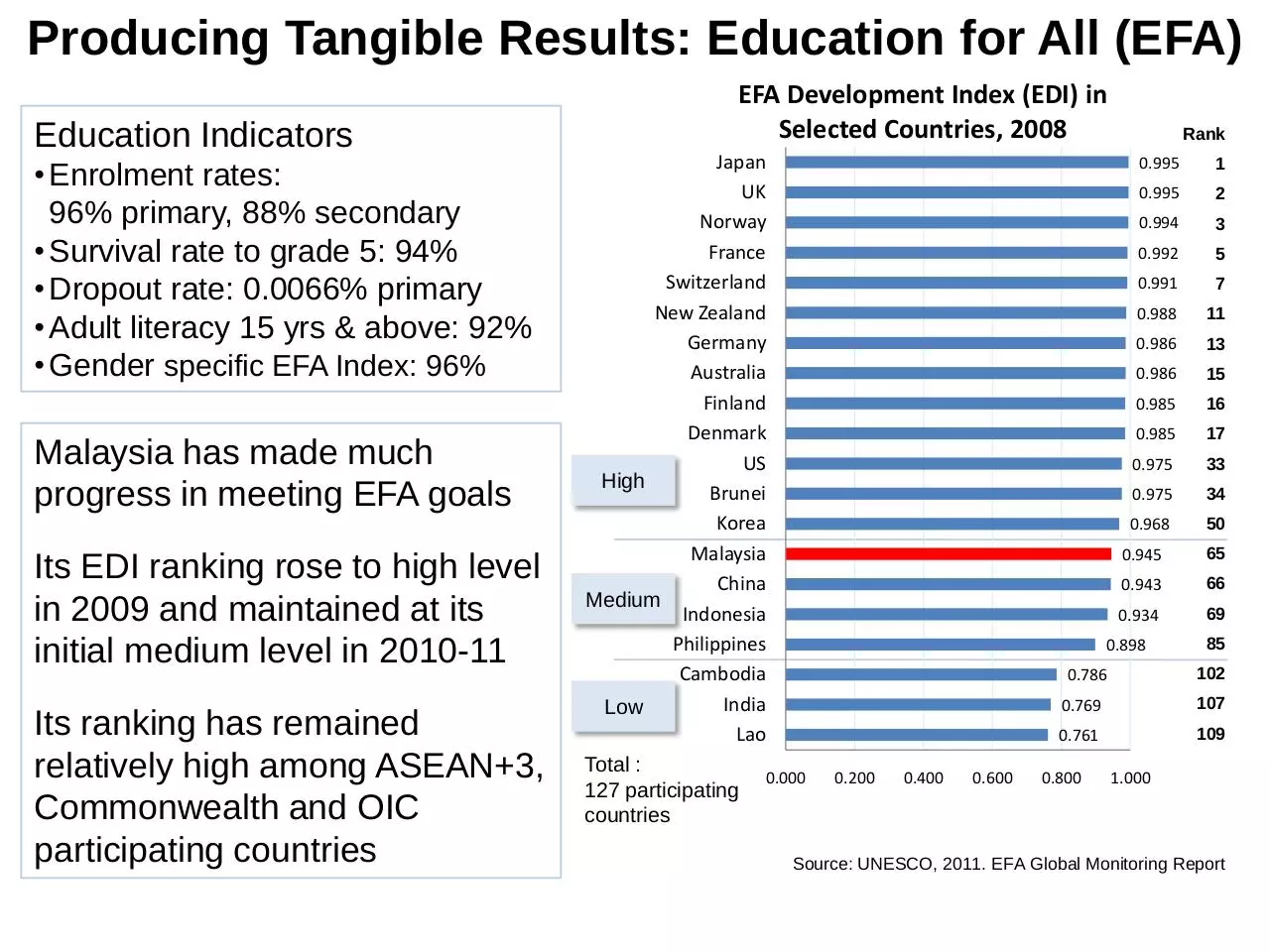
Malaysia has made much
progress in meeting EFA goals
Its EDI ranking rose to high level
in 2009 and maintained at its
initial medium level in 2010-11
Its ranking has remained
relatively high among ASEAN+3,
Commonwealth and OIC
participating countries
EFA Development Index (EDI) in
Selected Countries, 2008
Japan
UK
Norway
France
Switzerland
New Zealand
Germany
Australia
Finland
Denmark
US
High
Brunei
Korea
Malaysia
China
Medium
Indonesia
Philippines
Cambodia
India
Low
Lao
Total :
0.000
127 participating
countries
Rank
0.995
1
0.995
2
0.994
3
0.992
5
0.991
7
0.988
11
0.986
13
0.986
15
0.985
16
0.985
17
0.975
33
0.975
34
0.968
50
0.945
65
0.943
66
0.934
69
0.898
102
0.786
0.200
0.400
0.600
85
0.769
107
0.761
109
0.800
1.000
Source: UNESCO, 2011. EFA Global Monitoring Report
�
The Quality of Education: Learning Achievement
Malaysia’s achievement in TIMSS 1999, 20003 & 2007
Malaysia’s
performance in
TIMSS (1999,
2003, 2007) for
Mathematics
and Science at
the 8th grade
level have been
higher than the
international
scale average
Aspect
Mathematics
Science
1999 2000 2007 1999 2000 2007
Malaysia’s position
16
10
20
22
20
21
No. of participating country
38
45
49
38
45
49
Malaysia’s scale av.
519
508
474
492
510
471
International scale av.
487
467
450
488
474
466
Distribution of TIMSS mathematics scale score for 8th grade students in 2007
But large gaps
exist in learning
achievement
between
countries
Source: TIMSS,MOE Malaysia. UNESCO, 2010 EFA Global Monitoring Report.
�
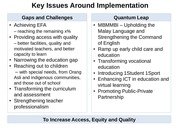
Key Issues Around Implementation
Gaps and Challenges
• Achieving EFA
•
– reaching the remaining x%
• Providing access with quality
– better facilities, quality and
motivated teachers, and better
capacity to learn
• Narrowing the education gap
• Reaching out to children
– with special needs, from Orang
Asli and indigenous communities,
and those out of school
• Transforming the curriculum
and assessment
• Strengthening teacher
professionalism
•
•
•
•
•
Quantum Leap
MBMMBI – Upholding the
Malay Language and
Strengthening the Command
of English
Ramp up early child care and
education
Transforming vocational
education
Introducing 1Student 1Sport
Enhancing ICT in education and
virtual learning
Promoting Public-Private
Partnership
To Increase Access, Equity and Quality
�
Public-Private Partnerships (PPP) in Education
Various forms of partnership already exist in the school system but PPPs through
the ETP and the 10th Malaysia Plan are relatively new and more extensive
EXAMPLES
Program
Type of PPP
Features
Early Child Care
& Ed (ECCE)
Education
services
Gov. provide tuition fee aid, grant
& soft loan to private operators
Trust School
(Basic ed)
PPP in
Vocational Ed
Benefit
• Expand access to low income
groups and underserved areas
• Leverage private investment
Public schools are managed
• More autonomy to schools in
Management
jointly by private partners and civil return for improved student
services
service school leaders
outcomes
Education
services &
PFI
• Gov. sponsor students in public/
private vocational colleges run
by private sector
• PFI - BOO, BOT, BOM
• Helps gov. in ed. transformation
– eg. fills in gap for enrolment
increases, provide infrastructure,
expertise and industry relevance
• Brings private sector expertise in
improving public ed & training
• Fills in gap in training needs
• Allows school staff to focus on
teaching & learning process
• Leverage on economies of scale
Teacher Training
Professional
services
Gov. contract out training for:
• ECCE
• Program pensiswazahan guru
• Pre-service training
School meals,
cleaning &
security
Support
services
Gov. contract out hostel meals,
canteen operation, & school
cleaning and security
�
Implementing PPP
Not business as usual … Must commit to action
Education policies
• Require changes in public policies, procedures and processes
& regulatory
with new and more extensive PPPs
framework
Enabling
framework
• Identify private sector involvement in the national ed. system
• Set criteria for private partners to provide services
• Provide funding scheme for students to attend private schools
• Establish effective monitoring and quality assurance system
Transparency
• Require transparent selection process of private partners,
procurement of services, implementation and reporting of PPP
Capacity building
Performance
measure
• Build own capacity to implement PPP
• Develop performance measures and targets for contractors/
partners, with incentives for performance and sanctions for
nonperformance
Ref: The World Bank, 2009. The Role and Impact f Public-Private Partnerships iEducation
�
THANK YOU
Ministry of Education Malaysia
zahriaziz@moe.gov.my
habibahar@moe.gov.my
�
 Historical archive . public document