Tales
From
Medevac
Page 4
Bl IN
Pr A oo SI
og fg d D
re ha Ne E:
ss n ed
in Me ed
D di
ay c
ku
nd
i
June 2011
�
Airborne Aid
Page 4
Regulars
4
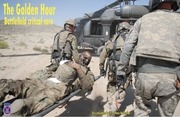
Pfc. Shawn Williams 1st Stryker Brigade Combat Team,
25th Infantry Division, gives the thumbs-up to members
of his unit as he is evacuated after being injured
by a roadside bomb June 17 in Kandahar province,
Afghanistan.
10
The
Mountainview
magazine
Around RC-South
Page 14
Latest LOLs
Page 16
Regional Command South
Commanding General
Maj. Gen. James L. Terry
Command Sergeant Major
Command Sgt. Maj. Christopher Greca
The Mountain View is an authorized
publication for members of coalition
forces. Contents of The Mountain View
are not necessarily official views of,
or endorsed by, coalition governments.
All editorial content of The Mountain
View is prepared, edited, provided and
approved by the Regional Command South
Public Affairs Office.
Top Shots
Page 8
Columns
Command Column
Page 13
The Don says
Page 12
2
On the cover
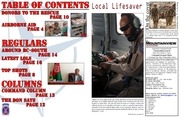
Donors to the rescue
Page 10
Photo by Lt. j.g. Haraz Ghanbari
Table Of Contents Local Lifesaver
Editorial Staff
RC-South PAO Lt. Col. Web Wright
RC-South PAO NCOIC
Master Sgt. Tami Hillis
Command Information OIC
Lt. j.g. Haraz N. Ghanbari
Managing Editor Sgt. Matthew Diaz
14
Afghan Air Force flight medic Sgt. Gulap Ahmadzia checks the blood pressure
and pulse on an Afghan National Army soldier as he is medevaced to the ANA
hospital at Camp Hero. The man fell from the back of a military vehicle and
suffered injuries to his shoulder and head, as well as a possible spinal injury.
Ahmadzia is the first Afghan flight medic to join American medevac crews as
they evacuate more serious patients from the battlefield. (Photo by Sgt. 1st Class
Stephanie L. Carl)
Read the story on page 16
Media queries please contact RC-South
Public Affairs at 10thmtnpao@gmail.com
Contributing Units
TF Kandahar
TF Lightning
TF Spartan
TF Thunder
TF Warhorse
CT Uruzgan
CT Zabul
NTM-A
16th MPAD
�
The Golden Hour
Battlefield critical care
4
Story and photos by Lt. j.g. Haraz N. Ghanbari
�
KANDAHAR AIRFIELD, Afghanistan — An air
ambulance crew from Company C, 1st Battalion, 52nd
Aviation Regiment, just finished their lunch in a small break
room in southern Afghanistan when a nine-line medevac
request was received.
The time was 1:51 p.m., and within a matter of
seconds the Army Soldiers, who are deployed from Fort
Wainwright, Alaska, ran a couple of hundred yards to two
Black Hawk helicopters.
As the co-pilot and crew chief prepared their
helicopter for the critical mission, the pilot and medic were
inside the tactical operation center getting grid coordinates
and information on the patient. Another couple of minutes
passed, and the pilot and medic headed to the helicopter to
suit up. Roughly 10 minutes elapsed since the initial request
was received, and the helicopters were now airborne en route
to Sha Wali Kot.
U.S. Army Pfc. Shawn Williams, 1st Stryker Brigade
Combat Team, 25th Infantry Division, also based in Fort
Wainwright, was driving a Stryker vehicle when a roadside
bomb detonated and ignited the vehicle on fire. Williams’
foot was fractured, his face covered with hot grease and his
right and left hands suffered second-degree burns.
As flames engulfed the Stryker and thick black smoke
filled the blue Afghan sky, Williams’ battle buddies stabilized
him, wrapping his right hand in gauze and providing support
to his right foot, while relaying information to the incoming
medical evacuation crew. Two Kiowa Warrior helicopters
circled overhead providing firepower and checking for
additional enemy threats as the medevac pilots made a final
approach to the landing zone.
“At the (point of injury), the first thing I was
concerned about was the security of the pick-up location.
Secondary (improvised explosive devices) targeting the
medevac helicopter is a very real threat for us, so we are
always looking below and around the helicopter,” explained
U.S. Army Sgt. Daniel Sherwin, the onboard flight medic.
“A captain approached me and briefly told me the injuries of
the patients, and their medic gave me a quick run down of
the treatment.”
The nine-line medevac request only noted one
patient, but Sherwin learned after landing that another
Soldier sustained a possible traumatic brain injury.
Four Stryker Soldiers carried Williams on a litter
toward the helicopter, its blades still turning as it sat within
eyesight of the damaged Stryker - ammunition exploding
inside from the intense heat. Sherwin, a Canadian citizen
who has been in the U.S. Army for seven
years and is on his second combat tour,
walked alongside Williams doing an initial
assessment of the patient.
Almost 20 yards from the door of the
helicopter, Williams, raised his left hand,
6
blackened from grease, and gave his unit the thumbs-up.
Once loaded into the helicopter, the pilots lifted off
quickly over the hills and mountains as Sherwin began a
more complete evaluation. From head to toe, he checked
Williams’ injuries, making sure his airway was clear, he was
breathing okay and that he wasn’t bleeding.
“We got the guys loaded as quickly as possible and
took off,” said Sherwin. “One of the biggest things we have
to offer is speed, so getting off the ground and on our way to
the hospital is essential.”
Sherwin needed to remove Williams’ improved outer
tactical vest, a specially designed piece of equipment used
to protect service members from war-zone hazards such
as shrapnel and different types of ammunition. The vest
and its components, typically weighing between 30 to 35
pounds, are at times cumbersome to remove so Sherwin
pulls a lanyard attached to the vest, causing it to quickly fall
apart into four pieces so the triage can continue. Williams
is a priority patient known as “Category A,” because of the
potential for loss of life, limb or eyesight.
“I was very concerned about his airway, because
inhalations burns will cause swelling,” said Sherwin. “I
looked in his nose and mouth to see if there were any signs
of burns, and was relieved to not see any.”
Cutting off Williams’ combat shirt and pant legs,
Sherwin takes a pulse and starts an IV while monitoring
other vital signs.
Due to the noise and vibration of the helicopter it
can be difficult to monitor a patient’s breathing, but Sherwin
says looking at and feeling the rise and fall of the chest works
well.
“The second patient was clearly shaken by the
incident, but was in stable condition; he was concerned
about his buddy,” said Sherwin. “I quickly got some vital
signs on him to be sure he was as stable as he appeared to be.
Simply giving them a thumbs-up and getting one in return is
reassuring to both us and the patient.”
Back on Kandahar Airfield, a distinct series of highpitched tones alerting the medical staff of an inbound Cat.
A, cuts through the chatter of nurses and doctors tending to
patients at the NATO Role 3 Multinational Medical Unit.
Within moments, a small group of hospital corpsman
who comprise the emergency vehicle operator course team
quickly gather their protective helmets and goggles as they
reach for their pagers to read the short description of the
inbound patients’ wounds.
Climbing into the rear of a specially designed
humvee ambulance, the head of the afternoon’s EVOC team
radios the hospital’s tactical operations center for an update.
The ride from the trauma bay to the flight line is short, but
long enough to discuss any critical information about the
patient. Sometimes the patient is stabilized, but other times
the corpsmen may need to assist with rending continuous
medical treatment until a nurse or doctor takes over in the survival increase dramatically.
trauma department.
As part of the transfer of care Sherwin says that all
Pulling up to the edge of the flight line, the driver of the information the medevac crew relays is particularly
positions the humvee as the helicopter pilot makes a fast important if the patient is unresponsive, but if the patient
approach to the landing zone. The rotor wash is so strong the is alert and oriented - talking to the doctors and not in any
corpsmen brace themselves against the side of the humvee apparent distress - the doctors typically can gather a great
until the helicopter has landed to prevent being blown over. deal about the patient’s general condition.
Two by two, the corpsmen carefully move toward
After various tests and treatments, approximately six
the side of the Black Hawk as Sherwin opens the door. Two hours have passed since Williams arrived at the Role 3, and
corpsmen carry the “head” or top of the litter and two carry he is recovering in a room with other service members. It’s
the “feet” or bottom of the litter.
nearly 9 p.m. and Williams receives a visit by the chief of
The time is 2:51 p.m., and Williams and the second staff and command sergeant major for International Security
patient are loaded into the ambulance, as a hospital corpsman Assistance Force Regional Command South and 10th
and Sherwin accompany them. The corpsman radios ahead, Mountain Division (Light Infantry).
and roughly 45 seconds later the team unloads Williams,
The 21-year-old private first class from Wichita,
securing him to a combat gurney before another team from Kan., his face now free from grease, his foot better stabilized
the trauma department takes over. The second patient was and his burns beginning to heal, recalls his escape from the
able to walk inside.
burning Stryker and his medevac flight to the hospital.
Once inside the trauma bay, Sherwin quickly briefs
Col. Erik C. Peterson, the chief of staff requests for
a team of U.S. Navy doctors, nurses and corpsmen along the orders to be read awarding Williams the Purple Heart
with
medical
for wounds received
professionals from
in action. As other
other
countries
service
members
who then begin
stand at attention,
more
advanced
Peterson clips the
treatment.
medal to a white
Sherwin
blanket Williams is
said the trauma
using to keep warm.
team is briefed on
Peterson asks
Williams about his
the
mechanism
family and his unit,
of injury, injuries
and then the three
sustained that have
share a few laughs.
been found, all the
Prior to departing,
vital signs, and
Command Sgt. Maj.
all the findings in
Christopher
Greca,
an assessment, to
presents
Williams
include the status
of their bleeding, U.S. Army Pfc. Shawn Williams of the 1st Stryker Brigade Combat Team, 25th Infantry with a command coin.
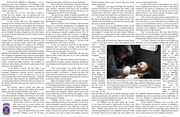
Division, based in Fort Wainwright, Alaska, right, is treated by flight medic U.S. Army
airway, breathing Sgt. Daniel Sherwin en route to the Kandahar Airfield NATO Role 3 Multinational Medical W i l l i a m s
under
the
and the level of Unit for additional treatment after he was injured by a roadside bomb June 17 in Kandahar rests
of a
consciousness.
province, Afghanistan. Sherwin is assigned to Company C, 1-52 Aviation Regiment, also observation
nurse and corpsman
“Lastly we based in Fort Wainwright.
before
departing
tell them all the
treatments that were done for the patient, and again include for Landstuhl Regional Medical Center in Germany for
what the ground medic did and what we did for the patient additional treatment en route back to the United States. At
in the air, medications administered, and the time and dose 4:25 a.m., Williams is discharged from the Role 3 for the
next chapter of his recovery.
given is also important for them to know.”
Stories similar to Williams’ occur every day at the
For Williams and his battle buddy, the transfer
of care from field medic to flight medic and then to the Role 3 with patients arriving by medevac or ambulance.
trauma team occurred within what is known as the “Golden Injuries range from debris in a person’s eyes to a service
Hour.” Medical professionals have determined that if a member who has suffered a catastrophic injury. Patients can
critically injured patient receives definitive treatment within include coalition service members, Afghan national security
60 minutes from the time of injury, his or her chances for forces, local nationals as well as military contractors.
�
S
T
O
H
P
S
O
T
8
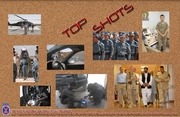
“TOP SHOTS” ENTRIES ARE OPEN TO ALL READERS.
ALL “TOP SHOTS” SUBMISSIONS MUST BE IN BY THE FRIDAY BEFORE PUBLICATION DATE. SEND SUBMISSIONS TO 10THMTNPAO@GMAIL.COM
�
10
Story and photos by Sgt. Matthew Diaz
Regional Command South Photojournalist
KANDAHAR AIRFIELD, Afghanistan — What
defines a hero of the battlefield? Is it a Soldier on the
frontlines or an engineer clearing a route?
Heroes come in all forms and a small group of
Airmen are making their own definition at the Kandahar
Airfield NATO Role 3 Multinational Medical Unit.
The aphaeresis center on KAF is responsible for
the collection of platelets and other blood products for
Regional Command South. While blood and plasma are
flown in from the United States, platelets have a shelf life
of only five days.
“With normal blood donations, once we take your
blood you’re done for two months due to the amount
of blood we take out of you,” said Air Force Capt. Aaron
Lambert, chief of aphaeresis with the 75th Medical Group
out of Hill Air Force Base, Utah.
The Chicago native oversees the operation of
platelet donation. With such a short shelf life on platelets,
he said frequent donors are required.
“There is no time to collect the platelets at home
station and ship them here,” Lambert said. “The U.S. has
decided to bring platelet centers over here and we supply
for all the south of Afghanistan.”
The donation process is a simple one – the first
step is for potential donors to get a prescreening at the
Role 3. Prescreening consists of filling out a questionnaire
and giving a blood sample to be sent back to the U.S. Once
the sample is tested, donors will be notified if they have
been approved, and then a donation appointment can be
scheduled.
Donors can give platelets about once a week due
to the technology used to collect the product. Blood is
drawn from the donor and platelets are then separated.
Once separation is complete, blood is returned to the
donor, leaving no feeling of weakness and allowing for
more frequent visits.
“Once they make their appointment and come in,
we do all the paperwork over again, just to be sure we’re
getting healthy product from them,” Lambert said. “We
hook them up to one of the machines and some people
read or watch TV.”
The entire donation process takes about two
hours, during which snacks, drinks and entertainment
are provided. Some service members use the donation
process as an escape from a chaotic workweek.
“These people know that they are doing something
good for our Soldiers,” Lambert said. “The surgeon
general of the Air Force called us and the people who
work here, ‘the heroes off the battlefield.’”
Recently, a perfect storm of bad timing and bad
luck hit RC-South. It was the end of the blood cycle – the
timeframe in which blood and other blood products can
be used before more arrives – and multiple casualties
arrived at the Role 3, all with grievous injuries.
“The way that it should work is that blood comes
from donors in the states to Qatar. From Qatar it’s then
distributed through Iraq and Afghanistan,” said Lambert.
“With the multiple traumas, they required a lot of blood
product. We started the day with plenty of product, they
just happened to go through all the product.”
The patients were going through blood at an
alarming rate and soon the hospital’s stock dwindled.
Then the aphaeresis center sprang into action.
“There are basically two things we can do when
we get low. We can call other FOBs to request more
(blood),” Lambert said. “The other thing is to activate
what is called the ‘walking blood bank’.”
A mass e-mail was sent out seeking donors with
type-O blood who have already been prescreened. The
response was overwhelming. The Airmen were drawing
blood for five hours straight before the need was finally
met.
“We drew about six times what they normally
have in the past,” Lambert added.
The walking blood bank was a huge success in the
end. All patients requiring blood products were stabilized
and flown out of theatre for ongoing treatment.
“We were never at a stoppage, we never did not
have the ability to get product,” Lambert said.
The walking blood bank is a big help in saving
lives, but it doesn’t work without donors. And what do
donors get out of the deal? For most it brings a sense of
pride.
“It’s an amazing feeling just knowing that I had a
huge part in someone’s recovery,” said U.S. Navy Seaman
Raven Crook, a hospitalman assigned to the Role 3. “This
is my second time being a walking donor.”
As long as the aphaeresis team is working hard at
the Role 3, no service member will have to worry about
lacking life-saving blood products should the worst
happen to them on the battlefield. But everyone needs to
do his or her part.
And how do you help?
“Come out and donate,” Lambert said with a smile.
Air Force Capt. Aaron Lambert, chief of aphaeresis with the 75th Medical
Group out of Hill Air Force Base, Utah, relaxes in a plush chair while
donating platelets at the Kandahar Airfield NATO Role 3 Multinational
Medical Unit.
�
As you know there is a new standard for carrying you “CAT” or combat
action tourniquet, it is to be carried in your right shoulder pocket with the tab
showing. This is to benefit all of us in case there were to be a casualty and you
needed to apply a tourniquet. This location is easy to find and the red tab allows
for quick response for the casualty. I have heard of some grumblings about the
tab showing and the new location but this is a good thing. This is a way to ensure
that all personnel are carrying their tourniquet and that everyone knows where it
is located. The bottom line is that tourniquets save lives. Everyone should know
how to use one and where and when to apply one. If you or your section needs
a refresher course on the “CAT” please feel free to come by the batallion aid
station here on Regional Command South for instructions.
Cultural
Considerations:
Afghan marriage customs demand that the
festivities are spread over three days. The ceremonies
are conducted between 6 p.m and 2 a.m.
The ceremony begins with the bride and the
groom exchanging vows in the presence of the mullah
or priest. The priest will read sections from the
Quran and direct the bride and the groom through
the ceremony. This is a family event in which close
family and friends participate.
The next part of the wedding is similar to
the western marriage reception. This is normally
hosted by the groom’s family and a large number of
guests are invited to attend. In conservative Afghan
families, the female and male guests are separated
and entertained in exclusive areas. Lavish dinner is
provided and after dinner, the bride and groom walk
up the aisle as they are showered with sweets and
flowers and a special song is played known as the Asta
Burrow meaning “go slow.” The bride
and groom then seat themselves on
a raised stage. They then go through
several rituals, exchange rings and
cut the cake.
In the morning, breakfast is
served and the bride and groom are
taken to their wedding chamber and
left alone.
12
Soldier In The Spotlight
Name: Spc. Janalu Swenson
Unit: 511th MP CO, 504th MP BN,
1BCT, 4th ID
Hometown: Santarita, Guam
Spc. Janalu Swenson has been serving as a driver
in 3rd Platoon, 511th Military Police Company,
Police Sub Station 3, Kandahar, Afghanistan. Due
to her maturity and understanding of the unit’s
mission, Swenson has distinguished herself by
being selected to conduct female engagements with
the Human Intelligence Collection Team. Working
well above her skill level, Swenson has been able
to extract information from female local nationals
where male Human Intelligence Collection Teams
have been unsuccessful.
Over the last two months, there have been some major developments
in Afghanistan. We know the Taliban’s capabilities have been significantly
reduced, we are seeing gains in the Afghan National Security Forces and
we are witness as developments in governance at the district and provincial
level begin to take hold. One of the most significant events was the killing of
Osama bin Laden, which caused much speculation about the effect it would
have on our mission here. Let me take a minute and share my views to help
you sort this out.
President Obama recently outlined his objectives for the U.S.
military mission in Afghanistan. His decisions were informed by advice from
senior military leaders, civilian advisers and his cabinet. His decision took
into account the military situation, the economy and a full range of national
security matters. Based on all of these factors, he laid out a timetable for
withdrawing the ‘surge’ troops deployed in 2009 and 2010, of which most
of us are a part. He directed that 10,000 troops be withdrawn by the end of
the year with the rest of the surge troops to leave by the summer of 2012
and that security of Afghanistan be handed over to the Afghan government
by 2014. Let me assure you that our commitment to Afghanistan and our
mission remains unchanged.
What we are tasked to do here remains valid. The ongoing offensive
operations are necessary to dismantle the insurgent networks and to solidify
the gains that we have fought so hard to achieve. We must continue to take
the fight to the enemy while countering their every attempt to regain the
initiative. Simultaneously, we must continue to work alongside our Afghan
partners to build their capability to protect and provide for the people of
Afghanistan
The U.S. surge is not over. Our troops will remain in theater for
some time, withdrawing to meet the president’s timeline. The ISAF and IJC
commands in Kabul are working hard to develop plans to off-ramp forces
in compliance with the president’s direction, all the while transitioning to
Afghan-lead where transition is warranted. During this same time, the
Afghans will continue to build up their own forces. Our ANSF partners have
already expanded their size and capabilities, increasing their own numbers
by 80,000 since December 2009 with a target end strength of 352,000 by
November 2012.
The day after his speech, President Obama visited Fort Drum,
telling those 10th Mountain Soldiers and families in attendance that, “because
of what you’ve done, areas like Kandahar are more secure than they have
been in years.” This is a testament to our hard work and sacrifices and
you should be proud. Acknowledging the efforts of U.S. service members,
civilian personnel and our many coalition partners, the president said we
have turned a corner which provides us the opportunity to begin to draw
down our forces in a way that ensures the gains you have achieved will be
sustained.
The ISAF commitment to Afghanistan remains strong. Our
enduring partnership and our commitment to Afghanistan and her people
will last far beyond the end of our combat mission.
I am proud of all of you, and I look forward to seeing you on the
battlefield.
“This is the time, this is the place, and we are the team.”
CORNER
r
u
o
y
Have
COMMAND COLUMN
Spc. Don W. Ellen
The Don Says ... tourniquet!
CHAPLAIN’S
The Involved Father
CH (MAJ) Herman Cheatham
Below are some things I gathered from
an article on Focus on the Family’s website.
I’ll just highlight a few things.
Fathers parent differently.
By eight weeks of age, infants can
tell the difference between their mother’s and
father’s interaction with them. This diversity,
in itself, provides children with a broader,
richer experience of contrasting relational interactions.
Whether they realize it or not, children are learning,
by sheer experience, that men and women are different
and have different ways of dealing with life, other
adults and children. This understanding is critical for
their development.
Fathers build confidence.
Go to any playground and listen to the parents.
Who is encouraging kids to swing or climb just a little
higher, ride their bike just a little faster, throw just a
little harder? Who is encouraging kids to be careful?
Mothers protect and dads encourage kids to push the
limits. Either of these parenting styles by themselves
can be unhealthy. One can tend toward encouraging
risk without consideration of consequences. The other
tends to avoid risk, which can fail to build independence
and confidence. Together, they help children remain
safe while expanding their experiences and increasing
their confidence.
Fathers discipline differently.
Educational psychologist Carol Gilligan tells
us that fathers stress justice, fairness and duty (based
on rules), while mothers stress sympathy, care and
help (based on relationships). Fathers tend to observe
and enforce rules systematically and sternly, teaching
children the consequences of right and wrong. Mothers
tend toward grace and sympathy, providing a sense
of hopefulness. Again, either of these disciplinary
approaches by themselves is not good, but together,
they create a healthy, proper balance.
Fathers prepare children for the real world.
Involved dads help children see that attitudes
and behaviors have consequences. For instance, fathers
are more likely than mothers to tell their children that
if they are not nice to others, kids will not want to play
with them. Or, if they don’t do well in school, they
will not get into a good college or secure a desirable
job. Fathers help children prepare for the reality and
harshness of the world.
http://www.focusonthefamily.com/parenting/
parenting_roles/the_involved_father.aspx
�
Daykundi: A model for success
in southern Afghanistan
Story and photos by Sgt. Sam P. Dillon
Regional Command South Photojournalist
14
DAYKUNDI PROVINCE, Afghanistan - Nestled at the
base of a 12,000-foot mountain lies the town of Nili, the
provincial capital of Daykundi. In the streets of Nili, people
are powering their motorcycles and vans up and down the
steep and narrow roads. People on foot meander through the
shops of the town’s bazaar, and children walk with books in
hand on their way to the local schools. No one really rushes,
or seems to be on edge. It is just another peaceful day in the
largest town in Daykundi.
DAYKUNDI PROVINCE, Afghanistan – In the International
Security Assistance Force’s Regional Command South, lack of
security has plagued the area since the start of Operation Enduring
Freedom nearly 10 years ago. The region, consisting of Kandahar,
Zabul, Uruzgan and Daykundi provinces, has been the Taliban’s
stronghold throughout much of the war, except for one province,
Daykundi.
The people of Daykundi, mostly Hazara (Mongolian
descendents living primarily in central Afghanistan), have secured
their province to the point where only minimal ISAF service
members are needed within the province, and many different aid
projects are underway.
In fact, the security of the province is so good that
Daykundi Governor Qurban Ali Orugani says that the government
of Afghanistan will announce that control of the province will
be returned to the people of Daykundi in October, and all ISAF
service members will be pulled out of the province.
This security has made way for many different aid
projects to bolster the infrastructure of the area. The newest
project completed being the Nili Airstrip, a 900-meter dirt runway
that was completed on June 12. Members of the U.S. Agency
for International Development contracted the project out to the
Central Asia Development Group, a company that specializes
in engineering, project management, civil design, agriculture,
finance and economics. The company locally hired a staff of 400
men. Paying the construction crew $6 to $14 per day and using
mostly hand tools, the work force moved nearly 200 metric tons
of earth, costing a total of $946,000 to finish the project.
“We use all local goods and materials from lumber to
gasoline, so in the end all the money is going to the people of
Nili,” said Frank Martin Leyland, a USAID employee.
Another project backed by Central Asia Development
Group is the Tamazan Pass road project. This project has
an initiative of completing a nearly three and a quarter mile
long paved road through the mountainous pass. The road will
connect the provincial capital and the village of Tamazan, and
open up interior Daykundi to farther larger towns to the south.
The construction project will be budgeted for $365,000 and is
estimated to be finished by the end of September.
“For 20 years there was no non-government organizations
that would go near that area and it was my desire to change that,”
said Leyland. “For me the main reason is to help with the security
of this province.”
The Nili footpath, another Central Asia Development
Group project, is just one more example of the many projects
transforming the infrastructure of interior Afghanistan. The three
and three quarter mile long path will wind its way through the
heart of the town and will be made of a crushed rock surface to
help with drainage. The path will help a prominently walking
town navigate throughout and will cost nearly $600,000 with a
projected completion time of September.
“When the snow melts you get two months of sludge and
this is a walking city,” said Leyland.
The student body is the most impressive part of Daykundi.
They have grown at an exponential rate of nearly 1,800 percent in
only seven years. Children walk for miles to attend a school with no
windows or even enough room to fit all the students. Many of the
students attend class in makeshift classrooms made of poles with
blankets hanging off the sides. Due to the progressive thinking
of Hazara people in Daykundi, said Gina Mansouri Ladenheim,
RC-South cultural adviser, there are two new school projects
underway to build new structures at two of the three campuses
in the Nili area, adding additional classrooms and expanding the
educational opportunity for the children of Nili.
“The new school will help us out a lot. It will give us eight
additional classrooms,” said Khadija Mousawi, Gandanak Girls’
School principal.
Nili also has a hospital with a 44-person staff consisting
of doctors, nurses, midwives, anesthesiologist, X-ray technician,
lab technician and a dentist. The hospital was built four years ago
and consists of two wards: a surgery ward, housing 20 beds, and
a maternity ward with eight beds. The majority of patients in the
hospital are for pregnancies, nearly 65 a month, and many of the
births are premature.
This is a problem for the hospital. The hospital doesn’t
have power at night, and neither does the rest of Nili. The only
power sources are gas-powered generators or solar panels, which
were installed a couple of years ago throughout the town. But the
hospital doesn’t have either power sources. The equipment for the
premature newborns doesn’t run 24 hours a day, which leads to a
high infant mortality rate.
“The public opinion in Daykundi is to have one child a
year and that maybe one will survive,” said Hava Rezaie, director
of women’s affairs for Daykundi.
This is only part of the problem though, because of the
high amount of pregnancies in the province and the low number
of beds in the maternity ward many of the women only get six to
24 hours of recovery time post birth, said Ali Akbaor, director of
nurses.
“This doesn’t give the mothers much recovery from the
pregnancy and it’s setting them up for infections once they leave
the hospital,” Akbaor said. “We see a lot of them back, if not here,
at the clinic.”
This is the one blemish in an overall developing province.
Due to the ability of the people of Daykundi to secure their
province, much more development has been able to take place,
which has made the life of the people of Nili easier and brought
more stability to the region.
Abraham Niazi, an Afghan security guard, poses for a photo on a hilltop
over looking part of Nili. Security in Daykundi has brought many
development organizations to build the infrastracture within Nili.
�
THIS JUST IN!
FROM THE INTERNET
Soldier’s Board
What are the two physical
fitness formations?
10-Mile Combat Relay
July 17 at the Bazaar Lake
Five-Soldier team event (within same
organization)
Each leg runs two miles (3.2k)
Each team member will hand off a weapon
and 30-pound rucksack to the next leg
Awards given to the top five relay teams
Register at the Boardwalk Tuesday,
Thursday and Saturday 7 p.m. to 9 p.m.
Extended Rectangular
Circular
Point of contact is Sgt. Costas at
gregory.costas@swa.army.mil
12
16
Afghan Air Force medic takes experience to new heights
Story and photo by Sgt. 1st Class Stephanie L. Carl
“Having Sergeant Gulap with us also really helped with our
KANDAHAR PROVINCE, Afghanistan – After about 20
medevac missions to evacuate mildly injured Afghans, Afghan Air Forcepatients,” Clark said. “When we picked up the patient who fell off the
flight medic Sgt. Gulap Ahmadzia gained a new level of experience todaybarrier, the only thing we knew was that he was being belligerent. Sergeant
as he became the first Afghan to treat a Category B patient during flight. Gulap was able to talk with him and keep him calm.”
“We don’t have much opportunity in the clinic to treat this type
While language differences can impact medevac missions,
of patient,” said Ahmadzia.
they didn’t impact the integration with Ahmadzia. The two medics used
Instead, Ahmadzia joined the medevac crews of Company C, 1stbasic medical terms to talk with each other, and they didn’t run into any
Battalion, 52nd Aviation Regiment, as they evacuated four Afghans whoconfusion. Some of this comes from the extensive training Ahmadzia has
had suffered mid-grade injuries and were classified as Cat. B.
received in the past.
Cat. B patients require medical evacuation to a higher level of
Ahmadzia is one of seven flight medics who have been working
care within four hours before they are at risk
with the 441st Air Expeditionary
of losing life, limb or eyesight. The patients
Advisory Squadron to further their skills.
Ahmadzia treated had suffered a variety of
The ultimate goal is for the Afghan
injuries.
Air Force to become the primary unit
The first was an Afghan soldier
responsible for evacuating Afghan
who was hit with shrapnel from an RPG.
patients; a goal the medics are quickly
The second was an Afghan soldier who fell
progressing toward.
from a barrier after hearing the news of his
The training all the medics participate
son’s passing and suffered a spinal injury.
in focuses on preparing them to treat
After retrieving these two patients
more serious patients while in a moving
and delivering them to Camp Hero – the
aircraft rather than just on the ground,
Afghan National Army hospital here – for
explained Air Force Tech. Sgt. Steven
further treatment, Ahmadzia thought he
A. Guillen, the flight medic advisor
would get a chance to stop for lunch. But
for the 441st AEAS. The medics have
duty called.
already conducted evacuations of less
The UH-60A Black Hawk
critical patients, but they haven’t had
helicopter lifted off once again, this time
the exposure to the ones who require
to pick up an Afghan soldier who fell from
immediate care.
a vehicle and landed on his head. Once
“This interaction today is the biggest
Ahmadzia and his American counterpart,
step toward the hands-on experience
Staff Sgt. Kyle Clark, loaded their patient
these guys need to be able to perform the
into the aircraft, he began checking the
mission,” said Guillen.
patient’s vital signs and hooked up an IV
While today was the biggest step, it
Afghan Air Force flight medic Sgt. Gulap Ahmadzia wasn’t the only one. The Afghan medics
drip.
helps load an Afghan patient into a UH-60A Black will continue to work with the American
“At one point, his oxygen
Hawk helicopter. The man was involved in a motorcycle teams on a regular basis, gradually
saturation level dropped to 93,” Clark said.
accident that left him with a broken nose, broken bones increasing the severity of the patients
“The normal level is 95.”
around his eye and the potential for a neck or spinal they treat.
When this happened, Ahmadzia
injury. Ahmadzia is the first Afghan flight medic to “They’re already capable of handling
leaned in to explain to the man that he was
join American medevac crews as they evacuate more the most critical patients medically,” said
going to put an oxygen mask on him. The
serious patients from the battlefield.
patient’s numbers quickly rose back to normal.
Guillen. “But they haven’t been getting
Ahmadzia had the advantage of
the trauma and wartime experience they
being able to talk to the patient in his native language. This also came inreally need to do the mission in this country.”
handy at Camp Hero, where he quickly exited the ambulance and went to
It’s a mission Ahmadzia said he takes on with pride.
brief the Afghan doctors on the patients’ conditions and what treatment
“I can serve my people,” he said of the experience’s impact on
had been provided thus far.
his ability as a medic. “I can serve my country.”
Become a friend and check in often for the latest news, pictures and video from RC-South.
FACEBOOK
www.facebook.com/ISAF.RCSouth
TUMBLR
The Mountain View Magazine wants your input!
www.ISAF-RCSouth.Tumblr.com
We are looking for cartoonists, columnists,
TWITTER
sports fanatics and many more to contribute.
www.twitter.com/ISAF_RCSouth
If interested, contact the RC-South Public AfYOUTUBE
fairs Office at 10thmtnpao@gmail.com.
www.youtube.com/user/ISAFRCSouth
DVIDS
www.dvidshub.net/units/RC-S
�
 Historical archive . public document