1
A. Kate Woodlief
October 27, 2010
ENGL1101 – 1:00
Paper #2 – Final Draft
High-Fructose, Highly Frightening
The Corn Refiners’ Association has recently launched an ad
campaign to improve Americans’ perspective on high-fructose corn
syrup. This sweetener, now present in almost everything on our
supermarket shelves, has been met with much controversy. And with the
United States guzzling down an average of 60 pounds of high-fructose
corn syrup every year, concern is to be expected (Parker). The front
page of the Corn Refiners’ website, sweetsurprise.com, is covered in
claims such as “...whether it’s corn sugar or cane sugar, your body
can’t tell the difference.” And although the website does quote
university research and medical professionals to back up such
statements, the testimonies date back as far as 1996. In the time
since then, much more research has been done and America has reached
many scientific milestones regarding obesity and nutrition. There is
no longer any mystery surrounding high-fructose corn syrup because the
truth has been unveiled by science, and the truth is not consistent
with what the corn refiners are saying; high-fructose corn syrup is a
dangerous, toxic sweetener that simply cannot be compared to natural,
pure cane sugar.
High-fructose corn syrup is derived of corn kernels, but the
process that surrounds it can only be described as “pretty weird”
�
2
A. Kate Woodlief
October 27, 2010
ENGL1101 – 1:00
Paper #2 – Final Draft
(Novak). CNN News laid out the procedures in detail in a recent
report, in which Kat Kinsman stated the following:
The corn syrup is made by first steeping kernels of corn in
a solution of 122°F-140°F water and a small percentage of
sulfur dioxide...for 30-40 hours....The kernels are
coarsely ground...then spun in cyclone germ
separators....The corn and starch are then sent through a
second, more intensive milling process that releases the
starch and gluten from the fiber in the kernel. The fiber
is screened out, milled again, then piped off....The starch
is diluted, washed 8-14 times to remove any residual gluten
protein, and then re-diluted and washed again to produce
high quality starch.
In addition to these terrifying methods, some studies have even
suggested that nearly half of all high-fructose containing products
have detectable traces of mercury due to the use of “mercury-cell”
technology (“Study”). At the end of the process, the syrup no longer
even resembles corn or anything else present in nature, especially not
cane sugar (even though the Corn Refiners claim the two substances are
chemically equal). But, the two substances are far from comparable for
two main reasons: First, high-fructose corn syrup contains about 5%
more fructose than cane sugar, which is composed of a 50-50 split
�
3
A. Kate Woodlief
October 27, 2010
ENGL1101 – 1:00
Paper #2 – Final Draft
between sucrose and fructose. Second, the molecules in high-fructose
corn syrup are free, while cane sugar contains bound molecules. In
essence, this means that high-fructose corn syrup is absorbed more
quickly than cane sugar because the bound molecules in cane sugar
require an extra metabolic process before absorption can take place
(Parker). The extra step that cane sugar requires to break down leaves
more time for the sugars to be worked off and expelled before it they
are released into the blood and circulated throughout the body, or
worse, later stored as fat.
There are other damaging effects to the body, both long-term and
short-term, that high-fructose corn syrup can cause as well. The
first, most obvious problem is obesity. In one study by the
prestigious Princeton University, a sample of lab rats was observed to
gain significantly more weight when given water sweetened with highfructose corn syrup than another sample of rats that were given water
sweetened with cane sugar (when fed an otherwise identical diet)
(Parker). However, the rats given high-fructose corn syrup did not
just become overweight; they were categorized as being clinically
obese. This is because the rats demonstrated two characteristics
unique of obesity: weight gain specifically in the abdominal area, and
a specific type of fats, called triglyceride fats, circulating in the
blood. One constituent of the study, graduate student Miriam Bocarsly,
�
4
A. Kate Woodlief
October 27, 2010
ENGL1101 – 1:00
Paper #2 – Final Draft
said, "In humans, these same characteristics are known risk factors
for high blood pressure, coronary artery disease, cancer and diabetes"
(qtd. in Parker). Furthermore, high-fructose corn syrup is also proven
to cause a hindrance in the production of leptin, an important
appetite-suppressing hormone. In a study done by the University of
Florida, it was proven that rats became resistant to the hormone after
being fed high-fructose corn syrup for only six months (Birdwell).
This would explain why the rats in the Princeton study that were fed
high-fructose corn syrup also gained more weight over time in
comparison to the rats which were given cane sugar (Parker).
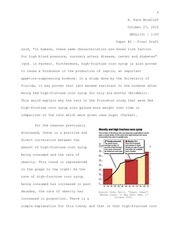
For the reasons previously
discussed, there is a positive and
direct correlation between the
amount of high-fructose corn syrup
being consumed and the rate of
obesity. This trend is represented
in the graph to the right: As the
rate of high-fructose corn syrup
being consumed has increased in past
decades, the rate of obesity has
increased in proportion. There is a
Source: Drum, Kevin. “Sugar, Sugar”.
Mother Jones. 12 May 2009. Web. 17
October 2010.
simple explanation for this trend, and that is that high-fructose corn
�
5
A. Kate Woodlief
October 27, 2010
ENGL1101 – 1:00
Paper #2 – Final Draft
syrup causes weight gain at a magnitude unequal to that of any other
known dietary factor. Inherently, when the results of two Princeton
studies were matched up, the comparison exposed that even a diet high
in fat did not necessarily cause weight gain in every case. However,
the consumption of high-fructose corn syrup at levels far less than
those in soda did cause weight gain, in every single case (Parker).
One team of scientists uncovered that the consumption of highfructose corn syrup increased over 1000% from 1970-1990, more than any
other food substance (Bray & Nielson & Popkin). These findings make it
obvious that high-fructose corn syrup is beyond excess within the
American diet. Still, in September 2010, the Corn Refiners’
Association petitioned to the Federal Food and Drug Administration to
have the name “high-fructose corn syrup” permanently changed on
product labels as “corn sugar” in order to oust the bad reputation the
sweetener has earned and increase sales as well as increase the need
for corn in order to advance their own business interests
(sweetsurprise.com). Nevertheless, the facts have revealed that highfructose corn syrup is exactly what its name implies; it is anything
but equal to the natural goodness of cane sugar and should never bear
the likeness of its name. Science has whispered the truth in all of
our ears, and the truth is we would be much better off using cane
sugar instead of high fructose corn syrup.
�
 Historical archive . public document