�
REFERENCE
HANDBOOK
MATERIALS • PROCESSES
TECHNIQUE
EASTMAN KODAK COMPANY • ROCHESTER, N . Y.
~-
�
COPYR IGHT 1946 (also 1940, 1943. a nd 1945 ) EASTMAN KODAK COMPANY
PRINTED IN THE UN ITED STATES OF AMERICA
All right s reserved. This book , or parts thereof, ma y not be
reproduced i" any f orm w ithout Permission of the publishers.
�
INTRODUCTION
KODAK REFERENCE
HANDBOOK
M AI N TE N A N<:;E of the hig h a rtistic a nd technical standards, today d em a nded by photogra phic craftsmen in a ll field s, r equires complete
information o n the pho tograp hic materials employed. The Koda k
R eference H a ndbook provides a wealth of practical r ecommend a tions
and technica l d a ta on a la rge group of Kod ak materials a nd apparatus
used for still photogra phy in black-and- white or color, a nd for a m ate ur
motion pictures in color.
The information, as well as the form in which it is presented , is the
result of collaboration between the K od ak R esearch L abo rato ries, experienced photograp hers, a nd photogra phic technicians . The Koda k
R eference H and book h as been found extremely useful by those who
enjoy photography as a hobby, those whose interest is profession al, a nd
those who employ it in specia l ap plications.
New Kod a k R eference H and books have as indi vidual sections the
la test r evisions of the K odak D a ta Books on L enses, Films, Filters,
Color Films, Pape rs, Formul as a nd Processing, a nd Copying. This
m ethod of assembly offers you two importa nt benefits: you have the
latest published information in each section of your H a ndbook, a nd
you can kee p yo ur Handbook up-to-d ate by re plac ing entire sections
with newly-revised Koda k D ata Books- see next p age for d etails of
the revision program.
To d etermine which is the most r ecent inform ation on a given
subject, compare the d ates of the sections or D a ta Sheets in which the
information a ppears. The d ate is located a t the bottom of the fi rst page
of each section, and in small type at the end of each D ata Sheet.
3
�
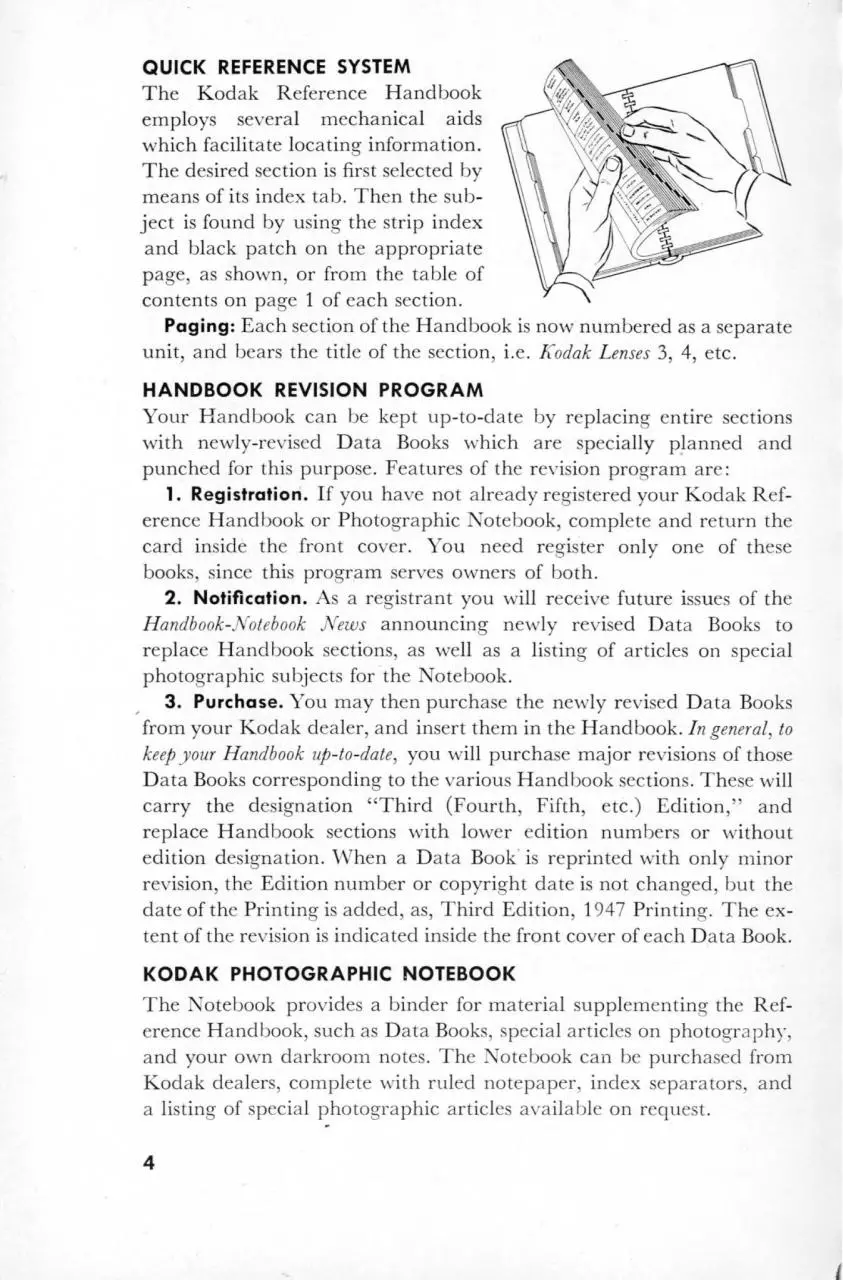
QUICK REFERENCE SYSTEM
The Kodak R eference H a ndbook
employs several mechanical aids
which facilitate loca ting information.
The desired section is first selected by
means of its index tab . Then the subj ect is found by using the strip index
a nd black patch on the appropriate
p age, as shown , or from the ta ble of
contents on p age 1 of each section.
Paging: Each section of the Hand book is now numbered as a sep arate
unit, a nd bears the title of the section, i.e. K odak L enses 3, 4, etc .
HANDBOOK REVISION PROGRAM
Your H a nd book can be kept up -to-da te by replacing entire sections
with newly-revised D ata Books which a re specially planned a nd
punched for this purpose. Fea tures of the revision program a re:
1. Registration . If yo u have not a lready registered you r Koda k R eference H a ndbook or Photographic Notebook, complete and return the
card inside the front cover. You need register only one of these
books, since this progra m serves owners of both .
2. Notification. As a registra nt you will receive future issues of the
H andbook -Notebook News announ cing n ewly revised D a ta Books to
replace H a ndbook sections, as well as a listing of a rticles on special
photographic su bj ects for the Notebook.
3. Purchase . You may then purchase the newly revised D a ta Books
from yo ur Kod a k dealer, and insert them in the H and book. I n general, to
keep your H andbook up-to-date, you will purchase m ajor revisions of those
D a ta Books corresponding to the various H and book sections. These will
carry the designation "Third (Fourth, Fifth, etc .) Edition ," and
replace Hand book sections with lower edition num bers or without
edition designa tion . When a D ata Book· is reprinted with only minor
revision , the Edition number or copyright da te is not changed, but the
date of the Printing is added , as, Third Edition, 194 7 Printing. The extent of the revision is indicated inside the front cover of each D ata Book.
KODAK PHOTOGRAPHIC NOTEBOOK
T he Notebook provides a binder for material supplementing the R eference H a ndbook, such as D ata Books, spec ia l a rticles on photograp hy,
a nd your own d arkroom notes . T he Notebook can be purchased from
K odak dealers, complete with ruled notepaper, index se parators, and
a listing of specia l photogra phic a rticles avail able on req uest.
4
�
KODAK PUBLICATIO NS
The follo wing books on various aspects of photography are stocked
and sold by Kodak dea lers, or ca n be ordered through them . Owing to
shortages of certain printin g and binding materials, however , some of
the publica tions listed m ay not be ava il a ble in sufficient qua ntity to
meet all de mands.
INTRODUCTORY
H ow to lvfake Good Pictures-A complete,
nontechni ca l book for the amateur
pi cture maker. 240 pages.
H ow to Nl ake Good M ovies-A nontech nical but thorough discussion of the
d etails of amateur movie making.
230 pages.
D eveloping, Printing, and Enlarging- A
comp lete ly illu strated instruction
booklet for the beginn er. 24 pages.
This Is Photography, by T. Ji. Miller and
W . Brummi tt - L ogica ll y organized
information on photography informally prese nted for those who a lready
know so mething about it, and want
to know more. 260 pages.
Picture Taking Outdoors with K odak Films
- An ill ustrated booklet g iving camera settings for ty pical su bj ects, and
a 20-minute course in picture taking.
24 pages.
FOR THE ADVANCED WORKER
Kodak D ata Books- A series of booklets
co vering various phases of photography. Each D ata Book is a complete
unit, containing general information
on its subject together with recomm endatio ns and techn ical data for
su itable K odak mate rials. With the
exception of the last three listed, the
Data Books parallel the corresponding sections of the Kodak R efere nce
Handbook. Included are :
K odak Lenses, Range Finders, and
Shutters
Kodak Films
-Filters a nd Pola-Screens (ill ustrated
in color )
K odachrome and Kodacolor Film
(illustrated in color)
Kodak Papers
Formulas and Processing
Copying
Slides
Photography with Kodachrome
Professional Film (illustrated in
colo r)
Infrared and Ultraviole t Photograph y
Kodaguides-A series of hand y, pocketsize books, cards, and calculators giving working data a nd recommendations fo r using films, papers, lenses,
fi lters, etc., under various cond iti ons.
Kodak Photographic Notebook-A con venient binder for darkroom notes and
other material supplementing t he
Kodak R efe re nce H andbook. Supplied w ith fift y sheets of note paper,
five separator pages, and a list of
photograph ic articles ava ilable on
request.
5
�
Eastman Films suppl ied for professional motion-picture prod uction , a nd
fo r 1 6-mm. K odac hrome Film. 72
pages.
Wratten L ight Filters- A complete catalog of the spectrophotometric properties of all Wratten Filters. 86 pages.
Photomicrography--A manu a l o n photography through the m icroscope. 1 74
pages.
The Theory of the Photographic Process, by
DR. C. E. K. MEES- A review and
summary, by the leading authority
on the subject, of the scientific work
of the past fift y years wh ic h has contributed to the knowled ge of the
photographic process. 1 124 pages.
Commercial Photojinishing- A general su rvey of the fundamenta ls of photofinishing-plant layo ut and eq uipment ,
records, processing and printing tec hniques, and quality control. 48 pages.
E astman M otion Picture Film s fo r Professional Use- Technical data for the
*
*
*
In addition to ma teria ls for genera l photographic work, the Eas tman
K oda k Compa ny ma nufactures specia l photographic materia ls for
nearl y every known use of sensitized products. Some of the fields for
which such ma teria ls a re regula rly supplied include spectroscopy,
aerial photography, photomicrogra phy, rad iography, graphic 'arts,
and industrial, documenta ry, and template .photogra phy.
Literature describing Koda k products and a rticles a bout various
photographic subjec ts a re availa ble on request. At the present time,
bibliogra phies of books a nd articles dealing with many specia lized
aspects a nd applications of photogra phy a re a lso availa ble on request.
Those who wish information abo ut specia l applications of photograp hy, or who need help with other photographic problems, are
invited to write to the Sales Service Division, Eastma n Koda k Company, Rochester 4, N. Y.
6
�
�
�
Lens
Specifications
KODAK LENSES
RANGE FINDERS AND SHUTTERS
Page
2
2
L ENS PR O P ER TIES.
" Lumenized " Le nses . .
. . . ... .
Foca l Leng th . . . ... .. . . ... .
Pho tograp hic Perspective.
Lens Diaphragm and Its M a rkings.
Effectivef-Number for Extreme C lose- Ups . . .
Corrections in Photograph ic Le nses.
0
•
•
0
0
•••
•
•
0
•
0
0
••
0
•••
0
•
0
.
0
0.
0
0
0
••••••••
0
.
0
0
0
0
0
•
4
5
L ENS P ER FOR M ANCE.
D efi niti o n at Various Apertures.
D efiniti o n and Ca mera Technique .
Circl e of Confusion a nd D e pth of Field .. . .. . .
D e pth of Field Indi cators.
Lens Performan ce in Color Photograp hy ..
0
0
0.
0
•
•
0
0
••••
0
•
•
•
•
0
8
8
9
11
•
•
0
•
•••
K ODA K LEN SES.
K oda k Ektars .. ...... ....... .
K oda k Anastigmats.
Koda k Enlarging Lenses ...
C in e-Kodak Lenses . .. .. . ........
K oda k Supp le mentary Lenses ... . .. . ....... . ..
Table- Optical D ata for Kodak Portra Lenses ...
Care of Lenses .
0
•
•
•
0
0
0
•
0
••••
0.
0
0
•
0
0
0
0
••••
0
0.
0
0
0
0
0
0
0
0
0.
0
.
0
0
••••
0
0
0
0
0
0
•
0
0
0
•
0
••••
0
•
0
0
0
•
12
13
13
15
15
16
17
20
21
22
24
K ODAK RA NGE FINDERS.
R a nge Finder Data .
K o DAK S H UTTER S . . . . .. . . •
0
•
25
26
27
29
30
30
0
Types of S hutters.
Sy nchro ni za ti o n of Shutters with Flas h Bulbs.
Shutter Efficiency.
Koda k S hutter Data.
Tablc:!- Shutter Speeds to R ecord Subjects in M o tio n .
UsEFUL OPTICAL F oR M ULAS .
Focal Leng th , Back Focus, S ubj ect and I mage Positio n .
Effective Aperture for C lose-U ps.
Supplementary Le nses ..... . . . ..... . .
Angle of View .
Depth of Field Com putations ..
0
••
Lens
Performance
••
KoDAK L ENS SPEC I FI C ATIONS AND SuMMAR Y TABLES ..
0
31
31
32
33
33
34
Kodak Camera
and Enlarging
Lenses
Cine-Kodak
Lenses
Kodak
Supplementary
Lenses
Care of Lenses
Kodak Range
Finders
. .. .. 35-60
Copy ri ght , 19-1 5 ( al so 1942) , Eastma11 K odak Co m pa11y
Second 1946 Printing
Kodak ShuHers
Optical Formulas
�
KODAK LENSES
RANGE FINDERS AND SHUTTERS
PHOTOGRAP HY finds ever wider application in specialized and technical
fields on the part of both the professiona l photographer and the serious
hobbyist. This has led to greater emphasis on the correct a nd accurate
use of the most importa nt part of the camera- the lens. Higher sta nd ards in picture quality, the extended practice of color photography, the
greater interest in picture taking at all times regardless of adverse light
conditions, and increased activity in photographing small objects- all
demand more attention to such matters as lens correction, lens definition, exact focus, effective lens aperture, depth of field , proper use of
supplementary lenses, etc. The excellence of a lens or shutter alone will
not necessarily assure precise results; their properties must be fully
understood and correctly applied.
The information presented on the following pages is intended to
afford a thoroug h understanding of lens and shutter operation. In
addition, the characteristics of each Kodak Lens a re described in
deta il in Specification pages. Optical formulas are included for the
convenience of those faced with special problems.
"LUMENIZED" * LENSES
The most recent advance in Kodak lenses is the wide application of
Lumenizing . Many Kod ak lenses now "bear a thin, hard coating of
magnesium fluorid e to reduce surface reflections and consequently fl a re
lig ht a nd spots. Picture quality is improved in shadow contrast and
detail and in shadow color purity of color pictures. Because of the
reduced tendency to veiling and spots, the camera has grea ter freedom
of position with regard to the sun or bright lights .
Lumenizing slightly increases the speed of a lens having many glassair surfaces. More light is transmitted to the highlights, less to the
shadows. In color work the increase may amoun t to as much as a
third of a lens opening setting; in black-and-white no allowance should
be made .
2
KODAK LENSES
*T. AI. Reg. U.S . Pat. Off.
�
When all the elements including condensers of a proj ection system
a re Lumenized , screen brigh tness is increased- SO% in the case of the
K odaslide Proj ector, Model 2A. The proj ected picture quality is a lso
improved , mostl y in the shadows.
Lumenized enla rger lenses tend to give improved highlight deta il,
espec ia lly from negatives of high contrast or la rge shadow a reas.
Lumenized lenses, as currently made, bear a circled " L " engra ved
o n the mount. T reated lenses can a lso be iden tified by the sligh t tint
see n by reflec ted light. The lens is unco lored by tra nsmitted lig ht.
Color rendering is not a ffec ted .
Dirt o n Lumenized lenses tends to cancel the ad vantages of Lu men izing. Oil spo ts look like holes in the surface. Lumenized lenses ca n a nd
should be cleaned in the usua l way, as descri bed elsewhere.
R ecen tl y designed Ekta r lenses have mecha nical improvements in
the mo un t, a lso designed to reduce fl are light.
I
Lens Properties
FOCAL LENGTH
A fund a mental cha racteristic of a ny le ns is the focal length . This
controls the image dista nce a nd size, a nd ordina ril y deter m ines the
usable negative size. T he focal leng th is a pproxima tely the dista nce
from the lens to the image of a dista nt obj ect. M ethods of findin g
focal leng th a nd the rela tion between it a nd su bj ect and image dista nces a re given on pages 31 a nd 32.
Photographic Perspective
Huma n eyes see in three dimensions, but a lens reproduces a view
in two dimensions only. The missing dimensio n, depth, is suggested
ma inly by the rela tive size a nd posi tio n of the va rious o bj ects in the
picture. T he relation of these obj ec ts, or perspecti ve, a nd therefore the
na tura lness of the picture, is infl uenced by the position of the camera .
Laboratory test comparison of a Lumenixed and an untreated lens. A bare lamp was photographed against a blackboard with-Upper-Lumenixed lens-Lower-untreated but otherwise similar lens . Note the freedom from flare effects, and better contrast by the Lumenixed lens .
3
�
A camera position too close to the subject results in an exaggeration
of the parts nearest the lens.
Correct perspective in the final picture depends largely upon the
distance at which it is viewed. Contact prints should be viewed at a
distance equal to the focal length of the lens with which they were
made. Enlargements require a viewing distance equal to the camera
lens focal length times the number of diameters of enla rgement.
This usually results in a viewing distance more conve nient to the
eye tha n the one most desirable for contact prints, which is ra rely
prac tical , with the result that enlargements seem to convey an improvement in naturalness. For pictures projected on a screen, the
correct vievving distance is equal to projector-screen distance mu lti plied by the ratio of the focal length of the taking lens to that of the
projection lens. It is natura l, however, to view any picture at a distance
convenient to the eye when looking at it as a whole. Only if this
resu lts in a departure by more than a factor of 2 from the correct
viewing distance is the rendering of perspective noticeably affected.
The bes t balance between normal perspective in the picture and
compact still-camera design calls for a focal length slightly greater
than the picture diagonal. Lenses with a focal length shorter than
this a re known as wide a ngle, while long-focus lenses, such as the
telephoto type, exceed the diagonal considerably in focal length.
LENS DIAPHRAGM AND ITS MARKINGS
\1\lhile slower lenses have a fixed opening or a series of apertures in a
movable slide or disk, faster lenses have an adjustable opening to vary
the amount of light passed. The size of this opening is indicated by a
diaphragm scale, generally marked in ] -numbers. Each ] -number is
the focal length divided by the effective diameter of the diaphragm.
These numbers are related to light intensity at the image plane and
permit common exposure recommendat:ions for lenses of all focal
lengths. The ] -num bers 1.4, 2, 2.8, 4, 5.6, 8, 11 , 16, 22 , 32 indicate
successive decreases of one half in light inte nsity. For an average lens
at j /8, the illumination of the image in foot-candles is about 1/ 700
of the subject brightness in foot-l amberts.
Until recently the U.S. (Un iform System) markings in which the numbers a re proportional to the exposure required were used on a number
of lenses. The U .S. markings compare with the ] -values as follows:
,_ _
1 __
1
j /4
u.s.
4
KOD AK LENS ES
I f /5.6 I
J /8
J /11
1~1___!!33__1__!!!!__1
16
32
64
J /45
128
�
Effective f- Number for Extreme Close-Ups: In making extreme closeups, the image distance no longer app roaches the focal length;
h ence the effective ] -number will be higher than indicated. This is
especially important in color photography and in copying. The
formul a for computing the effective ] -number is given on page 32, or
the exposure modification can be determined with the Kodak Lens
Guide, sold by Kodak dealers.
CORRECTIONS IN PHOTOGRAPHIC LENSES
A single convergent lens can be used to form an image, which will ,
however, be found to suffer from serious d efects due to lens aberrations, especially when used at fu ll apertu re. K odak lens d esigners
and lens makers use every means known to optical science to elimin ate these aberrations entirely, or reduce them to a d egree consistent
with good performance. Some of the inherent shortcomings of lenses
which a re corrected in Kodak objectives, to make them meet the
exacting d emands of modern photography, are briefl y listed . Those
interested in further details should consult a good textbook on optics .
Spherical Aberration: In the case of a simple lens with spherical su rfaces, the rays coming through the central portion of the lens a nd
t he r ays coming through an outer zone do not converge at the same
distance from the lens. As a result a point is im aged as a blur. The
aberration is due to the fact that spherical surfaces a re used on the
lens, a nd is therefo re called "s pherical aberration. " The effect of a
small amo un t of this aberration on the image of a n extended subject
is to cover it with a haze of light. If present in large amounts, spherica l
aberration will spoil the sharpness and crispness of definition, app roxim ately uniformly over the whole field . As the magnitude of this
aberration usually rises rapidly with increased lens aperture, it becomes
progressively more troublesome a nd ha rder to elimin ate ~s the speed
of a lens is increased. (See Figure 1.)
Coma: Coma is a kind of la tera l spherical aberra tion . In spherical
aberr ation itself, the various zones of a lens suffer from a longitudinal
d ifference of focus for rays parallel to the lens axis. Coma a ffects the
rays not parallel to the axis. \,Yhen coma is present, these oblique rays
passing through the various zones converge at different dista nces from
the center of the image, so that a single poin t in the subj ect is im aged
as an arrowhead po inting toward the center of the field .
Astigmatism: In th is aberration, a single point in the subject is im aged
not as a point but as two short, mutually perpendicula r lines a t
different d istances from the lens . The d istance between the lines is a
KODAK LENSES
5
I
�
measure of the astigmatism present in the lens. Neither coma nor
astigmatism exists at the center of the picture or, in other words,
on the axis of the lens.
Curvature of Field: The field of a lens is the imaginary surface where
the image of the subject is brought to focus. The fi eld of a simple lens
is not flat, but concave or saucer-shaped. As a result, a fl at subj ect at
right angles to the lens axis is brought to focus not in a plane as would
be desirable for recording the image on a fl at film, but on a concave
spherical surface. Curvature of field is present in single-lens cam eras,
and, in order to provide a satisfactorily sharp image over the entire
picture a rea , the film is placed at the distance for best ave rage focus
and a small rel ative aperture is used to increase definition and depth
of focu s. In some simple lens cameras, the fi lm is held in a curved
position, approximating the concavity of the lens field.
Distortion: In the case of distortion, the magnification varies from the
center of the picture outward. This results in a distortion of the image
SP~£RICA.L ABERRAT ION
~
-
--
CURVATURE:. OF" F"ILLO
mmm
SUB J ECT
DISTORTED IMAGE:S
DISTORTION
1-:1:
w
0
---\-+"~
CHROMATIC ABERRATION
Figure 1-Lens Aberrations . The subject is to the left of the lens, image to the right.
All aberrations are shown greatly exaggerated.
6
KODAK lENSES
�
and causes a sq ua re o bject to be imaged as either a barrel-sha ped or
a cushion-sha ped fi gure . vVhen d istortion is present, a stra ig ht line
running across the center of the pic ture re ma ins stra ight, bu t stra ig ht
lines lying in the outer pa r ts of the image field a re bowed.
Chromatic Aberration: Becau se the degree of refraction or bend in g
of a ray of light upon entering or leav in g a polished glass surface
va ries with the color of the lig ht, every property of a lens depends o n
color. Thus the position of the image itself cha nges slig htly with the
color or wave length of light (see Figure 1) ; this effec t is known as
ax ia l or longitudin a l chroma tic aberra tio n. Fortunately, it is poss ible
to reduce this deficiency greatly by using the pro per com bina tion
of two or more different kinds of glass in a lens.
Lateral Color: The varying degrees of refraction of different colo rs
ca n result in a no ther a berra tion know n as " latera l color" or chroma tic
difference of m ag nification . This can occur in a compound le ns eve n
though the lens may be correc ted for the chroma tic a berra tion as
descri bed above. In the case of lateral color, while a ll the color im ages
m ay be focused in the sa me pla ne, the effec tive focal leng th of th e
le ns va ries slightly fro m one color to a no ther ; this results in differences
in magn ificat ion of the res pec tive color images . If present, this aberra t ion results in colored frin ges surround ing the images in the o uter
par ts of the field. In black-and-white pho togra phy, these colo red
frin ges appear as a slight blur or fuzziness, but in color work, es pec ia ll y
if the le ns is used in an enlarger, colored frin ges may show up very
badly. This aberra tion is not reduced by stopping down the lens.
Correction of Aberrations: Corrections are achieved by the use of
optical glasses differing in their light- bending and color-spreading
powers, by the thickness and curvature of lens elements a nd the spac in g
be tween them. In general, the la rger the a perture, the more elements
a re requi red for full correction . T he tas k of designing lenses will
be realized since various aberrations m ust be corrected simulta neously
with a limited choice of glasses a nd nu mber of elemen ts.
Kodak Optical Glasses: These rela tively new glasses a re unusua l in
tha t they are not made from silica, but ra ther from com pounds of ra re
elemen ts such as tanta lum , tungs ten, a nd la ntha num. These new types
. h ave a high light-bending power (refractive index) combined with
unusua lly low spreading of individu al colors (dispersion) . Such properties permit lens elements which a re Jess steeply curved tha n those of
the older glasses. This, in turn , simplifies a nd permits a higher degree
of correction . These new glasses a re now in widespread use a nd a re
re presented in nearl y every recent type of K od ak lens.
KODAK LENSES
7
�
Lens Performance
DEFINITION AT VARIOUS APERTURES
The term "definition" refers to the ability of a lens to form a clear
image of fine d etail. Not even a theoretically perfect lens would be
capable of imaging a point source of light as a geometrical point.
All practical lenses image such a point as a small blur which changes
in character with the change of lens aperture. In addition to reducing
speed and increasing the depth of field, decreasing the lens aperture
improves definition, as it removes the small amount of haze caused
by residual aberrations. This also results in a slight increase in image
contrast. As a general rule, the best compromise between maximum
definition and speed is made by closing down the diaphragm from
wide open about two stops for moderately fast lenses, such as J/4.5's,
and about three stops for ultrafast lenses.
The wave nature of light sets a limit to the increase in definition
as the aperture is closed down. A beam of light passing through an
aperture does not continue unchanged, but spreads slightly at the
aperture edge in a manner similar to the spreading of water waves
after p assing through a small opening in a breakwater. The smaller
the opening, the greater the spreading. This diffraction may begin
to influence definition unfavorably as the minimum aperture is
approached . If maximum definition is desired, it may be advisable
to use a diaphragm setting one to two stops away from the minimum.
Enlarger lenses used at their smaller lens apertures may limit print
definition in extreme enlargements due to the diffraction effect mentioned. This limit is seldom reached in ordinary work.
Good lenses will perform satisfactorily at all stops provided . However, for extremely critical work, especially with ultrafast lenses and
those of short focal length, it is well to take into consideration the
above two factors influencing definition. In general photographic work,
these small changes in performance with varying lens apertures are
of li ttle consequence.
DEFINITION AND CAMERA TECHNIQUE
Poor definition and lack of sharpness in negatives are more often due
to faults in camera handling, in particular focusing errors and camera
motion, than to lens quality.
Focusing for Visible Light: As the subject-to-lens distance is reduced
the lens-to-image distance has to be increased. With lenses of comparatively short focal length and small aperture as used on Brownies
8 KODAK lENSES
�
and inexpensive Kodaks, the depth of field is sufficiently great to
cover the range of distance normally used for picture taking. With
faster lenses when used at their greater apertures the depth of field
is more limited and focusing is necessary. With cameras provided with
ground glass or coupled ra nge finder focusing, this operation is simple
and exact. Using cameras with scale-focusing requires an ability to
estimate dista nces rather closely. For all close-up work and when
working at m aximum lens apertures with fast lenses, the distance
cannot, as a rule, be estimated with sufficient accuracy, a nd should
therefore be measured by a ruler or with the help of a range finder.
Focusing for Infrared Light: Focusing a lens by ground glass, range
finder, or dista nce scale setting, produces sharp pictures only with
visible light. Infra red light rays, due to their longer wave length, focus
in a different plane from visible light rays. Some focusing scales provide
a special focusing mark to be used when taking infrared pictures. For
certain Kodak lenses, the correction is given in the specification sheet.
These corrections a re worka ble averages. As a general rule, better
infra red pictures a re obtained if the lens is extended by about XI:% of
its focal length after it has been focused for visible light . To a ttain
additional sharpness, the diaphragm should be closed down .
Camera Motion During Exposure: Small cameras are not held sufficiently steady by the average person for longer than 1/ 50 to 1/ 100
second, nor large h and cameras for longer than 1/25 second. At
slower shutter speeds the use of a good tripod eliminates camera
motion. A shutter speed of 1/ 50 second is recommended for large
hand-held cameras, and 1/ 50 or preferably 1/ 100 second for small
cameras, if light conditions permit. To release a shutter properly, a
s-1-o-w, "trigger squeeze" finger movement should be used without
moving the rest of the h a nd. H olding the breath at the instant of
exposure often helps to avoid camera motion.
CIRCLE OF CONFUSION AND DEPTH OF FIELD
Theoretically, when a lens is focused for a certain distance, objects
at tha t distance only are sharp . Objects at all other distances are
more or less out of focus, and points outside of the pla ne focused upon
are imaged as blurred circles which are referred to here as "circles of
confusion." The farther the points are from the plane focused on, the
larger the circles of confusion and the greater the out-of-focus effect.
The size of the circle of confusion which appears to the eye as a point
and therefore is accepted as tolerable is not a mark of lens quality, bu t
is purely a mathematical value chosen for the purposes of computation.
KODAK LENSES
9
I
�
For critical definition or sharpness, the circle of confusion in the
print should not be larger than about 1/ 100 inch, if the print is to be
viewed at the normal viewing distance of 10 inches. or, on an angular
basis, the circle of confusion should not subtend more than two minutes of arc at the eye when the print is viewed for correct perspective
(i .e., viewing distance equal to the focal length of the camera lens
times the amount of enlargement, if any). When the circles of confusion exceed these limits, they appear to the eye as small blurs rather
than points, and details within the image no longer appear sharp.
"Depth of field" of a lens refers here to the range of distances on
the near and far sides of the plane focused upon, within which details
are imaged with acceptable sharpness in the final print when observed
from a normal viewing distance. Depth of field increases with increasing subject distance, decreases with increasing relative aperture, and
increases with decreasing focal length, other things being equal.
---------
Figure 2-The effect of lens
apertures on depth of field.
/
IMAGE POINTS OF:
/
/
' '\
/
I
I
\
\
PI.. AI'IE IP4"'C IACLE
I
I
LUIGE TO BE
\
TOL[AAT( O \
I
R--j'-'-----~--'7'.·
-- -- I
.·
\
I
j
I
\
OF COI'iF U S IO N TOO
SECTION A
,:'//
',,
TOL£AAB!.E
' .... .....
J
I
I
CIRCLE~-~/
/
/
_- or6; H
roc us
!.c -" I
s!HOWN
HlL::G£0
----J-->.
SECTION A
,~-;:
DEPTH OF FIELD
DIAPHRAG M SE:T AT
SMALL APERTURE
RAV-CON( MAO£ NARROWER
SO THAT A.·E IUYS INTf;R·
SECT A SMALLER AREA
ON f"ILM
10
KODAK LENSES
�
In addition to the factors mentioned above, the depth of field for
any lens is dependent upon the size of the circle of confusion which
is considered as acceptable. In computing the depth of field for Kodak
lenses, a circle of confusion of 1/ 200 inch is used for folding Kodaks,
1/500 inch for miniature Kodaks, 1/ 1000 inch for 16-mm. CineKodaks, and 1/2000 inch for 8-mm. Cine-Kodaks. For the Kodak
lenses intended for commercial, press, portraiture, and studio work, a
circle of confusion of 2 minutes of arc which is equal to approximately
1/1720 of the focal length is u sed in computing the d epth of field. This
is a smaller circle than is ordinarily used in computing d epth of field
tables for suc h lenses and is for critical definition when the print is
viewed for normal perspective. At the limits of the range of sharpness,
the circles of confusion are of the above dimensions, and between the
limits, the circles of confusion are smaller. In the plane focused upon,
these circles are a min imum.
Depth of field tables for a number of lenses are in the Lens Specifications. Formulas for computing d epth of field are on page 34.
Depth of Field Indicators: Some cameras have depth of field indicators which show the approximate depth of field at various distances
and lens apertures. The illustration ori the left shows a d epth of field
indicator as part of the focusing scale. At the setting shown it indicates, for example, that at J/8, subjects from about 7 feet to 19 feet
from the camera will be acceptably sharp. The right h and illustration shows an auxiliary type of depth of field indicator. The distance
focused upon is brought opposite the ind ex mark and the depth of
field can be read off for the various lens openings. Controlled depth
of field will help not only to emphasize or subdue fore - and background but also to avoid "wasting" depth of field. The following
example will illustrate this: The subject is 50 feet away; exposure
conditions call for J/ 11. If, instead of focu sing at 50 feet, the indicator
dial is turned until "infinity" comes to the j /11 line, the index m ark
is at 22 feet, a nd the gain in foreground sharpness is a n additional
6 feet. The camera is, therefore, focused for 22, not 50 feet.
DE PTH OF FIELD
INDICATORS :
As part of the
Focusing Scale.
KODAK lENSES 11
�
LENS PERFORMANCE IN COLOR PHOTOGRAPHY
12
The ever-increasing interest in color photog ra phy has brought more
emphasis on the color correc tions of photogra ph ic lenses. In sufficient
lateral color correction , for example, causes color fr inging in Kodachrome tra nsparencies, or lack of register in color-separa tion nega tives.
Kodak lenses of recent a nd present manufac ture, according to
their intended purposes, a re a dequ ately color corrected . The critical
user can, however, test a ny lens fo r sufficient latera l color correction
in t he following m a nner: A test object of white threads shou ld be
arranged against a black velvet drop . These threads shou ld be well
ill uminated , placed to fi ll the picture area, a nd critically foc used on
the camera ground glass. An image of a thread, close to one edge of
the ground glass and pa ra llel to th at edge, should be exam ined carefu ll y. If color frin ging is a ppa rent , the lens is not satisfactory for
exacting color work. Kod achrome tra nspa rencies made only for ord inary viewing require less exacting lens performa nce.
If a lens is to be used for ex tremely critical work, a more r igorous
test can be made photograph icall y with the same subject, as follows :
T hree exposures shou ld be made on panchromatic plates, such as
K odak Tri-X P anchromatic, Type B, Plates, with Wra tten tricolor
gelatin filters (cemented or glass fi lters should not be used fo r this
test) . Th ese plates should be developed to low contrast, fixed , washed,
and dried , as usual, a nd a contact posit ive on glass from one of them
mad e on another plate; the positive a lso should be developed to a
low contrast. This contact positive should be placed emu lsion-toemulsion with each of the ot her two negatives over an ill uminator to
see if the thread images coincide exactl y. One of the tes t plates can be
used to check the performance of the enla rger lens, if enl arged separa tion negatives are to be made, by focusing the enlarged image critica lly
on the easel, then examining it for color fr inging. If there is on ly a
slight departure from register, definition may nevertheless be satisfac tory
for many types of work, a nd the lens can be tried on a typical subj ect.
Koda k Ektars- Left to Right: f/ 3.3, 35-m m.; f/ 3.5, 50-mm .; f/ 1.9, 50-mm .; f/ 3 .5, 90-mm .;
f/ 3 .8, 135-mm .; and f/4 .5, 153-mm .
�
KOD AK LE NSES
KoDAK makes a complete line of lenses for still and amateur motionpicture cameras as well as for enlargers, projectors, and other photog raphic equipment. H ere only still-camera and Cine -Kod ak lenses
will be described in detail. Data for each lens are given in the Specific a tions starting on page 35. Summaries of lenses for en larging a nd
for home-movie a nd slide projection are shown on pages 51 and 60
respectively.
KODAK EKT ARS
Of the millions of photographers, an increasing number carry out
photographic work of a specialized nature. I ndustry and science are
making ever greater use of photography. All this has created a demand
for lenses that meet the most exacting requirements. I n line with
its policy to serve all photographic needs, the Eastman Kodak Company introduced in 1936 the first " Ektar" lens-the beginning of a
series of highest quality lenses. Since then, other Ektar lenses have
been added so tha t tod ay there is available a balanced line of Ektar
lenses serving prac tically all needs of the most exacting photographic
worker. Kodak Ektars are not intended to replace, but rather to
supplement, the long established line of Kodak Anastigmat Lenses,
which are made to precise standards and give excellent results both
in black-and -white and color.
I n the Ektars, designers a nd lens makers have co-operated in
ma king the best lenses that skill , care, a nd optical research can produce. For example, as tigmatism, which is normally present in small
amounts in a ll lenses, has been reduced in the Ektars to a new minimum. Air-glass surface treatment is applied to all Ektar lenses to
reduce fl are, a nd to improve the clarity a nd brilliance of the image in
black-and-white negatives a nd color purity in K odachrome transparencies. Color correction has bee n carried out to such a degree that
color pictures made with Ektars not only satisfy the most exacting
dema nds of the a dvanced color workers, but meet the far stricter
requirements encountered when making photomechanical color reproductions.
Kodak Ektars for Kodak Ektra and Bantam Cameras: Miniature photogra phy with its specialized technique, its severe demands on the
degree of enlargement of nega tives, finds in the Koda k Ektar a lens
which satisfies these requirements. All the corrections, notably those
KODAK LENSES
13
I
�
14
which make for greater definition, are carried out to an especially
high degree. The numerous lens surfaces necessary for well -corrected
high-aperture objectives permit the effective use of lens coating.
Ektar lenses for the Kodak Ektra and Bantam Special have treated
air-glass lens surfaces.
With interchangeable lenses, the change-over from one lens to
another must not only be quick but, above all, precise and positive.
To assure exact focus and positive coupling with the range finder,
Kod ak Ektars for the Ektra are held in precise position against a
fixed lens seat by means of a threaded collar w ith a locking device.
The 35- a nd 50-mm focal length lenses have a unique two-phase
focusing scale which permits the minimum focusing limit to be extend ed
from the customary 3Y2 feet to 1 foot.
Kodak Ektars for 21,4 x 31,4 and 31,4 x 41,4" Cameras: The J/3.7, 105 mm, j /4.5, 101-mm, and J / 4.7, 127-mm Ektars are available in
Flas h Supermatic Shutters for cameras such as the Speed Graphic. The
Kodak Medalist has an J/3.5, 100-mm Ektar. These lenses are of
particular interest to the photographer using Kod achrome Professional Film, yet they are equally suitable for black-and-white photography, especially under adverse light conditions or when short
exposures are necessary. In resolving power, definition, color correction , and other desirable lens qualities, they attain the very high
standard established for a ll Ektar lenses. The a ir-glass surfaces of these
lenses currently supplied are treated.
Eastman Ektars for 5 x 7 and 8 x 10" Cameras: These J/6.3 lenses,
available in 14-inch, 12-inch, 10-inch, and 8Y2-inch focal lengths,
and supplied in shutter or barrel, are especially designed for view
and studio cameras, such as the Eastman Commercia l View Camera
Model B (All-Metal 8 x 10), and Eastman View Cameras 2D and
33A. They are corrected to a very high degree, especially for tra nsverse chromatic aberrations or lateral. color, and are, therefore,
Kodak Anastigmats f/ 4 .5, supplied in a variety of focal lengths from SV2 to 12 inches for
commercial, portrait, and press cameras.
�
ideally suited to Kodachrome and black-and-white photography.
The trea tment of the a ir-glass surfaces improves tone separation in
shadows in both black-and-white a nd color pictures, and improves
color sa turation in co lor pictures. Each lens is tested for exact register
of the images of the three primary colors.
KODAK ANASTIGMATS
Kodak Anastigmat f/4.5 Lenses for commercial, portra it, and press
work are available in a varie ty of focal lengths from 5 Yz to 12 inches.
They are supplied in barrels or shutters for use on appropriate cam eras, such as the Speed Graphic a nd Graflex. They a re highly corrected anastigmats, and their excellence is attested by the popula rity
they have long enjoyed among leading photographers.
Kodak Anastigmat Specials are made in a variety of focal lengths and
in relative apertures of J/3.5 and J/4.5 and a re supplied on variou s
Kodaks. They are highly corrected a nd made according to the most
reliable optica l formul as a nd to very exact specifica tions, ta king full
ad vantage of recent progress in the optical field.
Kodak Anastigmats are well corrected anastigmats manufactured in
a variety of focal lengths, and in relative apertures fromj/3.5 toj/8.8 .
These lenses and the K od ak Anastigmat Specials permit the takin g
of pictures under unfavorable lig ht conditions or a t fas t shutter speeds.
Kodak Anastigmats, like other la rge-apertu re lenses, require focusing .
KODAK ENLARGING LENSES
A lens which gives excellent results in a camera may not perform
equa lly well as an enlarger lens, especially a t low degrees of magnification . Good enlarging lenses a re designed to meet the particula r requirements of enla rging. They a re especiall y corrected for short su bj ect
distances rather than for su bj ects at considerable distances from the
lens. They have to work between flat fi elds, the flat surface of the paper
and the flat negative. Since the usual way of focusing an en la rger lens
is by visual inspection of the projected image, the longitudinal chromatic
aberra tions must be exceptionall y well corrected. Enla rger lenses used
for the making of color-separation negatives must also be well corrected
for lateral color to insure precise register.
The lenses listed on page 51 are expressly designed to produce good
enlargements. In Projection Ektars, la teral chromatic aberrations have
been corrected to a n exceptionally high degree. These lenses a re therefore particula rly suited for critical color work. They a lso have click
stops which facili tate identifying diaphragm stops in the d ark .
KODAK LENSES
15
�
CINE:KODAK LENSES
The superb quality and preclSlon of Kodak lenses are particularly
evident when Cine-Kodak and Kodascope lenses are considered. Due
to the relatively small film-image size and the subsequent projection
to a screen picture many hundred times enlarged, especially high
demands are made on these lenses.
A noticeable difference between a Kodak and a Cine-Kodak lens is
the relatively longer foc al length considered as normal for the latter.
I t is about double the diagonal of the exposed part of the picture
frame: for 16-mm. film, 1 inch (25 mm.), and for 8-mm. film, 72 inch
(13 mm.). This longer focal length of the lens narrows the angle of
view down to about one-half that of a normal-focal-length lens of a
still camera. For viewing home movies on a screen, this narrower
angle approaches more closely normal vision for moving objects.
Human vision has less tendency to scan when viewing moving objects
and consequently has a smaller angle of view than when viewing a
still picture.
The narrower angle of view of Cine-Kodak lenses permits the
making of faster lenses at lower cost and with fewer lens elements.
The depth of field for Cine-Kodak lenses is calculated on the basis
of a circle of confusion of 1/ 1000 inch for 16-mm. and 1/ 2000 inch
for 8-mm. lenses. The fact that 8-mm. film is normally projected to
a higher magnification than 16-mm. accounts for the difference.
Wide-angle and long-focus Cine-Kodak lenses accomplish the same
effects as such lenses on still cameras. The former lenses will be found
useful in close quarters when it is desired to include a considerable
portion of the subject, and the latter when a relatively large screen
image of a distant object is wanted.
All Cine-Kodak lenses are "Kodak Anastigmats," each one designed,
corrected, and made to serve fully the task for which it is intended.
All of them are color corrected and give excellent results with Kodachrome as well as
black-and-white film.
All newer interchangeable lenses can be
mounted quickly and securely by means of
adap ters. This permits the use of these lenses
Cine-Kodak Lenses
Front row: f/ 1.9, 25-mm. lens; lens adapter for Magazine
Cine-Kodak; and f/ 2.7, 15-mm. lens.
Back row: f/4.5, 76-mm.; f/ 1.6, 50-mm.; f/4.5, 114-mm.;
f/ 2.7, 63-mm.; f/4.5, 152-mm.; and f/ 2.7, 102-mm. lenses.
16
KODAK LENSES
�
on various Cine-Kodaks, and on new Cine-Kodaks of the future. For
close-ups with fixed-focus lenses, a Kodak Portrait Attachment is available. For titling, and small-object photography with lenses of normal
focal length in focusing mount, Kodak Portra Lenses can be used.
Lenses of 38-mm. and longer focal length have unique two-phase
focusing. This feature permits scale focusing for normal distances,
and after lifting a plunger or removing a screw, the lens can be extended further for extreme close-ups. Using lens extension tubes
gives an image on the film up to 8 times the subject size with 16-mm.
and 14 times with 8-mm. Cine-Kodaks. Making such extreme closeups requires a camera with a reflex or an accessory focusing finder.
D etails about the various C ine-Kodak lenses, attachment sizes,
depth of field, and sizes of field covered, are shown on pages 52 to 59.
KODAK SUPPLEMENTARY LENSES
Two series of Kodak supplementary lenses are available. They are
the Kodak Portra Lenses, 1 +, 2 +, and 3 + diopters * and the Kodak
Telek Lenses, 1-, 2-, 3-, and 4- diopters. These lenses are supplied as members of the Kodak Combination Lens Attachments, a
series of combinable accessories which includes also filters, PolaScreens, and Lens Hoods. In addition to these, the Kodak Portrait
Attachment (% + diopter ) is supplied. All these lenses are shaped for
best lens correction, and are made and finished in the same manner as
anastigmat lenses.
Kodak Portra Lenses a re positive meniscus lenses and have three
general uses.
1. When used with cameras which otherwise cannot focus for subjects
closer than 3,Y:Z or 4 feet, the focusing range is brought to about 10
inches (with the 3+ lens) and the field size thereby reduced to about
5 x 7 inches. (See Figure 3.) This -permits copying and small-o bject
photography. Such photography otherwise demands a considerably
extended bellows.
' "'hen the camera is focused , it must be fixed on a steady support.
Unless the camera is equipped with a ground glass, focusin g must be
done by careful measurement, and the field covered, as given in the
table, can be . found roughly by disregarding the finder and sighting
along the side of the camera. An alternative method of determining
*The power of a lens is often expressed in " d iopters." A diopter is by definition
7
II
. Thus, a lens with a focal length of 1 meter (39.4 inches) has
h .
oca eng t zn meters
a dioptric power of 1. The
sign indicates a positive lens, the - sign indicates a
negative lens.
F
+
KODAK LENSES
17
I
I
�
--- ~
normal len•-to-film di•tance .
Figure 4 . Partra Len o: for larger picture.
of •mall object• at extended lens-to-film
distance .
Figure 5. Portra Leno: for wide-angle
work at •horter than normal len•-ta-film
di5tance.
Figure 6. Telek Len s: for larger images of
distant subjects ot extended lens-to-film
distance .
Figure 3 . Portra Lens : for close-ups at
the field is to open the came ra back he.fore loading, place a sheet of
ground glass- matte side to\\·ard the lens- in the pla ne normall y
occup ied by the film , open the shutter, a nd observe the image .
2. The use of Portra lenses wit h cameras having double-ex tensio n
bellows results in la rger images of sma ll objects. (See Figure 4.)
The image in some cases may be consid erably greater in size tha n t he
object. T he use of the 3+ Portra provides the grea test magn ificat ion.
3. Portra Lenses can be used on most cameras of the film -pack type
to secu re wide-a ngle effects, since the fqca l length of the combined
camera a nd Portra Lenses is shorter tha n that of the camera lens a lone.
(See Figure 5.) The camera must be focused by means of the ground
glass; the camera lens will be back of its usual infinity position. T he
stronger the suppleme nta ry lens, the wider is the a ngle of view; thus,
the 3+ lens gives the widest a ngle.
Kodak Portrait Attachments a re low-power (% +) rpen iscus lenses,
es pecially su itable for close-up pictures of people. They a re avail able
for most Koda ks and for C ine-Kodaks with fixed -focus lenses .
Kodak Telek Lenses a re negat ive men iscus le nses. They can be used
only with cameras hav ing dou ble ex tension bellows or other means
18
KODAK LENSES
�
of extending the lens-to-film distance considerably, such as extension
backs, extension tubes, etc., and focusing must be done on a ground
glass. They make possible low-power telephoto effects and are usefu l for
photographing distant objects and for the making of informal pictures
of children, pets, birds, and other subjects when it is impossible or
undesirable to take the camera close to the subject. (See Figure 6.) The
4- lens gives the greatest effect.
SeHing the Camera Fo cusing Scale for Portra Lenses does not de-
pend on camera lens focal length, but primarily on the subject d istance and power of the supplementary lens. The focusing scale settings
are given in the table on page 20. They can also be found by the
formu la on page 33.
Effective f-Number: The Portra Lens reduces the effective focal length
of the camera lens. As long as the lens combination is used at the
usual lens-to-film distances, the indicated ]-number applies for all
general work. When the Portra Lens is used for wide-angle effects,
there is a considerable increase in effective lens aperture. H owever,
when the Portra L ens is used for extreme close-ups with extension
bellows or backs or when Telek L enses are employed, there is a considerable decrease in effective lens aperture. In both cases this must be
taken into consideration. This can be done conveniently with the
Kodak Lens Guide or by the formula given on page 32.
Size of Field is primarily dependent on subject distance and camera
angle of view. It is also affected slightly by the separation between
camera and supplementary lens; the values given in the tables a re,
therefore, approximations. Exact field size should always be found
by ground glass focusing methods.
Depth of Field when using supplementary lenses is very shallow, a
matter of fractions of an inch in many cases. I t is, therefore, necessary
to measure lens-to-subject distance accurately, and to set the focusing
scale correctly. To gain depth of field, the smallest practical aperture
should be used. The depth of field atj/ 8 for min imum and maximum
distance settings with Portra Lenses 1 +, 2+, and 3+ on lenses of two
different focal lengths is shown on the following page.
Supplementary Len ses and Deflnition: A supplementary lens in troduces slight aberrations which increase with aperture and focal length
of the camera lens and with the power of the supplementary lens. For
practical purposes, definition is restored by using small apertures. A
supplementary lens should be shielded from side light by a lens hood.
KODAK LENSES
19
�
Subject Distances with Portra Lenses
Distance from Su pplementary L.ens to Subject in Inches for Kodaks and Ci ne-Kodaks
F ocusing
Scale Set
At Feet
1--~---
lnf.
50
25
15
10
8
6
5
Kodak
Portrait
I + Kodak
2 + K odak
3 + Kodak
Portra
Portra
P ortra
Lens
Lens
Lens
- - - - - - - -- - - -- - - -- - - - -- -- - 13
38!
19!
52~
37
19 '
12i
-+8 ~
-l4 t
34f
1 8~
121
40
17 ~
t2t
32!
16 }
II '
36!
16 }
34
11!
30
2St
1 5~
li t
10{
28
23f
l 4i
2 1}
14
10
25~
13 l;
10
201
231
Attachment
~~t
4
3!
3
1 8~-
2
9l
12i
l Ot
14 f
8!
Optical Data for Kodak Portra Lenses
Kodak Portra Lenses
24 x 36-mm. Camera
with 50-mm. Lens
1 +
f/8
D istance Scale set at {3l nf.
!'
2+
3 +
- - -1- - - - - -- 1- - - - - - - -1
D EPT H OF F IELD AT
18!"- 22t"
32t" - 46!-''
9 1" X \ 4 "
t8 l" x 28"
t 2~" -
t-H"
17 f"- 2 11"
6-'"
9V'
X
X
9f "
1-t-,
.q "
6 !"
X
X
6k"
9j "
21/4 x 3V.. -inch Camera
with 100-mm. Lens
D EPTH O F FIELD AT
.f/8
D istance Scale set at
3f
{ In f.
19}"- 2 1 ~-"
34" "- 43 !"
12f" - 13i"
1 8~" - 20 f"
APPROX. Fl ELD S IZE
D istance Scale set at { 3Inf.
~'
tO!"
22V'
X
X
1S t"
32"
6f"
IIi"
X
X
10 "
16!"
St"
7S"
X
71..''
I 0 ~- "
7} " 1 1 ~,,-
1 4~- "
X
16-mm . Cine-Kodak
with 25-mm. Lens
f /8
2'
D istance Scale set a t { I n f.
D E P T H OF FIELD AT
12 ~- "
;- 16i "
9 i"- !q-"
t 6t"- 23 }"
9"
APPROX. FJE L O SIZE
Distance Scale se t a t /2'
\ ln f.
4~"
X
5~
11
J"
X
4- "
s:" x n"
2l"
J~ "
X
X
Jl 11
S"
8-mm. Cine-Kodak
with 13-mm. Lens
DEPTH OF
FIELU
AT
/ /8
2'
D istance Scale set at { lnf.
11-j" -;- 19"
8~- "-
l2i "
14 " - 28}"
7.: "- 9!-"
1 0~ "-
16 {"
APPROX. FIELD SIZE
D istance Scale set at 12'
\ I n f.
2!"
5"
3~
X 6~ "
X
11
2t "
3l "
X
X
J"
·H "
*T here is no advantage in using a Portra Lens 1 +on any of the C in e- Koclak Lenses when the lens is
focused at a distance greater than 4 feet , because the sa me field size can be obtained bv using the
regu lar lens wi thout the Portra Lens I +~
20
KODAK LENSES
�
Diffus ion AHachments
The Kodak Pictorial Diffusion Disk for cameras is a device which, by
means of concentric circles and radial lines polished into its surface,
produces a picture made up of a combination of sharp and soft images.
The softness produced is desirable in many pictures, such as landscapes.
The Kodak Portrait Diffusion Disk is somewhat similar to the Kodak
Pictorial Diffusion Disk in its diffusion effect. It has, in addition, the
required optical power( %+ diopter) to focus the camera for close-ups.
The Kodak Diffusing Disk is used over the enlarger lens; with it
soft-focus prints can be made from sharp-focus negatives. These disks
(in three grades for slight, medium, or strong diffusion) are made by
polishing a pattern of crossed parallel lines in one face of flat optical glass.
CARE OF LENSES
For lenses to perform satisfactorily they must be properly a ligned with
the film, plate, etc. Rough handling or the application of undue force in
the use of a camera may upset such alignment and should, therefore, be
avoided. If a camera yields consistently imperfect results through no
apparent fault of the user, it should be inspected by a reliable dealer
and repaired if necessary.
All optical glass surfaces should be protected as much as possible
from dust, dirt, and fingerprints. Keeping the camera closed when not
in use, in the case of a folding model, or the use of a carrying case or lens
cap affords some protection. Lenses should a lso be protected from jars
and jolts, and from extreme and sudden temperature changes. They
should not be stored in hot or humid places.
An occasional cleaning of a ll outer lens surfaces-the front as well as
the rear- is not only recommended but is necessary for best optical
results . Care should be used not to scratch these lens surfaces while
cleaning. Any dust or grit should be removed first by gently b rushin g
the surface with wadded Kodak Lens Cleaning Paper or a fine camel'shair brush. If this brushing action fails to clean the lens, wipe it gently
with a wad made from one or several sheets of Kod ak Lens Cleaning
Paper or a clean, soft, lin t-free cloth, such as well-washed linen. Always
wipe lightly and with a circular movement. In the case of fingerprints
or scum formation, the use of a drop of Kodak L ens Cleaner on the
cleaning paper or cloth or breathing on the lens is suggested. Do not
use acid, alcohol, and other solvents or harsh, linty cloth. Avoid excessive
cleaning and excessive pressure as this may do more h arm than good.
Important: No attempt should be made to take a lens apart. If the lens or
mounting requires attention, it should be returned to the manufacturer.
KODAK LENSES
21
I
�
KODAK RANGE FINDERS
As an aid to accurate focusing, certain Koda ks, such as the Kodak
Ektra, the Kodak :~vf eda li st, etc., have r a nge finders coupled to the
camera lens. For cameras not so equ ipped, the Kodak Service R a nge
Finder is available. Basically, range finders measure the angle of
convergence between two beams of light coming from the same subject point a nd separated at the ca mera by the distance between the
two apertures of the range finder. The range finder operates by
changing the direction of one beam to bring the two beams into
alignment in the eyepiece. In coupled range find ers, the movable
prism or other means for d eflecting the one beam of light is linked with
the focusing mechanism in such a manner that the lens is focused , a t all
times, for the point of convergence of the two beams forming the
aligned image. The K odak Service R a nge Finder contains a scale which
transl ates a ngle of convergence to linear distance directly. With
subject distance thus determined, the ca mera can be set according
to its focusing scale.
The longer the base of the range finder, the greater is its accuracy,
SPLIT-FIELD, MILITARY TYPE OF RANGE FINDER OF THE KODAK EKTRA
22
The image of the subj ect to be focused upon is reflected by fixed prism (a) through
lens (b) lower coincidence prism (c) on to the latter's front part where it forms
stationary half of the image. The second image of the same subject is reflected
through movable prism (d), lens (e), upper coincid ence prism (f) on to the latter's
front part where it form
...
 Historical archive . public document