2008 International Conference on Computer Science and Software Engineering
Towards a Framework for Reasoning about Aspect
Weaving Impact
Chunhua Yang / Shandong Institute of Light Industry
School of Information Science and Technology
Jinan, China
jnych@126.com
The rest of the paper is organized as follows: In section 2,
the framework is outlined. Then, the aspect weaving and
semantic impact of weaving is defined in section 3 and section
4 separately. Finally, section 5 describes the conclusion.
Abstract—This paper presents a framework for reasoning about
the semantic impact of aspect weaving at the level of early design
modeling. The framework is based on semantic consistency
between a model and its projection in the woven model. If a
weaving preserves the semantic consistency between the model
and its projection, then it has no impact on the model. The
underlying formalisms are Process Algebras. Firstly, notations
for aspect weaving are given. Then, semantic preserved weaving
is defined, through which the semantic impact of aspect weaving
can be reasoned about. Understanding the impact of weaving can
aid developers in foreseeing unintended aspect impacts and
increase the reliability of the software, which is especially vital
for aspect oriented system refinements.
II.
Keywords- aspect weaving; impact; reasoning about; process
algebra; early design
I.
INTRODUCTION
To achieve better separation of crosscutting concerns,
aspect-oriented concepts are currently introduced in all phases
of the software development life cycle. At the design level,
several aspect-oriented approaches[1][2][3][4] have been proposed
to modularize cross-cutting concerns.
=?
However, aspects should be used with care as
superimposing aspects on software modules may cause side
effects, sometimes in a harmful way that is unexpected[11].
Nowadays, to promote understanding the effects of aspects,
many methods for promoting modular reasoning or aspect
interactions have been proposed for the programming
level[7][8][9][10]. The programming techniques cannot be used
immediately for the design level because they rely on the
operational specification of the complete behavior as given by
the code, while designs abstract from these details. At the
design level, some researches focused on checking the impact
of weaving on the desired system properties through model
checking[11][12]. However, they provide no way for reasoning
about the overall semantic impact of weaving on the base
model that it applies to.
B
+
B′
M
M1
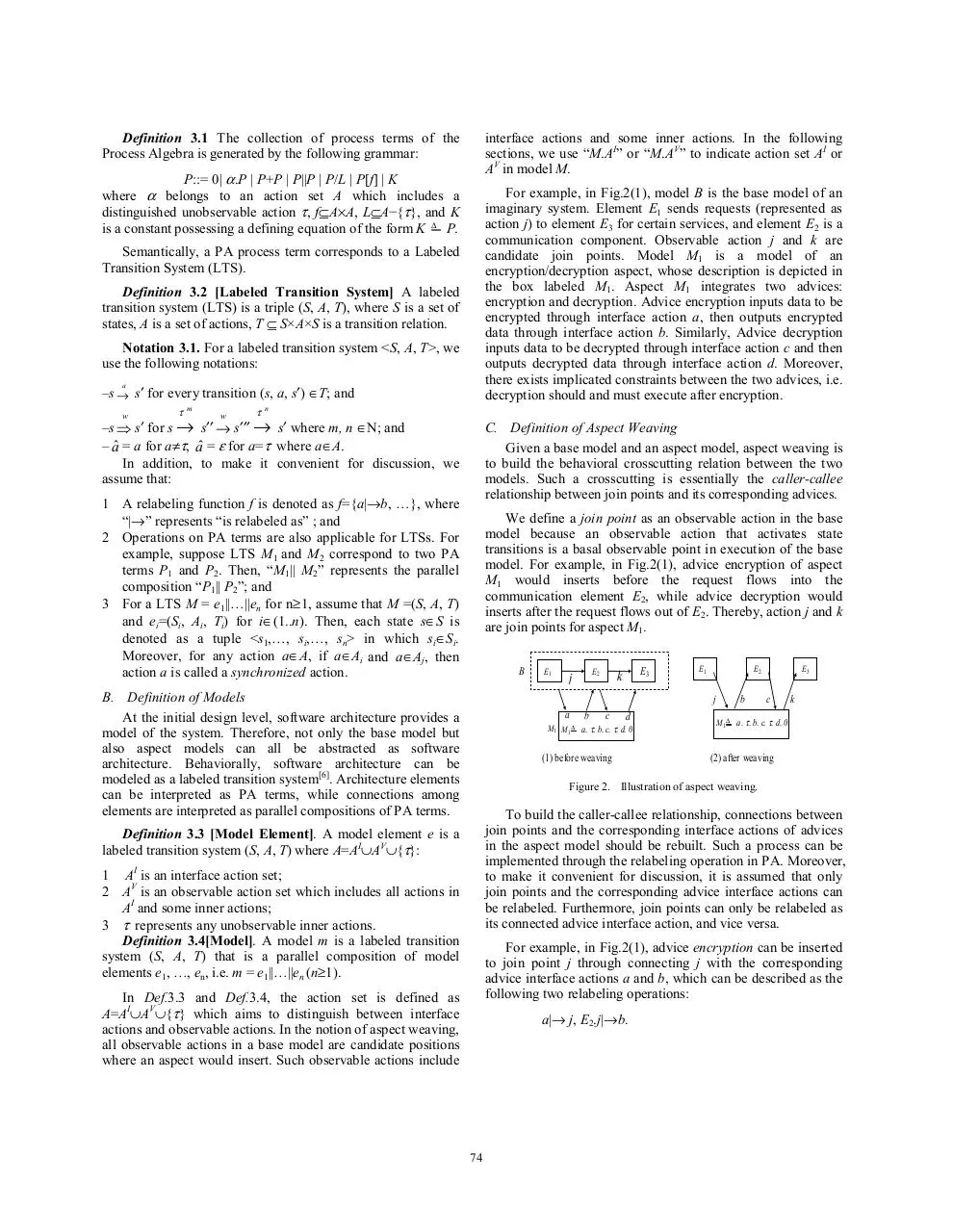
Figure 1. Outline of the framework.
In Fig.1, model M results from weaving of aspect model M1
into the base model B. B′ are projections of M on B. Here, the
projection represents a model’s behavior in the woven model.
If B is semantic consistent with B′, then the weaving is
semantics-preserved. A semantics-preserved weaving has no
impact on the base model that it applies to, which is the basis
for reasoning.
This paper presents a framework for reasoning about the
semantic impact of aspect weaving at the level of early design
modeling. The framework is based on semantic consistency
between a model and its projection in the woven model. The
underlying formalisms are Process Algebras. Firstly, notations
for aspect weaving are given. Then, semantic preserved
weaving is defined.
978-0-7695-3336-0/08 $25.00 © 2008 IEEE
DOI 10.1109/CSSE.2008.1121
OUTLINE OF THE FRAMEWORK
At early design level, designs for concerns are mainly based
on models. The design model for core concern is called the
base model, while designs for the crosscutting concerns are
aspect models. In essence, the weaving of an aspect model and
a base model is a certain composition of the two models. In the
woven model, the two models interweave with each other
according to certain methods or rules. The original semantics
of a model would be altered in the woven model. Here, we
interpret the semantics as the behavior of the model. Therefore,
through checking consistency between a model’s semantics in
the woven model and its original semantics, impact of weaving
on the model can be got. Grounded on this, our framework is
outlined in Fig.1.
III.
NOTATIONS
A. Related PA Notions and Notations
The underlying formalisms of the framework is Process
Algebra[5].
73
�
Definition 3.1 The collection of process terms of the
Process Algebra is generated by the following grammar:
interface actions and some inner actions. In the following
sections, we use “M.AI” or “M.AV” to indicate action set AI or
AV in model M.
P::= 0| α.P | P+P | P||P | P/L | P[f] | K
where α belongs to an action set A which includes a
distinguished unobservable action τ, f⊆A×A, L⊆A−{τ}, and K
is a constant possessing a defining equation of the form K Δ P.
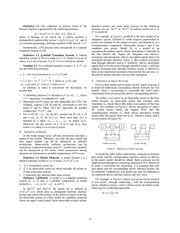
For example, in Fig.2(1), model B is the base model of an
imaginary system. Element E1 sends requests (represented as
action j) to element E3 for certain services, and element E2 is a
communication component. Observable action j and k are
candidate join points. Model M1 is a model of an
encryption/decryption aspect, whose description is depicted in
the box labeled M1. Aspect M1 integrates two advices:
encryption and decryption. Advice encryption inputs data to be
encrypted through interface action a, then outputs encrypted
data through interface action b. Similarly, Advice decryption
inputs data to be decrypted through interface action c and then
outputs decrypted data through interface action d. Moreover,
there exists implicated constraints between the two advices, i.e.
decryption should and must execute after encryption.
Semantically, a PA process term corresponds to a Labeled
Transition System (LTS).
Definition 3.2 [Labeled Transition System] A labeled
transition system (LTS) is a triple (S, A, T), where S is a set of
states, A is a set of actions, T ⊆ S×A×S is a transition relation.
Notation 3.1. For a labeled transition system <S, A, T>, we
use the following notations:
a
–s → s′ for every transition (s, a, s′) ∈T; and
w
τ
m
w
τ
n
–s ⇒ s′ for s → s′′ → s′′′ → s′ where m, n ∈N; and
– aˆ = a for a≠τ, aˆ = ε for a=τ where a∈A.
In addition, to make it convenient for discussion, we
assume that:
C. Definition of Aspect Weaving
Given a base model and an aspect model, aspect weaving is
to build the behavioral crosscutting relation between the two
models. Such a crosscutting is essentially the caller-callee
relationship between join points and its corresponding advices.
1 A relabeling function f is denoted as f={a|→b, …}, where
“|→” represents “is relabeled as” ; and
2 Operations on PA terms are also applicable for LTSs. For
example, suppose LTS M1 and M2 correspond to two PA
terms P1 and P2. Then, “M1|| M2” represents the parallel
composition “P1|| P2”; and
3 For a LTS M = e1||…||en for n≥1, assume that M =(S, A, T)
and ei=(Si, Ai, Ti) for i∈(1..n). Then, each state s∈S is
denoted as a tuple <s1,…, si,…, sn> in which si∈Si.
Moreover, for any action a∈A, if a∈Ai and a∈Aj, then
action a is called a synchronized action.
We define a join point as an observable action in the base
model because an observable action that activates state
transitions is a basal observable point in execution of the base
model. For example, in Fig.2(1), advice encryption of aspect
M1 would inserts before the request flows into the
communication element E2, while advice decryption would
inserts after the request flows out of E2. Thereby, action j and k
are join points for aspect M1.
B
B. Definition of Models
At the initial design level, software architecture provides a
model of the system. Therefore, not only the base model but
also aspect models can all be abstracted as software
architecture. Behaviorally, software architecture can be
modeled as a labeled transition system[6]. Architecture elements
can be interpreted as PA terms, while connections among
elements are interpreted as parallel compositions of PA terms.
E1
E2
j
E3
k
E1
E2
j
a
b
c
d
M1 M1 Δ a. τ. b. c. τ. d. 0
(1) before weaving
b
E3
c
k
M1 Δ a. τ. b. c. τ. d. 0
(2) after weaving
Figure 2. Illustration of aspect weaving.
To build the caller-callee relationship, connections between
join points and the corresponding interface actions of advices
in the aspect model should be rebuilt. Such a process can be
implemented through the relabeling operation in PA. Moreover,
to make it convenient for discussion, it is assumed that only
join points and the corresponding advice interface actions can
be relabeled. Furthermore, join points can only be relabeled as
its connected advice interface action, and vice versa.
Definition 3.3 [Model Element]. A model element e is a
labeled transition system (S, A, T) where A=AI∪AV∪{τ}:
1 AI is an interface action set;
2 AV is an observable action set which includes all actions in
AI and some inner actions;
3 τ represents any unobservable inner actions.
Definition 3.4[Model]. A model m is a labeled transition
system (S, A, T) that is a parallel composition of model
elements e1, …, en, i.e. m = e1||…||en (n≥1).
For example, in Fig.2(1), advice encryption can be inserted
to join point j through connecting j with the corresponding
advice interface actions a and b, which can be described as the
following two relabeling operations:
In Def.3.3 and Def.3.4, the action set is defined as
A=AI∪AV∪{τ} which aims to distinguish between interface
actions and observable actions. In the notion of aspect weaving,
all observable actions in a base model are candidate positions
where an aspect would insert. Such observable actions include
a|→ j, E2.j|→b.
74
�
Noted that here “E2.j|→b” is used to assure the action j of
E2 is relabeled because j is a synchronized action between
E1and E2.
From the projection, we can see the behavior of aspect
model M1 in the woven model. Here the term Act(B∠fM1) refers
to the action set of model B∠fM1.
Essentially, such relabeling operations are micro codes for
weaving an advice. Through a list of such codes, aspect
weaving is implemented. The following Def.3.6 defines aspect
weaving formally.
According to their definition, a model and its projection are
two LTSs. Semantics between two LTSs with the same action
set can be compared using weak bisimulation in PA. However,
the action set of a model is not the same as that of its projection
as some actions may be relabeled after aspect weaving. But, if
we build the corresponding relationship between actions of the
model and its corresponding relabeled actions in its projection,
then we can check their semantic consistency (equivalence) by
borrowing the idea of the weak bisimulation. The following
definition of semantic consistency is based on such ideas,
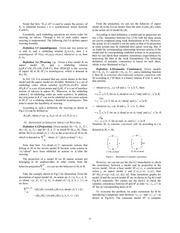
which is also illustrated in Fig.3.
Definition 3.5 [unambiguous]. Given any two action set
A1 and A2 and a relabeling relation f⊆A1×A2, then f is
unambiguous iff ∀(a1|→b1),(a2|→b2)∈f, whenever a1=a2 then
b1=b2.
Definition 3.6 [Weaving ∠f]. Given a base model B, an
aspect
model
M1,
and
a
relabeling
relation
f⊆(B.AV×M1.AI)∪(M1.AI×B.AV), then (B||M1)[f] is the weaving
of aspect M2 to M1 iff f is unambiguous, which is denoted as
B∠f M1.
Definition 4.2[Semantic Consistency]. Given models
M1=<S1, A1, T1> and M2=<S2, A2, T2>, and a relabeling function
f, then M1 is (external observational) semantic consistent with
M2 according to f iff there is a binary relation R over S1 and S2
that satisfies:
In Def. 3.6, it is assumed that any action names in the base
model and the aspect model are divisible. Relation f is a set of
relabeling codes which satisfies f⊆(JP×I)∪(I×JP), where
JP⊆B.AV is a set of join points and I⊆M1.AI is a set of interface
actions of advices in aspect M1. Moreover, in the relabeling
relation f, its relabeling codes are order sensitive. In addition,
any join point in B.AV can not be relabeled as two more actions
in M1.AI, i.e. a relabing relation f should be unambiguous. This
aims to assure the feasibility of weaving.
a
⎯ whenever (s1 , s2) ∈R and s1 → s1′∈T1, then:
∧
a
• s2 ⇒ s2′∈T2 for a∈A1-domf or a∈A1∩ranf, and (s1′, s2′)∈R;
∧
f (a)
• s2 ⇒ s2′∈T2 for a∈A1∩domf, and (s1′, s2′)∈R;
a
⎯ whenever (s2, s1)∈ R and s2 → s2′∈ T2, then:
According to such a definition, the weaving as shown in
Fig.2 (2) can be defined as:
∧
a
• s1 ⇒ s1′∈T1 for a∈A1-domf or a∈A1∩ranf, and (s2′, s1′)∈ R;
B∠fM1, where f={a|→j, E2.j|→b, d|→ k, E2.k→c }.
∧
f−1(a)
• s1 ⇒ s1′∈ T1 for a∈ranf -A1, and (s2′, s1′)∈R.
IV. DEFINITION OF SEMANTIC IMPACT OF WEAVING
Notation: M1 is semantic consistent with M2 according to f is
Definition 4.1[Projection]. Given models M1=<S1, A1, T1>,
M2=<S2, A2, T2>, and M=<S, A, T> in which M=M1∠f M2. Then,
define M/(A-(A1-domf∪A1′)–{τ}) as the projection of M on M1
which is denoted as
f
denoted as M1 ≈ M2.
f M
1
Note that here “(A1-domf∪A1′)” represents actions that
belong to M1 in the woven model M because some actions in
“A1∩domf” have been relabeled as actions in A1′after the
weaving.
behavior projection ∇
f M
1
B∠ f M 1
f M
1
s2
s1
s2
a
s1′
a
s2′
a
s1′
f(a)
s2 ′
R
(2) for a∈domf
Figure 3. Illustration of semantic consistency.
However, we can not use the Def.4.2 immediately to check
the consistency between a model and its projection in the
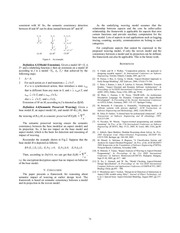
woven model. Given a base model M=e1|| e2, a synchronized
action j, an aspect model A and f={e1.j|→x, y|→j}, then
M′=M∠fA=e1[j|→x]|| e2|| A[y|→j]. State transitions graphs for
model M and the woven model M′ are as shown in Fig.4(1) and
Fig.4(3) separately. We cannot use the def.4.2 to check the
semantic consistency between M and M′ as state <s1′, s2, s2′> in
M′ has no corresponding states in M.
, we can see the behavior of M1 in M.
Take the example shown in Fig.2 for illustration. From the
description of aspect model M1, its action set A1={a, b, c, d, τ},
A1∩domf ={a, d}, A1′={j, k}, A1-domf∪A1′={j, k, b, c, τ }, so
we have:
∇
s1
R
(1) for a∉domf
The projection of a model M on M1 makes actions not
belonging to M1 unobservable. In other words, from the
M
R
R
M
∇ , where A1′={f(a)| a∈domf ∩ A1} .
=(B∠fM1) /(Act(B∠fM1)-(A1-domf∪A1′)–{τ})
To overcome the problem, we make extensions for M by
introducing a temporary state between <s1, s2> and <s1′, s2′> as
shown in Fig.4(2). The extension model M′′ is semantic
= (B∠fM1) /(Act(B∠fM1)-{j, k, b, c}–{τ}).
75
�
consistent with M. So, the semantic consistency detection
between M and M′ can be done instead between M′′ and M′.
s1, s2
j
s1′, s2′
(1) M
s1, s2
As the underlying weaving model assumes that the
relationship between aspects and the core be caller-callee
relationship, the framework is applicable for aspects that own
certain functions and provide auxiliary computation for the
base model. Lots of aspects in real applications such as logging,
tracing, counting, security, communication etc belong to such
categories.
s1, s2, s3
Stmp
x
s1′, s2, s3 ′
j
s1′, s2′
j
s1′, s2′, s3′′
j
For complicate aspects that cannot be expressed in the
proposed weaving model, if only the woven model and the
consistency between a model and its projection can be defined,
the framework can also be applicable. This is the future work.
(3) M′
(2) M′′
Figure 4. An example.
REFERENCES
Definition 4.3[Model Extension]. Given a model M=<S, A,
T> and a relabeling function f, then an extension on a model M
according to f is a model <Se, Ae, Te> that achieved by the
following steps:
1
Ae= A;
2
For each action a∈A and transition s → s′∈T :
if a is a synchronized action, then introduce a state stmp
[1]
S. Clarke and R. J. Walker, “Composition patterns: An approach to
designing reusable aspects”, In International Conference on Software
Engineering, Toronto, Ontario, Canada, 2001, pp.5-14.
[2] R. France, I. Ray, G. Georg, S. Ghosh, “Aspect-Oriented Approach to
Early Design Modeling”, IEE Software, 2004, 151(4):173-186.
[3] J. Pérez, I. Ramos, J. Jaén, P. Letelier, E. Navarro, PRISMA: Towards
Quality, “Aspect Oriented and Dynamic Software Architectures”. In
Proceedings of 3rd IEEE International Conference on Quality Software
(QSIC 2003), Dallas, Texas, USA, 2003, pp. 59-66.
[4] M. Pinto, L. Fuentes, J. M. Troya, “DAOP-ADL: An Architecture
Description Language for Dynamic Component and Aspect-Based
Development”. In Proceeding of the Second. International Conference
on GPCE, Erfurt,. Germany, 2003. 118–137. Springer-Verlag.
[5] M. Bernardo, P. Ciancarini, L. Donatiello, “Architecting families of
software systems with process algebras”, ACM Transactions on
Software Engineering and Methodology, 2002, 11(4):386-426.
[6] R. Allen, D. Garlan, “A formal basis for architectural connection”. ACM
Transactions on Software Engineering and M ethodology, 1997,
6(3):213-249.
[7] G. Kiczales, M. Mezini, “Aspect-oriented programming and modular
reasoning”, In Proc. of the 27th International Conference on Software
Engineering (ICSE'05), May 15-21, 2005, St. Louis, MO, USA, pp.4958.
[8] J. Aldrich, Open Modules: Modular Reasoning about Advice. In: Proc.
2005 European Conf. Object-Oriented Programming (ECOOP 05),
LNCS 3586, Springer, pp. 144-168, 2005.
[9] M. Rinard, A. Salcianu, S. Bugrara, “A Classification System and
Analysis for Aspect-Oriented Programs”, In Proc. of the ACM SIGSOFT
2004 Symposium on the Foundations of Software Engineering (FSE'04),
Newport Beach, California, November 2004.
[10] H. Shinomi, T. Tamai, “Impact Analysis of Weaving in Aspect-Oriented
Programming”, In Proceedings of the 21st IEEE International
Conference on Software Maintenance(ICSM’05), Budapest, Hungary,
Sept 25-30, 2005, pp. 657 – 660
[11] D. Xu, I. Alsmadi, and W. Xu, “Model Checking Aspect-Oriented
Design Specification”, In Proceedings of the 31st IEEE International
Computer Software and Applications Conference (COMPSAC'07), 2007,
Beijing, China, pp.491 – 500.
[12] F. Mostefaoui and J. Vachon, “Design-level Detection of Interactions in
Aspect-UML models using Alloy”, Journal of Object Technology, vol.
6, no.7, Special Issue: Aspect-Oriented Modeling, August 2007, pp.137–
165.
a
a
that is different from any state in S, and s → stmp∈Te and
a
stmp → s′∈Te and s, stmp, s′∈Se;
a
else s → s′∈Te and s, s′∈Se.
Extension of M on M1 according to f is denoted as Εf(M).
Definition 4.4[Semantic Preserved Weaving]. Given a
base model B, an aspect model M1, and model M=B∠f M1, then
f
the weaving of B∠f M1 is semantic preserved iff Ef(B)
M
≈∇ .
f B
The semantic preserved weaving ensure the semantic
consistency between the base model(or an aspect model) and
its projection. So, it has mo impact on the base model and
aspect model, which is the basis for detection and reasoning of
impact of weaving.
Reconsider the example shown in Fig.2. Suppose that the
base model B is depicted as follows:
B Δ E1 || E2 || E3; E1 Δ j. x 0;
E2 Δ j.k.0;
E3 Δ k.y.0.
f
Then, according to Def.4.4, we can get that Ef(B)
M
≈∇ ,
f B
i.e. the encryption/decryption aspect has no impact on behavior
of the base model.
V. CONCLUSION
The paper presents a framework for reasoning about
semantic impact of weaving at earlier design level. The
framework is based on semantic consistency between a model
and its projection in the woven model.
76
�
 Historical archive . public document