Katholieke Universiteit Leuven
Hoger Instituut voor Wijsbegeerte
Kard. Mercierplein 2, 3000 Leuven
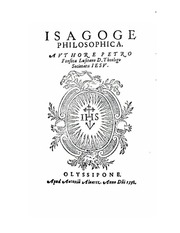
Pedro da Fonseca’s Isagoge Philosophica
and the Predicables from Boethius to the Lovanienses
Promotor: Prof. Dr. Martin W. F. Stone
A thesis presented in
fulfillment of the requirements for
the degree of doctor in
Philosophy
By
João Madeira
November 2006
�
ii
Hoger Instituut voor Wijsbegeerte
Katholieke
Kard. Mercierplein 2, 3000 Leuven
Universiteit
Leuven
Pedro da Fonseca’s Isagoge Philosophica
and the Predicables from Boethius to the Lovanienses
Jury:
Prof. Dr. Antoon Vandevelde, chairman
A thesis presented in
fulfillment of the requirements for
the degree of doctor in
Prof. Dr. Martin W. F. Stone, promotor
Prof. Dr. Carlos Steel
Prof. Dr. Russell Friedman
Prof. Dr. Jan Papy (Arts faculty-KULeuven)
Prof. Dr. Mário S. de Carvalho (Coimbra-Portugal)
Philosophy
By
João Madeira
�
iii
Contents
INTRODUCTION
1
CHAPTER I – DOCTA, GRAUE, AND CONTROVERSIAL
1.1. The Importance of a Correct Introduction to Philosophy
1.2. Dialectics (Logic in a Broader Sense), Cognition, and Metaphysics
1.3. Fonseca’s Allegiances
1.4. Aristotle’s Passages
1.5. Citations of Other Authors
9
20
25
41
43
47
CHAPTER II – UNIVERSALS
51
2.1. Fonseca on Universals
2.1.1. The Common Nature
2.1.2. The Unity of Universals
2.1.3. The Aptitude to Be in Several Items
2.1.4. The Role of the Intellect
54
58
71
78
91
2.2. Conclusion
101
CHAPTER III – INTERNAL SENSES AND ABSTRACTION
106
3.1. The Powers of the Soul
3.1.1. Galen and Francisco Valles
3.1.2. Toledo and Suárez
3.1.3. Fonseca on Internal Senses
112
115
119
122
3.2. Abstraction and Cognition
3.2.1. Fonseca on Abstraction and Cognition
140
146
3.3. Conclusion
156
CHAPTER IV – PORPHYRY’S ISAGOGE IN THE LATER SIXTEENTH CENTURY 161
4.0.1. Recent Literature on the Isagoge
168
4.0.2. Commentary tradition
183
4.1 The Isagoge in Fonseca’s Commentaries on the Metaphysics
4.1.1. The Relation of Universals and Particulars
4.1.2. The Five Common Kinds or the Predicables
4.1.3. Genus and Species
4.1.4. Differentias
4.1.5. Properties and Accidents
205
211
218
231
259
270
4.2 Conclusion
282
GENERAL CONCLUSION
286
BIBLIOGRAPHY
293
�
iv
Appendix – Isagoge Philosophica
Author philosophiae studiosis
Prooemium
Quid sit universale
Quotuplex sit universale
De particularibus
De abstractione universalium a singularibus
De triplici consideratione universalium, et particularium, et quo pacto ea ad Dialecticam pertineant
De duplici rerum universalium unitate
De genere
De specie
De differentia
De proprio
De accidente
De aliis quibusdam universalium speciebus, quas ethnici philosophi non agnoverunt
i
i
iii
vii
xi
xv
xix
xxv
xxix
xxxv
xli
xlvii
liii
lvii
lxi
�
v
�
vi
Acknowledgements
At the end of this work I would like to express my gratitude to all those who contributed to it. The
present thesis is the result of four years of work, during which hope, incertitude, and fatigue were
daily companions, yet the joy of finishing it assures me that it was worth it all.
My foremost intellectual debts are to my promotor Prof. Dr. Martin W. F. Stone for his patience,
helpful criticisms, and invaluable suggestions, his expertise and skills greatly contributed to
whatever merits this thesis may have; to Prof. Dr. Carlos Steel for his help with all the
bureaucracy and for essential advice every time that I needed him; to the late Prof. Dr. Jos
Decorte who approved the project but whose premature departure prevented him from taking
any part in it; to all the professors, students and staff of the Hoger Instituut voor Wijsbegeerte
for their warmth and solicitude, as their welcome and attention have made my stay in this
beautiful Leuven an unforgettable experience.
I would like to express my gratitude to my family, especially my parents Baltazar and Maria
Antônia, as well as my brothers and sisters, Pe. Flávio Rosa, and my Flemish and Brazilian
friends, without whose support any achievement would certainly be meaningless – if not
impossible. Among those to be especially thanked, I have to acknowledge my indebtedness to
Ellen Nys and to her family and friends for inestimable help, inspiration, and support.
Special thanks are due to D. Arnaldo Ribeiro, ADVENIAT, and Ir. Regina Trautmann for
material and psychological support, without which the whole enterprise would have been much
more difficult.
This research was made possible by a scholarship from CAPES of the Brazilian ministry of
education. I thank all those involved in the process.
I have benefited from the help, knowledge, and support of several people. I am especially
grateful to Prof. Mário Santiago de Carvalho for assistance and advice and for creating a
friendly academic environment during my several stays in Coimbra. I also would like to thank
Prof. António M. Martins; Prof. Dr. Nainora M. B. de Freitas; Prof. Dr. Luis A. Cerqueira; Pe.
Ilson Montanari; and the library of the Catholic University of Lublin.
My stay in Leuven also meant that I had the opportunity to make many friends. I would like to
thank Michel Vangool, a man of great culture and a good friend; Marco Túlio Lyrio, a friend of
all times and an example of hard work and determination; my friends of COPAL, Fr. Dr. Basile
Ekanga, Zr. Hilde and Zr. Marleen, and many others of the Brazilian and Latino communities of
Belgium.
Last but not least, like a Portuguese troubadour, I would like to sing a Loa to my Muse, the most
beautiful Wisdom, whose company I could enjoy during the past years. This is certainly the most
appropriate moment to add that all the qualities this thesis may have are the fruit of the learning
process to which many contributed, and the many deficiencies are my own fault.
�
vii
Abbreviations
CMA
Pedro da Fonseca, Commentariorum in libros Metaphysicorum Aristotelis. vv. 1-4
ID
Pedro da Fonseca, Institutionum Dialecticarum
IP
Pedro da Fonseca, Isagoge Philosophica
PPI
Averroes, Porphyrii Phoenicei introductio
IIP
Boethius, In Isagogen Porphyrii commentorum editionis secundae
CE&E
Thomas de Vio Cajetan, Commentarium super opusculum De ente et essentia
Thomae Aquinatis.
CIPPA
Thomas de Vio Cajetan, Commentaria in Isagogen Porphyrii ad Praedicamenta
Aristotelis.
CIPLAD
LOVANIENSES, Commentaria in Isagogen Porphyrii, et in omnes libros Aristotelis
de Dialectica(...)
ELPP
William of Ockham, Expositio in librum Porphyrii de Praedicabilibus
QLPI
John Duns Scotus, Quaestiones in librum Porphyrii Isagoge
RPF
Revista Portuguesa de Filosofia
�
1
Introduction
Like most philosophers of the sixteenth century, Pedro da Fonseca remains relatively unknown.
However, his name will be familiar to those interested in the history of Later Medieval,
Renaissance, and Sixteenth century Philosophy. Since biographical and bibliographical data
concerning his life and times are scarce in English, a short account of his life and works may
prove useful in understanding how Fonseca relates to the historical and intellectual context of his
days.
Pedro da Fonseca was born in Cortiçada/Proença-a-Nova, Portugal, in 1528 to a wealthy
family.1 He was the son of Pedro da Fonseca (his namesake) and Helena Dias. In his early years
with his parents, he learned some Latin (three or four years on an irregular basis) and, at the age
of fourteen, left to study in Coimbra, where he was probably a student under the “masters from
Bordeaux.”2 He entered the Society of Jesus on 17th March 1548, where he studied another year
of Latin and Arts (philosophy), first at Sanfins, in the region of Minho, and then at the College of
Arts of Coimbra. Theology was included in the course but he would only receive his doctoral
degree some years later from the University of Évora, which like the College of Arts, was in the
charge of the Jesuit order.3
1
This date is uncertain, it is usually considered to be 1528, but it may also have been two years before, since the
Necrológio composed by Fernão Carvalho to celebrate his death (two weeks after it actually happened) informs that
Fonseca was then 73 years old. Also in favour of 1526 is the account that he was 22 when he entered the Society. Cf.
Francisco Rodrigues, História da Companhia de Jesus na Assistência de Portugal, book II, pp. 457; 590-594.
2
The “mestres bordaleses” as they are known in Portuguese, are those professors brought by André de Gouveia (the
first principal of the “Colégio das Artes”) in 1547 to Portugal, where they were responsible for the beginning of the
renovation of the philosophical studies. Cf. Mário Brandão O Colégio das Artes p. 70. Among those teachers, there
was a certain Nicholas Grouchy (c. 1510-1572), who read and explained Aristotle’s logical works in Greek, during
the lectures. Cf. Rodrigues, ibid., p. 282.
3
Because Fonseca had joined the Society in its early years, he enjoyed seniority and influence in his native
Portuguese province, and due, in part, to his cordial association with the Jesuit General Everard Mercurian, he was
elected Assistant of the province at the Third General Congregation in 1573 and had also influence in the Society as
a whole. Along the years, Fonseca also felt compelled to comment on the appropriateness or otherwise of certain
practices such as affective prayer and had a reputation as a rigorist in the enforcement of a particular ideal of Jesuit
life, see Nuno da Silva Gonçalves, “Jesuits in Portugal,” in Thomas McCoog (ed.), The Mercurian Project. Forming
Jesuit Culture, 1573-1580, St. Louis/Rome, 2004, 715. It is also known that his interests extended to the cultural life
of his time with respect to forms of theatre, see Augustin de la Granja, “Un documento inédito contra las comedias
en el siglo XVI: Los fundamentos, de P. Pedro de Fonseca,” in: Homenaje a Camoens, Granada, 1980, 173-194.
In order to have an idea on why young men were moved to join the Jesuits, one which makes specific
reference to the situation in Portugal, see Dauril Alden, The Making of an Enterprise, The Society of Jesus in
Portugal, its Empire and Beyond, Stanford, CA, 1996, 36-39.
�
2
His teaching career began with a course of lectures to seventeen students of arts in
Coimbra, from 1552 until 1553.4 Then, when the College of Arts of Coimbra was given to the
Jesuits in 1555, he was immediately assigned the task of lecturing in the third (1555-1557) and in
the fourth course (1557-1561),5 which he did until 1561. According to the programme of studies
of the Jesuits at this time, in the third course (year) the students were taught the third book of the
Physics, the De coelo, the De generatione, some of the books of the Metaphysics, the
Meteorology, and at least the first and the second books of the De anima of Aristotle. While in
the fourth course (first half of the fourth year) the remaining parts of the De anima, the Parva
naturalia, and the remaining parts of the Metaphysics were studied.6 A successful and
charismatic teacher, Fonseca would earn himself the reputation of being “the Portuguese
Aristotle.”7
When Jerónimo Nadal (1507-1580),8 the superior general of the Jesuits, visited Portugal
in 1561, he directed the teachers of The College of Arts of Coimbra to prepare commentaries on
all the Aristotelian works which would be employed in the teaching of philosophy and theology.
Remarkably, Nadal explained that:
Aristotle should be read in such a way that those parts which he had treated diffusely and which
were not of central importance to the sciencia were to be followed [not directly in the
Aristotelian text but] in textbooks, the meaning of them being explained only. This would allow
more time to be devoted to the Metaphysics, to the De generatione, to the De anima, and to the
Parva naturalia. However, special attention was to be given to the Metaphysics which is the
most profitable for the [study of] Scholastic theology.9
4
Cf. Rodrigues ibid., book III, p. 575.
Cf. João Pereira Gomes, “Os Professores de Filosofia do Colégio das Artes,” RPF XI/II, 1955, p. 524.
6
Cf. Cassiano Abranches, “Origem dos Comentários à Metafísica de Aristóteles,” RPF 2, 1946, p. 51.
7
For a detailed account of the historical and philosophical background of Portugal in the sixteenth century and the
importance of Fonseca in this context, see A. A. Coxito & M. L. C. Soares, “Pedro da Fonseca.” In P. Calafate,
História do Pensamento Filosófico Português v. II, Renascimento e Contra-Reforma, Lisbon, 2001, pp. 455-502.
8
J. Nadal was a Spanish Jesuit of Jewish origin. A man of great culture, he was one of the Jesuits that contributed
the most to the spreading of the Ignatian spirit within the Society. Cf. Sommervogel, Bibliothèque de la Compagnie
de Jésus. v. V, publiée par la Province de Belgique, 1892, cc. 1517-1520; Diccionario Histórico de la Compañía de
Jesús: biográfico-temático, Madrid, 2001, pp. 2793-2796.
9
J. Nadal, “Instructiones Conimbricae de Cursu Artium Datae,” 1561: “Aristoteles se lea de manera, que muchas
partes que él trató difusamente, y no son de importancia para la sciencia, se lean en compendio, diziéndose la
substancia solamente dellas, sin se leer la letra, para que quede más tiempo para leer Metaphysica y De Generatione
y De anima y Parvos naturales, y especialmente la Metaphysica, que es lo que más aprovecha para la theologia
scholástica”
5
�
3
This statement conformed to the general practice of the Jesuits, namely, to follow
Aristotle in all the subjects related to philosophy and Thomas Aquinas in theology. Nadal
believed that such commentaries would provide invaluable pedagogical tools, which new
printing technology would help to circulate Jesuit ideas and doctrines more efficiently than the
circulation of manuscripts could ever do. With the help of such printed material, all the Jesuit
colleges would have the same text, and this would guarantee uniformity and orthodoxy in the
intellectual apostolate.10
This important commission was assigned to a group which Pedro da Fonseca was chosen
as the head (notice that the works to be given special attention match almost entirely the content
of the third and fourth courses in which Fonseca was lecturing). The other members of the
commission were Marcos Jorge (1524-1571),11 Cipriano Suárez (1524-1593),12 and Pero Gómez
(1535-1600).13 Fonseca’s plan was to get hold of the necessary books, receive feedback from the
10
António Martins, “The Conimbricenses” in Proceedings of the 11th Conference of the SIEPM (Porto, Aug. 2002)
(forthcoming): “According to the most current version of the genesis of these texts, everything would have begun
with the instructions given by Jerónimo Nadal in 1561 with the purpose of printing a text that would free the
professors and the students from the task of writing everything that the professor dictated in the classes. It was
intended in this way that two principal strategic goals would be reached: 1) to significantly alter the teaching and
learning process by putting the emphasis on assimilation of contents through the more active methods of
interpretation and the discussion of themes; 2) to guarantee with more efficacy the doctrinal unity in the sense of
excluding preliminarily that which was judged incompatible with church doctrine.”
In the order in which they were published the commentaries were: Commentarii Collegi Conimbricensis
Societatis Jesu in octo libros Physicorum Aristotelis Stagyritae, Coimbra, 1592; Commentarii Collegi
Conimbricensis Societatis Jesu in quatuor De Caelo Aristotelis Stagyritae, Lisbon, 1592); Commentarii Collegi
Conimbricensis Societatis Jesu in libros Meteorum Aristotelis Stagyritae, Lisbon, 1592; Commentarii Collegi
Conimbricensis Societatis Jesu in Parva Naturalia appellantur, Lisbon, 1592; In libros Ethicorum Aristotelis ad
Nicomachum apud Conimbricensis Cursus disputationes, Lisbon, 1593; Commentarii Collegi Conimbricensis
Societatis Jesu in duos libris De Generatione et Corruptione, Coimbra, 1597; Commentarii Collegi Conimbricensis
Societatis Jesu in tres libros De anima, Coimbra, 1598; Commentarii Collegi Conimbricensis Societatis Jesu in
universam Dialecticam Aristotelis, Coimbra, 1606. For useful discussion of the labours and achievements of the
Coimbran Jesuits see Diccionario Histórico de la Compañía de Jesús, pp. 923-924; Sommervogel, ibid., v. II, cc.
1272-1278; J. Bacelar Oliveira, Filosofia escolástica e Curso Conimbricense, RPF 16, 1960, 124-141; António
Manuel Martins, “Conimbricenses,” in Logos Enciclopédia Luso-brasileira de Filosofia v. I, 1112-1126; A. A.
Coxito, “O Curso Conimbricense,” in Pedro Calafate (ed.), ibid., pp. 503-546; and John P. Doyle (ed.), The
Conimbricenses. Some Questions on Signs, Milwaukee, 2001, pp. 15-30.
11
Marcos Jorge was a Portuguese Jesuit who taught philosophy (1556-1560) and theology (1561-1566) in Coimbra.
Cf. Sommervogel, ibid. v. III, cc. 821-822; Diccionario Histórico de la Compañía de Jesús, pp. 2153-2154.
12
Cipriano Suárez (Soares ou Soarez) was a Spanish Jesuit (of a family of ‘conversos,’ probably of Jewish origin).
He taught rhetoric in Lisbon (1553) and in Coimbra (1555). He obtained his degree of doctor in theology in Évora
(1566) and was the rector of the Colégio of Braga (1571-1575). Cf. Sommervogel, ibid. v. III, cc. 1331-1338;
Diccionario Histórico de la Compañía de Jesús, p. 3593.
13
Pedro Gómez was a Spanish Jesuit, who taught philosophy in Coimbra (1556) and worked with Fonseca. He left
Coimbra in 1570 to become a missionary, reaching as far as Japan and Macao (China) where he taught theology and
wrote textbooks of philosophy and theology. Cf. Sommervogel, ibid. v. III, cc. 1555-1557; Diccionario Histórico de
la Compañía de Jesús, p. 1774.
�
4
teachers concerning any doubts and problems encountered during the courses, and finish the
commentaries within two or three years.14
The resulting commentaries came to be known as the Cursus Conimbricensis (Coimbra
Commentaries). However, the final work was not to be an accomplishment of Nadal’s original
commission, for reasons not yet fully disclosed. Nevertheless, this failure has to be put into
context, since Fonseca was heavily involved in the affairs of the Jesuit Order, his presence at
three general congregations of the Jesuit order attests to that.15 Fonseca was also associated with
the group responsible for the development of the program of studies to be used in all Jesuit
colleges. Fonseca was a member of the first commission of 1581 which for reasons unknown
never managed to convene a single meeting. A new group of Jesuits was only appointed three
14
Pedro da Fonseca, “letter to Jerónimo Nadal,” Coimbra 14 January 1562: “Y que entre tanto se ventilarían más las
materias, excitarían dudas, et declararían más todas las cosas; y que yo le diesse una memoria para encomendar a los
maestros y algunos theólogos, que entre tanto hiziessen por apuntar cada uno en su cartapacio las dudas y todo lo
demás que en el processo de sus estudios les ocurriesse, que podiesse servir para qualquiera parte del curso, y que yo
me diesse entre tanto al scholástico, teniendo siempre advertentia a ver iuntamiente cosas que me puedan ayudar,
para quando se tomare de propósito; y que escriviesse al P. Adorno que por vía de Venezia comprasse allá los libros
que sabe que acá nos faltan, como luégo lo hize, escriviendo V. R. iuntamente al P. Polanco que le diesse allá
expedición para ello. Dixo luégo el Padre que se hiziesse assí, y luégo avisar a los de Évora que attendiessen a esto,
cada uno en lo que podiesse, parecendo a todos que era este un modo para se hazer cosa de mucho provecho, y que
en tanta multitud de libros se pueda leer con gusto. Occurrióme para esto que ya que V. R. me dava mayor parte del
assumpto, et repartía el trabajo con el P. Cypriano y con los padres Marcos Jorge y Pero Gómez, sería bueno que los
que podemos tomássemos cada dia algún tiempo, para cada uno ver cosas que puedan ayudar, y preparar la materia
para quando se hiziere: que yo tomasse dos horas, el P. Cypriano una, y el P. Marcos Jorge media, con est continua
proportion de tiempo, cada uno conforme a sus occupations, dexando el P. Pero Gómez con las que tiene, porque
harto haraa agora en acudirles. Assimismo me parecia que yo fuesse en este tiempo viendo todos los libros de
Aristóteles que no tengo vistos y pueden servir (o no tam vistos) apuntando las dudas y buenas expositions con dos o
tres graves intérpretes como por cifras, exponiendo uno lugares por otros, etc.; Porque esto es lo que ayudará mas al
que toma el principal assumpto; y que el P. Cypriano attendiesse especialmente a las cosas de mathematicas que ay
en Aristoteles, como son exemplos de geometría, demonstraciones, lugares que hablan de lo que pertenece a
cosmographía, astrología y perspectiva, como ay muchos en los libros de coelo y metéoros; y allende desto hiziesse
por traer algo de las theóricas de los planetas al 4o cap. de la sphaera de Sacrobosco que acá se lee, quanto
buenamente se pudiesse hazer, y se compadeciesse con el tiempo que se daa a estas cosas. Finalmente que leyesse en
Plinio y otros algunos lo que puede servir para materia de metéoros, como de vientos, de origine fontium, etc.
passando también las obras de philosophia de Cicero, y apuntando los modos de hablar y tratar que commodamente
podemos tomar del; y que el P. Marcos Jorge podría ver algunas questiones (que sabe seren altercadas en el curso)
por Scoto y otros que le pareciesse, apuntando brevemente lo que ay de difficultad o de resolución, y leyesse las
questiones naturales de Séneca, Alexandro Aphrodiseo, et de alguno otro antiguo que hiziesse al caso. Parecio al
Padre mui bien esto; y luégo ordenó que se executasse cada dia en el tiempo que tengo dicho. Y cierto, yo creo que
aunque esto parecerá, por ventura algún tanto largo, es la meior vía que se puede tomar para se hazer la cosa con
exacción y provecho. Y tanto se executaraa meior, quanto com menos hastío, y quedando tiempo para otras
occupationes que podían interromper, por las necessidades que ay, el hilo de los que luégo se pusiessen totalmente
en ello. Creo que a cabo de dos o tres annos, si esto procede deste modo y los otros maestros y theó1ogos ayudan en
lo que tengo dicho, estaraa la materia tan dispuesta, que se haga mui en breve el curso todo, y con occupación de
quasi no más que de una persona. Esto es lo que passa neste negocio.”
15
Fonseca is cited five times in the texts of III, IV, and V General Congregations. In the III General Congregation
text he is cited in decree 17; the IV cites the name of Fonseca in decrees 30 and 31; and the V cites him in decrees 1
and 40. Cf. J. Padberg, M. O’Keefe, & J. MacCarthy (ed.s), For Matters of Greater Moment. The First Thirty Jesuit
General Congregations, St. Louis, 1994, p. 745.
�
5
years later and their intense and meticulous collective work resulted in the famous Ratio
Studiorum16 which dealt with the teaching methods, offices and content of courses to be used in
all colleges. As the most important members of the order were deeply involved in the whole
process, we can safely assume that Fonseca still played a part in it.
At his own request, Fonseca was relieved of teaching activities in 1562, in order to devote
himself to the necessary research and writing of his part of the commentaries17 on the Isagoge of
Porphyry and on the Categories of Aristotle. However, he still had other responsibilities within
the Order. One of his tasks was to write a textbook to be utilised as an introduction to philosophy
for use by the students that had just entered the arts course, which was then, as it had been
before, a preparation for later studies in the traditional faculties of law, medicine, and theology.
The text was the Institutionum Dialecticarum Libri Octo, first published in 1564.
Soon after the publication of the Institutionum, Fonseca taught speculative theology at the
University of Évora for two years. It was also during this period that the controversial theory of
the scientia media, was taught for the first time.18 Hence, it is evident that Fonseca’s special
16
The Ratio atque Institutio Studiorum Societatis Jesu, which might mean something like ‘Method and System of
the Studies of the Society of Jesus,’ was not the result of the work of the first commission (1581) of which Fonseca
was a member. The new commission that was appointed three years later (1584), finished its works in August 1585,
but after the scrutiny of the General, his assistants, and the teachers of the Colegio Romano, the whole Jesuit order
also studied the document and Fonseca certainly gave his contributions. The final version was published in 1599. Cf.
Leonel Franca, O Método Pedagógico dos Jesuítas, Rio de Janeiro, 1952, p. 19.
17
Cf. S. Tavares, “Pedro da Fonseca. Sua Vida e Obra.” RPF, v. 9, fasc. 4 1953, 344-353; A. M. Martins, “Pedro da
Fonseca,” Logos Enciclopédia Luso-brasileira de Filosofia, 655-665.
18
It is not possible to deal with the problem of the authorship of this doctrine here, seeing that it is a tricky issue and
that both Fonseca and Molina claim its authorship. CMA v. 3 book VI, q. 4, s. 8: “Ante annos triginta, quam haec
scriberemus, (scribimus autem anno Domini nonagesimo sexto supra millesimum et quingentesimum) cum materia
de providential divina, et praesdestinatione in publicis lectionibus essemus ingressi multaeque, ac graves difficultates
quae in ea occurrunt, se nobis obiicerent, nulla faciliori via, et ratione putabamus expliccari omnes posse, quam
constituenda ea distinctione, quam paulo ante fecimus duplicis status eorum contingentium, quae re vera futura sunt,
absoluti scilicet, et conditionati, afferendaque certitudine divinae cognitionis circa illa in utroque statu; prius quidem
in conditionato, deinde vero in absoluto. Quae distinctio et utriusque certitudinis confirmatio, ita nobis omnium pene
obiectarum difficultarum tenebras depellebant, ut nona quaedam lux nostrae mentis oculis oborta videretur.”
Luís de Molina, Concordia, q. 114, a. 13, disp. 53, ed. Antwerp, 1595, p. 241: “A triginta annis in privatis
et publicis disputationibus, a viginti vero in nostris ad primam partem Commentariis eam sub nomine scientiae
naturalis idcirco tradiderimus, quod libera m Deo non sit omnemque divinae voluntatis liberum actum antecedat,
novissime autem exactius quam antea, sub nomine scientiae mediae (...) eamdem in nostra docuerimus Concordia,
nemo sane potest jure id nobis vitio vertere.”
As for bibliographical references see F. Annat, Scientia Media, Toulouse, 1645; L. De Meyer, Historia
controversiam de divinae gratiae auxiliis, Brussels, 1715; G. Schneeman, Controversiarum de diviniae gratiae
liberique arbitrii concordia initia et progressus, Freiburg, 1881; J. Rabeneck, “De Vita et Scriptis Ludovici Molina.”
Archivum Historicum Societatis Jesu 19. Rome, 1950, 75-145; J. C. Lavajo, “Molina e a Universidade de Évora,”
Irene Borges-Duarte (ed.) Luís de Molina, regressa a Évora, Évora, 1997, 99-122; and M. F. Patrício, “A Doutrina
da ‘Ciência Média’: de Pedro da Fonseca a Luís de Molina,” ibid., pp. 163-182; J. D’O. Dias, “Liquidação Final de
�
6
leave to further his research did not last long, and was cut short because he could not avoid
resuming his lectures due to the desperate need of the order for more teachers at that time. On
more than one occasion Fonseca complained about the impossibility of reconciling his multiple
activities – especially the heavy burden of lecturing – with the writing of the commentaries.19
In 1567, Fonseca became rector of the College of Arts of Coimbra, an office that he was
to hold for two years. Three years later he received a doctorate in theology from the University of
Évora. In the meantime, he was also working on his commentary on Aristotle’s Metaphysics. The
year 1572 marked his election as one of the Portuguese delegates to the Third General
Congregation of the Jesuits, which would take place that year in Rome. During this congregation,
Everard Mercurian (1514-1580)20 was chosen to be superior general, and he in turn chose
Fonseca as his general assistant21 for the Portuguese province.22
In consequence of new incurred responsibility, Fonseca spent the following ten years in
Rome. These years were to be decisive regarding the quality of his future philosophical works. In
Rome, he had access to the codices of the Corpus Aristotelicum, as well as to a vast bibliography
which would have been impossible had he stayed in Portugal.23 When he had already been there
for more than four years, he published in 1577 the first volume of his Commentarium in libros
uma Controvérsia,” Verbum, Rio de Janeiro, 1955, 207-228; S. Tavares, “A Questão Fonseca-Molina. Resposta a
uma Crítica,” RPF 11-1, 1955, 78-88.
19
Cf. J. F. Gomes, “Pedro da Fonseca: Sixteenth Century Portuguese Philosopher,” International Philosophical
Quarterly v. VI, n. 4, 1967, 632-644.
20
Everard Mercurian was a Belgian Jesuit (his family was from Marcourt, hence his Latin name ‘Mercurianus’). His
generalate was marked by a rapid growth in the number of Jesuits and in the number of colleges and by an effort of
consolidation of the Ignatian spirit and of avoidance of desviations. Cf. Diccionario Histórico de la Compañía de
Jesús, pp. 1611-1614; Mario Fois, Everard Mercurian, in: McCoog (ed.), The Mercurian Project: Forming Jesuit
Culture 1573-1580, 1-34.
21
Because of the of the sheer size of the territory of apostolate of the Jesuits, they had to resort to an administrative
division. The provinces are formed by a number of professed houses or communities, under the same superior. The
assistances are the grouping of provinces due to their geographical proximity, their shared cultural background, or
language (in the first general congregations the assistants were chosen based on some provinces or nations. There are
also vice-provinces, missions, regions, and districts, but it is not necessary to deal with them now. Cf. Diccionario
Histórico de la Compañía de Jesús, pp. 3782-3783.
22
Cf. M. Stone, “Explaining Freedom through the Texts of Aristotle: Pedro da Fonseca S.J. (1528-1599) on liberum
arbitrium and his Commentary on the Metaphysics.” In G. Frank, & A. Speer (eds.), Der Aristotelismus in der
Frühen Neuzeit nach dem Fall von Konstantinopem - Kontinuität oder Wiederaneignung. Wolfenbüttel, 2007, p.18.
23
That is what we can infer from a search in the available online catalogues of Portuguese and Italian libraries, and
from P. O. Kristeller, Iter Italicum, especially volume II, 1998, pp. 89-138 (Rome) and pp. 297-418 (Vatican);
volume IV, 1989, pp. 445-472 (Portugal); and volume VI, 1992, pp. 560-565 (Rome) and pp. 581-610 (Vatican).
�
7
Metaphysicorum Aristotelis Stagiritae. It is worth noticing that it came to light some twenty
years before the Disputationes Metaphysicae of Suárez.24
Fonseca returned to Portugal in 1582 to become the superior of the St. Roque professed
house in Lisbon. Despite the duties specific to this position, he prepared the remaining volumes
of his commentary on the Metaphysics, which he had then decided would be his starting point of
the ‘Coimbra commentaries.’ He had apparently finished (but not published) the commentaries
on the Isagoge and on the Categories, when he took the decision to produce those books on the
Metaphysics, as it is explained in the preface of his first edition of these texts.25
The second volume of the Commentarium in libros Metaphysicorum was published in
1589. From that year until 1592, Fonseca performed the function of visitor of the Portuguese
province of the Jesuits. The Isagoge Philosophica had its first edition in 1591. In 1593 he was
again chosen to be one of the three delegates to the Fifth General Congregation in Rome after
which he immediately returned to Portugal and resumed his duties in Lisbon, there staying until
his death on 4 November 1599.26
The structure of our presentation bears some relation to the structure of the work of Boethius,27
since he had started his second commentary on the Isagoge with a brief discussion of the
faculties of the soul, then he presented his answers to Porphyry’s unanswered questions, and
finally he commented on each of the sections of Porphyry’s text. Fonseca, however, followed a
24
Francisco Suárez (1548-1617) was a Spanish Jesuit who achieved fame as a jurist, philosopher, and theologian. He
studied in Granada and Salamanca. He taught philosophy in Segovia (1571-1573). He taught theology in Valladolid
(1574-1575), in Segovia (1575), again in Segovia (1576-1580), in the Collegio Romano (1580-1585), in Alcalá
(1585-1593), in Salamanca (1593-1594), in Coimbra (1597), and again in Coimbra (1601-1603). However, he is also
well-known for his publications, especially the Disputationes metaphysicae (1597), the De legibus (1612), and the
De anima (1621). Cf. Sommervogel, ibid. v. VIII, cc. 1661-1688; Diccionario Histórico de la Compañía de Jesús,
pp. 3654-3656.
25
Fonseca, “Preface to the second edition” (1574), ID, pp. 10-12: “Quod vero attinet ad reliquos Philosophiae
commentarios, quos in prima editione, me conscripturum pollicitus sum, non est quod me quisquam iure accuset,
quod nihil hactenus ediderim. Vix enim absoluta explicatione Porphyrianae Isagoges, categoriarumque Aristotelis
eas res non paucis annis obire coactus sum, quae nihil otii ad scribendum permittebant. Mihi vero tandem aliquando
redditus, in eam sententiam sum adductus, ut ante omnia, constituerim libros primae Philosophice enarrare, atque
adeo in publicum emittere.”
26
Cf. V. Ribeiro, Obituários da Igreja e Casa Professa de São Roque da Companhia de Jesus, Lisbon, 1916, n. 163,
p. 36.
27
Boethius, In Isagogen Porphyrii commentorum editionis secundae
�
8
slightly modified order of exposition and this is the order that will be followed here. The first
chapter will present some introductory considerations concerning the reception of Fonseca’s
Isagoge Philosophica, with special emphasis on its content and aims. The second chapter is
centred on Fonseca’s treatment of the problem of universals. In order to understand the main
components of this problem, it is necessary to present in a nutshell the fundamental issues of the
nature or essence of particulars, the unity and aptitude to be in several which are peculiar to
universals, and the role reserved to the intellect with regard to the origin, place, and existence of
universals. There will be a special emphasis on the way Fonseca deals with nominalist, scotist,
and Thomist positions on each of these points. This part is centred on the analysis of Fonseca’s
own texts, which correspond to the content of questions I-V. The third chapter focuses on how
Fonseca handles the internal sensitive faculties of the soul, and on the abstraction of the
universals from the particulars involved in this process, as Fonseca presents this issues in
questions VI-VII. Again, some of the most important ideas are presented, from Aristotle to
Fonseca and his fellow Jesuits. This chapter also includes a section on how the intellect, closely
assisted by phantasia, actually performs this abstraction, which corresponds to question VIII.
The fourth chapter starts with a short survey of the recent secondary literature on the Isagoge,
followed by a short summary of the main characteristics of the commentaries of Boethius,
Averroes, Ockham, Cajetan, Scotus, and the Lovanienses. This chapter is centred on Fonseca’s
response to Porphyry’s unanswered questions in the Isagoge and to all the other issues
incidentally raised by the most important authors who commented on Porphyry’s Isagoge, such
as the number of predicables, the relation of universals and particulars, and the main points
concerning genus, species, differentia, property, and accident. Fonseca’s account of all these
issues is found in questions IX-XX.
�
9
Chapter I – Docta, Graue, and Controversial
The fact that there is no modern critical edition of the Isagoge Philosophica28 contrasts with the
fact that Fonseca’s last book went through at least 18 editions until 1623 (plus an edition in
1965); hence it was by all standards a very successful publication. Nevertheless, the history of
this success cannot be written without some qualification. The first thing to be observed is that
apart from the first edition, it was always printed together with Fonseca’s first book, namely, the
Institutionum Dialecticarum, which was published at least 55 times, from 1564 to 1625. This fact
could be interpreted as a sign that the Isagoge Philosophica possessed no value on its own, as it
would have been considered to be a mere appendix of the Institutionum Dialecticarum. On the
other hand, because it only appeared in roughly half of the editions, in 17 of the 39 editions of the
Institutionum that were published between 1592 and 1625, there appears to be room for other
interpretations as well.
One possibility is that each time the Isagoge Philosophica was published, it was the result
of a serious and conscious decision in favour of its intrinsic value. Although it is difficult to trace
the motives behind each of those editions, it seems reasonable to assume that, given the
considerable costs and efforts involved in publishing them, those responsible were more inclined
to parsimony rather than to prodigality. Also to be considered is the reception of the book during
that period. Interestingly, those 66 pages were not to remain immune from strong criticism and
opposition. And if it is possible to take Pero Luis’s29 words, in a letter that he wrote to the
Superior General of the Jesuits, at their face value, and not as a consequence of Fonseca’s
nationality or his position within the Jesuits, this book was regarded by Fonseca’s
28
The only extant modern edition of the Isagoge Philosophica (1965) has no critical apparatus, but has several
imprecisions and even a missing passage: IP, p. 126: “[Dividitur autem proprium in generale et speciale,] ac si
proprium quidem sumatur (...).” The Institutionum Dialecticarum has a very competent semi-critical edition and the
Commentariorum in libros Metaphysicorum Aristotelis has still to receive a modern critical edition (we have news
that the critical edition of the first volume is in preparation).
29
Pedro Luis Beuther (1538 or 1539-1602) was a Spanish Jesuit, who taught philosophy in Braga (1561-1564) and
Évora (1564-1568). He studied theology in Évora under L. Molina and taught theology in Évora (1575-1576), in
Coimbra (1576-1579), and again in Évora (1579-1595). Cf. C. Sommervogel, ibid. v. V, c. 185; Diccionario
Histórico de la Compañía de Jesús, p. 434.
�
10
contemporaries as a fine piece of scholarship, but that the ideas it contained were far from being
unanimously accepted among his confreres. Pero Luis writes:
Pedro da Fonseca’s Isagoge is very learned and profound but to be suitable as a textbook it has
this inconvenience that such a text has to be neutral with regard to the themes being discussed,
dealing with each opinion, [but Fonseca’s Isagoge] adheres to particular opinions and opposes
the proponents of contrary views. For instance, [Fonseca’s Isagoge] posits [the existence of
universals as] entia realia and that the intellect does not cognise in the first place out of
singulars.30
Moreover, there is at least another case, since Marcus Hellyer in his Catholic Physics31
writes:
In 1602 the general sent a number of instructions to the provinces to assess the progress of the
implementation of the 1599 Ratio Studiorum throughout the Society. To this end, visitors of
studies were appointed to examine the schools in their province. One of their tasks was to consult
with professors on the question of which authors were to be taught in order to limit philosophy
professors’ «liberty and license in opinions» and prevent the spread of dangerous opinions. Pedro
Ximénez (1554-1633), the visitor of studies for the Austrian province, found that the professors
at the college in Graz had begun to use the logic textbook of the Jesuit Pedro da Fonseca but had
later returned to the old custom of explicating the Isagoge of the Neoplatonic philosopher
Porphyry (c. 234-c. 305) because they felt that it was the most suitable text.
Hellyer, who mistakenly thinks that the text in question is Fonseca’s Institutionum
Dialecticarum,32 is referring to the “Letter of Pedro Ximénez,33 visitor of studies to the Austrian
Province, to P. Claudius Acquaviva, Praepositus generalis of the Jesuits (18 august 1602)34:”
The Isagoge of Porphyry ceased to be explained in [the course of] logic, when the new [Isagoge
Philosophica] of Fonseca was first proposed by the catalogue [Ratio studiorum], but now none is
proposed. It seems that the old use of proposing and explaining the Isagoge of Porphyry was
restored just as it is done in other colleges by the previous agreement. Because [Fonseca’s text] is
not more suitable than the other, or because the professors agree to do so.35
30
This letter of Pero Luis to the Fifth General of the Society of Jesus C. Aquaviva (1543-1615), is very informative
especially when he says that although Fonseca’s Isagoge is “mui docta y grave,” it lacks the necessary neutrality
required for a textbook since it is in favour of one particular opinion (realism), and therefore invites opposition from
the adepts of the contrary opinion. J. F. Gomes, “Introdução,” ID, p. LIX, footnote 4. The passage reads: “Lo 3 es
que la Isagoge del P. Pero da Fonseca es muy docta y grave pero para servir de texto tiene este inconveniente que el
texto ha de ser indifferente en questiones ventiladas y hazerlas in utraque parte y el es parcial en algunas opiniones y
assi tiene por contrarios los que fueren de la contraria opinion. Exemplo es que pone entia realia y que intellectus
non cognoscit 1.u ex singularia.”
31
M. Hellyer, Catholic Physics, Indiana, 2005, p. 27.
32
Hellyer, ibid., p. 255.
33
Pedro Ximénes was a Spanish Jesuit, who taught theology in Vienna. He became rector of the colleges of
Klagenfurth, Olmutz, Prague, and Gratz. Cf. Sommervogel, ibid. v. VIII, cc. 1352-1355.
34
Claudio Acquaviva (1543-1615) was an Italian Jesuit who succeeded E. Mercurian to become the fifth General of
the Society, among the several achievements of his generalate, there is the preparation and publication of the Ratio
Studiorum (1599). Cf. Diccionario Histórico de la Compañía de Jesús, pp. 1614-1621.
35
Monumenta Paedagogica VII, p. 504: “Isagoge Porphyrii desiit in logica explicari, ut aliquando nova Phonsecae in
catalogo proponi caepit, nunc autem nulla proponitur. Videtur vetus mos revocandus in usum, ut Porphiriana
proponatur et explicetur; quod in aliis collegiis fit veteri consuetudine. Siquidem non est alia accommodatior, vel cui
aquiescant professores.”
�
11
If there were disagreements, we may suppose that whenever a new edition of the
Institutionum Dialecticarum was published alone,36 it was also a sign of a conscious decision
against Fonseca’s rather more radical proposals as they were expressed in the Isagoge
Philosophica. Furthermore, implicit in the foreword of Fonseca’s book, there may be traces of
the strenuous efforts made by the Jesuit order to produce a useful, updated, and competent series
of textbooks and, in this sense, it might provide the key to discovering when, and perhaps even
why, Fonseca was relieved of the task of writing and coordinating the abovementioned Coimbra
Commentaries.
The complete history of the composition and publication of those commentaries has yet to
be written. Among several obscure facts awaiting clarification is the matter of how they were
brought to press. As mentioned above, the elaboration of the Cursus was first assigned to a
commission headed by Pedro da Fonseca, but that group of Jesuit scholars failed to accomplish
this appointed task. The first volumes would only appear after some important changes in
direction. Those facts related to the publication of this series of textbooks are difficult to
determine, both in time and in motivation.37 Fonseca had written in the beginning of the third
paragraph of the Admonitio Lectoris, which he added to the first edition of the first volume of his
famous Commentariorum in Libros Metaphysicorum Aristotelis (1577), that he was going to
write commentaries on Porphyry’s Isagoge and on Aristotle’s Categories.38 However, in the
corresponding part of the second volume of those commentaries (1589), namely on the
Philosophiae studioso, Fonseca says that he was not responsible for the coordination of the whole
36
Editions of the Institutionum dialecticarum without the Isagoge Philosophica: Venice 1592, 1597, 1602, 1611,
and 1615; Tounon 1594; Cologne 1595, 1613, and 1622; Lyon 1597 (officina juntarum), 1597 (Claudius
Michaelem), 1601, 1606, 1608, 1609, 1610, 1611, 1612, 1614, 1622, and 1626). For a list of the 53 (our research has
identified two other editions which are not listed there) editions of the Institutionum Dialecticarum, see J. F. Gomes,
“Introdução,” ID, pp. XXXV-XLVI.
37
The complete history of the whole project ‘Cursus Conimbricensis’ if it ever sees the daylight will provide an
invaluable help to the history of philosophy of that period.
38
CMA v. 1, “Admonitio lectoris”: “Hoc consilio cum a libro categoriarum Aristotelis, eiusque Porphyriana Isagoge
ordiremur, institutaeque brevitati studentes, difficile esse experiremur, paucis rebus, ac facilibus (id est propriis eius
loci) iis satisfacere, qui et multa, et difficilia de iisdem libris audire soliti essent, nisi lectores reiiceremus ad ea, quae
iam fusius a nobis scripta essent”
�
39
project,
and that he was not to even write the commentaries on those two works.
40
12
Moreover,
the foreword of the Isagoge Philosophica does not mention the Cursus Conimbricensis at all.
Instead, Fonseca says that he had composed that text at the request of his fellow Jesuits, seeing
that Porphyry’s book was found to be faulty, imprecise, and repetitive. As a consequence, it
would have been much better to abolish Porphyry from the Christian schools and replace him
with an introduction by Fonseca.41
Furthermore, there is the fact that in the last questions of Fonseca’s commentary on the
Metaphysics V chapter 28 qq. I-XX, he cites and quotes an astonishing wealth of commentaries
on the Isagoge from a variety of different authors, ranging from Boethius to the Lovanienses.42
This interest in studying and somehow accounting for the questions raised in the contributions of
virtually all the possible readings of Porphyry’s book, indicates Fonseca’s strong commitment to
the study of this text. It would make sense if Fonseca were trying to address the most serious
metaphysical problems raised by the text, as a kind of prolegomena43 for his future commentaries
on Aristotle’s works. Otherwise, this great investment would appear misplaced or, to say at the
very least, disproportional.
Additional insight into Fonseca’s choice of the themes and their subsequent explanation
in his last published book can be gained by looking for signs in Fonseca’s own work that could
shed light on the historical and philosophical background to the Isagoge Philosophica. Also,
39
CMA v. 2, “Philosophiae studioso”: “Illud vero alterum de cursu Philosophico conscribendo, quod iamdudum
video per me perfici non posse; aliorum opera compensatum iri speramus.”
40
The Conimbricense commentary on the Physics was published in 1592, under de direction of Manuel de Góis,
therefore, the final decision with regard to the coordination of the whole project may have occurred a short while
before or around the time of the publication of Fonseca’s second volume of the commentary on the Metaphysics, as
it was recorded that it took Manuel de Góis only three years to finish the preparation of the volume on the Physics.
Cf. António Martins, “The Conimbricenses” in Proceedings of the 11th Conference of the SIEPM, (Porto, 2002)
(forthcoming).
41
IP, pp. 6-8: “Mitto complura eius libelli supervacanea esse, aut parum cohaerentia, quaeque lectoribus frustra
negotium exhibeant. Qua de causa optarunt nostri, ut alia Isagoge a me conficeretur, et plenior ad doctrinam, et ad
veritatem certior, et ad generalem scientiarum usum commodior: unde etiam illud effectum iri sperabant, ut a
Christianae Philosophiae scholis perfidi desertoris Christianae fidei liber exploderetur.”
42
We use this term ‘Lovanienses’ to designate the Louvain Arts Masters of the sixteenth century. The text concerned
here is Commentaria In Isagogen Porphyrii, et in omnes Libros Aristotelis de Dialectica, olim maturo consilio, et
gravissimis sumptibus venerandae Facultatis Artium in inclita Academia Lovaniensi per dialecticae ac totius
philosophiae peritissimos viros composita. Iam vero tertio in commodum ac utilitatem bonorum ingeniorum
diligenter recognita, emendata, multis in locis prudenter abbreviata, et ad Argyropoli ac Boetii versiones studio
summo accommodata.
43
Fonseca appears to have been increasingly aware of the fact that because of his particular instances on several
themes, the commentaries on the Metaphysics should be prepared before the other commentaries. Cf. Martins, ibid.
�
13
bearing in mind Pero Luis’s words, the reason why some Jesuits were uncomfortable with it
should be traceable to the ideas themselves. More precisely, in the position Fonseca assumes in
relation to some of the contentious issues of that time, namely with regard to the real existence of
universals and the primum cognitum of the intellect, since in both cases Fonseca would be too
close to Scotus and too far away from Aquinas, the nominalists, and others. Our contention is
that such assessment misses an important point with regard to Fonseca’s real agenda.
In the Isagoge Philosophica, Fonseca puts forward a number of interesting ideas. The
first there is his attempt to discredit Porphyry on the grounds that he was a heretic and an
apostate. This attitude would have placed somebody who defended the necessity of studying
Porphyry in an awkward position,44 as the person would be endorsing the value of “the book by
an open enemy of the faith” (perfidi desertoris Christianae fidei liber ).45 Another marked
position is the defence of the existence of universals, not as “real” but as “objective existence,”
and Fonseca supports his view by re-examining and corroborating Scotus’s position, and
somehow reconciling it with Aristotle’s and Aquinas’s theses. Fonseca saw the whole scholastic
tradition as being in line with his own conclusions. An illustration of this can be provided by an
examination of his opinion on the ontological status of universals, as it is presented in his
Commentaries on the Metaphysics. First, Fonseca rejects the nominalist position by examining
and refuting its basic tenets. Furthermore, he asserts that common natures are per se, thus before
any activity of the intellect, a unity of precision46 and the aptitude to be in several.47 Second, that
after an act of the intellect, they acquire an objective existence. And third, that in the individuals,
44
IP, p. 8: “Usque adeo enim exosum erat Porphyrii nomen, cum Arius Christi Ecclesiam petulantius invaderet, ut
quo huius sectatoribus maius odium constaretur, iusserit Magnus Constantinus in ea epistola, quam ad Episcopos et
populum scripsit, Arianos vocari Porphyrianos”
45
IP, p. 10.
46
IP, pp 68-70: “Unitas vero praecisionis idem est, quod indivisio rei universalis non in seipsa, sed in sua
particularia, qualis est indivisio animalis in hominem, et bestiam, hominisque in Socratem, et reliquos singulares
homines. Dicitur vero praecisionis, quia non convenit rei universali in quocunque statu sumptae (quo pacto ei
convenit unitas formalis, quae semper rem comitatur, sive antequam ad sua particularia contrahatur, sive cum iam in
eis contracta est, sive postquam est ab illis abstracta, et quasi avulsa per intellectum) sed praecise in eo statu, in quo
apta est, ut ad sua particularia descendat, et in ea dividatur ac multiplicetur. Quatenus enim res apta est ut sit in
pluribus, in eaque dividatur, et multa dici possit, necdum tamen naturae ordine divisa et multiplicata est; eatenus est
indivisa in illa, ac proinde unum quid, hac praecisionis unitate. Alioqui si sumatur ut iam est in suis particularibus, in
eisque divisa et numerabilis, iam est multa, et non unum, hoc unitatis genere.”
47
Fonseca cites Aristotle, Metaphysics VII, 13, 1038b11-12: “quod aptum est, ut in pluribus insit.”
�
14
they do not have existentia realis. From this particular interpretation of the Scholastic tradition,
48
Fonseca’s own view becomes clear. It is based on a distinction between the modus essendi
possibilis and the existentia objectiva or realis. Consequently, the common natures ex se, before
any intellectual abstraction or contraction and before they exist in the individuals, are universals
in act and not only in potency.49
Furthermore, Fonseca was conscious of the difficulties of this “Realist position” and he
tried to corroborate it with two arguments. First, he observed that the actus essendi in pluribus,
which is the foundation of the predication, does not depend on the intellect because it should
precede in nature any activity of the intellect. Consequently, this should also hold for the aptitude
or potency to this act. Second, the modus essendi potentialis varies from nature to nature. For
example, ‘animal’ cannot be ‘stone’ nor ‘stone’ be ‘animal.’ This diversity of potencies does not
come from the abstraction by the intellect, which is the same for all natures. There remains only
the nature of things to explain this diversity.50
Accordingly, a summary of some of the most important views about the Scholastic debate
on universals will be very useful, especially since Fonseca seems to imply that the whole
scholastic tradition favours his reading.51 What is more, because the existing level of research on
these authors, although quite rich and vast, is still marked by many divergent views, this
presentation will only be concerned with Fonseca’s interpretation of them. Moreover, a
48
CMA v. 2, c. 995: “(N)aturas communes habere ex se, et ante operationem intellectus et unitatem praecisionis, et
aptitudinem, ut sint in pluribus. Quo fit, ut hac ratione tantum sint, ac fiant universales operatione intellectus,
quatenus non habent universalitatem actu existentem, nisi obiective in intellectu.” (for economy’s sake, from this
point onwards Fonseca’s Commentariorum in Libros Metaphysicorum v. 2 will always be cited in this way, i.e., by
indicating the number of the column in the Olms reprint of the Cologne edition of 1615).
49
CMA v. 2, c. 995: “Est igitur vera germanaque et omnium ut credere par est, veterum Scholasticorum sententia,
naturas communes ex se, et ante eam operationem intellectus, qua a suis particularibus abstrahuntur, nempe prius
natura, quam in suis particularibus existant, aut contractae in eis sint, esse actu et non potentia tantum universales,
tametsi non habent suam universalitatem existentem, nisi cum intellectu sine differentiis contrahentibus obiiciuntur.”
50
CMA v. 2, cc. 995-996: “Quae sententia etsi ex dictis patet, tamen quoad priorum partem, quae maiorem
difficultatem recentioribus ingerit, duobus item argumentis confirmari potest.
Unum est, quia quae conveniunt rebus per operationem intellectus, sunt posteriora iis, quae illis conveniunt
ut existunt in rerum natura, sive ut dicitur, a parte rei: sed aptitudo earum, ut sint in pluribus non est posterior, sed
prior ipso esse in pluribus, qui est actus conveniens illi a parte rei; non convenit igitur rebus per operationem
intellectus: quod si aptitudo essendi in pluribus non convenit rebus per operationem intellectus: ergo nec
universalitas, cum in ea posita sit tota universalitatis ratio. Idem arguementum hunc etiam in modum proponi potest.
Actus essendi in pluribus, qui est fundamentum praedicationis de pluribus, non pendent ab operatione intellectus, ut
omnes fatentur, ergo nec aptitudo, seu universalitas, quae ordine naturae praecedit actum.”
51
CMA v. 2, c. 995: “Est igitur vera germanaque et omnium ut credere par est, veterum Scholasticorum sententia.”
�
15
consideration of Fonseca’s own model will help to shed light on important philosophical themes,
especially with respect to those issues concerning the controversies around universals,52 namely,
disputes on the unity (and plurality), on the aptitude (nature) of universals to be in several items,
and on the role of the intellect (ratio, conceptus) with respect to universals.53
Another aspect deserving of our attention is Fonseca’s reinterpretation of the theory of
abstraction.54 Here, he seems to be keen to adopt, as much as possible, Aquinas’s account,
contrasting and combining it with his view of the theory of the unity of universals, in which he
seems to incline towards Scotus’s position. Moreover, there is the adjacent issue of the internal
senses of the soul. In this regard, Fonseca seems to be willing to add something new to the
philosophical debate of this issue, since he proposes a simplified system for theoretical purposes.
Consequently, an innovative55 discussion on the faculties of the soul can be found in the second
set of questions from the second volume of his Commentaries on the Metaphysics,56 where
52
CMA v. 2, cc. 949-950: “Haec enim tam celebris gravisque inter praecipuos Philosophiae principes controversia
non de rebus ipsis, quae universales cognominantur, absolute sumptis intelligitur: cum apertum sit cohaerere illas in
rerum natura; non item de iis, quatenus invicem referuntur relationibus universalitatis et particularitatis: quippe cum
constet, non excitari eam quaestionem de illo esse absoluto rerum universalium, quo simul natura sunt cum suis
particularibus: sed de eo, quo illis sunt priores aut posteriores, iuxta huius aut illius sententiam. Plato enim creditur
existimasse dari res universales ante particularia in rerum natura cum ipsa rerum universalitate, seu communitate,
hoc est, ad nullum particulare addictas: ut hominem communem, qui nullus sit ex singulis, sed ex aequo omnes
respiciat seiunctus a singulis. Aristoteles autem iudicat, quicquid universale est; ut huiusmodi est, posteriorius esse
suis particularibus, nihilque esse a singularibus separatum, nisi operatione intellectus, cuius hoc munus est, ut quae
in rebus coniuncta sunt, ipse seiungat ac secernat.”
53
CMA v. 2, c. 950: “Relatio enim universalis ad particularia duo supponit: alterum est unitas rei, non nominis
tantum, sed rationis etiam: alterum aptitudo, ut in multis insit per modum identitatis, ac proinde, ut eo pacto de
multis dicatur. Nam, neque unitas sine aptitudine, neque aptitudo sine unitate satis est, ut rem faciat vere ac proprie
universalem: siquidem analoga, ut ens, suo modo apta sunt, ut in multis sint: et singulare quodque, ut Socrates, non
tantum nomine, sed sua etiam ratione est unum: nec tamen vel analoga, vel singularia sunt universalia: quod analogis
desit vera unitas, et singularibus aptitudo, ut sint in multis, in quibus ipsa videlicet mu
...
 Historical archive . public document