GALLERY OF
PHOTOGRAPHERS
�
22
GAL L E RY OF P H OTOGR A P H E R S
�
I N TRO DUCT I O N
23
THE GREATEST PHOTOGRAPHERS HAVE CHALLENGED
AND EXPANDED OUR VISUAL HORIZONS. THEY HAVE
TAUGHT US TO SEE THE WORLD IN A DIFFERENT WAY,
THE BETTER TO APPRECIATE AND UNDERSTAND
IT. AS PHOTOGRAPHERS, WE CAN LEARN SO MUCH
FROM THESE ARTISTS WHO INSPIRE US TO SEEK
EXCELLENCE IN OUR OWN WORK.
The shining beacons
photographic artists in
in the history of
their own right. Most
photography are those
photographers create
creative and technical
their own images through
geniuses whose work
the exploration and
demonstrates not only a
exploitation of the work
total control over their
of photographic pioneers.
medium, but also
Indeed, part of the
combines clarity of
creative struggle for
Alfred Eisenstaedt
vision, determination,
many photographers is
Eisenstaedt is considered by
many to be the father of
invention, and a
to find an individual style
photojournalism (see p.44).
receptiveness to new
or to make their own
ideas. Much, though not
distinctive mark which is
all, of the history of photographic
different and sets them apart from
output is written by the originators of
those who inspired them.
the art, and their work continues to
This gallery of photographers
inspire all who follow them.
celebrates both those who have defined
However, one of the great appeals of and beaten new paths—whether artistic,
photography is shared with other arts
conceptual, or technical—and also
such as music and theater: one does not those photographers who have taken
need to be an original creator to enjoy well-trodden paths to a new level of
photography, work professionally, and
creativity or expertise.
even win great acclaim. The vast
Some have circumnavigated the
majority of published and exhibited
globe many times in pursuit of
photography is in fact the work of the
grandiose photographic projects.
elaborators—superlative artists who
Others have literally put their life on
were often inspired to take up
the line and endured hardships and
photography by the originators, and
physical violence in order to use their
who have themselves become great
photography to act as an advocate for
the dispossessed or vulnerable.
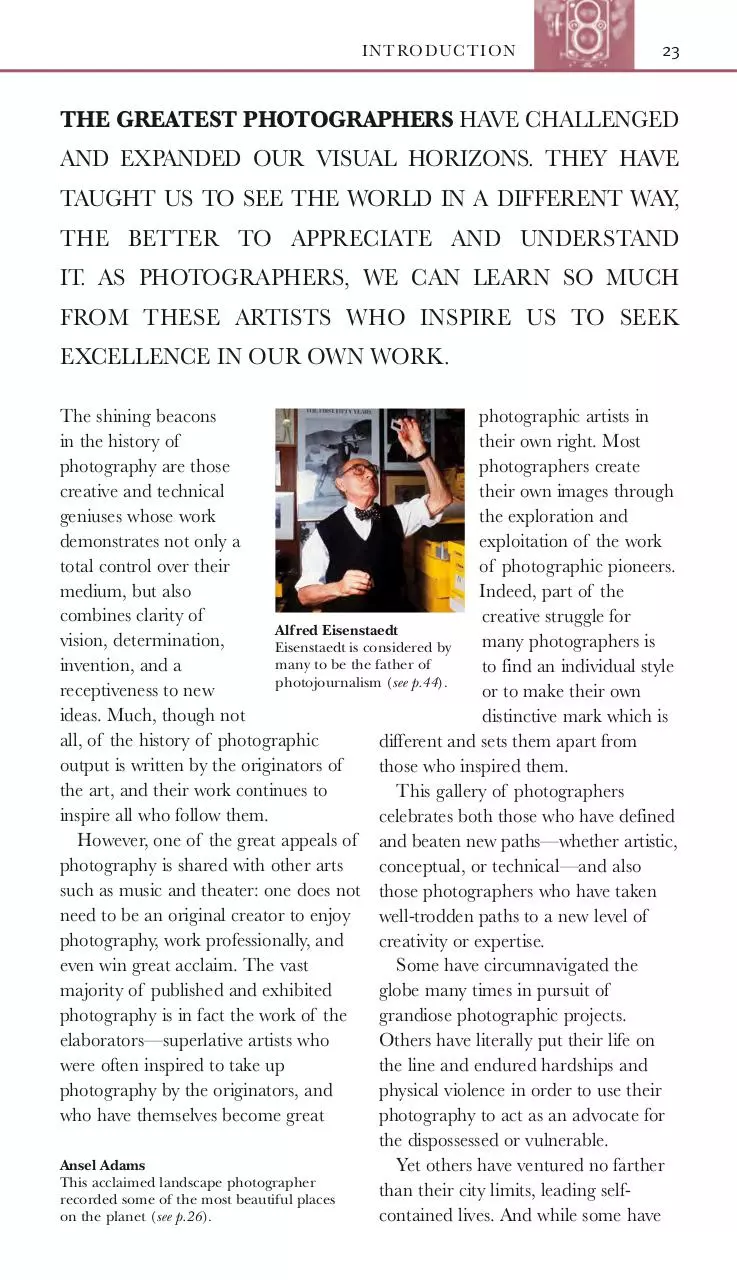
Ansel Adams
Yet others have ventured no farther
This acclaimed landscape photographer
than
their city limits, leading selfrecorded some of the most beautiful places
on the planet (see p.26).
contained lives. And while some have
�
24
GAL LE RY OF P H OTOGR A P H E R S
In a world that is swarming with
concentrated all their energy on the
same subject for their entire career, you images, the power of a truly great
photograph to become rooted in the
will also find photographic polymaths
memory is a magical
who work comfortably
and admirable thing—
from the documentary
the image’s greatness
to the commercial,
defined by its time
from landscapes
in history, and its
to still-life.
synthesis of form,
The artists on the
light, and, of course,
following pages
its momentary
demonstrate that
Stephen Dalton
significance. The
there are many
Dalton uses cutting-edge technology
photograph is a
paths to photographic and high-speed photography to
shoot the natural world (see p.42).
physical, tangible link
greatness. However, if
to one moment in
there is one trait that
history, a point of revelation, and
great photographers share, it is that
artistic birth. Whatever the subject,
time and again they show themselves
a great photograph requires one
to be humble and accepting of their
fundamental thing: that a
chosen subjects. There is reinvention
photographer—fully aware, highly
and renewal in every imitation. In
photography, what matters most is not skilled, and suitably equipped to
preserve the image for posterity—
believing in yourself, but believing in
was present at the crucial moment.
the integrity of your subject.
Eve Arnold
Arnold (below)was revered for her documentary
images, especially her movie stills. Working on a
film set required her to work unobtrusively yet
quickly to capture telling moments (see p.30).
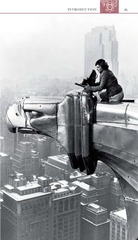
Margaret Bourke-White
This intrepid photojournalist (right) would go
to extraordinary lengths to get her picture,
and here she shows no fear while working high
on the Chrysler Building, New York (see p.35).
�
I N T RO DUCT I O N
25
�
26
GAL LE RY O F P H OTOGR A P H E R S
Ansel Adams
American 1902–1984
Best known for the matchless monumentality of his
landscape photography, Ansel Adams was a versatile
photographer who was widely influential. He had a
flawless command of photographic technique.
As Adams said “You don’t take a photograph, you make it.” The most enduring
examples of his contribution to
photography are his richly detailed,
pin-sharp, and exquisitely lit landscapes—
almost all of them created on largeformat film. Thanks to the impact of his
landscape works, which exulted in and
celebrated the beauty of the American
wilderness, Adams’ photography entered
the political sphere, playing a part in the
conservation movement in the US.
Adams was influenced by the
pictorialist and precisionist ideals of
contemporary photographers, such as
Paul Strand and Edward Weston. He
contributed to the development of the
Zone System (see opposite), which has
influenced generations of photographers
at both professional and amateur levels
throughout the world.
A prolific photographer, Adams also
founded a gallery in Yosemite National
Park, set up a department of photography
at the California School of Fine Art in
San Francisco, and helped to establish the
photography department at the Museum
of Modern Art in New York. His many
books have become classics.
CAREER HIGHLIGHTS
1916 Takes his first photographs of
Yosemite National Park, California
1927 First portfolio Parmelian,
Prints of the High Sierras published
1931 One-man show at Smithsonian
Institute, Washington, D.C.
1935 Making a Photograph, first in a classic
series of books, published
1948 Awarded the Guggenheim Fellowship
1960 Portfolio 3: Yosemite Valley published
�
GAL L E RY OF P H OTOGR A P H E R S
27
ZONE SYSTEM
Mount Williamson, from Manzanar, California
Exploiting an extensive depth of field created
by using camera movements, Adams captures
a distant sunburst while keeping the foreground
rocks sharply detailed (top).
Leaves, Glacier National Park
Even when working close up, Adams succeeds
in conveying the monumental. He achieves this
through strong composition and by ensuring
all major elements are sharply detailed (center).
Aspens, Northern New Mexico
Seeing this print—one of his most celebrated
images (left)—in the original to appreciate the
delicate spectrum of silvery tones should be
part of every photographer’s education.
The Zone System helps the photographer
translate a scene into the photographic
medium. It is a three-stage process—
of previsualization, exposure, and
development—based on analyzing the
scene according to a scale of ten zones of
brightness ranging from deep shadow to
bright highlight. Previsualization is the
technique of picturing the desired result
before a photograph is taken: by doing
this against the range of brightness, the best
camera exposure for the film can be set.
The film is developed to compensate for
the range of zones in the scene in order
to produce a desired contrast. The print
is then made, trying to match the result to
the previsualized image. With the rise of
miniature formats and automatic exposure,
the Zone System has retreated into a niche.
Zone system scale
0
This system divides
I
the brightness
II
spectrum into 10
III
equally spaced
IV
steps, each one a
V
stop apart. Zone V
VI
is the crucial middle
VII
gray—tanned skin,
VIII
grass in the sun,
IX
and so on.
�
28
GAL LE RY O F P H OTOGR A P H E R S
Manuel Alvarez Bravo
Mexican 1902– 2002
Combining Mexican and European influences, Alvarez
Bravo’s work straddles surrealist and documentary styles.
His images—described by Nobel laureate Octavio Paz as
“realities in rotation”—can be read on several levels.
A self-taught photographer, Alvarez Bravo
was a child at the time of the Mexican
Revolution of 1910. He began working
professionally for the journal Mexican
Folkways in 1928, documenting Mexican
cultural history. Bravo’s style arose from
the traditions and myths of mestizo
Mexico—the blend of indigenous Indian
X-Ray Photograph
One of the earliest pioneers of using the X-ray
for art photography, here (right) Alvarez Bravo
offers a teasingly pseudoscientific and objective
treatment of the theme of murderous love.
CAREER HIGHLIGHTS
1930 Teaches at San Carlos Academy
1943 Starts work as still photographer
for films
1975 Awarded the Guggenheim Fellowship
1984 Awarded Victor & Erna Hasselblad Prize
Invented Landscape from Fifteen Photographs
A common theme for the surrealists was the
interplay between the human-made and the
natural. In this image (below) the shadows do
all the suggesting and none of the explaining.
with Spanish—but was also influenced by
ideas brought from Europe by visiting
photographers such as Cartier-Bresson
(see pp.40–41). His work gave a poetic
vision of modern Mexico, validating it as
an emerging nation. His centennial in 2002
as Mexico’s greatest living photographer
was a cause for national celebration.
�
GAL L E RY OF P H OTOGR A P H E R S
29
Nobuyoshi Araki
Japanese 1940–
One of Japan’s most controversial photographers,
Nobuyoshi Araki’s work crosses from observation of
modern Japan to pornography, and back. His snapshot
style is unashamedly voyeuristic and widely influential.
After years in advertising, Araki turned his
observant eye to women—particularly those
working in nightclubs, and as prostitutes.
Celebrated for holding up a mirror to the
moral ambiguities of Japanese society,
Araki has been subjected to the attention of
censors unwilling, or unable, to distinguish
documentary photos from pornography.
CAREER HIGHLIGHTS
1972 Tokyo Autumn series published
1989 Tokyo Nude published
1999 Vaginal Flowers series published
Telephone Booth from Tokyo Nostalgia
Even when seen individually, Araki’s images
hint at narrative. At the same time, we cannot
tell if the image is candid or not.
Diane Arbus
American 1923–1971
The powerful images of Diane Arbus haunt the viewer
like no other; they are a benchmark of unflinching honesty
in portraiture. Yet she said, “A photograph is a secret
about a secret. The more it tells you the less you know.”
Having developed an excellent reputation
as a fashion stylist helping out her husband,
fashion photographer Allan Arbus, Diane
Arbus only began photographing in her
mid-30s. A successful career in advertising
and fashion followed. Arbus was one of
the first photographers to use on-camera
flash balanced with daylight in her
portraiture.One of the hallmarks of
her work, it helps to flatten and make
the light artificial, bringing the subject
unfettered and unflatteringly to the fore.
CAREER HIGHLIGHTS
1960 First pictures published in
Esquire magazine
1963 Awarded the Guggenheim Fellowship
(and again in 1966)
1967 Exhibits at Museum of Modern Art,
New York
A Young Man in Curlers
Arbus’s portrait at first appears uncompromising,
but reveals itself to be tender and sympathetic
of the subject’s defiant unease.
�
30
GAL LE RY O F P H OTOGR A P H E R S
Eve Arnold
American 1913–
At the top of her profession for more than 50 years, Eve
Arnold’s approach to documentary photography is one
that is self-effacing almost to a fault. Her work tells all
about the subject and nothing of the photographer.
Arnold’s rapid rise has made her a legend
among photographers. After a mere six
weeks of study with the famously hard-toplease Alexey Brodovitch, then art director
at Harper’s Bazaar, she was given her first
commission for the magazine. Within
three years, she had been approached by
the equally fastidious Magnum agency
and was made a full member in 1955—
the first woman to be admitted. While her
work took her all over the world—most
notably to China, working for LIFE and
The Sunday Times Magazine—she is best
known for her work on movie sets. By
winning the trust of those she worked
with, Arnold achieved a special intimacy
with stars such as Marilyn Monroe and
Joan Crawford. She brought the genre of
production stills to a standard that few, if
any, have since attained.
CAREER HIGHLIGHTS
1980 Awarded Master Photographer by
International Center of Photography
1986 Won Krasna-Krausz Book Award
for In Retrospect
2003 Awarded honorary OBE
Cowboy, Inner Mongolian Steppes, China
This image displays Arnold’s fine instincts for
magazine photography. The clear composition
reveals atmosphere and suggested movement,
yet it still has ample space for titles or text.
Anthony Quinn and Anna Karina
The stars relaxing on the set of The Magus
(1976) are depicted by Arnold in documentary
style. This is a revealing image that conveys the
charisma and charm of the actors.
�
GAL L E RY OF P H OTOGR A P H E R S
31
Felice Beato
British c. 1825–1906/8
One of the great pioneers of travel photography, Felice
Beato was a tireless documentarist whose importance is
only now being recognized. His views of Japan provide a
comprehensive record of the country in the 1860s and 70s.
Born in Italy but naturalized British,
Beato was incorrigibly restless throughout
his life. He recorded the aftermath of the
Crimean War in the Mediterranean and
went on to document the Indian Mutiny of
1858. In 1863 he moved to Japan, where
he spent 14 years photographing daily life.
He eventually settled in Burma.
CAREER HIGHLIGHTS
1856 Exhibits photographs in London of
the Battle of Balaclava
1863 Starts photographing in Yokohama
1878 Photographs in Burma
Temples, Nagasaki
This road of temples at Nagasaki with the
Kazagashira Mountains behind shows Beato’s
artistic and documentary style.
Karl Blossfeldt
German 1865–1932
An untrained and amateur photographer who used his
photography to teach art students about natural forms,
Karl Blossfeldt celebrated nature’s beauty, creating a
unique body of work of matchless consistency.
In 1890 Blossfeldt began to cast models
of botanical specimens and photograph
plants. Treating the plant as a “totally
artistic and architectural structure,” his
photographs grew into a collection of
thousands of botanical studies. He
explained: “Since only simple forms lend
themselves to graphic representation, I
cannot make use of lush flowers.”
Young Shoots
Working at magnifications of nearly 30 times
life-size, Blossfeldt stunned the art world with
the beauty of the forms he revealed.
CAREER HIGHLIGHTS
1898 Starts teaching at
Kunstgewerbemuseum, Berlin
1928 Uniformen der Kunst published
1932 Wundergarten der Natur published
�
32
GAL L E RY OF P H OTOGR A P H E R S
�
GAL LE RY O F P H OTOGR A P H E R S
33
Guy Bourdin
Although he was noted for staging his fashion
photographs in intense, dramatic tableaux,
Bourdin (see p.34) did sometimes relax. This
light-hearted shot combines fun and frivolity
with superb depiction of the clothes.
�
34
GAL LE RY O F P H OTOGR A P H E R S
Guy Bourdin
French 1928–1991
One of the most accomplished fashion photographers of
his generation, Guy Bourdin sought notoriety through
images that were considered shocking at the time. Today,
his work appears light-heartedly stylish and very polished.
First exhibited as a fine artist, Bourdin’s
surrealist and elegantly anarchic images
soon caught the attention of Vogue
magazine. He insisted his photographs
be viewed in their intended context and
for the following 33 years, his work was
CAREER HIGHLIGHTS
1952 Exhibits at Galerie 29, Paris
1955 Starts photographing for Vogue
1975 Photographs campaign for fashion
designer Issey Miyake
1988 Receives Infinity Award,
International Center of Photography
Charles Jourdan, Spring 1978
Bourdin’s advertising work set new standards
for its knowing, artistically self-referential wit.
Here (right), a Polaroid proof displaces the main
image creating a tension between picture planes.
Charles Jourdan, Summer 1977
Bourdin’s mastery of composition is evident in
this image (below). Despite its numerous
interlocking elements and elaborate lighting,
the viewer’s gaze is still led straight to the shoes.
never seen outside the pages of fashion
magazines. The first solo photographic
exhibition of his work was shown only
10 years after his death, but throughout
his career he continued exhibiting his
drawings. From the mid-1970s he worked
on advertising campaigns, most notably
for Miyake, Jourdan, and Chanel. Bourdin
had a reputation as a hard taskmaster,
testing the endurance of his models to the
limit. Indeed, violence – expressed as
shocking colours and contrasts – is never
far from the narrative of his pictures.
�
GAL L E RY OF P H OTOGR A P H E R S
35
Margaret Bourke-White
American 1904–1981
Epitomizing the notion of an uncompromising
photojournalist, Bourke-White went to extreme measures
to get a picture. A technical virtuoso, she could work in the
toughest conditions, and still bring back flawless images.
In 1929, two years after graduating from
Cornell University, Bourke-White landed
a staff job as an industrial photographer
for Fortune magazine, then became one of
the founding staffers on LIFE magazine,
where she worked for the rest of her
career. Bourke-White was infamously
aggressive in pursuit of both assignments
and pictures, once saying: “If you banish
fear, nothing terribly bad can happen to
you.” In the 1930s, she photographed in
the Soviet Union and her work provided
an early record of the emerging nation.
Bourke-White’s tenacity was demonstrated
when she met Mahatma Ghandi. Before
agreeing to pose for photographs next to
a spinning wheel, he requested she learn to
spin. She duly did and got her picture.
CAREER HIGHLIGHTS
1930 Photographs General Paton’s
campaign through France and Germany
1936 Becomes photographer for LIFE
1937 Takes images for Erskine Caldwell’s
book You Have Seen Their Faces
Gold miners, Robinson Deep
Despite the harsh conditions, Bourke-White
used a large-format camera to deliver this
technically perfect and powerful image of
miners working deep underground.
Construction of Fort Peck Dam
Bourke-White’s early industrial photographs,
such as this shot of giant pipes used to
divert the Missouri River, combined visual
sophistication and technical prowess.
Eskimo, Canada
This portrait shows Bourke-White’s later, sparse
approach to photography. Characteristically, she
chose to cover this story in the depths of winter,
eschewing the comforts of working in summer.
�
36
GAL LE RY O F P H OTOGR A P H E R S
Bill Brandt
British 1904–1983
The subjects of Bill Brandt’s photography seem to speak
clearly and with directness through the print. Given his
status as a master of photography, Brandt’s output was
surprisingly small, but much of his work remains iconic.
Born into wealth and privilege in
Germany, Brandt turned to photography
while studying architecture. His time as
assistant to Man Ray (see p.62) laid the
foundations for a non-purist attitude to
the photographic process, and a surrealist
streak that was to characterize his work.
On settling in England in 1931, he
worked as a documentary photographer,
motivated by a combination of humanist
and left-wing ideals, while also making
use of actors and models.
CAREER HIGHLIGHTS
1929 Assists photographer Man Ray
1936 The English at Home published
1951 Literary Britain published
1961 Perspective of Nudes published
1983 Curates The Land exhibition at
Victoria and Albert Museum, London
Fog, London Bridge
Brandt’s reportage of London, like this image
of a gull soaring over the Thames (right), defined
the image of the city as dreary and fogbound.
Man in Pub, London
Brandt regularly used models in his work. This
shot of a man in a pub (above) illustrated a 1946
Picture Post essay titled The Doomed East End,
which covered post-war rebuilding in London.
Afternoon and Evening
Even Brandt’s fashion photography—here, of a
model in evening dress, published in Picture Post
in 1951 (right)—has menacing undertones: the
shadows appear to close in on the model.
After World War II, he became
disillusioned with documentary work and
turned to nudes, portraiture, and abstracts.
Brandt’s series of nudes in landscapes,
exploiting the projection distortion effects
of a wide-angle lens used close up, were
shocking at the time, their references to
the works of Picasso and Henry Moore
notwithstanding. His understanding of
light and form found eloquent expression
in print, making him one of the most
widely collected of photographers.
�
GAL L E RY OF P H OTOGR A P H E R S
37
Julia Margaret Cameron
British 1815–1879
It was her eye for the intimate and the intensity of her
portraiture that made Julia Margaret Cameron unique.
With a productive period of just 14 years, her career is
the shortest of any world-class photographer.
Cameron could be regarded as the patron
saint of amateur photography. She
photographed out of love, although in
her case it bordered on obsession. She
was given her first camera by her
daughters when she was 48 years old.
Unfettered by niceties, she made family,
servants, and visitors to her home in
England—including luminaries such as
historian Thomas Carlyle—pose for her
to create portraits or romantic tableaux.
She coaxed an extraordinary intensity
of emotion from her subjects, creating
images with a defined sense of style,
working her sitters to the limit. Alfred
Tennyson allegedly left the poet Henry
Longfellow with the warning, “Do
whatever she tells you. I shall return
soon and see what is left of you.”
Working in the dim, soft light she
favored, Cameron used glass plates
requiring exposures that often lasted
several minutes. The photography
establishment was, she reported,
“manifestly unjust” in its criticism of her
work, but by the 1870s her prints were in
great demand. Cameron left England for
Ceylon (now Sri Lanka) in 1877, and all
but gave up photography. Her modern
reputation has been assured by her
inclusion in Alfred Stieglitz’s Camera Work
magazine in the early 1900s.
CAREER HIGHLIGHTS
1863 Receives first camera as gift
1865 First exhibitions
1867 Exhibits in Paris
1868 Exhibits in London
1874 Illustrates Alfred Lord Tennyson’s
Idylls of the King
Summer Days
This image (above) shows that Cameron was an
early master of the group photo. The grace and
poise of her groupings is remarkable given the
lengthy preparations and long exposures needed.
St. Agnes
This tableau of the martyred saint (left)
combined classical themes with a covert Victorian
sensuality, mirroring the tension in John Keats’
contemporaneous poem, The Eve of St. Agnes.
�
38
GAL LE RY O F P H OTOGR A P H E R S
Robert Capa
Hungarian 1913–1954
The photojournalist as hero, Robert Capa characterized
the notion of the swashbuckling photographer who braved
bullets with a winning grin, always getting his picture with
an uncanny ability to be in the right place at the right time.
Born André Friedman, Robert Capa
studied political science in Berlin in the
early 1930s, during which time he took
his first published photograph, of Trotsky.
With the rise of Hitler, he was forced to
move to Paris, where he invented the
persona of the “famous American
photographer Robert Capa” in order
to justify charging a premium rate. He
moved through the heady high-art circles
of pre-war Paris, meeting luminaries such
as Ernest Hemingway and Pablo Picasso,
and influential photographers such as
Henri Cartier-Bresson (see pp.40–41).
His coverage of the Spanish Civil War
(1936–39) is justly hailed as a most perfect
example of rounded, passionate, and
humanist photojournalism, producing the
iconic image of a soldier at the moment
of his death. His technique was shorn of
inessentials, powered by his dictum “If
your pictures aren’t good enough, you’re
not close enough,” and was shaped by the
Leica camera’s abilities and limitations.
Despite his derring-do reputation, he
loathed war, confessing once that “it’s
not always easy to stand aside and be
unable to do anything except record the
sufferings around one,” and fervently
Picasso and Son
Capa was an intelligent editorial photographer.
His few images of Picasso and Matisse have
become iconic, including this shot of Picasso
with his son Claude, taken in 1948.
hoped to be “unemployed as a war
photographer till the end of my life.”
Besides his images, one of his lasting
contributions to photography was the
founding of photographic agency
Magnum (with Polish photojournalist
David “Chim” Seymour, Frenchman
Henri Cartier-Bresson, the Briton George
Rodger, and American William Vandivert).
The agency’s combination of hard-nosed
commercialism and humanist idealism
bears Capa’s mark.
CAREER HIGHLIGHTS
1936 Photographs Spanish Civil War
1938 Portfolio published in Picture Post
1942 Hired by Collier’s Weekly
1943 Hired by LIFE magazine
1947 Co-founds the Magnum picture agency
Chinese Teenage Soldier
Capa photographed this teenage soldier in
Hankow (now Wuhan) in China in 1938. The
low perspective mocks the threatening nature
of the soldier, whose youth is all too obvious.
�
GAL L E RY OF P H OTOGR A P H E R S
The Battle of Troina, 1943
Capa’s interest was in exploring the human
side of war, and his genius lay in his innate
ability to capture people’s emotions. This
moving image, taken during World War II in
39
the aftermath of the American bombing of the
German-held town of Troina in Sicily, draws in
the viewer by clearly depicting the fear, anger,
and pain of the three subjects.
�
40
GAL LE RY O F P H OTOGR A P H E R S
Henri Cartier-Bresson
French 1908–2004
The greatest inspiration to countless photographers,
Cartier-Bresson was an elusive person and yet one of the
most approachable photographers. His work is a perfect
union of the intellectual and the humanist.
Inspired by Hungarian photojournalist
Martin Munkacsi’s vivacious image
of black youths running into the sea,
Cartier-Bresson forsook his art studies
and took up photography. He was
passionate about his work and would
prowl the streets of Paris with his camera
from morning until night, as his prolific
output testifies. Much of Cartier-Bresson’s
greatest work was produced in a few
productive years during the 1930s.
Blessed with determination (and good
luck), he covered the Spanish Civil War,
escaped from the Nazis, worked for the
Balthus with His Wife and Daughter
This seemingly informal family shot of the
artist Balthus (right) shows Cartier-Bresson’s
compositional sophistication. Balthus’s gaze
separates him from the women and their source
of amusement, which lies out of frame.
Hyères, France
Even without the perfectly positioned cyclist, the
lines of the stairs, railing, and road would form a
pleasing composition (below). An optical illusion
makes the cyclist appear smaller than reality.
French Resistance, and then went on to
film the liberation of Paris and its return
to French hands in 1944.
After World War II, Cartier-Bresson
helped found the Magnum photographic
agency, remaining its father figure and
best-known photographer throughout
its early years—itself a remarkable
achievement. His own words, that “no
one thing is independent of another…one
thing rhymes with another, and light gives
them shape,” explain the philosophy
behind his photography more clearly
than volumes of analysis ever could.
�
GAL L E RY OF P H OTOGR A P H E R S
CAREER HIGHLIGHTS
1935 Studies film with photographer Paul
Strand; assists filmmaker Jean Renoir
1937 Makes documentary film of
Spanish Civil War
1947 Co-founds the Magnum agency
41
Japan, 1965
Photographing the rehearsal of a Noh play from
the side rather than the front, Cartier-Bresson
demonstrates lateral thinking. The frame of the
rehearsal room encloses the artificial dramatic
world, while the pine trees reflect the kagami-ita
(painting of a pine tree) used as a backdrop.
1952 Exhibits major retrospective Decisive
Moment in the Louvre, Paris
1973 Menil Foundation of Houston
commissioned to edit his life’s work
2003 Retrospective at Bibliothèque
Nationale de France, Paris
STANDARDIZING THE LENS
Although Cartier-Bresson did use various
focal lengths, the vast majority of his
work was “taken” (his word) through
a 50mm lens. Only by paring back his
equipment to the barest minimum could
he work the camera like a “sketchbook,
an instrument of intuition and
spontaneity, the master of the instant
which, in visual terms, questions and
decides simultaneously.”
Viewfinder
An early portrait of
Cartier-Bresson
shows him looking
through a universal
viewfinder attached
to his favored
Leica camera. The
viewfinder shows
fields of view for
different lenses.
Atomic Energy Plant in India, 1997
Cartier-Bresson’s later work lost none of its
ability to surprise. The three planes of this image
shift and incline at different angles, rendering
it more unsettling the closer it is examined.
�
42
GAL LE RY O F P H OTOGR A P H E R S
Valdir Cruz
Brazilian 1954–
The images of Valdir Cruz reveal that documentary
photography, when carried out with simplicity,
conviction, and purpose, still retains the power to plead
the case of the underrepresented and dispossessed.
Turning to professional photography in
his late 30s while he was living in New
York, Cruz rediscovered his Brazilian roots
and so found a focus for his work. His
images helped publicize the plight of the
remote, threatened tribes of the Brazilian
rainforest. Cruz’s approach to photography
was deceptively naive, straightforward, and
free of visual gimmickry.
CAREER HIGHLIGHTS
1980 Starts to photograph
1996 Exhibits at Fotofest, Houston;
awarded the Guggenheim Fellowship
2003 Faces of the Rainforest published
Irokai-teri, Venezuela, 1997
Cruz did not use artifice or clever camera
angles to achieve this image; instead, he allowed
the children’s naturally graceful poses and
dignified expressions to speak for themselves.
Stephen Dalton
British 1937–
Taking high-speed nature photography to new heights
by using technical invention and artistic vision, Dalton
reveals the beauty of the natural world by capturing
movements that are too quick for the human eye to see.
While high-speed photography is nothing
new—Harold Edgerton photographed
bullets in flight in the 1930s—Dalton
used the techniques on unpredictable live
subjects, tiny insects such as moths, bees,
and wasps, as well as birds. This requires
flash exposures of 1/25,000 of a second
or shorter, of extremely high power, with
responsive switching devices. Although
mainly shot in the studio, his work has
brought a new beauty and realism to this
type of photography.
CAREER HIGHLIGHTS
1970 Starts high-speed
photography work
1975 Borne on the Wind published
1978 Becomes Honorary Fellow of
the Royal Photographic Society
1999 Secret Worlds published
European Tree Frog
The beauty of the frog’s leap is perfectly
revealed with three stroboscopic flashes
exposed on 35mm color film.
�
GAL L E RY OF P H OTOGR A P H E R S
43
David Doubilet
American 1946–
Visual awareness and technical prowess have made
David Doubilet the greatest of underwater photographers.
His work has inspired many to explore the wonders of
the marine world and influenced the style of nature films.
Having taken up snorkeling at a very young
age, Doubilet was only 12 years old when
he began to scuba dive and just 13 when
he started photographing underwater
using a Brownie camera wrapped in a
watertight bag. By 1972, at the age of 26,
he was working regularly for National
Geographic, and has since completed over
60 assignments for the magazine.
CAREER HIGHLIGHTS
1989 Light in the Sea published
1992 Pacific: an Undersea Journey published
2001 Becomes Honorary Fellow of the
Royal Photographic Society
Slick Swimmers
Breathtaking composition and clarity of detail,
the hallmark features of Doubilet’s work, are
evident in this image. Subtle lighting and
careful use of flash focus the viewer’s gaze.
Max Dupain
Australian 1911–1992
The most important documentary photographer of
Australian life and architecture, Max Dupain left a
finely crafted legacy of photographs, producing iconic
work with a uniquely Australasian “voice.”
Influenced by Modernism, Dupain
fused a love and understanding of his
country with a minimalist style of
photography, often using the harsh
lighting conditions that he regularly
encountered in Australia to his advantage.
In the course of a long career, he moved
comfortably between architectural,
industrial, and portrait photography,
working both commercially and as a
documentary photographer.
CAREER HIGHLIGHTS
1934 Starts working professionally
1948 Max Dupain Photographs published
1975 Retrospective at Australian Centre of
Photography, Sydney
1982 Receives an OBE
Sunbaker, 1937
Dupain’s signature image rose quickly to iconic
status. With its stark composition, Dupain
exploits a tension between the ambiguous
position of the body—the person could be
injured—with its bronzed physical perfection.
�
44
GAL LE RY O F P H OTOGR A P H E R S
Alfred Eisenstaedt
German 1898–1995
Considered by many to be the father of photojournalism
and the greatest of photographers, Alfred Eisenstaedt
was above all a consummate professional who retained
his modesty, as well as his capacity to be amazed by life.
Throughout a long career spent mostly
in the top ranks of photojournalism,
Eisenstaedt was sparing in his use of
equipment, frequently only working with
one camera. This, and the ability
to disappear into the background, made
him a master of candid photography. He
contributed some 2,500 stories to LIFE
magazine, and nearly 90 covers. Less
well known is the fact that Eisenstaedt
pioneered the celebrity profile, giving
publicity shots the respectability of the
picture essay. His down-to-earth approach
is exemplified by his advice that “the most
important thing is not clicking the shutter,
it is clicking with the subject.”
CAREER HIGHLIGHTS
1927 Sells first photograph
1935 Buys Rolleiflex; emigrates to US
1954 Exhibits at George Eastman House,
Rochester, New York
1966 Witness to Our Time published
1971 Photojournalism published
1981 Germany published
1989 Receives National Medal of the Arts
Drum Major, Ann Arbor, 1950
This photograph of children imitating a drum
major during his practice is one of Eisenstaedt’s
best-loved images. It shows his knack for being
in the right place at the right time.
Sophia Loren
The formal presentation of the room,
characteristic of an architectural photograph,
is thrown awry by the relaxed figure on the bed.
�
GAL L E RY OF P H OTOGR A P H E R S
45
Elliott Erwitt
American 1928–
With a rare ability to capture a fleeting moment, Elliott
Erwitt’s work ranks him unequivocally among the
photography greats. It demonstrates photojournalism of
the highest order of observation, prediction, and timing.
Erwitt studied photography during World
War II, serving as a photographer in
Germany and France before continuing
with film studies. By the 1960s he was
gaining a reputation as the funny man of
photography, sealed in 1974 with his book
on dogs Son of Bitch, which remains
unchallenged as the most humorous
photography book ever published. While
continuing his work as a still photographer,
Erwitt started making films in the 1970s.
He is a sensitive documentarian and highly
successful advertising photographer, with
a reputation for having a deceptively
laid-back approach. He advises, “Keep
working, because as you go through the
process…things begin to happen.”
CAREER HIGHLIGHTS
1942 Studies photography at Los Angeles
City College
1948 Studies film at New School for Social
Research, New York
1950 Begins freelance photography
1954 Joins Magnum
1971 Films Beauty Knows No Pain
1977 Films documentary Glassmakers of
Herat, Afghanistan
New York City, 1953
This warmly intimate image of Erwitt’s family
was taken early in his career. Already, his eye
for richly subtle composition and the
emotionally charged moment is evident.
Saint-Tropez, France, 1968
Erwitt’s classic study of the seafront blends a
sharp eye for the mildly surreal with a warm
humanity. His images incite laughter not in
mockery but from sharing the absurdities of life.
�
46
GAL LE RY O F P H OTOGR A P H E R S
Ernst Haas
Austrian 1921–1986
The most articulate of photographers—in both words
and images—Ernst Haas taught us virtually everything
we know about using color in photography. He was a
technical pioneer with a painter’s eye.
A dropout from medical school who
took up painting, Haas was 26 before he
found his calling. When he did, he was
unstoppable. His first picture essay—of
the homecoming of soldiers to his native
Vienna in 1947—was a stunning debut:
nearly every shot on the first roll of film
was publishable. It led to an invitation to
join the photographic agency Magnum,
and another to work for LIFE magazine.
While working in the US, Haas was
captivated by the colors of New Mexico
and gave up black-and-white photography
to use only Kodachrome and Leica
equipment. He went on to discover
IMAGES OF MOTION
By using very slow (12 ASA) color film
in indoor arenas, Haas was exploring
new territory. Low light called for long
exposures, which smear the moving
image over a single frame, thus depicting
motion in a way inaccessible to
any other medium. Haas used a
viewfinder camera so that he could
watch the action during the exposure
(it is blacked out in an SLR camera).
This helped him control the otherwise
highly unpredictable results.
Bronco Rider, California, 1957
With the very-fast-moving action of a bronco
rider, only the very shortest of exposure times
will freeze action. Conversely, a moderately short
exposure time—1/8 or 1/4 of a second—will
be sufficient to induce a blurred image. A
longer exposure time could render the image
unintelligible. Here, Haas exposed generously
while keeping the outlines of the subject clear.
blurred motion photography while
shooting a rodeo in light deemed
useless by other photographers.
Haas traveled throughout the
world, and many of his picture essays
still set standards for photographers
today. A recipient of an honor almost
each year of his professional life, Haas
proclaimed: “The limitations of
photography are in yourself, for what
we see is only what we are.” A fine source
for photographic bon mots, his genius is
perhaps best defined by his rhetorical
question: “If the beautiful were not in us,
how would we ever recognize it?”
�
GAL L E RY OF P H OTOGR A P H E R S
47
Mandala Mudra Prayer Beads, India, 1974
Combining a harmonious composition of
colors with informative content, this image
(left) shows a monk’s mandala mudra symbol of
enlightenment expressed through the hands.
Raindrop on Leaf
In a development of the traditional still-life
aesthetic, Haas delved deep into detail to
compose deceptively simple images of plants
(below). These have become some of his bestknown and most widely published works.
CAREER HIGHLIGHTS
1943 Studies photography at Graphischen
Lehr- und Versuchsanstalt, Vienna
1945 Photographs for American Red Cross
1953 Magic Images of New York published
in LIFE
1962 Has retrospective at Museum of
Modern Art, New York
1962 The film The Art of Seeing is made
1971 The Creation published
1975 In America published
1986 Wins Hasselblad award
Doge’s Palace, Venice, 1955
To take this photograph (below), Haas worked
in the most unpromising lighting conditions to
deliver a timelessly elegant image.
�
48
GAL LE RY O F P H OTOGR A P H E R S
John Heartfield
German 1891–1968
Powered by political passion and using a subversive
Dadaism all of his own, John Heartfield’s photomontages
remain powerful and barbed. His images demonstrate
an acute sensitivity and a sardonic humor.
Born Helmut Herzfeld, Heartfield initially
had a career as an artist, and in the interwar
years he became increasingly rebellious.
Under the influence of Dadaism, he
found a channel, through photomontage,
for his protest at the Weimar Republic
and the rise of the Nazi party.
We Pray to the Power of the Bomb
Heartfield’s 1934 photomontage of artillery
shells at different scales made to look like a
cathedral was shockingly striking in its time.
CAREER HIGHLIGHTS
1920 Organizes First International Dada
Fair, Berlin
1940 One Man’s War Against Hitler
exhibition, London
1954 Elected to Deutsche Akademie der
Künste
Eric Hosking
British 1909–1991
As the founding father of modern nature photography,
Eric Hosking was a technical innovator. His dedication
to wildlife preservation led the way for using photography
for conservation campaigning.
Through a deep respect for wildlife,
together with infinite patience and
meticulous technical skills, Hosking
compiled the first comprehensive library
of bird images. He became an expert in
bird behavior and was one of the first
to use color film—Kodachrome—for
natural history photography. In 1948, he
was also the first photographer to use
electronic flash to capture birds in flight.
CAREER HIGHLIGHTS
1929 Embarks on nature photography career
1944 Birds of the Day published
1955 Birds published
Barn Owl
This celebrated image of a barn owl caught
in midflight with a vole hanging from its
beak is the most widely published nature
photograph from the 1950s.
�
GAL L E RY OF P H OTOGR A P H E R S
49
Eikoh Hosoe
Japanese 1933–
The work of Eikoh Hosoe is rich with significance, as art
object, as investigation into sexual separateness, as
representation of identity anxiety, even as symbolist
theater, but all his images have a powerful impact.
Hosoe’s images appear at first merely to
be nude or tableaux studies, but the totality
of his work reveals a preoccupation with
identity. His widely acclaimed books
reveal a sure touch in picking collaborators.
The legendary writer Yukio Mishima
was the subject of his darkly erotic images
in the book Barakei (Ordeal by Roses). Hosoe
revealingly said: “The photographer who
wields [the camera] well can depict what
lies unseen in his memory.”
CAREER HIGHLIGHTS
1960 Man and Woman published
1963 Barakei (Ordeal by Roses) published
1984 The Cosmos of Gaudi published
1998 Has retrospective at International
Center of Photography, New York
Manwoman from Man and Woman
Hosoe’s work dramatically combines allegory
with dance and theater, as in this image from his
collaboration with the dancer Tatsumi Hijikata.
Graciela Iturbide
Mexican 1942–
Imbued with with an insider’s understanding, Graciela
Iturbide’s photographs of her native Mexico expose
the shallowness of mainstream travel photography
that is motivated only by the stunning image.
An apprenticeship with Manuel Alvarez
Bravo (see p.28) inspired Iturbide to
document Mexico’s indigenous peoples.
One of her most famous photo essays
focuses on the matriarchal values of the
CAREER HIGHLIGHTS
1990 Exhibits at MoMA, San Francisco
1996 Images of the Spirit published
1998 Has retrospective at Philadelphia
Museum of Art
Mujer Angel (Angel Woman)
This incongruous image of a woman in a rocky
landscape carrying a portable radio poses more
questions than it actually answers.
Zapotec Indians. Her work examines the
tensions between native and modern
cultures, Catholicism, and pre-Hispanic
beliefs. It has a nascent discomfort, as if
constantly in search of resolution.
�
50
GAL LE RY O F P H OTOGR A P H E R S
André Kertész
Hungarian 1894–1985
Master of the epigrammatic composition, André Kertész
delighted in the poetry of the street, exposing the
elegance of chance occurrences. Henri Cartier-Bresson
admitted, “Whatever we have done, Kertész did it first.”
Kertész was one of the first to master the
Leica camera and to recognize its potential.
He moved in the circles of interwar Paris’s
artistic elite, where his spontaneous
approach was a revelation for the time,
influencing Brassaï, Capa (see pp.38–39)
and Cartier-Bresson (see pp.40–41).
After emigrating to the US, he became a
successful editorial photographer for Condé
Nast magazines, but he is best known for his
timeless and quietly stylish personal work.
CAREER HIGHLIGHTS
1917 First photograph published: Erkedes
Ujsag (Interesting Newspaper), Budapest
1936 Works for Keystone Studios, New York
1962 Wins Gold Medal, Venice Biennale
1975 Awarded the Guggenheim Fellowship
Well in Puszta, Hungary
Kertész’s early documentary work in his home
country forms a remarkable collection. This
image (below)wraps a sign of poverty—the well—
in sunshine to make a lightly ironic comment.
Hal Sherman Performing Mid-Air Splits
With a whimsicality rare in photography,
Kertész caught the dancer and comic Hal
Sherman performing (above). For this work, the
Leica’s precise shutter release was indispensable.
�
GAL L E RY OF P H OTOGR A P H E R S
51
Frans Lanting
Dutch 1951–
One of the most stylish and innovative of nature
photographers, Lanting’s sensitive photographic approach
is guided by his training in environmental science. He
has given the public a deeper understanding of wildlife.
Abandoning a career in environmental
studies in 1980, Lanting combined his
love of photography and the natural
world. Approaching his assignments with
scientific thoroughness, he spends weeks
with his subjects getting to know them.
He has pioneered the wide-angle, closeup
view of animals simply by learning how
to get closer to them than anyone else.
For him, success in nature photography is
“part science, part expedition skills, and
part human relations skills.”
CAREER HIGHLIGHTS
1972 Starts to photograph
1980 Leaves post-graduate environmental
studies to concentrate on photography
1985 Starts working for National
Geographic magazine
1988 Wins World Press Photo award
1991 Wins BBC Wildlife Photographer of
the Year award
African Elephants
Slow-moving elephants allow Lanting to use a
long exposure, enabling him to record colors
that low light renders invisible to the naked eye.
Giant Water Lilies
Judicious use of electronic flash lighting
balanced with a long exposure for the low
light brings out the stillness of this pond.
1994 Okavango, Africa’s Last Eden
published
1995 Wins Kodak Fotokalender Preis
FLASH IN THE FIELD
One of Lanting’s contributions to nature
photography is his skillful use of flash
balanced with existing light. The coloring
of light that he achieves can bring out
incredibly accurate detail. Elaborate
setups are required to avoid results that
look artificial, so Lanting travels with six
or more portable flash units, stands, and
soft-boxes (to soften the lighting).
African Lions
Lanting’s inventive use of flash is well
illustrated in this picture, taken in Botswana.
The lower part of flash coverage has
illuminated the out-of-focus grasses in the
foreground, making them glow like a fire.
�
52
GAL L E RY OF P H OTOGR A P H E R S
�
GAL LE RY O F P H OTOGR A P H E R S
53
Frans Lanting
Deep knowledge of animal behavior enables
Lanting to make stunning photographs
seemingly without effort. This picture of a group
of puffins gathering off the coast of Scotland is
perfectly timed and full of character.
�
54
GAL LE RY O F P H OTOGR A P H E R S
Annie Leibovitz
American 1947–
Annie Leibovitz’s whole-person portraiture—a highly
evolved style of posing with precision lighting and
staging—has never lost its ability to surprise. A remarkable
number of her photographs have become modern icons.
While her professional origins as a
rock-band photographer will occasionally
resurface mischievously in her images,
Leibovitz is best known for her elaborate
celebrity portraits, which are essentially
modern tableaux. Using complex
lighting— often flash balanced with
daylight in outdoor locations—and
theatrical settings, yet still allowing herself
to respond to the spur of the moment,
Leibovitz contrives to hide all technical
artifice while making the subject the main
focus of the image. At best, her work
reaches below the surface and captures
something of the subject’s inner self.
Leibovitz’s style of photography is ideal
for her most influential showcase, Vanity
Fair magazine, as her images serve to
iconize the subjects with the photographer’s
own editorial comment, their brilliance
often overshadowing the accompanying
feature articles themselves.
Her outlook is revealed in her own
words: “I’m pretty used to people not liking
having their picture taken...if you do...I
worry about you.” In 1991, the National
Portrait Gallery in Washington, DC,
honored her with a retrospective that
toured the US, Europe, and Asia.
CAREER HIGHLIGHTS
1971 Graduates in Fine Arts from San
Francisco Art Institute
1973 Chief photographer for Rolling
Stone magazine
1983 First contributing photographer to
Vanity Fair magazine
1984 Wins Photographer of the
Year award
1987 Wins Clio award
1990 Wins Infinity award from the
International Center of Photography
1999 Inducted into Art Directors Club Hall
of Fame, New York
Akke Alama
Leibovitz shows the dancer Akke Alama in
a bold, flaunting pose. The intrusion of the
edge of the background paper enhances the
sense of theatrical artifice.
Trini Campbell
Leibovitz’s portrait of a mother and child, from
her Women series, is typical of her treatment
of “ordinary” people. The image is shorn of
glamour, in contrast to her “celebrity” images.
�
GAL L E RY OF P H OTOGR A P H E R S
55
Herbert List
German 1903–1975
A man of contradictions, Herbert List was a coffee
merchant turned photojournalist. He was a perfectionist,
whose enduring images are hedonistic celebrations in a
style that is both avant-garde and formalist.
The turning point in List’s ordered life
as a Hamburg merchant was his meeting
with German photographer Andreas
Feininger in 1929, which led him into
photography. He started with experiments
in surrealism and other avant-garde ideas,
concentrating on the male figure in a
spirit influenced by the Jugendbewegung
movement (see p.326), which extolled
CAREER HIGHLIGHTS
1929 Starts to photograph
1933 Exhibition at Galerie du Chasseurs
des Images, Paris
1936 Works for Verve and Vogue magazines
1951 Joins Magnum
1953 Licht über Hellas published
1958 Caribia published
1965 Gives up photography to curate own
Old Master drawings collection
Torremolinos
List’s portrait of young men under a reed roof
combines formalist elements (graphic lines of
light and shadow) and surreal elements (the
viewpoint and the pose) with homoeroticism.
a romantic vision of youth. While
Europe erupted into full-scale war, he
photographed boys among the ruined
temples of Greece, exploring surrealist
interpretations of classical Hellenic ideals.
Forced to return to Germany, where he
was drafted to design maps for the army,
he photographed the ruins of Munich at
the end of the war. An associate member
of Magnum from 1951, he was sufficiently
wealthy to refuse assignments, funding his
own projects that were published in LIFE,
Picture Post, and other magazines. Since
the 1920s, List had been collecting
drawings, and by 1965 he had given up
active photography to concentrate on
curating what had become one of the
world’s most important private collections.
Man and Dog, Portofino
This relaxed seaside shot (below) is one of
List’s best-known images thanks to its arch
sensuality and perfect composition.
�
56
GAL LE RY O F P H OTOGR A P H E R S
Leo Mason
British 1952–
A love of sports and adventure permeates all of Leo
Mason’s images. He has embraced new technology,
from the super-telephoto lens to the remote control,
to push the artistic limits of sports photography.
One of the first to photograph sports
with a creative vision that extended
beyond the actual event to abstract shape
and color, Mason started his career in
advertising before turning to sports
photography. His intelligent, questing
CAREER HIGHLIGHTS
1981 Exhibition at Shelly Gallery, London
1984 Wins Colour Portfolio sports
photographer of the year
1993 Exhibition at Icon Gallery, London
style—always in search of a different and
surprising view—was so striking that in
1975, only one year after changing tack,
he joined the Observer magazine as chief
sports photographer. He explains: “From
the beginning, I hunted alone, always
looking for a personal statement of a
particular sport or athlete...always
prepared to try anything...in an attempt
to create an image that might...
encapsulate the beauty and grace of
sports. I try to be the ‘eye’ for the viewer
who could not be present.”
Checkered Flag
Mason has used a long focal length set to a wide
aperture to throw the background out of focus
to counterpoint the blurred row of rectangles
against the black and white of the flag (left).
Crew Race
Capturing the movement of many oarsmen
in this image (below) is technically simple in
principle, but difficult in practice. The length
of exposure must be timed perfectly so that it is
blurred enough but not too much. Photographic
skill and knowledge of the sport are needed.
�
GAL L E RY OF P H OTOGR A P H E R S
57
Don McCullin
British 1935–
Anguished and articulate, in words as well as images,
McCullin’s work reveals his compassionate vision and
his innate ability to uncover dignity in utter desperation,
giving a voice to those who suffer.
Having learned how to use a camera
in the Royal Air Force, McCullin’s
photographic break came early in his
career, when his pictures of a street
gang, later linked with the murder of a
policeman, were published in the Observer
newspaper. This led quickly to war
assignments for the leading British
Sunday newspapers. Taking enormous
risks, he soon achieved his ambition to
be known as a photographer. While best
known for his war images (most notably
from Congo, Vietnam, and Cambodia),
McCullin’s work at home on the underclass
of English society, his haunting landscapes,
and darkly luminous still-lifes are all
part of the man and his photography.
Through his autobiographical accounts,
we know more about his anxieties
and pains than those of any other
photographer. He once said that “when
human beings are suffering, they tend to
look up, as if hoping for salvation. And
that’s when I press the button.” Still
passionate about his work, he has been
photographing the effects of AIDS in
Africa since 1999. Of this ongoing
project, he has said, “I could do this work
for the rest of my life, until we got some
doors kicked in, not just opened.”
CAREER HIGHLIGHTS
1953 Becomes photo assistant in RAF
1959 Pictures published in the Observer
1964 First assignment covering the civil
war in Cyprus for the Observer
1966 Joins The Sunday Times Magazine
(until 1984)
1977 Becomes Honorary Fellow of the
Royal Photographic Society
1980 Retrospective at Victoria and Albert
Museum, London
1993 Awarded CBE; Honorary Doctorate
from University of Bradford; Dr. Erich
Salomon Preis
Funeral, Zambia
Shown in Christian Aid’s Cold Heaven
exhibition, this image records the funeral of an
AIDS victim. Like the best of McCullin’s work,
deeper layers are revealed with repeated viewing.
Shell-Shocked Soldier, 1968
McCullin’s lasting legacy is his face-to-face
depiction of the pain of war. The haunting
strength of this image is matched by McCullin’s
written account about this marine in Vietnam.
�
58
GAL LE RY O F P H OTOGR A P H E R S
Steve McCurry
American 1950–
A photographic craftsman with the instincts of a
journalist, Steve McCurry’s work appears to be carried
on waves of serendipity, uncovering the humanity in
even the most extreme situations of war and privation.
McCurry is the consummate photojournalist with a knack for being in the
right place at the right time. Working in
locations such as India, Pakistan, and
Afghanistan, which suit his color-rich
style, he has produced some of the late
20th century’s iconic images, in particular
the mesmerizing portrait of the Afghan
girl that first appeared on the cover of
National Geographic. His stories tend to have
a humanist slant, and his images speak
convincingly of his personal involvement
with the subjects. With a willingness to
engage in their lives, if only briefly, he is
rewarded by a clear sense of humanity in
his work. He once explained: “If you
wait…the soul would drift up into view.”
Buddhist Monk Studying, 1998
Tact and faultless technique are evident in this
study created in Aranyaprathet, Thailand (right).
With an almost palpable heat and silence, the
image’s ability to make you feel you are there is
quintessential to good travel photography.
CAREER HIGHLIGHTS
1978 Freelances as photojournalist in India
1984 Wins four World Press Photo prizes
1988 Monsoon published
1999 Portraits published
THE POWER OF THE IMAGE
This image from McCurry’s book Monsoon
reveals that photography can sometimes
have unexpected results. McCurry spotted
this man wading through floodwaters
carrying his ruined sewing machine.
When the picture appeared on the cover
of National Geographic, the machine
manufacturers sent the man a new one.
Indian Tailor with Sewing Machine, 1983
Despite the adverse conditions this man is
smiling: this speaks as much for the power of the
camera as McCurry’s rapport with his subjects.
Tahoua, Niger, 1986
McCurry’s travel portraiture is characterized by
the subject’s strong eye contact. This image
shows an elaborately decorated woman.
�
GAL L E RY OF P H OTOGR A P H E R S
59
Susan Meiselas
American 1948–
One of the leading exponents of photojournalism,
Susan Meiselas is renowned for her uncompromising
documentary style. She shows enormous physical
courage and patient tenacity in her work.
Meiselas began her career as a photography teacher, but turned a corner when
she met photojournalist Gilles Peress,
who guided her toward membership of
Magnum with her study of showgirls and
strippers. At the age of 30, she traveled to
Nicaragua, where—with a mixture of
naive foolhardiness and genuine courage—
she documented the civil war. Her
coverage has become the best record
extant of the internecine conflicts. Gaining
a taste for such work, Meiselas went on to
cover the civil war in El Salvador, where
her bravery and reportage gained her a
Robert Capa Gold Medal in 1979. Her
much published and award-winning work
is extending into multimedia publishing
with a website complementing her book
on Kurdistan. Active in her espousal of
the underprivileged, she says of her work
that it is “
...
 Historical archive . public document