THOMAS AQUINAS ON NECESSARY TRUTHS
ABOUT CONTINGENT BEINGS
A Dissertation
Submitted to the Graduate School
of the University of Notre Dame
in Partial Fulfillment of the Requirements
for the Degree of
Doctor of Philosophy
by
Gloria Ruth Frost
___________________________
Alfred Freddoso, Director
Graduate Program in Philosophy
Notre Dame, Indiana
January 2009
�
THOMAS AQUINAS ON NECESSARY TRUTHS
ABOUT CONTINGENT BEINGS
Abstract
by
Gloria Ruth Frost
The aim of this dissertation is to give an account of Aquinas’s thinking on the
ontological grounds of necessary propositions about creatures. The kind of necessary
propositions that this dissertation concerns are essential propositions, such as Man is
an animal or Dogs are sentient. Throughout his works Aquinas affirms that every
truth asserted by the human intellect is adequated to or conforms to some res.
Accordingly, it seems that if necessary propositions are true at all times, then there
must be some res that exists at all times to which these necessary propositions
conform. Since both creatures and their essences are contingently existing beings that
come to be and perish in time, many have concluded that the creatures themselves or
their essences cannot be the res to which necessary propositions about creatures
conform. It seems for example, that the proposition Dodo birds cannot fly cannot be
grounded by dodo birds or their essences since both dodo birds and their essences
ceased to exist almost four hundred years ago and still this proposition remains true.
�
Gloria Ruth Frost
Various interpreters of Aquinas’s thought have argued that some feature of
God, such as his power or essence, grounds necessary propositions about creatures.
In this dissertation, I argue for alternate interpretation of Aquinas. I make a textually
based argument for the conclusion that Aquinas held that necessary propositions
about creatures have their ontological grounds in the contingently existing substantial
forms of the created beings themselves. The precise feature of a substantial form that
guarantees the truth of a necessary proposition is its unicity. Aquinas thought that
Man is rational is necessarily true because man and rational signify one form in
reality. In addition to explicating Aquinas’s thinking on the grounds of necessary
propositions, I show how Aquinas thought that these propositions could remain true
even after the creatures that they are about (and their forms) have perished.
�
DEDICATION
To Jacob
“Amicitia, quanto maior, tanto est firmior et diuturnior.
Inter virum autem et uxorem maxima amicitia esse videtur....”
St. Thomas Aquinas, Summa Contra Gentiles III.123
ii
�
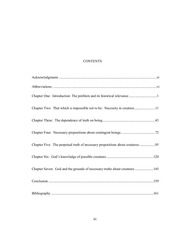
CONTENTS
Acknowledgments ...............................................................................................................iv
Abbreviations ......................................................................................................................vi
Chapter One: Introduction: The problem and its historical relevance ................................1
Chapter Two: That which is impossible not to be: Necessity in creation........................11
Chapter Three: The dependence of truth on being............................................................43
Chapter Four: Necessary propositions about contingent beings .......................................72
Chapter Five: The perpetual truth of necessary propositions about creatures ..................95
Chapter Six: God’s knowledge of possible creatures .....................................................120
Chapter Seven: God and the grounds of necessary truths about creatures .....................145
Conclusion .......................................................................................................................159
Bibliography ....................................................................................................................161
iii
�
ACKNOWLEDGMENTS
I would like to express my gratitude to many people who both directly and
indirectly helped me to write this dissertation. First, I would like to thank Fr. Kurt
Pritzl, O.P. and the faculty of the School of Philosophy at the Catholic University of
America for my initial training in philosophy. I am particularly grateful to Fr. Brian
Shanley, O.P. for first encouraging me to study philosophy and for offering his
supportive guidance throughout my time at C.U.A. I also have a deep gratitude to
Msgr. John F. Wippel who first introduced me to Aquinas’s metaphysics and
provided me with a sound foundation for further study of Aquinas’s thought.
During my time at Notre Dame, I continued to be blessed with excellent
teachers. I am grateful to John O’Callaghan for suggesting the topic of this
dissertation to me. His graduate seminar on truth, as well as many informal
conversations and email exchanges, helped me to grasp the philosophical difficulties
involved in several of the issues that I explore in this dissertation. I wish to thank
Stephen Dumont for all that he has taught me about how to work on medieval
philosophy through his courses and in his dirrection of my PhD candidacy exams.
Throughout my graduate studies he has provided me with much guidance and his
teaching sparked in me new areas of interest in medieval philosophy. Additionally, I
iv
�
would like to thank Profs. O’Callaghan, Dumont and Ralph McInerny for serving as
readers of my dissertation. Their thoughtful comments have improved this work in
many ways, as well as given me ideas for future work. Above all, in writing this
dissertation, I am thankful to my director Fred Freddoso for several sets of careful
and insightful comments. I am particularly appreciative to him for the many times
when he put aside his own projects and other pressing tasks in order to get comments
on my work back to me with incredible speed. I hope that I will display the same
dedication that he shows to his students as I begin my teaching career.
In addition to the faculty members that I have mentioned, I would like to
thank Timothy Pawl, who was a visiting graduate student at Notre Dame, for many
interesting email exchanges and coversations about Aquinas, truth and modality.
I have a deep gratitude to many of my fellow graduate students at Notre Dame
who have provided me with companionship and support, as well as contributed to my
intellectual growth through thoughtful conversations and the sharing of ideas. There
are more friends that I am grateful to than space will allow me to name, but I would
particularly like to mention Jennifer and Drew Rosato.
Finally, I would like to thank my husband Jake Frost, my parents Marianne
and Larry Wasserman, my brother Geoff Wasserman, and my late grandparents
Harold Wasserman and Gloria Bruno for their love, encouragement and support
throughout my studies.
v
�
ABBREVIATIONS
De ente
De ente et essentia
De Int.
Expositio libri Peryermeneias
De pot.
Quaestiones disputatae de potentia
De Trinitate
Super Boetium de Trinitate
De ver.
Quaestiones disputatae de veritate
In Ethic.
Sententia libri Ethicorum
In Meta.
In duodecim libros Metaphysicorum Aristotelis expositio
In Phys.
Commentaria in octo libros Physicorum Aristotelis
In I Sent.
Scriptum super libros Sententiarum magistri Petri Lombardi episcopi
Parisiensis
PA
Expositio libri Posteriorum
QQ. De A.
Quaestiones disputatae de anima
QQ.
Quaestiones de quolibet
ScG
Liber de veritate catholicae Fidei contra errores infidelium seu
Summa contra Gentiles
ST
Summa Theologiae
Super Io.
Super Evangelium S. Ioannis lectura
vi
�
CHAPTER ONE
INTRODUCTION: THE PROBLEM AND ITS HISTORICAL RELEVANCE
I. The Problem
Like his medieval contemporaries, Thomas Aquinas conceived of truth as
inextricably linked with existing things. Throughout his works, he maintains that the
essence of truth in the human intellect consists in its adequation (or commensuration)
with a thing (res). 1 In the De veritate, for instance, Aquinas writes: “To every true
act of understanding there must correspond some being and likewise to every being
there corresponds a true act of understanding.” 2 In addition to holding a view of truth
close to what has been labeled "the correspondence theory" in contemporary
philosophy, Aquinas also held that certain truths are necessarily true, i.e. they cannot
be false. 3 It would seem, then, that if truth is an adequation between intellect and
being and some truths are necessarily true, then there must be some necessarily
existing being to which the intellect can conform when it knows a necessary truth.
Some of the truths that Aquinas thought were necessary were in fact truths about the
*All translations are my own unless otherwise noted.
1
See, for example, In I Sent. 19.5.2, ad 2.; De ver 1.1 co.
2
De ver, 1.2 ad.1: “eo quod cuilibet intellectui vero oportet quod respondeat aliquod ens, et e
converso.”
3
In chapter three, the differences between Aquinas's theory of truth and contemporary
theories will become clear.
1
�
one necessary being in his ontology, i.e. God. 4 Aquinas, for example, thought the
proposition God is just is necessarily true. Although the human intellect may come to
know this proposition through a variety of causes, the truth of this proposition
consists in the intellect's adequation with the nature of God. This proposition could
not be other than true when it exists in the human intellect because the res with which
the intellect conforms, the being of God, cannot fail to exist or be just.
Aquinas did not think, however, that all necessary truths are about necessarily
existing beings. Like his contemporaries, he held that there are necessary truths about
contingent beings. In fact, the very possibility of science with respect to creatures
depended on there being propositions about contingent beings that could not be other
than true. When one accepts the conception of truth as adequatio along with the
claim that there are necessary truths about contingent beings, the question arises of
what the res are to which these necessary propositions are adequate. It seems that the
material creatures themselves, given that they are subject to generation and
corruption, along with other kinds of mutability, are insufficient relata to enter into
relation with the human intellect when it knows a necessary truth.
Answering this question becomes more complex in a genuinely Thomistic
tradition, which denies that the essences of creatures possess being of themselves or
in themselves. Although the essences of creatures are not themselves subject to
4
When refering to God as the one necessary being in Aquinas's ontology, I am using
'necessary' to refer to absolute or metaphysical necessity. Aquinas did admit that there were beings
other than God that were neither generable nor corruptible. Aquinas refers to these beings also as
necessary beings, yet their necessity differs from God's since they are caused beings and could not
have existed without being created by God. See for example ST Ia.2.3. For scholarship on Aquinas on
necessary being, see Patterson Brown, "St. Thomas's Doctrine of Necessary Being," The Philosophical
Review, 73:1 (1964): 76-90.
2
�
accidental change while they exist, Aquinas held that they too are created and are thus
subject to the substantial changes of generation and corruption. 5 Accordingly, it
seems that claiming that the res to which necessary truths about creatures conforms is
the essence of creatures will not help to explain how these truths remain true before
the creatures come into being or when the creatures cease to exist, since the essences
themselves do not exist apart from creatures. We cannot, for example, claim that it is
the essence of a dodo bird that is the ontological grounds for the truth Dodo birds
cannot fly since the essences of dodo birds ceased to exist around four hundred years
ago when dodo birds became extinct.
In this dissertation, I plan to give an account of the ontological foundation for
necessary truths about creatures according to the view of Thomas Aquinas. By
accounting for the “ontological foundation” or “basis” for necessary truths, I mean
that I will identify the res to which the human intellect conforms when it knows these
truths. The particular kind of necessary truths that I will be interested in are univeral
truths that express natural necessities, i.e. those that are the premises of or
conclusions of scientific demonstrations about creatures. I will leave aside the
perhaps more complicated issue of explaining mathematical truths and logical laws. 6
Aquinas does not have an explicit discussion of the ontological grounds for necessary
5
Aquinas is particularly clear about the creation of essences in De Potentia 3.5 ad 2: "Ad
secundum dicendum, quod ex hoc ipso quod quidditati esse attribuitur, non solum esse, sed ipsa
quidditas creari dicitur: quia antequam esse habeat, nihil est, nisi forte in intellectu creantis, ubi non est
creatura, sed creatrix essentia." This passage has generated a lot of debate among interpreters of
Aquinas's thought. Fred Freddoso has pointed out to me that there is one exception to the immutability
of creaturely essences. Sanctifying grace alters a creature’s essence. The human form is also an
exception since it is created by God, but incorruptible.
6
On the diverging views on the ontological grounds for mathematical truths in Aquinas'
thought see Armand Maurer, "Thomists and Thomas Aquinas on the Foundations of Math," The
Review of Metaphysics 47 (1993): 48-62.
3
�
truths about creatures, as later thinkers do. I believe, however, that his view on this
topic can be reconstructed based on his solutions to other problems regarding truth
and his positions on related ontological issues.
II. The Historical Relevance
Explaining the ontological source for necessary truths about creatures was a
much debated topic among 15th and 16th century thinkers who claimed to be
followers of St. Thomas. 7 The shared assumption of those who entered into this
dispute was that the fundamentum in re for necessary truth must be something
necessarily existing. Many held the view that although the essences of creatures are
created, the connections among the essential predicates that are signified by necessary
essential truths are eternal. Paul Soncinas (d. 1494) expresses this view as follows:
I will prove not that an essence does not have an efficient cause; for it
is certain that humanity, stone-ness, and anything else that exists in
reality are produced by the first cause [i.e.,God]. I instead prove that
there is no efficient cause of the connection signified by the
proposition humans are rational animals, in the way that there is an
efficient cause of the connection signified by the proposition a human
being exists. In fact, God, by producing a human, joins being to it. 8
7
For a summary of this debate, see Jeffrey Coombs, "The Ontological Source of Logical
Possibility in Catholic Second Scholasticism" in The Medieval Heritage in Early Modern Metaphysics
and Modal Theory, 1400-1700, Friedman, Russell L (ed), 191-229. Kluwer Academic Publisher:
Dordrecht, 2003.
8
Soncinas, Paulus. Pauli Soncinatis quaestiones metaphysicales acutissimae: nunc demum ab
erroribus plurimis expurgatae ... ; cum triplici earum indice. Venetiis: Scotus, 1588, 22a: "Et
probatur, non quidem quod essentia non habeat causam effectivam, quia certum est quod humanitas, et
lapideitas, et quicquid est in rebus, a prima causa est productum, sed probatur quod nulla sit causa
efficiens connexionis significati huius propositionis, homo est animal rationale, sicut aliqua est causa
efficiens connexionis significati huius propositionis, homo est, Deus nam producens hominem
copulavit ei esse." I quote this text, while making some emendations to the English translation, from
Jeffrey Coombs, "The Ontological Source of Logical Possibility," p. 196. This view was also held by
Sylvester of Ferrara (c. 1474-1528), who commented on Aquinas's Summa Contra Gentiles, Domingo
4
�
On this position, necessary truths are grounded in these eternal and uncaused
connections between essential predicates, rather than on the contingently existing
essences. This view is supposed to have an advantage over a "full-blown"
essentialism, which grants an eternal being to the essences themselves. The precise
nature, however, of these connections between essential predicates and their relation
to God was a subject of much debate. 9
This neo-scholastic controversy influenced the important early modern
discussion of the eternal truths. When he responded to Arnauld's objections to his
own doctrine on the eternal truths, Descartes either knew thoroughly or had at hand
Suárez’s work that summarized the major positions in the neo-scholastic debate.10
Descartes, Leibniz and their contemporaries all shared the assumption that creatures
themselves could not provide the ontological ground for the necessary truths about
them. In one (or more) places, Descartes famously identified the eternal truths with
the essences of creatures and claimed that they were created by God. 11 Leibniz, on
the other hand, made the essences of creatures necessary products of the divine
de Soto (1494-1560), Domingo Bañez (1528-1604), and Pedro de Fonaseca (1548-1599). See
Coombs, op. cit.
9
For a medieval account of this dispute, see Suárez's Disputatio Metaphysicae XXXI, sec. 12,
nn. 41-47.
10
See, Resp. 4ae, VII, 235.5-14.
11
A Mersenne Amsterdam, 27 Mai 1630, in Descartes, Correspondance, eds. C. Adam and
G. Milhaud, (Paris: Alcan) 1836, pp. 141-142: "Je vous répons que c'est 'in eodem genere causae' qu'il
a créé toutes choses, c'est-à-dire 'ut efficiens et totalis causa.' Car il est certain qu'il est aussi bien auter
de le'essence comme de l'existence des créatures: or cette essence n'est autre chose que ces vérités
éternelles; les quelles je ne conçois point émaner de Dieu comme les rayones du soleil mais je sais que
Dieu est auteur de toutes choses et que ces vérités sont quelque chose, et par consequent qu'il en est
auteur....”
5
�
intellect. 12 Both Descartes and Leibniz rejected as blasphemous the view that there
could be eternal truths if God did not exist. Norman Wells has argued that the
adversary Descartes may have had in mind when advancing his own position was
none other than the tradition, exemplified by Soncinas, which posited connections
between essential predicates that were not caused by God. 13 This early modern
debate helps to bring out a further philosophical issue that must be considered when
attempting to address the issue of the ontological ground of necessary truths. Once it
is assumed that the res to which necessary truth conforms is itself a necessarily
existing being, it must be determined how this res is related to God.
Aquinas's views on the ontological ground of necessary truths are discussed,
or at least referred to, with great frequency whenever the topic of necessary truths is
treated in literature on early modern philosophy and particularly on Descartes. 14 In
an article first published in 1970, Armand Maurer writes:
One of the most important legacies of medieval theology to modern
philosophy is the notion of eternal truths. The notion appears in
Descartes, Malebranche, Spinoza, and Leibniz, and through them it
became a commonplace in modern thought. Although extensive
research has been done on the meaning of the notion in the
seventeenth-century classical philosophers, the late medieval
background of the doctrine still remains largely unexplored. Indeed,
the history of the notion of truth in the Middle Ages still remains to be
12
See, for example, his Monadology par. 43-46.
Norman Wells, "Descartes and the Scholastics Briefly Revisited," New Scholasticism 2
(1961), pp. 187-190.
14
See for example Jorge Secada, Cartesian Metaphysics: The Late Scholastic Origins of
Modern Philosophy, (Cambridge, 2000), pp. 61-65; Gijsbert van den Brink, Almighty God: A Study of
the Doctrine of Divine Omnipotence (Peeters, 1993), pp. 106—113; Margaret Osler, Divine Will and
the Mechanical Philosophy: Gassendi and Descartes on contingency and necessity in the created
world (Cambridge, 1994), pp. 134-5.
13
6
�
written. In this complex and intricate history the divergent
conceptions of the eternity of truth would occupy a prominent place. 15
For much of the time since Maurer first penned these words, the status of research
into the Thomistic background of the modern doctrine of eternal truths remained
roughly the same. Recently, however, new interest has sparked in this topic. 16 In the
last decade, a few dissertations and articles have been written that attempt to explain
how Aquinas grounded modal truths with some of these studies focusing more
specifically on necessary truths. 17 Without exception, each of these studies has
argued that some aspect of God, namely his essence, ideas or power, grounds the
truth of necessary propositions about creatures. In this dissertation, I will challenge
that interpretation of Aquinas’s thought. I will argue that Aquinas held that the
necessary propositions on which a science of creatures is built are sufficiently
grounded in the contingently existing essences of created beings.
III. Overview
In order to accurately understand how Aquinas would have responded to the
question of what existing reality grounds the truth of necessary propositions about
15
Armand Maurer, "St. Thomas and Eternal Truths," Mediaeval Studies 32 (1970): 91-107.
91. This article is reprinted in Maurer's Being and Knowing: Studies in Thomas Aquinas and Later
Medieval Philosophers, (Toronto: PIMS, 1990).
16
In the last year, two doctoral dissertations were written which attempted to
17
See Amy Karofsky, “The ontology of alethic modalities in Aquinas, Suarez, and Leibniz,”
unpiblished Ph.D. dissertation, University of Virginia, 1997; Brian Leftow, “Aquinas on God and
Modal Truth” in S. Brower-Toland (ed.), “Sixth Henle Conference: Medieval Metaphysics, Part II.”
The Modern Schoolman 82:2 (2005): 171-200.; James Stone, “The foundation of universal and
necessary propositions in select writings of Thomas Aquinas,” unpublished Ph.D dissertation, Fordham
University, 2008; and Timothy Pawl, A Thomistic Account of Truthmakers for Modal Truths,
unpublished PhD dissertation, St. Louis University, 2008. (Pawl claims that he is not proposing the
view he describes as something that Aquinas explicitly held, but rather as a view that is consistent with
Aquinas's other doctrines.)
7
�
creatures, it is important to first understand which aspects of created reality were
thought by Aquinas to be necessary, as well as how Aquinas understood the
propositions in which a predicate is necessarily attributed to a subject. Accordingly,
in the next chapter of this work, I will disambiguate several ways in which Aquinas
uses the term necessity and I will isolate the sense that is relevant to the question of
this dissertation. I will show that Aquinas thought that the origin of all absolute
necessity in creation was the matter and form of creatures themselves. The problem
of accounting for the perpetual truth of necessary propositions about creatures will
emerge in this chapter when I explain how Aquinas thought that only contingent
existence belonged to these essential principles from which necessity arises.
In the third chapter, I will provide an overview of Aquinas’s thinking on truth.
I will focus particularly on his account of propositional truth. It will become clear in
this chapter that Aquinas held a view of propositions very different from most
contemporary analytic philosophers. For Aquinas, propositions are contingently
existing products of human thinking. The propositional structure of attributing a
predicate to a subject itself depends on the human mode of knowing. Making this
point is important because even scholars of Aquinas’s thought have attempted to
answer questions about the grounding of truths from Aquinas’s perspective while
assuming in an un-Thomistic fashion that propositions are abstract objects existing
apart from any mind that thinks them. 18 On Aquinas’s view, one cannot speak of the
truth of the proposition Man is an animal if there are no intellects existing that think
18
See, for example, Leftow’s, “Aquinas on God and Modal Truth.”
8
�
propositionally. In addition to explaining the nature of the proposition itself, my
main aim in this chapter is to explain how Aquinas thought that the truth of
propositions depended on existing things.
The opening chapters of this dissertation on necessity and truth can be seen as
providing the logical and ontological framework of Aquinas’s thought within which
our main question needs to be raised. In the fourth chapter, I will address the
question of what Aquinas thought the res was in virtue of which necessary
propositions about creatures are true. Building on the previous chapter about
propositional truth, I will make some distinctions that set necessary propositions apart
from all other propositions according to their structure. I will then argue on the basis
of his texts that Aquinas held that propositions about creatures, which predicate
essential attributes, were necessarily true because their subjects and predicates
signified the same substantial form in reality. Accordingly, the ontological
foundation for necessary truths about creatures is the unicity of substantial form.
The remaining three chapters of the dissertation constitute an attempt to raise
and respond to the strongest objections to the interpretation of Aquinas that I give in
chapter four. In chapter five, I raise the difficulty of how necessary propositions
about creatures remain true after creatures perish. If it is the form of dog that grounds
the truth of the proposition Dog is an animal, then, it seems, this proposition cannot
remain true when no forms of dogs exist. In chapter six and seven, I consider
whether the fact that God knows possible creatures independently of creation
undermines the account of Aquinas’s view that I have given. First, in chapter six, I
9
�
will enter into the debate in Thomistic scholarship about whether God knows possible
creatures and show that Aquinas’s texts give overwhelming evidence for a positive
answer to this question. Then in chapter seven, I argue that God’s ability to know
possible creatures in virtue of knowing his essence does not imply that God is the
ontological ground for propositional truths about creatures.
The main conclusion that I will draw in this dissertation is that because of
Aquinas’s unwavering commitment to the unicity of substantial form, he is able to
ground the necessity of essential predications about creatures in the essences of
creatures themselves. Since all of the essential attributes of a creature arise from one
single substantial form, no further cause beyond this form itself is needed to explain
why the essential attributes of creatures are necessarily joined together as they are.
Man is rational is necessarily true not because God’s will has joined the property of
being human with being rational or because God’s intellect eternally knows man to be
rational, but rather this proposition is necessarily true because the form that causes a
substance to be a man and the form which causes it to be rational are in fact one in
being.
10
�
CHAPTER TWO
THAT WHICH IS IMPOSSIBLE NOT TO BE: NECESSITY IN CREATION
The aim of this chapter is to give an overview of Aquinas's thinking on
necessity in creation. It is important to understand what Aquinas meant in describing
a being, its possession of one of its accidents or essential features, or the performance
of one of its actions as necessary. 19 It is also important to understand what types of
features he thought were necessary to a being, since it is the creature’s possession of
its necessary features that will be described by the necessary propositions that this
dissertation concerns. As will be seen, Aquinas thought that the term 'necessity'
admitted of different meanings. Before distinguishing between Aquinas's different
usages of the term 'necessity', I will discuss a more general point about Aquinas's
treatment of modality that has been subject to controversy in the literature, namely his
interpretation of modal terms. Then, I will give a classification of the various types
of necessity that operate in Aquinas's thought and I will isolate the sense that is
relevant to this study, namely absolute necessity. I will show that Aquinas thought
that all absolute necessity in creation has its origin in the intrinsic principles of
creatures, namely their matter and form. Finally, I will discuss the modes of
19
Unlike most contemporary philosophers, Aquinas and his contemporaries thought that a being’s
accidents were able to be necessary to it. The class of the essential and the necessary were not
coextensive, but rather the necessary included both essential and accidental features of a being. I
discuss the difference between necessary accidents and essential features on pp. 32-33.
11
�
existence that Aquinas thought belonged to matter and form. When it becomes clear
that the sources of necessity in creation have only contingent existence themselves,
the problem of explaining perpetual truth of necessary propositions about creatures
will emerge.
I. Aquinas’s Interpretation of Modal Terms
In contemporary philosophy, modal terms are understood according to the
model of possible worlds. On this model, each of the four modal terms can be
defined as follows:
necessary = df. true in all possible worlds
impossible = df. false in all possible worlds
possible
= df. true in at least one possible world
contingent = df. true in at least one possible world and false in at least
one possible world
The notion of a 'possible world' is not found in the thought of Thomas Aquinas. 20 So
the question naturally arises of what alternative model Aquinas used to interpret
modal terms. This question has been the subject of controversy for the past thirty five
years since Jaako Hintikka first advanced the thesis that Aristotle and scholastic
20
It has famously been argued that this notion has its origins in the thought of Scotus. See
Simo Knuuttila, “On the History of Modality as Alternativeness” in T. Buchheim, C.H. Kneepkens and
K. Lorentz (eds.), Potentialität und Possibilität. Modalaussagen in der Geschichte der Metaphysik
(Stuttgart-Bad Canstatt: Frommann-Holzboog, 2001), 219-236 and L. Alanen and S. Knuuttila, "The
Foundations of Modality and Conceivability in Descartes and His Predecessors," in S. Knuuttila ed.
Modern Modalities (Dordrecht, 1988). Stephen Dumont has shown that the notion of synchronic
contingency was present in Scotus's predecessors. See his “The Origin of Scotus's Theory of
Synchronic Contingency,” The Modern Schoolman 72 (1995): 149-167.
12
�
thinkers accepted a 'temporal model of modality.' 21 According to this model, modal
terms are interpreted as follows:
necessary = df. true at all times
impossible = df. false at all times
possible
= df. true at some time
contingent = df. true at some time and false at some time
This interpretive model is also referred to as the 'statistical model' and the 'diachronic
model of contingency’. It is called the diachronic model of contingency because the
contingent is defined as that which is able to be false at a time other than the time it is
true. On the rival synchronic model, what is contingent is able to be false at the time
that it is true. 22 The temporal model is also called the statistical model because modal
terms are interpreted with reference to extensional periods of time in the one actual
world.
Perhaps the most significant feature of the temporal model is that it is
reductionist. Modal terms are able to be reduced to temporal terms. This is a point of
contrast with the contemporary possible worlds model in which modal terms remain
basic. On the contemporary model, the term 'possible' occurs in the definition of all
21
See his Time and Necessity. Studies in Aristotle's Theory of Modality, (Oxford, 1973). His student
Knuuttila later published specifically on this modal scheme in Aquinas, see “The ‘Statistical’
Interpretation of Modality in Averroes and Thomas Aquinas," Ajatus 37 (1978): 79-98. Hintikka and
Knuutila's thesis has been challenged by Klaus Jacobi and Harm Goris. See K. Jacobi, "Statements
about events. Modal and Tense Analysis in Medieval Logic,” Vivarium 21:2 (1983): 85-107 and H.
Goris, Free Creatures of an Eternal God, (Leuven: Peeters, 1996), pp. 260-265.
22
This is expressed symbolically: For some time t, Wa at t & ‘ (W5a) at t. Proponents of
synchronic contingency do not endorse this claim: For some time t, ‘ (Wa & W5a) at t. This
proposition clearly violates the principle of non-contradiction.
13
�
other modal terms. The definitions of modal terms only clarify the relations of the
other modal notions to a primitive notion of possibility. On the temporal model,
modal notions are completely replaced by extensional temporal notions. Strictly
speaking, if Aquinas or other scholastics did hold the reductive temporal model for
interpreting modal terms, they in fact held no modal theory at all.
Fortunately, there is explicit textual evidence that shows that Aquinas rejected
the temporal model of "modality". In his commentary on Aristotle's De
Interpretatione, Aquinas notes that, as Boethius says in his commentary, there are
various opinions on how the possible and necessary are to be understood. 23 Among
the views that Aquinas rehearses is that of Diodorus. According to Aquinas,
Diodorus held that "the impossible is that which never will be; the necessary is that
which always will be; the possible is that which sometimes will be and sometimes
will not be." 24 Aquinas criticizes this view because the distinctions it makes between
modal notions are a posteriori. 25 He writes: "[I]t is not the case that something is
necessary because it always will be, but rather, it always will be because it is
necessary." 26 Klaus Jacobi expresses Aquinas's sentiment in this passage well when
he writes: "The connection between modal and tense qualifiers is not a matter of
23
De Int. 1.14, n. 8.
Ibid.: "Quidam enim distinxerunt ea secundum eventum, sicut Diodorus, qui dixit illud esse
impossibile quod nunquam erit; necessarium vero quod semper erit; possibile vero quod quandoque
erit, quandoque non erit." In this passage, Aquinas does not distinguish between the contingent and the
possible. Elsewhere, however, he is sensitive to the distinction that must be made between these
categories. In SCG III.86, for example, he recognizes that the necessary is also possible. Therefore,
the class of that which is possible cannot be coextensive with that which is contingent.
25
De Int. 1.14, n. 8.
26
Ibid.: "Nam prima distinctio est a posteriori: non enim ideo aliquid est necessarium, quia
semper erit; sed potius ideo semper erit, quia est necessarium: et idem patet in aliis."
24
14
�
definition but one of argumentation." 27 Aquinas recognized that there was a
relationship between modality of an event and the frequency with which it occurs
over time, but he did not reduce modal statements to assetoric propositions about
what occurs in the actual world. Jacobi rightly explains that the occurrence of an
event in the actual world was not seen as a definition of possibility, but rather
evidence of the fact that something is possible. Similarly, a thing's occurring at some
time and not at another would give proof that the thing's occurrence is contingent.
Aquinas, however, would reject this as a definition of contingency. Jacobi explains
that since appeals to what has occurred in the actual world cannot give evidence that
something is necessary or impossible, the line of argumentation from temporal
occurrences to modal claims runs in the opposite direction. In order to argue that
something will always be or not be the case, one must first prove that the thing
belongs to the class of the necessary or the impossible. 28 There is further evidence
that Aquinas rejected the temporal model for interpreting modal terms. On this
model, there is an equivalence between the necessary and that which is always the
case. Aquinas, however, admitted that it was possible for there to be a contingent
thing that always existed, namely an eternally created world. 29
27
"Statements about events," 91. On this topic, see also Jacobi's "Kontingente
Naturgeschehnisse," Studia Mediewistycne, 18,:2 (1977): 3-70.
28
Ibid.
29
See for example De pot. 3.14. There has been some dispute among scholars about whether
Aquinas actually thought that an eternally created world was possible or whether he more modestly
held that neither the impossibility nor possibility of the world's eternal creation could be proved. For
discussion of this debate, see John Wippel, "The possibility of eternal creation," in his Metaphysical
Themes in Thomas Aquinas, (Washington DC: CUA Press, 1984), pp. 191-214. Wippel shows that
Aquinas accepted that an eternally created world is possible.
15
�
In his De Interpretatione commentary, there is a second interpretation of
modality that Aquinas rejects. This interpretive model, which is based on external
prevention, is attributed to the Stoics. It holds that the necessary is that which is not
able to be prohibited from being true, the impossible is that which is always
prohibited from being true, the possible is that which is sometimes prohibited and
sometimes not. 30 Aquinas rejects this model because it bases the necessity or
contingency of something on what is external to it. This results in the modality of
something being accidental to it. For example, in a world where no dams exist it will
be necessary that rivers flow unrestricted. In a world where dams do exist, though,
this will be contingent since the flow of rivers will be able to be prevented. Just as he
recognized that time was connected to modality, Aquinas also recognizes that there is
a connection between a thing's modality and its ability to be prevented. The
connection, however, is the reverse of what the Stoic theory proposes. Aquinas
writes, "It is not the case that something is necessary because it does not have an
impediment; rather because it is necessary, it is unable to have an impediment." 31
Aquinas's rejection of this view is relevant to a contemporary proposal about how we
are to understand Aquinas's thinking on modality. Brian Leftow has recently
proposed that in Aquinas's thought modal claims can be reduced to claims about
God's power. 32 The possible is that which God is able to do and the necessary is that
30
De Int. 1.14, n. 8: "Stoici vero distinxerunt haec secundum exteriora prohibentia. Dixerunt
enim necessarium esse illud quod non potest prohiberi quin sit verum; impossibile vero quod semper
prohibetur a veritate; possibile vero quod potest prohiberi vel non prohiberi."
31
Ibid.: ".... non enim ideo aliquid est necessarium, quia non habet impedimentum, sed quia
est necessarium, ideo impedimentum habere non potest."
32
See his “Aquinas on God and Modal Truth”.
16
�
which God is unable to prevent. I will address Leftow's view in greater detail in a
later chapter. Another passage from the De Interpretatione gives initial reason to
think, however, that Leftow's reading is mistaken, given its similarity to the view
Aquinas explicitly rejects.
In the conclusion of the De Interpretatione passage that I have been
discussing, we get Aquinas's own view on what the best account of modal terms is.
He writes:
Such others rightly distinguish modal terms according to the nature of
things, namely so that it is said that the necessary is that which in its
nature is determined only to being; the impossible is that which is
determined only to nonbeing; the possible, however, is that which is
not completely determined to either being or nonbeing. It is either
related more to one than the other or it is equally related to both and
said to be contingent to either one. 33
This account of modal terms is preferable to the other two because according to it a
thing's modality is determined by what is intrinsic to it. According to their natures,
certain things are unable not to be while other things have a potentiality toward either
being or not being. It is this difference in the natures of things that accounts for the
different modal categories. The necessary, for example, has the features of being
always the case and unable to be prevented. The fact that something always is or
cannot be prevented can be epistemological signs that it is necessary, yet Aquinas
33
De Int. 1.14, n. 8: "Et ideo alii melius ista distinxerunt secundum naturam rerum, ut scilicet
dicatur illud necessarium, quod in sua natura determinatum est solum ad esse; impossibile autem quod
est determinatum solum ad non esse; possibile autem quod ad neutrum est omnino determinatum, sive
se habeat magis ad unum quam ad alterum, sive se habeat aequaliter ad utrumque, quod dicitur
contingens ad utrumlibet."
17
�
rejects that a thing's necessity can be reduced to one of these facts. A thing's modality
is an irreducibly basic feature of its essence.
II. Aquinas's Classifications of the Necessary
Now that we have seen how Aquinas interprets modal terms, we can look
more closely at his discussions of the modal notion that is of most importance to this
study, i.e. necessity. Throughout his works, Aquinas defines the necessary as that
which is unable or impossible not to be. 34 Although all necessary substances and
relations have in common an inability not to be, he claims that the term "necessity" is
"said in many ways". 35 Aquinas denied that necessity is a univocal term because
there are a number of different respects in which something is unable not to be.
Aquinas thought that men were unable not to be rational; the human will was unable
not to will its own happiness; if God knows p then p is unable not to be; and that if a
stronger agent coerces a weaker agent to do x, then x cannot not to be. The inability
not to be of each of these examples, however, depends on different causes and
conditions. Accordingly, Aquinas thought that each of these is necessary in a
different way. There are several theological contexts in which Aquinas asks whether
a certain things are necessary. For example, he asks whether it is necessary for fallen
human nature to be restored (In III Sent. 20.1.1.3 co.), whether it was necessary for
God to assume the defects of human nature in the Incarnation (ST IIIa.14.2 co.), and
34
See for example ST Ia.82.1 co.: "necesse enim est, quod non potest non esse"; In. III Sent.
16.1.2 co.: "necessarium idem est, quod impossible non esse";
35
ST Ia.82.1 co.
18
�
whether grace and the sacraments are necessary for the beatific vision (In II Sent.
29.1.1 co. and In IV Sent. 7.1.1.2 co.). Aquinas undertakes the task of distinguishing
the various types of necessity before addressing each of these questions. From these
discussions, Aquinas's classifications of the kinds necessity found in creation can be
reconstructed.
Aquinas's most basic distinction of the necessary is a four-fold division that
corresponds to Aristotle's four causes. Aquinas thought that a created being was
unable not to possess a certain accident or perform a certain action either because of a
being's form or matter, or because of an agent or final cause. The example Aquinas
always gives of the necessity that arises from matter is the fact that material beings
necessarily corrupt. Although a material being has both matter and form as intrinsic
principles, the necessity of corruption is traced back to the being's matter alone, since
the substantial change of corruption happens because matter becomes unable to
support its form. The examples that Aquinas gives of formal necessity vary. One
example he often uses is that a triangle has three angles. 36 Elsewhere, Aquinas gives
fire's causing heat as an example of a formal necessity. 37 Aquinas identifies the
necessity that arises from an agent or efficient cause with the necessity of coercion.
An action of agent a is necessary in this way when agent b acts in a way such that
with agent b's act having been posited, agent a's act cannot not happen. Necessity
arises from an end when a certain object or event is needed for another to obtain. In
36
ST Ia.82.1 co.; In Phys. II l.15 n. 2
ST III.14.2 co.: "Alia autem est necessitas naturalis, quae consequitur principia naturalia,
puta formam, sicut necessarium est ignem calefacere; vel materiam, sicut necessarium est corpus ex
contrariis compositum dissolvi."
37
19
�
the replies of In II Sent. 29.1.1 and In IV Sent. 7.1.1.2, Aquinas distinguishes between
two types of necessity from an end, namely things that are conditions for an end to be
achieved simpliciter and things that are necessary for an end to be easily achieved or
achieved well. Food is necessary for life in the former way and a ship is necessary to
cross the sea in the latter way.
Aquinas thought that there was a fundamental difference between the
necessity that arose from matter and form and the necessity that followed from an
agent or final cause. Matter and form are essential principles of the beings to which
they belong. For this reason, Aquinas refers to material and formal necessity as
intrinsic necessity while he calls the necessity that arises from agent and final causes
extrinsic necessity. 38 Since a material being cannot exist without its matter and form,
it cannot exist without being subject to the necessities that follow from its matter and
form. Accordingly, Aquinas also calls the necessity that arises from matter and form
"absolute" or "natural" necessity. 39 The necessity that arises from agent and final
causes, on the other hand, is merely conditioned necessity. The consequences that
follow with necessity from an agent's action are only necessary given that the agent's
action is performed. Similarly, the objects or events that are necessarily required for
the achievement of an end are only necessary given that the end is posited. The
results that necessarily follow from an action or end are not necessary simpliciter
given that certain created beings exist in the way that material and formal necessities
are.
38
39
ST Ia.82.1 co.
See, for example, In III Sent. 20.1.1 qc. 3 co. and ST IIIa.14.2 co.
20
�
Natural and absolute necessity is the necessity that will be of interest to us in
the remainder of this study. 40 Since this class of the necessary will be our main
focus, it will be helpful to make a clarifying point about Aquinas's usage of the terms
"natural" and "absolute". Commentators on Aquinas have struggled to understand
whether Aquinas thought that the entire class of that which is necessary from an
intrinsic principle, i.e. both the materially and formally necessary, is both absolutely
and naturally necessary. After discussing formal and material necessity in ST Ia.82.1
co., Aquinas claims that the necessity that follows from matter and form is "natural
necessity and absolute." In this text, it is unclear whether “natural” and “absolute”
apply interchangeably to all that is either materially or formally necessary or whether
the “natural” applies to some part of this class and the “absolute” applies to the other.
Hester Gelber, for example, identifies the naturally necessary with the materially
necessary and the absolutely necessary with the formally necessary. She goes on to
explain that what is meant by the naturally necessary is that "things necessarily have
the consequences of what they happen in fact to be" and what is meant by the
absolutely necessary is that "things necessarily have the consequences of their
definitions." 41
40
Below, I will distinguish natural/absolute necessity from a secondary sense of natural
necessity used by Aquinas.
41
See her It Could Have Been Otherwise: Contingency and Necessity in Dominican Theology
at Oxford 1300-1350, (Brill), 2004., pp. 115-116. Robert Pasnau has pointed out that there is an
ambiguity in whether the term "natural necessity" should be taken to refer solely to material necessity.
See his commentary and translation of Thomas Aquinas, Treatise on Human Nature (Summa
theologiae 1a 75-89) (Indianapolis: Hackett, 2002), p. 310. Pasnau's diagram on this page also reflects
this ambiguity.
21
�
If one looks beyond this one passage from ST Ia.82.1, it is clear that Aquinas
thought that the naturally necessary and absolutely necessary together referred to the
necessities that followed from both matter and form. In In II Sent. 29.1.1 co., for
example, Aquinas writes that "One necessity is absolute which is from prior causes,
as from matter and form, from which things are composed."42 In ST III.14.2 co.,
Aquinas makes clear that what is formally necessary is also naturally necessary when
he writes, "Another necessity, moreover, is natural necessity, which follows from the
principles of nature, as for example it is necessary for fire to heat from its form." 43 I
suspect that some of the confusion that contemporary readers have had with
Aquinas's terminology stems from their preconceptions based on contemporary
understandings of modal descriptions. On contemporary accounts, natural necessity
is a weaker-than-logical causal necessity that is often contrasted with logical
necessity. 44 Since we are accustomed to thinking of the naturally necessary and the
logically necessary as distinct types of necessity, many will assume that the naturally
necessary and the absolutely necessary must refer to different classes in Aquinas’s
thought as well. For the medievals, though, natural necessity referred to necessities
that arise from a being’s nature. Medieval thinkers held that the quidditative
definition of a thing signified its nature, so natural necessities have the logical
necessity that follows from a definition. A triangle's having three sides, for example,
42
In II Sent. 29.1.1 co.: "Una absoluta, quae est ex prioribus causis, ut ex materiali et formali,
ex quibus componitur res...." See also ScG II.30 where Aquinas refers to the materially necessary as
absolutely necessary.
43
ST III.14.2 co.: "Alia autem necessitas naturalis, quae consequitur principia naturalia, puta
formam, sicut necessarium est ignem calefacere...."
44
It will become clear below that there is another way in which Aquinas uses 'natural
necessity' that is the same as this sense.
22
�
is a natural necessity on the medieval understanding, since this property is part of a
triangle's nature.
While there is overwhelming textual evidence to support the view that
Aquinas thought that whatever was absolutely necessary was also naturally necessary
and vice versa, there are certain texts that appear to present a challenge to this view.
In the context of discussing God’s omnipotence, for example, Aquinas contrasts the
absolutely impossible with the naturally impossible in order to establish that certain
feats are merely naturally impossible, but not absolutely impossible. 45 Raising the
dead, for example, is thought by Aquinas to be naturally impossible, but not
absolutely impossible. Since the impossible is the contrary of the necessary, it seems
that if the naturally impossible is distinct from the absolutely impossible, then the
naturally necessary must be distinct from the absolutely necessary. This difficulty
can be solved, however, by distinguishing two understandings of the naturally
impossible that operate in Aquinas’s thinking. In the context of discussing material
and formal necessity, Aquinas implicitly understands naturally impossible1 as any
assertion that involves the denial of a property that is included in or entailed by a
property of a being’s essence. In the context of discussing divine power, though,
Aquinas understands naturally impossible2 as any effect that cannot be brought about
by a created power. 46 Clearly there are some events that are impossible according to
naturally impossible2, but not naturally impossible1. Running at the speed of one
hundred miles per hour does not involve the denial of a property included in or
45
46
ST I.25.4 ad 1
Ibid.; ST Ia.110.4 co.
23
�
entailed the essence of a human being, however, no human being is able to do this.
Aquinas would think, however, that it is within God’s power to create a human with
this ability since it involves no contradiction. What is naturally impossible1 is also
absolutely impossible. It involves a contradiction and cannot be brought about even
by God. Its opposite is both naturally and absolutely necessary. What is naturally
impossible2 is not absolutely impossible and its opposite is not absolutely necessary.
It is the first type of natural impossibility that we are interested in here since its
opposite is coextensive with the absolutely necessary. Throughout the remainder of
this dissertation, when I refer to the naturally impossible, what I will have in mind is
naturally impossible1, i.e. an assertion that involves the denial of a property that is
included in or entailed by a property of a being’s essence.
In addition to Aquinas’s discussions of the various types of necessity in which
he distinguishes absolute and natural necessity from conditioned necessity (or that
which is necessary from an extrinsic causes), there are other contexts in which
Aquinas distinguishes absolute necessity from other types of necessity. It is helpful
to consider these cases because Aquinas’s understanding of the absolutely necessary
in these contexts differs from how he understands absolute necessity when he is
contrasting it with extrinsic necessity.
Aquinas thought that a kind of necessity applied to past and present events,
which could be properly contrasted with absolute necessity. Although an event may
have a contingent relationship to its cause, once it occurs, it is unable not to be. 47
47
See, for example, De pot. 1.3 ad 9.
24
�
This necessity is called 'accidental' or per accidens necessity because it does not
pertain to something in virtue of its nature. An event is 'accidentally' necessary
because it occurred or is occurring. Nothing in the event’s nature makes it the case
that it necessarily is or was, but once it is or was, it cannot not be. A past or present
event’s inability not to be, however, does not imply that it followed with necessity
from its cause. The necessity with which certain effects follow from their causes is
the necessity that Aquinas refers to as absolute necessity in this context. Here the
absolutely necessary is understood as whatever is entailed by a previous event. On
this understanding, effects that are necessary from an agent by coercion would count
as absolutely necessary. Aquinas is not interested here in whether or not that which
is causally entailed is caused by an intrinsic or natural principle or an extrinsic cause.
He is simply trying to show that the 'accidental' necessity that applies to the past
cannot be equated with the necessity that arises from either an intrinsic or extrinsic
cause.
In other contexts, Aquinas distinguishes absolute necessity from conditional
necessity in attempt to differentiate de re and de dicto necessity. Here again the
absolutely necessary is understood as whatever is entailed by a previous action or
occurrence and includes that which is caused by either intrinsic or extrinsic causes.
Conditional necessity is understood in this context as the necessity that attaches to
certain conditional propositions. Aquinas’s purpose in making this distinction is to
show that it does not follow from the necessary truth of a conditional proposition that
what is expressed by the consequent of the proposition is causally necessitated by the
25
�
antecedent. Aquinas makes this distinction in the context of discussing God’s certain
knowledge of contingents. Aquinas is interested in showing that the necessary truth
of the conditional If God knows x, then x will be does not imply that x is itself is
causally necessitated by God’s knowledge. 48
I would like to set aside these last two understandings of absolute necessity,
which are contrasted with per accidens and de dicto necessity. For the remainder of
this chapter and throughout this dissertation, I will understand by absolute necessity
the necessity that arises from intrinsic natural principles of creatures, i.e. material and
formal necessity.
III. The Types of Absolute Necessity
Now that we have seen how Aquinas separates the absolutely necessary from
other types of necessity, we can look more closely at his understanding of absolute
necessity. In book two, chapter thirty of the Summa Contra Gentiles, Aquinas raises
the question of how there could be anything absolutely necessary in creation. 49 In the
preceding chapters, Aquinas argued that nothing outside of God is necessarily willed
by him. Aquinas is aware that it may seem to an objector that if God is the first cause
of all creation and God causes nothing outside of himself necessarily, then there can
be no necessity in creation. So he takes the occasion in this chapter to explain how
absolute necessity can arise in creation. Aquinas is careful to point out, however, that
when created realities are considered with respect to God, who is their primary cause,
48
49
ST Ia.14.13 ad 2.
ScG II.30
26
�
none of them are absolutely necessary. Since God's act of creation is free, nothing
that is created has absolutely necessary existence. When it is posited, however, that
God creates certain types of beings or events, Aquinas grants that certain other effects
follow with absolute necessity. When God creates fire, for example, heat follows
with absolute necessity. It is only in this restricted sense that there is absolute
necessity in creation. All necessity in creation is in a certain sense necessity of
supposition, i.e. necessary only when some given condition is presupposed. Even
though there is this restriction on absolute necessity, God's creative action is still
bound by it. 50 Aquinas claims that if God wills to create a human being, it is
necessary for him to give him a rational soul and a certain kind of body. 51 While it is
not necessary for God to will to create a human being, if he does will to create a
human being, then it is necessary for him to will certain other things to be.
Aquinas's discussion of the origins of absolute necessity in this Summa Contra
Gentiles text is more nuanced than in other texts where he is distinguishing absolute
necessity from conditioned or extrinsic necessity. In other contexts when
distinguishing the various types of necessity, Aquinas always had a particular
question in mind about whether a certain thing is necessary. Accordingly, the types of
necessity that he distinguished were not exhaustive, but only the ones that are relevant
to the particular thing
...
 Historical archive . public document