Exploring Identity
The Social Science
The definition of ‘identity’ has been the subject of much debate both scientifically and
philosophically. One theory is that identity is ‘…(a) a social category, defined by membership
rules and (alleged) characteristic attributes or expected behaviors, or (b) socially distinguishing
features that a person takes a special pride in or views as unchangeable but socially
consequential, (or (a) and (b) at once).
Fearon, James D. (1999). WHAT IS IDENTITY (AS WE NOW USE THE WORD)?. Available:
http://www.stanford.edu/~jfearon/papers/iden1v2.pdf. Last accessed 05/02/11.
In his book ‘Portraiture’, Richard Brilliant lists what he considers to be the essential constituents
of one identity. These are:
A recognised or recognisable appearance.
A given name that refers to no one else.
A definable social or interactive function.
In context, a pertinent characterization.
A consciousness of the distinction between one’s own person and another’s, and the
possible relationship between them.
He also notes that ‘only physical appearance is naturally visible and even that is unstable. The
rest is conceptual and must be expressed symbolically.’
Brilliant,R (2008). Portraiture. 4th ed. London: Reaktion Books Ltd. p9.
The Freudian psychologist Erik Erikson theorised that each individual was comprised of three
separate identities, these being the Ego Identity, the Personal Identity and the Socio-cultural
Identity. This means that the person that we are is defined by the basic sub-conscious self that
is controlled by the primal needs and desires (ego), the personal traits and idiosyncrasies that
define us from everyone else (personal) and the person that is shaped by our social roles that
we play to win acceptance either by society as a whole or a minority group (socio-cultural).
Brittany. (2010). Erik Erikson: Noteworthy Psychologist. Available: http://helpingpsychology.com/erik-erikson-noteworthypsychologist. Last accessed 04/02/11.
My own theory, based upon the Erikson frame-work, suggests that our identity is made up of the
person that we believe ourselves to be (ego), the person that we really are (personal), and the
person that everyone else sees (socio-cultural).
These different identities can then be dissected again into a series of characteristics that help to
make an entity definable or recognisable. Such characteristics may be physical, behavioural,
and/or psychological.
The Portrait
Portraits reflect social realities. Their imagery combines the conventions of behaviour and
appearance appropriate to the members of society at a particular time, as defined by categories
of age, gender, race, physical beauty, occupation, social and civic status and class.
Richard Brilliant
Brilliant,R (2008). Portraiture. 4th ed. London: Reaktion Books Ltd. P11.
�
The artist or photographer, when trying to capture the individual essence of a person may wish
to focus on one or more of these categories to try to present an image that the viewing public
would recognise and that would present their subject in a certain light, such as Yousuf Karsh’s
1941 portrait of Winston Churchill.
When I look at this picture I see a picture of one of Britain’s greatest leaders, but is my view of
the identity of the subject coloured by my historical knowledge of the man? I don’t think so. For
I also know that Churchill was inclined to drink heavily and was afflicted by bouts of depression.
But these qualities of his identity don’t come through in the picture.
Karsh has deliberately set up the picture to show off Churchill’s best qualities. He is smartly
dressed, he has been posed in a fine, wood panelled room. The look on his face isn’t quite a
frown, but the stern look in his eyes gives the impression that he is a very serious individual. I
believe that the artist has captured the socio-cultural view of Churchill that history will
remember, but is it a real depiction of the subject or is it little more than a piece of
political/historical propaganda?
At the time the picture was taken Britain had been at war for two years. Was the picture an
attempt to show the public, our allies and our enemies, the unwavering determination of the
British government?
When Sir Peter Lely was commissioned to paint the portrait of Oliver Cromwell, Cromwell
supposedly asked for the painting to be a ‘warts and all’ depiction. Martin, Gary. (2010). Warts and All.
Available: http://www.phrases.org.uk/meanings/warts-and-all.html. Last accessed 05/02/11.
�
This portrait shows Cromwell in his armour and, as per his instructions, the painting is a good
likeness of him. (This can be confirmed by the death mask that was made and is held in The
British Museum.)
Unknown Author. (2010). Wax death mask of Oliver Cromwell. Available:
http://www.britishmuseum.org/explore/highlights/highlight_objects/pe_mla/w/wax_death_mask_of_oliver_cromw.aspx. Last
accessed 05/02/11.
This portrait is an example of personal identity. Unlike the Churchill portrait that was set up and
arranged by the artist, this was arranged by the sitter himself. The portrait would have been
commissioned more as an historical document than anything else, as Cromwell’s puritan values
would have prevented him from having a portrait done out of vanity, but, like the Churchill
portrait it may also have served to intimidate his friends and enemies alike.
This picture may also give us an insight into the psychology of the man. The fact that he is
wearing armour may show that he wishes to be seen as a warrior rather than a politician or a
doer rather than a talker, and the ‘warts and all’ portraiture style is probably a way of showing
that he is still, in essence, a common man.
�
Documentary Portraiture
‘A portrait is just a portrait, but a documentary portrait makes a connection between the subject
and his or her surroundings. And this connection conveys a visual statement about the social
condition.’ – Tom Chambers
Chambers, Tom. (2010). Documentary Portraiture. Available: http://www.photo-seminars.com/Seminars/DocPort/docport.htm. Last
accessed 11/02/11
In 1936 Paul Strand and Berenice Abbot founded ‘The Photo League. This group of amature
and professional photographers was born from the ashes of the Workers Film and Photo
League. Their aim was to provide news agency pictures of strikes and workers demonstrations.
During the 1940’s the League was investigated by the House of Un-American Activities
Committee and this led to many of its members being branded as communists and then
blacklisted. The group finally disbanded in 1951 and Paul Strand went to live in France.
Prior to their disbanding, the league had attracted many of Americas most noted photographers.
Such luminaries were Ansel Adams, Dorothea Lange and Edward Weston.
Simkin, John. (2010). The Photo League. Available: http://www.spartacus.schoolnet.co.uk/USAPphoto.htm. Last accessed 11/02/11.
One of the members of the Photo League was one Arthur Fellig, aka Weegee. Fellig is most
noted for the photojournalistic pictures of New York crime scenes that he took for Acme
Newspictures. His pseudonym, Weegee, a phonetic rendering of Ouija, was given to him
because of his ability to be in the right place at the right time to capture a shot. This ability was
also aided by the use of a police radio receiver that he was licenced to use.
Unknown Author. (2009). Weegee. Available: http://en.wikipedia.org/wiki/Weegee. Last accessed 12/02/11.
�
Although he is best known as a photojournalist, many of his later works can be defined as
documentary portraiture. These pictures, although not newsworthy, are a fine historical
document and social study of New York during the 30’s and 40’s.
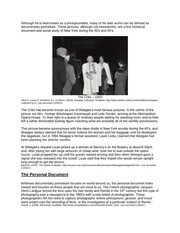
The Critic – 1943
Hare E, Lowes K, Konttinen S L, & Others. (2006). Weegee Collection. Available: http://www.amber-online.com/exhibitions/weegeecollection?p=5. Last accessed 12/02/11.
The Critic has become known as one of Weegee’s most famous pictures. In the centre of the
picture are Mrs. George Washington Kavenaugh and Lady Decies, arriving at the Metropolitan
Opera House. To their right is a queue of ‘ordinary people waiting for standing room, and to their
left a rather disheveled looking figure clutching what are probably all of her worldly possessions.
This picture became synonymous with the class divide in New York society during the 40’s, and
Weegee always claimed that he never noticed the woman and her baggage until he developed
the negatives, but in 1994 Weegee’s former assistant, Louie Liotta, claimed that Weegee had
been planning the shot for months.
At Weegee’s request Louie picked up a woman at Sammy’s on the Bowery at about 6:30pm
and, after plying her with large amounts of cheap wine, took her to wait outside the opera
house. Louie propped her up until the guests started arriving and then when Weegee gave a
signal she was released into the crowd. Louie said that they hoped she would remain upright
long enough to get the picture.
Barth,M. (1997). The Opera. Available: http://museum.icp.org/museum/collections/special/weegee/weegee09.html. Last accessed
12/02/11.
The Personal Document
Whereas documentary portraiture focuses on world around us, the personal document looks
inward and focuses on those people that are close to us. The French photographer Jacques
Henri Lartigue turned the lens upon his own family and friends in the 19th century but this type of
photography saw a resurgence in the 1960’s with a new breed of photographer. These
photographers felt the need to capture photographs ‘where atmosphere, gesture, and mood
were prized over the recording of facts, or the investigation of a particular subject or theme.’
Hoone, J. (2006). Bill Arnold. Available: http://www.josephbellows.com/artists/bill-arnold_1/bio/. Last accessed 13/02/11.
�
One such photographer was Christian Sunde. He became interested in photography at the age
of 25, but saw his duties as a husband and father as a hindrance to his becoming a professional
photographer but the travel photographer Tom Zimmerman taught him that to one had to
‘examine the personal to discover the universal’.
Arbus D, Bady E, Barrow T F, & Others (1976). Documentary Photography. 4th ed. New York: Time Life International. p214 - 217.
From this point on Sunde started to photograph his family. Instead of being hindrances to his
career, they became his source of inspiration. Through his pictures he learnt to notice again the
things that he had taken for granted. He learnt much about their appearance, their moods, the
similarities that bound them as a family and the differences that made them individuals.
The one picture that I feel demonstrates this is a picture that he took in 1970 called ‘Denise,
Christian, Glenn and Luke’.
Hoone, J. (1990). Christian Sunde. Available:
http://photography.cdmhost.com/cdm4/item_viewer.php?CISOROOT=/p4023coll6&CISOPTR=1696&CISOBOX=1&REC=3. Last
accessed 13/02/11.
The picture shows Sunde’s step-daughter, Denise, and his three sons sat in the back of the
family car. The group shows them as a family unit, yet each has their own air of individuality.
Each child seems to be in their own world, lost in with their own thoughts and feelings. They all
appear to be looking at different things. The youngest of the children is quite clearly interested in
something that is going on outside the car. We don’t know what it is, but I assume that it is
something that an adult wouldn’t notice, or would perhaps find totally disinteresting. This is
because none of the older children seen to find whatever it is in the least bit exciting. In fact the
boy in the back of the car seems to be more interested in his own hand whilst the others cannot
be shaken from their personal reveries.
�
 Historical archive . public document