Model Checking Aspect-Oriented Design Specification
Dianxiang Xu, Izzat Alsmadi, and Weifeng Xu
Department of Computer Science
North Dakota State University
Fargo, ND 58105, USA
E-mail: {dianxiang.xu, izzat.alsmadi, weifeng.xu}@ndsu.edu
Abstract
Aspects can be used in a harmful way that
invalidates desired properties. Rigorous specification
and analysis of aspect design is thus highly desirable.
This paper presents an approach to model-checking
state-based specification of aspect-oriented design. It
is based on a rigorous formalism for capturing
crosscutting concerns with respect to the design-level
state models of classes. An aspect model not only
encapsulates pointcuts and advice, but also supports
inter-model declarations, aspect precedence, and
references to the behaviors of other classes in advice
models. For verification purposes, we convert the
aspect-oriented state model of a system into woven
models and further transform the woven models and
the non-base class models into FSP processes. The
generated FSP processes are checked by the LTSA
model checker against the desired system properties.
We have applied our approach to the modeling and
verification of a non-trivial aspect-oriented cruise
control system. A total of 21 properties that provide a
comprehensive coverage of the system requirements
are successfully formalized and verified.
1. Introduction
Aspect-Oriented
Programming (AOP)
[12]
modularizes crosscutting concerns into aspects with the
advice invoked at the specified points of program
execution. It is expected to “improve reuse and ease of
change…, and ultimately creating more value for
producers and consumers alike” [18]. While the ability
to modularize crosscutting concerns appears to
improve quality, aspect-oriented software development
does not assure correctness by itself. For example,
AOP supports a variety of composition strategies,
“from the clearly acceptable to the questionable” [16].
Aspects can be used in a harmful way that invalidates
desired properties [10][11] and even destroys the
conceptual integrity of programs [16]. A piece of
around advice may completely alter the behavior of the
base classes no matter whether it is expected or
unexpected. Therefore, aspects must be applied with
care. To assure the quality of an aspect-oriented
system, rigorous analysis of aspect design is highly
desirable. Existing methods for aspect-oriented design
modeling have focused on the formalisms for aspect
specification. Since UML is a widely applied tool for
modeling object-oriented design, exploring the metalevel notation of UML or extending the UML notation
has been a dominant approach for specifying
crosscutting concerns [17]. This approach, however,
lacks the ability of rigorous verification due to the
informal or semi-formal nature of UML.
This paper presents an approach to model-checking
state-based specification of aspect-oriented design. It is
based on rigorous notations (e.g. pointcuts, advice,
aspects) for capturing crosscutting concerns with
respect to the design-level state models of classes. An
aspect-oriented state model consists of class models,
aspect models, and aspect precedence. For verification
purposes, we first compose aspect models into class
models by an explicit weaving mechanism. Then we
transform the woven models and the class models not
affected by the aspects into FSP processes. Finally we
apply the LTSA model checker [14] to verifying the
generated FSP processes against the desired system
properties. Our experiment has shown that the modelchecking approach is highly effective in assuring the
quality of aspect-oriented design.
The rest of this paper is organized as follows.
Section 2 is a brief introduction to the LTSA modelchecker. Section 3 describes aspect-oriented state
models for design specification. Section 4 discusses
verification of the aspect-oriented models. Section 5
presents the empirical study. Section 6 reviews the
related work. Section 7 concludes the paper.
31st Annual International Computer Software and Applications Conference(COMPSAC 2007)
0-7695-2870-8/07 $25.00 © 2007
�
2. Background: LTSA and FSP
The model checker LTSA (Labeled Transition
System Analyzer) [14] mechanically verifies whether
or not a model satisfies the particular properties
required of a system when it is implemented. A model
is a simplified, abstract description of the behavior of a
system. Through exhaustive exploration of the state
space, LTSA checks for both desirable and undesirable
properties for all possible sequences of events and
actions. The modeling approach of LTSA is based on
labeled transitions systems (LTS), where transitions in
a state machine are labeled with action names. Since
representing state machines graphically severely limits
the complexity of problems that can be addressed,
LTSA introduces a textual (algebraic) notation, FSP
(Finite State Processes), to describe system models. It
can translate FSP descriptions to the equivalent
graphical LTS description.
An FSP process consists of one or more local
processes separated by commas. The description is
terminated by a full stop. A local process can be a
primitive local process, a sequential composition, a
conditional process, or is defined using action prefix
(“->”) and choice (“|”). Shared actions in concurrent
processes indicate synchronization between the
processes. Parallel composition (“||”) can be used to
form composite processes.
LTSA allows system properties to be defined as
(safety and progress) property processes and/or Fluent
Linear Temporal Logic (FLTL) assertions. A safety
property process P asserts that any trace including
actions in the alphabet of P is accepted by P. A
progress property asserts that in an infinite execution
of a target system, at least one of the actions listed in
the property will be executed infinitely often (the
progress properties are actually a subset of liveness
properties). Properties can also be specified as stateoriented logical propositions in FLTL. As states in FSP
are implicit, LTSA takes an approach that maps an
action trace into a sequence of abstract states described
by fluents. A fluent is defined as fluent FL =
<{s1,…sm}, {e1,…en} initially B, where B is the initial
value, s1,…sm are the initiating actions, and e1,…en are
the terminating actions. FL becomes true when any of
the initiating actions occur and false when any of the
terminating actions occur. In other words, a fluent
holds at a time instant if and only if it holds initially or
some initiating actions has occurred, and in both cases,
no terminating action has yet occurred. An action
fluent is a fluent such that the action itself is the
initiating action and other actions are the terminating
ones. An action fluent becomes true immediately when
the action occurs and false when the next action
occurs. Fluent expressions can be constructed by
applying normal logical operators (conjunction,
disjunction, negation, implication, and equivalence) to
fluents. FLTL assertions are formed by applying
temporal operators to fluent expressions. They specify
the desired properties that are true for every possible
execution of a system.
3. Aspect-Oriented State Models
3.1. Class Models
A state model M consists of states S, events E, and
transitions T. Transition (si , e[φ], sj) ∈ T means that
event e∈E results in state sj∈ S from state si ∈ S under
guard condition φ (φ is optional). For the state model of
a given class, S, E, and T represent object states, public
constructor/methods, functionality implemented by the
constructor/methods, respectively. s∈S can be a
concrete object state or a state invariant. A guard
condition is a logical formula constructed by using
constants, instance variables, and functions (methods
with return values).
For convenience, we use α to denote the state
before an object is created (as in [2]) and the new event
to represent the constructor (we often omit α in state
diagrams, though). Usually, a class model includes α
in S and new in E. Object construction transition, (α,
new[ φ], s0)∈ T, creates an object with initial state s0
under condition φ. Thus we can determine the initial
state of a given state model from its object construction
transition. To distinguish states and events of different
classes, we use C.e, C.s and C (si, e[φ], sj) to denote
the event e, state s, and transition (si , e[φ], sj) in the
state model of class C.
new
Pending
complete
drop
drop
Completed
Dropped
complete
drop
complete
Figure 1. The state model for Connection class
stop
new
start
start
Started
Stopped
getTime
stop getTime
Figure 2. The state model of Timer class
As part of our running example, Figures 1 and 2
show the state models of classes Connection and Timer
in the aspect-oriented Telecom simulation [1]. The
states of the Connection class are Pending, Completed,
and Dropped, and the events are new, complete and
drop. Typically, a connection is established by the
31st Annual International Computer Software and Applications Conference(COMPSAC 2007)
0-7695-2870-8/07 $25.00 © 2007
�
complete event at the Pending state and then dropped
by the drop event at the Completed state. The states in
the Timer class model are Stopped and Started; the
events are new, start, stop, and getTime.
3.2. Modeling Aspect-Oriented Design
As in AOP [12], aspects in our approach are
explored to modularize concerns that crosscut or are
separate from primary concerns (i.e. classes). Our
approach, however, aims to capture crosscutting
features with respect to abstract class models (similar
to the UML 2.0 protocol state machines [20], except
for the post-conditions of transitions), as opposed to
the abstraction level of programming constructs or
control flow graphs. The preliminary modeling
formalism was originally developed for the purposes of
test generation from aspect-oriented state models
[23][25]. A major problem with the model-based
testing is that we have to inspect the aspect-oriented
state models by hand when test execution reports a
failure. If the models are proven correct, it can be
determined that the failure has to do with the code.
This paper exploits a generalized formalism for
specification of aspect-oriented design so that
verification of correctness can be automated. It thus
improves the model-based testing process for aspectoriented programs.
An aspect model consists of inter-model
declarations (ID), state pointcuts (SP), transition
pointcuts (TP), and advice models (AM). An intermodel declaration introduces one or more new
transition (state or event) to the base models. For an
introduced transition C(si, e[φ], sj), if si , sj, and/or e are
not yet in base model C, then they become a new state
or event in C. A join point is a transition or state in a
base model. A pointcut picks out a group of join
points. Pointcuts are defined as follows:
(1)
(2)
pointcut <cutname> <transition-variable>:
<base><transition> {,<base> <transition>}
pointcut <cutname> (<state-variable>):
<base>.<state>{,<base>.<state>}
where (1) and (2) define transition and state pointcuts,
respectively; <cutname> identifies a pointcut; <transitionvariable> is a formal transition, (si, e[φ], sj), where si , e,
and sj are variables; and <base>.<state> refers to a state
in the base model. A transition or state variable serves
as a unified reference to multiple transitions or states in
one or more base models.
The advice for a pointcut, specified by a state
model, describes the control logic applied to each join
point picked out by the pointcut. An advice model can
be empty, which means removal of the transitions
picked out by the pointcut from the base models. An
advice model that modifies a transition (e.g. the guard
condition or resultant state) in a base model can simply
have one transition. Figure 3 shows the model for a
Checking aspect that applies to the Connection class in
Figure 1. The first pointcut completeAtDropped picks
out the transition join point (Dropped, complete,
Completed) in the Connection model. The advice (with
an empty model) means that at the Dropped state, the
complete event is not applicable. The third pointcut
dropAtPending picks out the transition (Pending, drop,
Dropped). The advice is that the resultant state of the
drop event at the Pending state should be Pending
(remain unchanged).
Aspect Checking
pointcut completeAtDropped (Dropped, complete, Completed):
Connection (Dropped, complete, Completed)
// join point
advice completeAtDropped // remove the transition
pointcut self (si, e, si):
Connection (Completed, complete, Completed), // join point
Connection (Dropped, drop, Dropped)
// join point
advice self // remove the transitions
pointcut dropAtPending (Pending, drop, Dropped):
Connection (Pending, drop, Dropped)
// join point
advice dropAtPending
drop
Pending
Figure 3. The Checking aspect model
Aspect Timing
pointcut startTiming (Pending, complete, Completed):
Connection (Pending, complete, Completed)
advice startTiming
Pending
complete Completed
Timer.start Timer.Started
pointcut endTiming (Completed, drop, Dropped):
Connection (Completed, drop, Dropped)
advice endTiming
Completed drop
Dropped
Timer.stop
Timer.Stopped
pointcut init (α, new, Pending): Connection (α, new, Pending)
advice init
new
Pending
Timer.new
Timer.Stopped
Figure 4. The Timing aspect model
Figure 4 shows the model of the Timing aspect in
the Telecom simulation. The first pointcut picks out the
transition (Pending, complete, Completed) in the
Connection model. The advice is to start timing once
this transition has happened. Similarly, the second
pointcut picks out the transition (Completed, drop,
Dropped). The advice is to stop timing once the
transition has happened. The third pointcut picks out
the object creation transition of Connection, the advice
is to create a Timer object and get ready for timing
(Timer is called a non-base class in an advice model - it
is used but not affected by aspects).
Note that both Checking and Timing take
Connection as the base class. To deal with aspect
interference, we can specify an explicit precedence
31st Annual International Computer Software and Applications Conference(COMPSAC 2007)
0-7695-2870-8/07 $25.00 © 2007
�
relation (>) between aspects. It is a partial-order
relation on the given set of aspect models. In the
Telecom example, we have Checking > Timing, i.e.,
Checking is applied before Timing. Multiple pointcuts
in the same aspect can also share join points. The order
in which their advice is applied to the shared
transitions depends on their occurrences in the aspect
model. As such, the aspect-oriented state model of a
system consists of class models, aspect models, and a
precedence relation on the aspect models.
4. Checking Aspect-Oriented Models
To verify an aspect-oriented state model, we first
weave aspect models into their base class models. This
results in woven state models. Then we convert the
woven models and the models of those classes not
modified by the aspects into respective FSP behavior
processes and verify if they have unreachable states.
Meanwhile, we formalize the properties to be verified
according to the system requirements. The properties
are expressed as (safety and progress) property
processes and/or FLTL assertions. Finally, we
compose all behavior and property processes into a
system-level process and feed the resultant process into
LTSA. LTSA then verifies whether or not the
properties are violated. If violated, it reports a trace to
property violation (i.e., counterexample). This helps
improve the aspect-oriented state model or examine
correctness of system properties. Figure 5 shows the
general process for verifying the aspect-oriented state
models. A prototype tool has been implemented in the
MACT (Model-based Aspect Checking and Testing)
toolkit to automate the transformation from aspectoriented state models into FSP processes. In the
following, we focus on the two core components of the
verification process: weaving for checking and
converting woven models and class models into FSP
behavior processes.
4.1. Weaving for Checking
In aspect models, inter-model declarations
introduce new transitions, states, and events to base
models. State and transition pointcuts are a naming
mechanism for mapping state/event variables in advice
models to the counterparts selected from base models
by pointcut expressions. The selected transitions are
then replaced with corresponding advice models or
transitions. To represent woven state models, we
slightly extend the state models described in Section
3.1. Specifically, a generalized transition in a woven
model is of the form (si , e1[φ1]->e2[φ1]->…-> ek[φk],
sj) where φl (l=1,…k) is the guard for event el. It means
the sequence of guarded events e1[φ1]->e2[φ1]->…->
ek[φk] (called a composite event) results in state sj from
si. Typically, one of these events belongs to the base
class whereas the rest are events of other classes
involved. If there is only one event in the sequence, the
transition reduces to a traditional one.
Aspect-oriented
state models
System
requirements
Weaving for
checking
Woven
models
Class
models
Converting state
models to FSP
FSP behavior
processes
Formalizing
properties
Property processes
/ FLTL assertions
Checking with LTSA
Figure 5. The model-checking process
Now we present the weaving algorithm that
composes an aspect model with a base model for
checking purposes. Let “:=” be the assignment
operator, M.S, M.E and M.T be the sets of states,
events, and transitions of state model M, respectively.
Algorithm 1 (Weaving for Checking). Given base
model BM and aspect model A = (ID, SP, TP, AM).
The woven state model, WM, of composing aspect A
into base model BM results from the following
procedure:
(1) Initially, WM := BM;
(2) For each inter-model declaration in ID that is
defined on BM, add each new transition into
WM.T. If states (or events) used in the new
transitions have not yet in WM.S (or WM.E), add
them into WM.S (or WM.E).
(3) For each advice model in AM that involves nonbase classes, combine the transitions that use states
and events of the non-base classes into composite
events (leaving out the states of the non-base
classes). Let AM’ denote the new set of advice
models.
(4) For each transition pointcut in TP, replace each
transition in WM.T picked out by the pointcut with
the corresponding advice model in AM’. If the
advice model uses a state variable defined by some
state pointcut in SP, then replace the state variable
31st Annual International Computer Software and Applications Conference(COMPSAC 2007)
0-7695-2870-8/07 $25.00 © 2007
�
with the corresponding state in WM.S according to
the state pointcut.
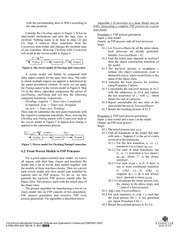
Algorithm 2 (Conversion of a State Model into an
FSP). Generating a complete FSP process for a given
state model
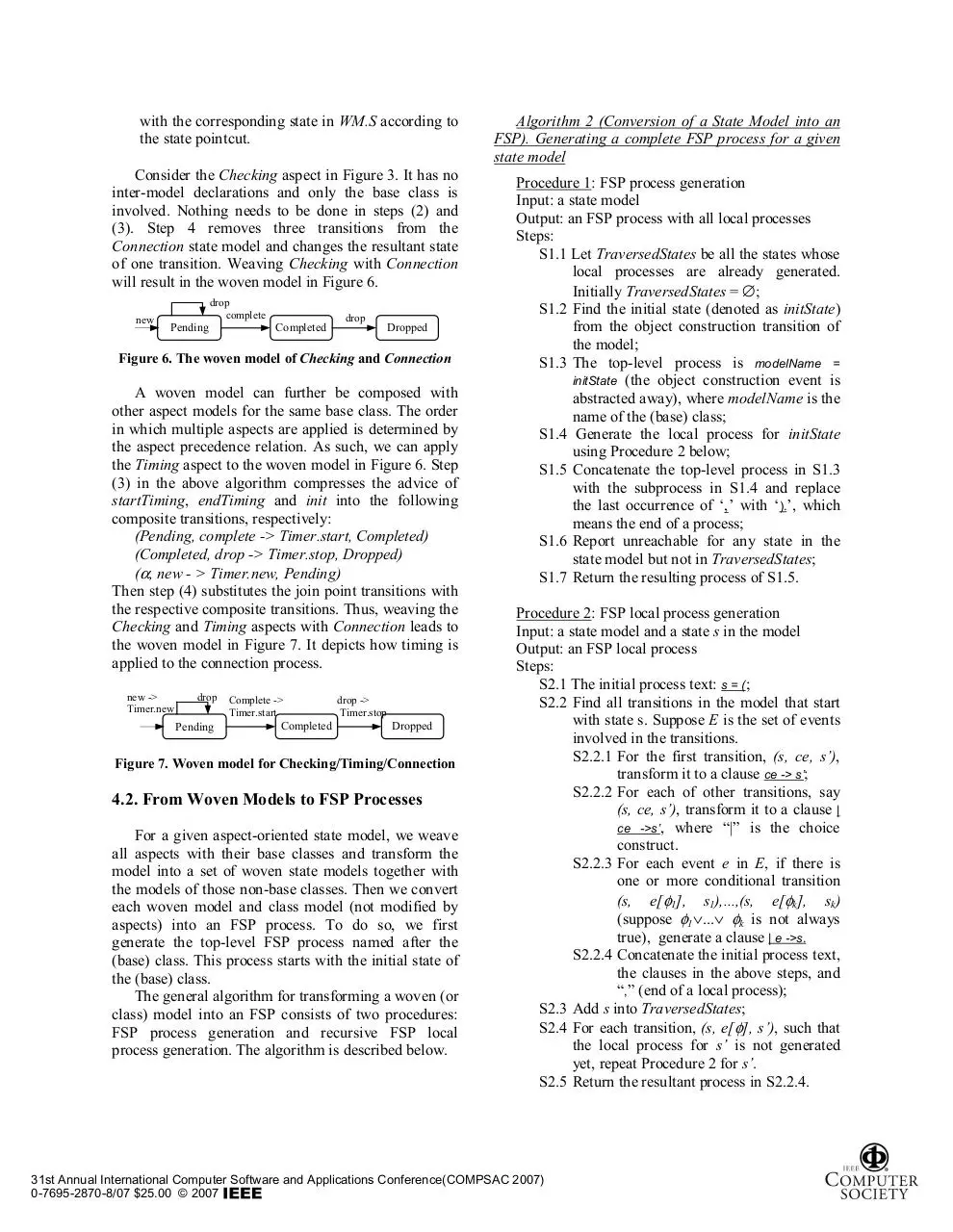
Consider the Checking aspect in Figure 3. It has no
inter-model declarations and only the base class is
involved. Nothing needs to be done in steps (2) and
(3). Step 4 removes three transitions from the
Connection state model and changes the resultant state
of one transition. Weaving Checking with Connection
will result in the woven model in Figure 6.
Procedure 1: FSP process generation
Input: a state model
Output: an FSP process with all local processes
Steps:
S1.1 Let TraversedStates be all the states whose
local processes are already generated.
Initially TraversedStates = ∅;
S1.2 Find the initial state (denoted as initState)
from the object construction transition of
the model;
S1.3 The top-level process is modelName =
initState (the object construction event is
abstracted away), where modelName is the
name of the (base) class;
S1.4 Generate the local process for initState
using Procedure 2 below;
S1.5 Concatenate the top-level process in S1.3
with the subprocess in S1.4 and replace
the last occurrence of ‘,’ with ‘).’, which
means the end of a process;
S1.6 Report unreachable for any state in the
state model but not in TraversedStates;
S1.7 Return the resulting process of S1.5.
new
drop
complete
Pending
Completed
drop
Dropped
Figure 6. The woven model of Checking and Connection
A woven model can further be composed with
other aspect models for the same base class. The order
in which multiple aspects are applied is determined by
the aspect precedence relation. As such, we can apply
the Timing aspect to the woven model in Figure 6. Step
(3) in the above algorithm compresses the advice of
startTiming, endTiming and init into the following
composite transitions, respectively:
(Pending, complete -> Timer.start, Completed)
(Completed, drop -> Timer.stop, Dropped)
(α, new - > Timer.new, Pending)
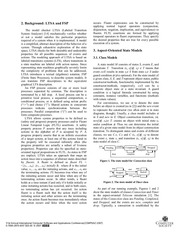
Then step (4) substitutes the join point transitions with
the respective composite transitions. Thus, weaving the
Checking and Timing aspects with Connection leads to
the woven model in Figure 7. It depicts how timing is
applied to the connection process.
new ->
Timer.new
drop
Pending
Complete ->
Timer.start
Completed
drop ->
Timer.stop
Dropped
Figure 7. Woven model for Checking/Timing/Connection
4.2. From Woven Models to FSP Processes
For a given aspect-oriented state model, we weave
all aspects with their base classes and transform the
model into a set of woven state models together with
the models of those non-base classes. Then we convert
each woven model and class model (not modified by
aspects) into an FSP process. To do so, we first
generate the top-level FSP process named after the
(base) class. This process starts with the initial state of
the (base) class.
The general algorithm for transforming a woven (or
class) model into an FSP consists of two procedures:
FSP process generation and recursive FSP local
process generation. The algorithm is described below.
Procedure 2: FSP local process generation
Input: a state model and a state s in the model
Output: an FSP local process
Steps:
S2.1 The initial process text: s = (;
S2.2 Find all transitions in the model that start
with state s. Suppose E is the set of events
involved in the transitions.
S2.2.1 For the first transition, (s, ce, s’),
transform it to a clause ce -> s’;
S2.2.2 For each of other transitions, say
(s, ce, s’), transform it to a clause |
ce ->s’, where “|” is the choice
construct.
S2.2.3 For each event e in E, if there is
one or more conditional transition
(s, e[φ1], s1),...,(s, e[φk], sk)
(suppose φ1∨...∨ φk is not always
true), generate a clause | e ->s.
S2.2.4 Concatenate the initial process text,
the clauses in the above steps, and
“,” (end of a local process);
S2.3 Add s into TraversedStates;
S2.4 For each transition, (s, e[φ], s’), such that
the local process for s’ is not generated
yet, repeat Procedure 2 for s’.
S2.5 Return the resultant process in S2.2.4.
31st Annual International Computer Software and Applications Conference(COMPSAC 2007)
0-7695-2870-8/07 $25.00 © 2007
�
For clarity, algorithm 2 does not deal with the
naming convention. In fact, it has to follow the naming
convention of LTSA. Specifically, we capitalize
process (i.e. model) and local process (i.e. state) names
and use a lower case for the first letter of each event
name. To differentiate the events of different classes,
we always prefix an event with its class name (starting
with a lower case letter according to the LTSA naming
convention, though). For example, the generated FSP
process for the woven model in Figure 7 is as follows:
CONNECTION = PENDING,
PENDING =
(connection.complete -> timer.start -> COMPLETED
| connection.drop -> PENDING),
COMPLETED =
(connection.drop -> timer.stop -> DROPPED).
Finally, we need to define the system-level process for
an aspect-oriented state model. To do so, we compose
the FSP processes for all woven state models and nonbase class models. For the previous Telecom example,
the system-level FSP process is:
|| TELECOM = (CONNECTION || TIMER).
Putting this together with the FSP processes for the
woven model and the Time class model, we have
obtained the complete FSP specification for the
Telecom subsystem that consists of the Connection and
Timer classes and Checking and Timing aspects.
when, at the initial system state (engine is off), one
first accelerates the car and then turns on the ignition.
According to the cruise control system
requirements, we have formalized 21 properties,
focusing on the required effects of the aspects. For
example, the following two properties apply to the
CarSimulatorFix and CruiseControlIntegrator aspects:
• The cruise controller cannot be active before
the ignition has ever been on.
• The cruise controller should not be active after
the controller or car engine is turned off.
They are inter-object state invariants between
CarSimulator and Controller and thus affected by the
CarSimulatorFix and CruiseControlIntegrator aspects.
Similarly, the following two requirements apply to the
SpeedControlIntegrator aspect:
• The cruising state cannot be entered before the
speed control is enabled.
• The standby state cannot be entered before the
speed control is disabled.
They are inter-object state invariants between
Controller and SpeedControl and affected by the
SpeedControlIntegrator aspect.
CarSimulatorFix
CarSimulator
GUI
CruiseControl
Integrator
5. Empirical Study
The running example in the previous sections has
been verified against a number of properties. This
section reports the application of our approach to a
non-trivial aspect-oriented cruise control system. Its
AspectJ implementation has 690 lines of code,
including 143 lines of aspect code. As an aspectoriented refactoring of a legacy Java applet [14], the
system provides engine control (engineOn, engineOff,
accelerate, brake) and cruise control (on, off, and
resume) operations. Engine control events are
processed by a CarSimulator object and cruise control
events by a Controller object. Figure 8 shows the
system architecture, where a small circle represents a
relationship between a base class and an aspect.
CruiseControlIntegrator composes CarSimulator with
such cruise control components as CruiseDisplay and
Controller, whereas aspect SpeedControlIntegrator
composes SpeedControl with Controller. The
CarSimulatorFix aspect solves a safety problem with
the legacy system, which was found when we were
testing the first executable aspect-oriented version. The
failure is that the car starts accelerating immediately
CarSimulator
SpeedControl
Integrator
Controller
CarSpeed
Runnable
SpeedControl
CruiseDisplay
Figure 8. The aspect-oriented cruise control system
We have successfully verified all of the formalized
properties against our aspect-oriented design model.
No property violation was found. To further evaluate
whether or not the model-checking approach can detect
design defects, we created 33 variations (mutants) of
the correct aspect-oriented model of the cruise control
system according to the potential detects of aspect
design (e.g. missing join points). 12 of them led to a
deadlock and 21 violated one or more properties (e.g.
variation 3-7 violated two properties #6 and #14). All
mutants are determined to be flawed design models.
This indicates that the model-checking approach is
indeed effective in aspect verification.
6. Related Work
There is a growing body of work on aspect-oriented
modeling with UML. This work exploits the meta-level
31st Annual International Computer Software and Applications Conference(COMPSAC 2007)
0-7695-2870-8/07 $25.00 © 2007
�
notation of UML or extends the UML notation for
specifying crosscutting concerns. It is not concerned
with the verification of aspect models due to the
informal or semi-formal nature of UML [24]. A recent
survey can be found in [17].
Since finite state models have long been in use for
rigorous specification of object-oriented software [2],
sate-based aspect modeling is of particular interest.
Elrad et al. have proposed an approach to aspectoriented modeling with Statecharts [4]. Base state
models and aspect state models are represented by
different regions of Statecharts. An aspect first
intercepts the events sent to the base state models and
then broadcast the events to the base state models.
Composition of base models and aspect models relies
on a specific naming convention as the weaving
mechanism is implicit. In comparison, our work uses a
rigorous formalism for capturing crosscutting elements
(join points, pointcuts, and advice) with respect to state
models. Aspects and classes are composed through an
explicit weaving mechanism. Xu and Nygard [22] have
developed aspect-oriented Petri nets for threat-driven
modeling and verification of secure software.
Verification is conducted with respect to the
correctness and absence of threat scenarios, as opposed
to desired system properties.
Several methods for model-checking aspectoriented programs have been proposed. Ubayashi and
Tamai [19] use model-checking to verify whether the
woven code of an aspect-oriented program contains
unexpected behavior. They propose a framework that
allows crosscutting properties to be defined as an
aspect and thus separated from the program body.
Denaro and Monga [3] report a preliminary experience
with model-checking a concurrency control aspect.
They manually build the aspect model in PROMELA
(the SPIN input language) and verify the deadlock
problem of the synchronization policy. Since the
transformation is done by hand, the conformance
between the PROMELA program and aspect code
remains an open issue. Nelson et al. [15] use both
model checkers and model-builders to verify woven
programs. The above work [3][15][19] does not
involve aspect-oriented modeling.
Krishnamurthi et al. [13] adapt model-checking for
verifying properties against advice modularly. Given a
set of properties and a set of pointcut designators, this
approach automatically generates sufficient conditions
on the program’s pointcuts to enable verification of
advice in isolation. It assumes that the programs and
advice are given as state machines, which represent the
control-flow graphs of program fragments. In a series
of papers, Katz and his group have addressed various
issues of model-checking aspect-oriented code. In [9],
model checking tasks are automatically generated for
the woven code of aspect-oriented programs. In [8],
they treat crosscutting scenarios as aspects and use
model checking to prove the conformance between the
scenario-based specification of aspects and the systems
with aspects woven into them. In [7], they propose an
approach to generic modular verification of code-level
aspects. They check an aspect state machine against the
desired properties whenever it is woven over a base
state machine that satisfies the assumptions of the
aspect. A single state machine is constructed using the
tableau of the LTL description of the assumptions, a
description of the join points, and the state machine of
the aspect code.
Our work is different from the above methods for
model-checking aspect-oriented programs. The
crosscutting notions (pointcuts, advice, and aspects) of
the aspect-oriented state models in our approach are
specified with respect to the design-level state models,
as opposed to the programming constructs or control
flow graphs of aspect-oriented programs. Aspect
models are allowed to introduce new states, events, and
transitions. Generally speaking, it is more difficult to
handle the state space explosion problem at the code
level than at the design level. Duo the complexity of
code, “model checking programs (of real applications)
often cannot completely analyze the program’s state
space since it runs out of memory” [21]. For assuring
the quality of aspect code, we provide a combination of
model-checking for correct design specification and
model-based test generation for conformance testing of
aspect code. Nevertheless, the approaches to modular
verification of aspects [7][13] can be adopted to
enhance our work.
7. Conclusions
We have presented a rigorous approach to
automated verification of aspect-oriented design
specification. This method can lead to two important
benefits: (1) uncovering aspect design problems before
code is written. This will reduce development costs due
to the earlier detection of problems; and (2)
determining programming faults through model-based
testing. The model-based testing method [23] generates
test cases from an aspect-oriented state model for
exercising the resultant aspect-oriented program. A
failure of test execution only indicates that the code
does not conform to the model. When correctness of
the model is assured by the model-checking method,
each failure of test execution implies that the code is
faulty (as long as the test oracle including test result
evaluation is reliable). Therefore, the combination of
the model-checking and model-based testing methods
can assure the quality of aspect-oriented programs.
31st Annual International Computer Software and Applications Conference(COMPSAC 2007)
0-7695-2870-8/07 $25.00 © 2007
�
The model-checking method also offers a potential
for generating test cases from an aspect-oriented state
model. The basic idea is to transform property
violation traces (i.e., counterexamples) into test cases.
Our future work will investigate how to define
properties for test generation from counterexamples
and integrate the generated test cases with the existing
model-based testing method.
8. Acknowledgement
This work was supported in part by the ND
EPSCoR IIP-SG via NSF Grant EPS-047679.
9. References
[1] AJDT
(AspectJ
Development
http://www.eclipse. org/ajdt/
Tools).
[2] Binder, R. V. Testing Object-Oriented Systems: Models,
Patterns, and Tools. Addison-Wesley, 2000.
[3] Denaro, G. and Monga, M. “An experience on
verification of Aspect Properties”. In International
Workshop on Principles of Software Evolution (IWPSE),
Vienna, Austria, Sept. 2001.
[4] Elrad, T., Aldawud, O., and Bader, A. “Expressing
Aspects Using UML Behavior and Structural
Diagrams”. In Filman et al. [5], pp. 459-478.
[5] Filman, R.E., Elrad, T., Clarke, S., and Aksit, M.
editors. Aspect-Oriented Software Development.
Addison-Wesley, Boston, 2005.
[6] Glusman, M. and Katz, S. “Model Checking
Conformance with Scenario-based Specifications”, In
Proc. of the 15th International Conference Computer
Aided Verification (CAV’03), LNCS 2725, pp. 328-340,
Boulder, CO, Springer, 2003.
[7] Goldman, M. and Katz, S. “Modular Generic
Verification of LTL Properties for Aspects. In Proc. of
Foundations of Aspect Languages Workshop (FOAL06),
2006.
[12] Kiczales, G., Lamping, J., Mendhekar, A., Maeda, C.,
Lopes, C.V., Loingtier, J. M. and Irwin, J. “AspectOriented Programming”. In Proc. of ECOOP’97, pp.
220-242, 1997.
[13] Krishnamurthi, S., Fisler, K., and Greenberg, M.
“Verifying Aspect Advice Modularly”. In Proc. of
FSE’04, Newport Beach, CA, Nov. 2004.
[14] Magee, J. and Kramer, J. Concurrency: State Models
and Java Programs. Second Edition, John Wiley &
Sons Ltd, 2006.
[15] Nelson, T., Cowan, D.D. and Alencar, P. S. C.
“Supporting Formal Verification of Crosscutting
Concerns”. In Reflection, pp. 153–169, 2001.
[16] Rinard, M., Salcianu, A., and Bugrara, S. “A
Classification System and Analysis for Aspect-Oriented
Programs”. In Proc. of FSE’04, Nov. 2004.
[17] Schauerhuber, A., Schwinger, W., Retschitzegger, W.,
and Wimmer, M. “A Survey on Aspect-Oriented
Modeling Approaches”, Technical Report, Vienna
University of Technology. January 2006.
[18] Sullivan, K., Griswold, W.G., Song, Y., Cai, Y., Shonle,
M., Tewari, N, and Rajan, H. “Information Hiding
Interfaces for Aspect-Oriented Design”, In Proc. of
ESEC/FSE'05, pp. 166-175, 2005.
[19] Ubayashi, N. and Tamai, T. “Aspect-Oriented
Programming with Model Checking”. In Proc. of
AOSD'02, pp. 148-154, The Netherlands, 2002.
[20] UML
2.0
Specification.
http://www.omg.org/
technology/documents/ formal/uml.htm
[21] Visser, W., Pasareanu, C.S., and Khurshid, S. “Test
Input Generation with Java PathFinder”. In Proc. of
ISSTA’04, 2004.
[22] Xu, D. and Nygard, K. “Threat-Driven Modeling and
Verification of Secure Software Using Aspect-Oriented
Petri Nets”. IEEE Trans. on Software Engineering. Vol.
32, No. 4, pp. 265-278, April 2006.
[23] Xu, D. and Xu, W. “State-Based Incremental Testing of
Aspect-Oriented Programs”. In Proc. of AOSD’06, pp.
180-189, Bonn, Germany, March 2006.
[8] Katz, E. and Katz, S. “Verifying Scenario-based Aspect
Specifications”. In Proc. of the International
Symposium of Formal Methods Europe, pp. 432-447,
Newcastle, UK, July 2005.
[24] Xu, D., Xu, W. and Wong, W. E. “Testing AspectOriented Programs with UML Design Models”,
International Journal of Software Engineering and
Knowledge Engineering, To appear.
[9] Katz, S. and Sihman, M. “Aspect-Validation Using
Model-Checking”. In Proc. of the International
Symposium on Verification, in honor of Zohar Manna,
LNCS 2772, pp. 389-411, Springer.
[25] Xu, W. and Xu, D. "State-Based Testing of Integration
Aspects". In Proc. of Second Workshop on Testing of
Aspect-Oriented Programs (WTAOP’06). In conjunction
with ISSTA’06, July 2006, USA.
[10] Katz, S. “Aspect Categories and Classes of Temporal
Properties”. Transactions on Aspect-Oriented Software
Development, Rashid, A. and Aksit, M. (Eds.), LNCS
3880, 1:106-134, 2006.
[11] Katz, S. “Diagnosis of Harmful Aspects Using
Regression Verification”. In C. Clifton, R. Lammel, and
G.T. Leavens, editors, FOAL: Foundations of AspectOriented Languages, pp. 1-6, March 2004.
31st Annual International Computer Software and Applications Conference(COMPSAC 2007)
0-7695-2870-8/07 $25.00 © 2007
�
 Historical archive . public document