An Approach for Modeling and Analyzing Crosscutting Concerns
Yujian Fu, Junhua Ding, Phil Bording
Abstract- Aspect-oriented software development (AOSD) is
a promising technique for modeling crosscutting concerns, but
formal specification and analysis of AOSD concerns is not well
exploited. In this paper, we propose an approach for formally
modeling and analyzing crosscutting concerns in software. We
designed an aspect-oriented Petri net with AOSD mechanisms
for identifying and modularizing crosscutting concerns. In
order to analyze concern interactions and other properties,
we developed an automated approach for formally analyzing
the software design using a model checking technique. We
demonstrate the effectiveness and feasibility of our approach
through modeling and analyzing a clinical diagnostic system.
I. INTRODUCTION
Software development often addresses many concerns.
A concern in software defined as is anything a developer
may consider as a conceptual unit such as features, security
requirements, and design idioms [13]. The concern that is
scattered and tangled throughout multiple modules is called
a crosscutting concern [13]. Security concerns are representative crosscutting concerns because it is difficult to separate
them from the tangling with other modules. AOSD was
developed to identify, isolate and modularize crosscutting
concerns through introducing the aspects concepts so that
hard-coded tangled connections with crosscutting concerns
are not needed, instead crosscutting concerns are separated
and encapsulated as aspects to be composed with other modules automatically. AOSD is an extension of object-oriented
(00) technology [1] and/or other software development
methodologies via integrating linguistic mechanisms from
aspect-oriented programming (AOP) [3]. Comparing to 00
models, AOSD models are easily to be understood, reused
and maintained thanks to the isolation and modularization
of crosscutting concerns. While the ability to modularize
crosscutting concerns appears to improve the quality, AOSD
does not assure the correctness by itself. Aspects may be used
in a harmful way that invalidates desired properties and even
destroys the conceptual integrity of systems [7] [18]. For
example, we assume different aspects are superimposed on
the same join point this may cause problems if the execution
orders or dependency of these aspects cannot be determined.
To assure the trustworthiness of an AOSD design, formal
analysis of the design is highly desirable. However, much
work on AOSD focus on modeling or programming of
crosscutting concerns, formal analysis of AOSD concerns is
Yujian Fu is with the Department of Computer Science, Alabama A&M
University, Normal, AL 35762, USA yuj ian. fu@aamu. edu
Juhua Ding is with the Department of Computer Science, East Carolina
University, Greenville, NC 27858, USA dingj@cs. ecu. edu
Phil Bording is with the Department of Computer Science, Alabama A&M University, Normal, AL 35762, USA
phil.bording@aamu.edu
978-1-4244-3541-8/09/$25.00 ©2009 IEEE
not well exploited. Due to the complexity of formal analysis
of an AOSD model, a feasible automated approach for
rigorously analyzing AOSD design is extremely necessary
[18]. Because formal analysis uses mathematical methods to
analyze software, a formal language for modeling software
will minimize the gap between the software specification and
analysis. In this paper, we first exploit formal modeling of
crosscutting concerns by defining a formalism called aspectoriented PredicatelTransition nets (AOPrT), which are an
extension of PredicatelTransition (PrT) nets with integrating
essential AOSD mechanisms such as aspects and pointcuts.
Then we investigate formal analysis of crosscutting concerns
using model checking technique. In our review of a clinical
diagnostic algorithm, we show the approach is effective for
assuring quality of AOSD design specifications.
The main contributions of this paper include: a. A new
AOPrT net for modeling crosscutting concerns in software
design. Comparing to existing aspect-oriented Petri nets,
the new AOPrT nets provide a more feasible approach for
weaving aspect nets with their base nets under different
situations. A set of rules is developed for resolving the
dependency and conflict issues among aspects. In addition,
the weaving algorithm in the new AOPrT nets is fairly simple
and easily to be automated thanks to the elegance of advice
types and the simplicity of join points in the AOPrT nets.
b. An automated approach using model checking technique
for analyzing AOPrT net models. The analysis approach
provides a practical solution to assure the correctness of an
AOSD design. We report a case study on a clinical diagnostic
system that demonstrates the feasibility and effectiveness of
our approach.
In the next section, we first briefly describe PrT nets,
and then we discuss the design of aspect-oriented PrT nets
for modeling crosscutting concerns. Section III discusses the
approach for analyzing semantic conflicts and interactions
between crosscutting concerns. In section IV, we discuss
the specification and analysis approach through studying a
clinical diagnostic system. We conclude with a discussion of
related work in section V and a summary of the paper in
section VI.
II. MODELING CROSSCUTTING CONCERNS
In order to formally analyze crosscutting concerns in
software, we need an AOSD language for formally modeling
the concerns. The desired modeling language should be a
mathematical language with graphical notations so that the
semantics of the language are well defined, and its models are
easily understood. In addition, the language should support
AOSD modeling, and the language should be executable
91
�
so that simulation of software design is possible. Based
on above requirements, we develop an AOSD modeling
language called AOPrT nets, which are a formal language
with graphical notations to support AOSD modeling, via
incorporating PrT nets with fundamental features of AOSD.
Petri nets [11] are a graphical and mathematical modeling
language well suited for defining and studying systems
that are characterized as being concurrent, asynchronous,
distributed, parallel, nondeterministic, and/or stochastic. PrT
nets are a type of high-level Petri nets where tokens carry
data types, labels on arcs filter incoming or outputting tokens,
and constraint expressions on transitions restrict the enabling
of transitions. The details on PrT nets can be found at [8].
Definition 1 (PrT Nets). A PrT net consists of: (1) a
finite net structure (P, T, F), (2) an algebraic specification
8PEC, and (3) a net inscription (<p, L, R, M o) [8, pp. 459476]. P and T are the set of predicates and transitions,
respectively, where P n T = 0. F is the flow relation where
F ~ P x TUT x P. 8PEC is a meta-language to define the
tokens, labels, and constraints of a PrT net. The underlying
specification 8 P EC = (8, 0 P, Eq) consists of a signature
~ = (8,OP) and a set Eq of ~-equations. 8 is a set
of sorts and 0 P is a family of sorted operations. Tokens
of a PrT net are ground terms of the signature ~, written
MCONs. The set of labels is denoted by Labels(X), where
X is the set of sorted variables disjoint with 0 P. Each label
can be a multiset expression of the form {k1Xl, ..., knx n}.
Constraints of a PrT net are a subset of first order logic
formulas containing the 8-terms of sort bool over X, denoted
as Termop, bool (X).
A. Definitions for Aspect-Oriented PrT Nets
AOPrT nets are PrT nets extended with aspect-oriented
modeling mechanisms including join points, pointcuts, and
aspects. In addition, algorithms for automatically weaving
aspects with join points based on pointcuts have to be
defined. An AOPrT model includes a group of base nets and
a group of aspects. Base nets are regular PrT nets, and an
aspect includes pointcuts and advice nets with their advice
types. Advices nets can be automatically composed with join
points based on pointcuts. The weaving algorithm defines
how an aspect is composed with a join point.
Definition 2 (AOPrT Nets). An aspect-oriented PrT
net is a 2-tuple: AOPrT = (BN, AN), where: BN =
(P, T, F) is a base net, which is a regular PrT net. AN =
(ANI, AN2, ... , ANm)(m 2: 0) is a group of aspects.
Definition 3 (Aspects). An aspect ANi in AOPrT net is
a structure ANi =< P, A », where P is a set of pointcuts,
A is a set of advice nets. Each advice net A includes
an advice name AI, an advice type < advicetype > «
parameters», and a regular PrT net AT.
Definition 4 (Join points). A joint point is the position
where advice nets may be composed with. A joint point is
a transition in base nets.
Definition 5 (Pointcuts). A pointcut defines rules in
an aspect for locating join points in base nets. A pointcut PT is an expression PT= < pointcutname >
« parameters»< basenet > . < transition », where
pointcutname identifies a pointcut, parameters define
formal parameters for chosing join points, and < basenet >
. < transition > refers to a transition selected from the
based net by the pointcut.
Definition 6 (Advice Types). There are four advice types
for weaving advice nets: before, after, around and concurrent. before means the aspect will be composed before the
matched join points, after means the aspect will be composed
after the matched join points, around means the aspect
will be composed to replace the matched join points, and
concurrent means the aspect will be composed concurrently
to the matched join points. Each advice type is followed by
its parameters, which define the weaving between an advice
net and its join points.
B. Weaving Aspects
The parameters of an advice type decide the connection
of an advice net and a join point. The following description
defines how an advice net is connected with a join point
under four different advice types with parameters, where A
represents an advice net in an aspect, Pi represents a place
in A, tj or tjrepresents a transition in A, and lk, and l~
represent labels in arcs that connect the base net with the
advice net.
1) Advice type before: before(A.tl < II >, A.t2 <
l2 >, , A.tn < In >; A·Pl < li >, A·P2 <
l~ >, , A.Pm < l~ ». The first half before the ";" defines the transitions {A.tl' ..., A.t x }
( {A.tl, ... ,A.tx } ~ {A.tl ...A.tm}) at advice net
A to be connected with the input places of the
matched join point t. All input places of the join
point t become the input places of each transition at
{A.t 1, ..., A.tx } , and the input places are disconnected
from the join point t. The second half after the ";" defines the places {A.Pl' ..., A.py} ({A.Pl' ..., A.py} ~
{A.Pl, ...,A.Pm}) at A to be connected with the join
point t, so that each place at {A.Pl' ..., A.py} serves
as an input place of the join point t.
2) Advice type after: after(A.Pl < II >, A.P2 <
l2 >, ... ,p.tn < In >; A.tl < li >, A.t2 < l~ >
, ..., A.t m < l~ ». The first half before the ";" defines the places {A.Pl' ..., A.py} ({A.Pl' ..., A.py} ~
{A.Pl, ...,A.Pm}) at advice net A to be connected
with the matched join point t as output places of
t. The connection between the join point t and its
original output places are disconnected. The second
half after the ";" defines the transitions {A.t 1, ..., A.tx }
( {A.tl' ... , A.tx } ~ {A.tl' ..., A.t m}) at advice net A
to be connected with the original output places of the
join point t, so that each original output place of the
join point t becomes one of the output places of each
transition at {A.tl' ..., A.tx } .
3) Advice type around: aroumdi At., < II >, A.t2 <
l2 >, ..., A.tn < In >; A.ti < li >, A.t~ < l~ >
, ..., A.t~ < l~ ». The first half before the ";" defines
the transitions {A.tl' ...A.tx } ( {A.tl' ..., A.t x } ~
92
�
~hfL,,~
at1
ap1
at2
ap3
~
advice neta1
BN~
c:hp.c:k
base net
aspect auth{
pointcut au:(BN.t2)
advice before: a1
advice after: a2
advice around: a3
advice concurrent a3
(a)
~2
advice neta2
la) before advice
at1
ap1
at2
~04\J
~
<x
An AOPrT model
(c)
{A.tl , ..., A.t n }) at advice net A to be connected with
the input places of the matched join point t. All input
places of the join point t become input places of each
transition at {A.tl, ..., A.t x }, and the input places are
disconnected from the join point t. The second half
after the " ;" defines the transitions {A .tl, ...A.t y} (
{A .tl, ...,A.ty } ~ {A.tl, ...,A.tm}) at advice net A
to be connected with the output places of the join
point t, so that each output place of the join point
t becomes one of output places of each transitions at
{A .tl , ..., A.t y } . The join point t and its original output
places are disconnected.
4) Advice type concurrent: concurrent (A.h < h >
, A .t2 < l2 >, , A .tn < In >; A .t~ < l~ >
, A .t2 < l2 >, , A .t~ < l~ ». The first half
before the ";" defines the transitions {A.h, ...A .t x }
( {A.tl ' ..., A.t x } ~ {A.tl, ..., A.tn }) at advice net A
to be connected with the input places of the matched
join point t. All input places of the join point will
be duplicated as the input places for each transition
at {A .tl, ..., A.t x } . Duplication of a place P in a base
net is implemented through adding P as an input place
to a new transition t; which has two new output
places PI ,P2, which are identical to the place p. PI is
connected to the join point t as an input place, and P2 is
connected to transitions at {A.tl, ..., A.t x } as an input
place. The label on each new arc is same as the label
on the arc that originally connects P to the join point
t. The second half after the ":" defines the transitions
{A .tl , ...A.t x }
(
{A.h , ..., A.t x }
~
{A.tl, ..., A .t m })
at advice net A to be connected with the output places
of the join point t, so that each output place of the
join point becomes one of the output places of each
transition at {A .t~ , ..., A.t~} .
The parameters for a advice type are optional. If there is
only one scenario for weaving an advice net with its join
points, the parameters for the advice type is not needed.
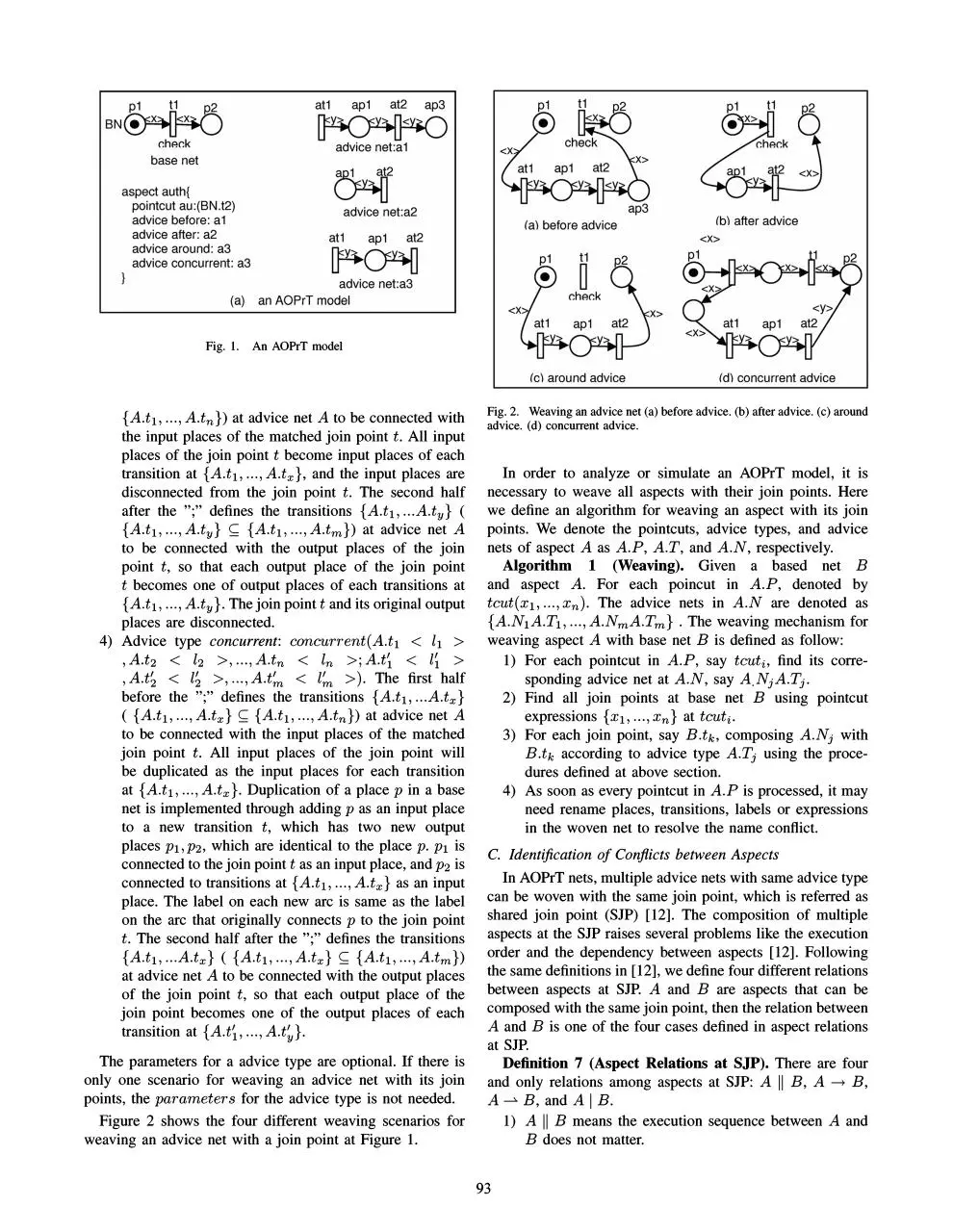
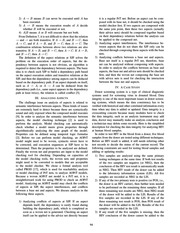
Figure 2 shows the four different weaving scenarios for
weaving an advice net with a join point at Figure 1.
after advice
~ c:hp.c:k
0
advice neta3
an AOPrT model
at1
Fig. l.
(b)
<x>
ap1
>.at2
around advice
Id) concurrent advice
Fig. 2. Weaving an advice net (a) before advice. (b) after advice. (c) around
advice . (d) concurrent advice .
In order to analyze or simulate an AOPrT model, it is
necessary to weave all aspects with their join points. Here
we define an algorithm for weaving an aspect with its join
points. We denote the pointcuts , advice types, and advice
nets of aspect A as A.P, A .T, and A .N, respectively.
Algorithm 1 (Weaving). Given a based net B
and aspect A. For each poincut in A.P, denoted by
tcut(Xl, ..., x n ) . The advice nets in A .N are denoted as
{A .NIA.Tl, ..., A.NmA.Tm} . The weaving mechanism for
weaving aspect A with base net B is defined as follow:
1) For each pointcut in A .P, say tcuu, find its corresponding advice net at A .N, say ANjA.Tj.
2) Find all join points at base net Busing pointcut
expressions {Xl, ...,xn } at tcut..
3) For each join point, say B .tk, composing A .Nj with
B .tk according to advice type A.Tj using the procedures defined at above section.
4) As soon as every pointcut in A.P is processed, it may
need rename places, transitions, labels or expressions
in the woven net to resolve the name conflict.
C. Identification of Conflicts between Aspects
In AOPrT nets, multiple advice nets with same advice type
can be woven with the same join point, which is referred as
shared join point (SJP) [12]. The composition of multiple
aspects at the SJP raises several problems like the execution
order and the dependency between aspects [12]. Following
the same definitions in [12], we define four different relations
between aspects at SJP. A and B are aspects that can be
composed with the same join point, then the relation between
A and B is one of the four cases defined in aspect relations
at SJP.
Definition 7 (Aspect Relations at SJP). There are four
and only relations among aspects at SJP: A II B , A ---. B ,
A ->. B, and A I B.
1) A II B means the execution sequence between A and
B does not matter.
93
�
2) A ---+ B means B can never be executed until A has
been executed.
3) A ~ B means the execution results of A decide
whether B will be executed or not.
4) AlB means A or B will execute but not both.
From Defintion 7, it is not difficult to show that the relation
---+ and ~ are both transitive. If A ---+ B, and B ---+ C, then
A ---+ C, and if A ~ B, and B ~ C, then A ~ C. The
combination relations between above two relations are also
transitive. If A ---+ B, and B ~ C, then A ~ C. If A ~ B,
and B ---+ C, then A ~ C.
The definition of the aspect relations at SJP solves the
problem on the execution order of aspects, but the dependency between aspects is not obvious, an algorithm is
required to detect the dependency between aspects. The basic
idea is to check each SJP to build a dependency path based
on the aspect execution orders and transitive relations at the
SJP, and then the dependency among aspects can be deduced
based on the dependency path. If an aspect depends on itself,
such as A ~ A, or A ---+ A can be deduced from the
dependency path (Le., same aspect appears in the dependency
path at least twice), the relation is called conflict [5].
III. ANALYZING ASPECTS
The challenge issue on analysis of aspects is related to
semantic interference between aspects. These kinds of issues
are extremely hard to detect because these are syntactically
sound and only exposed when the composed model executes
[9]. In order to analyze the semantic interference between
aspects, the model checking technique [2] is used to
perform the analysis. Model checking can automatically
check whether a model meets given properties through
algorithmically analyzing the state graph of the model.
Properties can be defined using temporal logic formulas
[2]. Before we can perform model checking, an AOPrT
model might need to be woven, syntactic errors have to
be corrected, and execution sequences at SJP have to be
determined. Then the properties to be analyzed are defined.
Finally the woven net and properties are input to the model
checking tool for checking. Depending on capacities of
the model checking tools, the woven nets and properties
might need to be converted to models that are acceptable
to the model checker. We chose a formal analysis tool
called PROD [17], which is used for reachability analysis
or model checking of PrT nets, to analyze AOPrT models.
Because a woven AOPrT net model is a PrT net, it is a
straightforward work for using PROD to check an AOPrT
model. Analyzing an AOPrT model may check the conflicts
of aspects at SJP, the aspect interferences, and conflicts
between a base net and aspects. We discuss analysis in the
following three aspects.
1) Analyzing conflicts of aspects at SJP. If an aspect
depends itself, the dependency is easily found during
building the dependency path, which is completed as
soon as a woven net is generated. Checking an aspect
itself can be applied to the advice net directly because
it is a regular PrT net. Before an aspect can be composed with its base net, it should be checked using the
model checker first. If two aspects are composed with
the same join point, then these two aspects (actually
their advice nets) should be composed together based
on their dependency relations before the analysis can
be applied to the composed net.
2) Analyzing aspect interferences. The interference between aspects that do not share the SJP only can be
checked through composing these aspects with the base
nets.
3) Analyzing conflicts between a base net and aspects.
Base net itself is a regular PrT net, therefore, base
net can be analyzed without composing with aspects.
In order to analyze the conflicts between an base and
aspects, the base net and advice nets should be checked
first, and then the woven net composing the base net
with advice nets is used for checking the interaction
between the base net and aspects.
IV. A CASE STUDY
Donor screening system is a type of clinical diagnostic
systems used for screening virus in donated blood. Data
integrity is one of the most important issues in donor screening systems, which means the data consistency has to be
verified with historical and other correlated information every
time when any data is added or updated. Data integrity is a
crosscutting concern because many modules have to check
the data integrity, such as an analysis instrument may add
data, doctor may manually make an analysis conclusion and
a technician may delete some records. Here is the simplified
description for checking the data integrity for analyzing HIV
at human blood samples.
In order to test HIV in the blood from a donor, five blood
samples from the donor are tested using different techniques.
Before an HIV result is added, it still needs referring other
test records to decide the status of the current record. The
following constraints are used for testing blood samples and
adding or updating results:
1) Two samples are analyzed using the same primary
testing techniques at the same time. If both test results
of the two samples are negative (or NEG), then the
conclusion of the HIV test result is automatically made
as NEG. Then HIV result of the donor can be added
to the laboratory information system (LIS). All five
samples are recorded as NEG in the LIS.
2) If any of the two primary tests is positive (or POS, Le.,
the donor is an HIV carrier), then further tests needed
to be performed on the remaining three samples. If all
three remaining test results are NEG, then NEG result
of the donor will be added to the LIS. Results of the
five samples are recorded in the LIS. If any of the
three remaining test result is POS, then POS result of
the donor will be added to the LIS. Results of the five
samples are recorded in the LIS.
3) If any result of the five samples is missing, then the
HIV conclusion of the donor cannot be added to the
94
�
BN
p
(a)
t2
Base net
Aspect integ{
pointcut di:(BN.t1 , BN.t2)
advice after:di
)
(b)
Advice net
A woven net
Fig. 4.
Fig. 3. An AOPrT model (a) adding or modifying data (base net). (b)
checking data integrity (aspect).
symbols
< c,e, d
LIS.
4) Each HIV record for a donor has a status value. Before
a new HIV record can be added to the LIS, the system
checks whether the donor has previous HIV records in
the LIS. If the donor has not a previous HIV record ,
the status of the record is flagged as status 1, which
means the blood cannot be used for transfusion to other
patients . If the donor has a POS result , then the record
is flagged as status -1, which means the donor will
not be selected in the future. If the donor has a NEG
record , the status of the current record is flagged as 0,
which means the blood can be used for transfusion.
5) Deleting one HIV record of a donor in the LIS may
affect the status of other records of the same donor,
such as there are only two records for one donor in the
LIS, if one of them is deleted, then status of the left
record cannot be because the historical information
of this record is missing (If it is 0, then it has to be
updated to 1).
6) Above data integrity checking is also applied for
modifying results.
°
A. Modeling Aspects using AOPrT Nets
We model the data integrity checking as an aspect using
AOPrT nets. We model a scenario that a technician is adding
or modifying HIV results in the LIS, which has to satisfy the
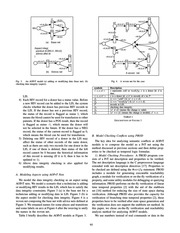
data integrity constraints. Figure 3 (a) is the base net for a
technician adding or modifying data in LIS. Figure 3 (b) is
the aspect model for checking data integrity. Figure 4 is a
woven net composing the base net with advice nets defined at
Figure 3. We renamed names for some places and transitions
and some labels on arcs at Figure 4 after the weaving to unify
the names in the woven net.
Table I briefly describes the AOPrT models at Figure 3.
>
< e.sts >
!l
h
P
h
f4
f5
t8
A woven net for the case
Description
c represents add or modify; e is a donor id; d is
data.
e is a donor id; s] S is records of e in P .
(c-- "add")&(s -s+d) .
(c - - " modify" ) & (s - s + d) .
records at LIS.
checking data integrity.
(s i' 4» (means the change is valid).
(s - - 4» (means the change is invalid); s - s.
TABLE I
DESCRIPTION OF FIGURE
3
B. Model Checking Conflicts using PROD
The key idea for analyzing semantic conflicts at AOPrT
models is to compose the model as a PrT net using the
method discussed at previous sections and then define properties to be checked as temporal logic formulae.
1) Model Checking Procedures: A PROD program consists of a PrT net description and properties to be verified.
The net description language is the C preprocessor language
extended with net description directives [17]. Properties to
be checked are defined using the #ver ify statement. PROD
includes a module for generating executable reachability
graph, a module for verification or on-the-fly verification of a
property, and some utility modules for debugging or querying
information. PROD performs on-the-fly verification of linear
time temporal properties [2] with the aid of the stubborn
set [16] method for reducing the size of state space during
verification. Although PROD also provides the capacity for
verification of branching time temporal properties [2], these
properties have to be verified after state space generation and
the verification does not support the stubborn set method. In
this paper, we chose on-the-fly verification and reach ability
analysis method for analyzing AOPrT models.
We use numbers instead of real commands or data in the
95
�
PROD program to reduce the complexity of the program but
it still well illustrates the analysis approach.
2) Model Checking the Properties: We performed reachability analysis and on-the-fly verification of the model
at Figure 4, which is composed with the data integrity
aspect and the base net used for adding or modifying donor
information. In the reachability analysis, we checked the
deadlock and livelock properties using the tester approach in
PROD. We checked composition or system properties using
the on-the-fly verification approach.
1. The model is deadlock-free after aspects were woven
with the join points. The following codes in the PROD net
description is used to check the deadlock-free property.
#place tester 10 «. 0 . » hi (« , 1 . » mk « 0 »
..
#tester tester deadlock«.O.»
semantic conflicts, execution orders and dependency among
aspects.
The property is verified as true.
4. Modifying donor data will be completed with success
if the data integrity is not violated, or failure if the data
integrity is violated. We perform the on-the-fly verification
on the woven net through defining the property as a linear
temporal logic formula at verify section in the PROD net
description:
Many AOSD modeling approaches are based on UML
such as work at [15] and [6], which extended UML notations
with AOSD mechanisms especially the linguistic constructs
from AspectJ such as aspects and pointcuts. Although UMLbased AOSD modeling provides a nice solution for general
developers to modeling crosscutting concerns, formal analysis of UML-based models is challenge due to the informal
nature of UML. In [19], PrT nets were extended with AOP
facilities for modeling security concerns. However, concern
conflicts at SJP were not considered in the work. Our work
refers to the work at [19], but our work simplified pointcuts in
the modeling language (one type of pointcuts instead of three
types of pointcuts) so that the composing aspects with base
nets are more feasible. In our work, the weaving algorithm
has general meaning so that composing complex advice
nets with base nets is possible thanks to the introduction
of four different advice types. In addition, concern conflicts
were resolved in our work through modeling the interference
among aspects. Our work provides an automated solution for
C. Discussion
Although modeling checking has been widely used for
analyzing systems with finite states [2], researches on modeling checking aspect-oriented systems are still rare due to
complexity caused by crosscutting nature of this type of
systems [14] [10] [18]. There are two key issues for model
checking an AOSD design: (1). How to specify an AOSD
design. Because modeling checking is a formal analysis
method, the gap between model checking and modeling
is minimal if we model an AOSD design using a formal
language. However, formal specification of an AOSD system
is a fairly challenge task to many software developers.
Therefore, many researchers prefer modeling systems using
First, we generate the executable reachability graph, and a non-formal language such as UML, and then transforming
then run the executable graph to check the deadlock-free the model into a model that is acceptable by a model
property. The model is deadlock-free. We also can check the checker. During the transformation, it is difficult to guarantee
the semantic consistency between the two models. In this
reachability graph information using the Probe utility.
2. The model is livelock-free after aspects are woven paper, an AOSD system is directly modeled using the formal
with the join points. The following codes in the PROD net language AOPrT nets, and model checking is directly applied
description is used to check the livelock-free property.
to AOPrT models. (2). How to check an AOSD model. One
#place tester 10 «. 0 . » hi «. 1 . » mk « 0 » way is to check an AOSD model using an existing model
..
checker, and then the AOSD model has to be pre-processed
#tester tester livelock«.l.»
before it can be checked. The pre-processing includes tasks
such as weaving aspects with join points, resolving aspect
The model is livelock-free.
3. Adding donor data will be completed with success execution orders at SJP. Weaving aspects, resolving conflicts
if the data integrity is not violated, or failure if the data or aspect dependency is complex, therefore, approaches for
integrity is violated. We perform the on-the-fly verification automatically pre-processing AOSD model is critical imporon the woven net through defining the property as a linear tant for model checking an AOSD system. In this paper, we
temporal logic formula at verify section in the PROD net proposed ways on how to pre-process an AOPrT model for
model checking or analysis. The second way is to model
description:
check an AOSD model directly, then a new model checker
may have to be built. We chose PROD for model checking
#verify (pl==<.O,O,l.> and p==<.O,O.»
AOPrT models because PROD can check PrT nets directly.
implies (eventually (p4 ==<.0,1,1.> or
p4 == <.0,0,1.»);
v. RELATED WORK
#verify (pl==<.l,l,l.> and p==<.l,l.»
implies (eventually (p3 ==<.1,1,1.> or
p4 == <.1,0,1.»);
The property is verified as true.
Through analyzing the reachability graph, we fixed some
errors in the original PROD net description program for
the net at Figure 4. Through changing the statement at
tester or verify in the net description, we can verify other
properties as well. Based on above analysis, we conclude
model checking is an effective and easy way for analyzing
96
�
analysis of AOSD design specifications, but the solution was
not at [19].
Formal proof, testing, simulation and model checking
have all been tried for checking AOSD designs or programs. But most analysis approaches were applied to aspectoriented programs. Krishnamurthi and Fisler developed some
theoretical work at [10] on incrementally model checking
aspect-oriented programs, and the work can be extended
for model checking AOSD design specifications. In [18],
Xu developed an approach for model checking state-based
specification of AOSD design. In order to model check
a design specification, an AOSD state model has to be
converted into the input model of a model checker. Sihman
[14] discussed an approach for model checking an aspectoriented program, where the model checking input was
automatically generated. Model checker SPIN was used for
model-checking a concurrency control aspect at [4], where
the AOSD models had to be manually converted into the
input programs of SPIN. Model checking at above work was
applied to programs directly or model checking was applied
to a design model indirectly via transforming the design
model into a model that can be accepted by a model checker.
However, model checking programs may easily suffer the
state space explosion issue. In addition, indirectly checking
AOSD design specifications also has some problems due to
the transformation from design specifications to input models
of model checking. Not only converting an AOSD design
model into an input model of a model checker is challenge,
but also the conformance between the two models is an issue.
In our work, the formal modeling language with graphic
notations is easy to use for modeling software design, and the
model checking is directly applied to design specifications
so that converting models is not necessary.
VI. SUMMARY AND FUTURE WORK
AOSD aims at improving the identification, separation
and modularity of concerns especially crosscutting concerns
in software. Formal specification and analysis of crosscutting concerns is highly effective for assuring the quality
of software design. In this paper, we developed a formal
approach for modeling and analyzing AOSD design specifications. Crosscutting concerns are separated and modularized
as aspects, and software is modeled using AOPrT nets,
which are an extension of PrT nets with aspect concepts.
System properties and interference among aspects in AOPrT
models are formally analyzed using the model checking
and reachability analysis tool PROD. To experiment our
approach, we modeled a clinical diagnostic algorithm using
AOPrT nets, and successfully analyzed the AOPrT models.
In conclusion, our approach is a powerful and practical
solution for modeling and analyzing crosscutting concerns in
software. In the future, we are going to extend our approach
for modeling and analyzing software requirements.
VII. ACKNOWLEDGMENTS
This work is supported by Title ITI grant under awards
P031B085057-08. The authors gratefully acknowledge the
contribution of National Research Organization and reviewers' comments.
REFERENCES
[1] G. Booch, R. A. Maksimchuk, M. W. Engel, and B. J. Young. ObjectOriented Analysis and Design with Applications (3rd Ed.). AddisonWesley, 2007.
[2] E. Clarke, O. Grumberg, and D. Peled. Model Checking. MIT Press,
Cambridge, MA, 2000.
[3] A. Colyer, A. Clement, G. Harley, and M. Webster. Eclipse Aspect]:
Aspect-Oriented Programming with Aspect] and the Eclipse Aspect]
Development Tools. Addison Wesley, 2004.
[4] G. Denaro and M. Monga. An experience on verification of aspect
properties. In IWPSE '01: Proc. ofthe 4th Int. Workshop on Principles
of Software Evolution, pages 186-189, 2001.
[5] R. Douence, P. Fradet, and M. Sudholt. Composition, reuse and
interaction analysis of stateful aspects. In Proc. of 3rd Int. Conf. on
Aspect-Oriented Software Development, pages 141 - 150, Lancaster,
UK, March 2004.
[6] L. Fuentes and P. Sanchez. Towards executable aspect-oriented uml
models. In AOM '07: Proc. of the 10th into workshop on Aspectoriented modeling, pages 28-34, 2007.
[7] W. Havinga, I. Nagy, L. Bergmans, and M. Aksit. A graph based
approach to modeling and detecting composition conflicts related to
introductions. In Proc. of 6th Int. Conf. on Aspect-Oriented Software
Development, pages 85 - 95, Vancouver, Canada, 2007.
[8] X. He and T. Murata. High-Level Petri Nets - Extensions, Analysis, and
Applications. Electrical Engineering Handbook (ed. Wai-Kai Chen).
Elsevier Academic Press, 2005.
[9] ir. P.E.A. Durr, if. T. Staijen, D. L. Bergmans, and P. M. Aksit.
Reasoning about semantic conflicts between aspects. In EIWAS 2005:
2nd European Interactive Workshop on Aspects in Software, 2005.
[10] S. Krishnamurthi and K. Fisler. Foundations of incremental aspect
model-checking. ACM Trans. Softw. Eng. Methodol., 16(2):7,2007.
[11] T. Murata. Petri nets: Properties, analysis and applications. In
Proceedings of the IEEE, volume 77, pages 541-580, Apr. 1989.
[12] I. Nagy, L. Bergmans, and M. Aksit. Composing aspects at shared
join points. In Proc. of Int. Conf. Net.ObjectDays (NODe), pages 19
- 38, Erfurt, Germany, 2005.
[13] M. P. Robillard and G. C. Murphy. Representing concerns in source
code. ACM Trans. Softw. Eng. Methodol., 16(1):3, 2007.
[14] M. Sihman and S. Katz. Model checking applications of aspects and
superimpositions. In Foundations of Aspect-Oriented Lang., pages 51
- 60,2003.
[15] D. Stein, S. Hanenberg, and R. Unland. A uml-based aspect-oriented
design notation for aspectj. In AOSD '02: Proc. of the 1st into conf.
on Aspect-oriented software development, pages 106-112, 2002.
[16] A. Valmari. On-the-fly verification with stubborn sets. In CAV '93:
Proc. of the 5th Int. Conf. on Computer Aided Verification, pages 397408, London, UK, 1993. Springer-Verlag.
[17] K. Varpaaniemi, J. Halme, K. Hiekkanen, and T. Pyssysalo. Prod
reference manual. Technical report, Helsinki University of Technology,
Dept. of Computer Science and Eng., Digital Systems Lab., 1995.
[18] D. Xu, I. Alsmadi, and W. Xu. Model checking aspect-oriented
design specification. Computer Software and Applications Conference,
Annual International, 1:491-500, 2007.
[19] D. Xu and K. E. Nygard. Threat-driven modeling and verification
of secure software using aspect-oriented petri nets. IEEE Trans. on
Software Eng., 32(4):265 -278, 2006.
97
�
 Historical archive . public document