The Chemistry
of
Life
Part II
�
Biological Molecules
Carbon is the most important
element to living things
Why is the carbon backbone
present in all of the biological
molecules?
�
Carbon
Has 4 electrons in its outer energy level
Can form covalent bonds with up to 4 other atoms
Can form chains or rings with single, double, or
triple bonds
�
Monomers and Polymers
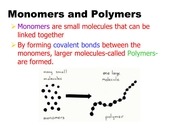
Monomers are small molecules that can be
linked together
By forming covalent bonds between the
monomers, larger molecules-called Polymersare formed.
�
4 Types of Monomers
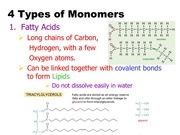
1. Fatty Acids
Long chains of Carbon,
Hydrogen, with a few
Oxygen atoms.
Can be linked together with covalent bonds
to form Lipids
Do not dissolve easily in water
�
Examples of Lipids
Oil made by plants for energy
storage
Fat made by animals for energy storage,
protection and insulation.
Phospholipids found in the membranes of all
cells
�
4 Types of Monomers (cont.)
2. Sugars- monosaccharides
Short chains or rings
Carbon, Hydrogen and Oxygen in the ratio
of (CH2O)n Ex. Glucose C6H12O6
Can be linked together with covalent bonds
to form a Disaccharide (2 sugars) or
Polysaccharide (many sugars) aka
Carbohydrate
�
Examples of Carbohydrates
Starch in plants for energy
storage
Glycogen in animal muscle and
liver for energy storage
Cellulose provides support for
plant cell walls
�
Examples of Carbohydrates
Chitin for support and protection
in the exoskeleton of insects and
crustaceans
Small sugars such as glucose,
sucrose, fructose and lactose for
energy storage
�
 Historical archive . public document