P.O.D.
Training For The Mission
ANNUAL TRAINING 2011
P
Prreep
paarriin
ngg F
Fo
orr B
Baassiicc E
En
nttrryy L
Leevveell T
Trraaiin
niin
ngg
OHMR’s NEW HOME
M
Mo
ovviin
ngg IIn
nA
Att H
Haau
ub
baacch
hA
Arrm
mo
orryy
�
OHIO’s OWN Fall 2011
From the desk of
MSgt Gary Kiser
Editor Ohio’s Own
I have been a member of the Ohio Military
OHIO’s OWN
FALL 2011
OHIO’s OWN is the official magazine of
the Ohio Military Reserve and is published
quarterly by the OHMR Recruiting &
Retention Section and approved by the
Public Information Officer, 1st Civil Support &
Sustainment Brigade, Ohio Military Reserve
at Columbus Ohio.
MISSION
STATEMENT:
To
provide
members of the Ohio Military Reserve their
families and citizens of Ohio with timely and
accurate command information, increase
awareness of the mission of the Ohio Military
Reserve and present the stories of individual
soldiers which highlight their diversity,
dedication to duty and service to the State of
Ohio.
MAJ Deano McNeil
OHMR Recruiting & Retention Manager
MAJ Sarah Reeseman
OHMR Public Information Officer
CPT Charles Glass
Supervising Editor
MSG Gary Kiser
Editor
Headquarters Ohio Military Reserve
Attn: Public Information Officer
4094 Sullivant Ave Columbus, Ohio 43228
Reserve since 2007, having come from a 21 year career
with the Ohio Army National Guard and feeling that tug
that came from time to time to slip back into uniform and
continue serving. Because I have a devoted Wife, a 12
year Army veteran herself, and a supportive family I
consider myself very fortunate to have made such an
easy transition from one branch to another. Others I
have found have not been as fortunate. Being a member
of such a unique organization that I consider an “elite”
force of well trained specialists, takes a special kind of
person with a dependence on those family members
that can make or break a decision to serve. We often
make the mistake that the decision to join is based
solely on our individual desire to serve and that we
alone are making the sacrifice. Nothing could be
further from the truth.
Spouses, parents, children and extended family
members have long been part of such a unique
organization. Our rank and file statistics bear out that
our soldiers are mainly comprised of individuals that are
established in their careers, well educated with an
average age of about 35 years old. Even with the overall
make-up of our members as a mature force, the
instance of NOT including our families has had a
detrimental effect on our retention and in turn requires
us to commit resources that should be focused on our
mission. Our Brothers and Sisters in the National Guard
discovered this years ago and as a result have a robust
and active relationship with the family members that wait
at home while we train.
Ohio’s Own Magazine is an ideal platform to
introduce the Ohio Military Reserve to your family and
shows them what we do and that they have a right to be
proud of you for serving, just as much as you take great
pride in your service. I encourage all of our faithful
readers to share this valuable resource with friends and
family and encourage them to ask questions. Perhaps
invite them to drill or annual training to experience for
themselves that the Ohio Military Reserve is truly an
elite group of individuals training collectively for a very
important mission.
Page 1
�
OHIO’s OWN Fall 2011
Annual Training 2011
““M
Ma
ak
kee ssu
urree tth
heey
y’’v
vee g
go
ott tth
heeiirr b
bo
oo
ottss b
brro
ok
keen
n iin
n…
…””
--SSeerrggeeaanntt M
Maajjoorr TTiim
mH
Hoollllyy
Sergeant Major Tim Holly, the non-commissioned officer
in charge (NCOIC) of the OHMR Academy, marches the
three elements of the Academy during Annual Training at
Camp Perry Training Site in Port Clinton.
Story & Photos by Cpt Jim Nowak
They’ve seen the movies and heard
the stories about that rite of passage known as
“basic training,” which trains civilians to
become soldiers. Annual Training 2011 (AT11),
doesn‟t have 20 mile hikes in full battle-rattle,
“Drop and give me 20!” or grueling obstacle
courses, but to the new OHMR recruit, the
prospect of basic training may still seem
intimidating.
As a volunteer force unpaid for training, OHMR
recruits cannot realistically dedicate weeks to
exclusive immersion in the military culture. Still,
for a week at Camp Perry, OH, they will learn
the basic soldiering skills to give them the
foundations on which their careers as
members of the State Guard will be built.
Sergeant Major Tim Holly, the noncommissioned officer in charge (NCOIC) of the
OHMR Academy has been instrumental in
crafting and implementing many of the
Academy courses. OHMR training has been
condensed but still strictly follows U.S. Army
training guidelines, something Holly can fairly
judge since he served as a Drill Instructor
during his time in the U.S. Army.
Holly says the Army coursework is adapted to
OHMR‟s mission and “...uses the same Points
of Instruction (POI) minus about 25% that do
not apply because they are relating to combat
operations.” Once an OHMR recruit graduates
from BELT, military occupational specialty
(MOS) training is done at battalion level.
When asked why BELT or other military
development courses aren‟t handled at each
soldier‟s home unit, Holly explained that the
decision is based on the Army‟s experience.
“Being out of a familiar environment helps focus
troops‟ attention on their training” He says
Page 2
Cont’d on Page 6
�
OHIO’s OWN Fall 2011
A Creative Approach to
Physical Training
By Specialist Robert Bell
When
I was appointed Bravo Company‟s PT
instructor, I was challenged with developing a program that
follows the Army PT manual FM 21-20 but which also
makes PT fun and challenging to each and every soldier. As
I have learned, preparation along with different routines
keeps the attention of those you are instructing. Another
challenge is learning how to issue the PT commands as the
instructor.
Recently those personnel in Bravo Company that took their
annual PT test, 14 in total, fully passed the OHMR standard.
Three of those troops had scores ranging from 60% to 80%
of the U.S. Army standard, consisting on average of 60
push-ups, 50 sit-ups, and a 2 mile run in 16 minutes or less.
This is a great achievement on all levels since a fit soldier
is an asset to the OHMR and its mission. A good example
of a PT routine is to start with just stretching exercises.
Then add one exercise at a time, such as push-ups or situps. If everyone can handle more then add more, but move
as a team. Start off with 20 minutes then add 10 minutes to
the routine until you reach the full hour. Also, find
supplemental exercises to handout to everyone to practice
by themselves a couple of times each week. The internet is
a wonderful tool for this.
Officer Candidate Greg Davda lines up to receive a pass while Cpl Tim
Chaykowski guards Pvt Eric Jagusch
Page 3
Cpl Tim Chaykowski prepares for a forward pass during a
nd
game of flag football for Bravo Company 2 Civil Support
Battalions July drill while SSgt Charles Bell serves as the
referee
I had to start our routines as informal instruction
and at everyone‟s own pace with timed sets. As
the months rolled on and I became better at
calling PT, we began to perform our routines
formally in cadence and as one team. As the PT
instructor for Bravo Company, I am proud of
each soldier, their accomplishments and their
dedication. As an alternative to formal PT and to
change up our routine, we played flag football
as our fitness requirement for the July drill. This
is a great team building activity and opportunity
for comradeship between troopers. As with all
competitive training, be sure to lay down the
rules beforehand in order to decrease the risk of
injury. Other competitions could consist of pushup and sit-up derbies between sections. Unit
Olympics is another possible idea. There are
several examples listed in the Army FM21-20. If
you are tasked with leading PT remember to
listen to the troops you are instructing. Take
their input and build on your routine. Change it
up to keep them interested. Be challenging with
your routine and always have your medic check
each soldier in order to clear him or her for any
PT beyond basic stretching. PT can be fun and
Cont’d
on Page
7
challenging. You will have better
results
if you
keep it that way.
�
OHIO’s OWN Fall 2011
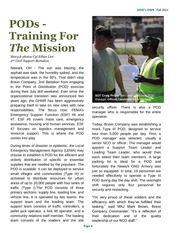
PODs Training For
The Mission
Story & photos Cpl Ethan List
2nd Civil Support Battalion
Newark, OH - The sun was blazing, the
asphalt was dark, the humidity spiked, and the
temperature was in the 90's. That didn't stop
Bravo Company, 2nd Battalion from engaging
in the Point of Distribution (POD) exercise
during their July drill weekend. Ever since the
organizational transition was announced two
years ago, the OHMR has been aggressively
preparing itself to take on new roles with new
responsibilities. The focus now: FEMA's
Emergency Support Function (ESF) #6 and
#7. ESF #6 covers mass care, emergency
assistance, housing and human services. ESF
#7 focuses on logistics management and
resource support. This is where the POD
comes into play
During times of disaster or epidemic, the Local
Emergency Management Agency (LEMA) may
choose to establish a POD for the efficient and
orderly distribution of specific or essential
supplies that are needed by the populace. The
POD is scalable. It can be deployed to service
small villages and communities (Type III) or
activated to distribute resources for urban
areas of up to 20,000 people with four lanes of
traffic (Type I).The POD consists of three
primary sections: supply line, loading line, and
vehicle line. It is operated by two teams: the
support team and the loading team. The
support team consists of traffic controllers, a
pallet jack operator, a fork lift operator, and a
community relations staff member. The loading
team consists of the loaders and the site
SGT Craig Proper gets instruction from POD
Manager Officer Candidate Dino Herbert
security officer. There is also a POD
manager who is responsible for the entire
operation.
Today, Bravo Company was establishing a
mock Type III POD, designed to service
less than 5,000 people per day. First, a
POD manager was selected, usually a
senior NCO or officer. The manager would
appoint a Support Team Leader and
Loading Team Leader, who would then
each select their team members. A large
parking lot is ideal for a POD and
fortunately the Newark ONG Armory was
just so equipped. In total, 19 personnel are
needed effectively to operate a Type III
POD during day the day shift. The overnight
shift requires only four personnel for
security and restocking.
“I‟m very proud of these soldiers and the
efficiency with which they‟ve fulfilled their
tasking,” said MAJ Mark Brown, Bravo
Company Commander. “It‟s a reflection of
their dedication and of the quality
leadership of our NCO staff.”
Page 4
�
OHIO’s OWN Fall 2011
Home
Sweet
Armory
Cont’d on Page 7
T
Th
hee O
Oh
hiio
oM
Miilliittaarryy R
Reesseerrvvee
S
Seettttlleess IIn
ntto
o IIttss N
Neew
wF
Faacciilliittyy
SSttoorryy &
&P
Ph
hoottooss bbyy C
Cpptt JJiim
mN
Noow
waakk
There
was the usual packing, organizing and sorting as the Ohio Military
Reserve Headquarters permanently shifted from the Rickenbacker Air National
Guard base to Haubuch Armory in Columbus, OH.
After working in the tight quarters of Rickenbacker, the unobtrusive but orderly armory looked
spacious. OHMR Chief of Staff COL John Fair put it simply, “This is our new home.”
Haubuch Armory‟s basement was cleaned and repainted by the State in preparation for permanent
occupancy. The facility at Haubuch affords more room for OHMR than was available at Rickenbacker.
Eventually, the plan is for the entire facility to be OHMR‟s, but that will be an eventual transition.
“We‟re sharing it right now with the (Ohio Army National Guard) 134th Field Artillery,” explained Fair.
“They‟re going to be moving out at some point, being deployed, but they are also coming back. So
there will be a few years before we actually get complete control from the Army.” Fair recognized
Brigadier General Jack E. Lee, (Ret.), now Facility Manager at Beightler Armory, for his efforts in
moving OHMR to the new location.
Fair believes that having the permanent, strategically-located home in the Armory will be valuable to
all OHMR troops. When asked what this means to the average soldier, he cited stability. “I think that
they‟ll know they have a headquarters,” remarked Fair. “Once we get more established here, we‟ll be
able to do more things. We are in the central portion of the state and we might be able to draw more
Page 5
Cont’d on Page 9
�
OHIO’s OWN Fall 2011
Annual Training 2011 cont’d from page 2
soldiers taking critical courses at home
stations “...miss the dynamics of being in a
separate environment with people taking the
same course, particularly the leadership
course. That lets them participate with a wide
variety of people on the same level and in the
same position that they‟re in.”
To illustrate the effectiveness of Academy
training, Holly remembered what happened at
last year‟s annual training. The BELT &
Primary Leadership Development Course
(PLDC) students were injected into the Squad
Training Exercise (STX), which is conducted
in the field. Tasks were passed down through
the chain of command, as they should be,
allowing students to see the system in
operation. Holly says this allowed students to
dramatically “see how I, personally, will be
individually involved in this exercise. We had
the BELT people, who were brand-new to
OHMR and knew nothing about the military
come back and say, „Oh my God, If we had
known OHMR was like this, we would have
joined much, much sooner. We would have
been much more enthusiastic.‟”
As troops prepare for BELT at AT11, OHMR
Academy Instructor First Sergeant Ron
Meyers predicts a worthwhile event. “They will
be in for an experience that they have never
had before. It‟s a great experience, especially
for a young person who has never done
anything like this before. We try to stay as
military-oriented as possible. And working as
a team. That‟s the whole concept, is being a
team member.”
Holly added some words of wisdom, “Be open
minded. Buy into group dynamics. You‟ll be
spoken to in a very authoritative manner.
Don‟t come in with a chip on your shoulder.
Leave your feelings at home. Do that with an
open mind and you‟ll have an experience
you‟ll be talking about when you‟re 65 or 70
years old.”
Honor Graduates of the Primary Leadership
Development Course and Basic Entry Level
Training receive congratulations from the
Commanding General of the Ohio Military
Reserve during a ceremony at Camp Perry.
Academy training to his own civilian experience
of taking a Dale Carnegie course. “OHMR troops
get this kind of training for free. It‟s an entry-level
opportunity to leadership courses.”
When asked for one key bit of advice he would
give BELT students, Holly emphatically
cautioned, “Make sure they‟ve got their boots
broken in. The biggest issue is the boots, the
marching. We have so many people who come
to annual training that are not prepared - I mean
we don‟t march that far. Eight miles in 4 days.
But we have blister issues and stress fracture
issues. They need to have at least 20 hours in
their boots already.”
The Academy will concurrently run BELT, PLDC
and Basic Officers Course (BOC) training during
AT11.
He adds that the benefits will spill into many
soldiers‟ personal lives and compared the
Page 6
�
OHIO’s OWN Fall 2011
Everybody Trains
Story & Photos by Cpt Jim Nowak
You’ve heard about them; People in
charge who act like they‟re exempt from the
requirements
of
their
subordinates.
Fortunately, that‟s not the case in the Ohio
Military Reserve because from staff officers
to buck privates, everybody in OHMR trains
for the mission. That means everybody!
All OHMR soldiers train on ESF 6
(mass care) and ESF 7 (resource support.)
“When we are trained up on that and can
show that we can do that, just like every
military unit in the National Guard, we will be
deemed mission ready,” says Colonel
Wayne Woodall, Assistant Chief of Staff for
Plans, Operations & Training (G3). “This is
the mission given to us according to the
National Response Plan, which is being
coordinated by the National Guard in the
State of Ohio. From this it could morph into
other duties, depending on how well we
perform.” That‟s why, according to COL
Woodall, this training for all troops is so
critical. “We must all pull together to show
that we can accomplish our mission.”
In addition to planning training for
OHMR, headquarters‟ officers & enlisted
Cardiac arrest “victims” patiently await treatment during
First AID/ CPR/ AED training at OHMR headquarters
troops must also be trained themselves. At the July drill
in Columbus, for example, Headquarters and Medical
Detachment personnel were re-certified with First Aid,
CPR and AED training.
G3 must plan training for the brigade and be
certain to provide qualified instructors. There can be no
shortcuts. In an effort to insure standards compliance,
early in 2011 Lieutenant Colonel Michael Reeseman,
Deputy Commander of G3, deployed to the Center for
Domestic Preparedness (CDP) at Ft. McClellan in
Anniston, AL for a full week to attend the L449 Incident
Command System (ICS) Train-the-Trainer certification
course.
This broadens the training capabilities available to
OHMR, says Lieutenant Colonel Reeseman. “It gives us
more depth on the bench for boot-strapping up
instructors who are qualified to give certified Incident
Command training. It‟s a force multiplier.” That means
Page 7
Ohio Air National Guard Nurse 2nd
Lieutenant Suzanne Latch instructs Pvt
Ryan Griffin on applying proper chest
compressions to Lt. Col. (Ret.) James
Osborn
Cont’d on Page 9
�
OHIO’s OWN Fall 2011
Financial Readiness
Submitted by
Bruce G. Nieman AFC/ChFC
Personal Financial Education and Counseling
Family Readiness and Warrior Support
Ohio National Guard Joint Force Headquarters
‘Squared away’ is a term you frequently
hear when talking to service members. It means to
put in order. It can also mean to describe one
whose performance is even with or above
satisfactory level.
For guard and reservist this term takes on a whole
new meaning as they not only have to be „squared
away‟ with their equipment and training ready to
mobilize with little notice, but they also have to be
„squared away‟ at home. This would include their
personal finances. Poor financial management can
derail even the most „squared away‟ service
member. Losing one‟s security clearance, not
being permitted to deploy with their unit, being
passed over for promotions etc are just a few of
the problems poor financial management skills can
cause for service members.
It can also have ramifications in the soldier‟s
civilian life at home, and on the job. Stress, worry,
arguments with your spouse, or significant other,
being passed over for a job, or not qualifying for
certain professions can all be the result of not
managing and understanding your money.
This is not to say money trouble is always the
result of someone having poor money
management
skills.
Unemployment,
Underemployment either in the form of working
only part-time or taking a position paying
significantly less than you last position, health
issues, or a myriad of other factors can all
contribute to financial problems especially in
today‟s economic environment.
With proper
planning many of these situations can be avoided,
their financial impact lessened, or even rectified
with time. The Department of Defense has long
recognized the financial challenges military
members, and their families face. Military Saves
was developed and tested by its non-profit
sponsor, Consumer Federation of America (CFA)
and the military services from 2003 to 2006 and
launched throughout the Department of Defense in
2007. It is part of two larger campaigns – the DoD
Financial Readiness Campaign, and the national
America Saves Campaign. The purpose of the
campaign is to motivate military members, and
their families to save money every month, and to
encourage leadership to take the lead in
promoting automatic savings. The campaign is a
network of organizations, and individuals
committed to helping and supporting military
members, and their families build personal savings
arsenals to provide for their immediate and long
term financial needs.
Financial stability is about a lot more than
knowledge -- it takes consistent action over time.
Most of us do better when we have a supportive
environment. Military Saves is a campaign to
make every military community that supportive
environment. When enough military members, civil
servants, contractors, retirees, other veterans,
family members, military organizations, private
organizations, and companies belong to Military
Saves, the entire military culture will be
changed.While it is an ongoing campaign, the
entire military community comes together to focus
on financial readiness during Military Saves Week,
the last Sunday in February to the first Sunday in
March.
In a saving community, people encourage each
other to save money regularly and habitually. They
discourage
excessive
spending
on
nonnecessities. Financial institutions help people save
by offering incentives and other perks. Systems
change to favor saving over not saving.
Page 8
To learn more or sign up go to
www.militarysaves.org
�
OHIO’s OWN Fall 2011
Home Sweet Armory cont’d from page 5
support or communications lines now that
everyone knows there‟s a central place to go.
This will be more Army-like and should help
with recruiting and retention.” One hope is that
the OHMR Training Academy will be based at
Haubuch.
As reported previously in Ohio‟s Own, Ohio‟s
Adjutant General, Major General Deborah A.
Ashenhurst stopped by the Armory during
the move. She was matter-of-fact about the
armory being provided to OHMR. “It‟s the kind
of support you should expect. It‟s just another
brigade headquarters. That‟s what it is, so...
I‟m glad you got that kind of support.”
Everybody Trains cont’d from page 7
more troops can be correctly trained, insuring that
the training benchmarks are met.
All efforts are focused on emergency & disaster
response. COL Woodall says constant training lets
troops automatically respond correctly and swiftly,
without having to consult manuals or trying to
remember long-ago training. This saves precious
time when minutes can make the difference.
Ultimately, though, it‟s about helping people.
“In the scope of the whole picture in response to
national disasters or local disasters, it‟s an integral
part of all of them. You‟re helping the citizens of this
country and the State of Ohio, when they‟re down &
out, hurting for their loved ones and their property.”
Colonel Woodall commented he and the command
staff truly recognize the contributions made by
OHMR soldiers, understanding that time spent
training will translate into a critical time saving when
responding to a disaster. “Their work does not go
unnoticed. I want to personally thank them for their
expenditure of their time. That‟s one thing they can
never get back-- their time.”
Adjutant General
Authorizes Wear of TRU
Columbus- Major General Deborah
Ashenhurst has authorized the wear of
the Tactical Response
Uniform/woodland by all members of
the Ohio Military Reserve. The much
more practical TRU will replace the
BDU although no wear out date has
been announced. BDU and TRU
components (top & bottom) may not be
worn together. All other component
items such as caps, parka, poncho etc
are authorized for wear with the TRU.
In an order issued by Brig Gen Charles
Rowell, Commander of the OHMR
OHMR reg 670-1 will contain specific
instructions on the wear of the TRU and
will appear in the next regulation
revision. Your chain of command
continues to be your best source of
information concerning uniform wear.
COL Wayne Woodall, OHMR Assistant Chief of
Staff for Plans, Operations & Training (G3)
describes OHMR‟s Haubuck Armory office plans to
COL Scott White, Ohio Army National Guard Joint
Operations (J3)
Elements of the 3rd Infantry Division of the Ohio State Guard maneuver at Camp Hocking in 1942
Page 9
�
OHIO’s OWN Fall 2011
“Buckeye Bits”
A Historical Perspective
Photo’s courtesy of Ohio Military Reserve Historical Detachment
Cincinnati Home Guardsman Patrick Olvey (above) was
certainly familiar with the Home Guard Manual when this
picture was snapped in 1917. Supplying the troops with
uniforms has always been a concern of officers in the State
Guard as evidenced by this solicitation from a uniform
distributor (right). The “Order of the Bayonet” (below) was very
much part of drill at the onset of World War I
The caption (left) says it all in this 1942
snapshot of a member of Company G Third
Infantry Division of the Ohio State Guard
Page 10
�
�
 Historical archive . public document