Scientific Research and Essays Vol. 6(12), pp. 2494-2500, 18 June, 2011
Available online at http://www.academicjournals.org/SRE
ISSN 1992-2248 ©2011 Academic Journals
Full Length Research Paper
Web based secure e-voting system with fingerprint
authentication
Adem Alpaslan ALTUN1* and Metin BİLGİN2
1
Selcuk University, Technical Education Faculty, 42031, Konya, Turkey.
Selcuk University, Natural and Applied Sciences Institutes 42031, Konya, Turkey.
2
Accepted 23 May, 2011
The elections that are made by using traditional methods are no longer preferred because of the long
period of preparation, fake voting, faulty voting, mistakes made in counting the votes, long period of
counting and high cost of voting process. In order to avoid these disadvantages affecting directly the
economy and policy of the country, it is obligatory to carry the available voting system to an electronic
system. In this study, an electronic voting system, E-voting for a general election is developed and
fingerprint authentication based e-voting system is applied. As a result, security of the voting system is
greatly improved by using biometric authentication system.
Key words: Electronic voting, biometric systems, fingerprint, authentication, election.
INTRODUCTION
Nowadays, voting for general and local elections is done
by electors with voting papers and voting boxes in which
the voting papers are placed. This method reveals some
kinds of negative situations. Not been able to determine
which party the stamp belongs to, the probability of
placing the voting papers in wrong box, problems with
counting the votes, loss of time when there happens to
be some objections, paper printing and expenditures
done for personel are some of the disadvatages of
classical election system. The secret ballot is a fundamental instrument for protecting the freedom of choice of
voters. For this reason, it is necessary to use new
technologies for making the election system more
trustable, economic and faster.
Electronic election system is set into use in some
countries, especially in USA and Europe, at the beginning
of nineties as a result of innovating technology and it
became more trustable by improving itself at the present
*Corresponding author. E-mail: altun@selcuk.edu.tr. Tel: +90
332 2233355. Fax: +90 332 2412179.
day. Electronic voting is an activity of realising the voting
in electronic environment. Electronic election is a system
which enables fast counting by electronic voting.
Electronic voting is used in some countries in the world
and there are also studies about it (Babu and
Padmavathamma, 2006; El-qawasmeh and Owais, 2010;
Folorunso et al., 2005; Hajjar et al., 2006). Electronic
voting is used for parliamentary elections in Australia in
2001 (Schoen and Faas, 2005), for student union
elections in Austria in 2003 (Prosser et al., 2003), for
municipal elections in Canada in 2003 (Nakhaie, 2006),
for both general and local elections in India in 2003
(Gorla, 2009). As a result of developments on information
technologies in recent years, public opinion polls and
nation-wide general elections will be realized faster and
more effectively on electronic environment.
Nowadays, security problems are experienced with the
fast developing technology. Besides developing the
system, there are also so many studies and new methods
for solving the security problems of the developing
system. As a result of developing technology, individual
password is started to be used to meet the security
requirements. In time, new methods are developed and
�
Altun and Bilgin
card technologies are used due to closing the security
holes about burglary of the cards or forgetting the
individual passwords. Usage of the ID cards and Private
Identification Numbers (PIN) become widespread at card
technologies (Sonkamble et al., 2010; Alkan and Bulut,
2010). Researches on security and identification
operations according to physical characteristics are
realized due to limitations of this technology in time.
Biometric systems are the methods which make
identification of people according to their physical
characteristics. Biometric methods consist of fingerprint,
face, hand shape, retina, iris, and voice track methods
(Sonkamble et al., 2010; Kadry and Smaili, 2010; Razzak
et al., 2010). These methods may be used alone or
together in the developed systems.
Fingerprint recognition method and ID system in
biometric methods are frequently preferred because
applications of them are easy and low-cost (Maltoni et al.,
2009). Fingerprint recognition system is the leading
method because everyone has different fingerprints, can
not be changed easily and probability of loosing, forgeting
and stealing of it is impossible. Besides, every finger has
distinctive characteristics because fingerprints of every
finger of a person are different (Altun et al., 2008).
For this reason, fingerprint method is used mostly alone
or together with other biometric methods for providing
security of the systems. Fingerprint method is also used
for identification of the internet applications.
In this study, biometric election system is aimed instead
of traditional election systems. By developing the
deficiencies of the present system, biometric based
election system has been developed.
MATERIALS AND METHODS
Electronic voting
Electronic voting systems have to respect the constitutional election
principles. For technological solutions, this translates into security
requirements that have to be fulfilled by the operational
environment in which the voting takes place.
First study on electronic voting is patented as “Electronic VoteRegistering Apparatus” (US Patent 90.646) by Thomas Edison on
1st of June 1869 (Edison, 1869). Edison developed this invention
for using on congress elections (Roth, 1998). Computers are used
on counting of the votes for the first time on Punch Card system in
1964 (Fleischmann, 2009). Direct Recording Electronic Systems
(DRE) manufactured in 1980 is the first full computer based system.
DRE systems consist of buttons and areas on the touch screen.
Electors in the election area get a PIN or smart card by showing
their ID. They enter DRE machines by using PINs or smart cards.
Elector makes his or her choice and after that DRE machine shows
the choice on the screen and finally gives elector an oppurtunity to
change his or her choice. And as a result of this, DRE records the
vote accurately. Lever Machines are first used in New York
Elections in 1982. The interface in this system is arms related with
2495
the questions on voting paper or every island. People vote by
moving the proper arm in this system.
European Commision started the E-voting project on September
2010 for showing online elections, reality of which can be proved
(Trechsel and Mendez, 2005). Stable and mobile internet terminals
are used within the scope of this project. The Project includes
partners from industries, universities and potential users. First
experiment is done in a village in France on 11th of December
2002. 860 electors chose city council representatives on electronic
environment. Second test is done in Bremen Universty in Germany
on 13 to 15th of January 2003. In this application, universty council
is chosen by 47 electors on electronic environment. The last
experiment is done in Sweden by 226 old electors on July 2003.
Biometric methods and applications
It is necessary to provide security of the systems due to developing
technology. Securities of most of the systems are provided by
passwords, PINs and ID cards (Hajjar et al., 2006). In time, these
methods did not meet the security needs and searched for new
methods. For this reason, some researches are done for alternative
methods. Physical characteristics of people came up for providing
people to login the system by making identification and studies
about biometric methods are started (Monrose and Rubin, 1999).
Biometric methods provide identification by using specifications
such as fingerprints, face, hand shape, iris, retina, voice track and
signature. These specifications vary from person to person. By this
way, reliableness of the system is preferred according to the system
used.
Biometric solutions are generally client/server solutions, giving
system administrators the ability to audit usage, manage security
levels, and remove unauthorized users. These solutions are
emerging rapidly that allow deployers to integrate biometric
functionality into Web sites, replacing password authentication.
Biometric methods are used for verification or identification of a
person. On recognition and identification system, you give your
information to the system; the system brings your information in the
data base, makes one-to-one comparison and answers the “Do I
know you?” question. In verification, you claim to the system who
you are and the system tries to find if you are really the person you
claimed. There is comparision and the system tries to answer the
“Are you the persone you claimed?” question. Biometric classifycation is also the classification of the biometric incomes in similar
specifications. During the identification, classification makes
comparisons between conspectuses in the same group but not the
whole data base. This application saves performance.
RESULTS
In this study, a biometric based e-voting system is
designed for providing a secure election on electronic
environment for the electors. XSL language which is
compatible with Asp.Net, Framework 2.0, Java Script,
Xml is used in this system and it can also run with
Microsoft Windows operating system (Tubishat et al.,
2010; Cömert et al., 2010). Besides, biometric based
software libraries are also used for integrating the
fingerprint control to the system. The elector identification
�
2496
Sci. Res. Essays
Figure 1. General structure of fingerprint device programming.
system is programmed with C# language and equipped
with an optical fingerprint scanner SDK (Suprema Inc®)
to accept a scan, recognize the elector, and open the
correct elector record in the database and verify system
(Suprema, 2010). This module uses a dynamic link library
(DLL) that can be displayed in a web application as
shown in Figure 1.
This allows the electors’ biometric data to be read by a
web application and sent to a web service for verification.
All of the biometric logon modules have two parts: A web
application, which is a webpage with program logic
running behind it, for data collection and a web service
for verification. The e-voting web application is allowed to
interface with the physical biometric device but not the
database containing the enrolled user data, while the web
service can do the exact opposite. The following scenario
shows the flow of data between the web application and
the web service during a fingerprint logon.
Working principle of the system is as follows:
1. Election, party, candidate, region, street, polling clerk
and village headman information is defined by system
administrator.
2. Electors’ information is recorded into the system with
their fingerprints by village headman.
3. System administrator starts the election on the day
determined before.
4. Polling clerk starts the election on the box within his or
her authorisation.
5. Elector comes to the box announced before and scans
the fingerprint for voting.
6. If the scanned fingerprint is not in the electors’
database, elector can not vote.
7. If the scanned fingerprint is in the electors’ database,
elector’s ID information is shown on the screen.
8. If there is no problem with the ID check, elector votes
by pressing on the vote button.
9. If elector voted before for the election in question, the
system warns about the situation. If elector has not voted
yet, the system brings the vote screen.
10. Elector votes for any party by pressing on the “YES”
button. Elector is warned as final step for preventing
misvoting by a message on the screen. If the elector
wants to continue voting, elector finishes voting by
pressing on the “YES” button.
11. If the elector tries to vote for the second time for the
election in question, the system does not allow this.
12. Then, election is finished by the system administrator.
13. Election results and statistical information can be
provided just after the election is finished.
�
Altun and Bilgin
2497
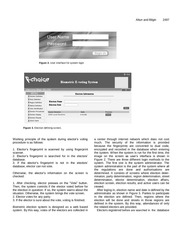
Figure 2. User interface for system login
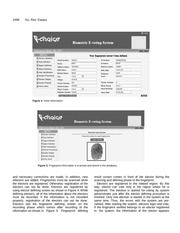
Figure 3. Election defining screen.
Working principle of the system during elector’s voting
procedure is as follows:
1. Elector’s fingerprint is scanned by using fingerprint
scanner.
2. Elector’s fingerprint is searched for in the electors’
database.
3. If the elector’s fingerprint is not in the electors’
database, elector can not vote.
Otherwise, the elector’s information on the screen is
checked:
1. After checking, elector presses on the “Vote” button.
Then, the system controls if the elector voted before for
the election in question. If so, the system warns about the
situation. Otherwise, the system brings the vote screen.
2. Elector votes for any party.
3. If the elector is sure about the vote, voting is finished.
Biometric election system is designed as a web based
system. By this way, votes of the electors are collected in
a center through internet network which does not cost
much. The security of the information is provided
because the fingerprints are converted to dual code,
encrypted and recorded in the database when entering
the system. When the system is run for the first time, the
image on the screen as user’s interface is shown in
Figure 2. There are three different login methods to the
system. The first one is the system administrator. The
system administration is the part of the system where all
the regulations are done and authorisations are
determined. It consists of screens where election determinaton, party determination, region determination, street
determination, elector determination, election affairs,
election screen, election results, and active users can be
viewed.
After loging in, election name and date is defined by the
administrator as shown in Figure 3. Parties to participate
in the election are defined. Then, regions where the
election will be done and streets in those regions are
defined in the system. By this way, attendances of only
the related electors are provided.
Electors registered before are searched in the database
�
2498
Sci. Res. Essays
Figure 4. Voter information.
Figure 5. Fingerprint information is scanned and stored in the database.
and necessary corrections are made. In addition, new
ellectors are added. Fingerprints must be scanned while
the electors are registered. Otherwise, registration of the
electors can not be done. Electors are registered by
using elector defining screen as shown in Figure 4. While
defining electors, all of the information about the electors
must be recorded. If the information is not recorded
properly, registration of the electors can not be done.
Electors see the fingerprint defining screen on the
recording phase which comes after recording of the
information as shown in Figure 5. Fingerprint defining
result screen comes in front of the elector during the
scanning and defining phase of the fingerprint.
Electors are registered to the related region. By this
way, elector can vote only in the region where he is
registered. The election is started for voting by system
administrator just after the elector defining procudure is
finished. Only one election is started in the system at the
same time. Thus, the errors with the system are prevented. After starting the system, electors login and vote.
If the fingerprint verified belongs to an elector registered
in the system, the information of the elector appears
�
Altun and Bilgin
2499
Figure 6. Parties list for voting.
Figure 7. The election results relevant to the region.
on the screen. Purpose of this application is identifiction
control by system administrator. Elector can vote by
pressing on the elector voting button just after authentication. Elector can vote clicking on the “YES” button of
the party that he/she chooses on the e-voting screen as
shown in Figure 6. After voting, a message appears on
the screen and voting procedure is completed for the
elector. Election results of any region or regions in any
time are observed by the system administrator. These
operations can be done on election results part of
system administrator window as shown in Figure 7.
DISCUSSION
Modern technology is used for elections and/or
referandums commonly. Number of the reseraches on
electronic election systems is increasing in recent years.
As a result of being in search of more efficient, more
trustable and faster election, different kinds of voting
�
2500
Sci. Res. Essays
boxes are manufactured and put into service of the
countries. Mercuri, MIT/Caltech and E-Vox are three of
these boxes.
Biometrics is also expected to be increasingly used in
conjuction with other technologies like the knowledgebased authentication (e.g. passwords and PIN) on the
Internet. In this study, user friendly electronic voting
system based on biometric verification is designed and
proposed. Thus, electronic voting boxes are offered
instead of voting boxes of the present election system.
The advantages of the e-voting system based on
biometric verification are as follows:
1. The number of the voting boxes decreases by using
biometric election system. The expenditures of the
elections decrease too.
2. Vote repetition is eliminated. By preventing voting of
someone instead of some other elector, the securty of the
election is provided.
3. Possible mistakes during voting and counting of them
are eliminated.
4. Incorrect and invalid votes are eliminated.
5. Results of general or local elections can be viewed
faster.
6. The expenditures of voting paper, envelopes, stamps,
voting boxes, stationery etc. are eliminated.
For making the election activities easier in biometric
voting system, kiosks or LCD touchscreens are used.
Thus, negative situations arising from personal
deficiencies of the electors can be prevented and electors
vote faster. Besides, by integrating vocal expression on
the system, visually impaired electors can vote by using
headphones. The security of the system is so important.
For this reason, required security precautions should be
taken and security system should be set up for
preventing any attack from the outside.
ACKNOWLEDGEMENTS
This work had been funded under the thesis project
“Design and Application of Biometric Based Electronic
Voting System” approved by the Selcuk University
(Turkey) in 2008.
REFERENCES
Alkan M, Bulut G (2010). GIS and remote-sensing-based urbaninformation system design and development: A case study for Kozlu,
Zonguldak, Sci. Res. Essays., 5 (19): 2889-2899.
Altun AA, Kocer HE, Allahverdi N (2008). Genetic algorithm based
feature selection level fusion using fingerprint and iris biometrics, Int.
J. Pattern Recog. Artif. Intell. (IJPRAI), 22(3): 585-600.
Babu GA, Padmavathamma M (2006). Optimally efficient multi authority
secret Ballot e-election scheme, J. Theor. Appl. Inf. Technol., 2(1): 16.
Cömert C, Uluta D, Akıncı H, Kara G (2010). Semantic web services for
implementing national spatial data infrastructures, Sci. Res. Essays.,
5(7): 685-692.
Edison TA (1869). Electric Vote-Recorder, US Patent, No: 90646.
El-qawasmeh E, Owais S (2010). E-democracy in middle east: hard to
approach, Journal of Theor. Appl. Inf. Technol., 21(1): 57-63.
Fleischmann KR (2009). Sociotechnical Interaction and Cyborg-Cyborg
Interaction: Transforming the Scale and Convergence of HCI, Inf.
Soc., 25(4): 227-235.
Folorunso O, Ogunseye OS, Okesola JO, Olaniyan OM (2010).
Visualizing e-voting results, J. Theor. Appl. Inf. Technol., 16(1): 5769.
Gorla N (2009). A Survey of rural e-Government projects in India:
Status and benefits, Inf. Technol. Dev. 15(1): 52-58.
Hajjar M, Daya B, Ismail A, Hajjar H (2006). An e-voting system for
lebanese elections, J. Theor. Appl. Inf. Technol., 2(1):21-29.
Kadry S, Smaili M (2010). Wireless attendance management system
based on iris recognition, Sci. Res. Essays., 5(12): 1428-1435.
Maltoni D, Maio D, Jain AK, Prabhakar S (2009). Handbook of
Fingerprint Recognition, 2nd ed., Springer.
Monrose R, Rubin A (1999). Keystroke dynamics as a biometric for
authentication, Future Gen. Comp. Syst. 16(4): 351-359.
Nakhaie MR (2006). Electoral Participation in Municipal, Provincial and
Federal Elections in Canada, Canadian J. Pol. Sci. 39(2):363-390.
Prosser A, Kofler R, Krimmer R (2003). Deploying Electronic
Democracy for Public Corporations, Lecture Notes in Comput. Sci.
(Electronic Government) 2739: 234-239.
Razzak MI, Yusof R, Khalid M (2010). Multimodal face and finger veins
biometric authentication, Sci. Res. Essays., 5(17): 2529-2534.
Roth SK (1998). Disenfranchised by design: voting systems and the
election process, Inf. Design J. 9(1): 1-8.
Schoen H, Faas T (2005). When Methodology Interferes With
Substance: The Difference of Attitudes Toward E-Campaigning and
E-Voting in Online and Offline Surveys, Soc. Sci. Comput. Rev.,
23(3): 326-333.
Sonkamble S, Thool R, Sonkamble B (2010). Survey of biometric
recognition systems and their applications, J. Theor. Appl. Inf.
Technol., 11(1):45-51.
Suprema
(2010).
http://www.supremainc.com/eng/product/pc_20.php?mark=3
(last
accessed 10.07.2010).
Trechsel AH, Mendez F (2005). The European Union and E-voting:
Addressing the European Parliament's Internet Voting Challenge,
Routledge Press. pp. 1-25.
Tubishat M, Alsmadi I, Al-kabi M (2010). Using XML for user interface
documentation and differential evaluation, J. Theor. Appl. Inf.
Technol., 21(2):119-127.
�
 Historical archive . public document