___________________________________________________________________________________________________________________
ISKCON TEMPLE ANNUAL REPORT
FORM 432.4
ISKCON Founder/Acharya: His Divine Grace A.C. Bhaktivedanta Swami Prabhupada
.
Temple:
Full address:
Tel.:
Fax:
1. Membership Registry: Number of Practicing Members this year
last year
Number of Supporting Members this year
last year
2. Temple Staff: Average total full-time staff members this year
last year
3. Statistical Measures by Temple Department (this year/ last year): Book Points
/
BBT Remittance (US$)
/
Income % from Book sales
/
Income % from congregation
/
Large Festivals conducted
/
Hare Nama party days
/
Total # of Nama Hatta programs
/
Prasada plates distributed (non-FFL)
/
FFL plates distributed
/
New Bhaktas/ Bhaktins
/
Other
/
4. Subjective evaluations: Rate as Good, Fair, or Poor the temple's:
1. Local reputation
Physical condition
5. Education: Number of children: In local gurukula:
In temple Sunday School
6. Yes or no questions: Did you deliver an annual financial report for your GBC Zonal Secretary?
Does the temple have a functioning Board of Directors?
Is the temple property held in trust
according to Srila Prabhupada’s instructions?
Did the temple present an annual plan/ budget to
the GBC?
Did the temple present a Mission Statement to the GBC? Is the temple going to be
represented at this year's ISKCON Managers Meeting?
(If yes, name representative here)
7. GBC Participation:
1. How many days did the temples' GBC Zonal Secretary(s) spend at the temple this year?
2. List the GBC Ministers or their representatives who helped the temple this year.
8. Comments
(Attach additional pages if necessary)
Signature of Temple President.
ISKCON Annual Action Plans and Budgets - Guideline #433
1
�
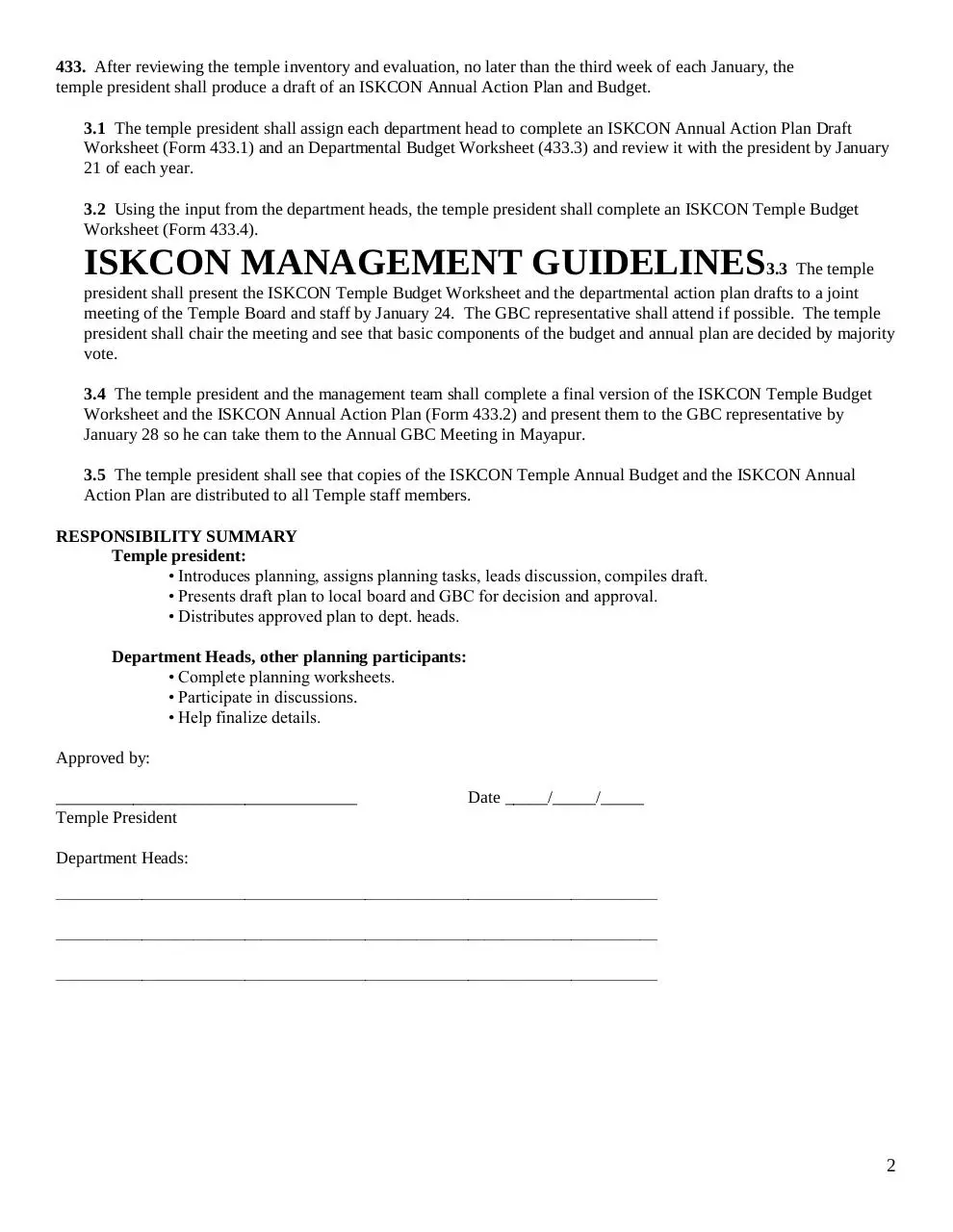
433. After reviewing the temple inventory and evaluation, no later than the third week of each January, the
temple president shall produce a draft of an ISKCON Annual Action Plan and Budget.
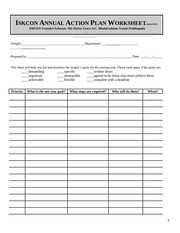
3.1 The temple president shall assign each department head to complete an ISKCON Annual Action Plan Draft
Worksheet (Form 433.1) and an Departmental Budget Worksheet (433.3) and review it with the president by January
21 of each year.
3.2 Using the input from the department heads, the temple president shall complete an ISKCON Temple Budget
Worksheet (Form 433.4).
ISKCON MANAGEMENT GUIDELINES3.3 The temple
president shall present the ISKCON Temple Budget Worksheet and the departmental action plan drafts to a joint
meeting of the Temple Board and staff by January 24. The GBC representative shall attend if possible. The temple
president shall chair the meeting and see that basic components of the budget and annual plan are decided by majority
vote.
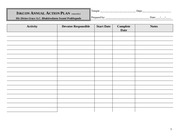
3.4 The temple president and the management team shall complete a final version of the ISKCON Temple Budget
Worksheet and the ISKCON Annual Action Plan (Form 433.2) and present them to the GBC representative by
January 28 so he can take them to the Annual GBC Meeting in Mayapur.
3.5 The temple president shall see that copies of the ISKCON Temple Annual Budget and the ISKCON Annual
Action Plan are distributed to all Temple staff members.
RESPONSIBILITY SUMMARY
Temple president:
• Introduces planning, assigns planning tasks, leads discussion, compiles draft.
• Presents draft plan to local board and GBC for decision and approval.
• Distributes approved plan to dept. heads.
Department Heads, other planning participants:
• Complete planning worksheets.
• Participate in discussions.
• Help finalize details.
Approved by:
___________________________________
Temple President
Date _____/_____/_____
Department Heads:
———————————————————————————————————
———————————————————————————————————
———————————————————————————————————
2
�
ISKCON ANNUAL ACTION PLAN WORKSHEET
FORM 433.1
ISKCON Founder/Acharya: His Divine Grace A.C. Bhaktivedanta Swami Prabhupada
.
Temple:
_______________
Department:
_________
Prepared by: ________________________________________________________________ Date: ___/____/_____
This sheet will help you list and prioritize the temple’s goals for the coming year. Check each space if the goals are:
____demanding
____important
____achievable
Priority
____specific
____measurable
____flexible
What is the one year goal?
____written down
____agreed to by those who must achieve them
____complete with a deadline
What steps are required?
Who will do them?
When?
3
�
4
�
ISKCON ANNUAL ACTION PLAN
Temple __________________________ Dept:_____________________
FORM 433.2
His Divine Grace A.C. Bhaktivedanta Swami Prabhupada
Activity
Devotee Responsible
Prepared by: ________________________________ Date:___/___/____
Start Date
Complete
Date
Notes
5
�
ISKCON DEPARTMENTAL BUDGET WORKSHEET
ISKCON Founder/Acharya: His Divine Grace A.C. Bhaktivedanta Swami Prabhupada FORM 433.3
.
Department:
_________
Date: ___/____/_____ Prepared by: __ __________________________
Item
________________________
________________________
________________________
________________________
________________________
________________________
________________________
________________________
________________________
________________________
________________________
________________________
________________________
________________________
________________________
________________________
________________________
________________________
________________________
________________________
________________________
________________________
________________________
________________________
TOTALS
Current
$________
Proposed
Difference
$________
________
________
________
________
________
________
________
________
________
________
________
________
________
________
________
________
________
________
________
________
________
________
________
________
________
________
________
________
________
________
________
________
________
________
________
________
________
________
________
________
________
________
________
________
________
________
________
________
$ ________
________
________
$________
$________
$________
$________
$________
$________
$________
$________
$________
$________
$________
$________
$________
$________
$________
$________
$________
$________
$________
$________
$________
$________
6
�
7
�
ISKCON TEMPLE BUDGET WORKSHEET
Temple: __________________________________ Date: ___/___/____
FORM 433.4
Prepared by: ______________________________________________
Founder/Acharya: His Divine Grace A.C. Bhaktivedanta Swami Prabhupada
DEPARTMENT
Current
EXPENSES
Proposed
Difference
Current
INCOME
Proposed
Difference
Current
NET
Proposed
Difference
SHARED
UTILITIES
SHARED
INSURANCE
SHARED
AUTO
SHARED
MISC.EXPENSES
SHARED
MISC.INCOME
TOTALS
8
�
ISKCON Temple Strategic Planning - Guideline #434
Purpose: To help ISKCON leaders appropriately plan for sustained temple development and growth.
GUIDELINES:
434.1 Each year each temple president shall develop a current, written mission statement for their temple using
the ISKCON Mission Statement Worksheet (Form 434.1). He shall consult all temple leaders and key members
before finalizing the document.
434.2 Each temple president shall develop a current, written strategic plan for their temple by 1999. The
strategic plan shall be summarized as follows:
Mission Statement
Vision
Challenges
Strategies
Timeline
The temple president shall begin the strategic planning process by consulting with ISKCON Foundation for
guidance and any necessary assistance. Strategic planning is recommended for all temples, but it requires
resources, skills, commitment, and a relatively crisis-free environment.
434.3 The temple administration and GBC shall review the strategic plan every 3-5 years to ensure the strategies
are current, effective and efficient.
9
�
ISKCON MISSION STATEMENT WORKSHEET
FORM 434.1
ISKCON Founder/Acharya: His Divine Grace A.C. Bhaktivedanta Swami Prabhupada
.
Temple:
Temple President:
___________________________________________
[Objective: In one, short, clear, memorable sentence, concisely articulate your mission. To start, answer the first three
general questions, then answer the next five specifically. With those answers, construct your mission statement.]
1. What results are we seeking? For what do we want to be
remembered?_______________________________________
____________________________________________________________________________________________________
___
2. What are our strengths?____________________________________________________________________________
_______________________________________________________________________________________________________
3. What are our
weaknesses?__________________________________________________________________________
_______________________________________________________________________________________________________
MISSION STATEMENT COMPONENTS
Who will we serve?_________________________________________________________________________________________
___________________________________________________________________________________________________________
What need will we fill? ______________________________________________________________________________________
___________________________________________________________________________________________________________
Why will we accomplish this mission?
____________________________________________________________________________________________________
___________________________________________________________________________________________________________
When will we accomplish this mission?
__________________________________________________________________
___________________________________________________________________________________________________________
Where will we accomplish this mission?
________________________________________________________________________
10
�
___________________________________________________________________________________________________________
Draft your mission statement here:
______________________________________________________________________
___________________________________________________________________________________________________________
___________________________________________________________________________________________________________
______________________________________________________________ Dated ____/___/____ Reviewed
__/___/___
ISKCON Treasury - Guideline #440
Introduction
Quotations from Srila Prabhupada:
" I'm so glad to learn that a scientific bookkeeping system is being introduced in our different centers. "
(letter to Rupanuga das, February 1972 , Siksamrta , page 2317)
" It is very good that you have the same treasury system and reporting system in all your temples. This is
wanted. " (letter to Bhagavan das, November 1975 , Siksamrta, page 2321)
".....along with our preaching and propaganda work, we must also give attention to financial matters, otherwise
the whole thing will collapse and it will be a farce....." (letter to Damodara das, 6 August 1972 , Siksamrta, page 2320)
" Bookkeeping is the most important item. As you are growing in stature, our accounting system should become
very perfect. " (letter to Karandhara das, March 1971 , Siksamrta, page 2317)
" It is very important that the accounts be kept very clear so that we retain our income tax exemption. " (letter to Tamal
Krishna Maharaja, January 1974, Siksamrta, page 2321)
Properly Managing Lord Krishna's Money
Sound financial management and accounting helps you get the most for your money, keep track of your
progress, and build confidence in ISKCON among donors, devotees, and the greater community. Here are six key
objectives to sound financial management.
Every ISKCON temple president should understand objectives outlined in this section. Treasurers may want
more detailed information which is available in the texts referred to below.
For a small temple, some of these accounting procedures may seem to require too many people. Even small
temples, however, can engage congregational members in executing these procedures. In doing so they'll build
a strong foundation for future growth.
Six Guidelines for achieving good financial management
1. Evaluate your present treasury system
2. Establish a written policy for spending money
3. Establish a written policy for receiving money
4. Produce effective reports
5. Prepare an operating budget
6. Comply with government regulations
11
�
ISKCON Treasury Evaluation - Guideline #441
Purpose: To develop effective ISKCON treasury departments which can:
1. Keep financial records.
2. Prepare accurate and meaningful financial statements.
3. Budget and anticipate financial problems.
4. Safeguard and manage the society's financial assets.
5. Comply with governmental requirements.
GUIDELINES:
The temple president shall complete the following exercise. These items detail a minimum standard
for a secure, accurate, and practical ISKCON treasury system. Check off each one to which you can answer
"yes". Learn about the rest on the following pages and work at it until you can check off the entire list.
1. Our Treasurer
__ is responsible and trusted
__ (if a corporate officer) meets GBC standard (see below)
__ is someone other than the temple president or his spouse
__ agrees to abide by ISKCON accounting standards
__ is or has contact with a certified accountant
__ counts cash only in the presence of others
2. Our Audit Committee
__ exists (an audit committee is a group of three or more members who review the treasurer's work)
__ reconciles the monthly bank statements
__ makes sure that reports are produced on time and reviews them
3. Policies. We have written policies for:
__ spending money
__ receiving money
__ we follow both guidelines
4. Reports. We produce these reports:
__ monthly income/ expense
__ annual financial statement
__ We send these reports to the GBC and our congregational members
__ Our annual statement is audited
__ We have and use a suitable Chart of Accounts
5. Budgets
6. __ We set our budget using our Chart of Accounts
__ We have a realistic 1-year operating budget
__ It has been approved by our Advisory Committee or leading congregational members, our staff, and
our GBC
7. __ Our financial reports compare actual to budget
8. Governmental Compliance
__ As required by law, we report all compensation paid to devotees in cash or in kind
__ We know and comply with all requirements for maintaining tax exemption
GBC Resolution 93.60.I.v. "a) All Officers of the [ISKCON] Affiliate must be qualified as follows:
I) They must be initiated devotees in the Gaudiya Vaisnava sampradaya. ii) They must be chanting daily sixteen
rounds of the Hare Krishna mantra. iii) They must be strictly following the four regulative principles, namely, no
eating of meat, fish, or eggs, no taking of intoxication, no illicit sex, and no gambling. Iv) They must meet any other
general requirements of membership in ISKCON described in the Laws of ISKCON. v) They must have signed the
prescribed Oath of Loyalty to ISKCON.
12
�
Receiving Funds - Guideline #442
Purpose: To insure that donations given in good faith to ISKCON are properly deposited, recorded, reported and used.
Quotation from Srila Prabhupada:
"The daily collections from the temple should be counted before three persons together. The accountant has
nothing to do with these things. He simply notes down the figure in the books. This is how it should be done."
(Srila Prabhupada in a letter to Haihaya das March 1976, Siksamrta page 2321)
"So I want that all centers follow the following procedure for handling money. Whatever income there is, every
cent must be given to the treasurer. Immediately he records it in the book. Then daily he deposits everything in
the bank." Srila Prabhupada in a letter to Satsvarupa Goswami, September 1975 , Siksamrta page 2313
GUIDELINE:
442.1 The Advisory Council shall form an audit committee from qualified members of the congregation. They shall:
1. Help establish temple policies for receiving and spending money (see sample, below);
2. Make sure the treasurer produces monthly and annual financial reports;
3. Reconcile the ISKCON bank statements each month;
4. Help you prepare an annual operating budget.
The audit committee shall review the following as a written guideline for handling income in the temple and
adjust it if necessary. Once the policy is finalized, the temple president shall discuss it at an istagosthi with all
devotees and post a copy.
Sample Temple Policy for Receiving Donations
1. Members receiving donations for ISKCON shall give them directly to the treasurer in their entirety.
2. The treasurer shall verify the amount and record it in the proper ledger.
3. The treasurer shall then deposit the whole amount before making disbursements.
When receiving donations ISKCON members shall:
1. As far as possible, obtain the donor's full name, address, and telephone number.
2. Note the Purpose of the donation.
3. Request checks whenever possible.
4. Issue number receipts to cash donors, with the original issued to the donor and a copy left bound in the receipt
book, and return the cash and receipt book to the treasurer.
5. Handle cash donations from anonymous donors, (such as the hundi or sankirtan as follows.
The donation box is secured with two locks, each with a key held by a different person. The two keyholders must
together empty and count the proceeds. The tally and the cash should then be given to the treasurer. The tally
should also be given to the audit committee.
'Restricted Gifts'
Funds which are given for particular Purposes require special considerations which are outlined on the next
page.
Restricted Donations - Guideline #443
Purpose: To help temples properly handle donations given for specific Purposes.
GUIDELINE:
To do this properly will require the use of 'fund accounting'. This can be done in two ways.
1. [Preferable method] The gift is deposited in a general bank account and credited on the books to the appropriate
department or account and not spent for anything else.
13
�
2.
[Conditionally acceptable method] Separate ISKCON bank accounts are opened, such as a Deity account, Food
For Life account, Sankirtan account, etc. The practice of multiple accounts is acceptable only if each account is
managed according to all the principles outlined herein. Further, the treasurers for each separate account must
produce accurate and regular reports for the main ISKCON treasurer so that comprehensive financial reports for the
overall ISKCON corporation can be produced.
Quotations from Srila Prabhupada:
"You write that you are very careful utilizing funds that are sent for that particular Purpose. In all matters of
management this careful attitude must be taken.' -- Letter to Jayapataka and Bhavananda, May 1974, Siksamrta, page
2311
[GBC Resolution 24, 1993] That as far as possible, donations to ISKCON should be accepted without any
conditions. However, donations may also be accepted with limited conditions. Acceptable conditions are
those which define a general category or use, such as deity worship, education, construction, etc. which
define a specific geographic location or project, or which give the donor a modest amount of recognition.
Unacceptable conditions are those which:
a. Give some right to the donor to reclaim part or all of the donation in the future. All donations become
ISKCON's inviolable property without any possibility of alienation.
b. Which are vague or ambiguous, and thus risk future disputes over interpretation.
c. Which in other ways risk future litigation or disputes, or which could harm ISKCON's reputation.
d. Which compromise ISKCON's right on ability to manage its assets in accordance with Srila Prabhupada's
instructions and ISKCON law.
ISKCON managers must use donations with conditions in accordance with the agreed terms.
[GBC Resolution 25, 1993] That, in the case of donations of real property or other donations specifically for real
estate purchases or improvements, any conditions relating to the property imposed by a donor must be
clearly spelled out in writing. The Property Trustees associated with the property must consider the
conditions in light of the ISKCON Guidelines for donations with conditions, and if they agree in writing that
the conditions are within the specified guidelines, then the donation may be accepted.
Spending ISKCON Funds - Guideline #444
Purpose: To help ISKCON temples spend funds properly and retain the goodwill of donors.
Quotations from Srila Prabhupada:
"Expenditures should be done by check as far as possible" -- letter to Gurukrpa Swami, August 1975, Siksamrta, page
2313
"As the treasurer of the branch, you will sign the checks of our banking account there jointly along with the
president or secretary." -- letter to Ksirodaksayi das, September 1971, Siksamrta, page 2308
"For petty expenses, not exceeding Rs. 200/- may be kept with you always and everything should be accounted
for with vouchers. No such items should be mentioned as "miscellaneous". Anyone who takes money personally
for miscellaneous expenditures must sign a voucher --- this is accounting." -- letter to Ksirodakasayi das, January 1972,
Siksamrta, page 2320
GUIDELINE:
The temple president shall propose the following Guideline to the audit committee. The audit
committee shall edit it if necessary. The temple president shall approve or return it for modification, then post a
final version and be sure it is clearly understood by all concerned.
Sample Temple Policy for Spending Money
I. Writing Checks
14
�
Two officers shall sign every check and shall not sign blank checks unless the name of a known and trusted payee has
been filled in.
II. Payment Decisions
The treasurer shall pay regular bills such as utilities, rents or salaries that have been pre-authorized by the audit
committee. This may also include a weekly petty cash fund to cover small, cash expenses. The temple president
shall be authorized to make decisions for amounts up to $_________, without having to consult with a temple board,
other temple officers, or the GBC.
III. Recording Payments
The treasurer shall record all details that appear on the check on the check stub. He shall keep all check stubs in
numerical order, along with the invoices these checks were written to pay. Every disbursement, even by check, shall
be backed up by an invoice. The amount on the check should be exactly equal to the amount of the invoice. Invoices
should then be filed together by month or year in a folder marked "Paid by Check". They may be needed by the
accountant to prepare the year end statement, and they would certainly be needed for an audit.
IV. Petty Cash
The petty cash float is drawn by check from the bank and used for those expenses that are not payable by check (car, gas
etc.). Whoever receives petty cash must sign a voucher with his name and the date and amount given. The treasurer
keeps the voucher as proof there is money outstanding and as a reminder that either the money or an invoice and
change is to be returned soon (see sample). When that happens, the voucher can be discarded.
V. Special Cash Funds (also known as "suspense" funds).
When there's a large festival, a larger cash advance check may be needed for special purchases. Be sure the treasurer
knows how to properly track and record these expenses (see "Guidelines for ISKCON Accounting").
Producing ISKCON Financial Reports - Guideline #445
Purpose: To help temple produce regular financial reports to help give donors confidence and enthusiasm for
supporting the project.
Quotations from Srila Prabhupada
" I am in due receipt of your statement of account and similarly every branch of our society should make
periodical trial balance and balance sheet. You can advise to all the branches that such accounts be kept very
nicely so that the public may know that we are very clear in our dealings." -- letter to Karandhara das, October 1971,
Siksamrta, page 2319.
Jayatirtha: The next point is to obtain reports from the temple presidents, financial reports, like this . .
Prabhupada: The general report should be submitted at least monthly.
Jayatirtha: Yes. So "to obtain all reports on a timely basis..."
Prabhupada: To the board of the GBC or to the individual, zonal GBC. Yes.
-- Srila Prabhupada room conversation, 1974.
GUIDELINE:
445.1 ISKCON treasurers shall provide, as a minimum:
1. Monthly income/ expense reports
2. An annual financial statement (using the accrual method)
445.2 ISKCON treasurers shall determine their method for producing reports by following these steps:
1. Develop a Chart of Accounts. This vital first step is the basis for all future accounting work. Refer to the
enclosed sample, which is appropriate for most ISKCON centers.
15
�
2. Decide on your bookkeeping method. Although handwritten books are still acceptable, today inexpensive
computerized accounting systems are readily available and make the task far, far easier. So use a computer if at
all possible, with the easily learned Quickbooks. Peachtree or AccPac are also acceptable.
3. Decide whether you'll use the 'cash basis' or 'accrual basis' for your bookkeeping. Cash basis is the simplest and
suitable for most ISKCON temples. This method involves the recording of all income and expenses actually
transacted. Accrual accounting involves not only all the actual cash transactions but also takes into account
amounts owed by you (unpaid bills etc.) and amounts owed to you. The accrual method gives a more accurate
picture of your financial position at any given time. (Note 1: which should you use? If you pay your bills on
time and have few accounts receivable, the cash basis is fine. If, however, you have large amounts of unpaid
expenses (bills, mortgage, etc.) or pending income (grants, etc.), use the accrual method for a true picture of
your financial position.)
(Note 2: Annual financial statements should be presented as accrual-based reports. A professional accountant
can convert cash-based records to accrual through journal entries.
(Note 3: You may present cash basis financial statements, with an added sheet detailing bills or revenue due.
4. Scour your congregation for a volunteer accountant who can review your financial reports. Pay one if necessary the fees will come back to you in increased donations from your congregation. The first-class standard is to have
your annual statement audited by a certified accountant. Try for it.
445.3 ISKCON temple presidents will deliver monthly and annual financial reports promptly to the GBC, audit
committee, and to the general congregation.
Producing ISKCON Annual Budgets - Guideline #446
Purpose: To help ISKCON temples produce annual budgets, which benefit us as follows:
1. Forces us to plan ahead.
2. Creates teamwork.
3. Prevents overspending.
4. Creates a means of measuring performance.
5. Provides an orderly means to deal with the unexpected.
6. Proves good financial management to prospective donors.
GUIDELINE:
446.1 The temple president and treasurer shall prepare an annual budget as part of the ISKCON annual
planning routine. See section 20 for details.
446.2 In preparation for the annual budget, the treasurer shall:
1. Calculate income and expenses for the year to date for all categories in the Chart of Accounts.
2. This report is provided to all department heads (or, in small temples, the temple president) to use as a basis for
planning the coming year's expenses.
3. Department heads (or the temple president) ask staff members for their ideas about what extra income or
expenses they expect for the coming year and for ideas about how to save money.
4. The treasurer gathers all the information and projects the coming year's income or expense for each item in the
Chart of Accounts. (Computerized accounting software packages are preprogrammed for this procedure).
5. The tentative budget is then shown at a meeting of the GBC (if available), Board of Directors, and the Advisory
Council, along with the temple's annual plan. The president and treasurer shall be prepared to answer every
question in detail.
6. Once the GBC and congregational members have approved the budget, it is final. The treasurer's monthly
income and expense reports and annual report for the next year should compare the actual amount to the
projected amount for each item on the Chart of Accounts.
Note: The budget is critical for an annual support fundraising campaign. (See 'Fund Development' section).
16
�
Meeting Governmental Financial Requirements - Guideline #447
Purpose: To help ISKCON leaders protect ISKCON's activities, assets, and devotees through compliance with
the local government's laws. (Note: Although each country is different, certain concerns apply in many cases.
These are outlined here, as well as specific objectives for ISKCON temples in America. For full details,
American temple presidents should refer to ISKCON Foundation’s ISKCON American Treasury Manual.
Suggested Procedure:
For ISKCON temples outside of America:
Make sure you know the answers to these questions. Explain to your audit committee how you are complying
with your local government regulations for each.
1. Is your ISKCON corporation required to file annual financial statements with any governmental agencies?
2. Does the government require ISKCON to report any money paid to devotees for maintenance? Is providing
housing, food, and other maintenance costs for individuals considered part of their 'salary' and thus reportable?
3. Does the government require devotees to report income received from ISKCON, either as cash or in food and
housing or both?
4. Is your ISKCON corporation engaged in any business activities not directly related to ISKCON's spiritual
mission? If so, does the government have special reporting requirements for this income? Is the ISKCON
corporation's tax exemption at risk because of these unrelated business activities?
5. If your ISKCON corporation tax exempt? If so, what special accounting and reporting requirements does the
government have for tax exempt corporations?
For ISKCON temples in America
I. ISKCON corporations should be registered as 501(C)3 tax exempt, religious corporations. Unrelated business
activities must be done privately or under a properly incorporated 501(D) corporation. The definition for a 501(C)3
corporation is that no individual can inure personal, private financial benefit from its activities.
II. Individuals receiving remuneration from ISKCON fall in one of five divisions:
1. ISKCON has no tax or reporting liability if: devotee works full time for ISKCON, receives room and board and a
maintenance allowance of $600 per year or less; or, second initiated devotee preaches or teaches full time for
ISKCON and has rent paid directly from the temple treasury as a board-authorized parsonage allowance.
2. ISKCON has the obligations of a normal employer if: devotee works full time in ISKCON religious (not
commercial) work, is given room and board, and receives more than $600 per year in compensation.
Note: ISKCON must send form 1099 to the IRS each year for each such devotee, including those who live in the
temple, sell books or collect, and keep a portion of their collection exceeding $600.
Note: the temple may opt out of paying Social Security if the devotee agrees (IRS form 8274 for ISKCON, form
4361 for devotees).
Note: ISKCON does not have to withhold federal taxes. See IRS Code, section 3401(1)(9).
Note: Unless the devotee has a green card, R1 Visa, or INS approval, no US corporation can pay him anything.
Note. The temple should consult a professional bookkeeper regarding proper deductions for Federal, State,
Medicare, Worker's Compensation, etc.
Note: If devotees are reimbursed for expenses incurred in their service (such as traveling), those reimbursements
are not considered taxable income.
3. Devotees who have control over how they sell or solicit may be considered independent contractors, provided
ISKCON executes a contract which details the relationship. They are responsible for their own tax filings, which
are usually done every three months.
4. Devotees who live outside ISKCON and buy books from BBT. They may say they work for ISKCON, but we
don not control what they do or receive any profit from their activity. ISKCON must formalize relations with
them through a contract. They must pay their own taxes.
5. Individuals who live outside the temple and collect unauthorizedly in ISKCON's name. ISKCON must advise
local authorities who is legitimately representing ISKCON. ISKCON ID badges must all have a six-month
expiration date
17
�
ISKCON Congregational Development - Guideline #450
Purpose: To help ISKCON leaders bring devotees and devotional practices into as many homes as possible, and
to increase the number of ISKCON family members.
Quotation from Srila Prabhupada
"Here in Bombay we are getting good response to our membership program and I am sure in Calcutta
you can also get good response. This membership program cannot be neglected. Do not rely on anyone else for
such matters but go out and do your own work." (Letter to Jayapataka Maharaja, 11/15/70).
GUIDELINE:
450. The temple president shall seek a leader for the Congregational Development department who meets as
many of the Department Head qualifications as possible (see sec. 414.) One member of the Board of directors
shall have the responsibility of Congregational Development. Both of these devotees shall work closely with the
members of the Advisory Council. With or without the department head and board or council support, the
temple president shall work to build the temple congregation through any or all of the following methods, as
described in these related guidelines:
123. Sunday school
570. Special events
451 'Cell' preaching and Nama Hatta
ISKCON Congregational Sadhana - Guideline #451
Purpose: Whereas members of the congregation who are not initiated need means of being recognized and
feeling accepted by ISKCON; whereas other groups are giving recognition to ISKCON congregation taking
advantage of our lack of giving recognition; and whereas since congregational members often take considerable
time to advance in sadhana bhakti a graduated system of encouragement and recognition is needed to serve as
guidelines and inspiration; therefore it is resolved that:
GUIDELINES
451.
a. ISKCON Managers and GBC Members shall, within their area of authority, be permitted to publicly bestow
acceptance and recognition to members of its congregation for devotional achievements and progress in
devotional service.
b. Local temples and congregational preaching units should implement programs for aiding the congregational
members to enhance their standing, and for training them to qualify for the higher levels. This should include
following a recommended study course for the different levels. (Adult Education and Congregational Preaching
Monitors shall recommend.)
c. Standard certificates shall be issued worldwide. (The proforma certificates shall be created and circulated by the
Corresponding Secretary in consultation with the Congregational Preaching Monitor
d. The recognition shall be granted in any of the following categories (giving these is optional, as also the bestowal
ceremony according to local time, place and circumstance):
i. Accepting Sacred Order of Lord Caitanya (Short name: Sat-sangi, or Sraddhavan)
Qualifications: Accepting the instructions or sacred order of Lord Caitanya to chant Hare Krishna
(minimum one round), to worship Lord Krishna (to visit the temple or otherwise cultivate devotional
service as far as possible), and to read the teachings of Lord Krishna (Bhagavad-gita, Srimad
Bhagavatam, and other books of Srila Prabhupada). [Note: Since this broadly correlates with sraddha or
sat-sanga stages of devotion, they can generally be called as "Satsangi" or "Sraddhavan".]
ii. Krishna (or Gauranga) Sevak
Qualifications: Chanting a minimum of four rounds of Hare Krishna japa, refraining from meat-eating,
believing in Lord Krishna as the Supreme Personality of Godhead, possessing a devotional attitude, and
avoiding of grossly immoral acts (drugs, prostitution, etc.)
iii. Krishna (or Gauranga) Sadhak
18
�
Qualifications: Chanting a minimum of eight rounds of Hare Krishna japa, refraining from intoxication,
meat-eating, gambling, and extramarital sex, offering of bhoga to pictures, establishing an altar at home,
and generally accepting the process of sadhana bhakti.
iv. Srila Prabhupada Asraya
Qualifications: Practicing the minimum standard of Krishna Consciousness for ISKCON members as
given by Srila Prabhupada, namely chanting of minimum sixteen rounds of Hare Krishna japa, refraining
from intoxication, meat-eating, gambling, and illicit sex, and generally showing a strong conviction in
Krishna Consciousness.
v. Sri Guru Caran Asraya
Qualifications: Same as Srila Prabhupada Asraya, with additional faith and surrender in an authorized
spiritual master coming in the disciplic succession. Must have been practicing Srila Prabhupada Asraya
standard for a minimum of six months. They should pass the exam provided for in ISKCON Law.
(The above guideline is GBC Resolution 93, passed in 1993).
19
�
[Note: This is a proforma application form for participating in the “Siksha” program of the congregation.]
ISKCON CONGREGATION SERVICES
ISKCON Founder/Acharya: His Divine Grace A.C. Bhaktivedanta Swami Prabhupada
___________Your Temple Name & Full Address_____________
.
SIKSHA CEREMONY APPLICATION
Dear Prabhu,
I am aware of the standards, commitments, and responsibilities of the different stages
of Siksha. I hereby express my desire and intention to practice the standards of:
[please mark your box below]
¯
¯
¯
¯
¯
Shraddhavan
Krishna Sevaka
Krishna Sadhaka
Srila Prabhupada Ashraya
Sri Guru Charana Ashraya
Date:_________________
Signature: _______________________________
_______________________________________
_______________________________________
_______________________________________
[Here get name and address, etc., or a confirmation if they are a donor member of a ―League of Devotee‖
member of the congregation for whom you have the detailed address, etc., on record.]
[Note: This is a sample questionnaire that an applicant for “Sraddhavan level of Siksa” or congregational
spiritual commitment would complete to enable you to better know their spiritual practices at present and
where they need help to further advance. (“SATSANGI) is an alternate title that can optionally be used instead
of Sraddhavan. Use whichever is suited to your congregation.) You should also have a separate study guide
explaining basic spiritual practices. Spaces may have been reduced between questions to conserve on space;
add in your form as needed. Each level should be provided an appropriate questionnaire for your purposes.]
20
�
ISKCON CONGREGATION SERVICES
ISKCON Founder/Acharya: His Divine Grace A.C. Bhaktivedanta Swami Prabhupada
SIKSHA QUESTIONNAIRE FOR
SRADDHAVAN
Please answer this questionnaire and drop it in the drop-box at the temple counter along with the Siksha form.
Name: ____________________________________________________________________________________
Siksha Code No. _____________________ (ignore in fresh cases)
1. How often do you come to the temple (in a month)? ____________________
2. How many Sunday programs do you attend every month? ____________________
3. How many Gita classes do you attend in ISKCON in a month? ___________________
4. How many rounds of the Hare Krishna maha-mantra do you chant everyday? _________________
5. How long does it take you to chant your rounds? ___________________
6. List all the books of Srila Prabhupada that you have read cover to cover.
_________________________________ b) ____________________________ c) ____________________,
d)________________________________, e) ___________________________, f) ____________________,
g) ________________________________, h) __________________________, i) ____________________.
7. Do you accept that Krishna is the Supreme Personality of Godhead? Why? ____________________________
__
8. Are you willing to render practical devotional service during the ISKCON festivals? ____ Yes ___No
9. I have been a vegetarian:
___ all my life
___ for the past ___ years
___ for the past ___ months
___ for the past ___ days
Date:_________________
Signature: _______________________________
[Note: This is a sample questionnaire that an applicant for “Krishna Sevaka level of Siksa” or congregational
spiritual commitment would complete to enable you to better know if they qualify. It also could serve as a study
guide and preparatory list (or you could have a separate study guide as well). Add more space between the
questions as needed. Provide appropriate questionnaires for each level.]
ISKCON CONGREGATION SERVICES
ISKCON Founder/Acharya: His Divine Grace A.C. Bhaktivedanta Swami Prabhupada
21
�
SIKSHA QUESTIONNAIRE FOR
KRISHNA SEVAKA
Please answer this questionnaire and drop it in the drop-box at the temple counter along with the Siksha form.
Name: ____________________________________________________________________________________
Siksha Code No. _____________________ (ignore in fresh cases)
1. How often do you come to the temple (in a month)? ____________________
2. How many Sunday programs do you attend every month? ____________________
3. How many Gita classes do you attend in ISKCON in a month? ___________________
4. How many rounds of the Hare Krishna maha-mantra do you chant everyday? _________________
5. How long does it take you to chant your rounds? ___________________
6. List all the books of Srila Prabhupada that you have read cover to cover.
_________________________________ b) ____________________________ c) ____________________,
d)________________________________, e) ___________________________, f) ____________________,
g) ________________________________, h) __________________________, i) ____________________.
7. Do you accept that Krishna is the Supreme Personality of Godhead? Why? ____________________________
__
8. Are you willing to render practical devotional service during the ISKCON festivals? ____ Yes ___No
9. I have been a vegetarian:
___ all my life
___ for the past ___ years
___ for the past ___ months
___ for the past ___ days
Date:_________________
Signature: _______________________________
[Note: This is a sample questionnaire that an applicant for “Krishna Sadhaka level of Siksa” or congregational
spiritual commitment would complete to enable you to better know if they qualify. It also could serve as a study
guide and preparatory list (or you could have a separate study guide as well). Add more space between the
questions as needed. Provide appropriate questionnaires for each level.]
ISKCON CONGREGATION SERVICES
ISKCON Founder/Acharya: His Divine Grace A.C. Bhaktivedanta Swami Prabhupada
SIKSHA QUESTIONNAIRE FOR
22
�
KRISHNA SADHAKA
Please answer this questionnaire and drop it in the drop-box at the temple counter along with the Siksha form.
Name: ____________________________________________________________________________________
Siksha Code No. _____________________ (ignore in fresh cases)
1. How often do you come to the temple (in a month)? ____________________
2. How many Sunday programs do you attend every month? ____________________
3. How many Gita classes do you attend in ISKCON in a month? ___________________
4. How many rounds of the Hare Krishna maha-mantra do you chant everyday? _________________
5. How long does it take you to chant your rounds? ___________________
6. List all the books of Srila Prabhupada that you have read cover to cover.
a) ________________________________, b) ___________________________, c) ____________________,
d)________________________________, e) ___________________________, f) ____________________,
g) ________________________________, h) __________________________, i) ____________________.
7. Do you accept that Krishna is the Supreme Personality of Godhead? Why? ____________________________
__
8. Are you willing to render practical devotional service during the ISKCON festivals? ____ Yes ___No
9. I have been a vegetarian:
___ all my life
___ for the past ___ years
___ for the past ___ months
___ for the past ___ days
10. Which of the following Deities / pictures do you worship on your altar?
a) Radha-Krishna
c) Krishna - Balarama
b) Lord Chaitanya Mahaprabhu
d) Srila Prabhupada
List others, if any:
a) _________________________
c) ________________________
b) _________________________
d) _________________________
11. Describe the process of offering foodstuffs to the Lord. What mantras do you chant? _________________
____________________________________________________________________________________
12. According to the sastras, how does one see women other than one’s wife? __________________________
____________________________________________________________________________________
13. What are the forbidden food items on ekadashi day? ___________________________________________
14. What time do you rise in the morning? _____________________________________________________
15. When and where do you chant most of your rounds everyday?____________________________________
Date:_________________
Signature: _______________________________
23
�
[NOTE: This is a sample questionnaire that an applicant for “Srila Prabhupada Ashraya level of Siksa,” or
congregational spiritual commitment, would complete to enable you to better know if they qualify. It also could
serve as a study guide and preparatory list. Space reduced between questions to conserve space. Add more
space between the questions as needed. For Guru-ashraya you could also use these questions plus the
remaining of the 13 questions required by the GBC.]
ISKCON CONGREGATION SERVICES
ISKCON Founder/Acharya: His Divine Grace A.C. Bhaktivedanta Swami Prabhupada
SIKSHA QUESTIONNAIRE FOR
SRILA PRABHUPADA ASRAYA
Please answer this questionnaire and drop it in the drop-box at the temple counter along with the Siksha form.
Name: ____________________________________________________________________________________
Siksha Code No. _____________________ (ignore in fresh cases)
1. How often do you come to the temple (in a month)? ____________________
2. How many Sunday programs do you attend every month? ____________________
3. How many Gita classes do you attend in ISKCON in a month? ___________________
4. How many rounds of the Hare Krishna maha-mantra do you chant everyday? _________________
5. How long does it take you to chant your rounds? ___________________
6. List all the books of Srila Prabhupada that you have read cover to cover.
_________________________________ b) ____________________________ c) ____________________,
d)________________________________, e) ___________________________, f) ____________________,
g) ________________________________, h) __________________________, i) ____________________.
7. Do you accept that Krishna is the Supreme Personality of Godhead? Why? ____________________________
__
8. Are you willing to render practical devotional service during the ISKCON festivals? ____ Yes ___No
I have been a vegetarian: ___ all my life
___ for the past ___ years
___ for the past ___ months
___ for the past ___ days
10. Which of the following Deities / pictures do you worship on your altar?
a) Radha-Krishna
c) Krishna - Balarama
b) Lord Chaitanya Mahaprabhu
d) Srila Prabhupada
List others, if any:
a) _________________________
c) ________________________
b) _________________________
d) _________________________
24
�
11. Describe the process of offering foodstuffs to the Lord. What mantras do you chant? _________________
____________________________________________________________________________________
12. According to the sastras, how does one see women other than one’s wife? __________________________
____________________________________________________________________________________
13. What are the forbidden food items on ekadashi day? ___________________________________________
14. What time do you rise in the morning? _____________________________________________________
15. When and where do you chant most of your rounds everyday?____________________________________
16. Who is a bonafide guru? _________________________________________________________________
17. What is the unique position of Srila Prabhupada in ISKCON?____________________________________
18. Why do we follow the four regulative principles? ______________________________________________
19. Explain the difference between the body and the self. ___________________________________________
20. What are the Bhagavad-gita’s instructions with regard to the proper manner of approaching a bonafide spiritual
master? ________________________________________________________________________
21. Do you avoid the following? If not, then explain why not.
a) onion/ garlic
yes/no
If no, why: _____________________________________
b) cinema/ TV
yes/no
If no, why: _____________________________________
c) coffee/ tea
yes/no
If no, why: _____________________________________
d) restaurants
yes/no
If no, why: _____________________________________
22. Describe your service connected to the temple on a regular basis. __________________________________
23. Please write the Srila Prabhupada pranam mantras and the Pancha Tattva pranam mantras. ____________
_____________________________________________________________________________________
_____________________________________________________________________________________
_____________________________________________________________________________________
_____________________________________________________________________________________
_____________________________________________________________________________________
_____________________________________________________________________________________
_____________________________________________________________________________________
_____________________________________________________________________________________
_____________________________________________________________________________________
Date:_________________
Signature: _______________________________
25
�
ISKCON Fund Development - Guideline #460
Purpose: ISKCON Temples should develop reliable, ongoing, and adequate sources of funds for maintaining
and expanding operations.
GUIDELINE:
461 . ISKCON affiliate leaders shall build an organizational fund-raising program according to the guidelines
in the ISKCON Fund Development Manual, published by ISKCON Foundation. The Director responsible for
Fund Development shall obtain the ISKCON Fund Development Manual. The president shall seek to recruit a
member to serve as the Development Officer (Department head in charge of fund-raising) according to the
criteria listed in the Fund Development Manual.
462. The Temple President shall use sources of earned income, such as book distribution, congregational
collections, and restaurant sales, as means to make contacts to develop as repeat donors. The president shall
strive to make the temple financially independent of earned income sources and use earned income for long term
debt-reduction, capital improvements, or special events.
463. To help develop repeat donors, the Development Officer shall promptly acknowledge and record all
contributions according to these guidelines:
1. Within 48 hours of receiving any gift, The Development Officer shall send a thank-you letter and receipt.
2. The Development Officer shall record the name, address and phone number of each donor and the date, amount,
and check number of each contribution he or she makes. If at all possible, the Development Officer shall obtain
and use an appropriate computer system and software for this Purpose.
3. The Development Officer and/or Temple Secretary shall produce a monthly newsletter to be mailed to each
donor or prospective donor. The Development officer will see that the newsletter lists the names of the previous
months donors and includes a report from the Temple Treasurer of the temple's income and expense for that
month.
4. The Head Pujari shall provide copies of any checks he/she receives to the Development Officer, as will the
Sankirtan Leader, Temple President, Head Cook, and all other temple officers.
464. The Development Officer, with the assistance of the appropriate Director, the president, and the Advisory
Council, will conduct a month-long annual support campaign in which all donors will be asked to contribute to
meet the Temple's annual operating budget. The Temple Treasurer shall provide a projected annual operating
budget. The Development Officer shall develop a standard of giving table which divides the operating budget
by five. He/she will then calculate a reasonable giving level and an appropriate amount of donors to meet each
20% segment. Example:
Projected budget:
$100,000
4 donors @ $5000 =
$20,000
8 donors @ $2500 =
$20,000
20 donors @ $1000 = $20,000
40 donors @ $500 =
$20,000
100 donors @ 200 =
$20,000
The Development Officer shall supplement the projected budget and standard of giving table with a properly
written case for support, taking help from ISKCON Foundation if needed. He shall then recruit, equip, and train
as many donors as possible who are willing to visit the best prospective donors in their homes and solicit their
support. He shall then contact by phone and/or mail all donors who are not personally visited by volunteers (see
sample letter). He shall supplement this campaign with special announcements, special events, and special
recognition as necessary. The temple leadership shall repeat this campaign annually with the goal of paying the entire
temple overhead through tithes or annual pledges
465. Each ISKCON affiliate shall conduct one capital campaign every one to three years.
26
�
Before starting the capital campaign, the Development Officer shall obtain and read the book, "The Lost Art
of Church Fund-raising" by Ashley Hale [available for ISKCON at 40% off from Precept Press, Chicago,
Illinois, USA, (312) 467-0424] and refer to this book for help on each of the following steps.
1.
2.
3.
4.
5.
6.
7.
8.
The Development Officer and Temple President will arrange an ad hoc budget committee consisting of both
staff and congregational leaders to draft a campaign budget. The budget draft will then be circulated among the
congregation for review and comments. The Temple President and Board of Directors shall then consider all
feedback and determine the final budget.
The Development Officer will develop a standard of giving chart for the campaign. (See example under section
4.1.2.).
The Development Officer and Temple President shall organize a campaign
The Development Officer will supplement the campaign budget and standard of giving table with a properly
written case for support, taking help from ISKCON Foundation if needed.
The Development Officer and the campaign committee shall recruit, equip, and train as many donors as possible
who are willing to visit the best prospective donors in their homes and solicit their support.
The Development Officer and the campaign committee shall contact by phone and/or mail all donors who are not
personally visited by volunteers.
The Development Officer shall supplement this campaign with special announcements, special events, and
special recognition as necessary.
The Temple President shall see that all funds collected for the capital campaign are used exclusively for the
proclaimed Purpose and reported as such to the donors.
464.1 Sample:
A Sample Case For Support/ Appeal Letter
Dear Friend,
I am very pleased that you have used the ISKCON ______ temple this past year to spiritually uplift yourself and
your loved ones. His Divine Grace Srila Prabhupada established ISKCON temples to spiritually benefit
people just like you and me.
This year we ask your continued financial support so that we can continue to serve you and so many others in the
______ area. With your help, this year we will:
* offer over 2000 aratis to Their Lordships Sri Sri Radha Krishna
* offer over 2000 bhoga offerings to Their Lordships
* distribute 50,000 plates of Krishna prasadam through the temple and Hare Krishna Food for Life
* provide continuous training for ten brahmanas who can in turn serve the community
* distribute 20,000 copies of the Bhagavad-gita As It Is and other translated Vedic texts
* provide continuing counseling, classes, and encouragement for the 1400 families in our congregation
both in the temple and in their homes.
To accomplish this, our operating budget for 199X will be:
* Deity worship - $25,000
* prasadam distribution - $25,000
* temple utilities & maintenance - $25,000
* books and outreach programs - $25,000
When you offer a portion of your income to achieve these most holy and important goals, you immediately purify
your life and become eligible for Lord Krishna's mercy and protection. As Lord Krishna states in the Bhagavad-gita
(XX.XX):
(choose an appropriate verse of your liking)
For this reason I sincerely hope you will open your heart and contribute generously when the ISKCON volunteer
27
�
visits or calls upon you.
With prayers for you and your loved ones, I remain,
Yours in Lord Krishna's service,
_______________________________
Temple President
28
�
ISKCON PREACHING GUIDELINES
Public Speaking - Guideline #500
Purpose: To guide ISKCON preachers in how to represent Srila Prabhupada by properly addressing different
groups of people in various circumstances.
GUIDELINES:
500. ISKCON leaders who regularly speak in public shall refer to the following basic Guidelines and apply them
according to time, place, and circumstance.
501. Basic principles for all public speaking occasions.
- Plan your presentation according to the needs, concerns, and interests of your audience.
- Base your words on what you've learned from the disciplic succession.
- Make it simple. Make it short. . . as simple and short as an enlightening treatment of the subject will allow.
- Make eye contact with your audience.
- Use moderate, natural gestures. Avoid random, distracting, nervous movements.
- Sit or stand in a firm, comfortable position.
- Speak from your own experience and realization.
- Avoid irrelevant personal details.
502. For Srimad Bhagavatam class:
- Study
...
 Historical archive . public document