AurorusVox Presents
RPG MAFIA
A 13 PERSON MINITHEME
For centuries, there was no better place for an adventurer than the Kingdom of Malura. Their liege,
Salarenzo, was a kind and just king, and even amongst those who fell on the wrong side of his laws
were people who admired him for his level headedness and kindness to those in need. His lands were
cursed with monsters that roamed freely, but the heroes of the Kingdom helped to keep them in
check. After all, you could make good money as an adventurer, and even the townsfolk enjoyed a
moderate income from the sale of weaponry and spell books. Inns were a flourishing business, and
the town guards were rarely troubled by the demonic creatures wandering too close.
The people had once prayed to the gods to banish the monsters, but their prayers had never been
answered. At least the heroes were making a difference. And so, over the years, the people began to
forget about the gods, and pay more heed to the accomplishments of mankind, until, some one
hundred years ago, the gods rebelled.
The priests tell us that it was man’s hubris that incited the gods. According to the ancient scriptures,
the gods drew their power from the continual worship of their people, and those who still preached
the gods’ will could sense that they were beginning to weaken. If they did not act soon, their time
would be coming to its end.
Something had to be done. But the King, enamoured as he was with the strength of his people,
ignored the pleas of the priests.
The stories tell of how Lioar and Gogith, the two most powerful beings in the world, joined forces. Of
how their rivalry and hatred for one another was quelled under the shared threat they faced in the
Era of the Heroes. Of how, all across the Kingdom, from the northernmost tips of the Irium Woods to
the sandy shores of Rook’s Coast, the ground and sky split in two, as a Great Rift opened.
The monsters that had lived and died in Salarenzo’s kingdom were nothing compared to the horrors
that crept out from the Rift. All across the Kingdom, whole swathes of adventurers fought, but very
�
few survived. None were able to face the sheer magnitude of the gods’ combined wrath, as demons
more powerful than any had faced before spilt out into the world. None, that is, except for the Order.
The Order. A collection of retired heroes, legends in their own day. These men and women, scholars
and barbarians alike, of holy or dark paths, had nothing left to lose. They ran into the fray. And they
fought it back. They pushed the threat into retreat, until they reached their origin, the Pale Void, seat
of the gods. Fighting still, flashes of steel and fire, the Great Rift was closed.
The heroes had forced the creatures into the Pale Void, and sealed themselves in there with them. No
one knew what happened inside. No one dared imagine. No one dared even speak of it.
The threat was over, but it seemed that the gods had achieved their goal. Thousands of heroes lay
slain or dying. Those that remained were shaken to their core, hanging up their staves and shields.
Through fear of further retribution, the people of Salarenzo turned back to their gods, their tongues
resting silent on the topic of the heroes that had given their lives. The priests were pleased, as they
felt their gods’ power swell once more, as they drew on the fears and prayers of the humans that
worshipped them.
Though they never enjoyed the same fame, heroes and adventurers began to make a return, around
the turn of the century forty years ago. People rarely sent them out on quests anymore, for fear of
incurring the wrath of their god, but they sometimes let them sleep in their barns, remembering, if
only faintly, the great feats once accomplished under their banner. Sometimes, a merchant would
require a particular item from another town; sometimes, ships needed a little extra muscle at sea;
sometimes, a little boy got lost in a cave and needed rescuing. Heroes mostly spent their time culling
the local monster population, though fighting back against the monsters without official backing
from the King meant that adventuring was not as financially rewarding as before. Many heroes no
longer wore the fine armour of days gone by, but tattered cloaks the keep the cold away whilst they
slept on cold stone floors.
Then, three years ago, the ancient King Salarenzo passed away.
His son, Aurorus, took up the throne. Aurorus was respected as a devout worshipper and excellent
tactician. No one had suspected that at his very core lay a paranoia so great that it could destroy the
world.
He still remembered the horrors of the Great Rift. His fiancée, Lineara, had been slaughtered by a
creature that had crept through, an abomination against whom the Heroes provided little protection.
When he had been a young boy, he had wanted to be an adventurer; in fact, his father had employed
Gharris Soryuju, one of the senior members of the Order, to act as his personal trainer. But where
had Gharris been when he had needed him the most? Heroes could do nothing. Heroes were
worthless. Heroes were responsible for the death of his beloved. He finally understood why the gods
had left him alive.
He issued a decree.
Heroism was made illegal. Anyone caught in possession of an unauthorised weapon or spell book
would be immediately arrested, and, dependent on the severity of their adventuring, would suffer
anything from fines, to jail time, to death. The Royal Guard were uncomfortable carrying out these
orders, but any soldier who made this known was immediately stripped of his rank and thrown into a
cell. Eventually, the guards started to believe Aurorus’ hype, and were worked into a frenzy. The
heroes would be the downfall of the Kingdom once more. They would cause more bloodshed than
�
they could ever prevent. It was their fault that the Rifts had opened in the first place! Finally, the
guards no longer used the word “hero.” They instead said “traitor.”
As we join our adventurers, almost all heroes have been wiped out; they either retired willingly once
more, or else were dealt with through the Courts. But, beyond the borders of the outer reaches of the
kingdom, lay a town where the Royal Decree had no hope of being successful. Llaranastra was a
walled city that for centuries had stood as a fortress successfully barring entry to the kingdoms to the
North. To cross the border with an army in tow would have been tantamount to declaring war; as
such, it remained isolated from the probing fingers of the Royal Guard.
Llaranastra was the last home of the heroes.
Heroes flocked there from all over the kingdom, searching for the safety afforded by its history and
its defences. Aurorus was not ignorant; he knew that the heroes were gathering here. His mind
reeled as he considered what plots were being hatched behind those walls. Not only was he worried
about a second retribution of the gods, he now feared a backlash from the collected heroes; with the
might of the Northern Kingdoms behind them, he could see his rule rapidly slipping away. He knew he
couldn’t assault the city; it was too defensible, and he had already thinned the ranks of his own army.
He’d require a more subtle approach.
Walking down to the lowest levels of the jails where the inmates were held before their execution, he
dangled a key before him. He looked at the heroes, no more than shells of their former selves, and
selected three of them. He gave them their instructions. They were to make it to Llaranastra
unhindered; and when they got there, they would slowly kill each and every hero within its walls. It
was that, or die here on the cold stone floor tonight. He would make sure they did not receive their
final blessings, did not have a chance to confess their sins. He looked them each dead in the eyes, and
asked this simple question;
“Are you in?”
�
RPG MAFIA CLASS LIST
1.
2.
3.
4.
5.
6.
7.
8.
9.
10.
11.
12.
13.
Alua Vanquisher
Assassin
Barbarian Immortal
Barbarian Mystic
Bard
High Priest
Monk
Necromancer
Nielwarren
Red Wizard
Shadewalker
Templar Paladin
Vagabond
�
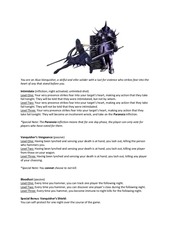
You are an Alua Vanquisher, a skilful and elite solider with a lust for violence who strikes fear into the
heart of any that stand before you.
Intimidate (infliction; night activated; unlimited-shot)
Level One: Your very presence strikes fear into your target’s heart, making any action that they take
fail tonight. They will be told that they were intimidated, but not by whom.
Level Two: Your very presence strikes fear into your target’s heart, making any action that they take
fail tonight. They will not be told that they were intimidated.
Level Three: Your very presence strikes fear into your target’s heart, making any action that they
take fail tonight. They will become an incoherent wreck, and take on the Paranoia infliction.
*Special Note: The Paranoia infliction means that for one day phase, the player can only vote for
players who have voted for them.
Vanquisher’s Vengeance (passive)
Level One: Having been lynched and sensing your death is at hand, you lash out, killing the person
who hammers you.
Level Two: Having been lynched and sensing your death is at hand, you lash out, killing one player
from those on your wagon.
Level Three: Having been lynched and sensing your death is at hand, you lash out, killing any player
of your choosing.
*Special Note: You cannot choose to not kill.
Bloodlust (passive)
Level One: Every time you hammer, you can track one player the following night.
Level Two: Every time you hammer, you can discover one player’s class during the following night.
Level Three: Every time you hammer, you become immune to night kills for the following night.
Special Bonus: Vanquisher’s Shield:
You can self-protect for one night over the course of the game.
�
PROTECT AND SEVER: THE ALUA VANQUISHER
The Alua Vanquishers tower above other men, great hulking soldiers in dark steel armour, ready to
cleave bodies in two at the bidding of their master. Indeed, the Alua is an organisation of
mercenaries for hire, who protect the interests of whoever pays them the most gold. Their training
ground, the Alua Keep, is the stuff of legends. Based in the northern mountain range of the Sixteen
Claws, trainees are taught how to fight as one man armies, ready to assault enemy forces or protect
a single target.
At one time, this service was commonly used by the noble elites who had not yet grasped the skill
of swordplay, and needed a little more help getting from place to place unmolested. But, at one
point in their blood-soaked history, the Vanquishers were used as pawns in the game of interfamilial
rivalries, and things grew out of hand – two Vanquishers facing off against one another was not
something the Alua condoned. The battle wreaked havoc as the very streets became a warzone,
stalls and storefronts smashed as the broad sweeping blades clashed with dark steel shields.
Eventually one Vanquisher pinned the other; but he refused to kill his brother, ignoring direct
commands from the nobleman who had hired him.
“We do not kill our own kind.”
Enraged at this disobedience, the nobleman sprung upon his Vanquisher, pulling a knife from
within his robes. The flimsy weapon could do very little, and the Alua instinctively responded to the
threat. The nobleman died instantly, and the Vanquisher was arrested for murder.
After this, the Alua fell out of favour. No one wanted to hire a giant that wouldn’t obey them. Not
even the struggling merchants were comfortable bringing an Alua on their journeys across banditinfested roads in fear that the mercenaries would turn on them!
Though they continued training, their numbers dwindled. They stopped recruiting – not that there
were many soldiers eager to sign up – and slowly faded out of memory.
When the Great Rift opened, however, the Alua made a comeback. They sent swathes of their
soldiers out alongside the regular armies of the King, stood beside mages and monks, and battered
every monster that came within their sight. The swirling blades and charging shields were a sight to
behold; each Vanquisher could destroy groups of ten, fifteen, even twenty monsters at a time with a
well timed swing of their huge weapons. It was a truly deadly dance.
When the most twisted demons stepped out from the Pale Void, the Vanquishers were the only
warrior to remain unshaken; they stood firm and ran towards their foes, full of courage and lust for
violence. After all, many of the Alua worshipped Gogith, the Living Shadow, who taught that instincts
– however animalistic or primal – must be embraced above all else. Those that sought Gogith’s
guidance in battle were run through with a desire for destruction and bloodshed, seeking murderous
thrills to prove that they themselves still breathe.
Of course, as the greater demons poured out, the Alua fell.
But the Alua had not been rash. Though they had sent many of their experienced warriors into the
fray, a significant number had been kept behind. Salarenzo acknowledged the great skill and sacrifice
of the Alua, and proposed a deal to those who still lived; rather than surviving on scraps taken from
the monsters plaguing the towns to the North – as they had been doing for decades – the King
offered the Alua a royal contract; they would fight as elite generals in the Royal Guard, they would
support the king’s barons in defence of their own townships, and most importantly, the top Alua
generals would serve as the King’s personal guardians. In return, they would be kept well funded,
and could begin to expand their order once more.
And so it came to pass that when Aurorus passed his decree, he had the Alua at his disposal. But he
was concerned; he knew that a Vanquisher had disobeyed his master once before, with dire
consequences. He had to pick carefully; would the Vanquisher do his bidding, or would he be
betrayed?
�
You are an Assassin, a swift and decisive killer who can slash a throat and disappear again, before
your victim has even realised that they’re dead.
Stealth (buff; night activated; vari-shot)
Level One: Melding with the shadows, your votes do not show on the vote count for the duration of
the next day (one-shot)
Level Two: Melding with the shadows, your votes do not show on the vote count for the duration of
the next day (two-shot)
Level Three: Melding with the shadows, your votes never show on the vote count (passive).
Neurotoxin (infliction; night activated; vari-shot)
Level One: Creep up behind a target player and inject a toxin into their nervous system, delaying any
action they take during the current night phase until the following night (one-shot)
Level Two: Creep up behind a target player and inject a toxin into their nervous system, delaying any
action they take during the current night phase until the following night (two-shot)
Level Three: Creep up behind a target player and inject a toxin into their nervous system, delaying
any action they take during the current night phase until the following night (unlimited)
Assassinate (active; day activated; one-shot)
Level One: Sometimes you just need to kill for a bit of gold; publicly force a lynch through on a player
currently at L-1.
Level Two: Sometimes you just need to kill for a bit of gold; publicly force a lynch through on a player
currently at L-2.
Level Three: Sometimes you just need to kill for a bit of gold; publicly force a lynch through on a
player currently at L-3.
*Special Note: This skill cannot be used in a situation where a mislynch would result in an immediate
scum victory.
Special Bonus: Silent Strikes
If you are stealthed, you can choose to perform Neurotoxin during the day, and Assassinate can be
performed secretly by PM’ing the mod.
�
A FLASH OF BLADE IN THE NIGHT: THE ASSASSIN
There is no glamorous brotherhood of assassins in Malura; but there is a hierarchy. Those that need
money will often offer their services, but most will get caught before killing their target. Few people
put their faith in novice or rookie assassins, but those that get rewarded with a surprisingly
competent killer save themselves a lot of money. For this reason, inexperienced assassins tend to
work for poorer people with petty rivalries, whose targets are not well guarded – the sort of job that
doesn’t even count as an assassination. It is little more than hiring a thug to rough up the
competition – though, of course, a little more fatal.
But for those who have the spare cash, or those who require something very special, every town
has its vigilante. These masterful Assassins do not linger in one place for long, constantly moving
from hiding place to hiding place, but always remaining within the same city limits. After all, knowing
the environment is half of the battle; which guards like to sleep during their watch, which torches
tend to extinguish in a strong wind, which shadows stretch the furthest from street to street.
Contacting an assassin can be tricky; most spend their days taking on regular jobs, working as
labourers or shopkeepers, drinking in the inn or paying a visit to the brothel. For all intents and
purposes they are normal citizens of the township. But each assassin has his own contact method; it
might be a red sash tied to the waist of the interested party, or a blue hat hooked over a chair in the
inn; the buyer might be asked to stroll three times around a fountain anti-clockwise, or request a
particular denomination of coin when purchasing a particular item from a particular shop. Some of
the methods are, of course, completely false – no more than the product of wild rumours run amok.
And the call will rarely be answered immediately; it should not be surprising that guards looking to
pin a murder or ten on an assassin might attempt to contact the rogue themselves. The very best of
assassins scout out their client before they scout out their victim.
Assassins’ methods of killing can be as varied as the assassins themselves. Some prefer poison,
some prefer hidden blades, and some prefer to make a spectacle of the whole thing. Many consider
themselves refined killers, better than the thuggish brutes who clobber with clubs and fists, but they
are not immune to the pull of gold and certainly can get caught by what they would consider the
slow and stupid guards. One on one, the assassin must rely on speed and subterfuge to outsmart or
outpace his opponent; generally slender and sprightly, the assassin can’t withstand too many direct
attacks.
When the Great Rift opened, it did not affect the assassins all that much. There were a small number
of opportunistic merchants and the like who wanted to kill off their competition whilst everyone was
distracted, but few assassins felt the need to go to the front. And since no one really sung of
assassins’ exploits, it wasn’t as if the gods themselves had an issue with the killers.
So too, when Aurorus declared his decree on heroes, the assassins were unaffected, not least of all
because no one knew their real identities. Thugs and criminals carrying swords or cudgels were often
arrested after being searched for unauthorised weaponry, but the clever assassins themselves
concealed their arms.
Indeed, when the time came to send warriors to Llaranastra, some people even said that they saw
the King pacing around a fountain with a red sash tied to his waist...
�
You are a Barbarian Immortal, a rugged warrior, whose harsh experiences growing up in your
homeland of the Plains have made you resilient to many forms of damage.
Survivor (passive)
Level One: Your determination to persevere means that you take one extra vote to lynch for the
duration of the game.
Level Two: Your determination to persevere means that you take two extra votes to lynch for the
duration of the game.
Level Three: Your determination to persevere means that you take three extra votes to lynch for the
duration of the game.
*Special Note: This skill can never raise your lynch threshold above "n-1", where n is the current
number of players.
Battlescars (passive)
Level One: Your familiarity with dangerous combat means that you can survive one kill attempt.
Level Two: Your familiarity with dangerous combat means that you can survive two kill attempts.
Level Three: Your familiarity with dangerous combat means that you can survive all kill attempts.
Last Stand (passive)
Level One: You are so hard to kill that if you do ever get killed or lynched, you can still post for one
further game-day. You can no longer vote and do not count towards your alignment's number for
the purposes of win conditions.
Level Two: You are so hard to kill that if you do ever get killed or lynched, you can still post for one
further game-day. You can no longer vote, but you do count towards your alignment's number for
the purposes of win conditions.
Level Three: You are so hard to kill that if you do ever get killed or lynched, you can still post for one
further game-day. You can also still vote, and you do count towards your alignment's number for the
purposes of win conditions.
*Special Note: Further kills will not work on you during Last Stand. You cannot take any other actions
during this time, and will die when the day ends. This cannot be prevented.
Special Bonus: War Games
If the you reach L-1 without getting hammered, you will survive for one additional day if you make a
Last Stand during the following day phase.
�
HONOUR IN BATTLE: THE BARBARIAN IMMORTAL
The barbarian tribes of Southern Malura, brutish warriors who carved out an existence on the
barren Plains and sandy shores of Rook’s Coast, had arrived by boat some four hundred years ago.
They once called an outlying island, known to Malurians as Whalestone, their home, before a
tsunami threatened to wipe them out of existence. A few hundred barbarians made it into boats,
crossing the Malurian Ocean and landing at Rook’s Coast; they proceeded to rampage through the
coastal fishing villages, setting up their own civilization amongst the dunes and harassing any that
dared come too close.
However, the monarchy and scattered barbarian tribes co-existed peacefully enough since the
reign of Salarenzo’s great-grandfather, Urbantus, who took the throne some two hundred and fifty
years ago. Urbantus was a diplomat with a silver tongue, and had managed to organise a truce with
the barbarian’s Great Warlord, Jihnu. It hadn’t been easy; the two rulers had engaged in combat,
much to the displeasure of the king’s advisors. But, surprising all in attendance, Urbantus bested the
barbarian, a mortal blow for a culture built on warfare. In truth, it was the King’s superior weapons
and armour, thick white-gold plate forged in the royal smithy, that had given him the inevitable
edge.
“Give. Now.”
The King knew that to refuse would be to ruin any chance of alliance. And yet he also knew he had
something that the barbarian wanted. He couldn’t just hand it over without getting anything in
return. And so he offered a deal; “I will show you how to make your own; but in return, you must
respect our position at the head of this Kingdom and allow our citizens and merchants free passage
through your lands.”
Though he was wild, violent and short-tempered, the Warlord knew that he had been defeated,
and had little choice than to submit to the King, entering into a truce that has held ever since.
When the Great Rift opened, the barbarians sent their Immortals to fight alongside the rest of the
kingdom’s forces. Battle-tested and ready, the barbarian warriors were the most revered soldiers
across all the lands of Malura. To hold the title of Immortal, a barbarian warrior must have fought in
over one hundred battles, skirmishes or duels, having never lost once; testament to their power and
longevity, the barbarians had nearly a thousand such warriors.
But faced with the demons of the Pale Void, they failed to live up to their name; falling in great
numbers, the civilized world and the barbarians bled as one.
Jinhu himself, now nearly five hundred years old, stood amongst the ranks of The Order, fighting
back the horrors with the very weapons that Urbantus had taught him to forge all those years ago.
But in the aftermath of the battle, the barbarian tribes were left scattered and without a clear
leader. Their golden age as the most renowned warrior force had come to a faltering end; with no
one to unite them, fighting erupted on a small scale across all the Plains, each rookie warrior vying
for that most glorious position at the head of all tribes. Soon, however, very few warriors were left
standing, and once the blood had dried, the barbarians as a whole were left as little more than a
series of disconnected farming villages. Some tribes fell back into their old ways, harassing the
Kingdom’s citizens that came too close, but many simply lived out their lives in relative peace and
quiet.
But, true to their nature, the barbarians were the first to pick up their weapons and go out on the
hunt once more. Their god was Huroa, the Bringer of Warfare, after all. The barbarian mystics,
reading the seasons and the weather, did not believe that the Great Rift opened as a vengeful act of
god; they thought it was a challenge sent by Huroa to test them, a challenge that they had failed. It
seemed natural that they would begin to satiate his desire for destruction once more by seeking out
further violence. Still disunited, they never managed to regain their former glory, but without a
doubt the Plains were amongst the safest places in the whole Kingdom. Once the barbarians
returned their weapons to their hands, very few monsters survived to stalk the lands.
�
And so it was with a great sense of dread that the Royal Guards handed over the decree.
Unsurprisingly, the barbarians fought back; they had respected the rule of the Kingdom because for
a long time they had no reason not to. But now, this was an abomination against their god! Yet the
Royal Guard swept through each village, overwhelming the barbarians through sheer number;
Aurorus had expected resistance, and dispatched a great number of his men accordingly. Some of
the barbarians fell into chains, but many fell into their graves. The barbarians were not really the
sort of people to be taken to the jails in any other way.
�
You are a Barbarian Mystic, a trickster and occult magician, whose magic does not respect the laws
of logic and confounds the mind.
Mortal Coil (buff; night activated; one-shot)
Level One: Choose a single player to hex; if they are killed or lynched, you will die in their place; if
you are killed or lynched, they will die instead. Lasts for the current day and night phase.
Level Two: Choose a single player to hex; if they are killed or lynched, you will die in their place; if
you are killed or lynched, they will die instead. Lasts for the current and next day and night phases.
Level Three: Choose a single player to hex; if they are killed or lynched, you will die in their place; if
you are killed or lynched, they will die instead. Lasts for the duration of the game.
Mystic Eye (active; night activated; vari-shot)
Level One: You read the messages of nature to discover who visited a target player tonight (oneshot)
Level Two: You read the messages of nature to discover who visited a target player tonight (twoshot)
Level Three: You read the messages of nature to discover who visited a target player tonight
(unlimited)
Smoke and Mirror (buff; any time; vari-shot)
Level One: A fundamental illusionist trick, you reflect any action used on you during the current day
or night phase back onto its user (one-shot).
Level Two: A fundamental illusionist trick, you reflect any action used on you during the current day
or night phase back onto its user (two-shot).
Level Three: A fundamental illusionist trick, you reflect any actions used on you during the current
day or night phase back onto its user (unlimited; once per day/night cycle).
*Special Note: A reflected skill does not affect the Mystic. Skills that last more than one round are not
reflected if Smoke and Mirror is used after their initial use.
Special Bonus: Pale Message
You can leave a message to be publicly posted by the mod upon your death.
�
SMOKE AND MIRRORS: THE BARBARIAN MYSTIC
The barbarian tribes of Southern Malura, brutish warriors who carved out an existence on the
barren Plains and sandy shores of Rook’s Coast, had arrived by boat some four hundred years ago.
They once called an outlying island, known to Malurians as Whalestone, their home, before a
tsunami threatened to wipe them out of existence. A few hundred barbarians made it into boats,
crossing the Malurian Ocean and landing at Rook’s Coast; they proceeded to rampage through the
coastal fishing villages, setting up their own civilization amongst the dunes and harassing any that
dared come too close.
Though the Barbarians were a warfaring peoples, they still had a set of spiritual, religious beliefs.
The witchdoctors known as Mystics were an integral part of Barbarian life, and indeed, Jinhu had
employed a Mystic as his second in command since taking over the barbaric throne. The Mystics
advised that they had been forced to flee Whalestone because they were not yet ready to face the
god whose coming the tsunami foretold.
That Barbarian god was Huroa, the Bringer of Warfare. Some say his coming was brought about in
a moment of ecstasy during the sexual encounter between the sky and the land; others say he lives
in the whistles of the winds; still others talk of a great wave crossing the ocean, within which Huroa
plots his next war. The stories vary in content but one thing remains consistent; the place of the
Mystic as mouthpiece of the god.
When the Great Rift tore the sky in two, the Mystics knew that it would not end well. And yet, they
would not advise the Warlord to remain in place, nor would they attempt to redirect the Immortals.
To do so would be to spit on the face of their culture, and to turn away from the god who had made
them strong. The Mystics collected their battlestaves and war wands, and set out alongside the
Immortal army to face their death.
Jinhu himself, now nearly five hundred years old, stood amongst the ranks of The Order, fighting
back the horrors with the very weapons that Urbantus had taught him to forge all those years ago.
But in the aftermath of the battle, the barbarian tribes were left scattered and without a clear
leader. Their golden age as the most renowned warrior force had come to a faltering end. Once the
blood had dried, the barbarians as a whole were left as little more than a series of disconnected
farming villages. Some tribes fell back into their old ways, harassing the Kingdom’s citizens that came
too close, but many simply lived out their lives in relative peace and quiet.
The Mystics, reading the seasons and the weather, learned that Huroa had sent the Great Rift to test
the barbarians’ resolve and capabilities in the face of insurmountable enemy forces. They knew
nothing of the reasons offered concerning Lioar or Gogith, and if they had, they would have laughed.
Huroa was not concerned with the petty matters of man – as long as his people were fighting, what
did he care who drew the most attention? He became strong as they became strong, and to curtail
their fighting spirit was to slice his right hand clean off. The Barbarians re-armed themselves; they
would continue to fight.
The Mystics could see a great red cloud on the horizon; blood would be spilt, and alliances would
be drawn. The future of the Barbarian people hung in the balance; it looked as though very few of
them would survive. It would be down to a couple of great warriors – swordsmen and spellcasters
equally – to push through to the other end of the coming troubles. They had fled once before, and
the Barbarians were not a people to be called cowards again. The Mystics steeled themselves. It
would do no good to interfere here; let the danger strip the people of their weaknesses, let those
who were not strong enough fall to the blades of whatever was waiting around the corner. Only the
best would persevere, and only the best would survive. Many Mystics knew that they were not
prepared for combat; but that it only took one or two strong warriors to defeat an army of inferiors.
When the Royal Guard attacked, the Barbarians fought back.
�
You are a spirited Bard who travels the world singing of your exploits, bringing epic tales of heroism
and tragedy to audiences all over the globe.
Silvertongue (active; day activated; vari-shot)
Level One: You can persuade people of something that is true, having one true statement
modconfirmed in-thread (one-shot).
Level Two: You can persuade people of something, even if it isn’t true, having one lie modconfirmed
as true in-thread (one-shot).
Level Three: You are an expert at lying and deception, and can choose which player – if any – you
wish to appear to have visited at night, as well as being able to mask any factional kills you make as
another role’s kill flavour (unlimited).
Discord (active; night activated; one-shot)
Level One: Orchestrate a confusing tune, swapping two players' targets tonight.
Level Two: Orchestrate a confusing tune, swapping three players' targets tonight.
Level Three: Orchestrate a confusing tune, swapping four players' targets tonight.
Silence (infliction; day; one-shot)
Level One: You stun a player with negative sound-waves, preventing them from using any one word
of four or more letters for the rest of the game.
Level Two: You stun a player with negative sound-waves, preventing them from using any two words
of four or more letters for the rest of the game.
Level Three: You stun a player with negative sound-waves, preventing them from using any three
words of four or more letters for the rest of the game.
*Special Note: A player who breaks this post restriction will lose their vote for the current day phase.
Special Bonus: Reverberations
If Silence is used the day after Discord, all players whose actions were successfully swapped will also
be afflicted with the post restriction of Silence.
�
A TALE WHISPERED ON THE WIND: THE BARD
Bards were once very common throughout Malura. They were also a very varied people; some were
heroes who had seen battle first-hand, and who had decided to recount their epic feats to those
unable to face the battlefield, whilst others were spreaders of rumour and hearsay picked up in one
town and embellished in another. Still more fabricated their tales, weaving together the most
fantastic and exciting threads of drama in order to entertain their listeners and earn some gold.
Unsurprisingly, Bards tended to move around a lot; the same stories, even when drawn from an
impressive repertoire, can begin to dull over time. Moving onto new cities offered the Bard a
constant freshness and ever increasing opportunities to experience the world. A Bard telling of his or
her own exploits naturally benefited from ever changing environments and the lack of commitment
that this offered, whilst a story creator could gain inspiration from his time away from the city.
As might be expected from such a carefree life, Bards rarely allowed themselves attachment to one
particular person or place. Most had as many lovers as they do fines at inns, tending as they did to
slip out before paying their tabs in most cities they stayed at – although there always used to be a
kind of honorary pact between the innkeepers and the entertainers, since the custom a good Bard
could bring to an inn was often more valuable than the money for the room itself, usually justifying
their sneaky and hasty exit.
Bards were not only masters of the spoken word, many were also gifted musicians, capable of
memorising melodies after hearing them but once on a whole range of instruments. Their music had
a subtle effect on those who heard it, seemingly speaking to the heart and toying with the emotions
of the listener. A number of Bards were renowned for holding the handcuffs at bay with a well timed
tune and a well crafted lie.
When the Great Rift opened, many Bards flocked to it; most had seen smaller rifts before, and some
had even partaken in or witnessed their closing. Such battles always provided fantastic narrative
material, and no Bard wanted to lose the edge other his competition by missing out.
None had quite expected the massacre that they witnessed in those early days of the skirmish. The
monstrous creatures that burst out of the Pale Void maurauded through the assembled warriors,
dealing out death and maiming those that were not fortunate enough to perish immediately. The
beasts had no notion of the Bards as non-combatants, and those that had never fought before were
overrun and swiftly killed. Those that had been adventurers in their youth or those who still carried a
sword in one hand and a lute across their back managed to live a short while longer, but the
unexpected strength of the first waves of beasts was simply too much.
Some of the Bards managed to escape, hide, or meet up with other fragmented groups of heroes,
and some, who had had a longer journey, turned up after the slaughter of the first few days. It is by
the determination of these few men and women that a coherent record of the battle remains; those
heroes that survived often knew only their own particular series of fights, whilst the Bards could
supply an overview of the whole war. They also helped to keep morale high, recounting the days
victories, whilst their tales of the losses gave the warriors confidence that their deaths – should they
come – would not be in vain, and their battle would not be forgotten.
But after the Great Rift closed, no one wanted to hear the Bards’ tales of heroic deeds – it was that
sort of behaviour that had angered the gods in the first place. The Bards nearly slipped out of
existence, and with them, the great stories of the past. Only one or two Bards continued to ply their
trade, writing their stories down when no one would listen. Most others just played their
instruments, though their music lacked the heart that had made it so special before.
When Aurorus took the throne, it was the Bards who received the harshest punishment. The
court’s Royal Minstrel had first inspired Aurorus’ love for heroes, and he now felt that it was the
Bards who bore the greatest responsibility for the gods’ hatred of men; after all, if anyone
represented a culture of hero admiration, it was the Bard. They were stripped of their instruments,
and those who protested had their tongues cut out.
�
You are a High Priest, a pure-hearted soul who believes only in achieving the will of your god Lioar;
you spend your energies on helping those in need and protecting your allies.
Heal (active; night activated; vari-shot)
Level One: Lay healing hands upon a target player, protecting them from death tonight (one-shot).
Level Two: Lay healing hands upon a target player, protecting them from death tonight (two-shot;
once per night phase).
Level Three: Lay healing hands upon a target player, protecting them from death tonight (unlimited;
once per night phase)
Blessing (buff; night activated; vari-shot)
Level One: Bless a single player, making them appear aligned with the town for the current night
phase (one-shot).
Level Two: Bless a single player, making them appear aligned with the town for the current night
phase (two-shot).
Level Three: Bless a single player, making them appear aligned with the town for the current night
phase (unlimited).
*The targeted player will appear aligned with the town regardless of the sanity of the investigation.
Faith (buff; day activated; one-shot)
Level One: Investing all your faith in a single player as your saviour, you publicly prevent that player
from being lynched in the current day phase.
Level Two: Investing all your faith in a single player as your saviour, you secretly prevent that player
from being lynched in the current day phase. Lynching that player will allow the day to continue.
Level Three: Investing all your faith in a single player as your saviour, you secretly prevent that player
from being lynched in the current day phase. Lynching that player will end the day.
Special Bonus: Blind Faith:
You will always appear aligned with the town, regardless of your true alignment, and regardless of
the sanity of the investigation.
�
A SAMARITAN’S PUNISHMENT: THE HIGH PRIEST
The Brotherhood of the Light were the most dominant religious order in the Kingdom, united as they
were under the banner of Lioar, their guiding god. The Monarchy itself worshipped Lioar as its
primary deity, because Lioar was supposed to represent justice and protection, truth and honour.
Although each of the three surviving gods had a church within Yallum, the city of the Royal Court,
Lioar’s was the most impressive, a structure built entirely out of white marble and glass. A great
shining beacon stood atop its roof, allowing pilgrims to find their way to it with ease, even at their
darkest hour.
The Brotherhood allowed no member to perform another violent act, and so were irrevocably
estranged from the Templars who shared their god. Once, far it the past, it is supposed that the
Templars and the Brotherhood had belonged to the same Holy Family, marching as one into battle.
For though the Brotherhood were pacifists, their faith invested them with the power to heal almost
any wound, and prevent even the most fatal of blows. Indeed, their protective abilities extend to the
many churches built in Lioar’s honour, which have stood firm under the assault of weather and siege
for thousands of years.
The Brotherhood is the paragon of a meritocracy. Those who worship Lioar, but offer little else,
remain no more than acolytes. It is up to each member to take it upon themselves and find their
own way of contributing, whether that be through helping those in need, volunteering at various
healing centres, building churches, spreading the word of Lioar, or a whole host of other good deeds.
As an acolyte distinguishes himself, he is gradually allowed to lead sermons and ceremonies within
the church, eventually rising to the level of Priest, High Priest, and Archpriest. The leaders of the
Brotherhood are the White Council, whose members frequently move between their seats there and
their position as an Archpriest.
When the Great Rift opened, the Brotherhood of Light did not take up weapons, for that would have
been acting against their whole belief system. Nor did they move against Lioar; the White Council
determined that his participation in the war was either a test for his supporters, or a move intended
to protect him from the attacks of his fellow gods. That said, they did lay their healing hands upon
the wounded that fell during the battles. But the creatures of the Rift proved too strong, breaking
past the fighters and tearing into the priests who stood at the rear. Lioar did not come to save them,
and much of the Brotherhood fell with no means of defending themselves.
When The Order pushed the creatures back into the Pale Rift, the remaining members of the
White Council went with them. It is said that their assistance was crucial; though The Order were
strong, they were mortal, after all. One Council member, Archpriest Morgan, remained behind to
organise the relief effort, but with most of the Brotherhood dead, it was not particularly effective.
Convinced that Lioar’s true anger had been directed at the Templars, the Brotherhood of Light
persisted with its activities after the Rift had been closed. It was with a heavy heart that Aurorus
ordered his Royal Guards to arrest the passive priests; many had led sermons from within the very
church where he first learnt about the gods. But he couldn’t allow petty feelings of remorse divert
him from his path; to do so would be to put the entire Kingdom in jeopardy.
It wasn’t a risk he was willing to take.
�
You are a Monk who has spent many years in isolation in the Irium Forests, training your body and
mind to fulfil and endure the most demanding tasks and challenges that you can throw at them.
Dual Fists (buff; day activated; vari-shot)
Level One: Your training allows you to strike with two fists at once, giving you a double-vote during a
day phase of your choosing (one-shot).
Level Two: Your training allows you to strike with two fists at once, giving you a double-vote during a
day phase of your choosing (two-shot).
Level Three: Your training allows you to strike with two fists at once, giving you a double-vote for the
duration of the game (passive).
*Special Note: The two votes do not have to be placed on the same person.
Irium Nectar (active; night activated; vari-shot)
Level One: Weaving in and out of sobriety, you can choose whether to watch, protect, track or block
your target (one-shot)
Level Two: Weaving in and out of sobriety, you can choose whether to watch, protect, track or block
your target (two-shot)
Level Three: Weaving in and out of sobriety, you can choose whether to watch, protect, track or
block your target (three-shot)
Meditation (active; any time; vari-shot)
Level One: Enter a state of meditation, restoring the natural balance of things and removing any
infliction effect from a single targeted player (one-shot).
Level Two: Enter a state of meditation, restoring the natural balance of things and removing any
infliction effect from a single targeted player (two-shot; once per day/night cycle).
Level Three: Enter a state of meditation, restoring the natural balance of things and removing any
infliction effect from a single targeted player each day/night cycle (unlimited).
*Special Note: The following are considered "Infliction" effects; Intimidate, Neurotoxin, Silence,
Necrosis, Life Drain, Sear, Shadowsnare, Devout Pact.
Special Bonus: Serenity
You cannot be affected by Infliction effects.
�
RIDERS OF THE COSMIC SKIES: THE MONK
Monks are a rare breed in the Kingdom. Turning away from all civilisation and order, the Monk is the
prototypical hermit. But more than this, Monks are amongst the only people in the whole Kingdom
who do not worship a god.
The Monks atheism allows them to concentrate solely on the natural world. They believe that the
world was created through a chain reaction of cosmic energies, and that it only exists as a counterbalance to the chaos of the skies. Whilst the skies arbitrarily create and destroy matter at an
unbelievable pace, the world gradually and purposefully expands. Unlike the believers of the gods,
the Monks think that when we die, our soul does not transcend existence and reach a higher plane
alongside the gods; rather, our body forms one with nature, which is slowly tipping the scales in
favour of our world as it amasses more energy from the deceased. When the world possesses
greater energies than the chaotic cosmos that birthed it, the skies will be wrenched from their
positions, plummeting earthwards, crushing the planet and causing another series of chain reactions
that will birth a new world. The Monks are the only ones who will be able to ride the waves of the
skies to this new world, allowing them to pass the story of the birth of the world down the
generations, until the next time, and so on, ad infinitum. The legends of the Monks claim that this is
how they came to exist on this planet, and how they alone understand the secrets of the world.
Preparation for the end of this world and the start of the new one is understandably a daunting
task. The Monks must steel their bodies and their minds, and spend much of their lives meditating
and training themselves to endure harsh punishment. Their meditative state enables them to see
the tipping of the equilibrium, and is often brought about by consuming the sweetened liquid of
various plants found in the Irium forests. As such, the Monks habitat tends to be localised in this
area. Their theories about the world rarely spread further than their own confines.
It should come as no surprise that the Great Rift was ambiguously received by the Monks. Initially,
they celebrated the tearing of the sky as the ending of the world, as the scales finally being
overturned. But when the world remained stable, their understanding was shaken. Untold amounts
of bodies had been offered up during the war – why then had the world not collapsed inwards? One
of the eldest Monks, Esiah the Timeless, suggested that this was a test, a challenge. If they could get
inside the Void, they would be transported upwards to the Cosmos itself, where they could observe
the destruction of the planet from afar.
As it stood, the Monks worked with the Order to fight back the slew of Rift demons. Many died
along the way, but a significant number pushed through into the Rift itself. No one knows where
they went when it shut – though they certainly did not get to witness the end of the world.
It is unclear how the legends of the Monks lived on after it seemed that all of them had perished or
been sealed within the Void. It is rumoured that deep within Irium forest, the trees steal secrets;
perhaps a traveller, losing his way, learnt of the legends in this way, and, convinced by their allure,
set about preparing for the end. Maybe a few Monks, so isolated from the world, had no idea that
the Rift Void had opened, and lived on, oblivious, for over a decade. Or perhaps Esiah had left some
Monks behind, in case she had been wrong. However their legends survived, they remained a hidden
and guarded secret for many years. Aurorus did not even know that they existed, until a drunken
Monk stumbled into two Royal Guards combing through Irium Forest. At first, the Monk was
arrested for his inappropriate behaviour, but soon, the new King figured out that he too was a hero.
This signalled the start of the hunt for all remaining Monks. Being atheists, they were the lowest of
the low, as far as Aurorus was concerned; none that were caught were spared, and all were
sentenced to death.
�
You are a Necromancer, an unholy mage who can call upon the souls and spirits of the recently
deceased to strike terror into the hearts of the living.
Commune (active; night activated; vari-shot)
Level One: Peering into the ether, you rend a soul back from the brink, allowing you to talk to a dead
player during the next day and night phase (one-shot; creates a QT).
Level Two: Peering into the ether, you rend a soul back from the brink, allowing you to talk to a dead
player during the next day and night phase (two-shot; creates up to two separate QTs).
Level Three: Peering into the ether, you rend a soul back from the brink, allowing you to talk to a
dead player during the next day and night phase (three shots; creates up to three separate QTs).
*Special Note: The skill can be used multiple times in one night, but each dead player will receive a
separate QT.
Revival (active; any time; vari-shot)
Level One: Giving a deceased soul a living manifestation, you command them to reuse their last used
ability on, or confer a random passive bonus to, yourself (one-shot).
Level Two: Giving a deceased soul a living manifestation, you command them to reuse their last used
ability on, or confer a random passive bonus to, yourself (two-shot).
Level Three: Giving a deceased soul a living manifestation, you command them to reuse their last
used ability on, or confer a random passive bonus to, yourself (unlimited).
Necrosis (infliction; night activated; vari-shot)
Level One: Select a target player, corrupting their flesh; if they are protected during the night, they
will die instead (one-shot)
Level Two: Select a target player, corrupting their flesh; if they are protected during the night, they
will die instead (two-shot)
Level Three: Select a target player, corrupting their flesh; if they are protected during the night, they
will die instead (unlimited).
Special Bonus: Spirit’s Guidance
Any Revivals used on a player that you have previously Communed are free.
�
GATEKEEPER OF THE DEAD: THE NECROMANCER
In the darkest corners of the kingdom, the Necromancer creeps. Turning their hands to dark, illegal,
demonic magic, these accursed souls reside on the very border between life and death. They spend
their days alone with the ghosts of the recently deceased, spirits who whisper their rotten secrets to
any ear that takes an interest in them, sometimes divulging more than they should. Necromancers
use the knowledge they gain to augment the power they reap from the souls of the dead; knowing
the circumstances of a death, they proceed to torment those who were involved, whether it is
focussing on loved ones or enemies of the deceased, drawing strength from the fear and horror that
these pseudo-hauntings inspire.
Their power is not infinite, however. The Necromancer cannot summon a human soul to flesh
forever, and the pursuit of the secret of immortality has cost many a Necromancer dearly. Often
living alone wherever shadows dwell, Necromancers must frequently test their powers on
themselves; bringing a dead frog back from the abyss is far easier than the same feat would be on a
humanoid. A great many Necromancers die at their own corrupt hand, and of those that survive,
most suffer an unshakeable bond to the afterlife and the corpses that litter the floor around them,
preventing them from ever leaving the demonic circle in which they cast their experiments. A
Necromancer who can push through this and emerge the other side unscathed is one of the most
feared magi in the entire kingdom, for once they have conquered the pull of death, little else can
hope to stop them.
An ultimate aim of many Necromancers’ pursuit of dark magic is to build an army of the undead,
resurrecting the same soldiers again, and again, and again, until they overwhelm their enemies
through sheer unkillable force. Necromancers are not picky; they will just as soon turn a slain
Barbarian against its people as they would funnel the power of a Priest to keep them safe. A
Necromancer surrounded by the death of the powerful is formidable indeed; but the brevity of their
control, weakened as they split their focus amongst multiple targets, seriously undermines the
potential for the Necromancer to construct a truly dangerous force.
One of the only times that such a despicable feat was possible was during the battle of the Great
Rift. The screaming of the dead, piercing the ears of the Necromancers at such sheer volume and
number, forced them into action. Emerging from their nooks and crannies, the Necromancers
converged at the Rift, channelling their power and sparking life amongst the thousands of bodies
that lay strewn across the ground. It was a terrifying sight; the jerky movements of the recently
deceased as they bore down on the creatures, falling to bloodied blows, but standing back up, struck
fear into the heart of the gods themselves. Never had the gods seen mere mortals tamper with the
balance of death on such a scale! But the Necromancers could not endure the fight for long; though
they surpassed all of their own expectations, the burden of reanimating corpse after corpse finally
took its toll, and those that did not retreat from exhaustion fell under the strain, bodies twitching
limply as their life force seeped away.
By the time he made his Royal Decree, it was difficult for Aurorus to track down the Necromancers.
They had slithered back to their hiding places; their short time amongst the living had convinced
them that things were better the way they were before. Residing once again amongst the cracks of
society, Aurorus had no idea how many Necromancers practiced the dark art, nor did he really know
where to find them; he only knew that they were a dangerous threat, not only to the gods, but also
to his own kingship. What if they united again, and came at him with full force? He didn’t stop to
consider how unlikely that would be.
When a Necromancer was eventually discovered, it was more by luck than anything. A team of
Royal Guards would be sweeping an area, and stumble upon their filthy huts, or unconver the marks
of a demonic circle on the ground. Some of the Necromancers, tied to the afterlife as they were,
could not run very far. Those that were free attempted to run, but not used to the need to escape
pursuit, were quickly caught and arrested.
�
You are a Nielwarren, a pale vampiric warrior who revels in violence and courts death at every turn,
generating great powers from the demise of the living.
Bone Tongue (active; night activated; vari-shot)
Level One: You study the bones of the dead, gaining insight into how they were killed (one-shot).
Level Two: You study the bones of the dead, gaining insight into how they were killed (two-shot).
Level Three: You study the bones of the dead, gaining insight into how they were killed (unlimited).
Death Absorption (active; night activated; one-shot)
Level One: Slipping amongst the carts carrying the latest dead bodies, you can spend one skill point
to gain one of the abilities of a target dead player.
Level Two: Slipping amongst the carts carrying the latest dead bodies, you can spend two skill points
to gain two abilities from up to two dead players.
Level Three: Slipping amongst the carts carrying the latest dead bodies, you can spend three skill
points to gain the abilities of up to three dead players.
*Special Note: Skill shots that have already been used up cannot be absorbed.
Life Drain (infliction; night activated; unlimited)
Level One: You suck the life out of a target player, funnelling any passive boosts they have to you
instead for one day and night cycle.
Level Two: You suck the life out of two target players, funnelling any passive boosts they have to you
instead for one day and night cycle.
Level Three: You suck the life out of three target players, funnelling any passive boosts they have to
you instead for one day and night cycle.
Special Bonus: Tethered Spirit:
If you are Communed by a Necromancer, you keep your QT open permanently and are allowed to
make one post per dead player during each day phase. You may not vote or take any other actions.
�
A NOBLEMAN’S UNDEATH: THE NIELWARRENS
Many years ago, there was an uprising against the throne. The Nielwarrens, an overly prosperous
and incredibly wealthy noble family, wardens of the North of Malura and overseers of Linport,
Malura’s busiest shipping town, attempted to lead an army against the king. It was a brutal civil war,
with the rebels sending a triple-pronged attack through the mountains and to either side. Thousands
of lives were lost. But whereas the Nielwarrens’ army was motivated by the weight of the purse, the
king’s guard fought with a sense of duty and honour; and though the Nielwarrens made it all the way
to the steps of Yallum, they could not penetrate the walled city. They had lost a good many of their
men to the treacherous swamps to the North of Yallum, and could not assault the steep steps which
led to the inner city and the throne of the king. The rebellious army was pushed back, until they
reached the Midmal mountains; some fled into the Shade, whilst others – wise as they were to the
dangers of the darkness – opted to surrender. But the Nielwarrens were too proud; the remaining
family members dove deep into
...
 Historical archive . public document