Oliver's Castle 1996 - further thoughts
The story of the 1996 Oliver's Castle footage continues to entreat us. Two things we can be certain of
are these: a) the man who showed it at The Barge on 11 August 1996 (calling himself John Weileigh)
was a year later identified as the very same man who then went under the name John Wabe; and b)
he was an outright liar! You have to ask yourself who is the more likely to be a faker - one who lies, or
one who tells the truth?
We know he was a liar because in 1996 he said he was camping on Oliver's Castle and 'happened to
see' balls of light. He then took out his video camera and filmed them. Yet when his video is viewed it
starts *before* any of the balls of light appear. So the camera must already have been running. That is
lie number 1.
Even assuming, however, that this story may be true, he followed it a year later (for National
Geographic) with a contradictory story claiming that it had been a hoax. Here he said he noticed a new
crop circle and took a video of it - later video-editing it to add balls of light and making it appear that a
circle was being formed by them.
At least one of these accounts must, therefore, be an outright lie. But the question is which one (if not
indeed, since at least one of them must be a lie, both accounts!). Clearly the dilemma is this:
"believers" will see the original story as being true and the latter false; while "non-believers" will
assume the opposite. But what about those with open minds? What are they supposed to believe?
One thing nobody can deny is that the man later known as John Wabe indeed WAS the person who
took the footage. At the end of the sequence his voice can clearly be heard to say "That's amazing" and it is the very same voice as that of the person interviewed a year later who claimed it was a hoax.
Furthermore, at least two independent witnesses identified "John Wabe" a year later as having been
the same person who showed the video the previous year at The Barge. Additionally, since he was in
possession of the video in 1996 it can be assumed that he must have made it himself (or at least been
part of the plan to create it).
But authenticity cannot be established merely by imposing 'belief systems' - that is the problem with the
two accounts. The first story was intended to make people believe one thing, while the second was
announced to make people believe the exact opposite! So 'beliefs' remain polarized - and the only way
of establishing an authenticity for either story is by a close forensic examination of the known facts.
�
Bert Janssen's recent review of the footage, together with a reconstruction through images of his own,
casts doubt upon the 'hoax' claim made in 1997 (although it does not, of course, validate the original
story). He concludes through his review that a) the camera must have been near to the grass and
could therefore not have been mounted on a tripod, b) that position is more consistent with the original
claim that the footage was the result of a chance sighting while camping, and c) Wabe's later account
of having faked the shot from the "tip" of Oliver's Castle was incorrect since the position must have
been further round to the NW.
The third claim (c above) can be briefly commented upon. If an aerial of the ramparts of Oliver's Castle
is viewed (as it can be in the images below) it will be clear which section is the "tip". Thought of not as
a single location, but rather as a geographic/topological feature, the proposed position is only 60 yards
round from the actual point of the "tip", but still clearly within the overall formation of the "tip". Even if
Wabe a year later did not get the precise position clear, it was certainly within a reasonable proximity
to the original camera position, and certainly at a point within what looks to be the "tip".
The first and second conclusions (a and b above) can only be settled by closer forensic examination of
Bert Janssen's images themselves. I believe that they will demonstrate - contrary to what he concludes
from them - that they do in fact support Wabe's second account (i.e. the "fake" one) more strongly than
his first account.
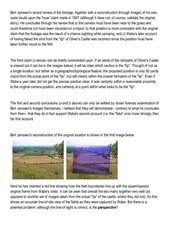
Bert Janssen's reconstruction of the original location is shown in the first image below:
Here he has inserted a red line showing how the field boundaries line up with the superimposed
original frame from Wabe's video. It can be seen that overall the two marry together very well (as
opposed to another set of images taken from the actual "tip" of the castle, where they did not). So this
shows an accurate line-of-site view of the fields as they were captured by Wabe. But there is a
potential problem: although the line-of-sight is correct, is the perspective?
�
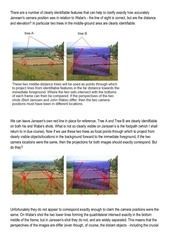
There are a number of clearly identifiable features that can help to clarify exactly how accurately
Janssen's camera position was in relation to Wabe's - the line of sight is correct, but are the distance
and elevation? In particular two trees in the middle-ground area are clearly identifiable:
We can leave Janssen's own red line in place for reference. Tree A and Tree B are clearly identifiable
on both his and Wabe's shots. What is not so clearly visible on Janssen's is the footpath (which I shall
return to in due course). Now if we use these two trees as focal points through which to project from
clearly visible objects/locations in the background forward to the immediate foreground, if the two
camera locations were the same, then the projections for both images should exactly correspond. But
do they?
Unfortunately they do not appear to correspond exactly enough to claim the camera positions were the
same. On Wabe's shot the two lower lines forming the quadrilateral intersect exactly in the bottom
middle of the frame; but in Janssen's shot they do not, and are widely separated. This means that the
perspectives of the images are differ (even though, of course, the distant objects - including the crucial
�
fields - remain almost identical in appearance). In order, therefore, to find exactly where Janssen
should have placed his camera, we need to project those two lines outside the image to find where
they cross each other (as they do in Wabe's). And it will be seen that in doing this it is also clear that
the elevation in Janssen's shot does not match that of Wabe's - Wabe's being taken from a higher
position.
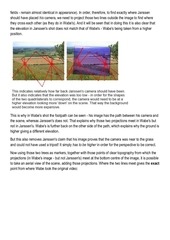
This is why in Wabe's shot the footpath can be seen - his image has the path between his camera and
the scene, whereas Janssen's does not. That explains why those two projections meet in Wabe's but
not in Janssen's. Wabe's is further back on the other side of the path, which explains why the ground is
higher giving a different elevation.
But this also removes Janssen's claim that his image proves that the camera was near to the grass
and could not have used a tripod! It simply has to be higher in order for the perspective to be correct.
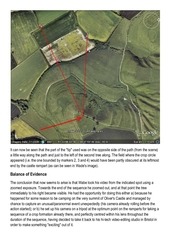
Now using those two trees as markers, together with those points of clear topography from which the
projections (in Wabe's image - but not Janssen's) meet at the bottom centre of the image, it is possible
to take an aerial view of the scene, adding those projections. Where the two lines meet gives the exact
point from where Wabe took the original video:
�
It can now be seen that the part of the "tip" used was on the opposite side of the path (from the scene)
a little way along the path and just to the left of the second tree along. The field where the crop circle
appeared (i.e. the one bounded by markers 2, 3 and 4) would have been partly obscured at its leftmost
end by the castle rampart (as can be seen in Wade's image).
Balance of Evidence
The conclusion that now seems to arise is that Wabe took his video from the indicated spot using a
zoomed exposure. Towards the end of the sequence he zoomed out, and at that point the tree
immediately to his right became visible. He had the opportunity for doing this either a) because he
happened for some reason to be camping on the very summit of Oliver's Castle and managed by
chance to capture an unusual/paranormal event unexpectedly (his camera already rolling before the
action started); or b) he set up his camera on a tripod at the optimum point on the ramparts for taking a
sequence of a crop formation already there, and perfectly centred within his lens throughout the
duration of the sequence, having decided to take it back to his hi-tech video-editing studio in Bristol in
order to make something "exciting" out of it.
�
The balance of evidence here, I believe, shows that through Janssen's own reconstruction the camera
position and setting was more likely to have been as his second "faked" statement detailed, and not
that according to his first "genuine" claim. For the first claim the camera would have had to be low, and
for the second high. The examination above of perspective argues for a higher position, and the
location indicated suggests to me that a) it would be an unlikely and over-exposed position to pitch a
tent, and b) it would have been a perfect position to mount a tripod in order to carry out a prearranged
hoax.
The obvious explanation for making a hoaxed video appear "genuine" - needing as it would an
explanation as to exactly why Wabe was in that remote location at that time - would be that he had
been there because he was camping.
Those who wish to cherish the belief that the event was genuine and real will go on believing the first
story, while those who are "disbelievers" will opt for the second. But for those who lie in between with a
still-open mind will need to look only at the actual evidence - of which there really is quite a lot.
Roger Wibberley
�
 Historical archive . public document