Contracts…
Exploring the required elements for
Contract validity
In the Real Estate Profession
6 Hours Continuing Education Credit TREC # XXXX
ITS School of Real Estate
ITSBusinessTraining@Yahoo.com
�
This Workbook is the property of
ITS School of Real Estate
ITSBusinessTraining@Yahoo.com
School # 1537
Course # 6815
September 2011
1st Edition
�
Learning Objectives…
This six (6) hour course for continuing education credit is designed
not only to help you meet your required educational requirements, but also
to examine the essential elements of a valid contract. We will look at a
contract first through a historical view. We will learn how the modern
contract is simply a product of an evolutionary process of adjustments and
tweaks to the English common law contracts we have had for a thousand
years.
Secondly, we will break down a valid contract into its necessary and
individual elements. We will examine how a contract is really a final
formal expression of these multiple elements. We will take each of these
elements and discuss them in detail.
Finally, we look at the contract requirements that are unique to the
real estate profession. We will then examine the role and purpose of the
Statue of Frauds, make sure we know the difference between the binding
and acceptance dates, and have a working knowledge of void and voidable
contract causes.
I hope you enjoy this study and take something away from this
course. Contract laws are an everyday reality for the real estate
professional, but how many of us are just filling in the blanks without really
understanding the history, necessity, and effects of many of these contract
elements.
Workbook materials by John Wilkinson
�
�
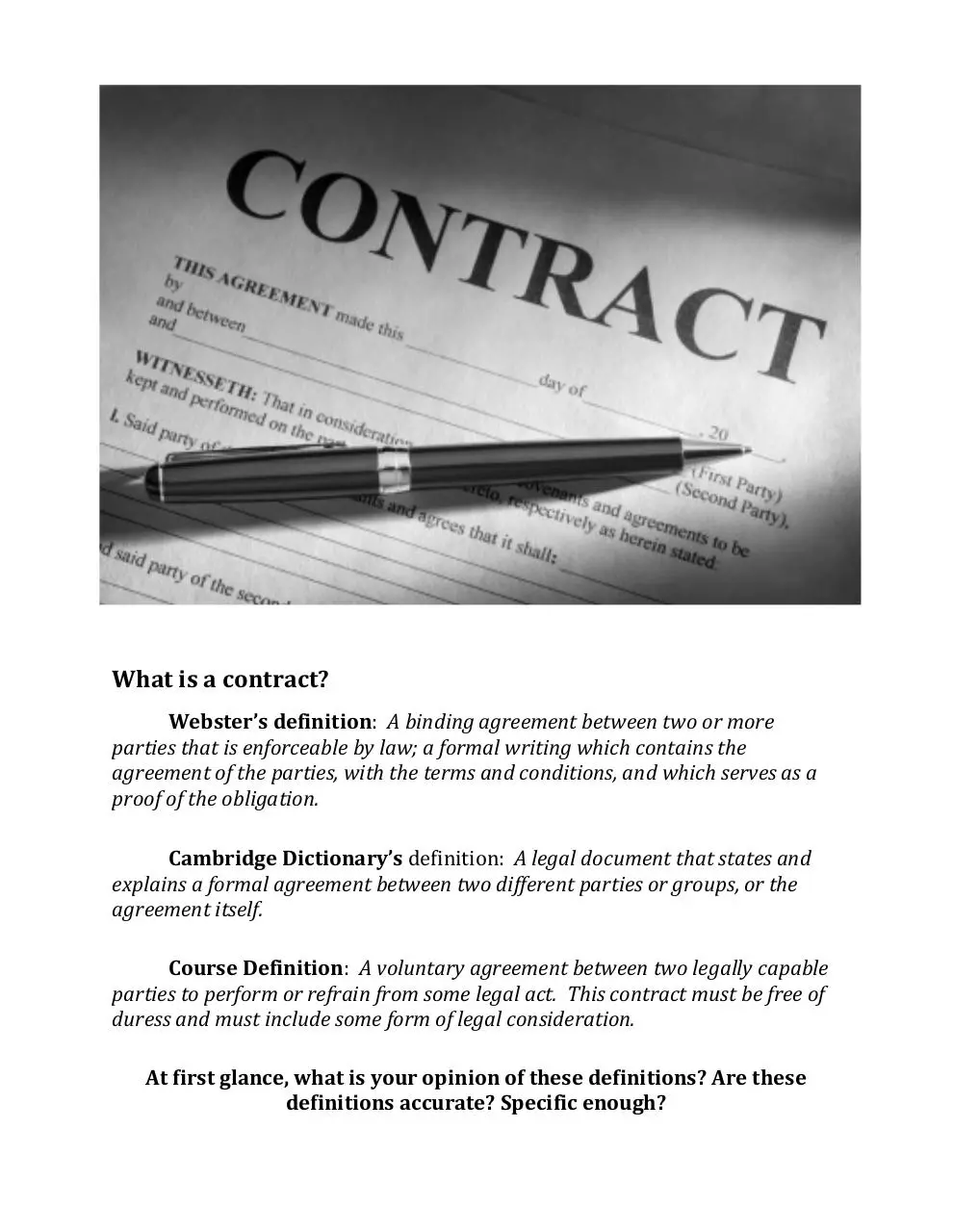
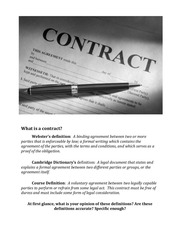
What is a contract?
Webster’s definition: A binding agreement between two or more
parties that is enforceable by law; a formal writing which contains the
agreement of the parties, with the terms and conditions, and which serves as a
proof of the obligation.
Cambridge Dictionary’s definition: A legal document that states and
explains a formal agreement between two different parties or groups, or the
agreement itself.
Course Definition: A voluntary agreement between two legally capable
parties to perform or refrain from some legal act. This contract must be free of
duress and must include some form of legal consideration.
At first glance, what is your opinion of these definitions? Are these
definitions accurate? Specific enough?
�
As we work through this study of contracts we will refer back to these
definitions and you will be asked to develop a new definition that
incorporates the elements of validity, the necessary parties, and duties.
Historical Perspective…
Elements in common law…
A common misconception is that the contract law practiced in the
United States legal system today is a creation of our founding fathers and
lawmakers of early American times, but in reality our contract law crossed the
Atlantic with the first English settlers who brought their “common law” with
them.
“A basic axiom to remember is that in the history of the world, as people of
different cultures mingle through trade, travel, and immigration or war, we pick
up pieces of other people’s culture and religions and incorporate them into our
own. This evolutionary process is so slow that it is barely noticeable.”
Gene Vitamamti
The term common law…
“Common law is that which is based on custom or usage of the common people
as opposed to law imposed from above by a higher source, such as a monarch,
dictator, or religious leader. It is a slow process that is always adjusting itself.”
“Note that the common law is designated “ common” because it was a law
common to all of England and administered by a central court, as distinguished
form the customary law that varied, albeit often in manor ways, from county to
county, lordship to lordship, or manor to manor.”
Gene Vitamamti
�
In reality, the 1st elements of the English common law that later evolved
into the contract law that we have today began in the 12th century. For the
first time, laws were set down to establish the methods by which the evidence
or “proofs” of a contract or debt could be proven. Initially there were three
options.
1st Proof by Duel… Yes, this is what is implied by the name. As in a
Hollywood film, two parties would settle their dispute with weapons. The
theory behind this arrangement is that the hand of God would guide the
righteous party to victory. For obvious reasons, we are not going to spend a
lot of time on this option.
2nd Proof by Witness… The proof of a debt or contract could be proven
by the swearing of an oath by two or more witnesses as to the validity of a
contract or debt. Initially there were no safe guards, as to the reliability of the
witnesses, or the option of examination or defense of the accused party. The
simple presentation of two or more witnesses was proof of the debt. We can
quickly see how this option could be used a dishonest party to produce
“proof” that did not is reality exist.
3rd Proof by Writing… The proof of a contract or debt could be proven
by the existence of a written agreement. Initially there was not any set form
or required elements, these would come later and by the 15th century this
would be the expected and preferred form of proof.
For the past 800 years, the evolution of this common law into today’s
contract law has been a continual process of trying to prefect this idea of
“proof” while trying to guarantee that the contract is an accurate
representation of the original deal or agreement. In this evolutionary process,
the idea of consideration, or proof of benefit, was established. The first
requirements for written contracts were establish with the first Statue of
Frauds, and other rules and requirements for elements of a valid contract
were slowly codified.
As we work through this course, if you will examine each element of
contract law as it fits into this evolutionary process, its function will become
�
clearer. Each element of a contract should work to identify the parties or
property, articulate the agreement, or prove the existence of the agreement.
What four principles would be in your definition?
1.
2.
3.
4.
Give me your definition of a contract.
�
Expressed vs. Implied Contracts
Expressed Contract: This is a contract in which the terms are expressed
explicitly, either in writing or verbally. The term and scope of this agreement
have been detailed and agreed upon beforehand, and the parties have reached
an agreement and mutual understanding. In this type of contract, there is no
ambiguity as to the details or agreement; it has already been worked out.
•
Don’t fall into the common trap where students believe expressed
contracts can only be in writing, verbal contracts can also be expressed.
Implied Contract: This is a contract in which the terms have not been
expressed in words, either orally or in writing. The terms and agreement of
the parties can only be determined on inferred by examination of the actions
taken by the parties. The evidence of the contract is shown the interaction or
subsequent exchange between the parties.
• An Implied Contract can be either Implied in Fact or Implied in Law
Implied in Fact: This is a contract in which the circumstances imply the
parties have reached an agreement even though they have not done so
expressly.
An example would be… If you walk into a restaurant, sit down, order a steak,
and eat the steak. Upon completion of the meal you are expected to pay for the
meal.
Implied in Law: This type of contract can also be called a quasi-contract. It is
not as much of a contract as it is a legal determination. This is a situation
where one party would be unjustifiably enriched if the courts were to hold
that a contract did not exist.
An example would be… An unconscious driver is removed from a vehicle
wreck and rushed to an ER where he receives live saving treatment. He is
responsible for payment to the hospital for these services.
�
Bilateral vs. Unilateral Contracts
Bilateral: This is the more common of the two; a bilateral contract is
where the agreement involves a promise by both parties. Both parties are
liable to each other for performance of their respective promises.
An example would be… John offers to sell his car to mark for $3,000. John
promises to turn over the car and the title, in exchange mark promises to pay
the agreed upon $3,000.
In this example, both John and Mark have made promises. In the event of a
breach by either party, the other party would have options.
Unilateral: In this type of contract, only one party makes a promise to
the other party. This promise acts an inducement to get the other party to
perform some action. In this type of contract, the requirement that
acceptance be communicated to the offeror is not required. The offeree
accepts by performing the action. When the required action is complete the
offeror is liable to the offeree for payment as advertised. In contrast, the
offeree is not liable unless he/she performs the action. The offeree can walk
away from the offer without recourse.
An example would be a sign in the front yard that offers $50 to the first person
who removes and Oak tree that was blown down in a storm.
Another example would be a $500 reward for the return of my lost dog, Binky.
In these examples, the offeror is making a promise to induce the offeree to act.
1st To remove the Oak tree
2nd To return Binky to his/her owner
Let’s work through some examples
�
Give four examples of bilateral contracts…
1.
2.
3.
4.
Give four examples of unilateral contracts…
1.
2.
3.
4.
What type of contract is an “Offer to Purchase” contract that is commonly used
in the real estate Profession?
Bilateral or Unilateral
�
Elements required for Validity
Mutual Assent: First and above all, there must be a “meeting of the
minds”. There must be an expressed or an implied agreement. This is a
requirement that both parties enter into this agreement knowingly and of free
will.
To have a mutual assent, the agreement must be free of…
1. Misrepresentations: This in an innocent misstatement of a material fact. It
must also be a misstatement that is relied upon by another individual that
suffered damages of some form. Note, that this is a MATERIAL fact.
2. Fraud: This is an intentional misstatement of a material fact that was
intended to deceive an individual, or was an intentional omission of a known
material defect.
3. Mistake: A mistake is a mutual misunderstanding between the two parties.
This does not involve a lack of judgment, ignorance, or unprofessional behavior
on the part of either party. It is simple a misunderstanding that prevents the
two parties from having a true “meeting of the minds”.
4. Duress, menace, and undue influence: This is to say that both parties
must be acting in free will and not under threat or fear of retaliation.
Consideration: This is by far the most complicated of the required
elements. We will study this element is detail in a further section, but for now.
Consideration is value promised by the offeror and/or legal detriment
promised or preformed by the offeree.
Competent Parties or Capacity: Both parties must have the ability to
enter into a legally binding contract. Both parties must also have the ability to
understand the terms and the implications of breach and his/her liability
within the terms of the contract.
�
In addition to employees who lack the authorization, children, mentally
disabled people, physically stricken and emotionally compromised people can
all be ruled as lacking the necessary capacity for entering into a contract.
A corporation is technically a entity and has the capacity to enter into a
contract.
Legal Purpose: Regardless of the form or elements found within a
contract, if the subject matter or purpose of a contract is illegal… The contract
is not valid
The courts will not enforce such a contract. It is said to be void “ab initio” or
void for the beginning.
Mutual Right to Remedy: Both parties must have an equal right to
remedy in the event of breach by the other party.
Examination of Capacity in more detail…
Give four examples of parties who could be held as lacking capacity.
1.
2.
3.
4.
�
Now, I want you to brainstorm and give me an example of a potential situation
that you might face where capacity is questioned when selling the home of an
elderly couple.
Now, I want you to develop a strategy for dealing with the previous situation
and by doing so, limiting your own and the firm’s liability.
Does your firm have a written policy for dealing with issues of capacity?
Yes or No
Here are some options…
1st Managing Broker involvement and authorization
2nd Next of kin involvement, disclosures and release forms
3rd Use of legal counsel for complex situations
�
Void, Voidable, and Unenforceable Contracts
Void: This is a contract that never came into existence. It lacked legal
purpose or other required elements for validity. This contract is not
enforceable upon either party.
For example, a contract with a drug supplier for a purchase of illegal drugs
would be void.
Voidable: If one of the parties in a contract has the option to terminate
or cannot be held liable, this contract is said to be voidable. It is important to
note, that just because the contract is not enforceable on one party, this does
not release the liability against the other party in the contract.
An example would be a contract with a minor, the contract can be terminated
by the minor…. But this same contract cannot be terminated by the merchant
or other party if they have legal capacity.
Unenforceable: This is a contract that may have the required element
of validity but neither party can force the other party’s obligation.
An example of this could be the verbal agreement to purchase a home for
$100,000 cash. This contract would be unenforceable because the United
States Statue of Frauds requires the contracts for the purchase of Realty to be
in writing.
• It is important to note that in the above example, if the buyer appeared
with the $100,000 and the seller appeared with the deed, the sale could
go through and be a valid sale. The difference is that if either party
backed out, there would be no recourse for the other party.
�
Executed vs. Executory Contracts
Executed Contract: This is an agreement or contract in which both
parties have fully performed their obligations.
For example, if John was offering to sell his watch to Mark for $200 and Mark
accepts. This contract would be executed WHEN John handed over the watch
and Mark paid the $200. The obligation would have been fulfilled and thus
the contract would be executed.
In contrast…
Executory Contract: This is an agreement or contract in which one or
both of the parties have yet to full perform their obligations.
Using the previous example, If John offered to sell his watch to Mark for $200
at the first of the next month when Mark receives his paycheck. If Mark
accepts these terms and agrees to the purchase, this would be an Executory
contract because Mark has yet to pay and John has not turned over the watch.
These two have a valid contract, but are yet to perform their obligations to
each other.
“Subject To” Contracts and Contingencies
If a contract is a ”subject to” contract, it may fall in to one of these three
categories
1. The parties are immediately bound to the bargain, but they intend to restate
the deal in a formalized contract that will not have a different effect.
2. The parties have completely agreed to the terms; but have made the
execution of some terms in the contract conditional on the creation of a
formalized contract.
�
3. It is merely an agreement to agree, and the deal will not be concluded until
the formalized contract has been drawn up. This is shown in Masters vs.
Cameron (1954) 91 CLR 353
If a contract specifies “subject to finance”, it imposes obligations on the
purchaser.
1. The purchaser must seek finance
2. When offers of finance arrive, the purchaser must make a decision as the
suitability of the offers.
Inherent in these conditions is a necessary element of good faith.
Meehan v. Jones (1982) 149 CLR 571
What are four ideas for protecting you client (seller) when presented an offer
with a “subject to financing” contingency?
1.
2.
3.
4.
�
Consideration
I think it is important to take a good hard look at this elusive concept of
consideration. It is very possible a real estate professional can have a
successful career and never fully gain a working understanding of this
antiquated element of contracts.
Under the historical English common law, consideration was required
for a contract to be enforceable. Modern interpretation on the other hand has
viewed contracts to be enforceable simply upon the principle of promissory
estoppel.
Promissory Estoppel: A doctrine of law that stops one from later
denying facts which that person once acknowledged were true and others
accepted on good faith.
The Two Theories on Consideration…
Benefit – Detriment Theory: To constitute consideration, the contract
must include an element of consideration that is either to the benefit of the
promisor or to the detriment of the promisee.
Benefit to the Promisor
-orDetriment to the Promisee
A historical case to examine this concept is from the 36th year of the
Reign of Henry VI (1459 A.D.)
The central question, “Is a father’s flippant and off the cuff verbal promise of
money made to a suitor in exchange for the suitor’s marriage of the father’s
daughter a legal debt?”
The courts were asked to determine… Was there a benefit to the father? Was
there a detriment to the suitor?
�
The judges were unable to reach a unanimous opinion; some judges
decided that simply getting rid of the daughter served as viable benefit to the
promisor (father) and that having to marry the daughter served as a viable
detriment to the suitor (Promisee). The daughter herself was argued to be the
actual consideration and therefore this was a legal debt owed by the father.
Ultimately, these judges were overruled and this debt was ruled to be invalid.
I use this example for two reasons. First, this example can create a wildly
entertaining argument in a room full of students, and secondly it serves as a
good introduction for the second and modern theory of consideration.
The Bargain Theory: The contract is seen to be a product of an
exchange or bargain between the two parties. For example an “off the cuff”
remark to sell a car for $50 would not become binding if a bystander yelled,
SOLD. In this evolution of consideration theory, the courts will not investigate
the adequacy of the consideration, but will rather look for the evidence of a
“bargain” or agreement between the two parties. In this theory, the intentions
of the parties are investigated to determine if the contract reflects a true and
intentional negotiation or offer.
Consideration vs. Earnest Money…
I hope by now we have cleared up some of the misconceptions involving
consideration, but there are still some out there who will confuse
consideration and earnest money. They will tell your buyers that earnest
money is a legal requirement for an offer-to-purchase contract.
Earnest Money: This is money given in addition to an offer to purchase
to show sincerity on the part of the purchaser to go through with the deal if
the offer is accepted
�
Breach of Contract
Breach: A breach is a violation of any of a contract’s terms without legal
excuse.
If the seller defaults, the buyer has three alternatives…
1. The buyer may rescind or cancel contract
2. The buyer may sue for “specific performance”
3. The buyer may sue for “compensatory damages”
If buyer defaults, the seller has four alternatives…
1. The seller may declare the contract forfeited; the contract may well contain
provisions for the seller to retain the earnest money and or be due an
additional sum.
2. The seller may sue for “specific performance”
3. The seller may sue for “compensatory damages”
4. The seller may rescind (cancel or terminate)
Liquidated Damages: A specific sum that is agreed upon by both parties and
is to be paid in the event that a future breach occurs. This method is used when
establishing damages as a result of breach would be difficult to estimate.
Compensatory Damages: All costs or losses actually suffered and proved
caused by the breach. This includes incidental (expenses incurred by the non
breaching party) and consequential damages (known foreseeable loses).
�
Punitive Damages: Damages awarded to affected party to be paid by the
breaching party or wrongdoer as a form of punishment. This is rarely seen in
breach of contract cases.
Specific Performance: The nonbreaching party (usually the buyer) can ask
the court to order the breaching party (the seller) to perform the contract. This
does not apply to personal service contracts.
Three legal excuses for breach of contract
1. Discharge by agreement of both parties
2. Discharge by operation of law
* Change in law that makes action illegal
* Statue of Limitations
* Bankruptcy Decree
3. Impossibility of performance
* Natural disaster
* Fire or some other destruction of property
�
Important Contract Terms
Substantial Performance: This is a contract that is nearly completely
fulfilled, this level of performance may be sufficient to force payment by the
other party.
Option Contract: An option agreement is a contract between the
owner and a potential buyer… This contract allows the potential buyer to buy
a piece of property within an agreed upon window of time for an agreed upon
price if he or she chooses… The buyer does not have to go through with the
purchase. The owner does have to sell, if the option is exercised… This option
is usually accompanied by an option price or fee that is not refunded if the
buyer does not complete the deal.
Contingency: This is a requirement found in the offer or contract that
requires that some action, some duty, or some event be satisfied before the
contract can be executed… without satisfaction, the contract will be void.
1st Right of Refusal: The first right of refusal gives the owner of this
right the first chance of buying the property if the property owner decides to
sell… the owner is not required to sell, the owner of the right is not required to
buy…The price does not have to be set in advance.
Assignment: The transfer in writing of interest in a bond, mortgage,
lease, or contract
Novation: the substitution of a new contract in place of an older one,
this action terminates and replaces the old contract.
Mirror Image Rule: This rules states that if you are to accept an offer,
you must accept the offer exactly, without modifications; if you change the
offer in any way, this is a counter offer which kills the original offer.
�
Statute of Frauds
In some circumstances, a contract meeting all of the previous
requirements for validity must meet the legal requirement of being in writing
to be enforceable. The purpose of this requirement is to have written proof of
the contracts existence and to detail the terms.
The Six types of contracts that fall under the Statutes of Frauds…
1. Guaranty of debt contracts
2. Contracts involving an interest in Realty
3. Contracts impossible to perform within one year of formation
4. Contracts for the sale of goods priced at $500 or more
5. Premarital or Antenuptial Contracts
6. Promises of Executors for Personal Liability for debts of the deceased
The Six types of Realty contracts that fall under the Statutes of Frauds…
1. Real Estate Purchase Contracts
2. Leases of Realty
3. Mortgages of Realty
4. Easements
5. Creation of Life Estate
6. Real Estate Broker Contracts
�
Interpretation of a Written Contract
Parole Evidence Rule: A fully integrated and complete contract clearly
written cannot be contradicted, varied, or altered by evidence of the parties
prior negotiations, prior agreements, or contemporaneous oral agreements
General Rules of Interpretation…
1. The meanings of terms are assumed to have their ordinary meaning; if
technical, their technical meaning.
2. Any and all ambiguities will be construed against the party who drafted
the contract.
3. No contradictions… a written contract can be explained, but not
contradicted by trade practices, course of performance, or course of dealing.
Uncertainty of Incomplete Contracts
In the event a contract is formed that is incomplete or ambiguous on key
elements of validity. This contract is said to have “failed to form” or does not
exist. If a key element such as price or terms of the performance is left blank
or is yet to be determined, the parties have yet to have reached a “meeting of
the minds” and do not have a contract. A contract cannot simply agree to
agree at some later date.
�
The Listing Contract
The most common contract a real estate professional will enter into is
the listing contract. This contract will create an agency or fiduciary
relationship between you and the client, detail the terms of that relationship,
and detail the terms and scope of the contractual engagement. Unlike the
contracts that we commonly associated the purchase of a home, this contract
is not between a buyer and a seller… it is a contract between YOU and the
seller.
Requirements of a valid Listing Agreement…
1. Name and Signatures of both parties… This will also require your
appropriate firm information also be supplied
2. Formal property description
3. This contractual arrangement should be for a definite period of time… there
must be an expiration date.
4. Formal fee structure and amount to be paid to broker upon completion of
assigned task. This does not have to be a percentage; it can be a flat fee, any
hourly wage… or some other agreement.
5. Creation of an agency relationship
6. Agreement upon the type of listing the brokerage is to have
7. Asking Price
Termination of an Agency or Listing Agreement
1. Performance or success of the broker
2. Destruction of the property
3. Condemnation of the property
�
4. Bankruptcy of either party
5. Expiration of the Listing
6. Abandonment by the Agent
7. Cancellation by either party, or by mutual agreement
8. Death or insanity of either party
9. Revocation or lapse of broker’s license
The Four Types of Listings
Open Listing: This is a listing arrangement with a seller that is not
exclusive to any one brokerage. The seller has the right to employ any
number of firms to sell his/her real estate. In addition, the seller reserves the
right to pay only the agent who produces the buyer and can withhold payment
to all firms if the seller produces the buyer.
Exclusive Agency Listing: In contrast to an Open Listing, this type of
listing is exclusive to one particular firm. If an agent from ABC Realty signs
this seller, then only ABC Realty will market and have to right to collect the
listing portion of the sales commission. As with Open Listings, the seller still
has the right to produce a buyer, and withhold payment of the commission
because the agent did not produce a buyer.
Exclusive Right to Sell: Like an Exclusive Agency Listing, this type of
listing is limited to only one firm. In contrast to the previous two types, the
agent is due a commission regardless of who produces the buyer. The agent
need not be the procuring cause of the sale. The agent needs only to be able to
prove the existence of this listing to be entitled to his/her share of the
commission.
�
Net Listing: This type of listing arrangement is commonplace and
accepted in many industries and parts of the country. The seller gives the
broker a fixed price the he or she expects to be paid. The broker is then free
to sell the article on behalf of the buyer at any price equal to or greater than
the set price given by the seller. The agent is entitled to the entire amount in
excess of the set price.
For Example: John lists his farm with agent Bill. They have agreed that any
amount that Bill is able to sell the farm for in excess of $400,000 will be kept
by Bill. Bill sells the farm for $449,000. Bill is entitled to a $49,000
commission.
Although commonplace in some industries, the Tennessee Real
Estate Commission has ruled that Net Listings are forbidden for use by
licensed real estate agents in Tennessee.
Why do you think net Listings are not legal?
1.
2.
3.
In this coursewe will use TAR forms, neither the Tennessee Real Estate
Commission or contract law requires any set provider of contract forms, but it
is stronly advisable that you and your firm use forms that have been created
and reviewed by competent legal professionals.
�
Sample Listing Contract…
The Robertsons
In the following pages, you will be provided with the necessary
information to fill out a listing contract, a buyer agency contract, and an
offer to purchase contract. You will not be asked to turn in these forms, but
the questions on the final will ask you for your entry on certain lines.
Take note, the questions will ask you for the entry on a certain line
number…On a certain date. Follow the information carefully as
negotiations progress, because the date of the question will affect your
answers.
This process will allow you to be creative and fill in some of the
information that is not provide to you…but take care to include the
necessary elements of validity.
�
Listing Contract Information…
Broker:
Broker: This is the name of the firm where you work; this is your chance to be
creative, Give your new firm a name, phone number, and address
The client or sellers: Ken and Mary Robertson
This is the legal description and street address to use…
123 Somewhere street, Small Town, Tn 37777
Rutherford County…Deed book #1, page #1
Asking Price: Your CMA suggest a home value of $158,000
On 4/15/XX When the Robertson list their home the asking price is $168,500
On 6/21/XX the asking price is lowered to $163,900
Your listing date is April 15th of this year and expires in 90 days
Your firm does not use a carryover clause.
clause
Possession with be given “with deed”
Your assessment of the Robertson’s home suggests it will qualify for all types of
financing and the Robertson’s agree.
The Robertson have “2” remotes for the garage door opener
The home has a storage building will remain on the property
The home has an above ground swimming pool will be removed prior to closing.
�
The water softener system is leased for $199 a year, payable ever February 15th
You and the Robertsons have agreed upon a 6% commission,
commission, they have agreed
with a 3/3 split with cooperating MLS member
The Robertsons are not in a position to lease the home
The Robertson choose not to offer a home warranty
Confidentiality… none
Exhibits and Addendums… none
Special Stipulations… none
Lines 338 – 344 … You will fill out and sign this area and then turn the document
over to the Robertsons to sign
�
�
�
�
�
�
�
�
Buyer’s Agency and Offer to Purchase Contract…
By chance you meet Mrs. Anita Fuller
at the gym, and discovered she is looking
to buy a home. She has contacted you and
asked that you help her prepare an
offer on the home she hopes to
purchase.
Please use the following
information to fill out the
Buyer Agency and
Offer-to-Purchase Contract
found on the following pages
�
Buyer Agency…
Agency…
As with a listing agreement, this is again a contract between yourself
and your client. In this case, it is with a potential “buyer”. This contract
details the duties and expectations of the two parties to each other, but
more importantly it “locks” down a buyer for a single agent.
This “locking in” of a buyer can be one of the most controversial and
disruptive practices in the real estate profession. The “issue” is the
disclosure to and understanding of potential buyers. Do we really believe
that most buyers who sign this contract are aware of the implications? Does
the damage done to inter-firm relationships by unscrupulous agents worth
the trouble? Should an agent whose only skill is signing up potential
buyers and turning them loose for others to service be paid a commission?
In fairness, there are good reasons to use such a contract… You are
investing your time and resources into this potential buyer. When a home
is listed with an exclusive listing agreement that seller has been locked in
with one particular agent… Why is this different? It may not be.
The question for the Real Estate community to answer is how are
these contracts being used? Are they being used as protection or as a
preemptive strike? If your client is driving around town and attending
open houses without you even knowing, if they are searching the internet
and contacting other agents for information…are they your client, really?
My personal position is that these contracts are only to be used when
a home has been found and you wish to create an agency relationship with
the buyer before beginning a lengthy negotiating process. The process of
searching for a home in my opinion is a job interview between yourself and
the potential buyer, the buyer should want to use you when they find the
first home they wish to buy…they should not be required to. If you need
the Buyer Agency Contract to keep clients, you might need a new
profession. Once again just my opinion…
�
Buyer Agency Contract…Mrs. Anita Fuller
Broker Info: Be creative…
Buyer: Mrs. Anita Fuller – Give her an address
Expires in 90 Days
Mrs. Fuller is looking for a 3 Bedroom Home with at least a half an acre. She
doesn’t want to spend more than $150,000, and the home must be in Rutherford
County.
You have agreed upon 3% on FSBO
Mrs. Fuller wants a fenced yard is possible
Mrs. Fuller want an enclose garage if possible
Mrs. Fuller is not available for showings before 5pm on workdays and on Sundays.
Line 154…
What are some examples of situations where a client might
154
release the agent from normal duties of confidentiality???
1.
2.
3.
You will find a Buyer Agency Contract on the following pages
�
�
�
�
�
�
Offers and CounterCounter-Offers…
The exchange of an offer for an acceptance is the traditional method
for determining if an agreement or contract between two parties exists.
This contract is said to have been formed if there is an expressed or implied
agreement. A contract is said to have come into existence when acceptance
of an offer has been communicated to the offeror by the offeree.
Offer:
Offer This is an expression of willingness to contract on certain
terms, made with the intention that it shall become binding as soon as it is
accepted by the person to whom it is addressed, the “offeree”.
An offer can be withdrawn at any time before acceptance by the other party
Counter – Offer: This is simply a follow-up offer to a previous offer…
It is important to remember the effect and consequences of a counter-offer.
By making this counter, you are formally rejecting the previous offer or
counter-offer. Once rejected any attempt to accept a previously rejected
offer… is a counter-offer. The original offeree can then choose whether or
not he/she will accept their original offer.
Advertising an Offer ? Advertising is generally not considered to be
an offer but rather an “invitation to treat.” This is a willingness to negotiate
an offer. For example, this could be a shop’s display window or good upon a
shelf.
Acceptance: This is a final and unqualified expression of agreement
to the terms of the offer.
Revocation: An offer can be revoked at any time before acceptance…
Whereas, an acceptance can be revoked at any time before that acceptance
is communicated to the other party.
�
The Acceptance
Acceptance Date:
Date: This is the date that the party who has been
presented with an offer or counteroffer signs and accepts it. However, a
legally enforceable contract is not created until the accepted contract is
then delivered back to the party who made the offer or counteroffer.
The acceptance can be withdrawn at any time before it is delivered to the other
party.
Binding Agreement Date:
Date The date this signed agreement is
returned to the original or other party, this the Binding Agreement Date.
In simple terms, what is the “acceptance date”?
In simple terms, what is the “binding date”?
Can the acceptance and binding date be two different days?
�
Purchase and Sale Agreement… Relevant Information
Line 3… Name of Buyer “Anita L. Fuller”
Line 4… Name of Seller “Larry and Susan Estes”
Lines 6 – 9… 400 Blue Jay Dr. Smyrna, Tn 37167 Deed Book 2, Pg 2
Line 18… “2” remotes
The seller has offered to leave an 18 horse power Murray Riding Mower… Mrs. Fuller
would like this shown in the contract
The seller will be removing a custom painted “Tennessee Titans Mailbox from the
property… Mrs. Fuller is a Cowboys fan is more than willing to agree to this but wants a
new mailbox installed.
The house has an installed water softener, the annual lease payments will be the
responsibility of the new buyer
The price Anita wants to offer is $140,000, One hundred and forty thousand dollars”
This offer is contingent upon and appraised value of $140,000
All cost associated with line 70 will be paid by “buyer”
The closing will be at the Law Office of H.H. Hillman
This offer is contingent upon financing of “90%” of the Offer
Mrs. Fuller will be using a conventional loan
Mrs. Fuller is offering to pay $500 earnest money to ABC Realty at 200 Main Street,
Smyrna TN 37167 within one day.
�
The closing must be by July 1st of this year
Possession will be with deed
Line 173… none
Line 200… “Anita Lee Fuller”
Line 208… Home was built in 2002
Line 241… No exclusions
Line 248… 15 days
Line 266… 10 days
Line 278… 3 days
Line 314… Home protection plan waived
Line 394… none
Line 400… none
Line 426… Offer terminates at 12:00 PM June 5th of this year
This information represents the Offer you submit on May 20th
of this year for Mrs. Fuller.
�
Details of the Negotiation…
May 20th 20XX… Initial offer by Mrs. Fuller to Mr. and Mrs. Estes
May 21st 20XX… Larry Estes formally rejects the offer with no counter offer
June 1st 20XX… Mrs. Fuller submits a new Offer that has been revised to offer $146,500 (offer to
expire in ten days)
June 3rd 20XX The Realtor for the Estes calls you and suggest the Estes are close, but that they
have not signaled any willingness to accept $146,500
June 4th 20XX… Mrs. Fuller submits an identical offer with the revision of $148,500 offer
June 5th 20XX… Mr. and Mrs. Estes accept and sign the offer with these changes…
-The buyer will pay $151,000 for the home
-The seller will not provide a new mailbox
June 6th 20XX… Mrs. Fuller accepts and signs the offer with these changes…
-The buyer will pay $150,000 for the home
-The seller will provide a new mailbox
June 7th 20XX… Mr. and Mrs. Estes accept and sign the offer
Fill out the following contract as it would be on May 20th…
�
 Historical archive . public document